|
시장보고서
상품코드
2123141
알고리즘 트레이딩 시장 : 시장 점유율 분석, 업계 동향 및 통계, 성장 예측(2026-2031년)Algorithmic Trading - Market Share Analysis, Industry Trends & Statistics, Growth Forecasts (2026 - 2031) |
||||||
 Mordor Intelligence
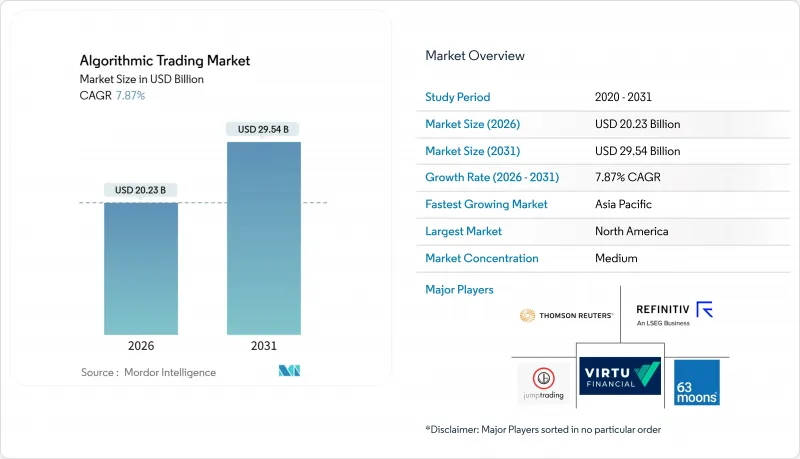
Mordor Intelligence에 의하면, 알고리즘 트레이딩 시장 규모는 2026년에 202억 3,000만 달러로 추정되고, 2031년까지 295억 4,000만 달러에 이를 것으로 예측되며, 이것은 예측 기간 중 CAGR이 7.87%로 성장할 전망을 나타내고 있습니다.
본 보고서는 트레이더 유형별(기관 투자자, 개인 투자자, 장기 트레이더, 단기 트레이더), 구성 요소별(솔루션 및 서비스), 도입 형태별(클라우드 및 온프레미스), 조직 규모별(중소기업 및 대기업), 지역별(북미, 유럽, 기타)로 분류되어 있습니다. 시장 전망은 금액(달러) 기준으로 제시되어 있습니다.
세계의 알고리즘 트레이딩 시장 동향 및 인사이트
미국 및 일본 주식 시장에서 1밀리초 미만의 주문 실행에 대한 수요
지연 차익 거래(Latency Arbitrage)는 현대의 유동성 경쟁을 특징짓고 있으며, 나스닥의 매칭 엔진은 500나노초 미만으로 작동하고, 도쿄증권거래소는 도쿄와 오사카 간에 시장 데이터를 200마이크로초 만에 전송하는 포토닉 링크를 채택하고 있습니다. 고빈도 거래의 주체들은 FPGA(Field Programmable Gate Array) 로직을 활용하여 주문을 결정론적으로 라우팅함으로써 역선택의 발생 창을 축소하는 동시에 스프레드 축소를 실현하고 있습니다. CME 그룹의 오로라 캠퍼스에 있는 코로케이션 랙의월이용료는 1만 5,000달러 이상이지만, 대형 딜링 데스크는 그렇지 않으면 마이크로초 단위로 사라져 버릴 순간적인 가격 편차를 포착함으로써 이 지출을 정당화하고 있습니다. 이러한 하드웨어 예산을 확보할 수 없는 중소규모 기업들은 클라우드의 직접 커넥트 노드에 의존하고 있으며, 확장성을 확보하기 위해 어느 정도의 지연 시간을 감수하고 있습니다. 미국 증권 시장에서는 타임스탬프의 정확도가 100마이크로초 단위로 향상되고 있으며, 이 기준을 충족하지 못하는 참여자는 규제 당국의 감시 대상이 될 위험이나 경쟁력을 상실할 위험에 직면하게 됩니다.
유럽에서 인덱스 리밸런싱 알고리즘을 뒷받침하는 패시브 투자 자산의 급증
유럽의 패시브 운용 자산은 2025년에 3조 유로(3조 3,900억 달러)를 돌파할 전망이며, STOXX 및 FTSE 지수의 정기적인 리밸런싱으로 인해현재 20-30 베이시스 포인트에 달하는 예측 가능한 장중 자금 유입 급증이 발생하고 있으며, 전문 알고리즘이 이를 활용하고 있습니다. 증권사는 지수 편찬 기관의 발표를 몇 주 전에 분석하여 구성 종목을 사전에 헤지함으로써, 자산운용사에 대해 막대한 수수료를 대가로 트래킹 에러와 슬리피지를 줄여주는 서비스를 제공합니다. 따라서 집행 데스크에서는 스마트 오더 라우팅과 기계 판독 가능한 룰북을 통합하여, 상장지수펀드(ETF)가 거래를 완료해야 하는 클로즈 경매에 앞서 유동성이 확보되도록 하고 있습니다. 그 결과 발생하는 종가 시점의 거래량 급증은 크라우딩 리스크를 모델화하여, 최상의 집행(Best Execution) 감사 규정을 위반하지 않으면서 다크 풀, 다자간 거래 시설(MTF), 주요 거래소 간에 주문을 분산시킬 수 있는 기업에 이익을 가져다줍니다. 알고리즘 트레이딩 시장에 있어 이러한 분기별 재조정 기간은 패시브 운용 비중의 확대에 따라 복리적으로 증가하는 지속적인 수익원이 되고 있습니다.
거래소의 코로케이션 비용 급등이 중견 자체 트레이딩 데스크를 압박
주요 거래소의 월간 랙 이용료는 이중화, 크로스 커넥트, 전력 소비량을 포함하면 2만 달러를 초과하며, 연간 1,000만 건 미만의 주문을 집행하는 중견 프로프라이어티 트레이딩 데스크의 경우 이 부담을 상쇄하기 어려운 상황입니다. 영국 금융행위감독청(FCA)의 조사에 따르면, 이러한 기업에서 인프라 비용은 기술 관련 총 지출의 최대 40%를 차지했으며, 이는 지연 시간에 민감한 전략에서의 철수나 지터가 큰 클라우드 노드로의 이전을 촉진하고 있습니다. 그 결과 발생한 시장 재편으로 인해, 이전에는 경쟁이 치열했던 마이크로 차익거래 통화 쌍의 스프레드가 확대되어, 의도치 않게 자본력이 있는 잔존 참여자들의 이익이 증가하고 있습니다. 이에 대응하여 클라우드 제공업체들은 거래소 구내에 엣지 노드를 설치하고, 장기적인 알고리즘에 적합한 1자리 밀리초 대의 왕복 지연 시간을 제공함으로써 대응하고 있습니다. 하지만, 시장 조성에 필수적인 결정론적인 나노초 단위의 성능은 가상화된 하드웨어로는 여전히 달성할 수 없어, 알고리즘 트레이딩 시장 내에서 2단계의 속도 계층이 유지되고 있습니다.
부문 분석
2025년 수익에서 가장 큰 비중을 차지한 것은 기관 투자자 데스크였으며, 그 점유율은 알고리즘 트레이딩 시장 규모의 61.16%에 달했습니다. 이는 다중 자산 운용 위탁과 전용 코로케이션 거점에 의해 뒷받침된 결과입니다. 장기 퀀트 운용사는 수년간 시장 데이터를 몇 시간 만에 재현하고, 고정된 하드웨어 비용을 부담하지 않고도 팩터 노출을 최적화할 수 있는 클라우드 기반 백테스트 클러스터를 선호합니다. 대조적으로, 단기 고빈도 거래 참여자들은 일시적인 매수 호가와 매도 호가의 가격 차이를 포착하기 위해 거래소 데이터센터 내에 서브 마이크로초급 주문 라우팅 시스템을 도입하고 있지만, 이 모델은 대부분의 개인 투자자에게는 경제적으로 현실적이지 않습니다.
개인 투자자 부문은 2031년까지 연평균 성장률(CAGR) 8.32%로 확대될 전망이며, 특히 인도와 싱가포르에서는 수수료 무료 증권사와의 제휴를 통해 플러그 앤 플레이 방식의 스크립트 환경이 통합되어 있습니다. MetaTrader 5는 2025년에 활성 거래 계좌 수가 200만 건을 돌파할 것으로 예상되며, 이 이정표는 기관 투자자 수준의 도구에 대한 접근이 대중화되었음을 나타냅니다. 플랫폼의 마켓플레이스에는 현재 유료·무료를 불문하고 수천 개의 전략 템플릿이 게재되어 있어, 개인은 처음부터 프로그램을 작성하는 대신 실적이 입증된 코드를 라이선싱할 수 있게 되었습니다. 교육 컨텐츠의 확충과 애플리케이션 프로그래밍 인터페이스(API) 제한 완화함에 따라, 개인 투자자의 진입은 데이터 공급업체와 호스팅 제공업체에게 새로운 수익원이 되고 있으며, 알고리즘 트레이딩 시장은 점차 더 다양한 참여자 기반으로 재균형을 이루고 있습니다.
분석 기능이 통합된 플랫폼 라이선스 솔루션 패키지는 2025년 알고리즘 트레이딩 시장 규모에서 지출의 68.32%(138억 3,000만 달러 상당)를 차지했습니다. 톰슨 로이터와 리피니티브는 전환 비용을 반영한 구독 계약을 통해 일관된 데이터 피드, 스마트 오더 라우팅 및 트레이드 블로터를 제공함으로써 이 부문을 주도하고 있습니다. 통합형 스택이 시장을 장악하고 있는 배경에는 바이사이드가 단일 벤더에 의한 책임 체제를 선호하는 경향이 있어, 이를 통해 규제 대응 및 운영 지원이 단일 헬프데스크를 통해 제공된다는 점이 보장되기 때문입니다.
한편, 서비스 부문은 연평균 성장률(CAGR) 9.14%로 가장 빠르게 성장하는 분야입니다. 이는 전문 벤더들이 알고리즘 설계, 모델 검증 및 최선집행 보고를 아웃소싱 기반으로 수주하게 되었기 때문입니다. AlgoTrader의 매니지드 서비스 사업은 백테스트 인프라를 종량제 클라우드 워크로드로 제공하는 반면, InfoReach는 컴플라이언스 관리 프레임워크 내에 고객의 알고리즘을 통합한 호스팅형 실행 셸을 제공합니다. 이러한 모듈식 접근 방식은 운용 보수의 감소에 직면하면서도 강화되는 감사 요건에 노출된 자산 운용사들에게 큰 공감을 불러일으키고 있습니다. 시간이 지남에 따라 소프트웨어 라이선스와 컨설팅 계약의 경계가 모호해지고, 실행량에 따라 월별 청구액이 변동하는 하이브리드 비즈니스 모델이 등장하면서 알고리즘 트레이딩 시장에서 공급업체와 고객 간의 상호 의존 관계가 깊어지고 있습니다.
지역별 분석
북미는 2025년 전 세계 매출의 38.14%를 차지했으며, 모든 대륙 중 가장 큰 알고리즘 트레이딩 시장 점유율을 기록했습니다. 뉴욕과 시카고의 코로케이션 허브에는 고빈도 거래 데스크의 대부분이 집중되어 있으며, 나노초 단위의 정확도로 거래에 타임스탬프를 부여하는 거래소 시설에 의해 뒷받침되고 있습니다. 미국 증권거래위원회(SEC)의 ‘서브페니 공시 의무’를 포함한 규제 현대화로 인해 스마트 오더 라우터의 지속적인 업그레이드가 요구되고 있으며, 블룸버그나 리피니티브와 같은 기술 대기업들은 거래소 연결 기능과 분석 기능을 결합하여 생태계를 강화하고 있습니다. 캐나다와 멕시코의 거래소도 거래량을 서서히 늘리고 있지만, 고도의 지식을 갖춘 참여자의 대부분은 여전히 미국 거래소에 집중되어 있으며, 이곳에서는 깊은 유동성과 높은 메시지 처리 한도 덕분에 자본 집약적인 전략이 정당화되고 있습니다.
아시아태평양은 인도와 동남아시아 거래소의 개인 투자자 참여에 힘입어 2025년 수익 기반에서 성장하여 연평균 성장률(CAGR) 8.73%로 가장 빠르게 성장하는 지역이 될 것으로 예측됩니다. 인도 증권거래위원회(SEBI)가 모든 회원에게 코로케이션 접근을 허용함에 따라 인프라 불균형이 해소되었으며, 도쿄의 포토닉 네트워크는 현물 주식과 오사카 증권거래소의 파생상품을 연결하는 새로운 차익거래 경로를 창출했습니다. 한국 및 호주의 규제 당국은 인공지능(AI)을 활용한 주문 유형을 시범적으로 도입하기 위한 샌드박스 체계를 채택하여, 해외의 자체 거래 회사가 영구적인 라이선스를 취득하지 않고도 전략을 시범 운영할 수 있도록 했습니다. 중국 본토에서 고빈도 거래의 보급률은 여전히 제한적이지만, 선전과 상하이에서의 단계적 자유화는 자본 규제가 완화됨에 따라 추가적인 수요를 유발할 가능성이 있는 점진적인 개방을 시사하고 있습니다.
유럽은 영국의 외환 유동성 풀과 STOXX Europe 600 및 FTSE 100 지수의 수동적 리밸런싱 흐름을 중심으로 2025년 지출의 상당 부분을 차지했습니다. MiFID II에 따른 최선 집행 감사로 인해 거래 비용 분석에 대한 수요가 증가하고 있으며, 집행 경로 내에 규정 준수 로직을 통합한 공급업체가 높은 평가를 받고 있습니다. 독일거래소(Deutsche Borse)의 프랑크푸르트 코로케이션 시설과 유로넥스트(Euronext)의 파리 데이터홀은 미국의 지연 시간 기준에 필적하며, 30개 이상의 거래 플랫폼을 실시간으로 분석하는 거래소 간 차익거래 전략을 가능하게 합니다. 남미, 중동 및 아프리카는 현재 규모는 작지만, 브라질 B3의 API 확충 및 아부다비의 새로운 코로케이션 시설을 통해 현지 거래량이 증가할 가능성이 있습니다. 이는 알고리즘 트레이딩 시장이 주목하는 새로운 성장의 조짐을 보여줍니다.
기타 혜택 :
- 엑셀 형식 시장 예측(ME) 시트
- 3개월간의 애널리스트 지원
자주 묻는 질문
목차
제1장 서론
제2장 조사 방법
제3장 주요 요약
제4장 시장 구도
제5장 시장 규모 및 성장 예측
제6장 경쟁 구도
제7장 시장 기회 및 향후 전망
AJY 26.09.07According to Mordor Intelligence, the algorithmic trading market size reached USD 20.23 billion in 2026 and is projected to advance to USD 29.54 billion by 2031, reflecting a 7.87% CAGR over the forecast period.
This report is Segmented by Types of Traders (Institutional Investors, Retail Investors, Long-Term Traders, and Short-Term Traders), Component (Solutions, and Services), Deployment (Cloud, and On-Premise), Organisation Size (Small and Medium Enterprises, and Large Enterprises), and Geography (North America, Europe, and More). The Market Forecasts are Provided in Terms of Value (USD).
Global Algorithmic Trading Market Trends and Insights
Demand for Sub-millisecond Order Execution on United States and Japanese Equities
Latency arbitrage defines the modern liquidity race, with Nasdaq's matching engine operating below 500 nanoseconds and Tokyo Stock Exchange adopting photonic links that move market data between Tokyo and Osaka in 200 microseconds. High-frequency principals deploy field-programmable-gate-array logic to route orders deterministically, shrinking adverse-selection windows and enabling tighter spreads. Colocation racks in CME Group's Aurora campus cost more than USD 15,000 per month, yet leading desks justify the spend by capturing fleeting price dislocations that would otherwise evaporate in microseconds. Smaller firms unable to match that hardware budget rely on cloud direct-connect nodes, accepting modest latency in exchange for elasticity. As United States securities markets upgrade time-stamping granularity to 100-microsecond precision, any participant failing to meet that benchmark risks regulatory scrutiny and competitive obsolescence.
Surging Passive-Investment Assets Fueling Index-Rebalance Algorithms in Europe
European passive assets surpassed EUR 3 trillion (USD 3.39 trillion) in 2025, and the scheduled rebalancing of STOXX and FTSE indices now generates predictable intraday flow spikes of 20-30 basis points that specialist algorithms exploit. Broker-dealers parse index-compiler announcements weeks in advance and pre-hedge constituents, offering asset managers reduced tracking-error slippage in exchange for sizable participation fees. Execution desks therefore integrate smart order routing with machine-readable rulebooks, ensuring liquidity is posted ahead of the closing auction when exchange-traded funds must finish their trades. The consequent surge in end-of-day volume rewards firms that can model crowding risk and stagger orders across dark pools, multilateral trading facilities, and primary exchanges without breaching best-execution audits. For the algorithmic trading market, these quarterly rebalance windows represent recurring revenue that compounds as passive share grows.
Rising Exchange Colocation Costs Squeezing Mid-tier Proprietary Desks
Monthly rack rates at major venues exceed USD 20,000 once redundancy, cross-connects, and power draws are included, a burden that mid-tier shops executing fewer than 10 million orders annually struggle to amortize. Financial Conduct Authority research shows infrastructure consumes up to 40% of total technology spend for such firms, prompting exits from latency-sensitive strategies or migrations to cloud nodes with higher jitter. The resulting consolidation enlarges spreads on previously crowded micro-arbitrage pairs, inadvertently increasing profits for the remaining capitalized participants. Cloud providers respond by placing edge nodes within exchange campuses, offering 1-digit-millisecond round trips that suit longer-horizon algorithms. Nevertheless, the deterministic nanosecond performance essential for market-making remains out of reach for virtualized hardware, preserving the two-tier speed hierarchy inside the algorithmic trading market.
Other drivers and restraints analyzed in the detailed report include:
- Expansion of Crypto-Exchange API Liquidity Pools in Southeast Asia
- Regulatory Push for Best Execution, MiFID II and SEC Reg-NMS Modernization
- Flash-Crash Liquidity Vacuum Risk
For complete list of drivers and restraints, kindly check the Table Of Contents.
Segment Analysis
Institutional desks generated the largest slice of 2025 revenue, and their share translated to a 61.16% portion of the algorithmic trading market size, backed by multi-asset mandates and dedicated colocation footprints. Long-term quant managers favor cloud-based back-testing clusters that replay years of market data in hours, optimizing factor exposure without incurring fixed hardware costs. Short-term high-frequency participants, in contrast, deploy sub-microsecond order routers inside exchange data centers to exploit fleeting bid-offer mispricing, a model financially prohibitive for most retail actors.
The retail segment is expanding at an 8.32% CAGR through 2031, particularly in India and Singapore, where zero-commission brokerage integrations embed plug-and-play scripting environments. MetaTrader 5 surpassed 2 million active trading accounts in 2025, a milestone that illustrates democratized access to institutional-grade tooling. Platform marketplaces now list thousands of paid and free strategy templates, allowing individuals to license proven code rather than program from scratch. As education content improves and application-programming-interface limits are relaxed, retail penetration introduces a growing revenue stream for data vendors and hosting providers, gradually rebalancing the algorithmic trading market toward a more diverse participant base.
Solutions packages platform licenses bundled with analytics captured 68.32% of 2025 spending, valued at USD 13.83 billion within the algorithmic trading market size. Thomson Reuters and Refinitiv anchor this segment by delivering cohesive data feeds, smart order routing, and trade blotters through subscription contracts that embed switching costs. The dominance of integrated stacks reflects buy-side preference for single-vendor accountability, ensuring regulatory and operational support arrives from one help desk.
Services, however, are the fastest-growing slice at a 9.14% CAGR because specialized vendors now assume algorithm design, model validation, and best-execution reporting on an outsourced basis. AlgoTrader's managed-service line delivers back-testing infrastructure as a consumption-priced cloud workload, while InfoReach offers hosted execution shells that wrap client algorithms inside compliance controls. This modular approach resonates with asset managers facing shrinking management fees yet escalating audit demands. Over time, the lines between software licence and consulting retainer blur, and hybrid commercial models emerge in which monthly invoices scale with executed volume, deepening vendor-client interdependence inside the algorithmic trading market.
Complete Report Scope:
- By Types of Traders
- Institutional Investors
- Retail Investors
- Long-term Traders
- Short-term Traders
- By Component
- Solutions
- Platforms
- Software Tools
- Services
- Solutions
- By Deployment
- Cloud
- On-premise
- By Organisation Size
- Small and Medium Enterprises
- Large Enterprises
- By Geography
- North America
- United States
- Canada
- Mexico
- South America
- Brazil
- Argentina
- Chile
- Rest of South America
- Europe
- Germany
- United Kingdom
- France
- Italy
- Spain
- Netherlands
- Russia
- Rest of Europe
- Asia Pacific
- China
- Japan
- South Korea
- India
- ASEAN
- Australia
- New Zealand
- Rest of Asia Pacific
- Middle East
- GCC
- Turkey
- Israel
- Rest of Middle East
- Africa
- South Africa
- Nigeria
- Kenya
- Rest of Africa
- North America
Geography Analysis
North America generated 38.14% of 2025 global revenue, giving the region the largest algorithmic trading market share among all continents. New York and Chicago colocation hubs house most high-frequency desks, supported by exchange facilities that time-stamp trades at nanosecond precision. Regulatory modernization, including the Securities and Exchange Commission's sub-penny disclosure mandate, compels continual upgrades to smart order routers, and technology stalwarts such as Bloomberg and Refinitiv reinforce the ecosystem by bundling venue connectivity with analytics. Canadian and Mexican exchanges contribute incremental volumes, yet the critical mass of sophisticated participants remains clustered in United States venues where deep liquidity and high message caps justify capital-intensive strategies.
Asia Pacific is projected to be the fastest-growing geography at an 8.73% CAGR, rising from a 2025 revenue base energized by retail participation on Indian and Southeast Asian exchanges. The Securities and Exchange Board of India's push to open colocation access for every member leveled infrastructure asymmetries, and Tokyo's photonic network has created new arbitrage arcs linking cash equities with Osaka Exchange derivatives. South Korean and Australian regulators adopted sandbox frameworks for testing artificial-intelligence-driven order types, inviting foreign proprietary houses to pilot strategies without permanent licensing. While high-frequency penetration in mainland China remains controlled, incremental liberalization in Shenzhen and Shanghai suggests a gradual opening that could unlock additional demand as capital-controls ease.
Europe captured a substantial slice of 2025 spending, anchored by the United Kingdom's foreign-exchange liquidity pools and passive rebalancing flows on STOXX Europe 600 and FTSE 100 indices. MiFID II best-execution audits increase demand for transaction-cost analytics, rewarding vendors that embed compliance logic inside execution paths. Deutsche Borse's Frankfurt colocation and Euronext's Paris data halls mirror United States latency benchmarks, enabling cross-venue arbitrage strategies that parse more than 30 trading platforms in real time. Although South America, the Middle East, and Africa currently represent smaller bases, Brazil's B3 API expansion and Abu Dhabi's new colocation hall could pivot local volumes upward, signaling nascent corridors of growth that the algorithmic trading market will monitor closely.
- Thomson Reuters Corporation
- Refinitiv Limited
- Virtu Financial Inc.
- Jump Trading LLC
- 63 Moons Technologies Ltd
- Citadel Securities LLC
- Hudson River Trading LLC
- Tower Research Capital LLC
- XTX Markets Limited
- Goldman Sachs Group Inc.
- JPMorgan Chase and Co.
- IG Group Holdings plc
- MetaQuotes Software Corp.
- Symphony Fintech Solutions Pvt Ltd
- InfoReach Inc.
- AlgoTrader AG
- ARGO SE
- Kuberre Systems Inc.
- DRW Holdings LLC
- Optiver BV
- Jane Street Group LLC
Additional Benefits:
- The market estimate (ME) sheet in Excel format
- 3 months of analyst support
TABLE OF CONTENTS
1 INTRODUCTION
- 1.1 Study Assumptions and Market Definition
- 1.2 Scope of the Study
2 RESEARCH METHODOLOGY
3 EXECUTIVE SUMMARY
4 MARKET LANDSCAPE
- 4.1 Market Overview
- 4.2 Market Drivers
- 4.2.1 Demand for Sub-millisecond Order Execution on US and Japanese Equities
- 4.2.2 Surging Passive-Investment AUM Fuelling Index-Rebalance Algorithms in Europe
- 4.2.3 Expansion of Crypto-Exchange API Liquidity Pools in South-East Asia
- 4.2.4 Regulatory Push for Best-Execution, MiFID II and SEC Reg-NMS Modernisation
- 4.2.5 Quantum-Optimised Back-Testing Cuts Strategy Time-to-Market
- 4.2.6 Open-Source Algo Frameworks (PLUTUS, LEAN) Democratise Institutional-Grade Tooling
- 4.3 Market Restraints
- 4.3.1 Rising Exchange Colocation Costs Squeezing Mid-tier Prop Desks
- 4.3.2 Flash-Crash Liquidity Vacuum Risk
- 4.3.3 Stringent Market-Surveillance Fines on HFT Spoofing in EU
- 4.3.4 Carbon-Footprint Caps on Data-Centre Latency Arms-Race
- 4.4 Industry Value Chain Analysis
- 4.5 Regulatory Landscape
- 4.6 Technological Outlook
- 4.7 Porter's Five Forces Analysis
- 4.7.1 Bargaining Power of Suppliers
- 4.7.2 Bargaining Power of Buyers and Investors
- 4.7.3 Threat of New Entrants
- 4.7.4 Threat of Substitutes
- 4.7.5 Intensity of Competitive Rivalry
- 4.8 Impact of Macroeconomic Factors on the Market
5 MARKET SIZE AND GROWTH FORECASTS (VALUE)
- 5.1 By Types of Traders
- 5.1.1 Institutional Investors
- 5.1.2 Retail Investors
- 5.1.3 Long-term Traders
- 5.1.4 Short-term Traders
- 5.2 By Component
- 5.2.1 Solutions
- 5.2.1.1 Platforms
- 5.2.1.2 Software Tools
- 5.2.2 Services
- 5.2.1 Solutions
- 5.3 By Deployment
- 5.3.1 Cloud
- 5.3.2 On-premise
- 5.4 By Organisation Size
- 5.4.1 Small and Medium Enterprises
- 5.4.2 Large Enterprises
- 5.5 By Geography
- 5.5.1 North America
- 5.5.1.1 United States
- 5.5.1.2 Canada
- 5.5.1.3 Mexico
- 5.5.2 South America
- 5.5.2.1 Brazil
- 5.5.2.2 Argentina
- 5.5.2.3 Chile
- 5.5.2.4 Rest of South America
- 5.5.3 Europe
- 5.5.3.1 Germany
- 5.5.3.2 United Kingdom
- 5.5.3.3 France
- 5.5.3.4 Italy
- 5.5.3.5 Spain
- 5.5.3.6 Netherlands
- 5.5.3.7 Russia
- 5.5.3.8 Rest of Europe
- 5.5.4 Asia Pacific
- 5.5.4.1 China
- 5.5.4.2 Japan
- 5.5.4.3 South Korea
- 5.5.4.4 India
- 5.5.4.5 ASEAN
- 5.5.4.6 Australia
- 5.5.4.7 New Zealand
- 5.5.4.8 Rest of Asia Pacific
- 5.5.5 Middle East
- 5.5.5.1 GCC
- 5.5.5.2 Turkey
- 5.5.5.3 Israel
- 5.5.5.4 Rest of Middle East
- 5.5.6 Africa
- 5.5.6.1 South Africa
- 5.5.6.2 Nigeria
- 5.5.6.3 Kenya
- 5.5.6.4 Rest of Africa
- 5.5.1 North America
6 COMPETITIVE LANDSCAPE
- 6.1 Market Concentration
- 6.2 Strategic Moves
- 6.3 Market Share Analysis
- 6.4 Company Profiles (includes Global Level Overview, Market Level Overview, Core Segments, Financials as Available, Strategic Information, Market Rank/Share for Key Companies, Products and Services, and Recent Developments)
- 6.4.1 Thomson Reuters Corporation
- 6.4.2 Refinitiv Limited
- 6.4.3 Virtu Financial Inc.
- 6.4.4 Jump Trading LLC
- 6.4.5 63 Moons Technologies Ltd
- 6.4.6 Citadel Securities LLC
- 6.4.7 Hudson River Trading LLC
- 6.4.8 Tower Research Capital LLC
- 6.4.9 XTX Markets Limited
- 6.4.10 Goldman Sachs Group Inc.
- 6.4.11 JPMorgan Chase and Co.
- 6.4.12 IG Group Holdings plc
- 6.4.13 MetaQuotes Software Corp.
- 6.4.14 Symphony Fintech Solutions Pvt Ltd
- 6.4.15 InfoReach Inc.
- 6.4.16 AlgoTrader AG
- 6.4.17 ARGO SE
- 6.4.18 Kuberre Systems Inc.
- 6.4.19 DRW Holdings LLC
- 6.4.20 Optiver BV
- 6.4.21 Jane Street Group LLC
7 MARKET OPPORTUNITIES AND FUTURE OUTLOOK
- 7.1 White-Space and Unmet-Need Assessment