|
시장보고서
상품코드
2123243
멸균 장비 시장 : 점유율 분석, 업계 동향과 통계, 성장 예측(2026-2031년)Sterilization Equipment - Market Share Analysis, Industry Trends & Statistics, Growth Forecasts (2026 - 2031) |
||||||
 Mordor Intelligence
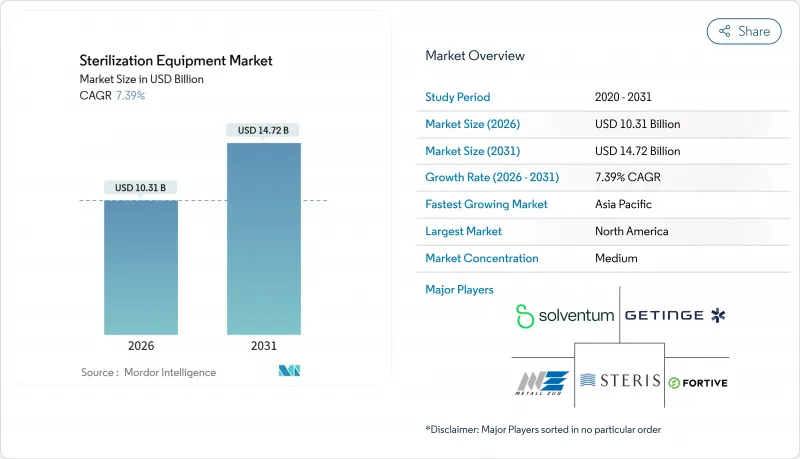
멸균 장비 시장 규모는 2026년에 103억 1,000만 달러로 추정되고 있어 예측 기간(2026-2031년)에서 CAGR 7.39%로 성장을 지속하여, 2031년에는 147억 2,000만 달러에 이를 전망입니다.
본 보고서는 장비별(고온 멸균, 저온 멸균(에틸렌옥사이드(ETO) 등), 여과 멸균, 이온화 방사선 멸균), 최종 사용자별(병원 및 진료소, 연구·학술 기관 등), 지역별(북미, 유럽, 아시아태평양 등)로 분류되어 있습니다. 시장 예측은 금액(달러) 기준으로 제시되어 있습니다.
전 세계 멸균 장비 시장 동향 및 인사이트
증가하는 병원 내 감염(HAI) 및 교차 오염 위험
의료 관련 감염은 미국에서 임의의 날 31명의 입원 환자 중 1명에게 영향을 미치고 있으며, 이 통계에 따라 감염 예방은 경영진의 최우선 과제로 자리 잡고 있습니다. 유럽의 감시 보고에 따르면 연간 320만 건의 사례가 보고되고 있으며, 그중 의료기기와 관련된 사례가 약 3분의 1을 차지하고 있습니다. 규제 당국은 현재 십이지장 내시경 및 유사한 의료기기에 대해 추가적인 고수준 소독을 의무화하고 있어, 구형 오토클레이브 및 에틸렌옥사이드 멸균 장비의 교체가 시급한 과제가 되고 있습니다. 일관된 멸균 주기의 타당성을 검증할 수 없는 의료 기관은 인증 자격 박탈 등의 제재를 받을 위험이 있으므로, 많은 의료 기관이 처리 시간 단축과 화학 물질 잔류량 감소를 동시에 달성할 수 있는 범용성이 높은 플랫폼 도입을 서두르고 있습니다. 지출 규모가 가장 큰 곳은 북미와 유럽의 대규모 의료 시스템이지만, 아시아태평양의 3차 의료기관에서도 유사한 추세가 나타나기 시작했습니다.
외과 수술 건수 증가
로봇 수술과 최소 침습 수술로 인해 전 세계적으로 수술 건수가 증가하고 있습니다. OECD 회원국에서 인공 고관절 치환술 및 인공 슬관절 치환술은 2019년부터 2024년까지 연평균 4.2% 증가했으며, 백내장 수술도 연평균 3.8% 증가했습니다. 미국의 병원에서는 일반외과 수술의 15% 이상에서 로봇 수술이 시행되고 있으며, 이에 따라 132℃의 증기 사이클을 견디지 못하는 섬세한 폴리머 재질의 기구가 도입되고 있습니다. 이러한 변화는 저온 멸균법이 멸균 장비 시장 전체를 상회하는 속도로 성장하고 있는 이유를 설명하는 한 요인이 되고 있습니다. 의료 기관에서는 기구의 무결성을 훼손하지 않으면서 처리 능력을 유지하기 위해, 기존의 증기 멸균 설비에 더해 과산화수소 플라즈마 및 저온 증기·포름알데히드 멸균 장비를 도입하고 있습니다. 아시아태평양에서는 가처분 소득 증가와 병원 건설의 진전을 반영하여 이러한 도입이 가장 빠르게 가속화되고 있습니다.
높은 초기 투자 및 유지 관리 비용
병원용 증기 멸균 장비의 가격은 5만 달러에서 15만 달러 사이이며, 과산화수소 플라즈마 시스템의 대부분은 검증 전에 20만 달러를 초과하는 경우가 많습니다. 연간 유지보수 계약비가 추가로 10%-15% 가산되기 때문에 이미 진료비 삭감이라는 과제에 직면해 있는 소규모 외래 진료 센터의 예산에 부담을 주고 있습니다. 미국병원협회(AHA)의 2024년 설비 투자 우선순위 순위에서 멸균 장비는 전자의무기록, 영상진단, 로봇 기술, 인프라에 이어 5위에 그쳤습니다. 많은 시설에서는 투자를 미루기 위해 고장 위험 증가를 감수하면서, 수명인 15년을 초과하여 오토클레이브를 가동하고 있습니다. 신흥 시장의 구매자들에게는 수입 장비의 가격이 외화로 책정되어 환율 변동에 좌우되기 때문에 더욱 큰 장벽에 직면하고 있습니다.
부문 분석
저온 멸균 시스템은 2026년부터 2031년까지 연평균 성장률(CAGR) 11.25%를 나타낼 것으로 예측되며, 이는 멸균 장비 시장 전체의 성장률 7.39%를 크게 상회하는 수치입니다. 병원에서는 기존의 증기 멸균 능력을 전면적으로 대체하기보다는 과산화수소 플라즈마, 에틸렌옥사이드, 오존 플랫폼을 단계적으로 도입하고 있습니다. 미국 환경보호청(EPA)은 2024년에 에틸렌옥사이드 배출 기준을 강화했으며, 이로 인해 상업용 멸균 장비의 운영 비용이 상승했을 뿐만 아니라, 발암성 잔류물을 남기지 않는 과산화수소 기반 멸균 사이클로의 전환이 촉진되고 있습니다. 한편, 코발트-60공급 부족으로 인해 동위원소가 아닌 고에너지 전력을 이용하는 전자빔식 멸균 장비로의 전환이 가속화되고 있으며, 이로 인해 처리 시간과 폐기물 처리 부담 모두가 경감되고 있습니다. 이러한 동향은 혼합된 의료 기구의 멸균 처리를 검증할 수 있는 범용성이 높고 독성이 낮은 시스템으로 자본이 이동하고 있는 이유를 여실히 보여줍니다.
고온 증기는 포장된 수술 트레이, 린넨 및 내열성 금속 기구에 여전히 필수적입니다. 사이클 비용은 약 0.10달러이며, 표준 부하 기준 45분 이내에 처리가 완료되므로, 유틸리티 인프라가 신뢰할 수 있는 곳에서는 증기 멸균이 여전히 주류를 이루고 있습니다. 160°C-180°C에서 60-120분간 작동하는 건열 멸균기는 일회용 제품의 보급에 따라 유리 기구나 석유 제품에 대한 사용이 점점 더 제한되고 있습니다. 여과 멸균은 바이오의약품 처리를 뒷받침하고 있지만, 멸균 장비 시장에서의 점유율은 극히 일부에 그치고 있습니다. 감마선 멸균은 여전히 일회용 의료기기의 처리량 대부분을 담당하고 있지만, 동위원소 공급 부족으로 인해 10 MeV 전자빔 가속기의 도입이 진행되고 있습니다. 가속기의 완전한 라인업을 구축하는 데는 500만 달러 이상의 비용이 소요될 수도 있지만, 처리량이 많은 시설에서는 사이클 시간 단축과 동위원소 물류 불필요로 인해 그 투자가 정당화되고 있습니다.
지역별 분석
북미는 2025년 매출의 39.13%를 차지하고 있으며, 그 원동력은 미국의 밀집된 병원 네트워크와 높은 시술 시행률입니다. 많은 시설이 자본 부족을 이유로 업그레이드를 미루고 있어, 현재는 교체 수요가 주류를 이루고 있으며, 계획 지출에서 멸균 장비는 영상 진단 장비 및 로봇 기술에 이어 두 번째 순위를 차지하고 있습니다. 캐나다에서는 유지보수 관련 비용을 분산시키기 위해 역량을 지역 허브로 집약하고 있는 반면, 멕시코에서는 의료 관광 수요가 소형 멀티모달 시스템의 신규 도입을 주도하고 있습니다.
아시아태평양은 중국과 인도의 병원 건설, 보험 적용 범위 확대, 그리고 로봇 수술의 보급에 힘입어 2031년까지 연평균 성장률(CAGR) 8.81%로 가장 높은 성장률을 나타낼 것으로 예측됩니다. 중국에서는 2022년부터 2024년까지 1,200개의 병원이 신설될 예정이며, 그 대부분은 저온 멸균과 대용량 증기 멸균을 병용하는 설비 도입을 정당화할 수 있을 만큼 충분한 규모의 중앙 멸균 부서를 갖추고 있습니다. 인도에서 실시된 이동식 시범 사업을 통해 지역 병원의 기구 가용성이 22% 향상되었으며, 고정 인프라가 미비한 지역에서 감염 관리를 확대하기 위한 현실적인 방안이 제시되었습니다. 일본에서는 65세 이상 인구 비율이 28.9%를 차지하고 있으며, 백내장 수술 및 인공 관절 치환술 건수가 꾸준히 증가하고 있어 오토클레이브에 대한 수요도 안정적입니다.
유럽에서는 여전히 기술을 중시하는 태도가 지속되고 있습니다. 2024년 의료기기 규정(MDR)의 시행에 따라 멸균 업무 위탁처에 대한 감사가 강화되었으며, ISO 규격에 준거한 문서 관리를 수행하는 기업이 우대받고 있습니다. 독일, 프랑스, 영국이 지출의 대부분을 차지하고 있지만, EU의 결속 기금을 통해 남유럽 및 동유럽 회원국 전역에서 현대화가 촉진되고 있습니다. 중동에서는 의료 관광을 지원하기 위해 조인트 커미션(Joint Commission)의 기준을 충족하는 대학 병원이 건설되고 있습니다. 사하라 이남 아프리카에서는 만성적인 정전에 대한 임시 대책으로 태양광 발전식 탁상형 증기 멸균기나 이동식 트럭이 도입되고 있습니다. 남미의 민간 네트워크, 특히 브라질에서는 대도시권의 외과 센터를 위해 중급형 증기 멸균기 및 과산화수소 멸균기가 구입되고 있습니다.
기타 혜택:
- 엑셀 형식 시장 예측(ME) 시트
- 3개월간의 애널리스트 지원
자주 묻는 질문
목차
제1장 서론
제2장 조사 방법
제3장 주요 요약
제4장 시장 구도
제5장 시장 규모와 성장 예측
제6장 경쟁 구도
제7장 시장 기회와 향후 전망
JHS 26.09.09According to Mordor Intelligence, the sterilization equipment market size is estimated at USD 10.31 billion in 2026, and is expected to reach USD 14.72 billion by 2031, at a CAGR of 7.39% during the forecast period (2026-2031).
This report is Segmented by Equipment (High-Temperature Sterilization, Low-Temperature Sterilization [Ethylene Oxide (ETO), and More], Filtration Sterilization, and Ionizing Radiation Sterilization), End User (Hospitals and Clinics, Research & Academic Institutes, and More), and Geography (North America, Europe, Asia-Pacific, and More). The Market Forecasts are Provided in Terms of Value (USD).
Global Sterilization Equipment Market Trends and Insights
Rising HAIs And Cross-Contamination Risk
Healthcare-associated infections affect 1 in 31 U.S. inpatients on any given day, a statistic that keeps infection prevention high on executive agendas. European surveillance shows 3.2 million cases every year, with device-associated episodes accounting for roughly one-third of events. Regulators now require supplemental high-level disinfection for duodenoscopes and similar devices, elevating the urgency of upgrading older autoclaves and ethylene-oxide chambers. Institutions unable to validate consistent cycles risk accreditation penalties, so many are fast-tracking versatile platforms that combine faster turnaround with lower chemical residuals. Spending is greatest in large North American and European systems, yet similar patterns are emerging in tertiary hospitals across Asia-Pacific.
Increase In Surgical Procedures
Robotic and minimally invasive surgeries are expanding procedure counts worldwide. Hip and knee replacements among OECD members increased 4.2% per year between 2019 and 2024, while cataract procedures advanced 3.8% annually. U.S. hospitals report robotic techniques in more than 15% of general-surgery cases, which introduces delicate polymer tools that cannot withstand 132 °C steam cycles. This shift helps explain why low-temperature modalities are outpacing the broader sterilization equipment market. Facilities are layering hydrogen-peroxide plasma or low-temperature steam-formaldehyde units on top of legacy steam capacity to maintain throughput without compromising instrument integrity. Asia-Pacific volumes are accelerating fastest, reflecting rising disposable incomes and hospital construction.
High Capital And Maintenance Costs
Hospital-grade steam units range from USD 50,000 to USD 150,000, and hydrogen-peroxide plasma systems often exceed USD 200,000 before validation. Annual service contracts add another 10%-15%, pressuring budgets in smaller ambulatory centers that already face tightening reimbursements. The American Hospital Association ranked sterilizers only fifth in 2024 capital-spending priorities, after electronic records, imaging, robotics, and infrastructure. Many facilities run autoclaves beyond a 15-year service life, accepting higher breakdown risk to defer investment. Emerging-market buyers confront even steeper hurdles because imported equipment is priced in foreign currency and tied to fluctuating exchange rates.
Other drivers and restraints analyzed in the detailed report include:
- Expansion Of Pharma & Biotech Manufacturing
- Regulatory Tightening On Sterilization Compliance
- Shift Toward Single-Use Disposable Instruments
For complete list of drivers and restraints, kindly check the Table Of Contents.
Segment Analysis
Low-temperature systems are projected to grow at an 11.25% CAGR from 2026 to 2031, substantially above the 7.39% pace of the overall sterilization equipment market. Hospitals are layering hydrogen-peroxide plasma, ethylene oxide, and ozone platforms onto existing steam capacity instead of wholesale replacement. The U.S. Environmental Protection Agency tightened ethylene-oxide emission limits in 2024, raising operating costs for commercial chambers and nudging facilities toward hydrogen-peroxide cycles that leave no carcinogenic residuals. Meanwhile, cobalt-60 shortages are accelerating the pivot to electron-beam lines that rely on high-energy electricity rather than isotopes, trimming both turnaround time and disposal liabilities. These dynamics underscore why capital is shifting toward versatile, low-toxicity systems capable of validating mixed instrument loads.
High-temperature steam remains indispensable for wrapped surgical trays, linens, and heat-stable metal tools. Cycle costs hover near USD 0.10, and standard loads finish in under 45 minutes, keeping steam dominant where utility infrastructure is reliable. Dry-heat sterilizers, operating at 160 °C-180 °C for 60-120 minutes, are increasingly confined to glassware and petroleum products as disposable alternatives proliferate. Filtration sterilization supports biologics processing but captures only a narrow slice of sterilization equipment market share. Gamma radiation still handles the bulk of single-use medical device volumes, yet isotope supply gaps have opened doors for 10-MeV electron-beam accelerators. Although a complete accelerator line can cost more than USD 5 million, high-throughput hubs justify the spend through faster cycles and elimination of isotope logistics.
Complete Report Scope:
- By Equipment
- High-temperature Sterilization
- Wet/Steam Sterilization
- Dry Heat Sterilization
- Low-temperature Sterilization
- Ethylene Oxide (ETO)
- Hydrogen Peroxide Plasma
- Ozone
- Other Low-temperature Methods
- Filtration Sterilization
- Ionizing Radiation Sterilization
- E-beam
- Gamma
- Other Ionizing Technologies
- High-temperature Sterilization
- By End User
- Hospitals & Clinics
- Pharma & Biotech Manufacturers
- Research & Academic Institutes
- Ambulatory Surgery Centers
- Other End Users
- By Geography
- North America
- United States
- Canada
- Mexico
- Europe
- Germany
- United Kingdom
- France
- Italy
- Spain
- Rest of Europe
- Asia-Pacific
- China
- Japan
- India
- South Korea
- Australia
- Rest of Asia-Pacific
- Middle East & Africa
- GCC
- South Africa
- Rest of Middle East & Africa
- South America
- Brazil
- Argentina
- Rest of South America
- North America
Geography Analysis
North America accounted for 39.13% of 2025 revenue, anchored by the United States' dense hospital network and high procedural rates. Replacement sales now dominate, as many facilities defer upgrades amid wider capital pressures, ranking sterilizers behind imaging and robotics in planned spending. Canada is centralizing capacity into regional hubs to spread maintenance overhead, whereas Mexico attracts medical-tourism cases that drive fresh installation of compact multi-modal systems.
Asia-Pacific is forecast to record the fastest 8.81% CAGR through 2031, fueled by hospital construction in China and India, rising insurance coverage, and growing adoption of robotic surgery. China added 1,200 hospitals over 2022-2024, most with central sterile departments large enough to justify mixed low-temperature and high-capacity steam installations. India's mobile pilot improved instrument availability by 22% in district hospitals, signaling a pragmatic route to scale infection control where fixed infrastructure lags. Japan's 28.9% 65-plus population share sustains cataract and joint replacement volumes that underpin steady autoclave demand.
Europe remains technology-focused. The 2024 Medical Device Regulation rollout increased audits of sterilization subcontractors, favoring firms with ISO-aligned documentation. Germany, France, and the United Kingdom represent most spending, while EU cohesion funds spur modernization across Southern and Eastern members. The Middle East is building academic hospitals that meet Joint Commission standards to support medical tourism. Sub-Saharan Africa is adopting solar-powered tabletop steam units and mobile trucks as stop-gaps against chronic power outages. South America's private networks, especially in Brazil, purchase mid-tier steam and hydrogen-peroxide units to serve metropolitan surgical centers.
- Andersen Products
- Cosmed Group
- E-BEAM Services
- Fedegari Group
- Fortive Corp. (ASP)
- Getinge
- Hanshin Medical
- Matachana Group
- Metall Zug (Belimed)
- MMM Group
- Noxilizer
- Shimadzu
- Solventum Corporation
- Steelco
- STERILE-LINK
- STERIS
- Stryker (TSO3)
- Tuttnauer
Additional Benefits:
- The market estimate (ME) sheet in Excel format
- 3 months of analyst support
TABLE OF CONTENTS
1 Introduction
- 1.1 Study Assumptions & Market Definition
- 1.2 Scope of the Study
2 Research Methodology
3 Executive Summary
4 Market Landscape
- 4.1 Market Overview
- 4.2 Market Drivers
- 4.2.1 Rising HAIs & cross-contamination risk
- 4.2.2 Increase in surgical procedures
- 4.2.3 Expansion of pharma & biotech manufacturing
- 4.2.4 Regulatory tightening on sterilization compliance
- 4.2.5 Robotics-driven need for low-temperature H?O? plasma
- 4.2.6 Growth of mobile on-demand sterilization services
- 4.3 Market Restraints
- 4.3.1 High capital & maintenance costs
- 4.3.2 Toxicity concerns over chemical sterilants
- 4.3.3 Co-60 isotope supply constraints for gamma facilities
- 4.3.4 Shift toward single-use disposable instruments
- 4.4 Supply-Chain Analysis
- 4.5 Regulatory Landscape
- 4.6 Technological Outlook
- 4.7 Porter's Five Forces
- 4.7.1 Threat of New Entrants
- 4.7.2 Bargaining Power of Buyers
- 4.7.3 Bargaining Power of Suppliers
- 4.7.4 Threat of Substitutes
- 4.7.5 Intensity of Competitive Rivalry
5 Market Size & Growth Forecasts (Value, USD)
- 5.1 By Equipment
- 5.1.1 High-temperature Sterilization
- 5.1.1.1 Wet/Steam Sterilization
- 5.1.1.2 Dry Heat Sterilization
- 5.1.2 Low-temperature Sterilization
- 5.1.2.1 Ethylene Oxide (ETO)
- 5.1.2.2 Hydrogen Peroxide Plasma
- 5.1.2.3 Ozone
- 5.1.2.4 Other Low-temperature Methods
- 5.1.3 Filtration Sterilization
- 5.1.4 Ionizing Radiation Sterilization
- 5.1.4.1 E-beam
- 5.1.4.2 Gamma
- 5.1.4.3 Other Ionizing Technologies
- 5.1.1 High-temperature Sterilization
- 5.2 By End User
- 5.2.1 Hospitals & Clinics
- 5.2.2 Pharma & Biotech Manufacturers
- 5.2.3 Research & Academic Institutes
- 5.2.4 Ambulatory Surgery Centers
- 5.2.5 Other End Users
- 5.3 By Geography
- 5.3.1 North America
- 5.3.1.1 United States
- 5.3.1.2 Canada
- 5.3.1.3 Mexico
- 5.3.2 Europe
- 5.3.2.1 Germany
- 5.3.2.2 United Kingdom
- 5.3.2.3 France
- 5.3.2.4 Italy
- 5.3.2.5 Spain
- 5.3.2.6 Rest of Europe
- 5.3.3 Asia-Pacific
- 5.3.3.1 China
- 5.3.3.2 Japan
- 5.3.3.3 India
- 5.3.3.4 South Korea
- 5.3.3.5 Australia
- 5.3.3.6 Rest of Asia-Pacific
- 5.3.4 Middle East & Africa
- 5.3.4.1 GCC
- 5.3.4.2 South Africa
- 5.3.4.3 Rest of Middle East & Africa
- 5.3.5 South America
- 5.3.5.1 Brazil
- 5.3.5.2 Argentina
- 5.3.5.3 Rest of South America
- 5.3.1 North America
6 Competitive Landscape
- 6.1 Market Concentration
- 6.2 Market Share Analysis
- 6.3 Company Profiles (includes Global level Overview, Market level overview, Core Segments, Financials as available, Strategic Information, Market Rank/Share, Products & Services, Recent Developments)
- 6.3.1 Andersen Products
- 6.3.2 Cosmed Group
- 6.3.3 E-BEAM Services
- 6.3.4 Fedegari Group
- 6.3.5 Fortive Corp. (ASP)
- 6.3.6 Getinge AB
- 6.3.7 Hanshin Medical
- 6.3.8 Matachana Group
- 6.3.9 Metall Zug (Belimed)
- 6.3.10 MMM Group
- 6.3.11 Noxilizer
- 6.3.12 Shimadzu Corporation
- 6.3.13 Solventum Corporation
- 6.3.14 Steelco S.p.A.
- 6.3.15 STERILE-LINK
- 6.3.16 STERIS plc
- 6.3.17 Stryker (TSO3)
- 6.3.18 Tuttnauer
7 Market Opportunities & Future Outlook
- 7.1 White-space & Unmet-need Assessment