|
시장보고서
상품코드
2123250
항공기 엔진 MRO 시장 : 점유율 분석, 업계 동향과 통계, 성장 예측(2026-2031년)Aircraft Engine MRO - Market Share Analysis, Industry Trends & Statistics, Growth Forecasts (2026 - 2031) |
||||||
 Mordor Intelligence
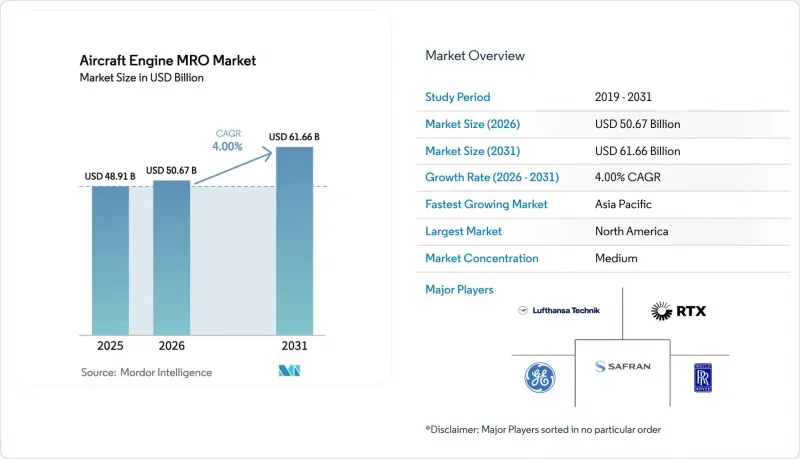
항공기 엔진 MRO 시장 규모는 2025년 489억 1,000만 달러에서 2026년에는 506억 7,000만 달러로 확대되어 2026년부터 2031년까지 CAGR 4.00%로 성장을 지속하여, 2031년에는 616억 6,000만 달러에 이를 것으로 예측됩니다.
본 보고서는 엔진 유형(터빈 엔진 및 피스톤 엔진), 항공 분야(민간 항공, 군용 항공, 일반 항공 및 무인 항공기), 서비스 제공업체(항공사 내 MRO, 독립 제3자 MRO 등), 지역(북미, 남미, 유럽,아시아태평양, 중동 및 아프리카)별로 분류되어 있습니다. 시장 예측은 금액(달러) 기준으로 제시되어 있습니다.
전 세계 항공기 엔진 MRO 시장 동향 및 인사이트
급증하는 협폭기 기단 확대와 높은 비행 주기 활용률
에어버스사는 A320 패밀리의 수주 대수가 19,233대이며, 그중 7,262대가 미인도 상태라고 보고하고 있습니다. 특히, 이 미인도분(백로그)의 72%는 A321neo의 각 모델로 구성되어 있으며, 이들 기종은 연간 3,000-3,500시간의 비행 시간을 기록하고 있습니다. 아시아태평양 및 라틴아메리카의 보잉 737 MAX 운항사는 하루 평균 11-12블록 시간을 정기적으로 비행하고 있으며, 이로 인해 LEAP-1A 및 -1B 엔진의 첫 번째 정비 주기가 8,000-9,000사이클로 단축되었습니다. 이러한 기간 단축으로 인해 MRO 사업자들은 예측 불가능한 수요 급증에 대응할 수 있는 모듈식 공구 및 유연한 정비 베이에 투자할 수밖에 없게 되었습니다. 이는 2024년에 가동을 시작한 루프트한자 테크닉 및 ST 엔지니어링의 시설이 입증하고 있습니다. 이러한 높은 사이클 수의 작업 부하에 대응하기 위해서는 FAA 및 EASA의 파트 145에 따른 인증이 여전히 필수적입니다. 그 결과, 항공기 엔진 MRO 시장에서는 턴어라운드 시간을 연장하지 않으면서도 인력, 공구, 부품 물류를 조정할 수 있는 사업자가 점점 더 높이 평가받고 있습니다.
LEAP 및 GTF 내구성 대책을 위한 OEM의 분해 지시
프랫 앤 휘트니사의 분말 금속 오염 문제로 인해 1,200기 이상의 GTF 엔진이 운항 중단되었으며, 정비 공장에서의 체류 기간은 250-300일에 달하고, 운항 중인 기체의 최대 12%가 운항 중단을 강요받고 있습니다. CFM 인터내셔널은 분진이 많은 지역에서 발생하는 블레이드 침식을 방지하기 위해 세라믹 매트릭스 복합재로 제작된 슈라우드와 첨단 코팅을 동시에 도입하고 있으며, 각 항공사는 4,000-5,000 사이클마다 점검 비용을 예산에 반영할 수밖에 없는 상황입니다. 델타 테크옵스(Delta TechOps)는 공구 및 추가 인력에 5,000만 달러를 투자한 결과, GTF 엔진의 연간 정비 수용 대수를 30% 증가한 450대로 확대했습니다. 플랫 앤 휘트니(Pratt & Whitney)는 부품 생산 가속화 및 싱가포르와 폴란드에 지역 정비 거점을 설립하기 위해 30억 달러를 예산에 편성했습니다. 이러한 필수 작업은 단기적인 수요를 창출하는 한편, OEM이 보유한 기술 데이터에 대한 의존도를 높이고, 항공기 엔진 MRO 시장 내 경쟁을 심화시키고 있습니다.
전 세계적인 인증 엔진 정비사 부족 문제
보잉사는 2043년까지 13만 2,000명의 새로운 정비 인력이 필요할 것으로 예측했습니다. 한편, 미국에서는 연간 1만 4,500명이 정년퇴직하는 반면, FAA 인증 학교 졸업생은 연간 6,000-8,000명에 그치고 있습니다. 유럽의 데이터에 따르면 정비사의 20%가 55세 이상이며, EASA Part 66 규정에 따라 국경을 넘는 이동이 제한되고 있습니다. 초봉이 4만 5,000-5만 5,000달러로 기술 업계 수준보다 낮은 점이 이직률 상승을 초래하고 있습니다. 각 MRO 기업들은 보어스코프 검사 자동화 및 AI를 활용한 결함 감지를 추진하고 있지만, 규제 당국이 여전히 사람의 승인을 의무화하고 있어 생산성 향상이 제한되고 있습니다. 따라서 인력 부족이 항공기 엔진 MRO 시장의 성장 궤도를 저해하고 있습니다.
부문 분석
2025년, 터빈 엔진은 항공기 엔진 MRO 시장 점유율의 74.36%를 차지하며, 상업용 항공기, 군용기, 비즈니스 제트기 등 각 기종에서 널리 사용되고 있는 점을 배경으로, 예측 기간 동안 연평균 5.32%의 성장이 전망됩니다. CFM56, LEAP, Trent, GEnx 등의 터보팬 엔진은 A320 및 737 기종의 높은 사이클 수에 힘입어 정비 입고 건수의 대부분을 차지하고 있습니다. 터보프롭 엔진 수요는 비행 시간이 4억 시간을 넘는 프랫 앤 휘트니 캐나다(Pratt & Whitney Canada)사의 PT6 엔진이 지역 항공 분야에서 활용되면서 견인되고 있습니다. 또한, GE T700의 파생형을 탑재한 2만 대 이상의 UH-60 및 AH-64 헬리콥터가 터보샤프트 엔진을 동력원으로 사용하고 있어, 이에 따라 회전익기의 MRO 수요는 견조한 추세를 보이고 있습니다.
피스톤 엔진은 일반 항공 및 UAV(무인 항공기) 기단이 확대됨에 따라 완만한 연평균 성장률(CAGR)로 증가할 것으로 예측됩니다. 배송용 드론의 경우 500-1,000시간마다 정밀 점검이 이루어지기 때문에 새로운 수익원이 창출됩니다. ASTM F3201에 기반한 표준화를 통해 UAV 정비에 관한 승인 절차가 효율화될 전망입니다. 이러한 추세에 따라 틈새 시장 제공업체들은 소형 추진 시스템 분야의 항공기 엔진 MRO 시장에서 전문성을 확립하는 입지에 서게 될 것입니다.
지역별 분석
북미는 2025년 매출의 29.91%를 차지하고 있으며, 성숙한 상업용 및 군용 항공기 기단의 정비는 연간 1,000건 이상의 정비 공장 입고 건을 관리하는 Delta TechOps, StandardAero, AAR의 각 시설에서 수행되고 있습니다. 그러나 기술자 부족으로 임금이 상승하여 확장 속도가 제한되고 있는 반면, GE, 프랫 앤 휘트니, 허넬에 인접해 있어 신속한 부품 물류가 뒷받침되고 있습니다.
아시아태평양은 연평균 성장률(CAGR) 6.65%로 확대되고 있으며, 2024년 한 해에만 6억 달러 이상의 투자가 기록되었습니다. 여기에는 중국의 GAMECO사의 5억 달러 규모의 LEAP 및 Trent 프로젝트와, 프랫 앤 휘트니사와 에어 인디아 간의 2억 달러 규모의 합작 사업이 포함됩니다. ST 엔지니어링은 싱가포르에서 와이드바디 항공기 대응 역량 개발에 1억 달러를 투자하기로 결정했으며, 롤스로이스도 같은 지역에 트렌트 허브를 운영하고 있습니다. 이 지역의 항공기 보유 대수는 2043년까지 1만 7,000대를 넘어설 것으로 예상되며, 이는 항공기 엔진 MRO 시장의 장기적인 작업량을 뒷받침할 것입니다.
유럽의 유서 깊은 기업인 루프트한자 테크닉, 에어프랑스-KLM, SR 테크닉스는 계속해서 규모를 확장하고 있습니다. 루프트한자 테크닉은 트렌트 XWB 및 GEnx 정비 업무를 위해 폴란드에 1억 5,000만 달러를 투자했습니다. 사프란은 모로코 내 LEAP 처리 능력을 두 배로 늘려, 비용 경쟁력이 있는 인력을 찾아 남쪽으로 사업 기반을 이동하고 있음을 보여주고 있습니다. 중동에서는 사나드와 튀르키예시 테크닉스가 정부의 지원을 활용하여 지역 내 작업량을 확보하고 있습니다. 남미와 아프리카에서는 여전히 서비스가 부족하여, 항공사들은 엔진을 해외로 운송할 수밖에 없어 물류 비용이 증가하고 있습니다. 이러한 불균형은 항공기 엔진 MRO 시장에서 향후 개척되지 않은 시장이 존재함을 시사합니다.
기타 혜택:
- 엑셀 형식 시장 예측(ME) 시트
- 3개월간의 애널리스트 지원
자주 묻는 질문
목차
제1장 서론
제2장 조사 방법
제3장 주요 요약
제4장 시장 구도
제5장 시장 규모와 성장 예측
제6장 경쟁 구도
제7장 시장 기회와 향후 전망
JHS 26.09.09According to Mordor Intelligence, the aircraft engine MRO market size is expected to grow from USD 48.91 billion in 2025 to USD 50.67 billion in 2026 and is forecasted to reach USD 61.66 billion by 2031 at a 4.00% CAGR over 2026-2031.
This report is Segmented by Engine Type (Turbine Engine and Piston Engine), Aviation (Commercial Aviation, Military Aviation, General Aviation, and UAVs), Service Providers (Airline In-House MRO, Independent Third-Party MRO, and More), and Geography (North America, South America, Europe, Asia-Pacific, and the Middle East and Africa). The Market Forecasts are Provided in Terms of Value (USD).
Global Aircraft Engine MRO Market Trends and Insights
Surging Narrow-Body Fleet Growth and High Flight-Cycle Utilization
Airbus reported 19,233 A320-family orders, with 7,262 units still undelivered. Notably, 72% of this backlog consists of A321neo variants, which accumulate 3,000-3,500 flight hours per year. Boeing 737 MAX operators in Asia-Pacific and Latin America routinely fly 11-12 block hours daily, shortening first shop-visit intervals on LEAP-1A and -1B engines to 8,000-9,000 cycles. This compression forces MROs to invest in modular tooling and flexible bays that absorb unpredictable surges, as demonstrated by Lufthansa Technik and ST Engineering facilities commissioned in 2024. Certification under FAA and EASA Part 145 remains essential to scale these high-cycle workloads. Consequently, the aircraft engine MRO market increasingly rewards providers that can synchronize manpower, tooling, and parts logistics without extending turnaround times.
OEM-Mandated Teardowns for LEAP and GTF Durability Fixes
Pratt & Whitney's powder-metal contamination has sidelined more than 1,200 GTF engines, stretching shop visits to 250-300 days and grounding up to 12% of the active fleet. CFM International is simultaneously rolling out ceramic-matrix-composite shrouds and advanced coatings to fight blade erosion in dusty regions, compelling airline budgets to include inspections every 4,000-5,000 cycles. Delta TechOps increased GTF throughput by 30% to 450 annual shop visits after investing USD 50 million in tooling and additional staff. Pratt & Whitney has earmarked USD 3 billion for accelerating parts production and establishing regional repair hubs in Singapore and Poland. This mandatory work injects near-term volume but also heightens dependency on OEM-owned technical data, intensifying competition inside the aircraft engine MRO market.
Chronic Global Shortage of Licensed Engine Technicians
Boeing forecasts a need for 132,000 new maintenance personnel by 2043, while US retirements reach 14,500 annually against 6,000-8,000 graduates from FAA-approved schools. European data indicate that 20% of mechanics are over 55, with limited cross-border mobility due to EASA Part 66 regulations. Starting salaries of USD 45,000-55,000 trail those of the technology sector, fueling attrition. MROs are automating borescope inspections and AI-assisted defect detection, but regulators still require human sign-offs, capping productivity gains. Labor scarcity, therefore, hinders the growth trajectory of the aircraft engine MRO market.
Other drivers and restraints analyzed in the detailed report include:
- Used-Serviceable-Material Scarcity Inflating Shop-Visit Pricing
- Digital-Twin Predictive Maintenance Adoption Cuts Unscheduled Removals
- Long-Lead Forgings and Castings Prolong Turnaround
For complete list of drivers and restraints, kindly check the Table Of Contents.
Segment Analysis
Turbine engines captured 74.36% of the aircraft engine MRO market share in 2025, with a projected annual growth rate of 5.32% during the forecast period, driven by their widespread use across commercial, military, and business jet fleets. Turbofan families, such as the CFM56, LEAP, Trent, and GEnx, generate the majority of shop visits, supported by high cycle counts on the A320 and 737 fleets. Turboprop demand follows regional aviation use of Pratt & Whitney Canada PT6 powerplants that exceed 400 million flight hours, turboshaft engines power over 20,000 UH-60 and AH-64 helicopters with GE T700 variants, keeping rotorcraft MRO steady.
Piston engines are projected to rise at a moderate CAGR as general aviation and UAV fleets expand; overhauls occur every 500-1,000 hours on delivery drones, bringing new revenue streams. Standardization under ASTM F3201 is expected to streamline the approval process for UAV maintenance. This trend positions niche providers to anchor specialization within the aircraft engine MRO market size for smaller propulsion categories.
Complete Report Scope:
- By Engine Type
- Turbine Engine
- Turbofan Engine
- Turboprop Engine
- Turboshaft Engine
- Turbojet Engine
- Piston Engine
- Turbine Engine
- By Aviation
- Commercial Aviation
- Narrowbody
- Widebody
- Regional Jets
- Military Aviation
- Combat
- Transport
- Special Mission
- Helicopters
- General Aviation
- Business Jets
- Commercial Helicopters
- Unmanned Aerial Vehicles (UAVs)
- Commercial Aviation
- By Service Providers
- Airline In-house MRO
- Independent Third-Party MRO
- OEM-Affiliated MRO
- By Geography
- North America
- United States
- Canada
- Mexico
- South America
- Brazil
- Rest of South America
- Europe
- United Kingdom
- Germany
- France
- Russia
- Rest of Europe
- Asia-Pacific
- China
- India
- Japan
- South Korea
- Rest of Asia-Pacific
- Middle East and Africa
- Middle East
- United Arab Emirates
- Saudi Arabia
- Rest of Middle East
- Africa
- Egypt
- Rest of Africa
- Middle East
- North America
Geography Analysis
North America accounted for 29.91% of 2025 revenues, with mature commercial and military fleets serviced by Delta TechOps, StandardAero, and AAR facilities that manage over 1,000 annual shop visits. Technician shortages, however, push wages higher and limit expansion pace, while proximity to GE, Pratt & Whitney, and Honeywell sustains rapid parts logistics.
Asia-Pacific, advancing at a 6.65% CAGR, recorded more than USD 600 million of investment in 2024 alone, including GAMECO's USD 500 million LEAP and Trent project in China and Pratt & Whitney's USD 200 million joint venture with Air India. ST Engineering has committed USD 100 million to developing wide-body capability in Singapore, while Rolls-Royce operates a Trent hub there. The regional fleet is forecast to exceed 17,000 aircraft by 2043, reinforcing long-term workload within the aircraft engine MRO market.
Europe's established players, Lufthansa Technik, Air France-KLM, and SR Technics, continue to expand; Lufthansa Technik has invested USD 150 million in Poland for Trent XWB and GEnx work. Safran doubled LEAP capacity in Morocco, illustrating a southward shift toward cost-competitive labor. The Middle East leverages state backing at Sanad and Turkish Technic to capture regional workloads. South America and Africa remain under-served, forcing operators to ferry engines abroad and inflating logistics costs, an imbalance that signals future white-space within the aircraft engine MRO market.
- Lufthansa Technik AG
- General Electric Company
- Rolls-Royce Holdings plc
- RTX Corporation
- Safran SA
- MTU Aero Engines AG
- Delta TechOps (Delta Air Lines, Inc.)
- Air France-KLM Group
- Singapore Technologies Engineering Ltd.
- Hong Kong Aircraft Engineering Company Limited
- StandardAero
- AAR CORP.
- SIA Engineering Company
- Honeywell International Inc.
- Israel Aerospace Industries Ltd.
- Magnetic Group
- Sanad
- SR Technics Switzerland Ltd.
- S7 Technics
- GMF AeroAsia
Additional Benefits:
- The market estimate (ME) sheet in Excel format
- 3 months of analyst support
TABLE OF CONTENTS
1 INTRODUCTION
- 1.1 Study Assumptions and Market Definition
- 1.2 Scope of the Study
2 RESEARCH METHODOLOGY
3 EXECUTIVE SUMMARY
4 MARKET LANDSCAPE
- 4.1 Market Overview
- 4.2 Market Drivers
- 4.2.1 Surging narrow-body fleet growth and high flight-cycle utilization
- 4.2.2 OEM-mandated teardowns for LEAP and GTF durability fixes
- 4.2.3 Used-serviceable-material (USM) scarcity inflating shop-visit pricing
- 4.2.4 Digital-twin-based predictive maintenance adoption cuts unscheduled removals
- 4.2.5 Green-time leasing boom amid engine capacity bottlenecks
- 4.2.6 3D-printed hot-section parts slash turnaround time
- 4.3 Market Restraints
- 4.3.1 Chronic global shortage of licensed engine technicians
- 4.3.2 Long-lead forgings and castings create prolonged TATs
- 4.3.3 OEM aftermarket lock-ins squeeze independent MRO margins
- 4.3.4 Escalating ESG compliance costs for chemical processing
- 4.4 Value Chain Analysis
- 4.5 Regulatory Outlook
- 4.6 Technological Outlook
- 4.7 Porter's Five Forces Analysis
- 4.7.1 Bargaining Power of Suppliers
- 4.7.2 Bargaining Power of Buyers/Consumers
- 4.7.3 Threat of New Entrants
- 4.7.4 Threat of Substitute Products
- 4.7.5 Intensity of Competitive Rivalry
5 MARKET SIZE AND GROWTH FORECASTS (VALUE)
- 5.1 By Engine Type
- 5.1.1 Turbine Engine
- 5.1.1.1 Turbofan Engine
- 5.1.1.2 Turboprop Engine
- 5.1.1.3 Turboshaft Engine
- 5.1.1.4 Turbojet Engine
- 5.1.2 Piston Engine
- 5.1.1 Turbine Engine
- 5.2 By Aviation
- 5.2.1 Commercial Aviation
- 5.2.1.1 Narrowbody
- 5.2.1.2 Widebody
- 5.2.1.3 Regional Jets
- 5.2.2 Military Aviation
- 5.2.2.1 Combat
- 5.2.2.2 Transport
- 5.2.2.3 Special Mission
- 5.2.2.4 Helicopters
- 5.2.3 General Aviation
- 5.2.3.1 Business Jets
- 5.2.3.2 Commercial Helicopters
- 5.2.4 Unmanned Aerial Vehicles (UAVs)
- 5.2.1 Commercial Aviation
- 5.3 By Service Providers
- 5.3.1 Airline In-house MRO
- 5.3.2 Independent Third-Party MRO
- 5.3.3 OEM-Affiliated MRO
- 5.4 By Geography
- 5.4.1 North America
- 5.4.1.1 United States
- 5.4.1.2 Canada
- 5.4.1.3 Mexico
- 5.4.2 South America
- 5.4.2.1 Brazil
- 5.4.2.2 Rest of South America
- 5.4.3 Europe
- 5.4.3.1 United Kingdom
- 5.4.3.2 Germany
- 5.4.3.3 France
- 5.4.3.4 Russia
- 5.4.3.5 Rest of Europe
- 5.4.4 Asia-Pacific
- 5.4.4.1 China
- 5.4.4.2 India
- 5.4.4.3 Japan
- 5.4.4.4 South Korea
- 5.4.4.5 Rest of Asia-Pacific
- 5.4.5 Middle East and Africa
- 5.4.5.1 Middle East
- 5.4.5.1.1 United Arab Emirates
- 5.4.5.1.2 Saudi Arabia
- 5.4.5.1.3 Rest of Middle East
- 5.4.5.2 Africa
- 5.4.5.2.1 Egypt
- 5.4.5.2.2 Rest of Africa
- 5.4.5.1 Middle East
- 5.4.1 North America
6 COMPETITIVE LANDSCAPE
- 6.1 Market Concentration
- 6.2 Strategic Moves
- 6.3 Market Share Analysis
- 6.4 Company Profiles (includes Global level Overview, Market level overview, Core Segments, Financials as available, Strategic Information, Market Rank/Share for key companies, Products and Services, and Recent Developments)
- 6.4.1 Lufthansa Technik AG
- 6.4.2 General Electric Company
- 6.4.3 Rolls-Royce Holdings plc
- 6.4.4 RTX Corporation
- 6.4.5 Safran SA
- 6.4.6 MTU Aero Engines AG
- 6.4.7 Delta TechOps (Delta Air Lines, Inc.)
- 6.4.8 Air France-KLM Group
- 6.4.9 Singapore Technologies Engineering Ltd.
- 6.4.10 Hong Kong Aircraft Engineering Company Limited
- 6.4.11 StandardAero
- 6.4.12 AAR CORP.
- 6.4.13 SIA Engineering Company
- 6.4.14 Honeywell International Inc.
- 6.4.15 Israel Aerospace Industries Ltd.
- 6.4.16 Magnetic Group
- 6.4.17 Sanad
- 6.4.18 SR Technics Switzerland Ltd.
- 6.4.19 S7 Technics
- 6.4.20 GMF AeroAsia
7 MARKET OPPORTUNITIES AND FUTURE OUTLOOK
- 7.1 White-space and Unmet-need Assessment