|
시장보고서
상품코드
2123270
의약품용 유리 포장 시장 : 점유율 분석, 업계 동향과 통계, 성장 예측(2026-2031년)Pharmaceutical Glass Packaging - Market Share Analysis, Industry Trends & Statistics, Growth Forecasts (2026 - 2031) |
||||||
 Mordor Intelligence
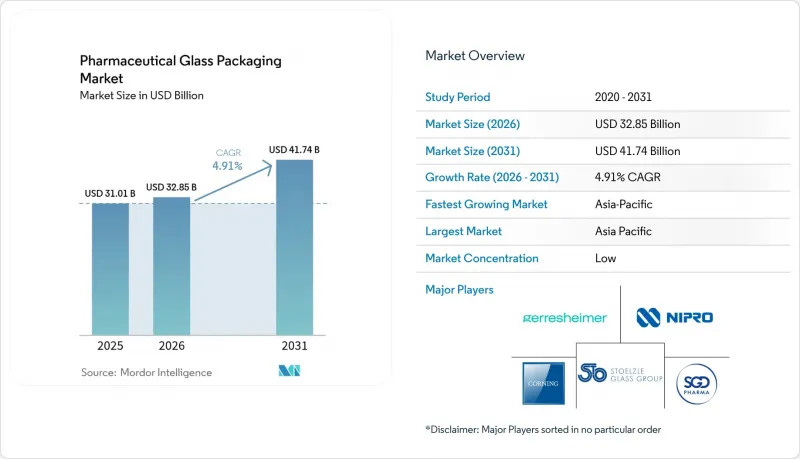
의약품용 유리 포장 시장 규모는 2025년에 310억 1,000만 달러로 평가되었고 2026년 328억 5,000만 달러에서 2031년까지 417억 4,000만 달러에 이를 것으로 예측되며, 예측 기간(2026-2031년) CAGR은 4.91%를 나타낼 전망입니다.
본 보고서는 제품별(병, 바이알, 앰플 등), 유리 유형별(유형 I 붕규산 유리, 유형 II 처리 소다-석회 유리 등), 의약품 제형별(주사제, 경구 용액제, 점안·점비제 등), 최종 사용자(혁신적 제약 기업, 제네릭 의약품 제조업체 및 CMO 등), 그리고 지역별로 분류되어 있습니다. 시장 예측은 금액(달러) 기준으로 제시되어 있습니다.
전 세계 의약품용 유리 포장 시장 동향 및 인사이트
바이오의약품 및 주사제 파이프라인의 확대
의약품용 유리 포장 시장은 후기 단계 바이오의약품의 급증에 힘입어, 2025년까지 2상 및 3상 임상시험 단계에 있는 후보 약물이 2,517건에 달할 것으로 예측됩니다. 그 중 3분의 2 이상은 24개월의 보관 기간 동안 단백질 구조를 보호하기 위해 저용출성 제1형 용기를 사용한 비경구 투여가 필요합니다. 단일 클론 항체 요법의 연간 출하량은 바이알 또는 프리필 가능한 주사기로 1억 5,000만 개를 초과할 가능성이 있으며, 이를 통해 설비 가동률을 안정화시키는 수년에 걸친 베이스 로드가 확립될 것입니다. 세포 및 유전자 치료는 현재 파이프라인의 5분의 1 가까이를 차지하고 있으며, 추출물이 1ppm 미만인 사전 멸균 바이알이 필요하기 때문에 경쟁 소재에 대한 기술적 장벽이 높아지고 있습니다. West Pharmaceutical Services와 Stevanart Group 양사의 RTU 충전 라인에 대한 투자는 이러한 고순도 포맷으로의 전환을 뒷받침하고 있습니다.
코로나19 이후 백신 충전 및 마감 처리 능력 확대
2020년부터 2024년까지 전 세계 충전 및 마무리 처리 능력은 47% 확대되어 연간 83억 회분의 투여량이 추가되었습니다. 그 대부분은 인도, 인도네시아, 남아프리카공화국, 브라질에서 증설된 것입니다. 이 라인들은 mRNA 백신 및 바이러스 벡터 백신에 대응하는 2밀리리터 및 5밀리리터 유형 I 바이알을 표준 사양으로 하고 있습니다. 인도의 세람 인스티튜트는 코로나19 팬데믹 기간 동안 생산량의 80%를 일반 예방접종용으로 확보할 방침이며, 이에 따라 연간 약 12억 바이알의 생산이 확정되었습니다. 현재 23개 중저소득 국가가 국내 백신 생산 라인을 신설하거나 확장하고 있으며, 그중 19개국이 유형 I 유리를 지정하고 있어 규제 당국의 이해가 깊어지고 있음을 반영하고 있습니다.
COP/COC 폴리머 주사기의 급속한 보급
제약 기업들이 유리 주사기 배럴에서 실리콘 오일 및 텅스텐 용출물을 제거하려는 움직임을 추진하는 가운데, 2025년에는 폴리머 주사기 시장 점유율이 18%에 달했습니다. 테르모가 2025년 3월에 레시팜의 자산을 인수함에 따라, 2027년까지 폴리머 주사기의 생산 능력은 3배인 6억 개로 확대되어 유리 제조업체에 대한 경쟁 압력이 강해질 전망입니다. 또한, 기기 설계자들은 치수 정밀도가 25% 향상되었다는 점을 강조하고 있습니다. 이를 통해 추가적인 육안 검사 없이도 고속 충전이 가능해져, 높은 처리량을 자랑하는 바이오의약품 생산 라인의 총 소유 비용(TCO) 절감으로 이어집니다. FDA가 2024년 용기 및 밀봉 시스템에 관한 지침에서 COP 및 COC를 적절한 비경구 투여용 용기 소재로 승인함에 따라, 규제 당국의 수용도도 확대되고 있습니다.
부문 분석
2025년, 바이알은 의약품용 유리 포장 시장에서 40.53%의 점유율을 차지했습니다. 이는 백신 충전 및 마무리, 동결건조 바이오의약품, 다회 투여용 주사제와 같은 용도에서 바이알이 확고한 입지를 다지고 있음을 반영하며, 이러한 분야에서는 확립된 충전 라인과 규제 당국의 이해가 이 형태에 우위를 가져다주고 있습니다. 카트리지 및 프리필 주사기는 만성 질환에 대한 환자 중심의 투여, 복약 순응도 향상 및 내원 횟수 감소로 이어지는 의료기기로의 제약 업계 전환을 배경으로, 2026년부터 2031년까지 연평균 성장률(CAGR) 5.93%를 나타낼 것으로 예측됩니다. 경구용 액제나 안과용 제제에 사용되는 병은 인도와 중국의 제네릭 의약품 제조업체들이 소아용 현탁액의 제품 라인업을 확대함에 따라 완만한 성장세를 보이고 있지만, 앰플은 일회용의 편의성보다 자동 충전 시 파손률이 더 높기 때문에 시장 점유율이 하락하고 있습니다.
바이오의약품 분야에서는 바이알에서 프리필 주사기로의 전환이 가속화되고 있으며, 스테바나트 그룹의 ‘EZ-fill nests’와 게레스하이머의 ‘Gx RTF’ 주사기는 2차 포장이나 콜드체인의 복잡성을 피하고 있습니다. 2024년 10월, 니프로가 코닝사와 제휴하여 입자 수준을 최대 96%까지 저감하는 ‘Velocity Vial’의 판매를 시작한 것은 주사기 채택이 진행되는 상황에서도 바이알의 중요성을 유지하려는 움직임을 여실히 보여주고 있습니다. 인슐린 및 GLP-1 디바이스에서는 카트리지가 주류를 이루고 있으며, 다회 투여 시 높은 정확도와 웨스트 파마슈티컬 서비스(West Pharmaceutical Services)의 ‘Westar’ 즉시 사용형 컴포넌트가 사실상 표준으로 활용되고 있습니다. 앰플은 기밀성을 중시하는 응급 의료 및 수의학 시장에서 여전히 활용되고 있으며, ‘기타 제품’이라는 틈새 시장인 듀얼 챔버 바이알과 블로우-필-씰은 CDMO 각사가 바이오시밀러로의 대체를 막기 위해 독자적인 패키지를 추구하는 가운데 연평균 성장률(CAGR) 4.2%로 확대되고 있습니다.
2025년에는 유형 I 붕규산 유리가 의약품용 유리 포장 시장의 54.56% 점유율을 차지할 것이며, 바이오의약품, 백신, 고pH 주사제 분야에서 그 화학적 내구성이 표준화됨에 따라 2031년까지 연평균 성장률(CAGR) 5.67%로 확대될 것으로 예측됩니다. 이산화황을 이용한 표면 처리로 개량된 II형 소다석회 유리는 가격에 민감한 제네릭 의약품에 사용되고 있지만, 고액의 재검증을 피하기 위해 전 세계 신청에서 I형이 기본으로 채택되는 경향이 강해짐에 따라 시장 점유율이 하락하고 있습니다. III형 소다석회 유리는 경구용 액제나 외용제 등 비경구 제제에 한정되어 있으며, 소아용 현탁액 시장에서 경량 플라스틱에 시장 점유율을 빼앗기고 있어 연평균 성장률(CAGR)은 3.8%에 그치고 있습니다.
파도바 대학의 플라즈마 이온 교환에 관한 연구에 따르면, 개질된 제1형의 표면은 단백질 흡착을 68%,나트륨 용출을 82% 저감시켜 점도 저하제를 사용하지 않고도 150 mg/ml를 초과하는 농도를 실현할 수 있음이 밝혀졌으며, 이 획기적인 성과는 항체-약물 복합체(ADC) 개발자들의 주목을 받고 있습니다. 2025년에 발표된, 독일과 인도를 아우르는 쇼트(Schott)사의 4억 5,000만 달러 규모의 투자 프로그램은 맞춤형 유형 I 금형의 리드 타임을 12-18개월 단축하는 것을 목표로 하고 있습니다. 유형 II 유리는 예산 제약이 있는 시장, 특히 사하라 이남 아프리카와 남아시아에서 꾸준한 수요가 있지만, 35-50%의 가격 경쟁력에도 불구하고 엄격한 추출물 시험으로 인해 유형 I의 사용이 의무화되어 있는 혁신적인 기업들을 끌어들이지는 못하고 있습니다. 빛에 민감한 의약품을 위한 호박색 바이알,‘Velocity Vial’과 같은 저마찰 코팅 등 ‘기타 유리 제품’ 라인은 기업들이 기능적 차별화를 추구하는 가운데 연평균 성장률(CAGR) 6.1%로 성장을 지속하고, 있으며, ISO 15378 추적성 규정이 유형 I의 우위를 더욱 공고히 하고 있습니다.
지역별 분석
아시아태평양은 2025년에 34.96%의 점유율을 차지했습니다. 이는 중국의 90억 개 생산량과 인도가 세계 충전 및 마무리 허브로 부상한 것을 반영합니다. 일본 기업들은 전 세계로 수출되는 고정밀 주사기와 표면 처리가 된 바이알에 주력하고 있습니다. ICH Q3D와의 규제 조화를 통해 유형 I 유리를 중심으로 한 표준화가 진행되고 있으며, 이 지역의 연평균 성장률(CAGR)은 5.2%로 성장을 지속하고, 있습니다.
아시아태평양은 현지 백신 접종 의무화와 ‘아프리카 백신 제조 이니셔티브’에 힘입어 연평균 성장률(CAGR) 5.88%가 예상됩니다. 남아프리카공화국, 케냐, 나이지리아에서의 용해로 건설로 인해 원자재 수입에 따른 물류상의 과제가 해소되고 있습니다. 생산 능력은 여전히 수요를 따라가지 못하고 있어, 다국적 기업들은 조기에 시장 점유율을 확보하기 위해 합작 사업에 진출하고 있습니다.
유럽과 북미를 합치면 2025년 수요의 42.1%를 차지하며, RTU로의 전환 및 AI 검사 도입을 통해 거래량 증가와 이익률 향상을 주도하고 있습니다. EU 그린딜에 기반한 재활용 목표에 따라 주요 회원국에서는 유리 파편 회수율이 78%로 향상되어, 유리의 지속가능성에 대한 평가를 더욱 강화하고 있습니다. 남미는 브라질의 바이오시밀러 추진과 포장재의 현지 생산을 의무화하는 정부의 조달 규정에 힘입어 연평균 성장률(CAGR) 4.7%로 성장하고 있습니다.
기타 혜택:
- 엑셀 형식 시장 예측(ME) 시트
- 3개월간의 애널리스트 지원
자주 묻는 질문
목차
제1장 서론
제2장 조사 방법
제3장 주요 요약
제4장 시장 구도
제5장 시장 규모와 성장 예측
제6장 경쟁 구도
제7장 시장 기회와 향후 전망
JHS 26.09.09According to Mordor Intelligence, the pharmaceutical glass packaging market size was valued at USD 31.01 billion in 2025 and is estimated to grow from USD 32.85 billion in 2026 to reach USD 41.74 billion by 2031, at a CAGR of 4.91% during the forecast period (2026-2031).
This report is Segmented by Product (Bottles, Vials, Ampoules, and More), Glass Type (Type I Borosilicate, Type II Treated Soda-Lime, and More), Drug Formulation (Injectables, Oral Liquids, Ophthalmic/Nasal, and More), End-User (Pharma Innovator Companies, Generic and CMOs, and More), and Geography. The Market Forecasts are Provided in Terms of Value (USD).
Global Pharmaceutical Glass Packaging Market Trends and Insights
Expansion Of Biologics And Injectable Drugs Pipeline
The pharmaceutical glass packaging market is riding a surge of late-stage biologics, with 2,517 candidates in Phase II and III by 2025. More than two-thirds require parenteral delivery in low-extractable Type I containers to safeguard protein structure during a 24-month shelf life. Annual launch volumes for monoclonal antibody therapies can top 150 million vials or prefillable syringes, establishing a multi-year base load that smooths capacity utilization. Cell and gene therapies now account for almost one-fifth of the pipeline and require pre-sterilized vials with extractables below 1 ppm, raising the technical barrier for competing materials. Investment in RTU filling lines by both West Pharmaceutical Services and Stevanato Group underpins this shift toward high-purity formats.
Mounting Vaccine Fill-Finish Capacity Post-COVID
Global fill-finish throughput expanded 47 % between 2020-2024, adding 8.3 billion annual doses, largely in India, Indonesia, South Africa, and Brazil. Those lines were standardized on 2- and 5-milliliter Type I vials compatible with mRNA and viral-vector vaccines. Serum Institute of India intends to retain 80 % of its COVID-era output for routine immunizations, locking in roughly 1.2 billion vials per year. Twenty-three low- and middle-income countries have now established or expanded domestic vaccine lines, and 19 of them specify Type I glass, reflecting regulatory familiarity.
Rapid Adoption Of COP/COC Polymer Syringes
Polymer syringes reached 18% market share in 2025 as drug firms moved to eliminate silicon oil and tungsten leachables from glass barrels. Terumo's March 2025 acquisition of Recipharm's assets will triple polymer syringe capacity to 600 million units by 2027, intensifying competitive pressure on glass producers. Device designers also cite a 25% gain in dimensional precision, enabling higher-speed filling without additional vision checks, thereby lowering the total cost of ownership for high-throughput biologics lines. Regulatory acceptance is expanding after the FDA acknowledged COP and COC as suitable parenteral container materials in its 2024 guidance on container-closure systems.
Other drivers and restraints analyzed in the detailed report include:
- Shift To Ready-To-Use Vials And Syringes
- Rising Demand for High-Value Borosilicate Type I Glass
- Volatile Soda-Ash and Energy Prices Inflating Glass Cost
For complete list of drivers and restraints, kindly check the Table Of Contents.
Segment Analysis
Vials held a 40.53% share of the pharmaceutical glass packaging market in 2025, reflecting their entrenched position in vaccine fill-finish, lyophilized biologics, and multi-dose injectable applications, where established filling lines and regulatory familiarity give the format an edge. Cartridges and prefillable syringes are projected to grow at a 5.93% CAGR from 2026-2031, driven by patient-centric delivery for chronic diseases and the drug industry's pivot toward devices that improve adherence and reduce hospital visits. Bottles, used for oral liquids and ophthalmic preparations, register modest gains as generic producers in India and China expand pediatric suspension portfolios, while ampoules slip as single-use convenience is outweighed by higher breakage during automated filling.
The swing from vials to prefillable syringes accelerates in biologics, where Stevanato Group's EZ-fill nests and Gerresheimer's Gx RTF syringes bypass secondary packaging and cold-chain complexity. Nipro's October 2024 partnership with Corning to distribute Velocity Vial, which reduces particulate levels by up to 96%, highlights the push to sustain vial relevance even as syringe adoption climbs. Cartridges dominate insulin and GLP-1 devices, leveraging multi-dose precision and West Pharmaceutical Services' Westar ready-to-use components as the de-facto standard. Ampoules still serve emergency medicine and veterinary markets that prize hermetic sealing, and the "other product" niche, dual-chamber vials and blow-fill-seal, expands at a 4.2 % CAGR as CDMOs pursue proprietary packages that deter biosimilar substitution.
Type I borosilicate glass captured 54.56% of the pharmaceutical glass packaging market share in 2025 and is forecast to expand at a 5.67% CAGR through 2031 as biologics, vaccines, and high-pH injectables standardize on its chemical durability. Type II treated soda-lime, upgraded by sulfur dioxide surface treatment, serves price-sensitive generics but loses ground as global filings increasingly default to Type I to avoid costly revalidation. Type III soda-lime, limited to non-parenteral formats such as oral liquids and topicals, grows only 3.8% CAGR as lightweight plastics erode share in pediatric suspensions.
Plasma ion-exchange research from the University of Padua shows that modified Type I surfaces cut protein adsorption 68 % and sodium leaching by 82 %, enabling concentrations above 150 mg/ml without viscosity reducers, a breakthrough attracting antibody-drug conjugate developers. Schott's USD 450 million investment program, announced in 2025 and spanning Germany and India, aims to reduce 12-18-month lead times for custom Type I molds. Type II glass clings to markets constrained by budgetary pressures, notably sub-Saharan Africa and South Asia, yet its 35-50% price discount fails to entice innovators locked into Type I by stringent extractables tests. "Other glass" lines, amber formats for light-sensitive drugs and low-friction coatings like Velocity Vial, push a 6.1 % CAGR as firms chase functional differentiation, and ISO 15378 traceability rules further cement Type I dominance.
Complete Report Scope:
- By Product
- Bottles
- Vials
- Ampoules
- Cartridges and Prefillable Syringes
- Other Product
- By Glass Type
- Type I Borosilicate
- Type II Treated Soda-Lime
- Type III Soda-Lime
- Other Glass Type
- By Drug Formulation
- Injectables
- Oral Liquids
- Ophthalmic / Nasal
- Topical
- By End-User
- Pharma Innovator Companies
- Generic and CMOs
- Biotech Firms
- Compounding Pharmacies
- Veterinary Pharma
- By Geography
- North America
- United States
- Canada
- Mexico
- Europe
- Germany
- United Kingdom
- France
- Italy
- Spain
- Russia
- Rest of Europe
- Asia-Pacific
- China
- India
- Japan
- South Korea
- Australia and New Zealand
- Rest of Asia-Pacific
- Middle East and Africa
- Middle East
- Africa
- South America
- Brazil
- Argentina
- Rest of South America
- North America
Geography Analysis
Asia-Pacific captured 34.96 % in 2025, reflecting China's 9 billion-unit output and India's emergence as a global fill-finish hub. Japanese firms focus on high-precision syringes and surface-engineered vials exported worldwide. Regulatory alignment with ICH Q3D promotes standardization around Type I glass, driving a 5.2% regional CAGR.
Asia-Pacific is poised for a 5.88% CAGR, driven by local vaccine mandates and the African Vaccine Manufacturing Initiative. Furnace builds in South Africa, Kenya, and Nigeria offset logistical hurdles associated with raw-material imports. Capacity still lags demand, so multinationals are entering joint ventures to secure early market share.
Europe and North America together accounted for 42.1% of 2025 demand, driving trading volume growth and margin accretion through RTU conversions and AI inspection rollouts. Recycling targets under the EU Green Deal raise cullet recovery rates to 78% in leading member states, reinforcing glass's sustainability narrative. South America advances at a 4.7% CAGR, led by Brazil's biosimilar push and government procurement rules that localize packaging.
- Gerresheimer AG
- Schott AG
- SGD Pharma
- Stevanato Group
- Corning Inc.
- Nipro Corporation
- West Pharmaceutical Services Inc.
- Bormioli Pharma S.p.A.
- Owens-Illinois Inc. (Ardagh Glass Pharma)
- Stoelzle Oberglas GmbH
- Beatson Clark Ltd.
- Shandong Medicinal Glass Co. Ltd.
- Arab Pharmaceutical Glass Co.
- Piramal Glass Private Ltd.
- Sisecam Group
- Baxter BioPharma Solutions LLC
- Kindeva Drug Delivery L.P.
- Origin Pharma Packaging Ltd.
- DWK Life Sciences GmbH
- GerroMed GmbH
Additional Benefits:
- The market estimate (ME) sheet in Excel format
- 3 months of analyst support
TABLE OF CONTENTS
1 INTRODUCTION
- 1.1 Study Assumptions and Market Definition
- 1.2 Scope of the Study
2 RESEARCH METHODOLOGY
3 EXECUTIVE SUMMARY
4 MARKET LANDSCAPE
- 4.1 Market Overview
- 4.2 Market Drivers
- 4.2.1 Expansion of Biologics and Injectable Drugs Pipeline
- 4.2.2 Mounting Vaccine Fill-Finish Capacity Post-COVID
- 4.2.3 Shift to Ready-to-Use (RTU) Vials and Syringes
- 4.2.4 Rising Demand for High-Value Borosilicate Type-I Glass
- 4.2.5 Pharma Sustainability Mandates Boosting Glass Recyclability
- 4.2.6 AI-Enabled Inline QC Reducing Glass Defect Rates
- 4.3 Market Restraints
- 4.3.1 Rapid Adoption of COP/COC Polymer Syringes
- 4.3.2 Volatile Soda-Ash and Energy Prices Inflating Glass Cost
- 4.3.3 Delamination and Breakage Concerns in Ultra-Potent Drugs
- 4.3.4 Regional Container-Glass Furnace Capacity Shortages
- 4.4 Industry Value / Supply-Chain Analysis
- 4.5 Regulatory Outlook
- 4.6 Technological Outlook
- 4.7 Impact of Macroeconomic Factors on the Market
- 4.8 Porter's Five Forces Analysis
- 4.8.1 Bargaining Power of Suppliers
- 4.8.2 Bargaining Power of Buyers
- 4.8.3 Threat of New Entrants
- 4.8.4 Threat of Substitutes
- 4.8.5 Competitive Rivalry
5 MARKET SIZE AND GROWTH FORECASTS (VALUE)
- 5.1 By Product
- 5.1.1 Bottles
- 5.1.2 Vials
- 5.1.3 Ampoules
- 5.1.4 Cartridges and Prefillable Syringes
- 5.1.5 Other Product
- 5.2 By Glass Type
- 5.2.1 Type I Borosilicate
- 5.2.2 Type II Treated Soda-Lime
- 5.2.3 Type III Soda-Lime
- 5.2.4 Other Glass Type
- 5.3 By Drug Formulation
- 5.3.1 Injectables
- 5.3.2 Oral Liquids
- 5.3.3 Ophthalmic / Nasal
- 5.3.4 Topical
- 5.4 By End-User
- 5.4.1 Pharma Innovator Companies
- 5.4.2 Generic and CMOs
- 5.4.3 Biotech Firms
- 5.4.4 Compounding Pharmacies
- 5.4.5 Veterinary Pharma
- 5.5 By Geography
- 5.5.1 North America
- 5.5.1.1 United States
- 5.5.1.2 Canada
- 5.5.1.3 Mexico
- 5.5.2 Europe
- 5.5.2.1 Germany
- 5.5.2.2 United Kingdom
- 5.5.2.3 France
- 5.5.2.4 Italy
- 5.5.2.5 Spain
- 5.5.2.6 Russia
- 5.5.2.7 Rest of Europe
- 5.5.3 Asia-Pacific
- 5.5.3.1 China
- 5.5.3.2 India
- 5.5.3.3 Japan
- 5.5.3.4 South Korea
- 5.5.3.5 Australia and New Zealand
- 5.5.3.6 Rest of Asia-Pacific
- 5.5.4 Middle East and Africa
- 5.5.4.1 Middle East
- 5.5.4.2 Africa
- 5.5.5 South America
- 5.5.5.1 Brazil
- 5.5.5.2 Argentina
- 5.5.5.3 Rest of South America
- 5.5.1 North America
6 COMPETITIVE LANDSCAPE
- 6.1 Market Concentration
- 6.2 Strategic Moves
- 6.3 Market Share Analysis
- 6.4 Company Profiles (includes Global Level Overview, Market Level Overview, Core Segments, Financials as available, Strategic Information, Market Rank/Share, Products and Services, Recent Developments)
- 6.4.1 Gerresheimer AG
- 6.4.2 Schott AG
- 6.4.3 SGD Pharma
- 6.4.4 Stevanato Group
- 6.4.5 Corning Inc.
- 6.4.6 Nipro Corporation
- 6.4.7 West Pharmaceutical Services Inc.
- 6.4.8 Bormioli Pharma S.p.A.
- 6.4.9 Owens-Illinois Inc. (Ardagh Glass Pharma)
- 6.4.10 Stoelzle Oberglas GmbH
- 6.4.11 Beatson Clark Ltd.
- 6.4.12 Shandong Medicinal Glass Co. Ltd.
- 6.4.13 Arab Pharmaceutical Glass Co.
- 6.4.14 Piramal Glass Private Ltd.
- 6.4.15 Sisecam Group
- 6.4.16 Baxter BioPharma Solutions LLC
- 6.4.17 Kindeva Drug Delivery L.P.
- 6.4.18 Origin Pharma Packaging Ltd.
- 6.4.19 DWK Life Sciences GmbH
- 6.4.20 GerroMed GmbH
7 MARKET OPPORTUNITIES AND FUTURE OUTLOOK
- 7.1 White-Space and Unmet-Need Assessment