

|
시장보고서
상품코드
2123277
폴리프로필렌 시장 : 점유율 분석, 업계 동향과 통계, 성장 예측(2026-2031년)Polypropylene - Market Share Analysis, Industry Trends & Statistics, Growth Forecasts (2026 - 2031) |
||||||
 Mordor Intelligence
폴리프로필렌 시장 규모는 2025년에 9,730만 톤으로 평가되어 2026년 1억 267만 톤에서 2031년까지 1억 3,429만 톤에 이를 것으로 예측되며, 예측 기간(2026-2031년) CAGR은 5.52%를 나타낼 전망입니다.
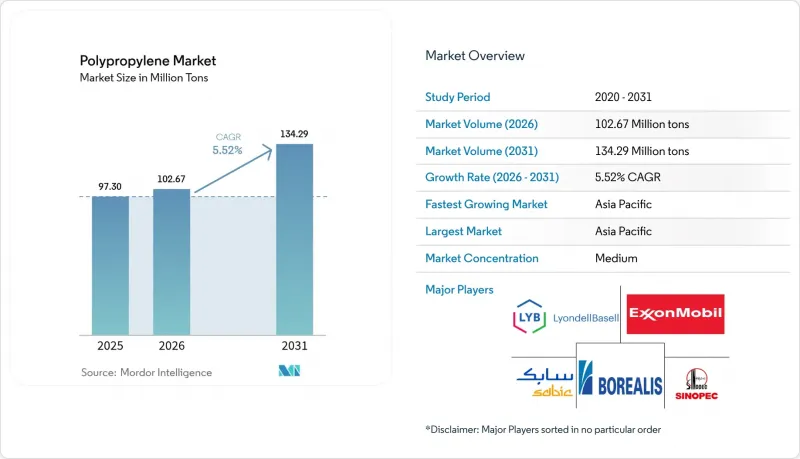
본 보고서는 유형(호모폴리머, 코폴리머), 가공 기술(사출 성형, 블로우 성형, 압출 성형, 기타), 최종 사용자 산업(포장, 자동차, 소비재, 전기 및 전자, 기타),및 지역(아시아태평양, 북미, 유럽, 남미, 중동 및 아프리카)별로 분류되어 있습니다. 시장 예측은 수량(톤) 단위로 제시되어 있습니다.
세계 폴리프로필렌 시장 동향 및 인사이트
자동차 및 e-모빌리티 분야의 경량화 추진
배터리 주행 거리 연장을 목표로 하는 자동차 제조업체들은 특히 계기판이나 보닛 하부 실드에서 충돌 안전성을 유지하면서 부품 중량을 최대 40%까지 줄일 수 있는 높은 용융 강도를 지닌 폴리프로필렌 폼으로 금속 어셈블리를 대체하고 있습니다. 또한, 통합형 촉매 시스템을 통해 프로파일렌계 엘라스토머가 생산되게 되었으며, 고무 그로밋 및 씰을 대체함으로써 설계자에게 부품 집약의 기회를 제공하고, 조립 시간 단축을 실현하고 있습니다. 1차 공급업체들은 사이클 타임을 최적화하기 위해 금형 전략을 박벽 사출 성형으로 전환하고 있으며, 이는 유럽 전역에서 성형기 개조라는 새로운 물결을 일으키고 있습니다. 북미의 각 OEM 업체들은 수지 선정 매트릭스를 제품 수명 종료 시 재활용 가능성 목표와 일치시키고 있으며, 이로 인해 단일 소재 인테리어가 더욱 촉진되고 있습니다. 그 결과, 자동차 용도 분야의 연평균 성장률(CAGR)은 6.29%를 기록하며, 폴리프로필렌 시장은 전동화 추세의 주요 수혜 시장으로서의 입지를 확고히 하고 있습니다.
단일 소재 연포장재에 대한 수요의 폭발적 증가
세계 브랜드 기업들은 2025년까지 포장재의 100% 재활용을 목표로 하는 자발적 목표 달성을 앞당기고 있으며, 이에 따라 컨버터 기업들은 다층 라미네이트를 폐지하고 배리어 코팅이 적용된 폴리프로필렌 필름으로의 전환을 추진하고 있습니다. 현재 유럽의 슈퍼마켓에서는 확대 생산자 책임(EPR) 수수료를 최소화하기 위해 단일 폴리머 구조로 만들어진 ‘진열대 진열용’ 파우치 사용을 지정하고 있으며, 이에 따라 독자적인 표면 처리 라인 도입이 급증하고 있습니다. 아시아태평양의 포장 제조업체들은 규모의 경제를 활용하여 식품 접촉 규정을 준수하면서도 고속 가동을 실현하는 무용제 라미네이션 기술을 채택하고 있습니다. 그 결과, 포장재는 여전히 최대 생산량을 유지하면서 프리미엄 가격을 책정할 수 있는 고수익률의 배리어 형태로 전환되고 있습니다. 이러한 전환으로 인해 기계적 재활용 공정에서 베일의 순도도 향상되어, 간접적으로 폴리프로필렌 시장에서 일용소비재(FMCG) 기업들의 재생 폴리프로필렌 펠릿에 대한 수요를 높이고 있습니다.
고성능 대체 수지의 가용성
연포장 분야의 제품 개발자들은 폴리프로필렌과 동등한 산소 차단성을 가지면서도 더 낮은 밀봉 온도에서 가공 가능한 금속 코팅 폴리에틸렌 필름에 대한 시험을 점점 더 늘리고 있으며, 이로 인해 폴리프로필렌이 기존에 가지고 있던 비용 측면의 우위가 서서히 사라지고 있습니다. 음료용 캡 분야에서는 폴리에스터 공급업체들이 화학적 재활용 소재의 함유율과 뛰어난 투명성을 내세워, 지속가능성을 중시하는 브랜드의 가이드라인 준수를 도모하고 있습니다. 아크릴로니트릴·부타디엔·스티렌(ABS)은 높은 표면 광택과 내충격성을 무기로 가전제품의 M 커버 시장에서 점유율을 지속적으로 확대하고 있으며, 고급스러움을 추구하는 분야에서 폴리프로필렌에 압박을 가하고 있습니다. 이에 대응해 수지 제조업체들은 강성 대 충격 비율을 향상시킨 혁신적인 폴리프로필렌 등급을 출시하며 맞서고 있지만, 그 채택 여부는 컨버터가 금형 재인증을 진행할 의사가 있는지에 달려 있습니다. 소재 선정 팀이 기계적 성능과 재활용 가능성의 목표를 저울질함에 따라 이러한 줄다리기는 격화되고 있으며, 이는 예측 연평균 성장률(CAGR)에 0.9%의 부정적 영향을 미치고 있습니다.
부문 분석
2025년, 호모폴리머는 폴리프로필렌 시장 점유율의 69.53%를 차지했습니다. 이는 강성 대 중량 비율이 최우선으로 고려되는 캡, 마개류 및 실 분야에서 가격에 대한 민감성을 반영한 것입니다. 이 부문은 PDH(폴리디메틸히드라진)에 의한 비용 경쟁력을 바탕으로 연평균 성장률(CAGR) 5.63%를 나타낼 것으로 예측되며, 호모폴리머 폴리프로필렌 시장 규모는 2031년까지 9,337만 톤에 달할 것으로 전망됩니다. 각 생산 업체는 루프 리액터 기술을 활용하여 분자량 분포를 좁히고, 강성을 저해하지 않으면서 투명성을 높이고 있으며, 이는 유제품 용기에서 랜덤 코폴리머로의 전환을 촉진하고 있습니다. 코폴리머는 생산량은 적지만, 자동차 범퍼나 세탁기 드럼 등 내충격성이 중요한 부품에서 프리미엄 가격을 확보하고 있습니다. 촉매의 지속적인 개량으로 인해 기존에 존재하던 성능 격차가 줄어들고 있으며, 코폴리머 수준의 인성을 가지면서 호모폴리머에 가까운 경제성을 실현하는 하이브리드 제품이 가능해졌습니다. 이러한 수렴 현상으로 인해 조달 담당자들은 표면적인 수지 가격이 아닌 총 도입 비용에 주목하게 되었으며, 특수 등급이 확대되는 상황에서도 호모폴리머의 압도적인 시장 점유율이 유지되고 있습니다.
2세대 기상 반응 장치를 통해 등급 전환을 신속하게 수행할 수 있게 되어, 전환에 따른 스크랩이 감소하고, 소비재 가공 제조업체가 요구하는 적시(JIT) 물류 체제가 촉진되고 있습니다. 에틸렌·프로파일렌 고무 영역을 활용한 내충격성 공중합체는 신뢰성이 높은 저온 연성으로 인해 한랭지용 자동차 전면 패널에 채택이 확대되고 있습니다. 랜덤 코폴리머는 감마선 멸균에 대한 안정성이 요구되는 의료용 주사기에서 틈새 시장을 유지하고 있습니다. 그러나 호모폴리머 블렌드에 멸균 내성 첨가제가 점점 더 많이 사용되고 있다는 점은 향후 코폴리머 시장을 잠식할 가능성이 있음을 시사합니다. 첨가제 마스터배치의 배합 기술이 성숙해짐에 따라, 호모폴리머의 판매량은 코폴리머의 성장분을 빼앗아 그 시장 규모 우위를 공고히 할 가능성이 있습니다.
지역별 분석
아시아태평양의 58.78% 점유율은 이 지역 제조업의 강점을 뒷받침하고 있지만, 2025년 중국에서 생산량이 68% 급증하면서 공급 과잉이 발생해 이익률을 압박했을 뿐만 아니라, 인도네시아와 필리핀에서 반덤핑 조치를 초래했습니다. 현재 각 지방 정부는 신규 PDH 프로젝트에 대한 환경 허가를 엄격히 심사하고 있어, 향후 생산 능력의 점진적인 증대를 억제하고 있습니다. 인도에서는 소비재의 보급이 확대됨에 따라 하류 수요가 가속화되고 있습니다. 인도에 건설이 예정된 80억 달러 규모의 에탄 크래커는 수입 의존도를 낮추고 아시아 지역 내 무역 구조를 재편할 것으로 기대됩니다.
북미는 폴리프로필렌 시장에서 PDH의 원료 측면에서의 우위와 회복세를 보이고 있는 자동차 산업에 대한 지리적 근접성을 활용하여, 남미 및 유럽으로의 경쟁력 있는 수출을 실현하고 있습니다. 에탄을 풍부하게 함유한 셰일가스가 프로파일렌의 저비용 생산을 뒷받침하고 있어, 세계 가격 변동에도 불구하고 걸프 코스트의 플랜트는 높은 가동률을 유지하고 있습니다. 캐나다 사니아에 거점을 둔 크래커는 확립된 철도 물류망을 통해 중서부 지역의 가공업체에 원료를 공급하며, 지역공급 안정성을 강화하고 있습니다.
유럽은 에너지 가격 급등과 엄격한 폐기물 규제라는 이중의 역풍에 직면해 있습니다. 각 생산 업체들은 EU의 ‘포장 및 포장 폐기물 규정’ 준수를 유지하기 위해 영구적인 가동 중단 또는 재생 원료 플랫폼으로의 전환을 검토하고 있습니다. 동시에 중동에서 유럽으로의 폴리머 무역 흐름이 확대되고 있습니다. 이는 통합형 정유·석유화학 허브가 저가 나프타를 활용하는 한편, 튀르키예의 가공업체들이 EU 관세동맹으로의 무역 관문 역할을 수행하고 있기 때문입니다. 수입에 크게 의존하고 있는 남미에서는 업스트림 부문에 대한 투자 유치가 진행되고 있으나, 통화 변동과 정책 불확실성으로 인해 대규모 신규 프로젝트가 지연되고 있습니다.
기타 혜택:
- 엑셀 형식 시장 전망(ME) 시트
- 3개월간 애널리스트 지원
자주 묻는 질문
목차
제1장 서론
제2장 조사 방법
제3장 주요 요약
제4장 시장 구도
제5장 시장 규모와 성장 예측
제6장 경쟁 구도
제7장 시장 기회와 향후 전망
JHS 26.09.09According to Mordor Intelligence, the polypropylene market size was valued at 97.30 million tons in 2025 and estimated to grow from 102.67 million tons in 2026 to reach 134.29 million tons by 2031, at a CAGR of 5.52% during the forecast period (2026-2031).

This report is Segmented by Type (Homopolymer, Copolymer), Processing Technology (Injection Molding, Blow Molding, Extrusion Molding, and Others), End-User Industry (Packaging, Automotive, Consumer Products, Electrical and Electronics, and Others), and Geography (Asia-Pacific, North America, Europe, South America, and Middle East and Africa). The Market Forecasts are Provided in Terms of Volume (Tons).
Global Polypropylene Market Trends and Insights
Lightweighting Push in Automotive and E-Mobility
Automakers targeting extended battery range are replacing metal assemblies with high-melt-strength polypropylene foams that cut part mass by up to 40% while retaining crashworthiness, particularly in instrument panels and under-hood shields Integrated catalyst systems now produce propylene-based elastomers that displace rubber grommets and seals, offering designers consolidation opportunities that trim assembly time. Tier-one suppliers are shifting tooling strategies toward thin-wall injection molding to optimize cycle times, spurring a fresh wave of press retrofits across Europe. North American OEMs are aligning resin selection matrices with end-of-life recyclability targets, giving an additional boost to mono-material interiors. The resulting 6.29% CAGR for automotive applications positions the polypropylene market as a pivotal beneficiary of electrification trends.
Exploding Demand for Mono-Material Flexible Packaging
Global brands have fast-tracked voluntary targets demanding 100% recyclable packaging by 2025, prompting converters to abandon multi-layer laminates in favor of barrier-coated polypropylene films. European supermarkets now specify shelf-ready pouches made from single-polymer structures to minimize extended-producer-responsibility fees, sparking a surge in proprietary surface-treatment lines. Asia-Pacific packagers, capitalizing on economies of scale, are adopting solvent-free lamination technologies that deliver high-speed runs while meeting food-contact compliance. As a result, packaging retains the largest volume base yet transitions toward higher-margin barrier formats that command premium pricing. The migration also elevates bale purity in mechanical recycling streams, indirectly raising demand for recycled polypropylene pellets among fast-moving consumer-goods companies in the polypropylene market.
Availability of High-Performance Substitute Resins
Product developers in flexible packaging are increasingly testing metallized polyethylene films that match polypropylene's oxygen barrier while delivering lower sealing temperatures, eroding polypropylene's historic cost advantage. In beverage closures, polyester suppliers tout chemical-recycling content and superior clarity to capture sustainability-oriented brand guidelines. Acrylonitrile-butadiene-styrene (ABS) continues to win share in consumer electronics m-covers through higher surface gloss and impact resistance, pressuring polypropylene in premium aesthetics. Resin makers counter by launching inspired polypropylene grades with boosted stiffness-to-impact ratios, but adoption hinges on converter willingness to requalify molds. The tug-of-war intensifies as material selection teams weigh mechanical performance against recyclability targets, creating a net 0.9 percentage-point drag on forecast CAGR.
Other drivers and restraints analyzed in the detailed report include:
- Capacity Surge of PDH Units Lowering Cash Cost
- High-Melt-Strength PP Enabling Foamed, Low-Density Applications
- Crude-Oil and Propylene Price Volatility Squeezing Converter Margins
For complete list of drivers and restraints, kindly check the Table Of Contents.
Segment Analysis
Homopolymer accounted for 69.53% of polypropylene market share in 2025, reflecting price sensitivity in caps, closures, and yarns where stiffness-to-weight ratio is paramount. The segment is forecast to post a 5.63% CAGR supported by PDH-driven cost competitiveness, with the polypropylene market size for homopolymers expected to reach 93.37 million tons by 2031. Producers are narrowing molecular-weight distributions using loop-reactor technology, enhancing clarity without sacrificing rigidity, which aids transition from random copolymer in dairy containers. Copolymers, while smaller in tonnage, secure premium pricing in impact-critical parts such as automotive bumpers and washing-machine tubs. Continuous catalyst upgrades blur the historical performance gap, enabling hybrid products that echo copolymer toughness at near-homopolymer economics. This convergence keeps procurement teams attentive to total-installed-cost rather than headline resin price, sustaining homopolymer's dominant share even as specialty grades expand.
Second-generation gas-phase reactors allow rapid grade switches, reducing transition scrap and favoring just-in-time logistics demanded by consumer-goods converters. Impact copolymers leveraging ethylene-propylene rubber domains gain traction in cold-climate automotive fascia owing to reliable low-temperature ductility. Random copolymers maintain a niche in medical syringes requiring gamma-sterilization stability. Yet rising sterilization-resistant additives in homopolymer blends signal potential future cannibalization. As additive master-batch formulations mature, homopolymer volumes could siphon incremental growth from copolymer, cementing their scale advantage.
Complete Report Scope:
- By Type
- Homopolymer
- Copolymer
- By Processing Technology
- Injection Molding
- Blow Molding
- Extrusion Molding
- Others
- By End-user Industry
- Packaging
- Automotive
- Consumer Products
- Electrical and Electronics
- Others
- By Geography
- Asia-Pacific
- China
- India
- Japan
- South Korea
- ASEAN Countries
- Rest of Asia-Pacific
- North America
- United States
- Canada
- Mexico
- Europe
- Germany
- United Kingdom
- France
- Italy
- Russia
- NORDIC Countries
- Rest of Europe
- South America
- Brazil
- Argentina
- Rest of South America
- Middle East and Africa
- Saudi Arabia
- South Africa
- Rest of Middle East and Africa
- Asia-Pacific
Geography Analysis
Asia-Pacific's 58.78% share underscores the region's manufacturing heft, but China's 68% production surge in 2025 spawned oversupply that pressured margins and spurred anti-dumping actions in Indonesia and the Philippines. Provincial governments are now scrutinizing environmental approvals for new PDH projects, tempering future capacity creep. India's downstream demand is accelerating as consumer-goods penetration deepens; the country's upcoming USD 8 billion ethane cracker promises to narrow import dependency, reshuffling intra-Asian trade.
North America leverages PDH feedstock advantages and proximity to a resurgent automotive sector in the polypropylene market, translating into competitive export offerings to South America and Europe. Ethane-rich shale gas underpins low propylene cash costs, enabling Gulf Coast plants to run at high utilization despite global volatility. Canada's Sarnia-based crackers feed into Midwestern converters through well-established rail logistics, fortifying regional supply security.
Europe faces twin headwinds of elevated energy pricing and stringent waste regulations. Producers are evaluating permanent shutdowns or conversions to recycled-feedstock platforms to stay compliant with the EU Packaging and Packaging Waste Regulation. Concurrently, polymer trade flows from the Middle East into Europe expand as integrated refinery-petrochemical hubs exploit low naphtha costs, while Turkish converters act as trading gateways into the EU customs union. South America, largely import-dependent, is courting upstream investment; however, currency volatility and policy uncertainty delay large-scale grassroots projects.
- Borealis AG
- Braskem
- China National Petroleum Corporation
- Ducor Petrochemicals
- Exxon Mobil Corporation
- Formosa Plastics Corporation
- Hanwha Total Petrochemical Co., Ltd
- HMC Polymers Company Limited
- INEOS
- LG Chem
- LyondellBasell Industries Holdings B.V.
- Mitsubishi Chemical Group Corporation
- Mitsui Chemicals Inc.
- OQ SAOC
- PJSC SIBUR Holding
- Reliance Industries Limited
- SABIC
- Sinopec
- Sumitomo Chemical Co. Ltd.
- TotalEnergies
- Trinseo PLC
- Vioneo
Additional Benefits:
- The market estimate (ME) sheet in Excel format
- 3 months of analyst support
TABLE OF CONTENTS
1 Introduction
- 1.1 Study Assumptions and Market Definition
- 1.2 Scope of the Study
2 Research Methodology
3 Executive Summary
4 Market Landscape
- 4.1 Market Overview
- 4.2 Market Drivers
- 4.2.1 Lightweighting Push in Automotive and E-Mobility
- 4.2.2 Exploding Demand for Mono-Material Flexible Packaging
- 4.2.3 Capacity Surge of Propane-Dehydrogenation (PDH) Units Lowering Cash-Cost
- 4.2.4 High-Melt-Strength PP Enabling Foamed, Low-Density Applications
- 4.2.5 Rapid Scale-Up of Chemical-Recycling Supply Agreements
- 4.3 Market Restraints
- 4.3.1 Availability of High-Performance Substitute Resins (PE, PET, ABS)
- 4.3.2 Crude-Oil and Propylene Price Volatility Squeezing Converter Margins
- 4.3.3 EU Plastics Tax Steering Converters Toward Mono-PE Laminates
- 4.4 Value Chain Analysis
- 4.5 Porter's Five Forces
- 4.5.1 Bargaining Power of Suppliers
- 4.5.2 Bargaining Power of Buyers
- 4.5.3 Threat of New Entrants
- 4.5.4 Threat of Substitutes
- 4.5.5 Competitive Rivalry
- 4.6 Price Trends
- 4.7 Import-Export Trends
- 4.8 Feedstock Analysis
- 4.9 Technological Snapshot
5 Market Size and Growth Forecasts (Volume)
- 5.1 By Type
- 5.1.1 Homopolymer
- 5.1.2 Copolymer
- 5.2 By Processing Technology
- 5.2.1 Injection Molding
- 5.2.2 Blow Molding
- 5.2.3 Extrusion Molding
- 5.2.4 Others
- 5.3 By End-user Industry
- 5.3.1 Packaging
- 5.3.2 Automotive
- 5.3.3 Consumer Products
- 5.3.4 Electrical and Electronics
- 5.3.5 Others
- 5.4 By Geography
- 5.4.1 Asia-Pacific
- 5.4.1.1 China
- 5.4.1.2 India
- 5.4.1.3 Japan
- 5.4.1.4 South Korea
- 5.4.1.5 ASEAN Countries
- 5.4.1.6 Rest of Asia-Pacific
- 5.4.2 North America
- 5.4.2.1 United States
- 5.4.2.2 Canada
- 5.4.2.3 Mexico
- 5.4.3 Europe
- 5.4.3.1 Germany
- 5.4.3.2 United Kingdom
- 5.4.3.3 France
- 5.4.3.4 Italy
- 5.4.3.5 Russia
- 5.4.3.6 NORDIC Countries
- 5.4.3.7 Rest of Europe
- 5.4.4 South America
- 5.4.4.1 Brazil
- 5.4.4.2 Argentina
- 5.4.4.3 Rest of South America
- 5.4.5 Middle East and Africa
- 5.4.5.1 Saudi Arabia
- 5.4.5.2 South Africa
- 5.4.5.3 Rest of Middle East and Africa
- 5.4.1 Asia-Pacific
6 Competitive Landscape
- 6.1 Market Concentration
- 6.2 Strategic Moves
- 6.3 Market Share (%)/Ranking Analysis
- 6.4 Company Profiles (includes Global-level Overview, Market-level Overview, Core Segments, Financials as available, Strategic Information, Market Rank/Share, Products and Services, Recent Developments)
- 6.4.1 Borealis AG
- 6.4.2 Braskem
- 6.4.3 China National Petroleum Corporation
- 6.4.4 Ducor Petrochemicals
- 6.4.5 Exxon Mobil Corporation
- 6.4.6 Formosa Plastics Corporation
- 6.4.7 Hanwha Total Petrochemical Co., Ltd
- 6.4.8 HMC Polymers Company Limited
- 6.4.9 INEOS
- 6.4.10 LG Chem
- 6.4.11 LyondellBasell Industries Holdings B.V.
- 6.4.12 Mitsubishi Chemical Group Corporation
- 6.4.13 Mitsui Chemicals Inc.
- 6.4.14 OQ SAOC
- 6.4.15 PJSC SIBUR Holding
- 6.4.16 Reliance Industries Limited
- 6.4.17 SABIC
- 6.4.18 Sinopec
- 6.4.19 Sumitomo Chemical Co. Ltd.
- 6.4.20 TotalEnergies
- 6.4.21 Trinseo PLC
- 6.4.22 Vioneo
7 Market Opportunities and Future Outlook
- 7.1 White-space and Unmet-Need Assessment


