|
시장보고서
상품코드
2123280
스몰셀 5G 네트워크 시장 : 점유율 분석, 업계 동향과 통계, 성장 예측(2026-2031년)Small Cell 5G Network - Market Share Analysis, Industry Trends & Statistics, Growth Forecasts (2026 - 2031) |
||||||
 Mordor Intelligence
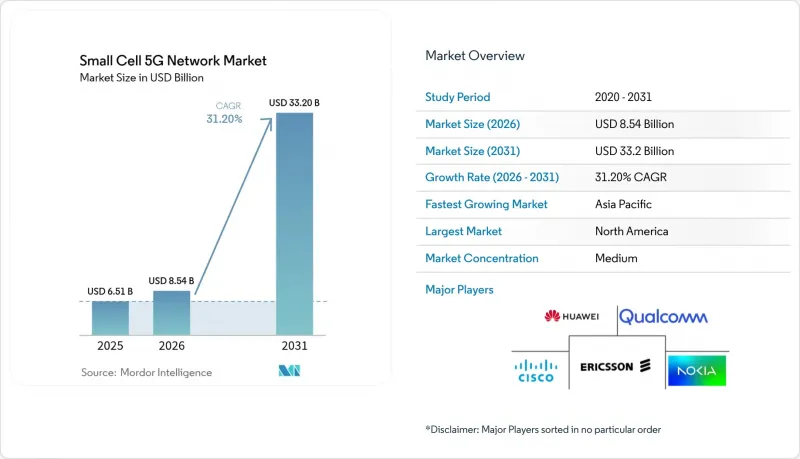
스몰셀 5G 네트워크 시장 규모는 2025년 65억 1,000만 달러에서 2026년에는 85억 4,000만 달러로 확대되어 2026년부터 2031년까지 CAGR 31.2%로 성장을 지속하여, 2031년까지 332억 달러에 이를 것으로 예측됩니다.
본 보고서는 셀 유형(펨토셀, 피코셀, 마이크로셀, 메트로셀), 운영 환경(실내 및 실외), 주파수 대역(6GHz 미만, mm파(24GHz 이상), 1GHz 미만), 최종 사용자(통신 사업자, 기업, 가정), 지역별로 분류되어 있습니다.
전 세계 5G 스몰셀 네트워크 시장 동향 및 인사이트
도시 지역의 5G 구축에 따른 급속한 고밀도화 수요
통신 사업자들은 인구 밀도가 높은 도시 지역에서 매크로셀만으로는 5G 서비스 수준 계약(SLA)을 충족할 수 없다는 사실을 확인하고 있습니다. EE사는 영국 전역에서 1,000기 이상의 스몰셀을 가동하고 있으며, 런던의 25개 사이트에서 매주 7.5 TB의 데이터를 처리함으로써 기존 섹터에서 발생하는 네트워크 혼잡을 완화하고 있습니다. Virgin Media O2는 영국 최초의 5G 독립형 스몰셀을 도입하여 매크로 사이트에서는 실현할 수 없는 네트워크 슬라이싱과 낮은 지연 시간을 실현했습니다. 스몰셀 내 주파수 부분 재사용을 통해 스펙트럼 이용률이 향상됩니다. 이는 AR이나 산업용 IoT 등 업링크 부하가 높은 용도이 주류를 이루게 됨에 따라 매우 중요해집니다. 지자체는 규제 완화를 추진하고 있으며, 현재 전 세계적으로 100건 이상의 중립 호스트 설치가 가동 중입니다. 이러한 요인들이 복합적으로 작용하여 중기적으로는 네트워크 고밀도화가 필수적임을 뒷받침하고 있습니다.
기업용 프라이빗 네트워크 수요(제조, 물류)
정부 정책과 인더스트리 4.0 로드맵에 따라 공장 및 물류 거점에서는 확실한 무선 연결이 요구되고 있습니다. 중국에서는 이미 약 4,000개의 5G 공장 네트워크가 도입되었으며, 2027년까지 1만 개를 목표로 하고 있습니다. 노키아는 2024년 4분기 기준으로 850개의 5G 프라이빗 네트워크 고객을 확보하고 있으며, 한 분기 동안 55개사가 증가했습니다. 운영상의 성과는 뚜렷합니다. 태국의 가전제품 공장에서는 5G를 활용한 자동화 도입 후 생산성이 15-20% 향상되었다고 보고되고 있습니다. 현재 유럽 7개국이 26GHz 대역에 대한 국내 라이선스를 부여하고 있으며, 6개국이 3.4-3.8GHz 대역에서 100 MHz를 할당하고 있어 기업들이 주파수 대역을 확보하기가 쉬워졌습니다. 스몰 셀은 엄격한 커버리지 경계를 확보하고, 엣지 컴퓨팅을 통합하며, 동시 병렬 네트워크 슬라이스를 지원하기 때문에 여전히 선호되는 무선 계층입니다.
교외 및 지방 지역의 광섬유/백홀 수익성 문제
교외 지역의 공중 광섬유 건설 비용은 1마일당 6만-17만 달러에 달하여, 인구 밀도가 낮은 지역에서는 수익성을 압박하고 있습니다. 크라운 캐슬(Crown Castle)은 백홀의 수익성이 어렵다고 판단한 후, 미국 내 7,000곳의 스몰 셀 거점을 동결하여 향후 8억 달러의 설비 투자를 절감했습니다. 마이크로파나 위성을 이용한 백홀은 설비 투자를 줄일 수 있지만, 현재로서는 5G의 용량 및 지연 시간 목표를 충족시킬 수 없습니다. 연방 고속도로청(FHWA)의 데이터에 따르면, 마이크로 트렌치 공법을 채택하더라도 교외 환경에서는 여전히 손익분기점에 도달하는 데 6년에서 8년이 걸립니다. 그 결과, 통신 사업자들은 차세대 무선 백홀이 상업적으로 실현 가능하다는 것이 입증될 때까지 수익성이 높은 대도시권 이외의 지역에서 기지국 고밀도화를 단행하지 못하고 있습니다.
부문 분석
피코셀은 2025년 매출의 40.45%를 차지하며, 혼잡한 도심 회랑의 100-200m 커버리지 구역에 대한 적합성을 입증하고 있습니다. 중대역 스펙트럼과 다중 사용자 MIMO를 통해 사이트당 용량이 향상됨에 따라, 피코셀을 대상으로 한 스몰 셀 5G 네트워크 시장 규모는 급속히 확대될 전망입니다. mm파(mmWave) 피코셀은 28GHz 및 39GHz를 활용하여 멀티 기가비트 처리량을 실현하는 사설 네트워크 및 고정 무선 접속에 힘입어 35.2%라는 가장 높은 연평균 성장률(CAGR)을 보이고 있습니다. EdgeQ사의 ‘베이스스테이션 온 어 칩(Base Station on a Chip)’과 같은 실리콘 기술 혁신을 통해 AI가 통합되어 전력 소비, 비용, 설치 면적을 절감하고 있습니다.
펨토셀은 주택이나 소규모 사무실과 같은 틈새 시장에서 입지를 유지하고 있지만, Wi-Fi 7로부터의 압박에 직면해 있습니다. 한편, 마이크로셀은 피코셀의 설치 밀도가 너무 높으면 비용 면에서 현실적이지 않은 광범위한 교외 지역을 커버하고 있습니다. Comba Telecom사의 ORAN 준수 마이크로 무선 유닛은 표준화된 멀티벤더 생태계로의 전환 추세를 반영하고 있습니다. AI를 활용한 최적화를 통해 각 폼 팩터 간의 성능 격차가 줄어들면서, 통신 사업자는 운영 효율성을 희생하지 않고도 각 사이트의 용량 요구 사항에 유연하게 대응할 수 있게 됩니다.
2025년 도입 건수의 62.10%를 실내 사이트가 차지했습니다. 이는 미드밴드 5G 신호가 현대 건축자재에 의해 감쇠되기 때문입니다. 중립 호스트 시스템과 스마트 빌딩 관리를 통해 사무실,경기장, 공장 전반에 걸쳐 서비스 품질(QoS)을 추구하는 기업들에게 실내 투자는 여전히 매력적인 선택지로 남아 있습니다. 실외 부문은 지자체 허가 절차의 신속화, Release-17 NR-U, 그리고 인프라 공유화를 통해 설치 장벽이 낮아짐에 따라 연평균 성장률(CAGR) 32.4%로 확대되고 있습니다. 맨체스터 도심에 위치한 Virgin Media O2의 실외 셀과 같은 사례는 이러한 변화를 여실히 보여주고 있습니다.
하이브리드 솔루션도 등장하고 있는데, Freshwave사는 영국의 4대 통신 사업자 모두를 단일 실외·실내용 스몰셀 인클로저에 통합하여 기존 시스템에 비해 비용을 65%, 에너지 소비를 60% 절감하고 있습니다. 실내 통신 사업자들은 현재 이론상 46Gbps 속도를 내세우는 Wi-Fi 7에 대항하기 위해, Wi-Fi로는 실현할 수 없는 확정 지연, 보안, 슬라이스 관리와 같은 강점을 강조해야 합니다.
지역별 분석
아시아태평양은 2025년 매출의 37.60%를 차지하며, 2031년까지 연평균 성장률(CAGR) 31.95%를 나타낼 것으로 예측됩니다. 이는 중국의 440만 개 5G 기지국과 300개 도시에서 5G-Advanced 오버레이 구축에 할당된 30억 위안 덕분입니다. 차이나 유니콤 베이징과 화웨이는 인구 1,000만 명을 대상으로 11.2 Gbps의 다운링크 피크 속도를 달성하여, 향후 고밀도 오버레이의 기준을 세웠습니다. 일본과 한국은 기업용 mm파(mmWave)를 추진하고 있으며, 인도에서는 경매 후 네트워크 구축을 통해 민관 파트너십을 통한 고밀도화의 여지가 생겨나고 있습니다.
북미에서는 수익화 효율성이 두드러집니다. 에릭슨의 해당 지역 매출은 AT&T와의 140억 달러 규모 계약을 바탕으로 전년 대비 55% 증가하여 견실한 투자 수익률을 입증하고 있습니다. 미국에서는 50건 이상의 중립 호스트 프로젝트가 CBRS 대역에서 가동 중이며, 캐나다의 TELUS는 최초의 상용 가상화 Open RAN을 구축하고 있어, 이 지역은 클라우드 네이티브 RAN 실험의 최전선에 위치해 있습니다. 하지만 크라운 캐슬의 구축 중단은 교외 지역에서의 경제성이 여전히 장벽으로 작용하고 있음을 여실히 드러내고 있습니다. 유럽은 명확한 주파수 정책을 갖추고 있음에도 불구하고, 독립형 5G 커버리지 측면에서는 뒤처져 있으며, 2024년 말 기준 보급률은 고작 2%에 그치고 있습니다. 버진 미디어 O2와 EE는 스몰셀 구축을 확대하고 있지만, 많은 통신 사업자들은 단말기 보급률이 높아져 비즈니스 모델의 전환점이 될 때까지 기다리고 있는 상황입니다. 중동에서는 UAE가 5G 통신 속도에서 사상 최고치인 30.5Gbps를 기록했으며, du사는 하이퍼스케일 데이터센터에 20억 AED를 투자했습니다. 이는 걸프 지역 통신 사업자들이 5G-Advanced로 직접 도약할 것임을 시사합니다. 라틴아메리카에서는 브라질의 Brisanet사와 우루과이의 Antel사가 공공용 5G를 확대하고 있지만, 거시경제적 제약과 주파수 대역 부족으로 인해 스몰 셀 구축은 주춤하고 있습니다.
기타 혜택:
- 엑셀 형식 시장 예측(ME) 시트
- 3개월간의 애널리스트 지원
자주 묻는 질문
목차
제1장 서론
제2장 조사 방법
제3장 주요 요약
제4장 시장 구도
제5장 시장 규모와 성장 예측
제6장 경쟁 구도
제7장 시장 기회와 향후 전망
JHS 26.09.09According to Mordor Intelligence, the small cell 5G network market size is expected to grow from USD 6.51 billion in 2025 to USD 8.54 billion in 2026 and is forecast to reach USD 33.2 billion by 2031 at 31.2% CAGR over 2026-2031.
This report is Segmented by Cell Type (Femtocell, Picocell, Microcell, and Metrocell), Operating Environment (Indoor and Outdoor), Frequency Band (Sub-6 GHz, Mmwave [More Than 24 GHz], and Sub-1 GHz), End-User (Telecom Operators, Enterprises, and Residential), and Geography.
Global Small Cell 5G Network Market Trends and Insights
Rapid densification needs in urban 5G rollouts
Operators have confirmed that macro cells alone cannot satisfy 5G service-level agreements in dense cities. EE has activated more than 1,000 small cells across the United Kingdom, with 25 London sites moving 7.5 TB of data each week, easing congestion in traditional sectors. Virgin Media O2 introduced the first UK 5G standalone small cells, unlocking network slicing and lower latency that macro sites cannot match. Fractional frequency reuse within small cells improves spectrum utilization, which is critical as uplink-heavy applications such as AR and industrial IoT become mainstream. Municipalities are cutting red tape, and more than 100 neutral-host installations are now live worldwide. Combined, these factors reinforce the densification imperative over the medium term.
Enterprise private-network demand (manufacturing, logistics)
Government policy and Industry 4.0 roadmaps are pushing factories and logistics sites toward deterministic wireless connectivity. China already hosts roughly 4,000 5G factory networks and targets 10,000 by 2027. Nokia counted 850 private 5G customers by Q4 2024, adding 55 in a single quarter. Operational outcomes are compelling: a Thai appliance plant reported 15-20% productivity gains after 5G-enabled automation. Seven European states now license the 26 GHz band locally, and six allocate 100 MHz in the 3.4-3.8 GHz range, making spectrum procurement easier for enterprises. Small cells remain the preferred radio layer because they enforce tight coverage boundaries, integrate edge compute, and support concurrent network slices.
Challenging fiber/backhaul economics in suburban and rural zones
Aerial fiber construction costs between USD 60,000 and USD 170,000 per mile in suburbs, depressing returns where population density is low. Crown Castle shelved 7,000 U.S. small-cell sites, preserving USD 800 million in future capital spending, after recognizing unfavorable backhaul math. Microwave and satellite backhaul trim capex but cannot yet meet 5G capacity or latency targets. Federal Highway Administration data show that using micro-trenching still leaves a six-to-eight-year breakeven in suburban settings. Consequently, operators hesitate to densify beyond profitable metros until next-generation wireless backhaul proves commercially viable.
Other drivers and restraints analyzed in the detailed report include:
- Release-17 5G NR-U enabling unlicensed small-cell spectrum
- AI-driven self-optimizing networks cutting OpEx
- Persistent security concerns around Open RAN small cells
For complete list of drivers and restraints, kindly check the Table Of Contents.
Segment Analysis
Picocells contributed 40.45% of 2025 revenue, confirming their suitability for 100-200 m coverage zones in crowded downtown corridors. The Small Cell 5G Network market size for picocells is on course to expand sharply as mid-band spectrum and multi-user MIMO raise per-site capacity. mmWave picocells show the sharpest 35.2% CAGR, propelled by private networks and fixed wireless access that exploit 28 GHz and 39 GHz to deliver multi-gigabit throughput. Silicon innovation, such as EdgeQ's base-station-on-a-chip, brings integrated AI that shrinks power, cost, and footprint.
Femtocells hold niche residential and small-office positions but face pressure from Wi-Fi 7, while microcells support wider suburban blocks where picocell density is cost-prohibitive. ORAN-compliant micro-radio units from Comba Telecom reflect a drift toward standardized multi-vendor ecosystems. As AI-enabled optimization narrows performance gaps between form factors, operators gain flexibility to match each site's capacity requirements without sacrificing operating efficiency.
Indoor sites represented 62.10% of 2025 deployments, since mid-band 5G signals fade through modern building materials. Neutral-host systems and smart-building management keep indoor investments compelling for enterprises seeking quality-of-service across offices, stadiums, and factories. The outdoor category is accelerating at a 32.4% CAGR as faster municipal permitting, Release-17 NR-U, and shared infrastructure lower siting friction. Initiatives such as Virgin Media O2's outdoor cells in central Manchester underline this pivot.
Hybrid solutions are emerging, with Freshwave integrating all four UK carriers into a single outdoor-indoor small cell enclosure, cutting costs by 65% and energy by 60% relative to earlier systems. Indoor providers must now defend against Wi-Fi 7, which advertises 46 Gbps theoretical speeds, by highlighting deterministic latency, security, and slice management that Wi-Fi cannot match.
Complete Report Scope:
- By Cell Type
- Femtocell
- Picocell
- Microcell
- Metrocell
- By Operating Environment
- Indoor
- Outdoor
- By Frequency Band
- Sub-6 GHz
- mmWave (More than 24 GHz)
- Sub-1 GHz
- By End-User
- Telecom Operators
- Enterprises
- Residential
- By Geography
- North America
- United States
- Canada
- Mexico
- South America
- Brazil
- Argentina
- Rest of South America
- Europe
- Germany
- United Kingdom
- France
- Russia
- Rest of Europe
- Asia-Pacific
- China
- India
- Japan
- South Korea
- Rest of Asia-Pacific
- Middle East
- Saudi Arabia
- UAE
- Turkey
- Rest of Middle East
- Africa
- South Africa
- Rest of Africa
- North America
Geography Analysis
Asia Pacific owns 37.60% of 2025 revenue and tracks a 31.95% CAGR to 2031, propelled by China's 4.4 million 5G base stations and CNY 3 billion earmarked for 5G-Advanced overlays in 300 cities. China Unicom Beijing and Huawei achieved downlink peaks of 11.2 Gbps across a population of 10 million, setting a reference point for future dense overlays. Japan and South Korea push enterprise mmWave, and India's post-auction build-out supplies scope for densification through public-private partnerships.
North America showcases revenue realization efficiency. Ericsson's regional revenue climbed 55% year over year on the back of AT&T's USD 14 billion contract, underlining robust investment returns. More than 50 U.S. neutral-host projects operate in CBRS, and Canada's TELUS is rolling out the first commercial virtualized Open RAN, positioning the region at the forefront of cloud-native RAN experimentation. Still, Crown Castle's canceled deployments highlight suburban economics as a persistent hurdle. Europe enjoys a clear spectrum policy yet lags in standalone 5G coverage, reaching only 2% penetration by late 2024. Virgin Media O2 and EE are ramping small-cell footprints, but many operators wait for a business-case inflection once device penetration rises. In the Middle East, the UAE logged record 30.5 Gbps 5G speeds, and du committed AED 2 billion to hyperscale data centers, signaling that Gulf operators will leapfrog directly to 5G-Advanced. Latin America sees Brazil's Brisanet and Uruguay's Antel expanding public 5G, though macroeconomic constraints and spectrum scarcity temper small-cell rollouts.
- Telefonaktiebolaget LM Ericsson
- Nokia Corporation
- Huawei Technologies Co. Ltd
- ZTE Corporation
- Samsung Electronics Co. Ltd
- Qualcomm Technologies Inc.
- Airspan Networks Inc.
- CommScope Inc.
- Cisco Systems Inc.
- NEC Corporation
- Baicells Technologies Co. Ltd
- Qucell Inc.
- JMA Wireless
- Parallel Wireless
- Mavenir Systems
- Casa Systems
- Corning Inc.
- Sercomm Corporation
- Comba Telecom Systems Holdings Ltd
- American Tower Corporation
- Boingo Wireless Inc.
Additional Benefits:
- The market estimate (ME) sheet in Excel format
- 3 months of analyst support
TABLE OF CONTENTS
1 INTRODUCTION
- 1.1 Study Assumptions and Market Definition
- 1.2 Scope of the Study
2 RESEARCH METHODOLOGY
3 EXECUTIVE SUMMARY
4 MARKET LANDSCAPE
- 4.1 Market Overview
- 4.2 Market Drivers
- 4.2.1 Rapid densification needs in urban 5G roll-outs
- 4.2.2 Enterprise private-network demand (manufacturing, logistics)
- 4.2.3 Release-17 5G NR-U enabling unlicensed small-cell spectrum
- 4.2.4 Neutral-host business models gaining regulatory support
- 4.2.5 AI-driven self-optimizing networks cutting OpEx (under-reported)
- 4.3 Market Restraints
- 4.3.1 Challenging fiber/backhaul economics in suburban and rural zones
- 4.3.2 Municipal site-acquisition delays and fees
- 4.3.3 Persistent security concerns around Open RAN small-cells (under-reported)
- 4.4 Supply-Chain Analysis
- 4.5 Regulatory Landscape
- 4.6 Technological Outlook
- 4.7 Porter's Five Forces Analysis
- 4.7.1 Bargaining Power of Suppliers
- 4.7.2 Bargaining Power of Buyers
- 4.7.3 Threat of New Entrants
- 4.7.4 Threat of Substitutes
- 4.7.5 Intensity of Rivalry
5 MARKET SIZE AND GROWTH FORECASTS (VALUE)
- 5.1 By Cell Type
- 5.1.1 Femtocell
- 5.1.2 Picocell
- 5.1.3 Microcell
- 5.1.4 Metrocell
- 5.2 By Operating Environment
- 5.2.1 Indoor
- 5.2.2 Outdoor
- 5.3 By Frequency Band
- 5.3.1 Sub-6 GHz
- 5.3.2 mmWave (More than 24 GHz)
- 5.3.3 Sub-1 GHz
- 5.4 By End-User
- 5.4.1 Telecom Operators
- 5.4.2 Enterprises
- 5.4.3 Residential
- 5.5 By Geography
- 5.5.1 North America
- 5.5.1.1 United States
- 5.5.1.2 Canada
- 5.5.1.3 Mexico
- 5.5.2 South America
- 5.5.2.1 Brazil
- 5.5.2.2 Argentina
- 5.5.2.3 Rest of South America
- 5.5.3 Europe
- 5.5.3.1 Germany
- 5.5.3.2 United Kingdom
- 5.5.3.3 France
- 5.5.3.4 Russia
- 5.5.3.5 Rest of Europe
- 5.5.4 Asia-Pacific
- 5.5.4.1 China
- 5.5.4.2 India
- 5.5.4.3 Japan
- 5.5.4.4 South Korea
- 5.5.4.5 Rest of Asia-Pacific
- 5.5.5 Middle East
- 5.5.5.1 Saudi Arabia
- 5.5.5.2 UAE
- 5.5.5.3 Turkey
- 5.5.5.4 Rest of Middle East
- 5.5.6 Africa
- 5.5.6.1 South Africa
- 5.5.6.2 Rest of Africa
- 5.5.1 North America
6 COMPETITIVE LANDSCAPE
- 6.1 Market Concentration
- 6.2 Strategic Moves
- 6.3 Market Share Analysis
- 6.4 Company Profiles (includes Global level Overview, Market level overview, Core Segments, Financials as available, Strategic Information, Market Rank/Share for key companies, Products and Services, and Recent Developments)
- 6.4.1 Telefonaktiebolaget LM Ericsson
- 6.4.2 Nokia Corporation
- 6.4.3 Huawei Technologies Co. Ltd
- 6.4.4 ZTE Corporation
- 6.4.5 Samsung Electronics Co. Ltd
- 6.4.6 Qualcomm Technologies Inc.
- 6.4.7 Airspan Networks Inc.
- 6.4.8 CommScope Inc.
- 6.4.9 Cisco Systems Inc.
- 6.4.10 NEC Corporation
- 6.4.11 Baicells Technologies Co. Ltd
- 6.4.12 Qucell Inc.
- 6.4.13 JMA Wireless
- 6.4.14 Parallel Wireless
- 6.4.15 Mavenir Systems
- 6.4.16 Casa Systems
- 6.4.17 Corning Inc.
- 6.4.18 Sercomm Corporation
- 6.4.19 Comba Telecom Systems Holdings Ltd
- 6.4.20 American Tower Corporation
- 6.4.21 Boingo Wireless Inc.
7 MARKET OPPORTUNITIES AND FUTURE OUTLOOK
- 7.1 White-space and Unmet-need Assessment