
|
시장보고서
상품코드
2123316
로봇공학 인공지능 시장 : 점유율 분석, 업계 동향과 통계, 성장 예측(2026-2031년)Artificial Intelligence In Robotics - Market Share Analysis, Industry Trends & Statistics, Growth Forecasts (2026 - 2031) |
||||||
 Mordor Intelligence
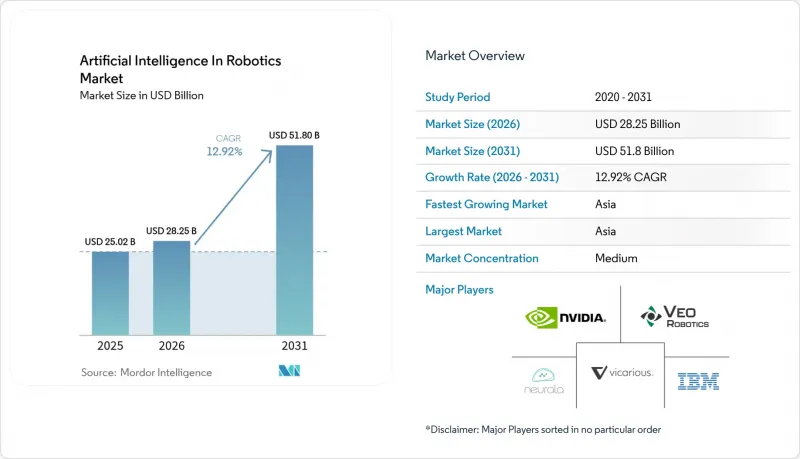
Mordor Intelligence에 의하면, 로봇공학 인공지능(AI) 시장 규모는 2025년에 250억 2,000만 달러로 평가되었고 2026년 282억 5,000만 달러에서 2031년에는 518억 달러에 이를 것으로 예측되며, 예측 기간(2026-2031년) CAGR은 12.92%를 나타낼 전망입니다.
본 보고서는 구성 요소(하드웨어 등), 로봇 유형(산업용 로봇, 서비스 로봇 등), 용도(제조·조립, 물류 및 창고, 의료·외과 수술 등), 최종 사용자 산업(자동차, 일렉트로믹스 및 반도체 등), 그리고 지역별로 분류되어 있습니다.
전 세계 로봇공학 인공지능(AI) 시장 동향 및 인사이트
엣지 AI 칩의 통합으로 로봇의 실시간 의사 결정 가능
엣지 AI 프로세서는 의사 결정 지연을 수 초에서 수 밀리초로 단축하여, 자율 이동 로봇(AMR)이 클라우드에 의존하지 않고 역동적인 생산 현장을 자율적으로 이동할 수 있게 합니다. 어드밴텍의 2025년 쇼케이스에서는 NVIDIA Jetson Thor 모듈을 AMR 플릿에 통합한 결과, 응답 시간이 75% 단축되었다는 점이 강조되었습니다. 심천과 수원의 전자 제조업체들은 비전 데이터와 모션 데이터를 로컬에서 처리함으로써, 초기 수율 향상 및 타크트 타임 단축과 같은 측정 가능한 성과를 보고하고 있습니다. 또한, 지연 시간 감소로 인해 예측 유지보수를 위한 피드백 루프가 단축되어 정밀 조립 라인에서 예정에 없던 가동 중단 시간이 줄어듭니다. 엣지에 최적화된 AI 모델이 성숙해짐에 따라 프로세서 비용이 낮아지고 있으며, 중견 공급업체들은 신규 장비를 구매하기보다는 기존 로봇을 개조하는 추세를 보이고 있습니다. 따라서 이러한 요인으로 인해 다양한 공장 환경에서의 도입이 확대되고 있으며, 이는 로봇공학 AI 시장에 긍정적인 기여를 하고 있습니다.
급속한 고령화가 돌봄 로봇 수요를 가속화
2025년에는 일본의 65세 이상 주민 비율이 29%를 넘어설 것으로 예상되어, 예측되는 37만 7,000명의 요양 인력 부족을 더욱 심화시키고 있습니다. 파나소닉, 소프트뱅크 및 일본 정부의 지원을 받는 여러 스타트업들은 심층 신경망을 활용해 낙상을 감지하고, 복약 일정을 알리며, 자연스러운 대화를 통해 교류를 하는 이동 지원 로봇 및 사회 교류 로봇을 선보이고 있습니다. 임상시험 결과, 로봇이 반복적인 환자 들어 올리기 작업이나 감시 업무를 맡음으로써 직원의 업무 효율이 향상되고, 간호사가 환자와의 직접적인 상호작용에 더 집중할 수 있게 되는 것으로 나타났습니다. 한국도 유사한 인구 구조적 과제에 직면해 있으며, ‘로봇 산업 비전 2030’ 계획을 통해 AI 돌봄 로봇에 대한 투자를 추진하고 있습니다. 이 계획에서는 병원 도입 및 재택 돌봄에서의 시범 운영에 대해 보조금이 지급되고 있습니다. 이 두 문화권에서의 조기 도입 성공은 인구 고령화가 진행 중인 유럽의 의료 제공업체들에게 벤치마크가 될 것이며, 로봇공학 AI의 미래 잠재 수요를 확대할 것입니다.
틈새 로봇 지각 과제를 위한 고품질 도메인 데이터의 부족
『Frontiers in Robotics and AI』 저널은 일관성이 부족하고 불완전한 데이터 세트가, 특히 로봇이 생소한 물체를 인식해야 하는 상황에서 인간과 협업 로봇 간의 협업 신뢰성을 저하시킨다고 지적하고 있습니다. 예를 들어, 농업용 수확기는 다양한 작물 품종에 걸쳐 숙성도를 판단하는 데 어려움을 겪고 있어, 시범 농장 이외의 장소에서의 상용화가 제한되고 있습니다. 데이터 부족은 안전성 검증도 방해하여, 공급업체는 지각 스택을 과도하게 설계할 수밖에 없게 되고, 이로 인해 시장 출시까지의 기간이 길어지고 있습니다. 독자적인 데이터셋은 대형 기존 기업들에게 경쟁 우위를 제공하며, 소규모 혁신 기업들이 성능 벤치마크를 따라잡는 것을 어렵게 만들고 있습니다. 합성 데이터 생성이나 전이 학습을 통해 이러한 장벽은 완화되고 있지만, 데이터 부족은 여전히 로봇공학 AI 시장 전반적 확장을 저해하는 요인으로 작용하고 있습니다.
부문 분석
2025년 시장 점유율의 61.20%를 하드웨어가 차지하고 있으며, 이는 로봇에 물리적 존재감을 부여하는 센서, 액추에이터, 구동 장치 및 구조 프레임을 반영한 것입니다. 힘 및 토크 센서가 내장된 자본 집약적인 산업용 암은 용접, 도장 및 정밀한 자재관리 분야에서 여전히 필수적입니다. 현재 각 벤더들은 제조업체가 전체 시스템을 개편하지 않고도 그리퍼, 카메라 또는 AI 엣지 모듈을 교체할 수 있는 모듈식 설계의 제품을 출시하고 있으며, 이를 통해 총 소유 비용(TCO)을 절감하고 장비의 수명을 연장하고 있습니다. 하드웨어 로드맵에서는 전력 효율이 뛰어난 서보 컨트롤러와 경량 복합 소재 조인트가 중시되고 있으며, 좁은 공장 통로를 이동하는 모바일 로봇에 필수적인 높은 적재량 대 중량 비율을 실현하고 있습니다. 머신러닝 및 딥러닝 소프트웨어는 연평균 성장률(CAGR) 23.10%로 확대되고 있으며, 사전 학습된 지각 및 동작 계획 라이브러리로 번들되는 사례가 증가하고 있습니다. 이러한 스택은 외부 프로그래밍 없이도 결함 감지, 예측 유지보수, 적응형 그리핑을 가능하게 함으로써 기존 기계에서 더 큰 가치를 이끌어냅니다. 조기 도입 기업들에 따르면, 소프트웨어 업그레이드만으로도 설비 종합 효율(OEE)을 두 자릿수 수준으로 향상시킬 수 있다는 보고가 있으며, 이는 소프트웨어의 기준 규모가 작음에도 불구하고 물리적 투자보다 빠른 속도로 성장하고 있는 이유를 보여줍니다. 고객이 라이프사이클 지원을 요구하는 가운데, 통합, 원격 모니터링, 지속적인 모델 재학습을 포괄하는 서비스는 공급업체에게 증가하는 지속적인 수익원이 되고 있습니다. 이러한 변화는 시장에서 경쟁사를 차별화하는 요소가 더 이상 기계적인 측면이 아니라 지능화에 있음을 여실히 보여주고 있습니다.
2025년, 산업용 로봇은 시장 규모의 67.30%를 차지했으며, 자동차 및 전자기기 생산 현장에 도입된 다관절 암이 이를 주도했습니다. 전 세계 공장에서의 도입 대수는 428만 대를 넘어섰으며, 연간 10% 증가율을 보여 수요가 정착되었음을 여실히 드러내고 있습니다. AI를 통한 업그레이드로 인해, 이러한 시스템은 재교육에 따른 가동 중단 시간 없이도 형태가 다른 부품에 대응할 수 있게 되어 자산 가동률이 향상되고 있습니다. 출하 대수 측면에서는 여전히 소수인 코봇이지만, 다품종 소량 생산 환경에서 유연한 자동화가 필수적이 됨에 따라 놀라운 성장을 이루고 있습니다. 의료 및 헬스케어용 로봇은 2026년부터 2031년까지 연평균 성장률(CAGR) 24.85%를 기록하며 가장 빠르게 성장하는 부문으로 자리매김하고 있습니다. 컴퓨터 비전과 힘 감각 피드백을 통합한 수술 지원 시스템은 최소 침습 수술에서 임상의사를 지원하며, 수술 후 합병증 감소와 입원 기간 단축에 기여하고 있습니다. 병원용 물류 로봇은 AI 의사결정 엔진과 융합된 동시 위치 추정 및 매핑(SLAM) 기술을 활용하여, 혼잡한 복도를 자율적으로 이동하며 린넨과 의약품을 운반합니다. 고령자의 일상생활을 지원하는 재택 간병 로봇의 보급이 보여주듯이, 소비자의 수용도 점차 확대되고 있습니다. 이러한 일련의 동향은 수익원의 다각화를 가져오고, 자동차 산업 중심 수요에 내재된 주기성을 완화함으로써 로봇공학 AI 시장에 긍정적인 영향을 미치고 있습니다.
지역별 분석
아시아태평양은 중국, 일본, 한국의 대규모 자동화 프로그램에 힘입어 2025년에는 전 세계 매출의 46.55%를 차지했습니다. 중국에서만 2023년에 27만 6,288대의 산업용 로봇이 도입되었으며, 이는 전 세계 출하 대수의 51%에 해당합니다. 이는 지방 자치 단체가 제조업의 경쟁력을 높이기 위해 세제 혜택과 저리 융자를 제공하고 있기 때문입니다. 한국의 전자 기업들은 픽 앤 플레이스 공정에 엣지 AI 비전을 도입하여, 마이크론 단위로 측정되는 웨이퍼 수준의 공차를 관리하고 있습니다. 한편, 일본의 자동차 제조업체들은 인간과 같은 손재주가 요구되는 최종 트림 작업에 AI 코봇을 도입하고 있습니다. 이 지역의 예상 연평균 성장률(CAGR) 17.45%는 제조업에서의 우위뿐만 아니라, 급속히 부상하고 있는 의료 및 서비스 로봇공학 시범 프로젝트도 반영하고 있습니다. 북미는 2위를 차지했으며, 그 중심인 미국에서는 AI 소프트웨어에 대한 전문 지식이 견조한 스타트업 설립과 벤처 자금 조달을 뒷받침하고 있습니다. 물류 대기업들은 2시간 이내 배송을 실현하기 위해 기존 컨베이어망에 AI가 탑재된 이동 로봇을 도입하고 있습니다. 자동차 제조업체들은 공장을 배터리식 전기차(BEV)에 맞추어 재구축하는 과정에서 AI를 활용해 새로 개발된 경량 소재의 용접 품질을 모니터링하는 등 AI 도입을 가속화하고 있습니다. 캐나다 광업 부문에서는 AI 기반 인식 기술을 활용해 GPS 신호가 약한 환경에서도 노천 채굴 현장을 주행할 수 있는 자율 주행 트럭의 실증 실험이 진행되고 있으며, 이는 로봇 시장 내 AI의 확산을 공장이라는 경계를 넘어 넓혀가고 있습니다. 멕시코의 산업 지역도 마찬가지로, USMCA(미국·멕시코·캐나다 협정)의 현지 조달률 관련 규정에 대응하고 경쟁력을 유지하기 위해 AI를 활용한 설비 개조를 추진하고 있습니다. 유럽에서는 윤리적이고 안전하며 신뢰성이 높은 AI를 중시하고 있으며, 기술 개발과 규제 체계 양쪽을 모두 구축하고 있습니다. 독일은 중견 기업(미텔슈탄트)의 자동화 프로젝트에 대한 정부 보조금의 지원을 받아 2023년에 2만 8,355대의 신규 도입을 기록하며 로봇 밀도 부문에서 선두를 달리고 있습니다. ‘호라이즌 유럽(Horizon Europe)’의 보조금은 애그리테크, 헬스케어, 친환경 제조 분야의 로봇공학 산학 클러스터를 촉진하고 있습니다. 그러나 CE 마킹 및 AI 책임에 대한 해석 차이로 인해, 특히 협업 로봇(코봇)의 국경 간 확산이 지연되고 있습니다. 중동유럽에서는 노동력 부족으로 인해 공장 투자가 진행되고 있어 성장 잠재력은 여전히 높습니다. 남미, 중동 및 아프리카의 비교적 소규모 시장은 아직 발전 단계에 있지만, 초기 투자 장벽을 낮추는 턴키 방식의 Robot-as-a-Service(RaaS) 계약의 혜택을 받고 있어, 로봇공학 AI 시장이 전 세계적으로 확산되는 데 기여하고 있습니다.
기타 혜택:
- 엑셀 형식 시장 예측(ME) 시트
- 3개월간의 애널리스트 지원
자주 묻는 질문
목차
제1장 서론
제2장 조사 방법
제3장 주요 요약
제4장 시장 구도
제5장 시장 규모와 성장 예측
제6장 경쟁 구도
제7장 시장 기회와 향후 전망
JHS 26.09.09According to Mordor Intelligence, the artificial intelligence in robotics market size was valued at USD 25.02 billion in 2025 and estimated to grow from USD 28.25 billion in 2026 to reach USD 51.8 billion by 2031, at a CAGR of 12.92% during the forecast period (2026-2031).
This report is Segmented by Component (Hardware and More), Robot Type (Industrial Robots, Service Robots and More), Application (Manufacturing and Assembly, Logistics and Warehousing, Healthcare and Surgery and More), End-User Industry (Automotive, Electronics, and Semiconductors, and More), and Geography.
Global Artificial Intelligence In Robotics Market Trends and Insights
Integration of Edge-AI Chips Enabling Real-Time Robot Decision-Making
Edge-AI processors cut decision-making latency from seconds to milliseconds, enabling autonomous mobile robots (AMR) to navigate dynamic production floors without cloud dependence. Advantech's 2025 showcase highlighted 75% faster response times after integrating NVIDIA Jetson Thor modules into AMR fleets. Electronics manufacturers in Shenzhen and Suwon report measurable gains in first-pass yield and takt-time reduction when vision and motion data are processed locally. Lower latency also tightens feedback loops for predictive maintenance, decreasing unscheduled downtime in precision assembly lines. As edge-optimized AI models mature, processor costs are falling, encouraging mid-tier suppliers to retrofit existing robots instead of purchasing new units. The driver, therefore, widens adoption across diverse factory footprints and contributes positively to the AI in robotics market .
Rapid Aging Population Accelerating Demand for Elder-Care Robots
Japan's share of residents aged 65 plus exceeded 29% in 2025, amplifying a projected shortfall of 377,000 caregivers.Panasonic, SoftBank, and startups backed by the Japanese government are rolling out mobility and social-companion robots that use deep neural networks to detect falls, remind medication schedules, and interact through natural speech. Clinical pilots show robots increase staff efficiency by reallocating repetitive lifting or monitoring tasks, letting nurses focus on direct patient engagement. South Korea faces similar demographic headwinds and is investing in AI robotic caregivers through its "Robot Industry Vision 2030" plan, which subsidizes hospital deployments and homecare trials. Success in these two cultural early adopters sets benchmarks for healthcare providers in Europe as their populations age, broadening future addressable demand for AI in the robotics market.
Scarcity of High-Quality Domain Data for Niche Robot-Perception Tasks
Frontiers in Robotics and AI highlights that inconsistent, incomplete datasets reduce the reliability of human-robot collaboration, especially where robots must recognize uncommon objects. For example, agricultural harvesters struggle to gauge ripeness across diverse crop varieties, limiting commercial deployment beyond pilot farms. Data gaps also impede safety validation, forcing vendors to over-engineer perception stacks and prolong time-to-market. Proprietary datasets give large incumbents a moat, making it harder for smaller innovators to match performance benchmarks. While synthetic data generation and transfer learning mitigate the barrier, the shortage remains a drag on the overall expansion of AI in the robotics market.
Other drivers and restraints analyzed in the detailed report include:
- EU Horizon Europe Funding Streamlining Collaborative AI-Robot Research
- E-Commerce Fulfilment Boom Driving AI-Enabled Warehouse Automation
- Fragmented Safety Standards Hindering Cross-Border Cobot Deployment
For complete list of drivers and restraints, kindly check the Table Of Contents.
Segment Analysis
Hardware accounted for 61.20% of the AI in robotics market share in 2025, reflecting the sensors, actuators, drives, and structural frames that give robots their physical presence. Capital-intensive industrial arms with integrated force-torque sensors remain indispensable for welding, painting, and precision material handling. Vendors are now shipping modular designs that let manufacturers swap grippers, cameras, or AI edge modules without full system overhauls, lowering total cost of ownership and prolonging equipment life cycles. Hardware roadmaps emphasize power-efficient servo controllers and lightweight composite joints, enabling higher payload-to-weight ratios crucial for mobile robots in tight factory aisles. Machine Learning & Deep Learning software is expanding at a 23.10% CAGR and is increasingly bundled as pre-trained perception and motion-planning libraries. These stacks extract more value from existing machines by enabling defect detection, predictive maintenance, and adaptive grasping without external programming. Early adopters report that software upgrades alone can raise overall equipment effectiveness by double digits, illustrating why software is outpacing physical spend despite its smaller baseline. Services covering integration, remote monitoring, and continuous model retraining form a rising annuity stream for vendors as customers seek lifecycle support. The shift underlines how intelligence rather than mechanics now differentiates competitors in the AI in robotics market.
Industrial robots commanded 67.30% of the AI in robotics market size in 2025, led by articulated arms deployed in automotive and electronics production. Their installed base surpassed 4.28 million units in factories worldwide, a 10% annual gain that highlights entrenched demand. AI upgrades are letting these systems handle variable part geometries without downtime for re-teaching, boosting asset utilization. Cobots, still a minority of shipments, enjoy outsized growth as flexible automation becomes essential for high-mix, low-volume environments. Medical & healthcare robots represent the fastest-growing class at a 24.85% CAGR for 2026-2031. Surgical systems incorporating computer vision and force feedback assist clinicians in minimally invasive procedures, trimming post-operative complications and length of stay. Hospital logistics robots autonomously ferry linens and medications through crowded corridors using simultaneous localization and mapping (SLAM) fused with AI decision engines. Consumer acceptance is widening, evidenced by homecare robots that support daily living tasks for seniors. Altogether, these trends diversify revenue pools and mitigate cyclicality inherent in automotive-centric demand, benefiting the AI in robotics market.
Complete Report Scope:
- By Component
- Hardware
- Sensors
- Actuators
- Power Systems
- Control Systems
- Software
- Machine Learning and Deep Learning
- Computer Vision
- Natural Language Processing
- Context Awareness / Decision-Making
- Services
- Integration and Deployment
- Support and Maintenance
- Hardware
- By Robot Type
- Industrial Robots
- Articulated Robots
- SCARA Robots
- Cartesian Robots
- Collaborative Robots (Cobots)
- Service Robots
- Professional Service Robots
- Logistics Robots
- Medical and Healthcare Robots
- Defense and Security Robots
- Field Robots (Agriculture and Mining)
- Personal and Domestic Robots
- Household Robots
- Entertainment and Companion Robots
- Professional Service Robots
- Industrial Robots
- By Application
- Manufacturing and Assembly
- Logistics and Warehousing
- Healthcare and Surgery
- Retail and E-Commerce Operations
- Food and Beverage Processing
- Inspection and Maintenance
- Other Applications
- By End-user Industry
- Automotive
- Electronics and Semiconductors
- Retail and E-Commerce
- Healthcare
- Food and Beverage
- Aerospace and Defense
- Others
- By Geography
- North America
- United States
- Canada
- Mexico
- South America
- Brazil
- Argentina
- Rest of South America
- Europe
- Germany
- United Kingdom
- France
- Italy
- Spain
- Nordics
- Rest of Europe
- Middle East
- United Arab Emirates
- Saudi Arabia
- Turkey
- Rest of Middle East
- Africa
- South Africa
- Nigeria
- Egypt
- Rest of Africa
- Asia Pacific
- China
- Japan
- South Korea
- India
- ASEAN
- Rest of Asia Pacific
- North America
Geography Analysis
Asia Pacific generated 46.55% of global revenue in 2025 driven by extensive automation programs in China, Japan, and South Korea. China alone installed 276,288 industrial robots in 2023, equal to 51% of world shipments, as local authorities provide tax incentives and low-interest loans to upgrade manufacturing competitiveness ifr.org. Korean electronics firms add edge-AI vision to pick-and-place cells to manage wafer-level tolerances measured in microns, while Japanese automakers deploy AI cobots for final trim operations that require human-like dexterity. The region's projected 17.45% CAGR reflects not only manufacturing dominance but also fast-emerging healthcare and service robotics pilots. North America ranks second, anchored by the United States where AI software expertise seeds robust startup formation and venture funding. Logistics giants retrofit existing conveyor grids with AI mobile robots to meet two-hour delivery windows. Automakers accelerate adoption as factories retool for battery electric vehicles, using AI to monitor weld quality on new lightweight materials. Canada's mining sector pilots autonomous haulage trucks that leverage AI perception stacks to navigate open-pit sites in low-GPS conditions, extending AI in robotics market penetration beyond factory walls. Mexico's industrial corridors likewise embrace AI retrofits to stay competitive following USMCA content rules. Europe emphasizes ethical, safe, and trustworthy AI, shaping both technology development and regulatory frameworks. Germany leads robot density with 28,355 new installations in 2023, aided by government subsidies for Mittelstand automation projects. Horizon Europe grants encourage academic-industry clusters in robotics for agri-tech, healthcare, and green manufacturing. Nonetheless, diverging interpretations of CE marking and AI liability delay cross-border deployments, particularly for cobots. Growth potential in Central and Eastern Europe remains high as labor shortages push factories to invest. Smaller markets in South America, the Middle East, and Africa are nascent but benefit from turnkey Robot-as-a-Service contracts that lower upfront capital barriers, nudging global uptake of the AI in robotics market.
- NVIDIA Corporation
- IBM Corporation
- Microsoft Corporation
- ABB Ltd.
- FANUC Corporation
- KUKA AG
- Yaskawa Electric Corp.
- Universal Robots A/S
- Hanson Robotics Ltd.
- Boston Dynamics, Inc.
- Brain Corporation
- Vicarious AI
- Neurala, Inc.
- Kindred AI
- Preferred Networks, Inc.
- Veo Robotics, Inc.
- Fetch Robotics, Inc.
- Blue River Technology (John Deere)
- UiPath Inc.
- SoftBank Robotics Group Corp.
Additional Benefits:
- The market estimate (ME) sheet in Excel format
- 3 months of analyst support
TABLE OF CONTENTS
1 INTRODUCTION
- 1.1 Study Assumptions and Market Definition
- 1.2 Scope of the Study
2 RESEARCH METHODOLOGY
3 EXECUTIVE SUMMARY
4 MARKET LANDSCAPE
- 4.1 Market Overview
- 4.1.1 Market Drivers
- 4.1.1.1 Integration of Edge-AI Chips Enabling Real-Time Robot Decision-Making in Asia's Electronics Manufacturing
- 4.1.1.2 Rapid Aging Population Accelerating Demand for Elder-Care Robots in Japan and South Korea
- 4.1.1.3 EU Horizon Europe Funding Streamlining Collaborative AI-Robot Research Consortia
- 4.1.1.4 E-Commerce Fulfilment Boom Driving AI-Enabled Warehouse Automation in North America
- 4.1.1.5 Surge in Autonomous Mobile Robots within German Automotive Final Assembly Lines
- 4.1.1.6 Falling Vision-Sensor Costs Allowing SMB AI-Retrofit Kits for Legacy Robots Globally
- 4.1.2 Market Restraints
- 4.1.2.1 Scarcity of High-Quality Domain Data for Niche Robot-Perception Tasks
- 4.1.2.2 Fragmented Safety Standards Hindering Cross-Border Cobot Deployment
- 4.1.2.3 High Up-Front Cost of AI Processor Modules for Low-Margin Food Processors
- 4.1.2.4 Cyber-Physical Security Concerns Limiting Cloud-Connected Service Robots in Hospitals
- 4.1.1 Market Drivers
- 4.2 Value / Supply-Chain Analysis
- 4.3 Regulatory and Standards Outlook
- 4.4 Technological Outlook
- 4.5 Porter's Five Forces
- 4.5.1 Bargaining Power of Suppliers
- 4.5.2 Bargaining Power of Buyers/Consumers
- 4.5.3 Threat of New Entrants
- 4.5.4 Threat of Substitutes
- 4.5.5 Intensity of Competitive Rivalry
- 4.6 Investment Analysis
5 MARKET SIZE AND GROWTH FORECASTS (VALUE)
- 5.1 By Component
- 5.1.1 Hardware
- 5.1.1.1 Sensors
- 5.1.1.2 Actuators
- 5.1.1.3 Power Systems
- 5.1.1.4 Control Systems
- 5.1.2 Software
- 5.1.2.1 Machine Learning and Deep Learning
- 5.1.2.2 Computer Vision
- 5.1.2.3 Natural Language Processing
- 5.1.2.4 Context Awareness / Decision-Making
- 5.1.3 Services
- 5.1.3.1 Integration and Deployment
- 5.1.3.2 Support and Maintenance
- 5.1.1 Hardware
- 5.2 By Robot Type
- 5.2.1 Industrial Robots
- 5.2.1.1 Articulated Robots
- 5.2.1.2 SCARA Robots
- 5.2.1.3 Cartesian Robots
- 5.2.1.4 Collaborative Robots (Cobots)
- 5.2.2 Service Robots
- 5.2.2.1 Professional Service Robots
- 5.2.2.1.1 Logistics Robots
- 5.2.2.1.2 Medical and Healthcare Robots
- 5.2.2.1.3 Defense and Security Robots
- 5.2.2.1.4 Field Robots (Agriculture and Mining)
- 5.2.2.2 Personal and Domestic Robots
- 5.2.2.2.1 Household Robots
- 5.2.2.2.2 Entertainment and Companion Robots
- 5.2.2.1 Professional Service Robots
- 5.2.1 Industrial Robots
- 5.3 By Application
- 5.3.1 Manufacturing and Assembly
- 5.3.2 Logistics and Warehousing
- 5.3.3 Healthcare and Surgery
- 5.3.4 Retail and E-Commerce Operations
- 5.3.5 Food and Beverage Processing
- 5.3.6 Inspection and Maintenance
- 5.3.7 Other Applications
- 5.4 By End-user Industry
- 5.4.1 Automotive
- 5.4.2 Electronics and Semiconductors
- 5.4.3 Retail and E-Commerce
- 5.4.4 Healthcare
- 5.4.5 Food and Beverage
- 5.4.6 Aerospace and Defense
- 5.4.7 Others
- 5.5 By Geography
- 5.5.1 North America
- 5.5.1.1 United States
- 5.5.1.2 Canada
- 5.5.1.3 Mexico
- 5.5.2 South America
- 5.5.2.1 Brazil
- 5.5.2.2 Argentina
- 5.5.2.3 Rest of South America
- 5.5.3 Europe
- 5.5.3.1 Germany
- 5.5.3.2 United Kingdom
- 5.5.3.3 France
- 5.5.3.4 Italy
- 5.5.3.5 Spain
- 5.5.3.6 Nordics
- 5.5.3.7 Rest of Europe
- 5.5.4 Middle East
- 5.5.4.1 United Arab Emirates
- 5.5.4.2 Saudi Arabia
- 5.5.4.3 Turkey
- 5.5.4.4 Rest of Middle East
- 5.5.5 Africa
- 5.5.5.1 South Africa
- 5.5.5.2 Nigeria
- 5.5.5.3 Egypt
- 5.5.5.4 Rest of Africa
- 5.5.6 Asia Pacific
- 5.5.6.1 China
- 5.5.6.2 Japan
- 5.5.6.3 South Korea
- 5.5.6.4 India
- 5.5.6.5 ASEAN
- 5.5.6.6 Rest of Asia Pacific
- 5.5.1 North America
6 COMPETITIVE LANDSCAPE
- 6.1 Market Concentration
- 6.2 Strategic Moves
- 6.3 Market Share Analysis
- 6.4 Company Profiles {(includes Global-level Overview, Market-level Overview, Core Segments, Financials, Strategic Info, Market Rank/Share, Products and Services, Recent Developments)}
- 6.4.1 NVIDIA Corporation
- 6.4.2 IBM Corporation
- 6.4.3 Microsoft Corporation
- 6.4.4 ABB Ltd.
- 6.4.5 FANUC Corporation
- 6.4.6 KUKA AG
- 6.4.7 Yaskawa Electric Corp.
- 6.4.8 Universal Robots A/S
- 6.4.9 Hanson Robotics Ltd.
- 6.4.10 Boston Dynamics, Inc.
- 6.4.11 Brain Corporation
- 6.4.12 Vicarious AI
- 6.4.13 Neurala, Inc.
- 6.4.14 Kindred AI
- 6.4.15 Preferred Networks, Inc.
- 6.4.16 Veo Robotics, Inc.
- 6.4.17 Fetch Robotics, Inc.
- 6.4.18 Blue River Technology (John Deere)
- 6.4.19 UiPath Inc.
- 6.4.20 SoftBank Robotics Group Corp.
7 MARKET OPPORTUNITIES AND FUTURE OUTLOOK
- 7.1 White-Space and Unmet-Need Assessment