

|
시장보고서
상품코드
2123344
간질 치료제 시장 : 점유율 분석, 업계 동향과 통계, 성장 예측(2026-2031년)Epilepsy Drugs - Market Share Analysis, Industry Trends & Statistics, Growth Forecasts (2026 - 2031) |
||||||
 Mordor Intelligence
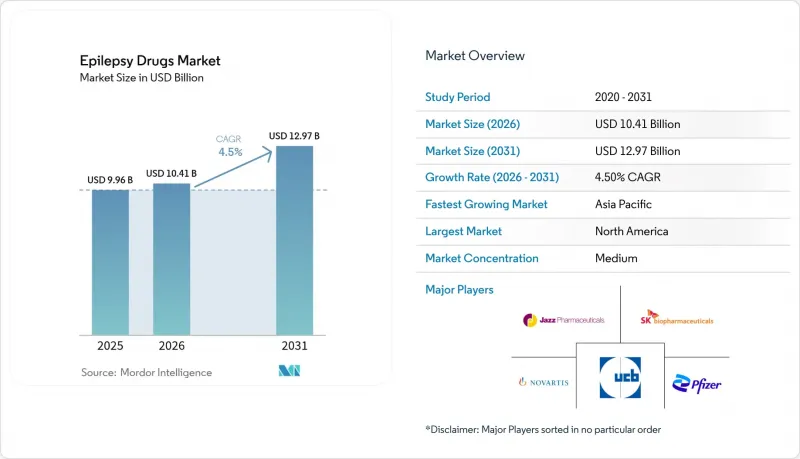
Mordor Intelligence에 의하면, 간질 치료제 시장 규모는 2025년 99억 6,000만 달러에서 2026년에는 104억 1,000만 달러로 확대되어 2026년부터 2031년까지 CAGR 4.5%로 성장을 지속하여, 2031년에는 129억 7,000만 달러에 이를 것으로 예측됩니다.
본 보고서는 약물의 세대(1세대 간질 치료제 등), 발작의 유형(국소 발작 등), 환자층(성인 및 소아),투여 경로(경구 투여 등), 유통 채널(병원 약국 등), 지역(북미, 유럽, 아시아태평양, 중동 및 아프리카, 남미)별로 분류되어 있습니다. 시장 예측은 금액(미 달러) 기준으로 제시되어 있습니다.
전 세계 간질 치료제 시장 동향 및 인사이트
안전성 프로파일이 개선된 3세대 간질 치료제의 승인이 급증
세계 규제 당국은 기존 약물에 비해 발작 감소율이 높고 부작용이 적은 세노바메이트, 브리바라세탐, 칸나비디올, 디아제팜 비강 스프레이 등 차세대 약물을 잇달아 승인하고 있습니다. SK 바이오파마슈티컬스는 2025년 1분기 ‘Xcopri’의 매출이 전년 동기 대비 46.6% 증가한 1억 240만 달러에 달했다고 보고했습니다. 2025년 미국신경학회(AAN) 연례 총회에서 발표된 실세계 데이터에 따르면, 세노바메이트로 치료받은 부분 발작을 가진 성인 환자에서 발작 횟수의 중앙값이 84% 감소한 것으로 나타났습니다. 한편, 이스라엘에서 진행된 관찰 연구에서는 동일한 분자를 사용한 약물 내성 환자 중 27.5%가 발작 없는 상태에 도달한 것으로 보고되었습니다. 2025년 4월, FDA가 디아제팜 비강 스프레이의 적응증을 2-5세 소아로 확대하기로 결정함에 따라 응급 치료의 선택지가 넓어졌습니다. 이러한 진전들이 맞물리면서 장기적인 치료 성과 향상에 대한 기대가 높아지고 있으며, 임상의들은 치료 저항성 사례에 대해 보다 새로운 치료법으로의 전환을 촉진하고 있습니다.
정밀 유전자 분석과 AI를 활용한 뇌파 진단을 통해 약물 선택과 치료 성공률이 향상되고 있습니다.
현재 인공지능 알고리즘은 수백만 건의 임상 기록을 분석하여, 전형적인 진단보다 수년 앞서 단일 유전자성 간질을 식별함으로써 더 조기적이고 적절한 치료를 가능하게 하고 있습니다. 필라델피아 소아 병원은 3만 2,000명의 환자에서 얻은 8,900만 건의 주석 데이터를 선별하여, 유전성 간질을 3.6년 더 빨리 검출하는 모델의 유효성을 검증했습니다. 전체 엑솜 시퀀싱을 통한 진단 정확도는 14%이며, 그 결과의 59%는 정밀 치료와 일치하지만, 보험 적용 및 접근성 문제로 인해 실제 임상에서의 도입률은 여전히 32%에 그치고 있습니다. 보험 적용 범위 확대와 AI에 대한 규제 당국의 승인이 진행됨에 따라, 임상의들은 유전자형 분석 결과와 3세대 항경련제를 결합하여 항경련제 시장 전반에 걸쳐 맞춤형 치료 경로를 강화해 나갈 것으로 기대됩니다.
특허 만료로 인해 기존 블록버스터 항경련제 브랜드의 이익률이 하락
UCB사의 ‘Vimpat’을 비롯한 오랫동안 시장을 주도해 온 몇몇 제품은 독점적 보호가 만료됨에 따라 대폭적인 가격 하락에 직면하고 있습니다. 연방거래위원회(FTC)는 제네릭 의약품 시장 진입을 저지하거나 지연시키는 업계의 전술을 면밀히 조사했으며, 비용 절감의 혜택이 환자에게 확실히 전달되도록 요구하고 있습니다. 특허 만료 후 1년 이내에 이익률이 70% 이상 하락할 가능성이 있지만, 한편으로는 처방 의사들이 특허 기간 중 혁신적인 약물을 시도하도록 권장받음에 따라, 풍부한 후기 개발 파이프라인을 유지하고 있는 기업으로 처방량이 이동하게 될 것입니다.
부문 분석
3세대 화합물군은 뛰어난 안전성과 이중 작용기전 덕분에 2025년 간질 치료제 시장에서 39.96%의 점유율을 차지하며 시장을 휩쓸었습니다. 세노바마트의 3상 임상시험 데이터에 따르면, 다양한 용량에서 12개월간 발작 없는 비율이 25.8%를 기록했습니다. 이러한 진전을 배경으로, 해당 부문은 2031년까지 선두를 더욱 확대할 것으로 예상되는 반면, 2세대 약물은 실제 임상에서의 풍부한 실적과 양호한 부작용 프로파일에 힘입어 연평균 성장률(CAGR) 6.08%로 성장할 것으로 전망됩니다.
앞으로 3세대 약물과 정밀 진단의 시너지 효과로 인해 난치성 환자의 치료법 전환이 가속화되어, 혁신적인 제약 기업의 수익원이 확고해질 것입니다. 하지만 자원이 제한된 환경에서는 약물 동태가 충분히 파악되어 있고 비용이 저렴하다는 점 때문에 1세대 대표 약물이 여전히 핵심적인 역할을 수행하고 있어, 간질 치료제 시장 내에서는 다층적인 구조가 유지될 전망입니다.
2025년에는 국소성 발작이 간질 치료제 시장 규모의 60.88%를 차지했는데, 이는 전 세계적으로 부분 발작의 유병률이 높다는 점을 반영한 것입니다. 1차 선택 약제로는 라모트리진이나 레베티라세탐이 꼽히지만, 비용을 중시하는 지역에서는 카르바마제핀이 여전히 널리 사용되고 있습니다.
‘미분류/복합성 발작’ 부문은 예측 기간 동안 5.76%의 성장률을 보일 것으로 전망됩니다. 유전체 연구를 통해 부분 발작성 간질과 전신 발작성 간질의 유전자 구조에 명확한 차이가 밝혀졌으며, 이는 파이프라인 개발자들에게 새로운 표적이 되고 있습니다. 정밀 선별 검사가 일상화됨에 따라, 임상의들은 부분 발작의 하위 그룹 내에서도 치료를 미세 조정할 수 있게 될 것으로 기대되며, 이를 통해 간질 치료제 시장 전체에서 판매량의 점진적 증가와 복약 순응도 향상이 이루어질 것입니다.
지역별 분석
북미는 종합적인 보험 적용, 전문의 밀집도, 그리고 3세대 제품의 급속한 보급에 힘입어 2025년 간질 치료제 시장에서 39.76%의 점유율을 차지했습니다. 2025년 1분기 Xcopri의 매출이 46.6% 급증한 것은 이 지역에서 차별화된 치료법에 대한 수요가 높음을 뒷받침합니다. 규제 유연성으로 인해 복약 순응도를 향상시키는 원격 의료를 통한 처방전 갱신 프로그램이 지원되고 있지만, 한편으로는 의료비 억제 정책으로 인해 가격에 하방 압력이 발생하고 있어 2031년까지의 연평균 성장률(CAGR)은 3.82%에 그치고 있습니다.
아시아태평양은 각국 정부가 공중보건 예산을 확대하고 진단 인프라를 확충함에 따라 5.74%라는 가장 높은 연평균 성장률(CAGR)을 보이고 있습니다. 눈에 띄는 진전이 있는 반면, 중국에서는 여전히 치료 격차가 해소되지 않아 브랜드 의약품 및 품질이 보장된 제네릭 의약품에 잠재적인 기회가 있음을 시사합니다. 일본의 칸나비디올 제제에 대한 후기 임상시험과 인도의 현지 생산 추진은 해당 지역의 제품 라인업을 다각화하여 항경련제 시장의 성장을 가속화하고 있습니다.
유럽에서는 혁신과 엄격한 비용 관리의 균형을 도모하며 4.18%라는 꾸준한 연평균 성장률(CAGR)을 유지하고 있습니다. SK 바이오파마슈티컬스는 안젤리니사를 통해 유럽 23개국에서 세노바메이트 판매를 전개하며, 난치성 증례에 대한 보급률 향상을 목표로 하고 있습니다. 남미 및 중동 및 아프리카는 규모는 작지만, 원격의료 시범 사업과 자원이 제한된 환경에 맞춘 실용적인 진단 지침 도입을 통해 시장이 확대되고 있습니다. 이러한 노력들이 어우러져 인지도가 높아지고 편견이 완화되면서, 신흥 경제국 전반에 걸쳐 간질 치료제 시장의 기반이 확대되고 있습니다.
기타 혜택:
- 엑셀 형식 시장 예측(ME) 시트
- 3개월간의 애널리스트 지원
자주 묻는 질문
목차
제1장 서론
제2장 조사 방법
제3장 주요 요약
제4장 시장 구도
제5장 시장 규모와 성장 예측
제6장 경쟁 구도
제7장 시장 기회와 향후 전망
JHS 26.09.07According to Mordor Intelligence, the epilepsy drugs market size is expected to grow from USD 9.96 billion in 2025 to USD 10.41 billion in 2026 and is forecast to reach USD 12.97 billion by 2031 at 4.5% CAGR over 2026-2031.
This report is Segmented by Drug Generation (First Generation Anti-Epileptics and More), Seizure Type (Focal Seizures and More), Patient Type (Adult and Pediatric), Route of Administration (Oral and More), Distribution Channel (Hospital Pharmacy and More), and Geography (North America, Europe, Asia-Pacific, Middle East and Africa, and South America). The Market Forecasts are Provided in Terms of Value (USD).
Global Epilepsy Drugs Market Trends and Insights
Surge in Approvals of Third-Generation Antiseizure Medications with Improved Safety Profiles
Global regulators are clearing a steady stream of next-wave agents such as cenobamate, brivaracetam, cannabidiol and diazepam nasal formulations that demonstrate higher seizure-reduction rates and fewer adverse reactions than legacy drugs. SK Biopharmaceuticals reported a 46.6% year-on-year jump in Xcopri sales to USD 102.4 million during Q1 2025. Real-world data presented at the 2025 American Academy of Neurology meeting showed an 84% median seizure cut in focal-seizure adults treated with cenobamate, while an Israeli observational study cited 27.5% seizure freedom among pharmaco-resistant patients using the same molecule. The FDA's April 2025 decision to extend diazepam nasal spray to children aged 2-5 broadens rescue options. Collectively these advances raise expectations for better long-term outcomes and spur clinicians to transition treatment-resistant cases onto newer regimens.
Precision Genetics and AI-Enhanced EEG Diagnostics Are Improving Drug Selection and Treatment Success Rates
Artificial-intelligence algorithms now parse millions of clinical records to flag monogenic epilepsies years before typical diagnosis, enabling earlier and more appropriate therapy. Children's Hospital of Philadelphia validated a model that detects genetic epilepsies 3.6 years sooner by screening 89 million annotations from 32,000 patients. Whole-exome sequencing yields a 14% diagnostic hit rate, and 59% of those findings align with precision therapies, though real-world uptake still lags at 32% for reimbursement and access reasons. As payer coverage widens and AI achieves regulatory endorsement, clinicians are expected to pair genotype insights with third-generation drugs, reinforcing personalized care pathways across the anti-epileptic drugs market.
Patent Expirations Erode Margins of Legacy Blockbuster AED Brands
UCB's Vimpat and several other long-standing leaders face steep price drops as exclusive protections lapse. The Federal Trade Commission is scrutinizing industry tactics to block or delay generic entry and insists that savings reach patients. While erosion can exceed 70% within the first year post-expiry, it also pushes prescribers to experiment with innovative agents still under patent, shifting volume toward companies that maintain rich late-stage pipelines.
Other drivers and restraints analyzed in the detailed report include:
- Rapid Adoption of Tele-Neurology Platforms, Raising Prescription Refill Frequency and Long-Term Adherence
- Orphan-Drug Incentives Expediting Therapies for Rare Epileptic Encephalopathies
- Recurring API Shortages for Carbamazepine and Levetiracetam Disrupt Supply Continuity
For complete list of drivers and restraints, kindly check the Table Of Contents.
Segment Analysis
Third-generation compounds dominated with 39.96% share of the anti-epileptic drugs market in 2025 thanks to superior safety and dual-mechanism action. Cenobamate's phase 3 data showed 25.8% seizure freedom over 12 months across varied doses. This progress underpins a forecast in which the segment broadens its lead through 2031, while second-generation agents grow at 6.08% CAGR on the back of extensive real-world familiarity and favorable side-effect profiles.
Moving forward, synergy between third-generation drugs and precision diagnostics will likely speed therapy switches for refractory patients, anchoring revenue streams for innovators. Even so, first-generation staples remain cornerstones in resource-limited settings because of well-known pharmacokinetics and low cost, preserving a multi-tier landscape within the anti-epileptic drugs market.
Focal seizures accounted for 60.88% of anti-epileptic drugs market size in 2025, a position that mirrors the higher prevalence of partial-onset conditions globally. First-line choices include lamotrigine and levetiracetam, while carbamazepine retains broad acceptance in cost-sensitive regions.
Unclassified/Combined Seizures segment is anticipated to record a 5.76% growth rate during the forecast period. Genomic research reveals distinct architectures for focal versus generalized epilepsies, giving pipeline developers fresh targets. As precision screening becomes routine, clinicians expect to fine-tune therapy even within the focal subgroup, yielding incremental volume growth and higher adherence across the anti-epileptic drugs market.
Complete Report Scope:
- By Drug Generation
- First Generation Anti-Epileptics
- Second Generation Anti-Epileptics
- Third Generation Anti-Epileptics
- By Seizure Type
- Focal (Partial) Seizures
- Generalized Seizures
- Unclassified / Combined Seizures
- By Patient Type
- Adult
- Pediatric
- By Route of Administration
- Oral
- Intravenous
- Nasal / Buccal
- Subcutaneous
- By Distribution Channel
- Hospital Pharmacy
- Retail Pharmacy
- Others
- By Geography (Value)
- North America
- United States
- Canada
- Mexico
- Europe
- Germany
- United Kingdom
- France
- Italy
- Spain
- Rest of Europe
- Asia-Pacific
- China
- India
- Japan
- Australia
- South Korea
- Rest of Asia-Pacific
- Middle East & Africa
- GCC
- South Africa
- Rest of Middle East & Africa
- South America
- Brazil
- Argentina
- Rest of South America
- North America
Geography Analysis
North America held a 39.76% share of the anti-epileptic drugs market in 2025 due to comprehensive insurance coverage, specialist density, and rapid uptake of third-generation products. Xcopri's 46.6% sales surge in Q1 2025 underscores the region's appetite for differentiated therapies. Regulatory flexibility supports tele-health prescription renewal programs that improve adherence, yet cost-containment policies create downward price pressure and keep CAGR at 3.82% through 2031.
Asia-Pacific exhibits the fastest 5.74% CAGR as governments scale public health budgets and widen diagnostic infrastructure. Despite sizable progress, China's treatment gap persists, underscoring latent opportunity for branded and quality-assured generics. Japan's late-stage trials for cannabidiol formulations and India's push toward local manufacturing diversify the regional offer set and accelerate growth within the anti-epileptic drugs market.
Europe balances innovation against stringent cost controls, producing a steady 4.18% CAGR. SK Biopharmaceuticals markets cenobamate in 23 European countries via Angelini, seeking higher penetration of refractory cases. South America and the Middle East & Africa, while smaller, advance on telemedicine pilots and pragmatic diagnostic guidelines tailored to resource-limited settings. These efforts collectively raise awareness, reduce stigma, and expand the anti-epileptic drugs market footprint across emerging economies.
- Bausch Health
- Cipla
- Dr. Reddy's Laboratories
- Eisai
- GlaxoSmithKline
- H. Lundbeck
- Jazz Pharmaceuticals
- Johnson & Johnson
- Marinus Pharmaceuticals Inc.
- Novartis
- Ovid Therapeutics Inc.
- Pfizer
- Sanofi
- SK Biopharmaceuticals Co. Ltd.
- Sun Pharmaceuticals Industries
- Sunovion Pharmaceuticals
- Supernus Pharmaceuticals
- Teva Pharmaceutical Industries
- UCB
- Zydus Lifesciences
Additional Benefits:
- The market estimate (ME) sheet in Excel format
- 3 months of analyst support
TABLE OF CONTENTS
1 Introduction
- 1.1 Study Assumptions & Market Definition
- 1.2 Scope of the Study
2 Research Methodology
3 Executive Summary
4 Market Landscape
- 4.1 Market Overview
- 4.2 Market Drivers
- 4.2.1 Surge in approvals of third-generation antiseizure medications with improved safety profiles
- 4.2.2 Precision genetics and AI-enhanced EEG diagnostics are improving drug selection and treatment success rates
- 4.2.3 Rapid adoption of tele-neurology platforms, raising prescription refill frequency and long-term adherence
- 4.2.4 Orphan-drug incentives expediting therapies for rare epileptic encephalopathies
- 4.2.5 Growing pool of patients with drug-resistant epilepsy, driving demand for combination and add-on therapies
- 4.2.6 Rising investments in cannabinoid- and neurosteroid-based pipelines
- 4.3 Market Restraints
- 4.3.1 Patent expirations erode margins of legacy blockbuster AED brands
- 4.3.2 Recurring API shortages for core molecules such as carbamazepine and levetiracetam disrupting supply continuity
- 4.3.3 Stringent payer controls and step-therapy mandates limit uptake of premium-priced novel ASMs
- 4.3.4 Complex titration and safety monitoring restrict adoption of cannabidiol and specialty formulations
- 4.4 Supply Chain Analysis
- 4.5 Pipeline Analysis
- 4.6 Porter's Five Forces Analysis
- 4.6.1 Bargaining Power of Suppliers
- 4.6.2 Bargaining Power of Buyers / Consumers
- 4.6.3 Threat of New Entrants
- 4.6.4 Threat of Substitute Products
- 4.6.5 Intensity of Competitive Rivalry
5 Market Size & Growth Forecasts (Value)
- 5.1 By Drug Generation
- 5.1.1 First Generation Anti-Epileptics
- 5.1.2 Second Generation Anti-Epileptics
- 5.1.3 Third Generation Anti-Epileptics
- 5.2 By Seizure Type
- 5.2.1 Focal (Partial) Seizures
- 5.2.2 Generalized Seizures
- 5.2.3 Unclassified / Combined Seizures
- 5.3 By Patient Type
- 5.3.1 Adult
- 5.3.2 Pediatric
- 5.4 By Route of Administration
- 5.4.1 Oral
- 5.4.2 Intravenous
- 5.4.3 Nasal / Buccal
- 5.4.4 Subcutaneous
- 5.5 By Distribution Channel
- 5.5.1 Hospital Pharmacy
- 5.5.2 Retail Pharmacy
- 5.5.3 Others
- 5.6 By Geography (Value)
- 5.6.1 North America
- 5.6.1.1 United States
- 5.6.1.2 Canada
- 5.6.1.3 Mexico
- 5.6.2 Europe
- 5.6.2.1 Germany
- 5.6.2.2 United Kingdom
- 5.6.2.3 France
- 5.6.2.4 Italy
- 5.6.2.5 Spain
- 5.6.2.6 Rest of Europe
- 5.6.3 Asia-Pacific
- 5.6.3.1 China
- 5.6.3.2 India
- 5.6.3.3 Japan
- 5.6.3.4 Australia
- 5.6.3.5 South Korea
- 5.6.3.6 Rest of Asia-Pacific
- 5.6.4 Middle East & Africa
- 5.6.4.1 GCC
- 5.6.4.2 South Africa
- 5.6.4.3 Rest of Middle East & Africa
- 5.6.5 South America
- 5.6.5.1 Brazil
- 5.6.5.2 Argentina
- 5.6.5.3 Rest of South America
- 5.6.1 North America
6 Competitive Landscape
- 6.1 Market Concentration
- 6.2 Competitive Benchmarking
- 6.3 Market Share Analysis
- 6.4 Company Profiles (includes Global level Overview, Market level overview, Core Segments, Financials as available, Strategic Information, Market Rank/Share for key companies, Products & Services, and Recent Developments)
- 6.4.1 Bausch Health Companies Inc.
- 6.4.2 Cipla Ltd.
- 6.4.3 Dr. Reddy's Laboratories
- 6.4.4 Eisai Co. Ltd
- 6.4.5 GlaxoSmithKline PLC
- 6.4.6 H. Lundbeck A/S
- 6.4.7 Jazz Pharmaceuticals PLC
- 6.4.8 Johnson & Johnson (Janssen)
- 6.4.9 Marinus Pharmaceuticals Inc.
- 6.4.10 Novartis AG
- 6.4.11 Ovid Therapeutics Inc.
- 6.4.12 Pfizer Inc.
- 6.4.13 Sanofi SA
- 6.4.14 SK Biopharmaceuticals Co. Ltd.
- 6.4.15 Sun Pharmaceutical Industries Limited
- 6.4.16 Sunovion Pharmaceuticals Inc.
- 6.4.17 Supernus Pharmaceuticals Inc.
- 6.4.18 Teva Pharmaceutical Industries Ltd.
- 6.4.19 UCB SA
- 6.4.20 Zydus Lifesciences
7 Market Opportunities & Future Outlook
- 7.1 White-space & Unmet-Need Assessment


