|
시장보고서
상품코드
2123369
웨어러블 주사기 시장 : 점유율 분석, 업계 동향과 통계, 성장 예측(2026-2031년)Wearable Injectors - Market Share Analysis, Industry Trends & Statistics, Growth Forecasts (2026 - 2031) |
||||||
 Mordor Intelligence
Mordor Intelligence에 의하면, 2026년 웨어러블 주사기 시장 규모는 124억 9,000만 달러로 추정되고 있어 2025년 109억 5,000만 달러에서 확대되어, 2031년에는 241억 1,000만 달러에 이를 것으로 예측됩니다. 2026년부터 2031년까지 CAGR은 14.06%를 나타낼 전망입니다.
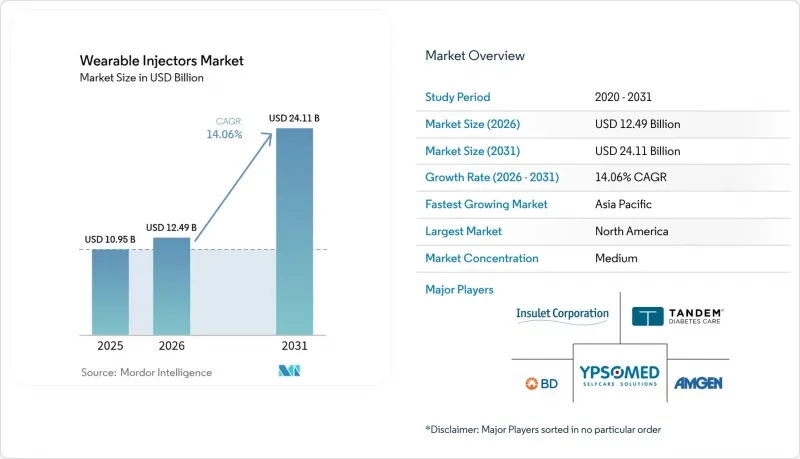
본 보고서는 제품 유형(체내 착용형 주사기, 체외형 주사기 등), 치료 분야(종양학, 자가면역질환, 당뇨병, 심혈관 질환 등), 최종 사용자(병원 및 진료소 등), 지역(북미, 유럽, 아시아태평양, 중동 및 아프리카, 남미)별로 분류되어 있습니다. 시장 전망은 금액(달러) 기준으로 제시되어 있습니다.
세계 웨어러블 주사기 시장 동향 및 인사이트
만성 질환 유병률 증가
2021년 기준으로 전 세계적으로 5억 3,660만 명의 성인이 당뇨병을 앓고 있으며, 2045년까지 7억 8,320만 명에 달할 것으로 예측됩니다. 이에 따라 병원 밖에서 다제 병용 요법을 관리할 수 있는 자동 투여 시스템에 대한 지속적인 수요가 뒷받침되고 있습니다. 미국에서는 성인의 27.1%가 여러 질환을 동반하고 있으며, 이는 10년 전의 21.8%에서 증가한 수치로, 복잡한 투약 일정을 추적할 수 있는 커넥티드 주사기에 대한 수요가 높아지고 있습니다. 이러한 추세에 따라 웨어러블 주사기 시장은 내원 횟수 감소, 복약 순응도 향상, 환자의 삶의 질 개선을 통해 만성 질환 관리의 핵심 동력으로서의 입지를 공고히 하고 있습니다.
웨어러블 주사기 플랫폼의 기술적 진보
마이크로 MEMS 기술의 혁신으로 15 cP를 초과하는 고점도 생물학적 제제도 얇은 캐뉼라를 통해 투여할 수 있게 되어, 체내 착용형 시스템이 환자에게 불편함을 주지 않고 10 mL의 투여량을 공급할 수 있게 되었습니다. 실시간 연결, 자동 바늘 회수 및 IoT 분석을 통해 투여 정확도가 향상되고, 보험사 및 임상의에게 약물 복용 준수 데이터가 생성됩니다. 의약품 전달에 있어 필수 출력에 관한 FDA의 지침 초안은 의료기기 승인을 가속화하는 성능 기준을 규정하고 있습니다. 35.7 kPa에서 4 mL/분의 유량을 달성하는 압전 마이크로펌프는 웨어러블 주사기 시장을 변화시키고 있는 정밀도 향상을 더욱 뚜렷하게 보여줍니다.
대체 약물 투여 방식에 대한 관심
병원의 정맥 주사 센터는 여전히 청구 가능한 시술을 생성하는 기존의 정맥 내 투여 워크플로우에 의존하고 있어, 웨어러블 주사기로의 전환을 지연시키고 있습니다. InsuJet과 같은 무바늘 기술은 자가 주사에 대한 불안감을 느끼는 환자들을 끌어들이고 있지만, Rani Therapeutics사의 경구용 바이오로직 캡슐은 장래에 의료기기를 이용한 투여를 불필요하게 만들 가능성이 있습니다. 이러한 대안들이 의료 제공업체들의 변화에 대한 저항 요인이 되어, 웨어러블 주사기 시장의 단기적인 성장을 억제하고 있습니다.
부문 분석
스마트 기기는 임상의와 보험사에 실시간 복약 순응도 데이터를 제공하는 통합 센서 및 모바일 앱에 힘입어 15.65%라는 가장 높은 연평균 성장률(CAGR)을 기록했습니다. 신체 부착형 패치는 당뇨병 치료 분야에서 확고하게 자리 잡은 사용에 힘입어 2025년에도 웨어러블 주사기 시장의 60.98%를 차지하며 여전히 지배적인 위치를 유지하고 있습니다. 대개 5mL를 초과하는 대용량 주사기는 비만 치료용 바이오의약품 및 항암제에 대응하고 있는 반면, 체외 부착형 벨트 형태는 장시간 착용이나 대용량 저장 탱크가 필요한 틈새 수요를 충족시키고 있습니다.
BD사와 Ypsomed사의 제휴를 통해 유리제 프리필 주사기와 고점도용 자동 주사기를 결합하여, 점도 15 cP를 초과하는 생물학적 제제를 투여할 수 있게 되었습니다. 이는 제약 업계의 고농도 제제 파이프라인에 부합하는 진전입니다. 차세대 스마트 주사기에 내장된 인공지능 알고리즘은 혈당 수치 및 바이오마커 피드백을 분석하여 투여 간격을 개인화함으로써 치료 성과를 향상시킬 뿐만 아니라, 특정 기기 생태계에 대한 고객의 충성도를 공고히 하고 있습니다.
지역별 분석
북미는 2025년 웨어러블 주사기 시장의 42.78%를 차지했습니다. 이는 FDA의 명확한 규제 경로, 확립된 의료 연결성, 그리고 만성 질환의 높은 부담에 힘입은 결과입니다. 인슬렛(Islet)사의 ‘옴니팟(Omnipod)’ 플랫폼만 보더라도, 2024년에 22%의 매출 성장을 기록한 후 활성 사용자 수가 50만 명을 넘어섰으며, 이는 기기의 꾸준한 보급을 보여줍니다. 현재 대부분의 보험사는 복약 순응도 데이터를 전자건강기록(EHR)으로 전송하는 커넥티드 주사기의 비용을 보상하고 있으며, 자가 투여에 대한 인센티브를 연계하고 있습니다.
아시아태평양은 중산층의 확대, 정부의 디지털 헬스 정책, 그리고 바이오의약품 출시 증가에 힘입어 2031년까지 연평균 성장률(CAGR) 14.79%라는 가장 빠른 성장세를 기록할 것으로 예측됩니다. 중국과 일본은 수요와 규제 현대화를 주도하고 있는 반면, 인도, 인도네시아, 태국에서는 만성 질환 유병률이 높고 모바일 헬스 보급률이 높아 도입이 가속화되고 있습니다. 그러나 보상 제도의 불균일성과 의료기기 지출 비율이 낮은 점이 당분간 대규모 확장을 억제하고 있습니다.
유럽에서는 의료기기 규제의 조화를 통해 국경을 초월한 승인 절차가 효율화되어, 독일, 프랑스, 영국에서 예측 가능한 도입이 보장되고 있습니다. 각국의 의료 제도에서는 환자 중심의 만성 질환 케어 경로가 중시되고 있으며, 통합형 질환 관리 프로그램에 커넥티드 주사기가 통합되어 있습니다. 라틴아메리카 및 중동 및 아프리카은 잠재력이 있지만, 인프라 부족과 보험 적용 범위의 제한으로 인해 여전히 제약을 받고 있으며, 각 벤더사는 초기 수요를 창출하기 위해 단계적 가격 책정이나 민관협력(PPP) 모델을 채택하는 경향을 보이고 있습니다.
기타 혜택:
- 엑셀 형식 시장 예측(ME) 시트
- 3개월간의 애널리스트 지원
자주 묻는 질문
목차
제1장 서론
제2장 조사 방법
제3장 주요 요약
제4장 시장 구도
제5장 시장 규모와 성장 예측
제6장 경쟁 구도
제7장 시장 기회와 향후 전망
JHS 26.09.07According to Mordor Intelligence, wearable injectors market size in 2026 is estimated at USD 12.49 billion, growing from 2025 value of USD 10.95 billion with 2031 projections showing USD 24.11 billion, growing at 14.06% CAGR over 2026-2031.
This report is Segmented by Product Type (On-Body Injectors, Off-Body Injectors, and More), Therapy Area (Oncology, Autoimmune Disease, Diabetes, Cardiovascular Disease, and More), End-User (Hospitals & Clinics, and More), and Geography (North America, Europe, Asia-Pacific, Middle East and Africa, South America). The Market Forecasts are Provided in Terms of Value (USD).
Global Wearable Injectors Market Trends and Insights
Growing Prevalence of Chronic Diseases
Diabetes affected 536.6 million adults worldwide in 2021 and is projected to reach 783.2 million by 2045, underpinning sustained demand for automated delivery systems that can manage polypharmacy outside hospital settings. Multi-morbidity affects 27.1% of US adults, up from 21.8% a decade earlier, amplifying the need for connected injectors that track complex dosing schedules. These trends position the wearable injectors market as a critical enabler of chronic disease management by reducing clinic visits, improving adherence, and elevating patient quality of life.
Technological Advancements in Wearable Injector Platforms
Micro-MEMS innovations now push high-viscosity biologics above 15 cP through slender cannulas, enabling on-body systems to deliver 10 mL volumes without patient discomfort. Real-time connectivity, automatic needle retraction, and IoT analytics refine dosing accuracy and generate adherence data for payers and clinicians. FDA draft guidance on essential drug-delivery outputs establishes performance benchmarks that accelerate device clearances. Piezoelectric micropumps attaining 4 mL/min flow at 35.7 kPa further illustrate the precision gains that are reshaping the wearable injectors market.
Preference for Alternative Drug-Delivery Modes
Hospital infusion centers still rely on traditional IV workflows that generate billable events, slowing transition to wearable injectors. Needle-free technologies such as InsuJet attract patients wary of self-injection, while oral biologic capsules from Rani Therapeutics could eventually bypass device-based delivery. These alternatives anchor provider inertia and temper the near-term growth of the wearable injectors market.
Other drivers and restraints analyzed in the detailed report include:
- Shift Toward Home-Based Treatment & Self-Administration
- Rising Pipeline of Biologics & Large-Molecule Drugs
- Unfavorable Reimbursement in Developing Nations
For complete list of drivers and restraints, kindly check the Table Of Contents.
Segment Analysis
Smart devices recorded the fastest 15.65% CAGR, buoyed by integrated sensors and mobile apps that furnish real-time adherence data to clinicians and payers. On-body patches remained dominant, controlling 60.98% of the wearable injectors market share in 2025, underpinned by entrenched use in diabetes therapy. High-volume injectors, often exceeding 5 mL, address bariatric biologics and cancer therapeutics, while off-body belt formats fill niche needs requiring prolonged wear and large reservoirs.
BD's alliance with Ypsomed couples glass prefillable syringes with high-viscosity autoinjectors to deliver biologics over 15 cP viscosity, an advance aligning with pharma's pipeline of dense formulations. Artificial-intelligence algorithms embedded in next-generation smart injectors personalize dosing intervals by analyzing glucose or biomarker feedback, improving outcomes, and cementing customer loyalty to specific device ecosystems.
Complete Report Scope:
- By Product Type
- On-body Patch Injectors
- Off-body Belt Injectors
- Smart Injectors
- High-volume (>=5 mL) Injectors
- By Therapy Area
- Oncology
- Autoimmune Disorders
- Diabetes
- Cardiovascular Diseases
- Rare & Orphan Diseases
- By End User
- Hospitals & Clinics
- Home Care Settings
- Specialty Infusion Centers
- By Geography
- North America
- United States
- Canada
- Mexico
- Europe
- Germany
- United Kingdom
- France
- Italy
- Spain
- Rest of Europe
- Asia-Pacific
- China
- Japan
- India
- Australia
- South Korea
- Rest of Asia-Pacific
- Middle East & Africa
- GCC
- South Africa
- Rest of Middle East & Africa
- South America
- Brazil
- Argentina
- Rest of South America
- North America
Geography Analysis
North America captured 42.78% of the wearable injectors market in 2025, undergirded by clear FDA regulatory pathways, entrenched healthcare connectivity, and a high burden of chronic disease. Insulet's Omnipod platform alone exceeded 500,000 active users after posting 22% revenue growth in 2024, illustrating robust device adoption. Most payers now reimburse connected injectors that transmit adherence data into electronic health records, aligning incentives for self-administration.
Asia-Pacific is projected to register the swiftest 14.79% CAGR through 2031, propelled by middle-class expansion, government digital-health policies, and rising biologic launches. China and Japan spearhead volume demand and regulatory modernization, while India, Indonesia, and Thailand show accelerating uptake owing to chronic-disease prevalence and mobile-health penetration. Fragmented reimbursement and lower device-spending ratios, however, temper immediate scale-up.
Europe benefits from harmonized medical-device regulations that streamline cross-border approvals, ensuring predictable adoption in Germany, France, and the United Kingdom. National health systems emphasize patient-centric chronic-care pathways that incorporate connected injectors into integrated disease-management programs. Latin America and the Middle East & Africa hold latent potential but remain inhibited by infrastructure deficits and limited payer coverage, steering vendors toward tiered-pricing and public-private-partnership models to seed early demand.
- Amgen
- Insulet
- West Pharmaceutical Services
- Ypsomed
- Beckton Dickinson
- Enable Injections
- Stevanato Group
- Eitan Medical
- Tandem Diabetes Care
- Sensile Medical
- United Therapeutics
- Subcuject
- CeQur
- Sorrel Medical
- Medtronic
- Vetter Pharma
- Nemera
- Oval Medical Technologies
- Gerresheimer
- Recipharm
Additional Benefits:
- The market estimate (ME) sheet in Excel format
- 3 months of analyst support
TABLE OF CONTENTS
1 Introduction
- 1.1 Study Assumptions & Market Definition
- 1.2 Scope of the Study
2 Research Methodology
3 Executive Summary
4 Market Landscape
- 4.1 Market Overview
- 4.2 Market Drivers
- 4.2.1 Growing Prevalence of Chronic Diseases
- 4.2.2 Technological Advancements in Wearable Injector Platforms
- 4.2.3 Shift Toward Home-Based Treatment & Self-Administration
- 4.2.4 Rising Pipeline of Biologics & Large-Molecule Drugs
- 4.2.5 Micro-MEMS Enabling High-Viscosity Formulation Delivery
- 4.2.6 Payer Adoption of Digital Adherence Analytics
- 4.3 Market Restraints
- 4.3.1 Preference for Alternative Drug-Delivery Modes
- 4.3.2 Unfavorable Reimbursement in Developing Nations
- 4.3.3 Battery-Life & E-Waste Disposal Concerns
- 4.3.4 Shortage Of Specialty Polymers for Injector Housings
- 4.4 Technological Outlook
- 4.5 Porter's Five Forces Analysis
- 4.5.1 Threat of New Entrants
- 4.5.2 Bargaining Power of Buyers
- 4.5.3 Bargaining Power of Suppliers
- 4.5.4 Threat of Substitute Products
- 4.5.5 Intensity of Competitive Rivalry
5 Market Size & Growth Forecasts (Value in USD)
- 5.1 By Product Type
- 5.1.1 On-body Patch Injectors
- 5.1.2 Off-body Belt Injectors
- 5.1.3 Smart Injectors
- 5.1.4 High-volume (>=5 mL) Injectors
- 5.2 By Therapy Area
- 5.2.1 Oncology
- 5.2.2 Autoimmune Disorders
- 5.2.3 Diabetes
- 5.2.4 Cardiovascular Diseases
- 5.2.5 Rare & Orphan Diseases
- 5.3 By End User
- 5.3.1 Hospitals & Clinics
- 5.3.2 Home Care Settings
- 5.3.3 Specialty Infusion Centers
- 5.4 By Geography
- 5.4.1 North America
- 5.4.1.1 United States
- 5.4.1.2 Canada
- 5.4.1.3 Mexico
- 5.4.2 Europe
- 5.4.2.1 Germany
- 5.4.2.2 United Kingdom
- 5.4.2.3 France
- 5.4.2.4 Italy
- 5.4.2.5 Spain
- 5.4.2.6 Rest of Europe
- 5.4.3 Asia-Pacific
- 5.4.3.1 China
- 5.4.3.2 Japan
- 5.4.3.3 India
- 5.4.3.4 Australia
- 5.4.3.5 South Korea
- 5.4.3.6 Rest of Asia-Pacific
- 5.4.4 Middle East & Africa
- 5.4.4.1 GCC
- 5.4.4.2 South Africa
- 5.4.4.3 Rest of Middle East & Africa
- 5.4.5 South America
- 5.4.5.1 Brazil
- 5.4.5.2 Argentina
- 5.4.5.3 Rest of South America
- 5.4.1 North America
6 Competitive Landscape
- 6.1 Market Concentration
- 6.2 Market Share Analysis
- 6.3 Company Profiles (includes Global level Overview, Market level overview, Core Segments, Financials as available, Strategic Information, Market Rank/Share for key companies, Products & Services, and Recent Developments)
- 6.3.1 Amgen
- 6.3.2 Insulet Corporation
- 6.3.3 West Pharmaceutical Services
- 6.3.4 Ypsomed
- 6.3.5 Becton, Dickinson and Company
- 6.3.6 Enable Injections
- 6.3.7 Stevanato Group
- 6.3.8 Eitan Medical
- 6.3.9 Tandem Diabetes Care
- 6.3.10 Sensile Medical
- 6.3.11 United Therapeutics
- 6.3.12 Subcuject
- 6.3.13 CeQur
- 6.3.14 Sorrel Medical
- 6.3.15 Medtronic
- 6.3.16 Vetter Pharma
- 6.3.17 Nemera
- 6.3.18 Oval Medical Technologies
- 6.3.19 Gerresheimer
- 6.3.20 Recipharm
7 Market Opportunities & Future Outlook
- 7.1 White-space & Unmet-need Assessment