

|
시장보고서
상품코드
2123370
혈액제제 시장 : 점유율 분석, 업계 동향과 통계, 성장 예측(2026-2031년)Blood Preparation - Market Share Analysis, Industry Trends & Statistics, Growth Forecasts (2026 - 2031) |
||||||
 Mordor Intelligence
Mordor Intelligence에 의하면, 2026년 혈액제제 시장 규모는 598억 1,000만 달러로 추정되고 있어 2025년 565억 5,000만 달러에서 확대해, 2031년에는 791억 9,000만 달러에 이를 것으로 예측됩니다.
2026년부터 2031년까지의 연평균 성장률(CAGR)은 5.76%를 나타낼 전망입니다.
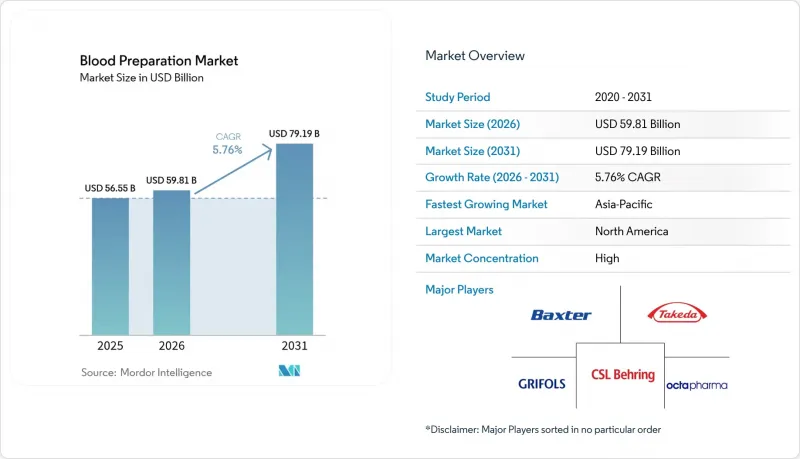
본 보고서는 제품 유형(전혈, 혈액 성분, 혈액제제), 혈액 희석제(항응고제 등), 용도(혈소판 증가증 등), 최종 사용자(병원·외과 센터 등), 지역(북미, 유럽, 아시아태평양, 중동 및 아프리카, 남미)별로 분류되어 있습니다. 시장 전망은 금액(달러) 기준으로 제시되어 있습니다.
전 세계 혈액제제 시장 동향 및 인사이트
전 세계 외과 수술 건수 증가
2025년에는 예정된 수술 및 외상 관련 수술 건수가 회복세를 보이며, 적혈구 농축액 및 혈장 성분에 대한 수요를 끌어올리고 있습니다. 미국의 병원에서는 정형외과 수술 건수가 전년 대비 8% 증가했으며, 이에 따라 혈액 성분 보관 체계 및 신속 검사 시스템의 업그레이드가 진행되고 있습니다. 서유럽에서도 유사한 추세가 나타나고 있으며, 최소 침습 수술 기술의 보급으로 외래 수술이 증가하고 있지만, 이러한 수술에서도 수술 전 혈액형 확인은 여전히 필요합니다. 자동 교차적합검사 장비와 디지털 혈액은행 소프트웨어를 통해 검사 소요 시간이 단축되어, 헌혈된 각 단위의 활용률이 향상되고 있습니다. 이러한 진전에 따라 혈액제제 시장의 수익 전망이 더욱 명확해지고 있습니다.
만성 질환 및 혈액 질환 유병률 증가
아시아태평양 전체에서 만성 신장 질환, 혈액암, 혈우병 환자 수가 지속적으로 증가하고 있으며, 혈장 유래 면역글로불린 및 응고 인자에 대한 지속적인 수요가 확대되고 있습니다. 중국과 인도 정부의 보험 적용 목록에는 현재 피하 면역글로불린 요법이 포함되어 있어, 환자들의 접근성이 가속화되고 있습니다. 다국적 기업들은 이에 대응하여 분획 라인과 헌혈 센터를 증설하고 있는 반면, 국내 기업들은 기술 이전을 목적으로 한 제휴를 추진하고 있습니다. 광범위한 질병 부담이 혈액제제에 대한 장기적인 수요를 보장하고 있으며, 이는 혈액제제 시장의 지속적인 성장을 뒷받침하고 있습니다.
수혈 관련 감염증의 위험
우간다의 연구에 따르면, 헌혈자 중 수혈 매개 감염증의 유병률은 13.8%이며, 특히 B형 간염 바이러스(HBV)와 C형 간염 바이러스(HCV)의 감염률이 현저히 높은 것으로 보고되었습니다. 병원체 제거 시스템을 통해 말라리아 감염 위험은 87% 감소하지만, 예산 제약으로 인해 위협이 가장 규모가 큰 지역에서의 도입이 저해되고 있습니다. 국제 헌혈 지원 기관들이 시범 프로그램에 자금을 지원하고 있지만, 그 확대 속도는 감염병 증가 속도를 따라가지 못하고 있습니다. 이러한 고질적인 격차는 합리적인 가격의 멸균 기술의 필요성을 부각시키고 있으며, 혈액제제 시장의 절대적인 성장을 저해하는 요인이 되고 있습니다.
부문 분석
혈액제제는 면역글로불린 및 응고 인자에 대한 견조한 수요에 힘입어 2025년 매출의 47.98%를 차지했습니다. 2025년 혈액제제 시장 규모에서 폐색전증 부문은 27.31%의 점유율을 차지하며, 급성기 의료 현장에서의 혈액제제 소비를 뒷받침했습니다. CSL Behring사는 리터당 혈장 채취 비용이 22% 감소한 데 힘입어 면역글로불린 매출에서 20%의 성장을 기록했습니다. 이는 대규모 분획 업체에 유리한 규모의 경제를 보여줍니다. Reveos와 같은 자동화 시스템은 혈액 성분의 연평균 성장률(CAGR)을 8.12%로 끌어올렸으며, 단위당 혈소판 및 적혈구 수율을 높이고, 폐기물을 줄이며, 초저온 보관을 통해 보존 기간을 42일에서 63일로 연장하고 있습니다. 병원 내 성분별 수혈 프로토콜의 채택 확대가 혈액제제 시장의 이러한 성장을 뒷받침하고 있습니다.
파생 제품 파이프라인은 계속해서 견조한 모습을 보이고 있습니다. Grifols사는 Yimmugo에 대해 FDA 승인 후 7년 동안 누적 매출 10억 달러를 예상하고 있습니다. 유럽 각국 정부는 2030년까지 알부민 자급률을 80%로 높이는 것을 목표로 하고 있으며, 이에 따라 국내 위탁 분획 프로그램이 촉진되고 있습니다. 전혈 처리 로봇 기술 및 인공 대체재 분야의 병행된 발전은 장기적인 대안을 제공하지만, 확립된 파생 제품의 입지를 위협하기까지는 시간이 걸릴 것입니다. 그 결과, 혈액 성분의 혁신으로 인해 혈액제제 시장의 효율성과 수익성이 향상되고 있음에도 불구하고, 파생 제품은 여전히 주도적인 위치를 유지하고 있습니다.
항응고제는 2025년 매출의 60.88%를 차지하고 있으며, 이는 확립된 임상 지침과 의사들의 높은 인지도를 반영합니다. 제XI인자 억제제인 아베라시맙은 심방세동 임상시험에서 리바록사반에 비해 출혈을 67% 감소시켜, 혈소판 응집 억제제의 성장을 연평균 성장률(CAGR) 8.29%로 견인했습니다. 아픽사반은 호주에서 가장 많이 처방되는 경구용 항응고제로 자리매김하고 있으며, 2024년에는 의료 시스템에 5억 달러의 비용을 발생시켰습니다. 폐색전증 부문은 혈액제제 시장의 27.31% 점유율을 차지하며, 응급 및 만성 질환 모두에서 항응고제 출하량을 끌어올렸습니다.
심장 수술에서 4인자 프로트롬빈 복합체 농축액이 냉동 혈장을 대체하여 중증 출혈을 50% 가까이 감소시켰습니다. 섬유소 용해제 수요는 견조하지만, 투여 시간을 단축하는 재조합 지혈제와의 경쟁이 심화되고 있습니다. 제11인자 제제가 개발의 후기 단계에 접어들면서 처방 경향은 변화할 가능성이 있지만, 예측 기간 동안에는 기존 항응고제가 혈액제제 시장의 수익 기반을 계속 유지할 것입니다.
지역별 분석
북미는 350곳의 CSL Plasma 헌혈 센터와 헌혈 시간을 15분 단축하는 Rika 채혈 시스템의 급속한 보급에 힘입어 2025년 매출의 38.12%를 차지했습니다. 이 지역에서는 2025년에 5건의 혈액 관련 지침 문서가 예정되어 있는 등 치밀한 규제 정책이 수립되어 있어, 기술의 승인 및 도입이 가속화되고 있습니다. 그러나 기후 변화로 인한 혼란이 공급에 타격을 주고 있습니다. 미국 적십자사에서는 2024년 7월의 폭염과 폭풍우의 영향으로 재고가 25% 감소했습니다.
아시아태평양은 7.14%라는 가장 높은 연평균 성장률(CAGR)을 기록하고 있습니다. 테루모(Terumo)사가 1,500만 달러를 투자한 항저우 공장은 현지 생산을 강화하고 있으며, 한편 인도네시아의 혈장 분획 프로젝트는 해당 지역의 자급자족을 가속화하고 있습니다. 나라 의과대학의 일본 인공 혈액 프로그램은 2년의 보존 기간과 모든 사람에게 적합한 특성을 갖추고 있어, 응급 수혈에 혁명을 가져올 가능성이 있습니다. 유럽에서는 새로운 SoHO 규정에 따라 자립화에 주력하고 있으며, 이를 위해서는 200만 명의 추가 헌혈자와 회원국 전체에 걸친 공통 품질 기준이 요구됩니다. 영국은 국내 혈장 분획 계약(gov.uk)의 지원을 받아 2025년까지 면역글로불린 자급률 25%를 달성할 전망입니다. 네덜란드의 Sanquin사가 도입한 자동 처리 기술은 기술 활용이 헌혈 건수 증가에 대한 의존도를 어떻게 줄일 수 있는지를 보여주고 있습니다. 이러한 지역별 동향이 맞물려 혈액제제 시장의 균형 잡힌 세계적 전망을 뒷받침하고 있습니다.
기타 혜택:
- 엑셀 형식 시장 예측(ME) 시트
- 3개월간의 애널리스트 지원
자주 묻는 질문
목차
제1장 서론
제2장 조사 방법
제3장 주요 요약
제4장 시장 구도
제5장 시장 규모와 성장 예측
제6장 경쟁 구도
제7장 시장 기회와 향후 전망
JHS 26.09.11According to Mordor Intelligence, blood preparation market size in 2026 is estimated at USD 59.81 billion, growing from 2025 value of USD 56.55 billion with 2031 projections showing USD 79.19 billion, growing at 5.76% CAGR over 2026-2031.
This report is Segmented by Product Type (Whole Blood, Blood Components, and Blood Derivatives), Blood Thinning Agents (Anticoagulants, and More), Application (Thrombocytosis, and More), End User (Hospitals & Surgical Centers, and More), Geography (North America, Europe, Asia-Pacific, The Middle East and Africa, and South America). The Market Forecasts are Provided in Terms of Value (USD).
Global Blood Preparation Market Trends and Insights
Increasing Global Surgical Procedures Volume
Elective and trauma-related surgeries are rebounding in 2025, boosting demand for red-cell concentrates and plasma components. Hospitals in the United States increased orthopedic procedure counts by 8% year-on-year, prompting upgrades in component storage and rapid-type testing. Similar momentum is visible in Western Europe, where minimally invasive techniques encourage outpatient surgeries that still require pre-operative blood matching. Automated cross-matching analyzers and digital blood-bank software shorten turnaround times, improving utilization rates for every donated unit. These developments strengthen revenue visibility for the blood preparation market.
Growing Prevalence of Chronic and Hematologic Disorders
Chronic kidney disease, hematologic cancers, and hemophilia continue to rise across Asia-Pacific, expanding recurring demand for plasma-derived immunoglobulins and coagulation factors. Government reimbursement lists in China and India now include subcutaneous immunoglobulin therapy, accelerating patient access. Multinationals respond by adding fractionation lines and donor centers, while domestic firms partner for technology transfer. The broad disease burden ensures long-term pull for blood derivatives, reinforcing sustainable growth for the blood preparation market.
Risk of Transfusion-Transmitted Infections
Studies in Uganda reported 13.8% prevalence of transfusion-transmitted infections among donors, with HBV and HCV notably high. While pathogen-reduction systems cut malaria transmission risk by 87%, budget limitations hinder adoption where the threat is greatest. International-donor agencies fund pilot programs, yet scalability lags behind infection growth. The persistent gap emphasizes the need for affordable sterilization, tempering absolute growth of the blood preparation market.
Other drivers and restraints analyzed in the detailed report include:
- Rising Government Support for Blood Collection Infrastructure
- Advancements in Blood Screening and Processing Technologies
- High Cost of Advanced Blood Preparation Technologies
For complete list of drivers and restraints, kindly check the Table Of Contents.
Segment Analysis
Blood derivatives held 47.98% of 2025 revenue, anchored by strong immunoglobulin and coagulation factor demand. The pulmonary embolism segment accounted for 27.31% share of the blood preparation market size in 2025, supporting derivative consumption in acute settings. CSL Behring logged 20% sales growth for immunoglobulins, aided by a 22% drop in plasma collection cost per liter, illustrating scale economics that favor large fractionators. Automated systems such as Reveos drive 8.12% CAGR for blood components, delivering higher platelet and red-cell yields per unit, lowering wastage, and extending storage times from 42 to 63 days through super-cooling preservation. Increasing hospital adoption of component-specific transfusion protocols sustains this expansion for the blood preparation market.
The derivatives pipeline remains buoyant. Grifols projects USD 1 billion cumulative sales for Yimmugo over seven years post-FDA approval. European governments aim to reach 80% self-sufficiency in albumin by 2030, stimulating domestic contract fractionation programs. Parallel advances in whole-blood robotics and artificial substitutes offer long-range alternatives but will take time to displace established derivatives. Consequently, derivatives retain leadership even as component innovation elevates the efficiency and profitability of the blood preparation market.
Anticoagulants represented 60.88% of 2025 revenue, reflecting entrenched clinical guidelines and physician familiarity. Abelacimab, a factor XI inhibitor, reduced bleeding by 67% versus rivaroxaban in atrial-fibrillation trials, propelling platelet-aggregation inhibitor growth at an 8.29% CAGR. Apixaban remained Australia's most prescribed oral anticoagulant, costing the health system USD 500 million in 2024. The pulmonary embolism segment captured 27.31% share of the blood preparation market, reinforcing anticoagulant volumes across emergency and chronic settings.
Four-factor prothrombin complex concentrate is displacing frozen plasma during cardiac surgery, lowering major bleeding by nearly 50%. Fibrinolytics hold steady demand but face increasing competition from recombinant hemostatic drugs that shorten infusion times. As factor XI agents enter late-stage development, prescribing patterns may pivot, but established anticoagulants will continue to anchor revenue for the blood preparation market during the forecast horizon.
Complete Report Scope:
- By Product Type
- Whole Blood
- Blood Components
- Red Blood Cells
- Platelets
- Plasma
- Blood Derivatives
- Immunoglobulins
- Coagulation Factors VIII & IX
- Albumin
- By Blood Thinning Agents
- Anticoagulants
- Fibrinolytics
- Platelet Aggregation Inhibitors
- By Application
- Thrombocytosis
- Pulmonary Embolism
- Renal Impairment
- Other Applications
- By End User
- Hospitals & Surgical Centers
- Blood & Plasma Banks
- Other End Users
- Geography
- North America
- United States
- Canada
- Mexico
- Europe
- Germany
- United Kingdom
- France
- Italy
- Spain
- Rest of Europe
- Asia-Pacific
- China
- Japan
- India
- Australia
- South Korea
- Rest of Asia-Pacific
- Middle East & Africa
- GCC
- South Africa
- Rest of Middle East & Africa
- South America
- Brazil
- Argentina
- Rest of South America
- North America
Geography Analysis
North America retained 38.12% of 2025 revenue, underpinned by 350 CSL Plasma donor centers and rapid uptake of the Rika collection system, which cuts donation time by 15 minutes. The region's elaborate regulatory agenda, with five blood-focused guidance documents slated for 2025, accelerates technology approval and adoption. Yet climate disruptions dent supply: the American Red Cross saw a 25% inventory drop in July 2024 during extreme heat and storms.
Asia-Pacific registers the highest 7.14% CAGR. Terumo's USD 15 million Hangzhou plant enhances local production, while Indonesia's plasma-fractionation project fast-tracks regional self-sufficiency. Japan's artificial-blood program at Nara Medical University could revolutionize emergency transfusion with two-year shelf life and universal compatibility. Europe focuses on autonomy under the new SoHO regulation, requiring 2 million extra donors and common quality standards across member states. The United Kingdom is on track for 25% immunoglobulin self-sufficiency by 2025, aided by domestic fractionation contracts gov.uk. Sanquin's adoption of automated processing in the Netherlands demonstrates how technology reduces dependence on incremental donations. These geographic dynamics collectively reinforce a balanced global outlook for the blood preparation market.
- CSL Behring
- Takeda Pharmaceutical Co.
- Baxter
- Grifols
- Octapharma
- Pfizer
- Bayer
- Sanofi
- Bristol-Myers Squibb
- Boehringer Ingelheim
- Daiichi Sankyo
- GlaxoSmithKline
- Leo Pharma
- Abbott Laboratories
- Haemonetics
- Terumo
- Fresenius
- Medtronic PLC (Blood Management)
- American Red Cross
- Kedrion Biopharma
Additional Benefits:
- The market estimate (ME) sheet in Excel format
- 3 months of analyst support
TABLE OF CONTENTS
1 Introduction
- 1.1 Study Assumptions & Market Definition
- 1.2 Scope Of The Study
2 Research Methodology
3 Executive Summary
4 Market Landscape
- 4.1 Market Overview
- 4.2 Market Drivers
- 4.2.1 Increasing Global Surgical Procedures Volume
- 4.2.2 Growing Prevalence of Chronic And Hematologic Disorders
- 4.2.3 Rising Government Support for Blood Collection Infrastructure
- 4.2.4 Advancements in Blood Screening and Processing Technologies
- 4.2.5 Expansion of Plasma-Derived Therapeutics Portfolio
- 4.2.6 Growing Adoption of Novel Oral Anticoagulants
- 4.3 Market Restraints
- 4.3.1 Risk of Transfusion-Transmitted Infections
- 4.3.2 High Cost of Advanced Blood Preparation Technologies
- 4.3.3 Supply Chain Constraints for Donor Plasma and Heparin
- 4.3.4 Inadequate Cold Chain and Storage Facilities in Developing Regions
- 4.4 Regulatory Landscape
- 4.5 Porter's Five Forces Analysis
- 4.5.1 Threat Of New Entrants
- 4.5.2 Bargaining Power Of Buyers
- 4.5.3 Bargaining Power Of Suppliers
- 4.5.4 Threat Of Substitutes
- 4.5.5 Competitive Rivalry
5 Market Size & Growth Forecasts (Value, USD)
- 5.1 By Product Type
- 5.1.1 Whole Blood
- 5.1.2 Blood Components
- 5.1.2.1 Red Blood Cells
- 5.1.2.2 Platelets
- 5.1.2.3 Plasma
- 5.1.3 Blood Derivatives
- 5.1.3.1 Immunoglobulins
- 5.1.3.2 Coagulation Factors VIII & IX
- 5.1.3.3 Albumin
- 5.2 By Blood Thinning Agents
- 5.2.1 Anticoagulants
- 5.2.2 Fibrinolytics
- 5.2.3 Platelet Aggregation Inhibitors
- 5.3 By Application
- 5.3.1 Thrombocytosis
- 5.3.2 Pulmonary Embolism
- 5.3.3 Renal Impairment
- 5.3.4 Other Applications
- 5.4 By End User
- 5.4.1 Hospitals & Surgical Centers
- 5.4.2 Blood & Plasma Banks
- 5.4.3 Other End Users
- 5.5 Geography
- 5.5.1 North America
- 5.5.1.1 United States
- 5.5.1.2 Canada
- 5.5.1.3 Mexico
- 5.5.2 Europe
- 5.5.2.1 Germany
- 5.5.2.2 United Kingdom
- 5.5.2.3 France
- 5.5.2.4 Italy
- 5.5.2.5 Spain
- 5.5.2.6 Rest of Europe
- 5.5.3 Asia-Pacific
- 5.5.3.1 China
- 5.5.3.2 Japan
- 5.5.3.3 India
- 5.5.3.4 Australia
- 5.5.3.5 South Korea
- 5.5.3.6 Rest of Asia-Pacific
- 5.5.4 Middle East & Africa
- 5.5.4.1 GCC
- 5.5.4.2 South Africa
- 5.5.4.3 Rest of Middle East & Africa
- 5.5.5 South America
- 5.5.5.1 Brazil
- 5.5.5.2 Argentina
- 5.5.5.3 Rest of South America
- 5.5.1 North America
6 Competitive Landscape
- 6.1 Market Concentration
- 6.2 Market Share Analysis
- 6.3 Company Profiles (includes Global level Overview, Market level overview, Core Business Segments, Financials, Headcount, Key Information, Market Rank, Market Share, Products and Services, and analysis of Recent Developments)
- 6.3.1 CSL Behring
- 6.3.2 Takeda Pharmaceutical Co.
- 6.3.3 Baxter International
- 6.3.4 Grifols S.A
- 6.3.5 Octapharma AG
- 6.3.6 Pfizer Inc
- 6.3.7 Bayer AG
- 6.3.8 Sanofi S.A
- 6.3.9 Bristol-Myers Squibb
- 6.3.10 Boehringer Ingelheim
- 6.3.11 Daiichi Sankyo
- 6.3.12 GlaxoSmithKline PLC
- 6.3.13 Leo Pharma
- 6.3.14 Abbott Laboratories
- 6.3.15 Haemonetics Corporation
- 6.3.16 Terumo BCT Inc.
- 6.3.17 Fresenius Kabi
- 6.3.18 Medtronic PLC (Blood Management)
- 6.3.19 American Red Cross
- 6.3.20 Kedrion S.p.A.
7 Market Opportunities & Future Outlook
- 7.1 White-Space & Unmet-Need Assessment


