
|
시장보고서
상품코드
2123373
임상 검사 서비스 시장 : 점유율 분석, 업계 동향과 통계, 성장 예측(2026-2031년)Clinical Laboratory Services - Market Share Analysis, Industry Trends & Statistics, Growth Forecasts (2026 - 2031) |
||||||
 Mordor Intelligence
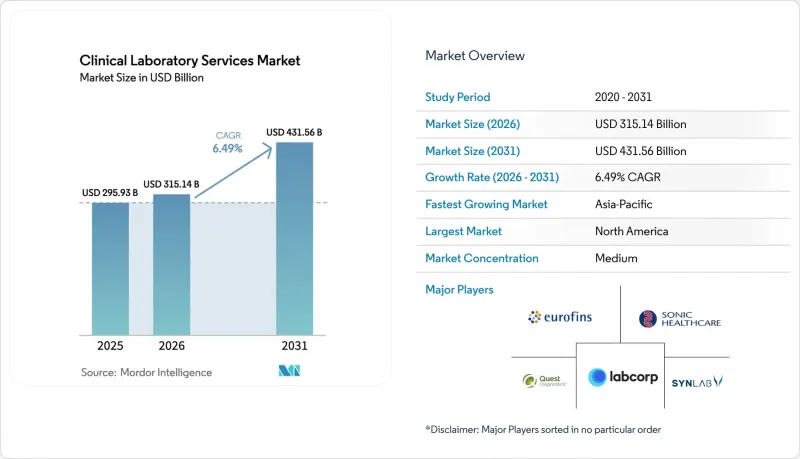
Mordor Intelligence에 의하면, 임상 검사 서비스 시장 규모는 2025년 2,959억 3,000만 달러, 2026년 3,151억 4,000만 달러에서 2031년까지 4,315억 6,000만 달러로 확대될 것으로 예측되고 있어 2026년부터 2031년까지 연평균 복합 성장률(CAGR)은 6.49%를 나타낼 전망입니다.
본 보고서는 검사 유형(임상화학, 면역학/혈청학, 미생물학·세포학 등), 서비스 제공업체(병원 내 검사실 등), 용도(감염병 검사 등), 지역(북미, 유럽, 아시아태평양, 중동 및 아프리카, 남미)별로 분류되어 있습니다. 시장 전망은 금액(달러) 기준으로 제시되어 있습니다.
세계 임상 검사 서비스 시장 동향 및 인사이트
만성 질환 및 감염병으로 인한 전 세계적 부담 증가
2024년에는 비감염성 질환으로 인한 사망자 수가 4,100만 명에 달하며, 이는 전 세계 총 사망자 수의 71%에 해당합니다. 한편, 당뇨병 유병자 수는 8억 3,000만 명으로 증가했습니다. 이러한 역학적 상황으로 인해 혈당 조절,지질 관리, 신장 기능 모니터링을 위한 정기 검사가 촉진되어 환자 1인당 검사 빈도가 증가하고 있습니다. 동시에, MPOX(원숭이두창) 집단 발생에 대한 PCR을 통한 확정 진단 및 비자·취업 절차에서의 결핵 선별 검사 의무화로 인해 감염병 관련 검사 건수는 높은 수준을 유지하고 있습니다. 고처리량 분석 장비와 데이터 분석 기능을 갖춘 검사 기관은 지속적인 수익을 확보할 수 있는 반면, 수작업에 의한 배치 처리에 의존하는 검사 기관은 루틴 검사 패널에 대한 지불자 측의 보상액 인하로 인해 이익률 압박에 직면하고 있습니다. 아시아태평양 및 사하라 이남 아프리카에서는 감염병과 만성 질환이라는 이중 부담으로 인해 검사 기관은 분자진단과 화학 검사 양쪽의 역량을 모두 유지해야 하므로, 자본 예산 및 인력 계획에 부담이 가중되고 있습니다. 임상 검사 서비스 시장에서는 중앙 워크플로우를 자동화하면서도 급성 병원체에 대한 신속한 반사 검사 능력을 유지하는 통합 검사 허브가 이러한 상황에 대응하고 있습니다.
고령화 및 예방적 건강 검진 프로그램의 확대
세계 65세 이상 인구는 2024년에 16억 명에 달하며, 2050년까지는 21억 명을 넘어설 것으로 전망됩니다. 이 연령대의 사람들은 50세 미만 인구에 비해 3.2배 더 많은 임상 검사를 의뢰하고 있으며, 이는 골다공증, 인지 기능 저하, 그리고 복잡한 약물 복용 계획의 모니터링 필요성을 반영하고 있습니다. 예방 프로그램에서는 현재 심혈관 패널 검사, 당뇨병 전단계 선별 검사, 생식세포 계통 위험 평가가 고용주나 보험사가 보조금을 지원하는 연례 건강검진에 포함되어 있습니다. CMS(미국 의료보험서비스센터)는 2024년, 호모시스테인과 비타민 B12를 포함하도록 인지 기능 평가의 보장 범위를 확대하여 특수 화학 검사에 대한 수요를 촉진했습니다. 일본에서는 2년마다 실시되는 대사증후군 검진을 통해 연간 5,000만 건 이상의 검사가 이루어지고 있으며, 이는 국가의 의무화가 어떻게 검사 이용을 공중보건 인프라에 통합하고 있는지를 보여줍니다. 데이터 보고를 1차 진료 포털과 연동하는 검사 기관은 우선 공급자로서의 지위를 확보하지만, 상호 운용성이 부족한 기관은 성과 연계형 보상 계약에서 제외될 위험이 있습니다.
가치 기반 의료 모델에서의 보상 삭감 및 가격 압박
CMS는 2025년 15% 삭감안을 철회한 데 이어, 2026년 임상 검사 요금표에 대해 3.4% 삭감을 제안하고 있어 지속적인 예산 압박이 부각되고 있습니다. 민간 보험사들도 메디케어를 본받아 청구액 전액을 지급하는 대신 메디케어 요금의 120-150%를 상환하는 한편, 유전자 패널 검사에 대해서는 사전 승인 요건을 부과하고 있습니다. 가치 기반 계약에서는 진단 검사가 정액 지급(캐피테이션)에 포함되어, 이용 위험이 검사 기관으로 전가됩니다. 검사 기관은 데이터 분석이나 의사에 대한 교육을 통해 검사 의뢰를 관리해야 합니다. 유럽에서는 각국의 공적 의료 제도가 분자 검사에 대한 지급 상한선을 설정하고 있어, 검사 내용의 고도화에 따른 수익 확대가 제한되고 있습니다. 소비자 대상 직접 판매 채널이나 전문적인 종양 검사로 사업을 다각화하고 있는 검사 기관은 수익 감소를 일부 상쇄하고 있지만, 임상 검사 서비스 시장 전체에서는 일반적인 생화학 검사의 이익률이 여전히 압박받는 상태가 지속되고 있습니다.
부문 분석
2025년, 임상 화학 검사는 임상 검사 서비스 시장의 56.60%를 차지했으며, 그 주요 원동력은 만성 질환 관리의 핵심이 되는 대사 패널 및 지질 검사였습니다. 동반 진단이 보험 적용 대상이 되고, 액체 생검 플랫폼을 통해 미세 잔류 병변을 모니터링할 수 있게 됨에 따라, 유전자·분자진단은 연평균 성장률(CAGR) 9.50%로 확대되어 다른 모든 검사 분야를 능가할 것으로 예측됩니다. 면역학 및 혈청학 분야에서는 자가면역 프로파일링에 대한 수요가 견조한 추세를 보이는 반면, 미생물학 및 세포학 검사 건수는 몇 시간 이내에 판정 결과를 제공하는 신속 분자진단 플랫폼으로 전환되고 있습니다. 혈액학은 자동 분획 검사를 통해 그 중요성을 유지하고 있지만, ‘임상 검사 수수료표(Clinical Laboratory Fee Schedule)’에 따른 가격 압박에 직면해 있습니다. 차세대 시퀀싱 및 생물정보학에 투자하는 검사 기관은 검사 건수의 비례적인 증가 없이도 수익을 늘릴 수 있지만, 그 대가로 1개 거점당 1,000만 달러가 넘는 자본 비용이 발생합니다.
액체 생검의 도입은 이러한 변화를 여실히 보여주고 있습니다. Guardant Health사의 미세 잔류 병변(MRD) 검사는 영상 진단으로 재발이 확인되기 몇 달 전부터 혈액 내 종양 DNA를 추적하여, 종양학 후속 관리 분야에서 새로운 지속적인 수익원을 창출하고 있습니다. Exact Sciences사의 ‘Cologuard Plus’는 대장 내시경 검사를 거부하는 환자에게도 비침습적 분자 선별 검사가 어떻게 활용될 수 있는지를 다시 한번 보여주고 있지만, 보험 환급에 관한 협상은 현재도 진행 중입니다. 임상화학 검사실에서의 질량 분석법 도입은 현장 진단(Point-of-Care) 기기로는 정확도가 부족한 비타민 D 및 치료제 측정에서 더 높은 특이성을 제공함으로써, 일상 검사 영역을 지키고 있습니다. 높은 이익률을 보이지만 검사 건수가 적은 분자 검사와, 가격 압박에 시달리는 일상 검사의 균형을 맞추는 것이 임상 검사 서비스 시장 전체에서 수익성을 유지하기 위한 핵심입니다.
지역별 분석
북미는 첨단 분자진단 인프라, 높은 전자의무기록 보급률, 그리고 메디케어의 종량제 진료(fee-for-service)에 따른 검사량에 힘입어 2025년에는 임상 검사 서비스 시장의 41.3%를 차지했습니다. ‘메디케어 접근 보호법(Protecting Access to Medicare Act)’으로 인해 환급액 삭감으로 고빈도 임상화학검사에 대한 지급액이 최대 30% 인하된 데다, 민간 보험사의 기준 가격 기반 가격 책정이 이익률을 압박하면서 성장세가 둔화되고 있습니다. 퀘스트 다이아그노스틱스(Quest Diagnostics)와 래보코프(LabCorp)는 합쳐서 5억 건 이상의 검사 의뢰를 처리하며, 그 규모를 활용해 가격 압박을 견디는 한편, 이동 채혈 서비스 및 인공지능을 활용한 품질 관리에 대한 투자를 추진하고 있습니다. 캐나다의 정부 자금 지원 모델에서는 검사량이 주립 검사 기관에 집중되어 있으며, 라이프랩(LifeLab)사의 퀘스트(Quest)사로의 통합은 국경을 초월한 서비스 모델의 선례가 되고 있습니다. 각 사업자는 체액 생검 및 분산형 임상시험에 대한 지원을 확대함으로써, 일상 검사의 성장 정체 현상을 보완하려 하고 있습니다.
유럽 임상 검사 서비스 시장의 성장은 고복잡도 검사의 보상액에 상한을 두는 각국의 기준 가격 제도와, 시약 공급망에 부담을 주는 ‘체외진단용 의료기기 규정(IVDR)’에 대한 지속적인 준수로 인해 제약을 받고 있습니다. SYNLAB과 Eurofins는 인증 취득 비용을 분산하고 품질 관리 시스템을 통일하기 위해 여러 국가에 걸쳐 중앙 집중식 허브를 구축하고 있습니다. 독일과 영국에서는 엄격한 임상 기준을 충족하지 않는 한 분자 검사의 보험 급여가 제한되고 있어, 이로 인해 검사 항목 구성의 변화에 따른 수익 확대가 억제되고 있습니다. 그럼에도 불구하고, 범유럽 임상시험 검사실이나 방사선 진단과 검사를 통합한 서비스 분야에는 여전히 틈새 시장이 존재합니다. 그 예로 Sonic Healthcare의 Canberra Imaging Group 인수를 들 수 있습니다. 이를 통해 병리 검사와 영상 진단이 통합된 계약 하에 연계될 것입니다.
아시아태평양은 인도와 중국의 보편적 의료 보장(UHC) 확대, 그리고 비자 및 고용 절차에서의 감염병 검진 의무화에 힘입어 2031년까지 연평균 성장률(CAGR) 7.84%를 나타낼 것으로 예측됩니다. 인도의 ‘아유슈만 바라트’와 중국의 인프라 부양책은 임상 검사 서비스 시장에 막대한 수요를 창출하고 있지만, 그 보수는 북미의 요금 수준보다 40-60% 낮은 수준에 머물러 있습니다. 따라서 검사 기관들은 수익성을 유지하기 위해 규모의 경제, 시약 임대 아웃소싱, 자동화 도입에 주력하고 있습니다. 일본에서는 고령화와 대사 스크리닝 의무화로 인해 일상적인 생화학 검사에 대한 안정적인 수요가 발생하고 있습니다. 한편, 민간 검사 기관들은 부유층을 대상으로 한 유전체 스크리닝 패키지 도입을 시도하고 있습니다. 동남아시아에서 사회보험 패키지의 시범 도입은 이용자 기반을 더욱 확대하고 있으며, 아시아태평양은 전 세계 검사 건수에서 가장 빠르게 성장하고 있는 지역이 되었습니다.
중동 및 아프리카에서는 외딴 지역의 검체 운송 시간 단축을 목적으로 한 민관협력(PPP)과 연계된 신규 투자가 진행되고 있으며, 한편 걸프협력회의(GCC) 회원국에서는 의료 관광을 지원하기 위해 최첨단 분자 검사 시설에 자금을 지원하고 있습니다. 남미의 발전은 일괄 처리와 통합된 품질 관리를 가능하게 하기 위해 브라질과 아르헨티나가 검사 의뢰 워크플로우의 디지털화를 추진할지 여부에 달려 있습니다. 이를 종합해 보면, 보상 모델의 지역적 차이, 환자층의 특성, 인프라 구축 현황이 임상 검사 서비스 시장 전체에 걸쳐 다양한 성장 매트릭스를 형성하고 있습니다.
기타 혜택:
- 엑셀 형식 시장 예측(ME) 시트
- 3개월간의 애널리스트 지원
자주 묻는 질문
목차
제1장 서론
제2장 조사 방법
제3장 주요 요약
제4장 시장 구도
제5장 시장 규모와 성장 예측
제6장 경쟁 구도
제7장 시장 기회와 향후 전망
JHS 26.09.07According to Mordor Intelligence, the clinical laboratory services market size is projected to expand from USD 295.93 billion in 2025 and USD 315.14 billion in 2026 to USD 431.56 billion by 2031, registering a CAGR of 6.49% between 2026 to 2031.
This report is Segmented by Test Type (Clinical Chemistry, Immunology/Serology, Microbiology & Cytology, and More), Service Provider (Hospital-Based Laboratories, and More), Application (Infectious Disease Testing, and More), and Geography (North America, Europe, Asia-Pacific, Middle East and Africa, South America). The Market Forecasts are Provided in Terms of Value (USD).
Global Clinical Laboratory Services Market Trends and Insights
Escalating Global Burden of Chronic and Infectious Diseases
Non-communicable diseases caused 41 million deaths in 2024, equivalent to 71% of global mortality, while diabetes prevalence climbed to 830 million cases. Such epidemiology drives serial testing for glycemic control, lipid management, and renal surveillance, thereby increasing the frequency of tests per patient. Concurrently, PCR confirmation of mpox outbreaks and mandatory tuberculosis screening in visa and employment protocols sustain elevated infectious disease volumes. Laboratories equipped with high-throughput analyzers and data analytics capture recurring revenue, whereas those relying on manual batch processing encounter margin pressure as payers' lower reimbursement on routine panels. In the Asia-Pacific and sub-Saharan Africa regions, the dual burden of communicable and chronic illnesses requires laboratories to maintain both molecular and chemical capacity, stretching capital budgets and staffing plans. The clinical laboratory services market responds with consolidated testing hubs that automate central workflows yet retain rapid reflex capabilities for acute pathogens.
Aging Population and Expansion of Preventive Health Screening Programs
The global population aged 65 and older reached 1.6 billion in 2024 and is expected to surpass 2.1 billion by 2050. Individuals in this cohort order 3.2 times more laboratory tests than those under 50, reflecting the need for monitoring for osteoporosis, cognitive decline, and complex medication regimens. Preventive programs now bundle cardiovascular panels, pre-diabetes screenings, and germline risk assessments into annual wellness visits, which employers and insurers subsidize. CMS broadened its cognitive-assessment benefit in 2024 to include homocysteine and B12, bolstering specialty chemistry demand. In Japan, biennial metabolic syndrome screening generates over 50 million tests annually, demonstrating how national mandates embed laboratory utilization into public health infrastructure. Laboratories that integrate data reporting with primary-care portals gain preferred-provider status, while those lacking interoperability risk exclusion from pay-for-performance contracts.
Reimbursement Cuts and Pricing Pressure within Value-Based Care Models
CMS proposed a 3.4% reduction to the 2026 Clinical Laboratory Fee Schedule, following its previous reversal of a 15% cut in 2025, underscoring persistent budget pressure. Private payers echo Medicare by reimbursing at 120-150% of Medicare rates instead of accepting billed charges, while imposing prior-authorization hurdles on genetic panels. Value-based contracts bundle diagnostics into capitated payments, shifting utilization risk to laboratories, which must manage test ordering with data analytics and physician education. In Europe, national health systems cap payments for molecular assays, restricting revenue growth through mix enrichment. Laboratories that diversify into direct-to-consumer channels and specialty oncology testing partially offset declines, yet routine chemistry margins remain compressed across the clinical laboratory services market.
Other drivers and restraints analyzed in the detailed report include:
- Technological Advancements in Molecular and High-Throughput Diagnostics
- Expansion of Health Insurance and Universal Healthcare Coverage in Emerging Markets
- Stringent and Evolving Regulatory Requirements for High-Complexity Testing
For complete list of drivers and restraints, kindly check the Table Of Contents.
Segment Analysis
Clinical chemistry contributed 56.60% to the clinical laboratory services market in 2025, primarily driven by metabolic panel and lipid testing, which are central to chronic disease management. Genetics and molecular diagnostics are expected to expand at a 9.50% CAGR, outpacing all other modalities, as companion diagnostics gain payer coverage and liquid biopsy platforms enable minimal residual disease surveillance. Immunology and serology remain steady in demand for autoimmune profiling, while microbiology and cytology volumes shift toward rapid molecular platforms that deliver identification within hours. Hematology maintains relevance through automated differential counts, yet faces pricing pressure from the Clinical Laboratory Fee Schedule. Laboratories investing in next-generation sequencing and bioinformatics can grow revenue without proportional volume gains, albeit at capital costs surpassing USD 10 million per site.
Liquid biopsy adoption highlights this shift. Guardant Health's minimal residual disease assay tracks tumor DNA in blood months before imaging reveals recurrence, offering new recurring-revenue streams from oncology follow-up. Exact Sciences' Cologuard Plus further illustrates how non-invasive molecular screening can reach patients who refuse colonoscopy, though reimbursement negotiations continue. Mass spectrometry adoption within clinical chemistry labs defends routine territory by delivering higher specificity in vitamin D and therapeutic-drug assays, where point-of-care devices lack accuracy. Balancing high-margin, low-volume molecular tests with price-pressured routine assays is central to sustaining profitability across the clinical laboratory services market.
Complete Report Scope:
- By Test Type
- Clinical Chemistry
- Immunology / Serology
- Microbiology & Cytology
- Genetics / Molecular Diagnostics
- Hematology
- Other Test Types
- By Service Provider
- Hospital-Based Laboratories (In-Patient & Out-Patient)
- Stand-Alone / Independent Laboratories
- Other Service Providers
- By Application
- Infectious Disease Testing
- Oncology & Tumor Marker Testing
- Endocrinology & Metabolic Disorder Panels
- Cardiovascular & Lipid Testing
- Drug Discovery & Clinical Trial Support
- Other Applications
- Geography
- North America
- United States
- Canada
- Mexico
- Europe
- Germany
- United Kingdom
- France
- Italy
- Spain
- Rest of Europe
- Asia-Pacific
- China
- Japan
- India
- South Korea
- Australia
- Rest of Asia-Pacific
- Middle-East and Africa
- GCC
- South Africa
- Rest of Middle East and Africa
- South America
- Brazil
- Argentina
- Rest of South America
- North America
Geography Analysis
North America commanded 41.3% of the clinical laboratory services market in 2025, owing to advanced molecular infrastructure, high electronic health record penetration, and Medicare fee-for-service volumes. The Protecting Access to Medicare Act dampens growth, as reimbursement cuts lowered payments for high-volume chemistry tests by up to 30%, alongside commercial payer reference-based pricing that narrows margins. Quest Diagnostics and Labcorp processed more than 500 million requisitions combined, leveraging their scale to absorb pricing pressure while investing in mobile phlebotomy and artificial intelligence-driven quality control. Canada's government-funded model channels volumes to provincial labs, with LifeLabs integration into Quest setting a precedent for cross-border service models. Operators aim to offset slower routine growth by expanding their support for liquid biopsy and decentralized clinical trials.
Europe's clinical laboratory services market growth is constrained by national reference pricing, which caps reimbursement for high-complexity assays, and by ongoing compliance with the In Vitro Diagnostic Regulation, which strains reagent supply chains. SYNLAB and Eurofins deploy centralized hubs across multiple countries to amortize accreditation costs and harmonize quality systems. Germany and the United Kingdom restrict reimbursement for molecular testing unless strict clinical criteria are met, thereby curbing revenue expansion driven by the mix. Nevertheless, niche opportunities persist in pan-European clinical-trial laboratories and in integrated radiology-laboratory offerings, exemplified by Sonic Healthcare's acquisition of Canberra Imaging Group, which aligns pathology and imaging under unified contracts.
The Asia-Pacific region is expected to post a 7.84% CAGR through 2031, driven by expansions in universal health coverage in India and China, as well as mandatory infectious disease screening for visa and employment processes. India's Ayushman Bharat and China's infrastructure stimulus inject large volumes into the clinical laboratory services market, yet pay 40-60% below North American rates. Laboratories thus focus on economies of scale, outsourcing reagent leasing, and adopting automation to sustain profitability. Japan's aging demographic and mandatory metabolic screening program create a steady demand for routine chemistry, while private laboratories experiment with genomic screening packages aimed at affluent consumers. Southeast Asian pilots of social insurance bundles further expand the user base, making the Asia-Pacific region the fastest-growing contributor to global volumes.
The Middle East and Africa are experiencing greenfield investments tied to public-private partnerships that aim to shorten specimen transit times in remote areas, while Gulf Cooperation Council states are funding advanced molecular labs to support medical tourism. South America's progress hinges on Brazil and Argentina digitizing requisition workflows to enable batch processing and centralized quality oversight. Taken together, geographic dispersion of reimbursement models, patient demographics, and infrastructure readiness shape a diversified growth matrix across the clinical laboratory services market.
- A.P. Moller Holding (Unilabs)
- ARUP Laboratories
- BioReference Laboratories
- Charles River
- Eurofins
- Exact Sciences
- Genova Diagnostics (GDX)
- Guardant Health
- H.U. Group Holdings
- Illumina
- LabCorp
- Laboratories Cerba
- Myriad Genetics
- NeoGenomics Laboratories
- Opko Health
- Quest Diagnostics
- Sonic Healthcare
- SYNLAB International
Additional Benefits:
- The market estimate (ME) sheet in Excel format
- 3 months of analyst support
TABLE OF CONTENTS
1 Introduction
- 1.1 Study Assumptions & Market Definition
- 1.2 Scope Of The Study
2 Research Methodology
3 Executive Summary
4 Market Landscape
- 4.1 Market Overview
- 4.2 Market Drivers
- 4.2.1 Escalating Global Burden of Chronic and Infectious Diseases
- 4.2.2 Aging Population and Expansion of Preventive Health Screening Programs
- 4.2.3 Technological Advancements in Molecular and High-Throughput Diagnostics
- 4.2.4 Expansion of Health Insurance and Universal Healthcare Coverage in Emerging Markets
- 4.2.5 Rise of Decentralized Specimen Collection and At-Home Phlebotomy Services Enabling Higher Test Volumes
- 4.2.6 Integration of Real-Time Laboratory Data with AI-Driven Clinical Decision Support Systems Driving Test Utilization
- 4.3 Market Restraints
- 4.3.1 Reimbursement Cuts and Pricing Pressures Amid Value-Based Care Models
- 4.3.2 Stringent and Evolving Regulatory Requirements for High-Complexity Testing
- 4.3.3 Cybersecurity and Data Privacy Risks Constraining Adoption of Cloud-Based Lab Information Systems
- 4.3.4 Intensifying Competition from Point-of-Care Testing Curtailing Central Lab Volumes
- 4.4 Value / Supply-Chain Analysis
- 4.5 Regulatory Outlook
- 4.6 Technological Outlook
- 4.7 Porter's Five Forces Analysis
- 4.7.1 Threat of New Entrants
- 4.7.2 Bargaining Power of Buyers/Consumers
- 4.7.3 Bargaining Power of Suppliers
- 4.7.4 Threat of Substitute Products
- 4.7.5 Intensity of Competitive Rivalry
5 Market Size & Growth Forecasts (Value, USD)
- 5.1 By Test Type
- 5.1.1 Clinical Chemistry
- 5.1.2 Immunology / Serology
- 5.1.3 Microbiology & Cytology
- 5.1.4 Genetics / Molecular Diagnostics
- 5.1.5 Hematology
- 5.1.6 Other Test Types
- 5.2 By Service Provider
- 5.2.1 Hospital-Based Laboratories (In-Patient & Out-Patient)
- 5.2.2 Stand-Alone / Independent Laboratories
- 5.2.3 Other Service Providers
- 5.3 By Application
- 5.3.1 Infectious Disease Testing
- 5.3.2 Oncology & Tumor Marker Testing
- 5.3.3 Endocrinology & Metabolic Disorder Panels
- 5.3.4 Cardiovascular & Lipid Testing
- 5.3.5 Drug Discovery & Clinical Trial Support
- 5.3.6 Other Applications
- 5.4 Geography
- 5.4.1 North America
- 5.4.1.1 United States
- 5.4.1.2 Canada
- 5.4.1.3 Mexico
- 5.4.2 Europe
- 5.4.2.1 Germany
- 5.4.2.2 United Kingdom
- 5.4.2.3 France
- 5.4.2.4 Italy
- 5.4.2.5 Spain
- 5.4.2.6 Rest of Europe
- 5.4.3 Asia-Pacific
- 5.4.3.1 China
- 5.4.3.2 Japan
- 5.4.3.3 India
- 5.4.3.4 South Korea
- 5.4.3.5 Australia
- 5.4.3.6 Rest of Asia-Pacific
- 5.4.4 Middle-East and Africa
- 5.4.4.1 GCC
- 5.4.4.2 South Africa
- 5.4.4.3 Rest of Middle East and Africa
- 5.4.5 South America
- 5.4.5.1 Brazil
- 5.4.5.2 Argentina
- 5.4.5.3 Rest of South America
- 5.4.1 North America
6 Competitive Landscape
- 6.1 Market Concentration
- 6.2 Market Share Analysis
- 6.3 Company Profiles {(Includes Global Level Overview, Market Level Overview, Core Segments, Financials as Available, Strategic Information, Market Rank/Share for Key Companies, Products & Services, and Recent Developments)}
- 6.3.1 A.P. Moller Holding (Unilabs)
- 6.3.2 ARUP Laboratories
- 6.3.3 BioReference Laboratories
- 6.3.4 Charles River Laboratories
- 6.3.5 Eurofins Scientific, Inc.
- 6.3.6 Exact Sciences Corporation
- 6.3.7 Genova Diagnostics (GDX)
- 6.3.8 Guardant Health Inc.
- 6.3.9 H.U. Group Holdings Inc.
- 6.3.10 Illumina Inc.
- 6.3.11 Labcorp
- 6.3.12 Laboratories Cerba
- 6.3.13 Myriad Genetics Inc.
- 6.3.14 NeoGenomics Laboratories
- 6.3.15 OPKO Health Inc.
- 6.3.16 Quest Diagnostics Incorporated
- 6.3.17 Sonic Healthcare Limited
- 6.3.18 SYNLAB International GmbH
7 Market Opportunities & Future Outlook
- 7.1 White-Space & Unmet-Need Assessment