|
시장보고서
상품코드
2123385
바이오서저리 : 시장 점유율 분석, 업계 동향과 통계, 성장 예측(2026년-2031년)Biosurgery - Market Share Analysis, Industry Trends & Statistics, Growth Forecasts (2026 - 2031) |
||||||
 Mordor Intelligence
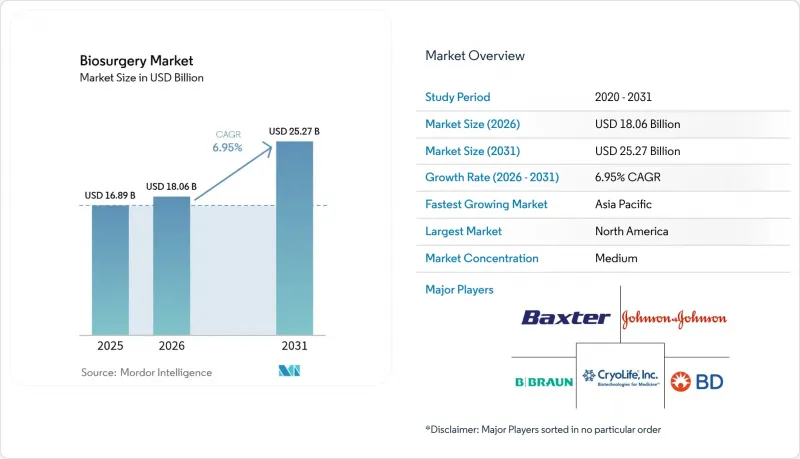
Mordor Intelligence에 의하면, 2026년 바이오 외과 시장 규모는 180억 6,000만 달러로 추정되며, 2025년 168억 9,000만 달러에서 2031년에는 252억 7,000만 달러에 달할 것으로 예측됩니다.
또한, 2026년부터 2031년까지의 연평균 성장률(CAGR)은 6.95%를 기록할 것으로 전망됩니다.
본 보고서는 제품별(골이식 대체재, 지혈제, 유착 방지제 등), 원료별(생물 유래, 합성/반합성), 용도별(정형외과 수술, 일반외과 수술 등), 최종 사용자별(병원, 외래수술센터(ASC) 등) 및 지역별(북미, 유럽, 아시아태평양 등)로 분류되어 있습니다. 시장 전망은 금액(달러) 기준으로 제시되어 있습니다.
세계 바이오서저리 시장 동향 및 인사이트
고령 환자 및 동반 질환을 가진 환자 수의 급증
수술 환자의 연령 중앙값은 2008년부터 2020년 사이에 56세에서 59세로 상승했으며, 2030년까지 61.5세에 도달할 것으로 예측됩니다. 이에 따라 취약한 조직의 출혈을 안전하게 제어하는 제품에 대한 수요가 증가하고 있습니다. 동시에 수술 대상자의 비만 유병률도 증가하고 있으며, 2030년까지 80%가 표준 이상의 BMI를 보일 것으로 예상되어 지혈을 더욱 어렵게 만들고 있습니다. 제네바의 3차 의료기관에서는 지난 10년간 고위험 고령자에 대한 마취 사례가 48.3% 증가한 것으로 보고되었으며, 의료 시스템이 복잡한 고령 환자 프로파일에 대해서도 수술을 수행하려는 태도를 강화하고 있음이 드러나고 있습니다. 90세 이상 환자의 경우, 전신 마취를 적용했을 때의 합병증 발생률은 32%를 초과하지만, 국소 마취에서는 19.4%에 그치고 있어, 이는 첨단 기술로 신체에 부담이 적은 바이오 외과 치료법의 필요성을 부각시키고 있습니다. 이러한 인구 통계학적 변화가 바이오외과 시장의 장기적인 성장을 확고히 하고 있습니다.
복잡하면서도 저침습적인 수술 건수 증가
북유럽 국가에서는 로봇 보조 탈장 교정술이 전체 교정술의 5% 미만에 그치고 있지만, 좁은 해부학적 공간 내에서 작동하는 로봇 플랫폼이 전 세계적으로 보급되고 있음을 반영하여 꾸준히 증가하고 있습니다. 복강경 및 로봇 보조 요추 고정술은 개복 수술에 비해 합병증 발생률이 낮고 회복 기간도 단축되지만, 제한된 수술 영역에서 확실하게 기능하는 실란트나 접착제에 의존하고 있습니다. 심혈관 분야에서도 유사한 추세가 나타납니다. 2025년에는 펄스 필드 절제술 제품이 주요 제조업체의 매출을 30% 가까이 끌어올릴 것으로 예상되며, 생체 활성 보조제와 원활하게 통합되어야 하는 첨단 의료기기의 채택이 꾸준히 확대되고 있음을 보여줍니다. 신흥 시장이 로봇 기술과 고해상도 영상 진단에 투자함에 따라, 생체의학 수술 시장은 더욱 큰 호재를 맞이하고 있습니다.
높은 가격 책정과 제한된 보험 환급
CMS(미국 의료보험서비스센터)는 2025년에 상처 치료에 대한 평균 지급액을 2.93% 삭감할 계획이며, 이로 인해 병원 예산이逼迫되어 고가의 바이오 외과 제품 조달에 압박이 가해지고 있습니다. 자가혈 유래 혈소판이 풍부한 혈장(PRP)은 당뇨병성 궤양에서 양호한 치료 성과를 보이고 있음에도 불구하고, 일관된 보험 환급 제도가 확립되지 않아 임상의들은 비용과 유효성을 저울질할 수밖에 없습니다. 신흥 시장에서는 이 문제가 더욱 심각해지고 있습니다. 브라질의 수입 관세로 인해 가격이 급등하여, 고급 생체 재료에 대한 접근이 제한되고 있습니다. 보험 환급 제도가 기술 혁신을 따라가지 못하고 있어 최신 제품의 보급 현황은 제각각이며, 바이오 외과 시장의 잠재력을 충분히 발휘하지 못하고 있습니다.
부문 분석
2025년, 골 이식 대체재는 정형외과 및 치과 수술 건수 증가로 인해 바이오 외과 시장 점유율의 32.97%를 차지했습니다. 이 부문은 종양 재발을 억제하고, 골 형성을 촉진하며, 고유한 항균 작용을 가진 3가지 원소가 도핑된 하이드록시아파타이트-폴리카프로락톤 스캐폴드의 혜택을 받고 있습니다. 지혈제는 54유형의 FDA 승인 제제가 개방 수술 및 최소 침습 수술용으로 다양한 형태를 제공하고 있어, 각 전문 분야에서 여전히 핵심 제품으로 자리 잡고 있습니다. SEPRAFILM으로 대표되는 유착 방지제는 섬유성 흉터 형성을 억제함으로써 재수술 횟수를 줄여줍니다. 비록 틈새 시장이지만, 스테이플 사용을 확대하는 로봇 수술의 보급에 따라 스테이플 라인 보강 제품도 주목받고 있습니다.
연평균 성장률(CAGR) 7.55%로 가장 빠르게 성장하고 있는 제품군인 외과용 실란트 및 접착제는 수혈량을 35% 줄이고 수술 시간을 25분 단축한 피브린 실란트 등의 혁신 기술의 혜택을 받고 있습니다. 2025년에 출시된 상온 보관 가능한 패치는 냉장 보관이 필요 없어져 물류 부담을 줄이고 적용 범위를 확대되고 있습니다. FDA 승인을 받은 유일한 내부 탈장용 실란트인 액체 접착제 ‘LIQUIFIX’는 복잡한 복원 수술에서 의료기기의 전문화를 상징합니다. 이러한 획기적인 발전은 재료 과학, 사용 편의성, 수술 시간 단축이 바이오 외과 시장을 어떻게 견인하고 있는지를 여실히 보여줍니다.
2025년 매출액 중 생체 유래 제품이 61.24%를 차지했습니다. 이는 치유 과정에 자연스럽게 통합되는 피브린 및 콜라겐 매트릭스에 힘입은 결과입니다. 혈장 유래 의약품에 대한 수요는 2030년까지 30% 증가할 것으로 예상되지만, 채취량 부족이 여전히 지속되고 있어 각국 정부는 혈장 공급의 현지화를 추진하고 있습니다. 그리폴스(Grifols)사의 ADFIRST 피브리노겐 연구와 같은 임상시험은 생체 유래 제품 분야의 지속적인 혁신을 뒷받침하고 있습니다.
한편, 합성 및 반합성 소재는 연평균 성장률(CAGR) 8.29%로 시장 평균을 상회하는 속도로 성장하고 있습니다. 현재 유방 재건술에 대한 임상시험이 진행 중인 완전 흡수성 P4HB 스캐폴드와 같은 고분자 구조체는 이물질이 잔류하지 않으면서도 장기적인 지지력을 보장합니다. 항생제가 함유된 주사용 알긴산-콜라겐 하이드로겔은 여러 번 투여하는 전신 요법과 동등한 단일 투여 효능을 보여주고 있어, 감염 위험을 줄이는 동시에 항생제에 대한 전반적인 노출을 억제하고 있습니다. 의약품 콜드체인에 대한 투자 증가(2035년까지 96억 달러에 달할 것으로 예상)는 합성 소재가 피하고 있는 생물학적 제제의 유통상 과제를 부각시키고 있습니다. 따라서 바이오 외과 시장은 양극화되어 있으며, 고성능이 요구되는 적응증에서는 생물학적 제제가 주류를 이루고, 비용과 물류가 가장 중요시되는 분야에서는 합성 소재가 두각을 나타내고 있습니다.
지역별 분석
2025년, 북미는 바이오 수술 시장의 41.34%를 차지했습니다. 이는 견실한 보험 환급, 높은 시술 건수, 그리고 꾸준한 규제 심사 진행에 힘입은 결과입니다. 2024년에 FDA 승인을 받은 여러 혈소판 농축 혈장(PRP)용 기기는 해당 지역에서 기술이 급속히 도입되고 있음을 여실히 보여줍니다. 캐나다에서는 공립 병원의 현대화가 가속화되고 있는 반면, 멕시코에서는 국경을 초월한 의료기기 공급망을 활용하고 있으나, 규제 조화는 여전히 진행 중입니다.
유럽에서는 냉장 물류가 필요 없는 상온 밀봉 패치의 채택이 견조한 추세를 보이고 있으며, 특히 중규모 병원을 중심으로 접근성이 확대되고 있습니다. EMA와 FDA의 협력 체제를 통해 동시 신청이 지원되고 있지만, 서류상의 미묘한 차이로 인해 일부 승인은 시간이 걸리고 있습니다. 제조 자동화 및 지속가능성에 대한 투자는 이 지역의 엄격한 환경 기준과 부합하며, 조달 기준을 착실히 형성하고 있습니다.
연평균 성장률(CAGR) 8.01%로 예측되는 아시아태평양은 인구 동향의 모멘텀과 인프라 투자에 힘입어 성장하고 있으며, 중국의 1,500만 달러 규모의 혈장 채취 시설 등 현지 생산 이니셔티브는 공급 확보와 바이러스 안전 기준 준수를 목표로 하고 있습니다. 이 지역은 취약한 콜드체인에 직면해 있어, 열대 기후에서도 제품 품질을 유지하는 AI 기반 모니터링 도구의 개발이 촉진되고 있습니다. 중동 및 아프리카 및 남미는 다른 지역에 비해 뒤처져 있지만, 공공 및 민간 보험사의 수술 보험 적용 범위 확대에 따라 수술 시행률은 상승 추세를 보이고 있습니다. 또한, 브라질의 규제 대대적인 개편은 지역적 표준화가 진행되고 있음을 시사합니다.
기타 혜택:
- 엑셀 형식 시장 예측(ME) 시트
- 3개월간의 애널리스트 지원
자주 묻는 질문
목차
제1장 서론
제2장 조사 방법
제3장 주요 요약
제4장 시장 구도
제5장 시장 규모와 성장 예측
제6장 경쟁 구도
제7장 시장 기회와 향후 전망
LSH 26.09.04According to Mordor Intelligence, biosurgery market size in 2026 is estimated at USD 18.06 billion, growing from 2025 value of USD 16.89 billion with 2031 projections showing USD 25.27 billion, growing at 6.95% CAGR over 2026-2031.
This report is Segmented by Product (Bone-Graft Substitutes, Hemostatic Agents, Adhesion Barriers, and More), Source (Biologic, Synthetic/Semi-synthetic), Application (Orthopedic Surgery, General Surgery, and More), End User (Hospitals, Ambulatory Surgical Centres, and More), and Geography (North America, Europe, Asia-Pacific, and More). The Market Forecasts are Provided in Terms of Value (USD).
Global Biosurgery Market Trends and Insights
Surging Geriatric & Co-Morbid Patient Pool
The median age of surgical patients climbed from 56 to 59 years between 2008 and 2020 and is projected to reach 61.5 years by 2030, amplifying demand for products that safely control bleeding in fragile tissue. Concurrently, obesity prevalence among surgical candidates is increasing, with 80% expected to present above-normal BMI by 2030, further complicating hemostasis. A Geneva tertiary center documented a 48.3% rise in high-risk elderly anesthesia cases over the past decade, underscoring healthcare systems' willingness to operate on complex geriatric profiles. Complication rates exceed 32% in patients over 90 years when general anesthesia is applied, compared with 19.4% under regional techniques, highlighting the need for advanced, minimally traumatic biosurgical options. These demographic shifts secure long-horizon growth for the biosurgery market.
Rise in Complex & Minimally Invasive Surgical Volumes
Robotic hernia repairs, though under 5% of all repairs in Nordic countries, are climbing steadily, reflecting global adoption of robotic platforms that work within confined anatomical spaces. Laparoscopic and robotic lumbar fusion surgeries show lower complication rates and reduced recovery times than open procedures, but they depend on sealants and adhesives that perform reliably in limited fields. Cardiovascular settings echo this trend: pulsed-field ablation products yielded nearly 30% revenue growth for a leading manufacturer in 2025, signalling robust uptake of advanced devices that must integrate seamlessly with bioactive adjuncts. As emerging markets invest in robotics and high-definition imaging, the biosurgery market receives another tailwind.
Premium Pricing & Limited Reimbursement
CMS plans a 2.93% cut to average wound-care payments in 2025, tightening hospital budgets and pressuring procurement of premium biosurgery products. Autologous platelet-rich plasma lacks consistent reimbursement despite favorable outcomes in diabetic ulcers, prompting clinicians to weigh cost against efficacy. Emerging markets magnify the challenge; Brazil's import tariffs elevate prices and restrict access to high-end biomaterials. As reimbursement lags innovation, uptake of the newest offerings is uneven, tempering the biosurgery market's full potential.
Other drivers and restraints analyzed in the detailed report include:
- Pipeline of Next-Gen Biomaterials & Combination Products
- Hospital-At-Home Reimbursement Accelerating Demand for Rapid Wound-Closure Kits
- Stringent Multi-Jurisdiction Biologic Approval Pathways
For complete list of drivers and restraints, kindly check the Table Of Contents.
Segment Analysis
Bone-graft substitutes captured 32.97% of the biosurgery market share in 2025, owing to escalating orthopedic and dental surgery volumes. The segment benefits from tri-element-doped hydroxyapatite-polycaprolactone scaffolds that inhibit tumor recurrence, foster osteogenesis, and provide inherent antibacterial action. Hemostatic agents remain core staples across specialties, as 54 FDA-approved formulations offer varied formats for open and minimally invasive procedures. Adhesion barriers, typified by SEPRAFILM, decrease repeat operations by limiting fibrous scar formation. While niche, staple-line reinforcement products gain traction alongside robotic surgeries that amplify staple use.
Surgical sealants and adhesives, the fastest-growing product set at 7.55% CAGR, benefit from innovations such as a fibrin sealant that cut transfusions 35% and trimmed operating time by 25 minutes. A room-temperature patch launched in 2025 eliminates refrigeration, easing logistics and broadening reach. LIQUIFIX liquid adhesive, the only FDA-cleared internal hernia sealant, exemplifies device specialization in complex repairs. These breakthroughs highlight how materials science, ease-of-use, and procedure-time savings propel the biosurgery market.
Biologic offerings commanded 61.24% of 2025 revenue, buoyed by fibrin and collagen matrices that integrate naturally into healing pathways. Demand for plasma-derived medicinal products is projected to climb 30% by 2030, yet collection shortfalls linger, prompting governments to localize plasma supply. Clinical trials such as Grifols' ADFIRST fibrinogen study underline ongoing biologic innovation.
Synthetic and semi-synthetic materials, however, are outpacing the market at an 8.29% CAGR. Polymer constructs like a fully absorbable P4HB scaffold now in breast revision trials promise durable support without foreign-body permanence. Injectable alginate-collagen hydrogels loaded with antibiotics demonstrated single-dose efficacy equal to multi-dose systemic regimens, mitigating infection risk while curbing overall antibiotic exposure. Rising pharmaceutical cold-chain investment (USD 9.6 billion expected by 2035) underscores biologic distribution hurdles that synthetics circumvent. The biosurgery market thus bifurcates, with biologics prevailing in high-performance indications and synthetics thriving where cost and logistics matter most.
Complete Report Scope:
- By Product Type
- Bone-Graft Substitutes
- Hemostatic Agents
- Surgical Sealants & Adhesives
- Adhesion Barriers
- Soft-Tissue Attachments
- Staple-Line Reinforcement
- By Source
- Biologic
- Synthetic / Semi-synthetic
- By Application
- Orthopedic Surgery
- General Surgery
- Neurological Surgery
- Cardiovascular Surgery
- Gynecological Surgery
- Thoracic & Reconstructive Surgery
- By End User
- Hospitals
- Ambulatory Surgical Centres
- Speciality Clinics
- By Geography
- North America
- United States
- Canada
- Mexico
- Europe
- Germany
- United Kingdom
- France
- Italy
- Spain
- Rest of Europe
- Asia-Pacific
- China
- Japan
- India
- Australia
- South Korea
- Rest of Asia-Pacific
- Middle East & Africa
- GCC
- South Africa
- Rest of Middle East & Africa
- South America
- Brazil
- Argentina
- Rest of South America
- North America
Geography Analysis
North America represented 41.34% of the biosurgery market in 2025, underpinned by robust reimbursement, high procedure volumes, and steady regulatory throughput. Multiple platelet-rich-plasma devices cleared by the FDA in 2024 spotlight the region's rapid technology adoption. Canada accelerates public-hospital modernization, while Mexico leverages cross-border device supply chains, though regulatory harmonization continues to evolve.
Europe sustains strong uptake of room-temperature sealing patches that bypass cold logistics, widening access especially in midsize hospitals. EMA-FDA cooperative frameworks support simultaneous submissions, yet subtle documentation differences prolong some approvals. Investments in manufacturing automation and sustainability align with the region's stringent environmental standards, steadily shaping procurement criteria.
Asia-Pacific, forecast at an 8.01% CAGR, is propelled by demographic momentum and infrastructure spend, with the local production initiatives, such as a USD 15 million plasma-collection facility in China, aim to secure supply and meet viral-safety norms. The region confronts fragile cold chains, spurring AI-driven monitoring tools that maintain product integrity in tropical climates. Middle East & Africa and South America trail but show rising procedure rates as public and private insurers broaden surgical coverage; regulatory overhauls in Brazil signal growing regional standardization.
- Johnson & Johnson
- Baxter
- Beckton Dickinson
- Medtronic
- B. Braun
- Integra LifeSciences
- CSL Behring
- CryoLife (Artivion)
- Hemostasis
- Arch Therapeutics
- Kuros Biosciences
- Zimmer Biomet
- Stryker
- Sanofi
- Terumo
- Advanced Medical Solutions (AMS)
- Grifols
- Gluetec AG
- Collagen Matrix
- Orthofix
Additional Benefits:
- The market estimate (ME) sheet in Excel format
- 3 months of analyst support
TABLE OF CONTENTS
1 Introduction
- 1.1 Study Assumptions & Market Definition
- 1.2 Scope of the Study
2 Research Methodology
3 Executive Summary
4 Market Landscape
- 4.1 Market Overview
- 4.2 Market Drivers
- 4.2.1 Surging Geriatric & Co-Morbid Patient Pool
- 4.2.2 Rise in Complex & Minimally-Invasive Surgical Volumes
- 4.2.3 Pipeline of Next-Gen Biomaterials & Combination Products
- 4.2.4 Hospital-At-Home Reimbursement Accelerating Demand for Rapid Wound-Closure Kits
- 4.2.5 Point-Of-Care 3-D Printed, Bioresorbable Scaffolds
- 4.2.6 Supplier Localisation of Plasma-Derived Sealants for Viral-Safety Compliance
- 4.3 Market Restraints
- 4.3.1 Premium Pricing & Limited Reimbursement
- 4.3.2 Stringent Multi-Jurisdiction Biologic Approval Pathways
- 4.3.3 Cold-Chain Fragility of Biologic Sealants in Emerging Markets
- 4.3.4 Collagen-Derived Graft Contamination & AMR Scrutiny
- 4.4 Porter's Five Forces Analysis
- 4.4.1 Threat of New Entrants
- 4.4.2 Bargaining Power of Buyers
- 4.4.3 Bargaining Power of Suppliers
- 4.4.4 Threat of Substitutes
- 4.4.5 Competitive Rivalry
5 Market Size & Growth Forecasts (Value in USD)
- 5.1 By Product Type
- 5.1.1 Bone-Graft Substitutes
- 5.1.2 Hemostatic Agents
- 5.1.3 Surgical Sealants & Adhesives
- 5.1.4 Adhesion Barriers
- 5.1.5 Soft-Tissue Attachments
- 5.1.6 Staple-Line Reinforcement
- 5.2 By Source
- 5.2.1 Biologic
- 5.2.2 Synthetic / Semi-synthetic
- 5.3 By Application
- 5.3.1 Orthopedic Surgery
- 5.3.2 General Surgery
- 5.3.3 Neurological Surgery
- 5.3.4 Cardiovascular Surgery
- 5.3.5 Gynecological Surgery
- 5.3.6 Thoracic & Reconstructive Surgery
- 5.4 By End User
- 5.4.1 Hospitals
- 5.4.2 Ambulatory Surgical Centres
- 5.4.3 Speciality Clinics
- 5.5 By Geography
- 5.5.1 North America
- 5.5.1.1 United States
- 5.5.1.2 Canada
- 5.5.1.3 Mexico
- 5.5.2 Europe
- 5.5.2.1 Germany
- 5.5.2.2 United Kingdom
- 5.5.2.3 France
- 5.5.2.4 Italy
- 5.5.2.5 Spain
- 5.5.2.6 Rest of Europe
- 5.5.3 Asia-Pacific
- 5.5.3.1 China
- 5.5.3.2 Japan
- 5.5.3.3 India
- 5.5.3.4 Australia
- 5.5.3.5 South Korea
- 5.5.3.6 Rest of Asia-Pacific
- 5.5.4 Middle East & Africa
- 5.5.4.1 GCC
- 5.5.4.2 South Africa
- 5.5.4.3 Rest of Middle East & Africa
- 5.5.5 South America
- 5.5.5.1 Brazil
- 5.5.5.2 Argentina
- 5.5.5.3 Rest of South America
- 5.5.1 North America
6 Competitive Landscape
- 6.1 Market Concentration
- 6.2 Market Share Analysis
- 6.3 Company Profiles (includes Global level Overview, Market level overview, Core Segments, Financials as available, Strategic Information, Market Rank/Share for key companies, Products & Services, and Recent Developments)
- 6.3.1 Johnson & Johnson
- 6.3.2 Baxter International Inc.
- 6.3.3 Becton, Dickinson & Company
- 6.3.4 Medtronic
- 6.3.5 B. Braun Melsungen AG
- 6.3.6 Integra LifeSciences
- 6.3.7 CSL Behring
- 6.3.8 CryoLife (Artivion)
- 6.3.9 Hemostasis LLC
- 6.3.10 Arch Therapeutics
- 6.3.11 Kuros Biosciences
- 6.3.12 Zimmer Biomet
- 6.3.13 Stryker Corporation
- 6.3.14 Sanofi
- 6.3.15 Terumo Corporation
- 6.3.16 Advanced Medical Solutions (AMS)
- 6.3.17 Grifols S.A.
- 6.3.18 Gluetec AG
- 6.3.19 Collagen Matrix Inc.
- 6.3.20 Orthofix Medical Inc.
7 Market Opportunities & Future Outlook
- 7.1 White-space & Unmet-need Assessment