|
시장보고서
상품코드
2123400
서보 모터 및 드라이브 시장 : 점유율 분석, 업계 동향과 통계, 성장 예측(2026-2031년)Servo Motors And Drives - Market Share Analysis, Industry Trends & Statistics, Growth Forecasts (2026 - 2031) |
||||||
 Mordor Intelligence
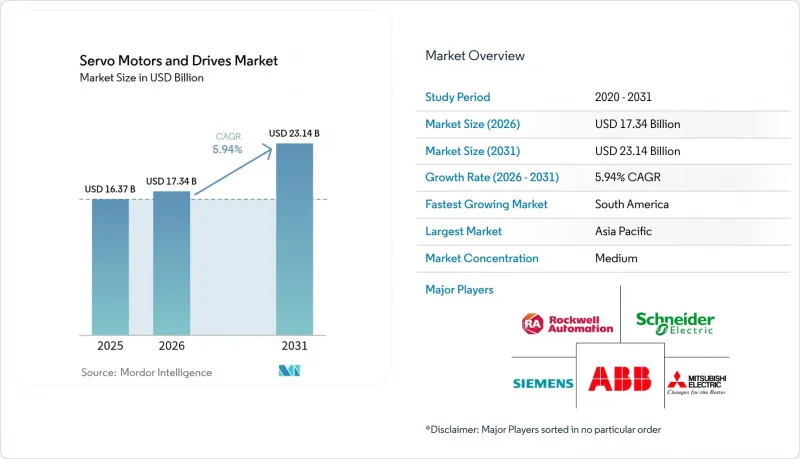
Mordor Intelligence에 의하면, 서보 모터 및 드라이브 시장 규모는 2025년에 163억 7,000만 달러, 2026년에 173억 4,000만 달러가 되어, 2031년까지 231억 4,000만 달러에 이를 것으로 예측되며, 2026년부터 2031년까지 CAGR 5.94%로 성장할 전망입니다.
본 보고서는 제품 유형(모터 및 드라이브), 전압 범위(저전압, 중전압, 고전압), 최종 사용자 산업(포장 및 라벨링, 반도체 및 전자, 화학제품 및 석유화학제품,식품 및 음료, 섬유·인쇄 등), 정격 출력(1kW 미만, 15kW 이상 등), 지역별로 분류되어 있습니다. 시장 예측은 금액(달러) 기준으로 제시되어 있습니다.
전 세계 서보 모터 및 드라이브 시장 동향과 인사이트
급속한 산업 자동화 및 스마트 팩토리 도입
각 제조업체는 무인 생산 모델 도입을 가속화하고 있으며, 서보는 단순한 옵션 업그레이드에서 필수 인프라로 그 위상이 변화하고 있습니다. 딜로이트의 조사에 따르면, 생산 기업의 68%가 2년 이내에 자율형 자재 운반 시스템을 도입할 의향이 있는 것으로 나타났습니다. 전자기기 조립 라인은 현재 분기마다 재구성되고 있으며, 서보 시스템은 고정식 자동화로는 실현할 수 없는 서브 mm 단위의 재현성을 가능하게 하고 있습니다. 자동차 및 소비자 가전 공장에서는 2026년에 라인당 서보 탑재량을 23% 늘리고, 제품 변종 급증에 대응하기 위해 공압 액추에이터를 대체했습니다. 2025년에는 전 세계 로봇 도입 대수가 55만 3,000대에 달했으며, 연간 330만 대 이상의 새로운 서보 모터가 추가되었습니다. 중국에서는 150억 위안(21억 달러) 규모의 표적형 보조금을 통해 서보 드라이브와 산업용 IoT를 통합하는 업그레이드가 가속화되어 2차 및 3차 시장이 개척되었습니다.
협동 로봇 및 이동형 로봇의 도입 확대
협동 로봇과 자율 이동 로봇은 대규모 공장에서 중소기업으로 보급이 확대되고 있으며, 각 유닛에는 유연한 동작을 실현하기 위해 6-8개의 프레임리스 서보 모터가 탑재되어 있습니다. 2025년 이동 로봇의 전 세계 출하 대수는 14만 대에 달할 전망이며, ABB는 1개 거점당 50-100대의 차량을 운영하는 체제에 힘입어 이동 로봇 부문 매출이 41% 증가했다고 보고했습니다. 대형 물류 기업에서 채택하고 있는 보스턴 다이내믹스의 ‘Stretch’는 11축 서보를 탑재하고 있어, 로봇 1대당 서보 수가 증가하고 있음을 보여줍니다. 이동 기능과 조작 기능의 결합으로 수요가 높아지면서, 2028년까지 물류 분야의 두 자릿수 성장이 지속될 것으로 전망됩니다.
유도 모터나 스테핑 모터와 같은 대체품에 비해 높은 초기 비용
5kW 서보 패키지의 평균 가격은 2,800달러인 반면, VFD(가변 주파수 드라이브)가 장착된 유도 모터는 950달러, 스테핑 모터는 600달러로, 중간 정도의 부하 작업에서는 3-5년 내에 투자 회수가 가능합니다. 신흥 시장의 중소기업은 특히 저비용 인건비가 자동화의 이점을 상회하는 경우, 자본을 절약하기 위해 스테핑 모터를 선택하는 경우가 많습니다. 수명 주기 전반에 걸친 이점은 조달 팀에게 반드시 명확하게 드러나지 않기 때문에 결정은 초기 비용이 가장 낮은 쪽으로 치우치는 경향이 있습니다. 현재 공급업체들은 성과 기반 계약을 제공하고 있지만, 2025년 기준 보급률은 15% 미만에 그쳤습니다.
부문 분석
2025년, 서보 모터 및 드라이브 시장에서 모터는 103억 9,000만 달러의 매출을 창출하며 시장 점유율의 63.47%를 차지했습니다. 이 점유율은 2031년까지 연평균 성장률(CAGR) 6.37%로 확대될 것으로 예측됩니다. AC 회전식 모델이 주류를 이루고 있는 이유는 그 높은 토크 대 관성비가 밀리초 단위의 응답 시간이 필요한 다축 CNC 가공기나 다관절 로봇에 적합하기 때문입니다. 브러쉬리스 DC 모터는 생산량은 적지만, 낮은 아웃가스성과 극한 온도 조건에서의 성능이 필수적인 외과용 로봇 및 항공우주용 기구 분야에서 주목받고 있습니다. 리니어 모터는 매출의 5% 미만을 차지할 뿐이지만, 서브마이크론 수준의 정밀도와 기계적 백래시 제거 덕분에 반도체 리소그래피 분야에서 두 자릿수 성장을 기록하고 있습니다.
드라이브 시장은 2025년에 59억 8,000만 달러의 매출을 기록하고, 안전성, 분석 기능, 다축 연동 기능을 통합한 지능형 모션 허브로 진화하고 있습니다. 이러한 변화의 기반이 되는 것은 AC 서보 드라이브이지만, 기계 제조업체들이 최대 64축을 하나의 랙에 통합함에 따라 조정 가능한 다축 플랫폼이 가장 빠르게 성장하고 있습니다. 일체형 모터·드라이브 액추에이터의 채택률은 신규 설치의 18%에 달하며, 캐비닛 공간을 줄이는 동시에 IEC 61800-5-2 기능 안전 규격 준수를 간소화하고 있습니다. 각 벤더는 현재 클라우드 연결형 진단 기능을 번들로 제공하여 구독 수익을 창출하고 있으며, 차별화의 새로운 영역은 하드웨어가 아닌 소프트웨어로 옮겨가고 있습니다.
2025년에는 1,000V 미만의 저전압 시스템이 매출의 72.38%를 차지했습니다. 이는 표준화된 400V 및 480V 산업용 전력망과 인증 주기를 단축하는 확립된 안전 기준에 힘입은 결과입니다. 이러한 플랫폼은 로봇 공학, 포장, 모바일 자동화 분야에서 주류를 이루고 있으며, 이 분야에서는 순수한 출력보다 컴팩트한 형태와 충격 위험이 낮다는 점이 더 중요하게 여겨집니다. 배터리 구동 협동 로봇과 무인 운반차(AGV)는 일관되게 저전압 서보를 채택하고 있으며, 평균 판매 가격이 하락하고 있음에도 불구하고 높은 판매 대수를 유지하는 데 기여하고 있습니다. 또한, 성숙한 공장의 개보수 시에도 고가의 개폐 장치를 업그레이드할 필요가 없고, 기존 배전반 레이아웃에 그대로 통합할 수 있기 때문에 600V 미만의 솔루션이 선호되고 있습니다.
1,000V에서 10,000V 범위의 중전압 제품은 연평균 성장률(CAGR) 6.54%로 확대되고 있으며, 이는 전압 등급 중 가장 빠른 성장률입니다. 이는 금속 가공, 광업, 석유 및 가스 산업에서 직류(DC) 구동 및 유압 구동이 정밀한 교류(AC) 서보로 대체되고 있기 때문입니다. 예를 들어, 새로운 강대 압연기에는 수율을 향상시키고 가동 중지 시간을 대폭 줄여주는 메가와트급 서보 스탠드가 도입되어, 그 높은 가격도 정당화되고 있습니다. 액티브 프론트엔드 정류기 및 공통 DC 버스 아키텍처를 통해 플랜트에서는 중전압 주전원과 저전압 모터를 결합할 수 있게 되어, 설치 면적과 효율을 모두 최적화할 수 있게 되었습니다. 10kV를 초과하는 고전압 제품은 여전히 입자 가속기나 항공우주용 발전기와 같은 특수한 틈새 시장을 대상으로 하고 있지만, 실리콘 카바이드 절연 기술의 점진적인 발전으로 인해 향후 10년 후반에는 보다 광범위한 산업용도로의 확대가 가능해질 가능성이 있습니다.
지역별 분석
2025년에는 아시아태평양이 전 세계 매출의 39.73%를 차지하며, 이 지역은 전자, 기계, 로봇 공학 분야의 생산 거점으로서의 역할을 두드러지게 했습니다. 중국에서만 2025년에 450만 대의 서보 모터가 생산되었으며, 국내 브랜드는 분해능과 열 안정성 면에서의 격차를 좁힘으로써 국내 수요의 55%를 차지했습니다. ‘중국 제조 2025’ 계획에서는 80억 위안(11억 달러)의 설비 갱신 보조금이 지급되었으며, 고정밀 서보 드라이브를 탑재한 CNC 공작기계 및 로봇이 우선적으로 지원받았습니다. 일본은 2,870억 엔(20억 달러) 상당의 서보 제품을 수출하여, 나노미터 단위의 위치 결정 정밀도가 필요한 반도체 및 의료기기 분야에서 주도적인 위치를 유지했습니다. 인도의 ‘생산 연계형 인센티브(PLI)’ 제도는 2025년에 12,500카롤 루피(15억 달러)를 투입하여, 18만 축의 신규 증설을 가져올 조립 라인에 자금을 지원함으로써,해당 지역의 서보 모터 및 드라이브 시장을 대폭 확대시켰습니다.
북미는 ‘CHIPS and Science Act’에 따른 반도체 제조 지원금 390억 달러에 힘입어 2025년 매출의 24% 가까이 차지했습니다. 인텔, TSMC, 삼성의 신규 팹에는 웨이퍼 핸들링, 리소그래피, 계측을 위해 각각 5,000-8,000축이 통합되어 있어, 고정밀 서보 모터 수주 증가를 견인하고 있습니다. 록웰 오토메이션은 숙련된 인력 부족을 보완하기 위해 자동차 및 식품 가공 업계가 자동화를 추진한 결과, 해당 지역에서의 수주가 18% 급증했다고 보고했습니다. 멕시코는 2024년부터 2025년까지 350억 달러 규모의 니어쇼어링 투자를 유치하고, 그린필드 공장에 최첨단 자동화 설비를 도입함으로써 북미 시장에서 멕시코의 서보 모터 및 드라이브 시장 점유율을 끌어올렸습니다.
유럽은 2025년에 전 세계 매출의 약 22%를 차지하며, 2027년에 발효될 IE4 효율 기준을 충족하기 위해 기존 설비의 개조를 가속화하고 있습니다. 지멘스는 수출 기업들이 포장 장비 및 CNC 기계에 ‘Sinamics S210’ 플랫폼을 탑재함에 따라 독일과 이탈리아에서 서보 드라이브 매출이 14% 증가했습니다. 영국의 45억 파운드(57억 달러) 규모의 ‘첨단 제조 계획’에서는 고대역폭 서보 모터가 필요한 항공우주용 복합재료 및 제약 업계의 충전·마감 라인에 자금이 투입되고 있습니다. 브라질과 아르헨티나를 필두로 한 남미 지역은 2031년까지 6.91%라는 가장 높은 연평균 성장률(CAGR)을 나타낼 전망입니다. 이는 2025년에 182억 달러의 외국인 직접 투자가 유입되어 세계 수준에 필적하는 자동화가 요구되기 때문입니다. 중동 및 아프리카의 점유율은 여전히 8% 미만에 그치고 있지만, 사우디아라비아와 아랍에미리트(UAE)의 경제 다각화 프로그램에서 건축자재 및 의약품 분야를 위한 서보 구동 장치가 지정됨에 따라 성장을 이어가고 있습니다.
기타 혜택:
- 엑셀 형식 시장 예측(ME) 시트
- 3개월간의 애널리스트 지원
자주 묻는 질문
목차
제1장 서론
제2장 조사 방법
제3장 주요 요약
제4장 시장 구도
제5장 시장 규모와 성장 예측
제6장 경쟁 구도
제7장 시장 기회와 향후 전망
JHS 26.09.09According to Mordor Intelligence, the servo motors and drives market size is projected to be USD 16.37 billion in 2025, USD 17.34 billion in 2026, and reach USD 23.14 billion by 2031, growing at a CAGR of 5.94% from 2026 to 2031.
This report is Segmented by Product Type (Motor, and Drive), Voltage Range (Low Voltage, Medium Voltage, High Voltage), End-User Industry (Packaging and Labelling, Semiconductor and Electronics, Chemicals and Petrochemicals, Food and Beverage, Textile and Printing, and More), Power Rating (Below 1 KW, Above 15 KW, and More), and Geography. The Market Forecasts are Provided in Terms of Value (USD).
Global Servo Motors And Drives Market Trends and Insights
Rapid Industrial Automation and Smart-Factory Rollout
Manufacturers are accelerating the adoption of lights-out production models, elevating servos from optional upgrades to mandatory infrastructure. Deloitte found that 68% of producers intend to deploy autonomous material-handling within two years. Electronics assembly lines now reconfigure quarterly, and servo systems enable sub-millimeter repeatability that fixed automation cannot match. Automotive and consumer-electronics plants boosted servo content per line by 23% in 2026, replacing pneumatic actuators to handle the proliferation of variants. Global robot installations hit 553,000 units in 2025, adding more than 3.3 million new servo motors annually. Targeted subsidies worth CNY 15 billion (USD 2.1 billion) in China accelerated upgrades that integrate servo drives with industrial IoT, opening Tier-2 and Tier-3 markets.
Rising Adoption of Collaborative and Mobile Robotics
Collaborative robots and autonomous mobile robots are spreading beyond large factories into small and medium enterprises, each unit containing 6-8 frameless servo motors for compliant motion. Global shipments of mobile robots reached 140,000 units in 2025, and ABB reported a 41% revenue jump in its mobile-robot division driven by fleets of 50-100 vehicles per site. Boston Dynamics' Stretch, adopted by major logistics firms, carries 11 servo axes, highlighting the rising servo count per robot. The combination of locomotion and manipulation intensifies demand, sustaining double-digit logistics growth through 2028.
High Upfront Cost versus Induction or Stepper Alternatives
A 5 kW servo package averages USD 2,800, versus USD 950 for an induction motor with a VFD and USD 600 for a stepper, yielding 3-5 year payback horizons for moderate-duty tasks. Emerging-market SMEs frequently choose steppers to conserve capital, especially when low-cost labor offsets the benefits of automation. Lifecycle advantages are not always visible to procurement teams, so decisions tend to skew toward the lowest upfront price. Vendors now offer performance-based contracts, but penetration remained below 15% in 2025.
Other drivers and restraints analyzed in the detailed report include:
- Stringent Global and Regional Energy-Efficiency Mandates
- Transition to Silicon-Carbide Power Modules in Servo Drives
- Supply-Chain Risk for High-Grade Rare-Earth Permanent Magnets
For complete list of drivers and restraints, kindly check the Table Of Contents.
Segment Analysis
Motors generated USD 10.39 billion of the servo motors and drives market in 2025, translating into a 63.47% market share, which is projected to widen at a 6.37% CAGR through 2031. AC rotary models dominate because their high torque-to-inertia ratios suit multi-axis CNC machines and articulated robots that demand millisecond response times. Brushless DC variants, though smaller in volume, are gaining traction in surgical robots and aerospace mechanisms where low outgassing and extreme-temperature performance are critical. Linear motors occupy less than 5% of revenue yet post double-digit growth in semiconductor lithography owing to their sub-micron accuracy and elimination of mechanical backlash.
Drives contributed USD 5.98 billion in 2025 and are evolving into intelligent motion hubs that embed safety, analytics, and multi-axis coordination. AC servo drives form the backbone of this shift, while adjustable multi-axis platforms are the fastest risers as machine builders condense up to 64 axes into one rack. Adoption of integrated motor-drive actuators climbed to 18% of new installations, cutting cabinet space and simplifying compliance with IEC 61800-5-2 functional-safety rules. Vendors now bundle cloud-connected diagnostics that unlock subscription revenue, making software, not hardware, the new frontier for differentiation.
Low-voltage systems below 1,000 V controlled 72.38% of revenue in 2025, driven by standardized 400 V and 480 V industrial grids and well-established safety norms that shorten certification cycles. These platforms dominate robotics, packaging, and mobile automation, where compact form factors and lower shock risk outweigh raw power. Battery-powered collaborative robots and automated guided vehicles universally use low-voltage servos, helping sustain high unit volumes even as average selling prices erode. Retrofits in mature factories also favor sub-600 V solutions because they drop into existing panel layouts without costly switchgear upgrades.
Medium-voltage products ranging from 1,000 V to 10,000 V are expanding at a 6.54% CAGR, the quickest rate among voltage classes, as metals processing, mining, and oil and gas replace DC and hydraulic drives with precision AC servos. New steel strip mills, for instance, deploy megawatt-class servo stands that boost yield and slash downtime, justifying their premium. Active front-end rectifiers and common DC-bus architectures now let plants combine medium-voltage mains with low-voltage motors, optimizing both footprint and efficiency. High-voltage offerings above 10 kV remain a specialized niche serving particle accelerators and aerospace dynos, but incremental gains in silicon-carbide insulation may unlock broader industrial use later in the decade.
Complete Report Scope:
- By Product Type
- Motor
- AC Servo Motor
- DC Brushless Servo Motor
- Brushed DC Servo Motor
- Linear Servo Motor
- Drive
- AC Servo Drive
- DC Servo Drive
- Adjustable / Multi-Axis Servo Drive
- Motor
- By Voltage Range
- Low Voltage
- Medium Voltage
- High Voltage
- By End-User Industry
- Automotive and EV Manufacturing
- Oil and Gas
- Healthcare and Medical Devices
- Packaging and Labelling
- Semiconductor and Electronics
- Chemicals and Petrochemicals
- Food and Beverage
- Textile and Printing
- By Power Rating
- Below 1 kW
- 1 kW-5 kW
- 5 kW-15 kW
- Above 15 kW
- By Geography
- North America
- United States
- Canada
- Mexico
- South America
- Brazil
- Argentina
- Rest of South America
- Europe
- United Kingdom
- Germany
- France
- Italy
- Rest of Europe
- Asia Pacific
- China
- Japan
- India
- South Korea
- Rest of Asia Pacific
- Middle East and Africa
- Middle East
- United Arab Emirates
- Saudi Arabia
- Rest of Middle East
- Africa
- South Africa
- Egypt
- Rest of Africa
- Middle East
- North America
Geography Analysis
Asia-Pacific led with 39.73% of global revenue in 2025, underscoring the region's role as the production hub for electronics, machinery, and robotics. China alone manufactured 4.5 million servo motors in 2025, and domestic brands accounted for 55% of local demand by narrowing the gap in resolution and thermal stability. The Made in China 2025 program disbursed CNY 8 billion (USD 1.1 billion) in upgrade subsidies, prioritizing CNC machines and robots equipped with precision servo drives. Japan exported JPY 287 billion (USD 2.0 billion) in servo products, maintaining leadership in semiconductor and medical equipment that need nanometer positioning accuracy. India's Production-Linked Incentive scheme released INR 12,500 crore (USD 1.5 billion) in 2025, funding assembly lines that added 180,000 new axes and substantially enlarged the regional servo motors and drives market.
North America held close to 24% of 2025 revenue, buoyed by USD 39 billion in semiconductor-fabrication incentives under the CHIPS and Science Act. New fabs from Intel, TSMC, and Samsung each integrate 5,000-8,000 axes for wafer handling, lithography, and metrology, driving incremental orders for high-precision servos. Rockwell Automation reported an 18% regional order spike, with automotive and food processors automating to offset skilled-labor shortages. Mexico attracted USD 35 billion in nearshoring investment during 2024-2025, equipping greenfield plants with state-of-the-art automation and lifting the country's servo motors and drives market share within North America.
Europe captured about 22% of global revenue in 2025 and is accelerating retrofits to meet IE4 efficiency mandates effective 2027. Siemens logged 14% servo-drive growth in Germany and Italy as exporters embedded the Sinamics S210 platform in packaging and CNC machinery. The United Kingdom's GBP 4.5 billion (USD 5.7 billion) Advanced Manufacturing Plan channels funds into aerospace composites and pharmaceutical fill-finish lines that favor high-bandwidth servos. South America, led by Brazil and Argentina, is forecast to post the fastest CAGR of 6.91% through 2031, as USD 18.2 billion in inbound investment in 2025 demands automation on par with global benchmarks. The Middle East and Africa remain below 8% share but are growing as Saudi and Emirati diversification programs specify servo-driven equipment for construction materials and pharmaceuticals.
- Yaskawa Electric Corporation
- Mitsubishi Electric Corporation
- Siemens AG
- Schneider Electric SE
- Rockwell Automation, Inc.
- ABB Ltd.
- Delta Electronics, Inc.
- FANUC Corporation
- Kollmorgen Corporation
- Bosch Rexroth AG
- Panasonic Holdings Corporation
- Nidec Corporation
- Omron Corporation
- Oriental Motor Co., Ltd.
- Lenze SE
- Parker-Hannifin Corporation
- Inovance Technology Co., Ltd.
- Moog Inc.
- WEG Equipamentos Eletricos S.A.
- Emerson Electric Co.
- AMETEK, Inc.
- TECO Electric & Machinery Co., Ltd.
- Nanotec Electronic GmbH & Co. KG
- SANYO DENKI Co., Ltd.
- Fuji Electric Co., Ltd.
Additional Benefits:
- The market estimate (ME) sheet in Excel format
- 3 months of analyst support
TABLE OF CONTENTS
1 INTRODUCTION
- 1.1 Study Assumptions and Market Definition
- 1.2 Scope of the Study
2 RESEARCH METHODOLOGY
3 EXECUTIVE SUMMARY
4 MARKET LANDSCAPE
- 4.1 Market Overview
- 4.2 Market Drivers
- 4.2.1 Rapid Industrial Automation and Smart-Factory Rollout
- 4.2.2 Rising Adoption of Collaborative and Mobile Robotics
- 4.2.3 Stringent Global and Regional Energy-Efficiency Mandates
- 4.2.4 Transition to Silicon-Carbide Power Modules in Servo Drives
- 4.2.5 Digital-Twin-Enabled Predictive Sizing of Servo Systems
- 4.2.6 Growth of Micro-Fulfilment Centres Requiring Compact Servo Actuation
- 4.3 Market Restraints
- 4.3.1 High Upfront Cost versus Induction or Stepper Alternatives
- 4.3.2 Supply-Chain Risk for High-Grade Rare-Earth Permanent Magnets
- 4.3.3 Cyber-Vulnerabilities in Networked Servo Drives Causing Downtime
- 4.3.4 Rising Share of Integrated Servo-Stepper Hybrids Cannibalising Entry-Level Servo Systems
- 4.4 Industry Value Chain Analysis
- 4.5 Regulatory Landscape
- 4.6 Technological Outlook
- 4.7 Porter's Five Forces Analysis
- 4.7.1 Bargaining Power of Suppliers
- 4.7.2 Bargaining Power of Buyers
- 4.7.3 Threat of New Entrants
- 4.7.4 Threat of Substitutes
- 4.7.5 Competitive Rivalry
- 4.8 Impact of Macroeconomic Factors on the Market
- 4.9 Key Use Cases and Case Studies
- 4.10 Investment Analysis
5 MARKET SIZE AND GROWTH FORECASTS (VALUE)
- 5.1 By Product Type
- 5.1.1 Motor
- 5.1.1.1 AC Servo Motor
- 5.1.1.2 DC Brushless Servo Motor
- 5.1.1.3 Brushed DC Servo Motor
- 5.1.1.4 Linear Servo Motor
- 5.1.2 Drive
- 5.1.2.1 AC Servo Drive
- 5.1.2.2 DC Servo Drive
- 5.1.2.3 Adjustable / Multi-Axis Servo Drive
- 5.1.1 Motor
- 5.2 By Voltage Range
- 5.2.1 Low Voltage
- 5.2.2 Medium Voltage
- 5.2.3 High Voltage
- 5.3 By End-User Industry
- 5.3.1 Automotive and EV Manufacturing
- 5.3.2 Oil and Gas
- 5.3.3 Healthcare and Medical Devices
- 5.3.4 Packaging and Labelling
- 5.3.5 Semiconductor and Electronics
- 5.3.6 Chemicals and Petrochemicals
- 5.3.7 Food and Beverage
- 5.3.8 Textile and Printing
- 5.4 By Power Rating
- 5.4.1 Below 1 kW
- 5.4.2 1 kW-5 kW
- 5.4.3 5 kW-15 kW
- 5.4.4 Above 15 kW
- 5.5 By Geography
- 5.5.1 North America
- 5.5.1.1 United States
- 5.5.1.2 Canada
- 5.5.1.3 Mexico
- 5.5.2 South America
- 5.5.2.1 Brazil
- 5.5.2.2 Argentina
- 5.5.2.3 Rest of South America
- 5.5.3 Europe
- 5.5.3.1 United Kingdom
- 5.5.3.2 Germany
- 5.5.3.3 France
- 5.5.3.4 Italy
- 5.5.3.5 Rest of Europe
- 5.5.4 Asia Pacific
- 5.5.4.1 China
- 5.5.4.2 Japan
- 5.5.4.3 India
- 5.5.4.4 South Korea
- 5.5.4.5 Rest of Asia Pacific
- 5.5.5 Middle East and Africa
- 5.5.5.1 Middle East
- 5.5.5.1.1 United Arab Emirates
- 5.5.5.1.2 Saudi Arabia
- 5.5.5.1.3 Rest of Middle East
- 5.5.5.2 Africa
- 5.5.5.2.1 South Africa
- 5.5.5.2.2 Egypt
- 5.5.5.2.3 Rest of Africa
- 5.5.5.1 Middle East
- 5.5.1 North America
6 COMPETITIVE LANDSCAPE
- 6.1 Market Concentration
- 6.2 Strategic Moves
- 6.3 Market Share Analysis
- 6.4 Company Profiles (includes Global Level Overview, Market Level Overview, Core Segments, Financials as available, Strategic Information, Market Rank/Share, Products and Services, Recent Developments)
- 6.4.1 Yaskawa Electric Corporation
- 6.4.2 Mitsubishi Electric Corporation
- 6.4.3 Siemens AG
- 6.4.4 Schneider Electric SE
- 6.4.5 Rockwell Automation, Inc.
- 6.4.6 ABB Ltd.
- 6.4.7 Delta Electronics, Inc.
- 6.4.8 FANUC Corporation
- 6.4.9 Kollmorgen Corporation
- 6.4.10 Bosch Rexroth AG
- 6.4.11 Panasonic Holdings Corporation
- 6.4.12 Nidec Corporation
- 6.4.13 Omron Corporation
- 6.4.14 Oriental Motor Co., Ltd.
- 6.4.15 Lenze SE
- 6.4.16 Parker-Hannifin Corporation
- 6.4.17 Inovance Technology Co., Ltd.
- 6.4.18 Moog Inc.
- 6.4.19 WEG Equipamentos Eletricos S.A.
- 6.4.20 Emerson Electric Co.
- 6.4.21 AMETEK, Inc.
- 6.4.22 TECO Electric & Machinery Co., Ltd.
- 6.4.23 Nanotec Electronic GmbH & Co. KG
- 6.4.24 SANYO DENKI Co., Ltd.
- 6.4.25 Fuji Electric Co., Ltd.
7 MARKET OPPORTUNITIES AND FUTURE OUTLOOK
- 7.1 White-Space and Unmet-Need Assessment