

|
시장보고서
상품코드
2123405
터널 자동화 시장 : 점유율 분석, 업계 동향과 통계, 성장 예측(2026-2031년)Tunnel Automation - Market Share Analysis, Industry Trends & Statistics, Growth Forecasts (2026 - 2031) |
||||||
 Mordor Intelligence
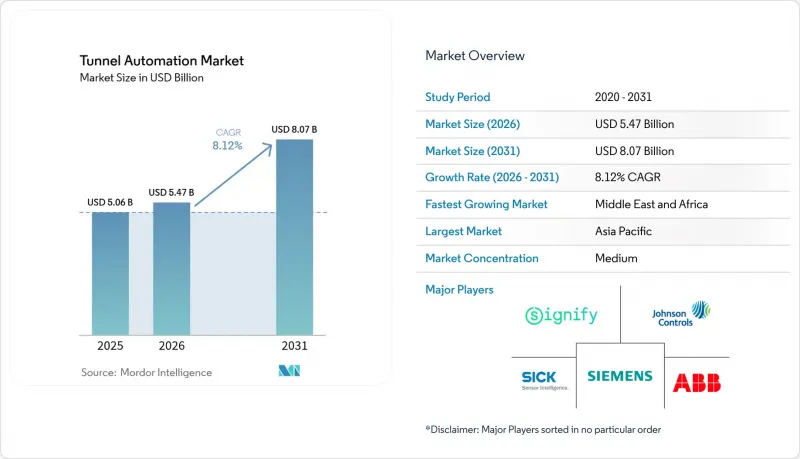
Mordor Intelligence에 의하면, 터널 자동화 시장 규모는 2025년에 50억 6,000만 달러로 평가되었고 2026년 54억 7,000만 달러에서 2031년까지 80억 7,000만 달러에 이를 것으로 예측되며, 예측 기간(2026-2031년) CAGR은 8.12%를 나타낼 전망입니다.
(1) 연방 고속도로청(Federal Highway Administration),‘전국 터널 점검 기준(National Tunnel Inspection Standards)’, ecfr.gov 규제 요건의 강화, IoT 기반 감시 제어·데이터 수집(SCADA) 플랫폼의 보급, 그리고 교통 회랑에 대한 공공 부문의 지속적인 자금 지원이 터널 자동화 시장의 성장 궤도를 뒷받침하고 있습니다. 본 보고서는 제공 형태(하드웨어, 소프트웨어, 서비스), 구성 요소(조명·전원, 신호·제어, 기타), 자동화 수준(반자동화, 완전 자동화), 용도(교통 관리·SCADA, 기타), 터널 유형(도로·고속도로, 철도·지하철, 기타) 및 지역별로 분류되어 있습니다. 시장 전망은 금액(달러) 기준으로 제시되어 있습니다.
전 세계 터널 자동화 시장 동향 및 인사이트
터널의 안전성과 지속가능성 향상을 의무화하는 정부 규제
세계 정책 프레임워크에 따라 터널 자동화 시장의 도입이 가속화되고 있습니다. 미국 ‘국가 터널 검사 기준’에서는 2년마다 점검을 의무화하고 있으며, 운영 사업자에게 자동화된 안전 시스템의 도입을 강제함으로써 사실상 의무적인 갱신 주기가 확립되어 있습니다. 유럽 횡단 교통망(TEN-T)의 유사한 지침에 따라, 브레너 기저 터널과 같은 프로젝트에서는 5,000만 톤의 화물을 도로 운송에서 철도 운송으로 전환할 수 있는 첨단 모니터링 시스템의 도입이 의무화되어 있습니다. 에너지 절약에 관한 법적 목표는 LED 조명으로의 교체 및 고효율 환기를 촉진함으로써 환경 측면의 노력을 뒷받침하고 있습니다. 중국의 감독 기관은 현재 모든 신규 고속도로에 지능형 관리를 의무화하고 있으며, 톈산 승리기통의 독자적인 자동화 기술이 그 한 예입니다. 이러한 규제가 결합되어 규정 준수를 주도하는 대규모 지출이 발생하고 있으며, 자본 예산은 일반적으로 나타나는 연기 주기에서 벗어나고 있습니다.
IoT 지원 SCADA와 클라우드 분석의 통합이 진전
실시간 분석을 통해 운영자는 터널 가동 중단 시간을 최대 40%까지 줄일 수 있으며, 설비의 수명을 연장하고 운영을 예측 유지보수 전략에 부합시킬 수 있습니다. 스페인 솜포트 터널에서 시멘스(Siemens)가 수행한 업그레이드에서는 SIMATIC WinCC OA와 이중화 구성의 S7-1500H PLC를 통합하여 통일된 비상 대응 및 자산 관리를 실현했습니다. 고급 클라우드 플랫폼은 공기질 및 설비 데이터 패턴에 머신러닝 알고리즘을 적용하지만, 한편으로는 악의적인 공격자에 대한 공격 표면을 확대하게 됩니다. 이러한 지식의 격차를 해소하기 위해서는 유지보수 인력의 재교육을 실시하고, 운영 기술(OT)과 IT의 모범 사례를 조화시키는 사이버 보안 거버넌스 모델을 확립해야 합니다.
높은 초기 투자(CAPEX)와 통합의 복잡성
종합적인 자동화에는 막대한 자본이 필요합니다. 특히 기존 터널의 경우 맞춤형 개조 설계나 단계적 도입이 필요하며, 이로 인해 공사 기간이 최대 2년까지 늘어날 가능성이 있습니다. 넷 제로 대응 시설에 관한 미국 연방 정부의 P100 기준에 따라 기본 사양이 상향 조정되어, 결과적으로 초기 예산도 증가합니다. 에너지 성능 계약은 이러한 비용을 일부 상쇄합니다. 존슨 컨트롤즈(Johnson Controls)의 580만 달러 규모의 코브 카운티(Cobb County) 프로그램에서는 에너지 비용 절감을 통해 206만 달러를 절감했으며, 성능 보증을 통해 새로운 자금 조달 경로를 개척할 수 있음을 입증했습니다. 전문 기술자의 만성적인 부족도 통합 작업의 진행을 더욱 복잡하게 만들고 있습니다.
부문 분석
2025년, 터널 자동화 시장에서 하드웨어는 45.75%를 차지하고 있으며, 이는 센서, 컨트롤러, 전력 인프라에 대한 기본적인 수요를 반영합니다. 그러나 소프트웨어는 예측 유지보수 및 자율적 의사 결정을 가능하게 하는 AI 기반 분석 기술의 부양에 힘입어 연평균 성장률(CAGR) 9.62%를 기록하며, 다른 모든 제품 및 서비스를 능가하는 성장을 보일 것으로 예측됩니다.
헬렌 크네히트(Helen Knehcht)사의 ‘Connected’ 플랫폼은 전 세계 TBM의 성능을 추적하고 가동 중단 시간을 줄이는 실시간 인사이트력을 제공함으로써 이러한 변화를 구현하고 있습니다. 서비스(설치, 교정, 수명 주기 관리)는 포트폴리오를 보완하는 요소이며, 사업자가 전문 지식을 외부에 위탁함에 따라 경상 수익의 비중이 확대되고 있습니다.
조명 및 전원 시스템이 38.10%의 점유율을 차지하고 있어, 에너지 효율이 뛰어난 LED와 스마트 전력 제어의 중요성이 부각되고 있습니다. 안전 및 화재 감지 센서는 사고 예방 규제가 강화됨에 따라 연평균 성장률(CAGR) 9.28%로 성장을 주도할 것으로 예측됩니다.
아시아에서 가장 긴 도로 터널에 도입된 ABB의 가변 속도 환기 구동 장치는 에너지 비용을 절감하면서 공기질 관리를 향상시키는 부품 통합의 좋은 사례가 되고 있습니다. 다중 매개변수 센서의 보급이 확대됨에 따라, 지금까지 실현할 수 없었던 실시간 구조 건전성 모니터링이 가능해졌습니다.
지역별 분석
아시아태평양이 터널 자동화 시장에서 42.10%의 점유율을 차지하고 있는 배경에는 끊임없는 설비 투자, 정부 주도의 산업 정책, 그리고 ‘인더스트리 4.0’ 규범이 널리 수용되고 있다는 점이 있습니다. 중국의 규모의 경제로 인해 건설 주기가 단축되었으며, 신장 위구르 자치구의 톈산 승리기 터널에서 입증된 바와 같이 광범위한 자동화를 통해 프로젝트 리드 타임을 거의 절반으로 줄이고 있습니다. 싱가포르의 창이 프로젝트는 항공 인프라와 최첨단 터널 시스템을 통합하는 지역적 전문성을 부각시키고 있는 반면, 호주의 자율 주행 TBM은 기술적 성숙도를 입증하고 있습니다. 민관 협력(PPP)이 표준화되어 있어, 운영자의 인센티브를 장기적인 에너지 및 안전 목표와 일치시키고 있습니다.
중동은 연평균 성장률(CAGR) 10.72%의 전망을 보이며 급속한 성장을 이루고 있습니다. 사우디아라비아의 ‘비전 2030’에서는 로봇을 활용한 제조, AI를 활용한 감시, 탄소 중립 목표가 융합된 대규모 스마트 시티 회랑에 대한 지원이 이루어지고 있습니다. 카타르의 철도 확장 사업과 UAE의 지하철 네트워크에서는 IoT 센서가 미리 내장된 모듈식 터널 패키지가 도입되어 현장 설정 작업을 줄이고 있습니다. 경쟁적인 조달 체계에서는 턴키 방식으로 완전히 통합된 생태계를 제공할 수 있는 공급업체가 우선적으로 선정됩니다.
유럽에서는 엄격한 규정 준수 체계와 국경을 초월한 메가 프로젝트에 힘입어 꾸준한 성장이 이어지고 있습니다. 브레너 기저 터널은 교통 수단 전환 목표 달성을 위해 EU의 공동 자금 지원을 받고 있는 반면, 독일의 SudLink 송전선로에서는 헬렌크네히트(Helen Knecht)사의 TBM을 사용하여 전력 도관을 부설함으로써 전력망의 탈탄소화를 도모하고 있습니다. 브라운필드 개보수 공사가 주류를 이루고 있으며, 특히 LED로 교체할 경우 검증된 60%의 에너지 절감 효과를 실현하고 있습니다.
기타 혜택:
- 엑셀 형식 시장 예측(ME) 시트
- 3개월간의 애널리스트 지원
자주 묻는 질문
목차
제1장 서론
제2장 조사 방법
제3장 주요 요약
제4장 시장 구도
제5장 시장 규모와 성장 예측
제6장 경쟁 구도
제7장 시장 기회와 향후 전망
JHS 26.09.07According to Mordor Intelligence, the tunnel automation market size was valued at USD 5.06 billion in 2025 and estimated to grow from USD 5.47 billion in 2026 to reach USD 8.07 billion by 2031, at a CAGR of 8.12% during the forecast period (2026-2031).
[1] Federal Highway Administration, "National Tunnel Inspection Standards," ecfr.gov Intensifying regulatory mandates, widespread adoption of IoT-enabled supervisory control and data acquisition (SCADA) platforms, and sustained public-sector funding for transportation corridors are reinforcing the growth trajectory of the tunnel automation market. This report is Segmented by Offering (Hardware, Software, Services), Component (Lighting and Power Supply, Signalization and Control, and More), Automation Level (Semi-Automated, Fully-Automated), Application (Traffic Management and SCADA, and More), Tunnel Type (Roadways and Highways, Railways and Metros, and More), and by Geography. The Market Forecasts are Provided in Terms of Value (USD).
Global Tunnel Automation Market Trends and Insights
Government Regulations Mandating Tunnel Safety and Sustainability Upgrades
Worldwide policy frameworks are accelerating the adoption curve of tunnel automation market deployments. The US National Tunnel Inspection Standards require biennial reviews and force operators to introduce automated safety systems, effectively creating a mandatory replacement cycle. Comparable directives within the Trans-European Transport Network compel projects like the Brenner Base Tunnel to employ advanced monitoring that can shift 50 million tonnes of freight from road to rail.Legislated targets for energy savings add an environmental dimension by encouraging LED lighting retrofits and high-efficiency ventilation. China's oversight bodies now require intelligent management across new expressways, as demonstrated by the Tianshan Shengli Tunnel's in-house automation technology. The cumulative effect of these mandates is a sizeable, compliance-driven spending pool that shields capital budgets from typical deferment cycles.
Rising Integration of IoT-enabled SCADA and Cloud Analytics
Real-time analytics allow operators to reduce tunnel downtime by up to 40%, extending equipment life and aligning operations with predictive maintenance strategies. Siemens' upgrades at Spain's Somport Tunnel merged SIMATIC WinCC OA with redundant S7-1500H PLCs, delivering unified emergency and asset management. Advanced cloud platforms apply machine-learning algorithms to patterns in air-quality and equipment data, yet also widen the attack surface for malicious actors. Bridging this knowledge gap requires reskilling maintenance crews and formalizing cyber-security governance models that align operational technology (OT) with IT best practices.
High Upfront CAPEX and Integration Complexity
Comprehensive automation requires significant capital, especially where legacy tunnels demand bespoke retrofit designs and phased rollouts that can stretch timelines by up to two years. US federal P100 standards for net-zero-ready facilities increase baseline specifications and thus initial budgets. Energy-performance contracts partly offset these costs; Johnson Controls' USD 5.8 million Cobb County program generated USD 2.06 million in utility savings, proving that guaranteed performance can unlock new funding channels. Persistent shortages of specialist technicians further complicate integration workstreams.
Other drivers and restraints analyzed in the detailed report include:
- Global Surge in Transportation Infrastructure Investments
- AI-driven Predictive Lighting and Ventilation Optimisation
- Cyber-security and Data-privacy Risks in Connected Assets
For complete list of drivers and restraints, kindly check the Table Of Contents.
Segment Analysis
Hardware accounted for 45.75% of the tunnel automation market in 2025, reflecting the foundational need for sensors, controllers, and power infrastructure. Software, however, is set to outpace all other offerings with a 9.62% CAGR, propelled by AI-enabled analytics that facilitate predictive maintenance and autonomous decision-making.
Herrenknecht's Connected platform illustrates the transition by tracking TBM performance globally and providing real-time insights that cut downtime. Services-installation, calibration, and lifecycle management-round out the portfolio and embody a rising share of recurring revenue as operators outsource expertise.
Lighting and power supply systems dominated with 38.10% share, emphasizing the importance of energy-efficient LEDs and smart power controls. Safety and fire-detection sensors are forecast to lead growth at 9.28% CAGR, aligned with stricter incident-prevention regulations.
ABB's variable-speed ventilation drives inside Asia's longest road tunnel exemplify component integration that enhances air-quality management while cutting energy costs ABB. The rising proliferation of multi-parameter sensors enables real-time structural health monitoring that was previously unattainable.
Complete Report Scope:
- By Offering
- Hardware
- Software
- Services
- By Component
- Lighting and Power Supply
- Signalisation and Control
- HVAC and Ventilation
- Safety / Fire-Detection Sensors
- Other Components
- By Automation Level
- Semi-Automated
- Fully-Automated
- By Application
- Traffic Management and SCADA
- Environmental Monitoring and Ventilation
- Lighting Control
- Emergency and Safety Systems
- By Tunnel Type
- Roadways and Highways
- Railways and Metros
- Water and Utility Conveyance
- Mining and Energy
- By Geography
- North America
- United States
- Canada
- Mexico
- South America
- Brazil
- Argentina
- Rest of South America
- Europe
- Germany
- United Kingdom
- France
- Italy
- Spain
- Russia
- Rest of Europe
- Asia Pacific
- China
- Japan
- South Korea
- India
- Australia and New Zealand
- ASEAN-5
- Rest of Asia Pacific
- Middle East and Africa
- Middle East
- Saudi Arabia
- United Arab Emirates
- Turkey
- Qatar
- Rest of Middle East
- Africa
- South Africa
- Egypt
- Nigeria
- Rest of Africa
- Middle East
- North America
Geography Analysis
Asia-Pacific's 42.10% hold on the tunnel automation market stems from relentless capital investment, state-backed industrial policies, and the widespread embrace of Industry 4.0 norms. China's scale advantage enables shorter construction cycles, cutting project lead-times nearly in half through extensive automation, as demonstrated in Xinjiang's Tianshan Shengli tunnel. Singapore's Changi project underscores regional proficiency in integrating aviation infrastructure with state-of-the-art tunnel systems, while Australia's autonomous TBMs confirm technical maturity. Public-private partnerships are standard, aligning operator incentives with long-run energy and safety objectives.
The Middle East is on a rapid ascent with a 10.72% CAGR outlook. Saudi Arabia's Vision 2030 subsidizes large-scale, smart-city corridors where robotic fabrication, AI-assisted monitoring, and carbon-neutral targets converge. Qatar's rail build-out and the UAE's metro networks deploy modular tunnel packages that are pre-fitted with IoT sensors, reducing on-site configuration. Competitive procurement frameworks prioritize vendors that can deliver turnkey, fully integrated ecosystems.
Europe sustains measured growth supported by strict compliance regimes and cross-border megaprojects. The Brenner Base Tunnel attracts EU co-funding for modal-shift objectives, while Germany's SudLink electricity link uses Herrenknecht TBMs to lay power conduits that decarbonize the grid. Brownfield retrofits dominate, particularly LED replacements that achieve documented 60% energy savings.
- Siemens AG
- ABB Ltd
- Johnson Controls International plc
- Signify Holding B.V.
- SICK AG
- SICE Tecnologiay Sistemas
- Agidens NV
- Indra Sistemas S.A.
- Advantech Co., Ltd.
- CODEL International Ltd
- Herrenknecht AG
- Schreder Group
- Nyx Hemera Technologies
- Tunnelsoft GmbH
- Epiroc AB
- Sandvik AB
- CRCHI (China Railway Construction Heavy Industry)
- CREC (Holding)
- LNSS China
- Phoenix Contact GmbH
- SITECO GmbH
Additional Benefits:
- The market estimate (ME) sheet in Excel format
- 3 months of analyst support
TABLE OF CONTENTS
1 INTRODUCTION
- 1.1 Study Assumptions and Market Definition
- 1.2 Scope of the Study
2 RESEARCH METHODOLOGY
3 EXECUTIVE SUMMARY
4 MARKET LANDSCAPE
- 4.1 Market Overview
- 4.2 Market Drivers
- 4.2.1 Government regulations mandating tunnel safety and sustainability upgrades
- 4.2.2 Rising integration of IoT-enabled SCADA and cloud analytics
- 4.2.3 Global surge in transportation infrastructure investments
- 4.2.4 AI-driven predictive lighting and ventilation optimisation
- 4.2.5 Autonomous TBMs accelerating project timelines
- 4.2.6 Energy-performance-contracting models for legacy retrofit
- 4.3 Market Restraints
- 4.3.1 High upfront CAPEX and integration complexity
- 4.3.2 Cyber-security and data-privacy risks in connected assets
- 4.3.3 Fragmented procurement standards across transport agencies
- 4.3.4 Shortage of tunnel-automation talent in remote regions
- 4.4 Value / Supply-Chain Analysis
- 4.5 Regulatory Landscape
- 4.6 Technological Outlook
- 4.7 Porter's Five Forces
- 4.7.1 Bargaining Power of Suppliers
- 4.7.2 Bargaining Power of Buyers
- 4.7.3 Threat of New Entrants
- 4.7.4 Threat of Substitutes
- 4.7.5 Competitive Rivalry
- 4.8 Investment and Funding Landscape
5 MARKET SIZE AND GROWTH FORECASTS (VALUE)
- 5.1 By Offering
- 5.1.1 Hardware
- 5.1.2 Software
- 5.1.3 Services
- 5.2 By Component
- 5.2.1 Lighting and Power Supply
- 5.2.2 Signalisation and Control
- 5.2.3 HVAC and Ventilation
- 5.2.4 Safety / Fire-Detection Sensors
- 5.2.5 Other Components
- 5.3 By Automation Level
- 5.3.1 Semi-Automated
- 5.3.2 Fully-Automated
- 5.4 By Application
- 5.4.1 Traffic Management and SCADA
- 5.4.2 Environmental Monitoring and Ventilation
- 5.4.3 Lighting Control
- 5.4.4 Emergency and Safety Systems
- 5.5 By Tunnel Type
- 5.5.1 Roadways and Highways
- 5.5.2 Railways and Metros
- 5.5.3 Water and Utility Conveyance
- 5.5.4 Mining and Energy
- 5.6 By Geography
- 5.6.1 North America
- 5.6.1.1 United States
- 5.6.1.2 Canada
- 5.6.1.3 Mexico
- 5.6.2 South America
- 5.6.2.1 Brazil
- 5.6.2.2 Argentina
- 5.6.2.3 Rest of South America
- 5.6.3 Europe
- 5.6.3.1 Germany
- 5.6.3.2 United Kingdom
- 5.6.3.3 France
- 5.6.3.4 Italy
- 5.6.3.5 Spain
- 5.6.3.6 Russia
- 5.6.3.7 Rest of Europe
- 5.6.4 Asia Pacific
- 5.6.4.1 China
- 5.6.4.2 Japan
- 5.6.4.3 South Korea
- 5.6.4.4 India
- 5.6.4.5 Australia and New Zealand
- 5.6.4.6 ASEAN-5
- 5.6.4.7 Rest of Asia Pacific
- 5.6.5 Middle East and Africa
- 5.6.5.1 Middle East
- 5.6.5.1.1 Saudi Arabia
- 5.6.5.1.2 United Arab Emirates
- 5.6.5.1.3 Turkey
- 5.6.5.1.4 Qatar
- 5.6.5.1.5 Rest of Middle East
- 5.6.5.2 Africa
- 5.6.5.2.1 South Africa
- 5.6.5.2.2 Egypt
- 5.6.5.2.3 Nigeria
- 5.6.5.2.4 Rest of Africa
- 5.6.5.1 Middle East
- 5.6.1 North America
6 COMPETITIVE LANDSCAPE
- 6.1 Market Concentration
- 6.2 Strategic Moves
- 6.3 Market Share Analysis
- 6.4 Company Profiles (includes Global level Overview, Market level overview, Core Segments, Financials as available, Strategic Information, Market Rank/Share, Products and Services, and Recent Developments)
- 6.4.1 Siemens AG
- 6.4.2 ABB Ltd
- 6.4.3 Johnson Controls International plc
- 6.4.4 Signify Holding B.V.
- 6.4.5 SICK AG
- 6.4.6 SICE Tecnologiay Sistemas
- 6.4.7 Agidens NV
- 6.4.8 Indra Sistemas S.A.
- 6.4.9 Advantech Co., Ltd.
- 6.4.10 CODEL International Ltd
- 6.4.11 Herrenknecht AG
- 6.4.12 Schreder Group
- 6.4.13 Nyx Hemera Technologies
- 6.4.14 Tunnelsoft GmbH
- 6.4.15 Epiroc AB
- 6.4.16 Sandvik AB
- 6.4.17 CRCHI (China Railway Construction Heavy Industry)
- 6.4.18 CREC (Holding)
- 6.4.19 LNSS China
- 6.4.20 Phoenix Contact GmbH
- 6.4.21 SITECO GmbH
7 MARKET OPPORTUNITIES AND FUTURE OUTLOOK
- 7.1 White-Space and Unmet-Need Assessment


