|
시장보고서
상품코드
2123409
자율운항 선박 시장 : 점유율 분석, 업계 동향과 통계, 성장 예측(2026-2031년)Autonomous Ships - Market Share Analysis, Industry Trends & Statistics, Growth Forecasts (2026 - 2031) |
||||||
 Mordor Intelligence
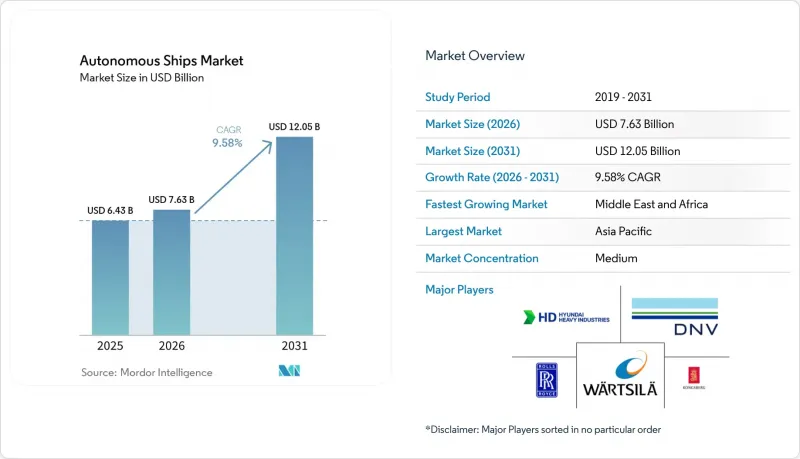
Mordor Intelligence에 의하면, 자율운항 선박 시장 규모는 2025년 69억 달러에서 2026년에는 76억 3,000만 달러로 확대되어 2026년부터 2031년까지 CAGR 9.58%로 성장을 지속하여, 2031년에는 120억 5,000만 달러에 이를 것으로 예측됩니다.
본 보고서는 자율 수준(부분 자율, 원격 조종 등), 구성 요소(하드웨어 및 소프트웨어), 선박 유형(화물선, 여객선, 국방용 선박 등), 최종 사용자(민간, 정부 및 군), 추진 방식(완전 전기식, 하이브리드, 기존 방식),및 지역(북미, 유럽, 아시아태평양 등)별로 분류되어 있습니다. 시장 전망은 금액(미화) 기준으로 제시되어 있습니다.
전 세계 자율운항 선박 시장 동향 및 인사이트
데이터 기반 선단 최적화 및 원격 운용
선단 소유주는 여러 선박의 엔진 텔레메트리, 기상 데이터, AIS 교통 정보를 동시에 스트리밍하는 육상 제어실을 구축하고 있으며, 이를 통해 1명의 자격을 갖춘 항해사가 최대 6척의 선박을 실시간으로 감시할 수 있게 되었습니다. 중앙 대시보드가 기존의 당직 교대를 대체함으로써, 운영자는 함교 인력을 줄이고, 승무원 교대에 따른 여행 경비를 최소화하며, 초과 근무 수당이나 항해 수당을 지급하지 않고도 24시간 전문가 감시를 실현할 수 있습니다. 예지 보전 알고리즘은 고장으로 인해 선박이 좌초되기 전에 베어링 마모, 인젝터 오염, 선체 저항을 감지하여 용선 수입에 손실을 주는 예정 외 운항 중단 일수를 줄여줍니다. 또한, 육상 팀이 선장의 여러 보고서를 확인할 필요 없이 갑작스러운 높은 파도 예보나 부두 혼잡을 피하여 항로를 변경할 수 있으므로, 일정 준수율도 향상됩니다. 연안 부근의 Ku 대역 통신 회선이 일상적인 데이터 처리를 담당하고, 저궤도(LEO) 위성은 현재 외해에서도 50밀리초 미만의 지연을 실현하고 있으므로, 관제 센터는 태평양 횡단 중에도 결정론적인 명령 루프를 유지할 수 있습니다. 하이브리드 시스템 설계 덕분에 충돌 회피 로직은 선박 측에 상주하고 있어, 교통량이 많은 항로 분리 구역이나 안개가 낀 항구에 입항할 때도 갑작스러운 대역폭 저하로 인해 핵심 안전 기능이 손상되는 일이 없습니다.
탈탄소화와 연료 효율이 자율운항 선박을 주도
IMO의 탄소 집약도 지표 및 EU 배출권 거래 제도에 따라 톤마일당 CO2 배출량 1그램마다 엄격한 가격이 부과됨에 따라, 운항 사업자들은 AI를 활용한 항해 계획을 채택하기 시작했습니다. 이를 통해 2024년에는 아시아-유럽 간 및 태평양 횡단 항로에서 연료 소비량을 5-12% 절감할 것으로 예측됩니다. 발치라(Valtira)사의 ‘선단 최적화 솔루션’은 최신 기상 그리드, 용선 계약 시간대, 선석 가용 상황을 대조하여, 도착 시간대를 준수하면서도 최소 비용을 실현하는 속도 일정을 제안합니다. 이를 통해 규정을 준수하는 선주는 선급협회가 인증한 탄소 크레딧을 획득할 수 있습니다. 그 후, 엣지 AI가 몇 초 만에 트림탭과 가변 피치 프로펠러를 조정합니다. 이러한 반응 속도는 수 주간에 걸친 항해에서 인간 선원으로는 유지하기 어려운 수준입니다. 이 정밀한 부하 제어를 통해 암모니아 및 메탄올을 연료로 사용하는 듀얼 연료 엔진의 최적 운전 범위가 확대되며, IMO의 2050년 넷제로 목표를 뒷받침하는 대체 추진 시스템의 수익화가 가속화됩니다. 연료 소비량 감소는 화주의 Scope 3 배출량도 줄여주며, 변조 방지 기능이 탑재된 센서 로그를 통해 배출량을 검증할 수 있는 선단에 대한 용선 수요를 강화합니다. 마지막으로, 엔진 부하 최적화를 통해 정비 주기가 단축되어 운임 변동이 심한 시기에도 운항 사업자에게 더 큰 여유가 생깁니다.
원격 항해 시스템의 사이버 보안 취약점
2024년 흑해에서 발생한 GPS 신호 위조로 인해 자율운항 시험선은 최대 30해리나 항로에서 이탈했습니다. 이로 인해 긴급 수동 제어가 불가피해졌으며, 공격자가 무선 통신을 통한 항법 시스템에 대한 의존도를 얼마나 쉽게 악용할 수 있는지가 드러났습니다. 육상 관제는 상시 연결된 IP 터널에 의존하고 있기 때문에 이론적으로 하나의 운영 센터만 침해당해도 여러 선박의 항로를 변경하거나 조타 명령을 중단시킬 수 있습니다. NIST의 2025년 해양 사이버 프레임워크에서는 암호화된 위성 통신 채널, 다단계 인증 토큰, 그리고 관성 항법에 의한 추정 항로에서 벗어난 위치 보고를 감지하는 지속적인 센서 기준선 점검이 의무화되어 있습니다. 현재 운항 사업자들은 지연의 급증이나 체크섬 오류가 발생할 경우, 하드와이어드 충돌 회피 조작을 실행하는 격리된 안전 컨트롤러를 도입하고 있으며, 이는 항공기 비행 제어 시스템에 채택된 것과 동등한 최후의 수단으로서의 복원력을 제공합니다. 보험사들은 이러한 다층적인 방어 체계를 입증할 수 있는 선단에 대해 보험료 할인을 제공하고 있으며, 이에 따라 사이버 보안 강화는 단순한 선택 사항에서 상업적 필수 요건으로 전환되고 있습니다.
부문 분석
2025년, 자율운항 선박 시장 규모의 71.24%를 부분 자율운항 선박이 차지했습니다. 이는 규정이 모호해지거나 교통 밀도가 급증하는 경우에도 자격을 갖춘 선원이 지휘를 맡으면서 승무원 비용과 연료 소비를 즉시 절감할 수 있는 시스템을 선주가 선호하고 있음을 보여줍니다. 이러한 조타실 지원 패키지는 충돌 회피 조작, 동적 전력 관리, 항해 최적화를 자동화하는 한편, 접안, 항해 안내, 긴급 조종에 대해서는 수동 제어를 유지하고 있습니다. 이를 통해 선적국 검사관의 신뢰가 유지되고, 보험사도 기존의 면책 금액으로 보험을 인수할 의지를 유지하고 있습니다. 완전 자율형 선체는 여전히 틈새 시장에 머물러 있지만, 2031년까지 연평균 성장률(CAGR)이 17.54%에 달한다는 점은 통계적 안전성 증거가 축적되고 표준화된 선급 기호에 의해 규제상의 불확실성이 완화된다면 시장에 변화가 일어날 것임을 시사합니다. 원격 조종 선박은 이 둘의 중간에 위치하며, 선상 AI가 이상을 감지하면 육상 팀이 지휘를 인계할 수 있습니다. 그러나 인지 부하에 관한 조사에 따르면, 한 명의 운영자가 동시에 담당할 수 있는 선박 수는 약 6척이 상한이므로, 선단 전체로의 확대는 실용적인 인간-기계 인터페이스의 유무에 달려 있습니다. IMO의 분류 체계와 명확하게 부합하는 DNV의 2025년 단계별 표기는 은행 및 리스 회사에 가격 책정의 기준이 되는 위험 계층을 제공하며, 상위 단계 승인 시 금리 스프레드 감소로 이어지고 있습니다.
엣지 AI의 비약적인 발전으로 인해 이 위험 계층을 더 쉽게 올라갈 수 있게 되었습니다. 초당 30프레임의 물체 분류가 가능한 ‘Jetson Orin’을 탑재함으로써 선상에서 레이더와 LiDAR의 감지 데이터를 융합할 수 있게 되어, 지연의 급증으로 인한 안전 여유 폭의 감소를 방지하고, 상시 이용 가능한 백홀 회선에 대한 의존도를 낮출 수 있습니다. 규제 당국의 준비가 완료되는 대로, 소프트웨어 전환을 통해 루프에서 마지막 인간 개입을 배제할 수 있으며, 부분 자율 운항 모델에 여전히 큰 부담이 되고 있는 초과 근무 수당 및 출장·로테이션에 드는 비용을 절감할 수 있습니다. 그러나 로이즈 마켓 어소시에이션(Lloyd’s Market Association)은 보험료가 기존 선체와 동일한 수준이 되기 위해서는 다양한 해황 조건 하에서의 자율 운항 실적이 최소 1,000만 시간에 도달해야 한다는 조건을 두고 있으며, 현재의 속도로 함대 시험이 계속된다면 이 기준은 2030년경에 달성될 것으로 예측됩니다.
2025년에는 자율운항 선박 시장의 64.41%를 하드웨어가 차지했습니다. 이는 모든 개조가 LiDAR 돔, 솔리드 스테이트 X-밴드 레이더, 관성 측정 장치, 듀얼 위성 안테나와 같은 구체적인 키트에서 시작되기 때문입니다. 이러한 키트는 선박의 상황 인식 범위를 확대하고 선급 협회의 기대에 부응하는 것입니다. 현재 수익의 성장 동력은 소프트웨어 분야로 이동하고 있습니다. 선주가 디지털 트윈 모델, 예측 유지보수 대시보드, 사이버 위협 분석 라이선스를 취득함으로써 드라이독에 정박할 필요 없이 탑재된 센서에서 수집된 데이터를 수익화할 수 있게 되므로, 소프트웨어 시장은 2031년까지 연평균 성장률(CAGR) 13.65%를 나타낼 것으로 예측됩니다. 롤스로이스의 ‘지능형 어웨어니스(Intelligent Awareness)’는 이미 레이더, AIS, 영상을 단일 뷰로 통합하여 잘못된 충돌 경보를 60% 줄이고 조타실의 부담을 경감시키고 있습니다. 발티라의 디지털 트윈과 텔레메트리 제품군의 조합은 2025년 컨테이너선에서 실시된 시험 운항에서 승무원이 일반적으로 산출할 수 없는 시간별 속도 및 트림 조정을 권장함으로써 연료 소비량을 8% 절감했습니다.
부품 비용의 하락도 이러한 전환을 뒷받침하고 있습니다. 벨로다인(Velodyne)사의 솔리드 스테이트 LiDAR 유닛 가격이전년의 1만 8,000달러에서 2025년에는 8,000달러로 하락함에 따라, 과거 LNG 운반선용 가격대에 주저하던 중형 선박 선주들에게도 중복 센서 구성을 도입할 수 있게 되었습니다. 한편, AIS 스푸핑 사건의 발생으로 인해 탈레스(Thales)와 레이시온(Raytheon)의 이상 감지 모듈은 선체 보험사에게 필수적인 실사 체크리스트의 일부가 되었으며, 갱신 시즌마다 신규 구독 라이선스의 꾸준한 확보를 보장하고 있습니다. 이러한 선순환이 계속되고 있습니다. 데이터가 늘어날수록 소프트웨어의 유효성이 높아지고, 이를 통해 센서의 설치 면적을 축소할 수 있음이 입증되어, 결과적으로 자율운항 선박 시장에서 소프트웨어의 점유율 확대를 가속화하고 있습니다.
지역별 분석
2025년, 아시아태평양은 자율운항 선박 시장 점유율의 41.35%를 차지했습니다. 그 원동력은 중국의 스마트 선박을 위한 경제 부양책, 일본의 연안 페리 컨소시엄, 그리고 수출 계약에 포함된 한국 조선소 차원의 자율화 옵션이었습니다. 전 세계 원양선 10척 중 9척이 아시아태평양 조선소에서 건조되고 있기 때문에 블록 조립 단계에서 센서 트렁크와 AI 랙을 통합함으로써 추가 비용을 낮게 억제할 수 있습니다. 각 부처는 보조금과 친환경 선박 세제 혜택으로 수요를 뒷받침하고 있으며, 이를 통해 다른 지역에서는 수익성이 떨어지는 자율 항해 기술의 시범 운영을 지역 소규모 해운사들에게도 장려하고 있습니다. 또한, 중국의 각 성 항만 당국은 전용 시험 항로를 마련하여, 절차가 느린 기국과 비교하여 승인까지의 리드타임을 단축하고 있습니다.
중동 및 아프리카은 2031년까지 연평균 성장률(CAGR) 13.60%를 기록하며 가장 빠른 성장이 예상됩니다. 사우디아라비아의 NEOM은 배출 가스 제로 물류 기반 구축을 목표로 하고 있으며, 전기식 자율 항만 선박 및 육상 전원용 마이크로그리드에 5억 달러를 배정하고 있습니다. 한편, DP 월드(DP World)가 제벨 알리(Jebel Ali)에서 실시한 자동화 시범 사업을 통해 부두에서 게이트까지의 사이클 타임이 18% 단축되었으며, 지역 해운사들은 유사한 설비 도입을 위한 예산 편성을 결정했습니다. 남아프리카공화국의 트랜스넷은 6척의 항만 예인선을 업그레이드하여 야간 자율 운항을 가능하게 함으로써, 경험이 풍부한 승무원이 악천후 시 구조 작업에 집중할 수 있도록 하고 있습니다.
북미와 유럽에서는 규제 당국이 ‘샌드박스’ 단계에서 영구적인 규제로 전환하는 가운데, 안정적인 한 자릿수 중반대의 속도로 진전이 이루어지고 있습니다. 중복된 센서 유형을 의무화하는 미국 해안경비대의 규정이 현재 조선소의 사양서 작성 지침이 되고 있으며, 노르웨이의 12개 피오르드 시험 구역은 조선업체에 보험 수리표 작성을 위한 실지 데이터를 제공합니다. 남미에서는 아직 발전 단계에 있습니다. 페트로브라스가 2025년에 실시한 해양 지원 드론 시험은 그 가치를 입증하고 있지만, 공급업체들은 여전히 아마존 강 및 남대서양 항로에서 수입 관세와 불안정한 통신 대역폭 문제에 직면해 있습니다.
기타 혜택:
- 엑셀 형식 시장 예측(ME) 시트
- 3개월간의 애널리스트 지원
자주 묻는 질문
목차
제1장 서론
제2장 조사 방법
제3장 주요 요약
제4장 시장 구도
제5장 시장 규모와 성장 예측
제6장 경쟁 구도
제7장 시장 기회와 향후 전망
JHS 26.09.07According to Mordor Intelligence, the autonomous ships market size is expected to grow from USD 6.90 billion in 2025 to USD 7.63 billion in 2026 and is forecasted to reach USD 12.05 billion by 2031 at a 9.58% CAGR over 2026-2031.
This report is Segmented by Autonomy Level (Partially Autonomous, Remotely Controlled, and More), Component (Hardware and Software), Ship Type (Cargo, Passenger, Defense, and More), End User (Commercial, Government and Military), Propulsion (Fully Electric, Hybrid, and Conventional), and Geography (North America, Europe, Asia-Pacific, and More). The Market Forecasts are Provided in Terms of Value (USD).
Global Autonomous Ships Market Trends and Insights
Data-Driven Fleet Optimization and Remote Operations
Fleet owners are building onshore control rooms that stream engine telemetry, weather feeds, and AIS traffic from several vessels simultaneously, allowing a single certified navigator to supervise up to six ships in real-time. Central dashboards replace traditional watch rotations, enabling operators to reduce bridge headcount, minimize travel expenses for crew changes, and achieve 24-hour specialist oversight without incurring overtime or voyage bonuses. Predictive maintenance algorithms flag bearing wear, injector fouling, and hull drag before failures strand a ship, shrinking unplanned off-hire days that erode charter revenue. Schedule reliability also improves because shore teams can re-route around sudden swell forecasts or berth congestion without waiting for the master to review multiple reports. Near-coast Ku-band links handle routine data; LEO satellites now provide sub-50 ms latency mid-ocean, allowing control centers to maintain deterministic command loops even during Pacific crossings. Hybrid system design keeps collision-avoidance logic resident on the vessel, guaranteeing that sudden bandwidth dips never degrade core safety functions during busy traffic separations or fog-bound harbor entries.
Decarbonization and Fuel Efficiency Propel Autonomous Ships
The IMO Carbon Intensity Indicator and the EU Emissions Trading System imposed a hard price on every gram of CO2 emitted per ton-mile, prompting operators to adopt AI-driven voyage planning that reduces fuel consumption by 5-12% on Asia-Europe and transpacific lanes in 2024. Wartsila's Fleet Optimisation Solution cross-references updated weather grids, charter-party time bars, and berth availability to suggest least-cost speed schedules that still hit arrival windows, earning class-verified carbon credits for compliant owners. Edge-AI then modulates trim tabs and variable-pitch propellers in seconds, a response rate that no human crew can sustain over multi-week passages. This precise load control extends the sweet spot of dual-fuel ammonia or methanol engines, accelerating the earning curve for alternative propulsion combinations that support the IMO 2050 net-zero trajectory. Reduced bunker consumption also lowers cargo owners' Scope 3 footprints, strengthening charter demand for fleets that verify emissions with tamper-proof sensor logs. Finally, optimized engine loading reduces maintenance intervals, providing operators with an additional margin of error during volatile freight cycles.
Cyber-Security Vulnerabilities of Remote Navigation Stacks
Spoofed GPS signals in the Black Sea during 2024 pushed autonomous trial craft up to 30 nm off course. They forced emergency manual overrides, showing how easily attackers can exploit over-the-air navigation dependencies. Because shore control relies on always-on IP tunnels, a single compromised operations center could, in theory, redirect multiple vessels or freeze helm commands. NIST's 2025 maritime cyber framework mandates encrypted satellite channels, multi-factor login tokens, and continual sensor-baseline checks that flag position reports deviating from inertial navigation dead-reckoning. Operators are now installing isolated safety controllers that execute hard-wired collision-avoidance maneuvers in the event of latency spikes or checksum failures, providing last-resort resilience comparable to that used in aircraft flight-control systems. Insurers reward fleets that can demonstrate such layered defenses with premium discounts, thereby pushing cyber hardening from an optional to a commercial imperative.
Other drivers and restraints analyzed in the detailed report include:
- Rising Demand for Advanced Situational-Awareness Suites
- Development of Next-Generation Autonomous Vessels
- Regulatory Fragmentation and Flag-State Variance
For complete list of drivers and restraints, kindly check the Table Of Contents.
Segment Analysis
Partially autonomous vessels commanded 71.24% of the autonomous ships market size in 2025, underscoring owner preference for systems that deliver immediate crew-cost and fuel-burn savings, while still leaving a licensed mariner in charge when rules become ambiguous or traffic density spikes. These bridge-assist packages automate collision-avoidance inputs, dynamic power management, and voyage optimization while preserving manual control for berthing, pilotage, and emergency maneuvers, which keeps flag-state inspectors comfortable and insurers willing to underwrite at conventional deductibles. Fully autonomous hulls remain a niche market, but their 17.54% CAGR through 2031 signals a shift once statistical safety evidence accumulates and standardized class notations reduce regulatory uncertainty. Remotely controlled craft sit between the two, allowing shore teams to assume command whenever the onboard AI flags an anomaly. However, cognitive-load research caps each operator at roughly six simultaneous vessels, meaning fleetwide scaling hinges on usable human-machine interfaces. DNV's 2025 tiered notation, which maps cleanly onto the IMO taxonomy, now supplies banks and leasing houses with a risk ladder they can price against, lowering interest spreads for higher-tier approvals.
Edge-AI leaps make that risk ladder easier to climb. Jetson Orin boards, capable of 30 frames per second object classification, enable the fusion of radar and LiDAR detections onboard, preventing latency spikes from compromising safety margins and reducing dependence on always-available backhaul links. Once regulators are ready, a software switch can remove the final human from the loop, squeezing out overtime and travel-rotation costs that still weigh on the partially autonomous operating model. Lloyd's Market Association, however, insists on at least 10 million logged autonomous operating hours in mixed sea states before premiums fall to parity with conventional hulls, a threshold forecast around 2030 if fleet trials continue at the present clip.
Hardware captured 64.41% of the autonomous ships market share in 2025, as every retrofit begins with a tangible kit, including LiDAR domes, solid-state X-band radar, inertial measurement units, and dual satellite antennas, which expand a vessel's situational awareness envelope to meet class expectations. Revenue momentum now tilts toward code. Software is projected to grow at a 13.65% CAGR through 2031 as owners license digital-twin models, predictive-maintenance dashboards, and cyber-threat analytics that monetize the data from installed sensors without requiring dry-dock downtime. Rolls-Royce Intelligent Awareness already fuses radar, AIS, and video into a single view, slashing nuisance collision alarms by 60% and easing bridge fatigue. Wartsila's paired digital twin and telemetry suite reduced fuel consumption by 8% in 2025 container trials by recommending hour-by-hour speed and trim adjustments that crews rarely have the capacity to calculate.
Falling component costs reinforce the pivot. Velodyne's slide to USD 8,000 for solid-state LiDAR units in 2025, down from USD 18,000 a year earlier, opens redundant-sensor configurations to medium-tonnage owners who once balked at price tags reserved for LNG carriers. Meanwhile, AIS-spoofing incidents have made anomaly-detection modules from Thales and Raytheon part of fundamental due diligence checklists for hull insurers, ensuring steady pull-through of new subscription licenses each renewal season. The flywheel turns: more data improves software efficacy, which validates smaller sensor footprints, in turn accelerating the software's share of the autonomous ships market.
Complete Report Scope:
- By Autonomy Level
- Partially Autonomous
- Remotely Controlled
- Fully Autonomous
- By Component
- Hardware
- Software
- By Ship Type
- Cargo
- Passenger
- Offshore Support and Energy
- Defense
- Special Purpose
- By End User
- Commercial
- Government and Military
- By Propulsion
- Fully Electric
- Hybrid
- Conventional
- By Geography
- North America
- United States
- Canada
- South America
- Brazil
- Rest of South America
- Europe
- United Kingdom
- Germany
- France
- Italy
- Russia
- Rest of Europe
- Middle East and Africa
- Middle East
- Saudi Arabia
- United Arab Emirates
- Rest of Middle East
- Africa
- South Africa
- Rest of Africa
- Middle East
- Asia-Pacific
- China
- India
- Japan
- South Korea
- Australia
- Rest of Asia-Pacific
- North America
Geography Analysis
Asia-Pacific held 41.35% of the autonomous ships market share in 2025, anchored by China's intelligent-ship stimulus packages, Japan's coastal-ferry consortia, and South Korea's yard-level autonomy options baked into export contracts. Regional builders deliver nine out of every ten deep-sea vessels worldwide, so embedding sensor trunks and AI racks during block assembly helps keep incremental costs low. Ministries top up demand with subsidies and green-shipping tax breaks, pushing small regional lines to trial autonomy that would be uneconomic elsewhere. China's provincial ports also carve dedicated test lanes, shortening approval lead times compared with slower flag states.
The Middle East and Africa are expected to experience the fastest growth, clocking a 13.60% CAGR through 2031. Saudi Arabia's NEOM aims for an emissions-free logistics spine and has earmarked USD 500 million for electric, autonomous harbor craft, as well as shore-power microgrids. Meanwhile, DP World's automation pilot at Jebel Ali has reduced berth-to-gate cycle times by 18%, convincing regional carriers to budget for similar kits. South Africa's Transnet is upgrading six harbor tugs to enable night-shift autonomy, allowing experienced crews to focus on heavy-weather salvage.
North America and Europe advance at stable mid-single-digit rates as regulators move from sandbox to permanent codes. US Coast Guard rules that demand redundant sensor types now guide shipyard specification lists, and Norway's twelve fjord trial zones give builders real-world data for actuarial tables. South America stays nascent; Petrobras' 2025 offshore-support drone trial highlights the value case, but suppliers still face import tariffs and inconsistent bandwidth on Amazon and South Atlantic routes.
- ABB Ltd.
- BAE Systems plc
- DNV AS
- Fugro NV
- Hanwha Corporation
- HD Hyundai Heavy Industries Co.Ltd.
- Kongsberg Gruppen ASA
- L3Harris Technologies, Inc.
- Marine AI Ltd.
- MITSUI E&S Group
- Praxis Automation Technology B.V.
- Rolls-Royce plc
- Sea Machines Robotics, Inc.
- Samsung Heavy Industries Co.,Ltd
- Wartsila Corporation
- Vigor Industrial LLC
Additional Benefits:
- The market estimate (ME) sheet in Excel format
- 3 months of analyst support
TABLE OF CONTENTS
1 INTRODUCTION
- 1.1 Study Assumptions and Market Definition
- 1.2 Scope of the Study
2 RESEARCH METHODOLOGY
3 EXECUTIVE SUMMARY
4 MARKET LANDSCAPE
- 4.1 Market Overview
- 4.2 Market Drivers
- 4.2.1 Data-driven fleet optimization and remote operations
- 4.2.2 Decarbonization and fuel efficiency mandates
- 4.2.3 Rising demand for advanced situational-awareness suites
- 4.2.4 Development of next-generation autonomous vessels
- 4.2.5 Defense demand for USVs
- 4.2.6 Edge-AI and 5G/LEO connectivity breakthrough
- 4.3 Market Restraints
- 4.3.1 Cybersecurity vulnerabilities
- 4.3.2 Regulatory fragmentation and flag-state variance
- 4.3.3 High retrofit capital expenditure
- 4.3.4 Marine-insurance and liability uncertainties
- 4.4 Value Chain Analysis
- 4.5 Regulatory Landscape
- 4.6 Technological Outlook
- 4.7 Porter's Five Forces Analysis
- 4.7.1 Bargaining Power of Suppliers
- 4.7.2 Bargaining Power of Buyers/Consumers
- 4.7.3 Threat of New Entrants
- 4.7.4 Threat of Substitute Products
- 4.7.5 Intensity of Competitive Rivalry
5 MARKET SIZE AND GROWTH FORECASTS (VALUE)
- 5.1 By Autonomy Level
- 5.1.1 Partially Autonomous
- 5.1.2 Remotely Controlled
- 5.1.3 Fully Autonomous
- 5.2 By Component
- 5.2.1 Hardware
- 5.2.2 Software
- 5.3 By Ship Type
- 5.3.1 Cargo
- 5.3.2 Passenger
- 5.3.3 Offshore Support and Energy
- 5.3.4 Defense
- 5.3.5 Special Purpose
- 5.4 By End User
- 5.4.1 Commercial
- 5.4.2 Government and Military
- 5.5 By Propulsion
- 5.5.1 Fully Electric
- 5.5.2 Hybrid
- 5.5.3 Conventional
- 5.6 By Geography
- 5.6.1 North America
- 5.6.1.1 United States
- 5.6.1.2 Canada
- 5.6.2 South America
- 5.6.2.1 Brazil
- 5.6.2.2 Rest of South America
- 5.6.3 Europe
- 5.6.3.1 United Kingdom
- 5.6.3.2 Germany
- 5.6.3.3 France
- 5.6.3.4 Italy
- 5.6.3.5 Russia
- 5.6.3.6 Rest of Europe
- 5.6.4 Middle East and Africa
- 5.6.4.1 Middle East
- 5.6.4.1.1 Saudi Arabia
- 5.6.4.1.2 United Arab Emirates
- 5.6.4.1.3 Rest of Middle East
- 5.6.4.2 Africa
- 5.6.4.2.1 South Africa
- 5.6.4.2.2 Rest of Africa
- 5.6.4.1 Middle East
- 5.6.5 Asia-Pacific
- 5.6.5.1 China
- 5.6.5.2 India
- 5.6.5.3 Japan
- 5.6.5.4 South Korea
- 5.6.5.5 Australia
- 5.6.5.6 Rest of Asia-Pacific
- 5.6.1 North America
6 COMPETITIVE LANDSCAPE
- 6.1 Market Concentration
- 6.2 Strategic Moves
- 6.3 Market Share Analysis
- 6.4 Company Profiles {(includes Global level Overview, Market level overview, Core Segments, Financials as available, Strategic Information, Market Rank/Share for key companies, Products and Services, and Recent Developments)}
- 6.4.1 ABB Ltd.
- 6.4.2 BAE Systems plc
- 6.4.3 DNV AS
- 6.4.4 Fugro NV
- 6.4.5 Hanwha Corporation
- 6.4.6 HD Hyundai Heavy Industries Co.Ltd.
- 6.4.7 Kongsberg Gruppen ASA
- 6.4.8 L3Harris Technologies, Inc.
- 6.4.9 Marine AI Ltd.
- 6.4.10 MITSUI E&S Group
- 6.4.11 Praxis Automation Technology B.V.
- 6.4.12 Rolls-Royce plc
- 6.4.13 Sea Machines Robotics, Inc.
- 6.4.14 Samsung Heavy Industries Co.,Ltd
- 6.4.15 Wartsila Corporation
- 6.4.16 Vigor Industrial LLC
7 MARKET OPPORTUNITIES AND FUTURE OUTLOOK
- 7.1 White-space and Unmet-Need Assessment