|
시장보고서
상품코드
2123461
거래 감시 시스템 시장 : 점유율 분석, 업계 동향과 통계, 성장 예측(2026-2031년)Trade Surveillance Systems - Market Share Analysis, Industry Trends & Statistics, Growth Forecasts (2026 - 2031) |
||||||
 Mordor Intelligence
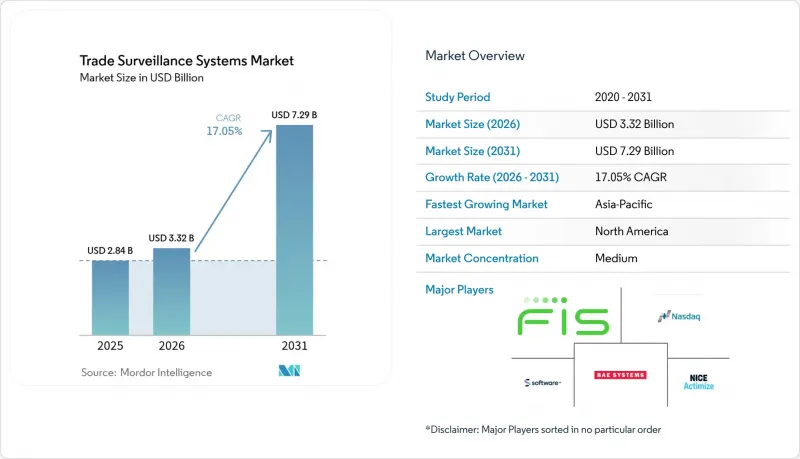
Mordor Intelligence에 의하면, 2026년 거래 감시 시스템 시장 규모는 33억 2,000만 달러로 추정되고 있어 2025년 28억 4,000만 달러에서 확대해, 2031년에는 72억 9,000만 달러에 이를 것으로 예측됩니다.
2026년부터 2031년까지의 연평균 성장률(CAGR)은 17.05%를 나타낼 것으로 전망됩니다.
본 보고서는 구성 요소(솔루션 및 서비스), 배포 방식(On-Premise 및 클라우드), 거래 유형(주식, 채권 등), 최종 사용자(셀사이드 기관, 바이사이드 기관 등), 조직 규모(Tier 1 세계 은행, Tier 2 및 중견 기업 등), 그리고 지역별로 분류되어 있습니다. 시장 전망은 금액(달러) 기준으로 제시되어 있습니다.
세계 거래 감시 시스템 시장 동향 및 인사이트
다중 자산 전자 거래 플랫폼의 급속한 확대
현재 고빈도 거래 및 알고리즘 트레이딩 전략이 미국 주식 거래량의 절반 이상을 차지하고 있어, 기존의 규칙 체계로는 대응하기 어려운 감시 사각지대가 발생하고 있습니다. 기업들은 주식, 채권, 옵션,원자재에 걸친 주문 장부를 상호 연관시키는 동시에, 거래소 간 차익 거래를 가능하게 하는 밀리초 단위의 지연 차이를 고려해야 합니다. 런던의 딜러 모델에서 완전 자동화된 주문 주도형 거래소로의 전환은 유동성 향상과 시장 남용 위험 증가가 공존하고 있는 실태를 여실히 보여주고 있습니다. 이에 대응하여 각 벤더사는 데이터 피드를 통합하고, 파편화된 시장 전반에 걸친 스푸핑 및 레이어링을 감지하는 거래소별 조정 기능을 탑재함으로써 대응하고 있습니다.
CAT 의무화 및 기타 거래 후 투명성 관련 규제
CAT 제도에 따라 미국의 증권사는 모든 주식 및 옵션 거래 내역을 단일 스키마에 따라 보고해야 할 의무가 있습니다. 2025년 3월 개정으로 개인 데이터 항목은 축소되었지만, 고유 식별자는 유지되어 규제 당국에 대한 완전한 정보 제공을 유지하면서 기업들은 연간 1,200만 달러의 비용 절감을 실현했습니다. 유럽에서도 유사한 압력이 높아지고 있으며, MiFIR 3에서는 디지털 토큰 식별자와 새로운 발효일 태그가 도입되어, 더 풍부한 페이로드를 처리하기 위한 시스템 업그레이드가 요구되고 있습니다. 따라서 금융 기관들은 감시 시스템을 단순한 옵션 리스크 관리 도구가 아닌, 컴플라이언스의 기반이 되는 인프라로 자리매김하고 있습니다.
레거시 프론트·미들·백오피스 시스템과의 고도화된 통합의 복잡성
영국 금융 기관의 92% 가까이가 여전히 야간 배치 처리를 통해 거래 파일을 처리하는 메인프레임에 의존하고 있으며, 이러한 처리 속도는 초 단위의 모니터링과 양립할 수 없습니다. 메시지 프로토콜, 필드 분류 체계 및 시간 동기화의 일관성을 확보하려면 수년에 걸친 로드맵이 필요하며, 대부분의 경우 50개 이상의 사내 팀이 참여하게 됩니다. 연동 불량으로 인해 데이터 피드가 불완전해지거나 경고를 놓치게 되므로, 규제 당국이 데이터의 무결성을 인증할 때까지 기존 플랫폼과 신규 플랫폼을 병행하여 운영해야 하는 기간을 마련할 수밖에 없습니다.
부문 분석
2025년, 솔루션은 거래 감시 시스템 시장의 61.55% 점유율을 차지하며, 주문, 실행, 통신 데이터를 통합하는 엔드투엔드 플랫폼의 중요성을 부각시켰습니다. 이 부문은 높은 전환 비용과 지속적인 규칙 업데이트의 혜택을 받고 있으며, 벤더는 지속적인 라이선스 수익을 얻을 수 있는 위치에 있습니다. 주요 규제 기한이 도래하기 전에 은행들이 엔터프라이즈 라이선스를 갱신함에 따라, 솔루션과 관련된 거래 감시 시스템 시장 규모는 꾸준히 확대될 것으로 예측됩니다.
서비스 부문은 규모는 작지만, 금융 기관들이 모델 튜닝 및 규제 대응 매핑을 외부에 위탁함에 따라 연평균 성장률(CAGR) 18%로 성장하고 있습니다. 매니지드 서비스 계약은 사내 인력 부족을 보완하고, 지역에 관계없이 24시간 지원을 제공합니다. 공급업체들은 도입, 행동 모델 보정, 가동 후 테스트를 패키지로 제공하고 있으며, 중견 증권사 입장에서는 전문 퀀트를 고용하는 것보다 비용 효율적이라고 평가됩니다.
2025년 시점에서도 On-Premise 도입 점유율은 54.15%를 유지하고 있으며, 이는 데이터 주권에 관한 의무와 감사인이 방화벽 내부에 설치된 시스템을 선호하는 경향을 반영한 것입니다. 그러나 클라우드 서비스에 기반한 거래 감시 시스템 시장 규모는 가장 빠르게 확대될 전망이며, 규제 당국이 “암호화된 데이터는 승인된 관할 구역 내에 보관되어도 무방하다”는 견해를 명확히 함에 따라 2031년까지 연평균 성장률(CAGR) 19.05%로 확대될 것으로 예측됩니다.
클라우드 제공업체는 하룻밤 사이에 수백만 건의 시나리오를 백테스트할 수 있는 탄력적인 컴퓨팅 능력을 제공하고 있으며, On-Premise 그리드에서는 자원을 과도하게 확보하지 않는 한 이러한 기능을 재현하기 어렵습니다. 하이브리드 모델이 주목을 받고 있는 이유는 개인을 식별할 수 있는 정보를 로컬 데이터센터에 보관하면서, 익명화된 거래 기록을 클라우드 클러스터로 전송하여 고급 분석을 수행할 수 있기 때문입니다. 싱가포르와 캐나다의 성공적인 시범 프로젝트 사례는 암호화 키가 고객의 관리하에 있는 한, 이러한 아키텍처가 규제 당국의 심사를 통과할 수 있음을 보여줍니다.
지역별 분석
아시아태평양은 17.6%라는 지역별 최고 연평균 성장률(CAGR)을 기록하며, 감독 기술 분야에서 추격자에서 선구자로 위상을 높이고 있습니다. 싱가포르 통화청(MAS)은 거래 감시 관리에 통합된 AI 기반 AML-CFT 모델을 시범 도입하여, 다른 규제 당국이 주목하는 참조 구현 사례를 만들어내고 있습니다. 홍콩에서는 인가를 받은 가상자산 사업자에게 감시 대상 범위 적용이 의무화됨에 따라, 거래소 및 프라임 브로커 간의 지출이 증가하고 있습니다.
북미는 CAT 및 2025년 중반에 발효될 예정인 공매도 플래그에 힘입어 33.92%의 점유율을 유지하며 여전히 가장 큰 기여 지역으로 남아 있습니다. 미국은 주요 주식 및 옵션 거래소에 대한 공급업체의 지리적 근접성 혜택을 누리고 있는 반면, 캐나다에서는 크로스 리스팅 거래량 증가에 따라 투자가 가속화되고 있습니다.
유럽은 성숙한 도입 단계에 있으며, MiFID II 및 EMIR에 따라 이미 엄격한 거래 보고가 통합되어 있습니다. 향후 시행될 MiFIR 3 개정안에 따라 디지털 토큰 식별자가 도입되고 규제 적용 범위가 확대될 것입니다. 유럽 대륙의 은행들은 사업 부문 간 거래 식별자를 대조하기 위해 시스템을 업그레이드하고 있으며, 영국의 기업들은 브렉시트 이후의 규제 차이에 대응하기 위해 병행 프로세스를 운영하고 있습니다.
기타 혜택:
- 엑셀 형식 시장 예측(ME) 시트
- 3개월간의 애널리스트 지원
자주 묻는 질문
목차
제1장 서론
제2장 조사 방법
제3장 주요 요약
제4장 시장 구도
제5장 시장 규모와 성장 예측
제6장 경쟁 구도
제7장 시장 기회와 향후 동향
JHS 26.09.09According to Mordor Intelligence, trade surveillance systems market size in 2026 is estimated at USD 3.32 billion, growing from 2025 value of USD 2.84 billion with 2031 projections showing USD 7.29 billion, growing at 17.05% CAGR over 2026-2031.
This report is Segmented by Component (Solutions and Services), Deployment Mode (On-Premise and Cloud), Trading Type (Equities, Fixed Income, and More), End-User (Sell-Side Institutions, Buy-Side Institutions, and More), Organisation Size (Tier-1 Global Banks, Tier-2 and Mid-Sized Firms, and More), and Geography. The Market Forecasts are Provided in Terms of Value (USD).
Global Trade Surveillance Systems Market Trends and Insights
Rapid Expansion of Multi-Asset Electronic Trading Venues
High-frequency and algorithmic strategies now drive more than half of US equity volumes, creating surveillance blind spots that legacy rule sets struggle to cover. Firms must correlate order books across equities, fixed income, options, and commodities while accounting for millisecond latency gaps that enable cross-venue arbitrage. The shift from dealer models to fully automated order-driven venues in London illustrates how liquidity gains coexist with higher market-abuse risk. Vendors respond by unifying data feeds and embedding venue-specific calibrations that flag spoofing and layering across fragmented markets.
Mandatory CAT and Other Post-Trade Transparency Mandates
The CAT regime obliges US brokers to report every equity and option event under one schema. A March 2025 amendment trimmed personal data fields yet preserved unique identifiers, saving firms USD 12 million yearly while keeping regulators fully informed. Similar pressure builds in Europe, where MiFIR 3 introduces digital-token identifiers and new effective-date tags, compelling upgrades to handle richer payloads. Institutions, therefore, treat surveillance as foundational compliance infrastructure rather than optional risk tooling.
High Integration Complexity with Legacy Front-, Middle- and Back-Office Systems
Nearly 92% of UK institutions still rely on mainframes that batch-process trade files overnight, a cadence incompatible with second-by-second surveillance. Bridging message protocols, field taxonomies, and clock synchronisation requires multi-year roadmaps, often involving 50-plus internal teams. Disconnects cause incomplete data feeds and missed alerts, forcing parallel run periods where old and new platforms coexist until regulators certify data integrity.
Other drivers and restraints analyzed in the detailed report include:
- AI/ML-Powered Anomaly Detection Reducing False Positives and Cost
- Cloud-Native SaaS Delivery Lowering Total Cost of Ownership
- Shortage of Trade-Surveillance Data-Science Talent
For complete list of drivers and restraints, kindly check the Table Of Contents.
Segment Analysis
Solutions held 61.55% of the trade surveillance systems market share in 2025, underscoring the primacy of end-to-end platforms that integrate order, execution, and communications data. The segment benefits from high switching costs and continual rule updates, positioning vendors for recurring licensing revenue. The trade surveillance systems market size attached to solutions is projected to lift steadily as banks renew enterprise licences before key regulatory deadlines.
Services, though smaller, grow at 18% CAGR as institutions outsource model tuning and regulatory mapping. Managed-service contracts fill in-house talent gaps and provide 24-hour coverage across regions. Providers bundle implementation, behavioural-model calibration, and post-go-live testing, a package that mid-tier brokers consider more cost-effective than hiring specialised quants.
On-premise deployments retained a 54.15% share in 2025, reflecting data-sovereignty obligations and auditor preference for systems housed within firewalls. Yet the trade surveillance systems market size attributed to cloud offerings is set to rise fastest, expanding at 19.05% CAGR through 2031 as regulators issue clarifications that encrypted data may reside in approved jurisdictions.
Cloud providers offer elastic compute for back-testing millions of scenarios overnight, an ability that on-premise grids struggle to replicate without oversizing. Hybrid models gain traction because they keep personally identifiable information in local data centres while diverting de-identified trade records to cloud clusters for heavy analytics. Successful pilots in Singapore and Canada demonstrate that such architectures pass regulatory inspection when encryption keys remain client-controlled.
Complete Report Scope:
- By Component
- Solutions
- Services
- By Deployment Mode
- On-Premise
- Cloud
- By Trading Type
- Equities
- Fixed Income
- Derivatives
- Foreign Exchange
- Commodities
- Digital Assets
- By End-user
- Sell-Side Institutions
- Buy-Side Institutions
- Market Venues and Exchanges
- Regulators and SROs
- By Organisation Size
- Tier-1 Global Banks
- Tier-2 and Mid-Sized Firms
- Small FIs and Broker-Dealers
- FinTech and Crypto Exchanges
- By Geography
- North America
- United States
- Canada
- Mexico
- South America
- Brazil
- Argentina
- Chile
- Rest of South America
- Europe
- Germany
- United Kingdom
- France
- Italy
- Spain
- Russia
- Rest of Europe
- Asia-Pacific
- China
- India
- Japan
- South Korea
- Australia
- Singapore
- Malaysia
- Rest of Asia-Pacific
- Middle East and Africa
- Middle East
- United Arab Emirates
- Saudi Arabia
- Turkey
- Rest of Middle East
- Africa
- South Africa
- Nigeria
- Rest of Africa
- Middle East
- North America
Geography Analysis
Asia-Pacific records the fastest regional CAGR of 17.6%, moving from follower to front-runner in supervisory technology. Monetary Authority of Singapore pilots AI-based AML-CFT models that feed into trade-surveillance controls, creating reference implementations that other regulators monitor closely. Hong Kong mandates surveillance coverage for licensed virtual-asset operators, lifting spending among exchanges and prime brokers.
North America remains the largest contributor with a 33.92% share, driven by CAT and planned short-sale flags that take effect mid-2025. The United States benefits from vendor proximity to major equity and options venues, while Canada accelerates investment as cross-listing volumes climb.
Europe holds a mature adopter profile where MiFID II and EMIR already embed strict transaction reporting. Upcoming MiFIR 3 changes introduce digital-token identifiers that widen the regulatory perimeter. Continental banks upgrade systems to reconcile trade identifiers across business lines, and UK firms run parallel processes to manage post-Brexit divergence.
- NICE Ltd. (Actimize)
- Nasdaq Inc. (SMARTS)
- BAE Systems Digital Intelligence
- Fidelity National Information Services Inc. (FIS)
- Software AG
- Eventus Systems Inc.
- ACA Group
- TradingHub Group Ltd.
- eflow Ltd.
- B-next Group GmbH
- Solidus Labs Inc.
- Aquis Technologies Ltd.
- Trillium Management LLC
- SIA S.p.A.
- IBM Watson Financial RegTech
- S&P Global Market Intelligence (KYC/Surveillance)
- VoxSmart Ltd.
- OneMarketData LLC
- SteelEye Ltd.
- CranSoft (Scila AB)
- KX Systems (First Derivatives plc)
- ShieldFC Ltd.
- IPC Systems Inc. (Connexus)
- Trapets AB
- Corvil Analytics by Pico
- Digital Reasoning Systems Inc.
Additional Benefits:
- The market estimate (ME) sheet in Excel format
- 3 months of analyst support
TABLE OF CONTENTS
1 INTRODUCTION
- 1.1 Study Assumptions and Market Definition
- 1.2 Scope of the Study
2 RESEARCH METHODOLOGY
3 EXECUTIVE SUMMARY
4 MARKET LANDSCAPE
- 4.1 Market Overview
- 4.2 Market Drivers
- 4.2.1 Rapid expansion of global multi-asset electronic trading venues
- 4.2.2 Mandatory consolidated audit trail (CAT) and other post-trade transparency mandates
- 4.2.3 AI/ML-powered anomaly detection reduces false positives and compliance costs
- 4.2.4 Cloud-native SaaS delivery lowering total cost of ownership
- 4.2.5 Growing adoption of crypto and digital-asset trading by regulated institutions
- 4.2.6 Tokenisation of real-world assets creating new surveillance blind spots
- 4.3 Market Restraints
- 4.3.1 High integration complexity with legacy front-, middle- and back-office systems
- 4.3.2 Shortage of trade-surveillance data-science talent
- 4.3.3 Fragmented global rule sets leading to costly rule-mapping
- 4.3.4 Rising privacy regulations limiting holistic surveillance data pooling
- 4.4 Industry Value Chain Analysis
- 4.5 Regulatory Landscape
- 4.6 Technological Outlook
- 4.7 Industry Attractiveness - Porter's Five Forces Analysis
- 4.7.1 Bargaining Power of Suppliers
- 4.7.2 Bargaining Power of Buyers
- 4.7.3 Threat of New Entrants
- 4.7.4 Threat of Substitutes
- 4.7.5 Intensity of Competitive Rivalry
- 4.8 Impact of Macroeconomic Factors on the Market
5 MARKET SIZE AND GROWTH FORECASTS (VALUES)
- 5.1 By Component
- 5.1.1 Solutions
- 5.1.2 Services
- 5.2 By Deployment Mode
- 5.2.1 On-Premise
- 5.2.2 Cloud
- 5.3 By Trading Type
- 5.3.1 Equities
- 5.3.2 Fixed Income
- 5.3.3 Derivatives
- 5.3.4 Foreign Exchange
- 5.3.5 Commodities
- 5.3.6 Digital Assets
- 5.4 By End-user
- 5.4.1 Sell-Side Institutions
- 5.4.2 Buy-Side Institutions
- 5.4.3 Market Venues and Exchanges
- 5.4.4 Regulators and SROs
- 5.5 By Organisation Size
- 5.5.1 Tier-1 Global Banks
- 5.5.2 Tier-2 and Mid-Sized Firms
- 5.5.3 Small FIs and Broker-Dealers
- 5.5.4 FinTech and Crypto Exchanges
- 5.6 By Geography
- 5.6.1 North America
- 5.6.1.1 United States
- 5.6.1.2 Canada
- 5.6.1.3 Mexico
- 5.6.2 South America
- 5.6.2.1 Brazil
- 5.6.2.2 Argentina
- 5.6.2.3 Chile
- 5.6.2.4 Rest of South America
- 5.6.3 Europe
- 5.6.3.1 Germany
- 5.6.3.2 United Kingdom
- 5.6.3.3 France
- 5.6.3.4 Italy
- 5.6.3.5 Spain
- 5.6.3.6 Russia
- 5.6.3.7 Rest of Europe
- 5.6.4 Asia-Pacific
- 5.6.4.1 China
- 5.6.4.2 India
- 5.6.4.3 Japan
- 5.6.4.4 South Korea
- 5.6.4.5 Australia
- 5.6.4.6 Singapore
- 5.6.4.7 Malaysia
- 5.6.4.8 Rest of Asia-Pacific
- 5.6.5 Middle East and Africa
- 5.6.5.1 Middle East
- 5.6.5.1.1 United Arab Emirates
- 5.6.5.1.2 Saudi Arabia
- 5.6.5.1.3 Turkey
- 5.6.5.1.4 Rest of Middle East
- 5.6.5.2 Africa
- 5.6.5.2.1 South Africa
- 5.6.5.2.2 Nigeria
- 5.6.5.2.3 Rest of Africa
- 5.6.5.1 Middle East
- 5.6.1 North America
6 COMPETITIVE LANDSCAPE
- 6.1 Market Concentration
- 6.2 Strategic Moves
- 6.3 Market Share Analysis
- 6.4 Company Profiles (includes Global level Overview, Market level overview, Core Segments, Financials as available, Strategic Information, Market Rank/Share for key companies, Products and Services, and Recent Developments)
- 6.4.1 NICE Ltd. (Actimize)
- 6.4.2 Nasdaq Inc. (SMARTS)
- 6.4.3 BAE Systems Digital Intelligence
- 6.4.4 Fidelity National Information Services Inc. (FIS)
- 6.4.5 Software AG
- 6.4.6 Eventus Systems Inc.
- 6.4.7 ACA Group
- 6.4.8 TradingHub Group Ltd.
- 6.4.9 eflow Ltd.
- 6.4.10 B-next Group GmbH
- 6.4.11 Solidus Labs Inc.
- 6.4.12 Aquis Technologies Ltd.
- 6.4.13 Trillium Management LLC
- 6.4.14 SIA S.p.A.
- 6.4.15 IBM Watson Financial RegTech
- 6.4.16 S&P Global Market Intelligence (KYC/Surveillance)
- 6.4.17 VoxSmart Ltd.
- 6.4.18 OneMarketData LLC
- 6.4.19 SteelEye Ltd.
- 6.4.20 CranSoft (Scila AB)
- 6.4.21 KX Systems (First Derivatives plc)
- 6.4.22 ShieldFC Ltd.
- 6.4.23 IPC Systems Inc. (Connexus)
- 6.4.24 Trapets AB
- 6.4.25 Corvil Analytics by Pico
- 6.4.26 Digital Reasoning Systems Inc.
7 MARKET OPPORTUNITIES AND FUTURE TRENDS
- 7.1 White-Space and Unmet-Need Assessment