

|
시장보고서
상품코드
2123465
컵 및 뚜껑 시장 : 점유율 분석, 업계 동향과 통계, 성장 예측(2026-2031년)Cups And Lids - Market Share Analysis, Industry Trends & Statistics, Growth Forecasts (2026 - 2031) |
||||||
 Mordor Intelligence
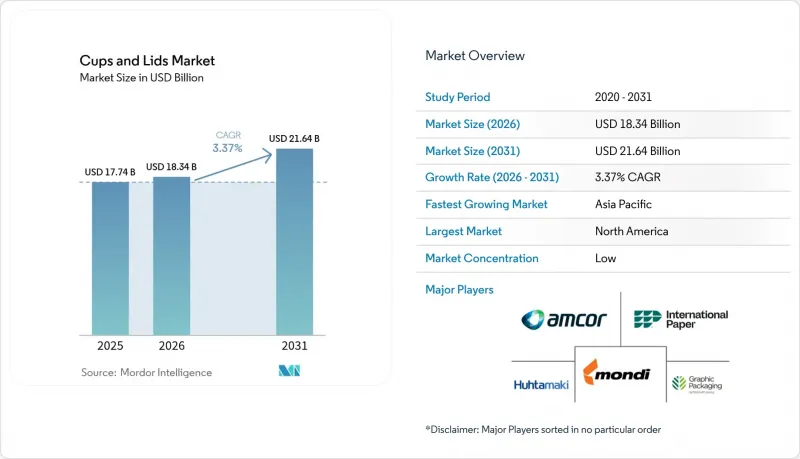
Mordor Intelligence에 의하면, 2026년 컵 및 뚜껑 시장 규모는 183억 4,000만 달러로 추정되고 있어 2025년 177억 4,000만 달러에서 확대해, 2031년에는 216억 4,000만 달러에 이를 것으로 예측됩니다.
2026년부터 2031년까지의 연평균 성장률(CAGR)은 3.37%가 될 것으로 전망됩니다.
본 보고서는 소재별(플라스틱, 종이 및 판지, 발포 스티로폼(EPS), 성형 섬유·바가스 등), 제품 유형별(음료 컵, 소분·포장용 컵, 뚜껑),최종 사용자별(식품 및 음료, 외식 산업, 소매 및 전자상거래 등), 그리고 지역별로 분류되어 있습니다. 시장 예측은 금액(달러) 기준으로 제시되어 있습니다.
전 세계 컵 및 뚜껑 시장 동향과 인사이트
QSR(퀵서비스 레스토랑) 및 음식 배달의 급속한 성장
퀵서비스 레스토랑(QSR)의 급속한 확대와 배달 주문의 두 자릿수 성장에 힘입어 1회용 패키지에 대한 수요가 증가하고 있습니다. 맥도날드는 2024년에 1,100개 이상의 매장을 신규 오픈했으며, DoorDash는 2025년 1분기에 총 주문액이 전년 동기 대비 18% 증가한 187억 달러를 기록했습니다. 배달 음식 1인분에는 보통 여러 유형의 음료가 포함되어 있어, 운송 중 식품의 안전성을 확보하기 위한 액체 누출 방지 기능이 있는 컵이나 변조 방지 기능이 있는 뚜껑이 요구되고 있습니다. 이러한 급증에 따라 각 컨버터 기업들은 일체형 통기 기능, QR 코드를 통한 추적 기능, 다구획 사양의 도입을 추진하고 있습니다. 아시아 시장은 QSR 보급률이 유럽 및 미국의 수준보다 낮음에도 불구하고 두 자릿수 성장을 이어가고 있으며, 일회용 용기에 대한 수요가 더욱 증가하고 있어 강력한 성장세를 보이고 있습니다.
테이크아웃 음료의 성장
2024년에는 도시 지역의 출퇴근자들이 테이크아웃 음료를 선호하게 되면서 전 세계 커피숍 방문객 수가 12% 증가했습니다. 이러한 추세는 콜드브루, 단백질 쉐이크, 생주스 분야로도 확대되고 있으며, 각 제품별로 특유의 차단 성능과 내열성이 요구되고 있습니다. 스타벅스는 3만 개 매장에서 빨대를 폐지하고 시퍼 뚜껑으로 전환했습니다. 이를 통해 연간 10억 개의 빨대가 절감되었으며, 이는 소비자의 행동이 뚜껑 재설계를 어떻게 촉진하고 있는지를 보여줍니다. 각 제조업체들은 폴리프로필렌을 사용하지 않는 뚜껑이나 핫필 테스트를 통과한 종이 통기구를 통해 이에 대응하고 있으며, ESG 메시지를 활용하여 프리미엄 진열 공간을 확보하고 있습니다.
플라스틱 규제
유럽의 ‘일회용 플라스틱 지침’ 및 캘리포니아주 SB 54법은 제조업체에 컵 1개당 0.05-0.15유로의 새로운 수수료 납부를 의무화하고, 2032년까지 플라스틱 사용량을 25% 감축할 것을 요구하고 있습니다. 이 규정을 준수하려면 소재 전환에 따른 자본 비용 증가가 수반되며, 지역 특화 제품 포트폴리오 구축이 촉진됩니다. 소규모 가공업체는 불균형한 부담을 떠안게 되어 컵 및 뚜껑 시장에서 철수할 가능성이 있으며, 그 결과 업계 재편이 진행될 가능성이 있습니다.
부문 분석
종이 및 판지는 2031년까지 연평균 성장률(CAGR) 4.55%를 기록하며 플라스틱을 앞질렀습니다. 다만, 2025년 시점에서 컵 및 뚜껑 시장에서 플라스틱은 여전히 60.78%의 시장 점유율을 차지하고 있었습니다. 각 커피 체인점들이 핫필 요건을 충족하는 성형 섬유 뚜껑의 시범 도입을 추진함에 따라, 섬유계 소재를 사용한 컵 및 뚜껑 시장 규모는 꾸준히 확대될 것으로 예측됩니다. 발포 폴리스티렌은 지자체의 사용 금지 조치 확대에 따라 감소 추세가 이어지고 있지만, 바이오플라스틱은 원료 비용이 높아 여전히 틈새 시장에 머물러 있습니다.
가공업체들은 다양한 규제 체제에 대응하기 위해 여러 공급원을 확보해야 하므로, 자본 배분은 PET, rPET 및 코팅지를 전환할 수 있는 유연한 생산 라인으로 이동하고 있습니다. Dart Container사의 1억 8,000만 달러 규모의 종이컵 생산 라인은 주문 변경을 신속하게 처리할 수 있게 해 주며, 주요 제조업체들이 친환경 라벨 수요를 추구하는 동시에 소재 리스크를 분산시키고 있음을 여실히 보여줍니다. 각 브랜드는 PFAS 규제를 회피하기 위해 화학 물질을 포함하지 않는 배리어 코팅을 요구하고 있으며, 이로 인해 음료용으로 100°C의 온도도 견딜 수 있는 수성 분산액에 대한 투자가 촉진되고 있습니다.
지역별 분석
북미는 2025년 컵 및 뚜껑 시장 점유율 38.96%를 유지했습니다. 이는 확고히 자리 잡은 드라이브스루 문화와 지속 가능한 포장재로 업그레이드하는 데 비용을 아끼지 않는 소비자들의 존재에 힘입은 결과입니다. 2024년 캐나다에서 시행된 일회용 플라스틱 금지 조치는 코팅지로의 전환을 촉진한 반면, 멕시코의 QSR(퀵 서비스 레스토랑) 매장 수 증가는 저비용 PET 컵의 판매량 증가에 기여했습니다. FDA의 식품 접촉 규제는 신규 시장 진출기업에게 진입 장벽이 되는 한편, 강력한 규정 준수 체계를 갖춘 기존 기업을 보호하고 있습니다.
아시아태평양은 4.44%라는 가장 높은 연평균 성장률(CAGR)을 기록하며, 계속해서 생산 능력 확대의 초점이 되고 있습니다. 중국에서는 2024년 커피 소비량이 20% 증가하면서, 테이크아웃 시 크레마의 질감을 유지하는 특수 뚜껑에 대한 수요가 높아졌습니다. 700억 달러 규모의 인도 조직화된 소매 업계에서는 현재 컵에 표준화된 용량 눈금 표시가 의무화되어 있어, 이를 통해 대량 생산과 수지 사용량을 줄이는 얇은 두께의 디자인이 촉진되고 있습니다. 또한, 지역적인 임금 면에서의 우위도 다국적 가공 제조업체들을 끌어들이고 있으며, 이들 기업은 중동 바이어에게 제품을 출하하기 위한 수출 거점을 건설하고 있습니다.
유럽은 완만한 성장에 그치고 있지만, 여전히 혁신의 선두주자로 자리매김하고 있습니다. 이는 주로 재활용 가능한 단일 소재 시스템을 우선시하는 엄격한 ‘확대 생산자 책임(EPR)’ 수수료 때문입니다. 독일이 2025년까지 70%의 재활용률 달성을 목표로 하고 있는 만큼, 브랜드 소유주들은 투명한 PET 컵과 이에 맞는 PET 뚜껑의 채택을 촉진하고 있으며, 이를 통해 단일 스트림 수거가 활성화되고 있습니다. 유럽연합 집행위원회의 ‘순환 경제 행동 계획’에서는 개당 0.05-0.15유로가 추가되는 보증금 제도가 도입되어, 이를 통해 총비용을 절감할 수 있는 경량 제품 형태에 대한 수요가 발생하고 있습니다. 재활용 소재 함량을 추적할 수 있는 인증을 취득한 공급업체는 대형 음료 체인점에서 우선적으로 조달되고 있습니다.
기타 혜택:
- 엑셀 형식 시장 예측(ME) 시트
- 3개월간 애널리스트의 지원
자주 묻는 질문
목차
제1장 서론
제2장 조사 방법
제3장 주요 요약
제4장 시장 구도
제5장 시장 규모와 성장 예측
제6장 경쟁 구도
제7장 시장 기회와 향후 전망
JHS 26.09.09According to Mordor Intelligence, the cups and lids market size in 2026 is estimated at USD 18.34 billion, growing from 2025 value of USD 17.74 billion with 2031 projections showing USD 21.64 billion, growing at 3.37% CAGR over 2026-2031.
This report is Segmented by Material (Plastic, Paper and Paperboard, Foam (EPS), Molded-fiber/Bagasse, and More), Product Type (Drinking Cups, Portion and Packaging Cups, and Lids), End-User (Food and Beverage, Foodservice, Retail and E-Commerce, and More), and Geography. The Market Forecasts are Provided in Terms of Value (USD).
Global Cups And Lids Market Trends and Insights
QSR and Food-delivery Boom
Rapid expansion of quick-service restaurants and double-digit growth in delivery orders heighten the need for single-serve packaging. McDonald's opened over 1,100 new outlets in 2024, while DoorDash posted an 18% year-over-year rise in gross order value to USD 18.7 billion in Q1 2025. Each delivery meal typically contains multiple beverages, requiring leak-proof cups and tamper-evident lids that protect food safety during transit. The surge encourages converters to add integrated venting, QR code tracking, and multi-compartment formats. Asian markets gain strongly because QSR penetration remains below Western levels yet grows in double digits, creating incremental demand for disposables.
Growth in On-the-go Drinks
Global coffee shop visits increased by 12% in 2024 as urban commuters sought takeaway beverages. The trend extends to cold brews, protein shakes, and fresh juices, each requiring distinct barrier properties and temperature resilience. Starbucks removed plastic straws by converting to sipper lids across 30,000 locations, eliminating 1 billion straws annually and illustrating how consumer behavior drives lid redesign. Manufacturers respond with polypropylene-free lids and paper-based vents that pass hot-fill tests, leveraging ESG messaging to capture premium shelf space.
Plastics Regulations
The European Single-Use Plastics Directive and California's SB 54 mandate require producers to pay new fees of EUR 0.05-0.15 per cup and mandate a 25% reduction in plastic use by 2032. Compliance adds capital costs for material conversion and encourages region-specific product portfolios. Smaller converters face disproportionate burdens and may exit the cups and lids market, leading to higher consolidation.
Other drivers and restraints analyzed in the detailed report include:
- Rise of Private-label SKUs
- Dry-molded-fiber Technology
- Volatile Resin Prices
For complete list of drivers and restraints, kindly check the Table Of Contents.
Segment Analysis
Paper and paperboard recorded a 4.55% CAGR through 2031, outpacing plastics, even though the latter still held a 60.78% market share in cups and lids in 2025. The cups and lids market size for fiber-based formats is projected to expand steadily as coffee chains trial molded-fiber lids that pass hot-fill requirements. Foam polystyrene continues to decline as municipal bans expand, while bioplastics remain a niche market due to high feedstock costs.
Converters must dual-source to serve mixed regulatory regimes, so capital allocation pivots toward flexible lines that switch between PET, rPET, and coated paperboard. Dart Container's USD 180 million paper cup line enables rapid order changes, highlighting how leading producers diversify material risk while pursuing eco-label demand. Brands demand chemical-free barrier coatings to avoid PFAS restrictions, prompting investment in water-based dispersions that still withstand temperatures of 100 °C for beverages.
Complete Report Scope:
- By Material
- Plastic
- Paper and Paperboard
- Foam (EPS)
- Molded-fiber / Bagasse
- Other Material Types
- By Product Type
- Drinking Cups
- Portion and Packaging Cups
- Lids
- By End-User
- Food and Beverage
- Foodservice
- Retail and E-commerce
- Other End-User
- By Geography
- North America
- United States
- Canada
- Mexico
- South America
- Brazil
- Argentina
- Chile
- Rest of South America
- Europe
- United Kingdom
- Germany
- France
- Italy
- Spain
- Russia
- Rest of Europe
- Asia-Pacific
- China
- India
- Japan
- South Korea
- Australia
- Rest of Asia-Pacific
- Middle East and Africa
- Middle East
- Saudi Arabia
- United Arab Emirates
- Turkey
- Rest of Middle East
- Africa
- South Africa
- Nigeria
- Rest of Africa
- Middle East
- North America
Geography Analysis
North America retained a 38.96% market share of cups and lids in 2025, supported by a well-established drive-thru culture and consumers willing to pay for sustainable packaging upgrades. Canada's single-use plastic ban in 2024 fueled migration to coated paperboard, while Mexico's growing QSR footprint supplied volume growth for low-cost PET cups. FDA food-contact regulations raise barriers for new entrants yet protect incumbents with strong compliance teams.
Asia-Pacific delivered the highest 4.44% CAGR and remains the focal point for capacity expansions. China experienced a 20% increase in coffee consumption in 2024, which heightened demand for specialty lids that preserve the crema texture during takeaway service. India's USD 70 billion organized retail sector now specifies standardized volume markers on cups, supporting large production runs and thin-wall designs that cut resin use. Regional wage advantages also attract multinational converters, who are building export hubs that ship to buyers in the Middle East.
Europe grew modestly yet remains the innovation leader, largely due to stringent Extended Producer Responsibility fees that favor recyclable mono-material systems. Germany's 70% recycling rate target for 2025 encourages brand owners to adopt clear PET cups with matching PET lids, thereby enhancing single-stream collection. The European Commission's Circular Economy Action Plan layers deposit schemes that add EUR 0.05-0.15 per unit, creating demand for lightweight formats that defend total cost. Suppliers with traceable recycled content certification receive procurement preference from large beverage chains.
- Amcor plc
- Dart Container Corporation
- Huhtamaki Oyj
- Graphic Packaging Holding Company
- Greiner Packaging International GmbH
- Novolex Holdings LLC
- Reynolds Consumer Products Inc.
- WinCup, Inc.
- Seda International Packaging Group S.p.A.
- Lollicup USA, Inc.
- Mondi plc
- Printpack, Inc.
- Sabert Corporation
- C-P Flexible Packaging, Inc.
- DETMOLD PACKAGING PTY. LTD.
- International Paper Company
- Coveris Holdings S.A.
Additional Benefits:
- The market estimate (ME) sheet in Excel format
- 3 months of analyst support
TABLE OF CONTENTS
1 INTRODUCTION
- 1.1 Study Assumptions and Market Definition
- 1.2 Scope of the Study
2 RESEARCH METHODOLOGY
3 EXECUTIVE SUMMARY
4 MARKET LANDSCAPE
- 4.1 Market Overview
- 4.2 Market Drivers
- 4.2.1 QSR and Food-delivery Boom
- 4.2.2 Growth in On-the-go Drinks
- 4.2.3 Shift from Glass to Plastic
- 4.2.4 Rise of Private-label SKUs
- 4.2.5 Dry-molded-fiber Technology
- 4.2.6 AI-optimised Inventory
- 4.3 Market Restraints
- 4.3.1 Plastics Regulations
- 4.3.2 Volatile Resin Prices
- 4.3.3 Growing Reusable Culture
- 4.3.4 PFAS Barrier Bans
- 4.4 Industry Supply-Chain Analysis
- 4.5 Regulatory Landscape
- 4.6 Technological Outlook
- 4.7 Porter's Five Forces Analysis
- 4.7.1 Threat of New Entrants
- 4.7.2 Bargaining Power of Suppliers
- 4.7.3 Bargaining Power of Buyers
- 4.7.4 Threat of Substitutes
- 4.7.5 Industry Rivalry
5 MARKET SIZE AND GROWTH FORECASTS (VALUE)
- 5.1 By Material
- 5.1.1 Plastic
- 5.1.2 Paper and Paperboard
- 5.1.3 Foam (EPS)
- 5.1.4 Molded-fiber / Bagasse
- 5.1.5 Other Material Types
- 5.2 By Product Type
- 5.2.1 Drinking Cups
- 5.2.2 Portion and Packaging Cups
- 5.2.3 Lids
- 5.3 By End-User
- 5.3.1 Food and Beverage
- 5.3.2 Foodservice
- 5.3.3 Retail and E-commerce
- 5.3.4 Other End-User
- 5.4 By Geography
- 5.4.1 North America
- 5.4.1.1 United States
- 5.4.1.2 Canada
- 5.4.1.3 Mexico
- 5.4.2 South America
- 5.4.2.1 Brazil
- 5.4.2.2 Argentina
- 5.4.2.3 Chile
- 5.4.2.4 Rest of South America
- 5.4.3 Europe
- 5.4.3.1 United Kingdom
- 5.4.3.2 Germany
- 5.4.3.3 France
- 5.4.3.4 Italy
- 5.4.3.5 Spain
- 5.4.3.6 Russia
- 5.4.3.7 Rest of Europe
- 5.4.4 Asia-Pacific
- 5.4.4.1 China
- 5.4.4.2 India
- 5.4.4.3 Japan
- 5.4.4.4 South Korea
- 5.4.4.5 Australia
- 5.4.4.6 Rest of Asia-Pacific
- 5.4.5 Middle East and Africa
- 5.4.5.1 Middle East
- 5.4.5.1.1 Saudi Arabia
- 5.4.5.1.2 United Arab Emirates
- 5.4.5.1.3 Turkey
- 5.4.5.1.4 Rest of Middle East
- 5.4.5.2 Africa
- 5.4.5.2.1 South Africa
- 5.4.5.2.2 Nigeria
- 5.4.5.2.3 Rest of Africa
- 5.4.5.1 Middle East
- 5.4.1 North America
6 COMPETITIVE LANDSCAPE
- 6.1 Market Concentration
- 6.2 Strategic Moves
- 6.3 Market Share Analysis
- 6.4 Company Profiles (includes Global level Overview, Market level overview, Core Segments, Financials as available, Strategic Information, Market Rank/Share for key companies, Products and Services, and Recent Developments)
- 6.4.1 Amcor plc
- 6.4.2 Dart Container Corporation
- 6.4.3 Huhtamaki Oyj
- 6.4.4 Graphic Packaging Holding Company
- 6.4.5 Greiner Packaging International GmbH
- 6.4.6 Novolex Holdings LLC
- 6.4.7 Reynolds Consumer Products Inc.
- 6.4.8 WinCup, Inc.
- 6.4.9 Seda International Packaging Group S.p.A.
- 6.4.10 Lollicup USA, Inc.
- 6.4.11 Mondi plc
- 6.4.12 Printpack, Inc.
- 6.4.13 Sabert Corporation
- 6.4.14 C-P Flexible Packaging, Inc.
- 6.4.15 DETMOLD PACKAGING PTY. LTD.
- 6.4.16 International Paper Company
- 6.4.17 Coveris Holdings S.A.
7 MARKET OPPORTUNITIES AND FUTURE OUTLOOK
- 7.1 White-space and Unmet-need Assessment


