|
시장보고서
상품코드
2123495
플렉소 인쇄 시장 : 점유율 분석, 업계 동향·통계, 성장 예측(2026-2031년)Flexographic Printing - Market Share Analysis, Industry Trends & Statistics, Growth Forecasts (2026 - 2031) |
||||||
 Mordor Intelligence
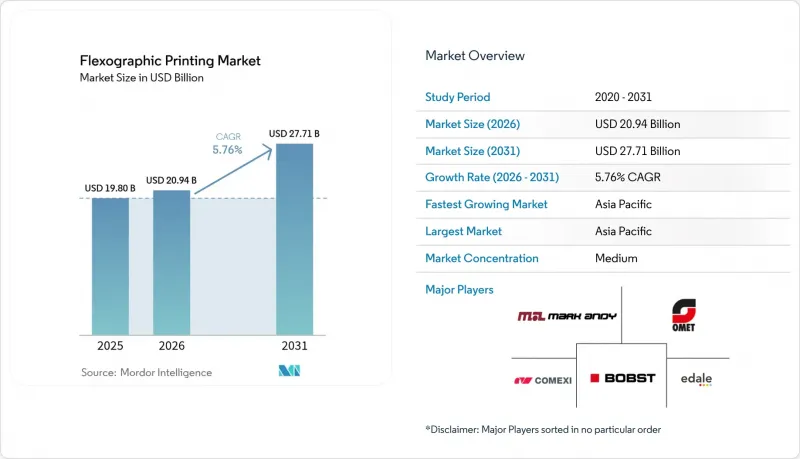
Mordor Intelligence에 의하면, 플렉소 인쇄 시장 규모는 2025년에 198억 달러로 평가되었고 2026년 209억 4,000만 달러에서 2031년까지 277억 1,000만 달러에 이를 것으로 예측되며, 예측 기간(2026-2031년) CAGR은 5.76%를 나타낼 전망입니다.
본 보고서는 인쇄 장비의 유형(나로우브, 미디엄우브 등), 잉크의 유형(수성, 용제계 등), 기재의 유형(종이 및 판지, 유연성 플라스틱 필름 등), 용도(골판지 상자, 접이식 카톤 등), 최종 사용자 산업(식품 및 음료 등),및 지역별로 분류되어 있습니다. 시장 전망은 금액(달러) 기준으로 제시되어 있습니다.
세계 플렉소 인쇄 시장 동향 및 인사이트
브랜드 소유자의 SKU 주기 단축에 대한 수요
소비자의 기호는 그 어느 때보다 빠르게 변화하고 있어, 브랜드 매니저는 패키지 아트워크를 빈번하게 업데이트할 수밖에 없는 상황입니다. 이에 대응하기 위해 각 컨버터 기업들은 몇 분 만에 판 교체를 완료할 수 있는 협폭 인쇄기를 도입하여 가동 중단 시간과 자재 낭비를 줄이고 있습니다. Onyx GO와 같은 솔루션은 능동적인 등록 제어를 구현하여 설정 시 발생하는 스크랩을 30% 줄여줍니다. 또한 소량 생산을 통해 소매업체는 과잉 재고를 안고 있지 않으면서도 시즌 한정 상품을 시험적으로 판매할 수 있게 되어, 플렉소 인쇄 시장 전체의 운전 자본 부담을 경감시킵니다. 이와 더불어, 클라우드 기반 워크플로우 소프트웨어가 아트워크 승인 프로세스를 가속화하여, 새로운 디자인이 컨셉 단계에서 매장 진열까지 불과 몇 주 만에 구현될 수 있게 됩니다.
비용 효율이 뛰어난 대량 생산 패키지 인쇄
인쇄 매수가 수백만 장을 초과하는 경우, 플렉소 인쇄는 여전히 최저의 단위 비용을 실현합니다. 포토폴리머 판은 수십만 회 사이클을 견디며, 에너지 효율이 뛰어난 건조기가 운영 비용을 절감합니다. 듀폰(DuPont)의 ‘Orion’ 사례에서는 그라비아 인쇄에서 플렉소 인쇄로 전환함으로써 용제 사용량을 30% 줄일 수 있었을 뿐만 아니라 작업 현장의 안전성도 향상되었습니다. 이러한 경제성 덕분에 기존 소비재 생산 라인은 플렉소 인쇄 시장에 계속 자리 잡고 있으며, 인쇄기의 가동률과 OEM 제조업체를 위한 예비 부품 판매가 유지되고 있습니다. 대부분의 경우, 3교대제로 가동되는 아시아의 각 컨버터 기업들은 수출 주도형 수요에 부응하기 위해 이러한 비용 측면의 우위를 최대한 활용하고 있습니다.
단기 납기 인쇄 분야에서 디지털 잉크젯에 의한 시장 잠식
피에조 헤드와 수성 분산 잉크의 발전으로 인해, 경쟁력 있는 클릭당 단가로 가변 데이터 인쇄와 오프셋에 필적하는 화질을 실현하고 있습니다. 의약품 포장 제조업체는 디지털 라인을 ERP 소프트웨어와 통합하여, 국가별 첨부 문서를 주문형으로 생산함으로써 재고를 제로로 줄이고 있습니다. 이에 대응하여 플렉소 인쇄 시장은 인라인 잉크젯 스테이션과 기존 장치를 융합한 하이브리드 인쇄기로 전환하고 있으며, 확립된 후가공 워크플로를 유지하면서 시리얼화 기능을 추가하고 있습니다.
부문 분석
각 컨버터 업체들이 대량 생산 모드와 맞춤형 배치 생산을 번갈아 전환할 수 있는 단일 라인을 추구한 결과, 디지털·하이브리드 인쇄기의 신규 도입 점유율이 상승했습니다. 2025년에는 좁은 폭 인쇄기가 매출의 30.52%를 차지했지만, 하이브리드 인쇄기는 연평균 성장률(CAGR) 9.09%를 기록할 전망이며, 이는 플렉소 인쇄 시장 전체의 성장률을 크게 상회하는 수치입니다. 대표적인 구성으로는 브랜드 컬러용 10색 플렉소 데크와 리와인더 바로 앞에 배치된 CMYK 잉크젯 바를 조합한 것을 들 수 있습니다. 이러한 구성을 통해 작업 전환 시간을 5분 미만으로 단축할 수 있으며, 평균 주문량이 5,000 리니어미터 미만이어도 라인의 수익성을 유지할 수 있습니다. 티슈의 오버랩이나 스낵 포장에서는 여전히 미디엄 웹 라인이 선호되는 반면, 스탠드업 파우치에서는 와이드 웹 CI 플렉소가 우위를 유지하고 있습니다. 단판 인쇄기는 다운스트림 공정에서 정밀한 다이컷 스테이션이 필요한 접이식 골판지 상자 제조에 사용됩니다.
모듈식 플랫폼을 도입한 컨버터는 고객의 제품 구성이 변경될 때에도 나중에 코로나 처리 장치, 칠 롤 또는 두 번째 잉크젯 바를 추가할 수 있습니다. ‘SapphireLUCE’는 이러한 모듈식 접근 방식을 구현한 제품으로, 1200×1200 DPI의 해상도와 시속 150 mpm의 속도를 겸비하고 있습니다. 서비스 수준 계약에는 대개 예측 유지보수 분석이 포함되어 있어, 예기치 못한 가동 중지 시간을 가동 가능 시간의 2% 미만으로 억제하고 있습니다. 이러한 기능 세트 덕분에 신흥국 시장에서 재생 인쇄기로 인한 경쟁 압박에 직면해 있는 플렉소 인쇄 시장 전체에서도 OEM 제조업체는 가격 결정력을 유지하고 있습니다.
수성 잉크 시스템은 냄새가 적고 대부분의 관할 구역에서 식품과의 직접 접촉이 승인되어 2025년에는 매출의 40.42%를 차지했습니다. 이들은 골판지 상자, 접이식 상자, 종이 포장의 기초가 되는 화학 조성을 형성합니다. 반면, UV 경화형 잉크는 더 높은 라인 속도를 지원하며 비다공성 필름에서 뛰어난 내스크래치성을 발휘하기 때문에 2031년까지 연평균 성장률(CAGR) 8.28%를 나타낼 것으로 예측됩니다. 에너지 경화형 솔루션에는 수은 아크 램프에 비해 전력 소비가 65% 적은 소형 LED 램프가 필요하며, 이를 통해 공장의 전기 요금을 절감할 수 있습니다. 한편, 미국 환경보호청(EPA)의 파트 59 규정에 따른 VOC 규제 강화로 제약을 받고 있는 용제형 잉크는 계속해서 시장 점유율을 잃고 있습니다. 전자빔 경화형은 보급률이 2% 미만으로 틈새 시장이지만, 유제품 용기 뚜껑이나 무균 카톤 분야에서 유망한 것으로 평가받고 있습니다.
각 잉크 공급업체들은 안료 분산의 안정성, 유변학 제어, 그리고 저이동성 첨가제 패키지를 통해 차별화를 꾀하고 있습니다. INX International사의 ‘GelFlex EB’ 잉크는 특정 스낵 식품 용도에서 라미네이션을 불필요하게 하여 종이 두께를 얇게 하고, 호일 사용량을 줄여줍니다. 이러한 혁신은 플렉소 인쇄 시장 전반에 확산되고 있는 지속가능성 노력과 부합하는 것입니다.
지역별 분석
아시아태평양은 2025년에 38.05%로 가장 큰 매출 점유율을 차지하며, 2031년까지 연평균 성장률(CAGR) 9.06%로 확대될 것으로 전망됩니다. 중국은 기판, 잉크, 기계를 공급하여 통합적인 비용 시너지를 실현하고 있는 반면, 인도에서는 전자상거래 소포의 두 자릿수 성장이 나타나 국내 포장 수요를 견인하고 있습니다. 일본과 한국은 자동화를 중시하며, 코봇(협동 로봇)을 활용한 롤 교환 기능을 갖춘 인쇄 라인 개발을 선도하고 있습니다. 아세안(ASEAN) 국가들의 정부 재활용 목표는 수성 잉크 및 단일 소재 파우치 설계를 촉진하고 있어, 플렉소 인쇄 시장 전체의 비즈니스 기회를 확대되고 있습니다.
북미는 여전히 기술의 선구자이며, AI 기반 검사 카메라와 클라우드 연결형 점도 제어 장치의 시범 운영이 진행되고 있습니다. 브랜드 소유주들은 FDA 규정을 준수하는 저이행 워크플로우를 입증하는 컨버터를 높이 평가하고 있으며, 이를 통해 제곱미터당 고부가가치 인쇄가 유지되고 있습니다. 인력 부족은 계속되고 있으며, 리코의 ‘어드밴스드 커리어 에듀케이션(Advanced Career Education)’ 프로그램과 같이, 인쇄기 옆에서 데이터 분석을 운영자에게 지도하는 노력이 진행되고 있습니다. 니어쇼어링 추세에 따라 소비재 제조 거점이 아시아에서 멕시코로 이동하고 있으며, 북미의 CI 플렉소 인쇄 라인에 대한 새로운 투자가 촉진되고 있습니다.
유럽에서는 엄격한 규제 감독이 유지되고 있으며, ‘제로 폴루션(Zero Pollution)’ 프레임워크 하에서 식물 유래 광개시제 및 광물유 무함유 잉크 세트의 신속한 도입이 요구되고 있습니다. 독일은 뛰어난 엔지니어링 기술을 기반으로 하고, 프랑스는 바이오플라스틱 포장을 가속화하며, 이탈리아는 보브스트(Bobst)사의 피렌체 센터(1,200제곱미터)와 같은 좁은 웹 기술 거점의 규모를 확대되고 있습니다. 동유럽의 컨버터들은 유리한 임금 구조를 활용하여 쏟아지는 주문을 소화하고 있으며, 플렉소 인쇄 시장에서 이 지역의 다양한 역할을 강화하고 있습니다.
기타 혜택:
- 엑셀 형식 시장 예측(ME) 시트
- 3개월간의 애널리스트 지원
자주 묻는 질문
목차
제1장 서론
제2장 조사 방법
제3장 주요 요약
제4장 시장 구도
제5장 시장 규모와 성장 예측
제6장 경쟁 구도
제7장 시장 기회와 향후 전망
JHS 26.09.09According to Mordor Intelligence, the flexographic printing market size was valued at USD 19.80 billion in 2025 and estimated to grow from USD 20.94 billion in 2026 to reach USD 27.71 billion by 2031, at a CAGR of 5.76% during the forecast period (2026-2031).

This report is Segmented by Printing Equipment Type (Narrow Web, Medium Web, and More), Ink Type (Water-Based, Solvent-Based, and More), Substrate Type (Paper and Paperboard, Flexible Plastic Films, and More), Application (Corrugated Boxes, Folding Carton, and More), End-User Industry (Food and Beverage, and More), and Geography. The Market Forecasts are Provided in Terms of Value (USD).
Global Flexographic Printing Market Trends and Insights
Brand-owner Demand for Shorter SKU Cycles
Consumer preferences now turn over faster than ever, pushing brand managers to refresh packaging artwork frequently. Converters respond by leaning on narrow-web presses that complete plate changes in minutes, curbing downtime and material waste. Solutions such as the Onyx GO deliver active register control that lowers setup scrap by 30%. Shorter runs also let retailers pilot seasonal editions without carrying surplus inventory, reducing the working-capital burden throughout the flexographic printing market. In parallel, cloud-based workflow software accelerates artwork approvals, ensuring that new designs progress from concept to shelf within weeks.
Cost-Effective Long-Run Package Printing
Where volumes exceed millions of impressions, flexography still offers the lowest unit cost. Photopolymer plates last hundreds of thousands of cycles, while energy-efficient dryers reduce operating expenses. DuPont's Orion case illustrates 30% solvent savings after migrating from gravure to flexo, along with safer shop-floor conditions. Such economics keep legacy consumer-goods lines anchored in the flexographic printing market, preserving press utilization and spare-parts sales for OEMs. Asian converters, often running three shifts, maximize these cost advantages to meet export-driven demand.
Digital Inkjet Cannibalisation in Short Runs
Advances in piezo-electric heads and aqueous dispersion inks enable variable data and near-offset image quality at competitive click rates. Pharmaceutical packagers integrate digital lines with ERP software to produce country-specific leaflets on demand, cutting inventory to zero. In response, the flexographic printing market is pivoting to hybrid presses that merge in-line inkjet stations with conventional units, preserving established finishing workflows while adding serialization capability.
Other drivers and restraints analyzed in the detailed report include:
- Water-Based Ink Adoption for Food Contact Compliance
- Shift Toward Sustainable Corrugated Logistics
- Volatile Photopolymer Plate Prices
For complete list of drivers and restraints, kindly check the Table Of Contents.
Segment Analysis
Digital-hybrid presses lifted their share of new installations as converters sought one line that could alternate between mass-production mode and personalized batches. Although narrow-web machines secured 30.52% of revenue in 2025, the hybrid cohort is on course for 9.09% CAGR, well above the overall flexographic printing market. Typical configurations combine 10-color flexo decks for brand colors with CMYK inkjet bars placed just before the rewinder. Such set-ups reduce job changeover time to under five minutes, keeping lines profitable even when average order quantities fall below 5,000 linear m. Medium-web lines remain favored in tissue overwraps and snack wrappers, while wide-web CI flexo retains dominance in stand-up pouches. Sheet-fed presses serve folding cartons that require precise die-cutting stations downstream.
Converters equipping themselves with modular platforms can later bolt on corona treaters, chill rolls, or second inkjet bars as client mixes evolve. The SapphireLUCE exemplifies this modular path, pairing 1200 X 1200 DPI resolution with speeds of 150 mpm. Service-level agreements often bundle predictive-maintenance analytics, shrinking unplanned downtime below 2% of available hours. These feature sets sustain pricing power for OEMs, even as the broader flexographic printing market experiences competitive pressure from refurbished presses in emerging economies.
Water-based systems commanded 40.42% revenue in 2025 thanks to low odour and direct-food-contact approval in most jurisdictions. They form the baseline chemistry for corrugated boxes, folding cartons, and paper wraps. UV-curable inks, however, are projected to register 8.28% CAGR through 2031 because they support higher line speeds and excellent scratch resistance on non-porous films. Energy-curable solutions require compact LED lamps that draw 65% less power than mercury arc units, reducing plant electricity bills. Solvent variants, constrained by tightening VOC caps under the US EPA Part 59 ruling, continue to cede share. Electron-beam curables remain a niche at under 2% penetration but show promise in dairy lidding and aseptic cartons.
Ink suppliers differentiate through pigment dispersion stability, rheology control, and low-migration additive packages. INX International's GelFlex EB ink removes lamination in certain snack applications, dropping gauge weight and cutting foil usage. Such innovations echo the broader sustainability narrative resonating throughout the flexographic printing market.
Complete Report Scope:
- By Printing Equipment Type
- Narrow Web
- Medium Web
- Wide Web
- Sheet-Fed
- Digital-Hybrid
- By Ink Type
- Water-Based
- Solvent-Based
- UV-Curable
- Electron-Beam
- By Substrate Type
- Paper and Paperboard
- Flexible Plastic Films
- Metallic Foil
- Other Substrate Type
- By Application
- Corrugated Boxes
- Folding Carton
- Flexible Packaging
- Labels
- Print Media
- Other Application
- By End-user Industry
- Food and Beverage
- Healthcare and Pharmaceuticals
- Personal Care and Cosmetics
- Industrial
- Other End-user Industry
- By Geography
- North America
- United States
- Canada
- Mexico
- Europe
- Germany
- United Kingdom
- France
- Italy
- Spain
- Russia
- Rest of Europe
- Asia-Pacific
- China
- India
- Japan
- South Korea
- Australia and New Zealand
- Rest of Asia-Pacific
- Middle East and Africa
- Middle East
- United Arab Emirates
- Saudi Arabia
- Turkey
- Rest of Middle East
- Africa
- South Africa
- Nigeria
- Egypt
- Rest of Africa
- Middle East
- South America
- Brazil
- Argentina
- Rest of South America
- North America
Geography Analysis
Asia-Pacific generated the largest revenue slice at 38.05% in 2025 and is projected to compound at 9.06% CAGR to 2031. China supplies substrates, inks, and machinery, enabling integrated cost synergies, while India posts double-digit e-commerce parcel growth that fuels domestic packaging demand. Japan and South Korea emphasize automation, pioneering press lines equipped with cobot-assisted roll changes. Government recycling targets across ASEAN incentivize water-based inks and mono-material pouch designs, broadening addressable opportunities throughout the flexographic printing market.
North America remains the technology pione-er, hosting pilot runs for AI-driven inspection cameras and cloud-connected viscosity controllers. Brand owners reward converters that demonstrate FDA-compliant low-migration workflows, sustaining high value-added print per square meter. Labor shortages persist, prompting initiatives like Ricoh's Advanced Career Education program that trains operators in press-side data analytics. Nearshoring trends reroute consumer-goods manufacturing from Asia to Mexico, spurring fresh investments in CI flexo lines within North America.
Europe maintains keen regulatory oversight, compelling swift adoption of plant-based photoinitiators and mineral-oil-free ink sets under the Zero Pollution framework. Germany anchors engineering excellence, France accelerates bio-plastic packaging, and Italy scales narrow-web competence hubs such as Bobst's 1,200 sqm Florence center. Eastern European converters leverage favorable wage structures to absorb overflow orders, reinforcing the region's diverse role in the flexographic printing market.
- Bobst Group SA
- Heidelberger Druckmaschinen AG
- Mark Andy Inc.
- Comexi Group
- Koenig and Bauer AG
- Windmoller & Holscher KG
- Uteco Group
- OMET SRL
- Edale Ltd.
- Star Flex International
- InterFlex Group
- Flexopack SA
- Pepin Manufacturing Inc.
- Wolverine Flexographic LLC
- Siva Group
- Gallus Ferd. Ruesch AG
- Nilpeter A/S
- Soma Engineering
- PCMC (Barry-Wehmiller)
- Tresu Group
- MPS Systems B.V.
Additional Benefits:
- The market estimate (ME) sheet in Excel format
- 3 months of analyst support
TABLE OF CONTENTS
1 INTRODUCTION
- 1.1 Study Assumptions and Market Definition
- 1.2 Scope of the Study
2 RESEARCH METHODOLOGY
3 EXECUTIVE SUMMARY
4 MARKET LANDSCAPE
- 4.1 Market Overview
- 4.2 Market Drivers
- 4.2.1 Brand - owner demand for shorter SKU cycles
- 4.2.2 Cost-effective long-run package printing
- 4.2.3 Water-based ink adoption for food contact compliance
- 4.2.4 Shift toward sustainable corrugated logistics
- 4.2.5 AI-driven press automation and waste reduction
- 4.2.6 E-commerce accelerates multi-wall mailers
- 4.3 Market Restraints
- 4.3.1 Digital inkjet cannibalisation in short runs
- 4.3.2 Volatile photopolymer plate prices
- 4.3.3 Solvent-based VOC regulations tightening
- 4.3.4 Skilled press-operator shortage
- 4.4 Supply-Chain Analysis
- 4.5 Regulatory Outlook
- 4.6 Technological Outlook
- 4.7 Porter's Five Forces Analysis
- 4.7.1 Bargaining Power of Suppliers
- 4.7.2 Bargaining Power of Buyers
- 4.7.3 Threat of New Entrants
- 4.7.4 Threat of Substitute Products
- 4.7.5 Intensity of Competitive Rivalry
- 4.8 Investment Analysis
5 MARKET SIZE AND GROWTH FORECASTS (VALUE)
- 5.1 By Printing Equipment Type
- 5.1.1 Narrow Web
- 5.1.2 Medium Web
- 5.1.3 Wide Web
- 5.1.4 Sheet-Fed
- 5.1.5 Digital-Hybrid
- 5.2 By Ink Type
- 5.2.1 Water-Based
- 5.2.2 Solvent-Based
- 5.2.3 UV-Curable
- 5.2.4 Electron-Beam
- 5.3 By Substrate Type
- 5.3.1 Paper and Paperboard
- 5.3.2 Flexible Plastic Films
- 5.3.3 Metallic Foil
- 5.3.4 Other Substrate Type
- 5.4 By Application
- 5.4.1 Corrugated Boxes
- 5.4.2 Folding Carton
- 5.4.3 Flexible Packaging
- 5.4.4 Labels
- 5.4.5 Print Media
- 5.4.6 Other Application
- 5.5 By End-user Industry
- 5.5.1 Food and Beverage
- 5.5.2 Healthcare and Pharmaceuticals
- 5.5.3 Personal Care and Cosmetics
- 5.5.4 Industrial
- 5.5.5 Other End-user Industry
- 5.6 By Geography
- 5.6.1 North America
- 5.6.1.1 United States
- 5.6.1.2 Canada
- 5.6.1.3 Mexico
- 5.6.2 Europe
- 5.6.2.1 Germany
- 5.6.2.2 United Kingdom
- 5.6.2.3 France
- 5.6.2.4 Italy
- 5.6.2.5 Spain
- 5.6.2.6 Russia
- 5.6.2.7 Rest of Europe
- 5.6.3 Asia-Pacific
- 5.6.3.1 China
- 5.6.3.2 India
- 5.6.3.3 Japan
- 5.6.3.4 South Korea
- 5.6.3.5 Australia and New Zealand
- 5.6.3.6 Rest of Asia-Pacific
- 5.6.4 Middle East and Africa
- 5.6.4.1 Middle East
- 5.6.4.1.1 United Arab Emirates
- 5.6.4.1.2 Saudi Arabia
- 5.6.4.1.3 Turkey
- 5.6.4.1.4 Rest of Middle East
- 5.6.4.2 Africa
- 5.6.4.2.1 South Africa
- 5.6.4.2.2 Nigeria
- 5.6.4.2.3 Egypt
- 5.6.4.2.4 Rest of Africa
- 5.6.4.1 Middle East
- 5.6.5 South America
- 5.6.5.1 Brazil
- 5.6.5.2 Argentina
- 5.6.5.3 Rest of South America
- 5.6.1 North America
6 COMPETITIVE LANDSCAPE
- 6.1 Market Concentration
- 6.2 Strategic Moves
- 6.3 Market Share Analysis
- 6.4 Company Profiles (Includes Global level Overview, Market level overview, Core Segments, Financials as available, Strategic Information, Market Rank/Share for key companies, Products and Services, and Recent Developments)
- 6.4.1 Bobst Group SA
- 6.4.2 Heidelberger Druckmaschinen AG
- 6.4.3 Mark Andy Inc.
- 6.4.4 Comexi Group
- 6.4.5 Koenig and Bauer AG
- 6.4.6 Windmoller & Holscher KG
- 6.4.7 Uteco Group
- 6.4.8 OMET SRL
- 6.4.9 Edale Ltd.
- 6.4.10 Star Flex International
- 6.4.11 InterFlex Group
- 6.4.12 Flexopack SA
- 6.4.13 Pepin Manufacturing Inc.
- 6.4.14 Wolverine Flexographic LLC
- 6.4.15 Siva Group
- 6.4.16 Gallus Ferd. Ruesch AG
- 6.4.17 Nilpeter A/S
- 6.4.18 Soma Engineering
- 6.4.19 PCMC (Barry-Wehmiller)
- 6.4.20 Tresu Group
- 6.4.21 MPS Systems B.V.
7 MARKET OPPORTUNITIES AND FUTURE OUTLOOK
- 7.1 White-space and Unmet-Need Assessment