|
시장보고서
상품코드
2123646
플렉소 인쇄기 시장 : 시장 점유율 분석, 업계 동향 및 통계, 성장 예측(2026-2031년)Flexographic Printing Machine - Market Share Analysis, Industry Trends & Statistics, Growth Forecasts (2026 - 2031) |
||||||
 Mordor Intelligence
Mordor Intelligence에 의하면, 2026년 플렉소 인쇄기 시장 규모는 43억 5,000만 달러로 추정되고, 2025년 42억 2,000만 달러에서 확대해, 2031년에는 50억 6,000만 달러에 이를 것으로 예측됩니다.
2026-2031년 연평균 성장률(CAGR)은 3.09%가 될 것으로 전망됩니다.
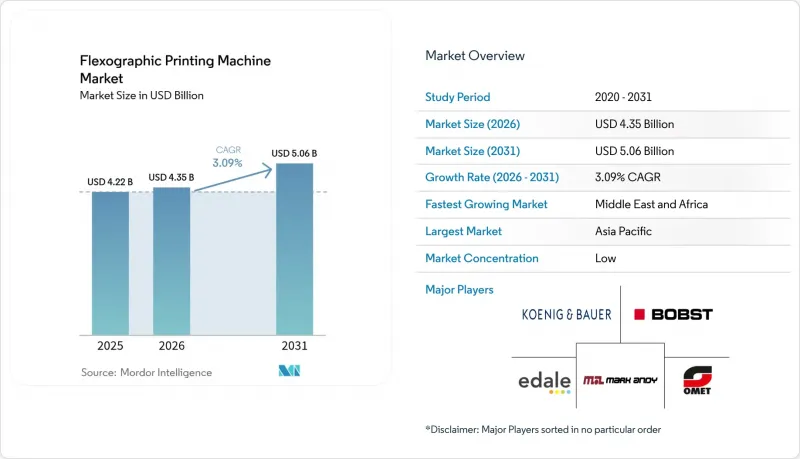
본 보고서는 소재별(종이 및 판지, 플라스틱 필름, 골판지, 기타), 인쇄기 유형별(센트럴 임프레션(CI), 스택, 인라인/모듈러), 최종 사용자 산업별(식음료, 의약품 및 헬스케어, 기타), 자동화 수준별(기존, 스마트/IoT 지원), 지역별로 분류되어 있습니다. 시장 규모와 전망은 금액(달러) 기준으로 제시되어 있습니다.
세계의 플렉소 인쇄기 시장 동향 및 인사이트
비용 효율이 뛰어난 소량 포장 대응 능력
플렉소 인쇄기 제조업체들은 셋업 시간을 대폭 단축하고, 수익성을 확보할 수 있는 최소 로트 수를 5,000m에서 500m 가까이까지 낮췄습니다. 사이클 시간 단축으로 인해 계절 한정 또는 지역 한정 SKU를 보유한 브랜드도 과도한 비용을 들이지 않고 맞춤형 그래픽을 도입할 수 있게 되었습니다. MacDermid의 LUX ITP 플레이트는 플레이트 룸에서 출하까지 소요되는 시간을 기존 2일에서 8시간으로 단축하여, 이로 인해 다음 날 아트 변경을 목표로 하는 컨버터에게 주요 병목 현상이 해소되었습니다. 플레이트의 고속화와 신속한 전환이 결합되면서, 플렉소 인쇄는 과거 디지털 인쇄기로 흘러갔던 작업을 다시 되찾을 수 있게 되었습니다. 그 결과, 각 컨버터 기업들은 속도와 유연성의 균형을 갖춘 중규모 모듈식 라인에 투자하고 있으며, 이것이 플렉소 인쇄기 시장 전체의 설비 수요를 뒷받침하고 있습니다.
식품 등급의 지속 가능한 연포장재의 급증
유럽과 북미의 규제로 인해 PFAS 배제가 요구되는 한편, 완전한 재활용 가능성도 요구되고 있습니다. 사이카 플렉스(Saica Flex)는 2030년까지 PCR(재활용 플라스틱) 함유율 5%의 100% 재활용 가능한 제품 라인업을 구축할 계획이며, 이는 컨버터들이 순환 경제에 대한 노력을 입증해야 한다는 압박을 여실히 보여주고 있습니다. INX의 GelFlex EB 잉크는 라미네이트 층을 제거함으로써 포장의 총 중량을 줄이면서도 배리어 성능을 유지하고 있습니다(inxinternational.com). Solenis와 Heidelberg와 같은 인라인 배리어 코팅 제휴를 통해 2차 공정이 더욱 줄어듭니다. 각 컨버터 업체들이 EU의 2026년 8월 PFAS 규제 상한선에 앞서 새로운 화학 조성의 인증 획득을 서두르는 가운데, 수성 잉크나 EB 경화 잉크를 경쟁 속도로 인쇄할 수 있는 인쇄기에 대한 수요가 높아지면서 플렉소 인쇄기 시장에 긍정적인 영향을 미치고 있습니다.
막대한 설비 투자가 필요한 다색 CI 인쇄기
모든 옵션을 갖춘 1,300mm CI 라인의 가격은 400만 달러에 달하며, 모듈식 대체 기계 유형보다 훨씬 비쌉니다. 그 결과, 2024년에는 전 세계의 주요 고객들조차 주문을 연기했고, Bobst사의 CI 수주는 24% 감소했습니다. 평균 로트 규모가 축소되는 가운데, 중견 컨버터들은 고가의 인쇄기 구입 자금 조달을 주저하고 있어 플렉소 인쇄기 시장의 교체 주기가 둔화되고 있습니다.
부문 분석
2025년에는 소매 전자상거래용 상자와 재생 크라프트 라이너 수요에 힘입어, 종이 및 판지가 플렉소 인쇄기 시장에서 45.10%의 점유율을 차지하며 시장을 주도했습니다. 가공업체들은 브랜드 요건을 충족하기 위해 종이의 용이한 재활용성에 의존하고 있는 반면, 코팅 기술의 향상으로 상온 보관 식품의 유통 기한이 연장되고 있습니다. 그러나 단일 소재 라미네이트 및 PCR 혼합이 순환형 사회와 차단성 요구를 해결하고 있어, 플라스틱 필름은 6.33%라는 가장 높은 연평균 성장률(CAGR)을 기록하고 있습니다.
INX의 EB 잉크를 통해 필름 구조에서 라미네이트 층을 1층 줄이고, 배리어 성능을 저해하지 않으면서 두께를 얇게 만들 수 있게 됨에 따라, 소재 대체를 둘러싼 경쟁이 격화되고 있습니다. UFlex가 이집트에 신설한 PET 수지 생산 능력은 공급망을 단축하기 위한 전 세계적인 수지 자급화 추세를 반영하고 있습니다. 전반적으로, 종이 컨버터는 골판지 제조기 보유 대수를 확대하는 한편, 필름 공급업체는 고차단성 파우치 수요를 추구하고 있으며, 이로 인해 기판 특화형 인쇄기를 대상으로 하는 플렉소 인쇄기 시장 전체에서 설비 수요가 유지되고 있습니다.
인라인/모듈러 시스템은 합리적인 도입 비용과 프라이빗 브랜드 식품 및 독립 화장품 제조업체가 선호하는 유연한 작업 전환 특성 덕분에 2025년에는 매출 점유율의 39.00%를 차지했습니다. 센트럴 임프레션(CI) 방식 인쇄기는 설비 투자 부담이 크지만, 수축 슬리브나 와이드 웹 스낵 과자에서 색상과 색상의 정밀한 정렬을 요구하는 브랜드 수요에 힘입어 연평균 성장률(CAGR) 5.28%라는 가장 빠른 속도로 점유율을 확대되고 있습니다.
하이브리드 설계로 인해 기존 유형 간의 경계는 점차 모호해지고 있습니다. Uteco의 ‘OnyxOMNIA’는 8색 플렉소 데크에 잉크젯 헤드를 통합하여 분당 400m의 인쇄 속도를 실현하는 동시에 가변 데이터 인쇄를 가능하게 하고 있습니다. CI 방식의 OEM 각사가 자동 판통 및 디지털 트윈 진단을 도입하는 가운데, 24/6 교대 근무 체제를 운영하는 컨버터들은 고사양화를 추진하고 있어, 플렉소 인쇄기 시장을 고사양 플랫폼으로 이끌고 있습니다.
지역별 분석
2025년, 아시아태평양은 전 세계 매출의 40.10%를 차지했습니다. 이는 중국의 생산 능력 확대와 ‘친환경 및 스마트’ 기준을 충족하는 CI 인쇄기를 우선적으로 지원하는 보조금 주도형 설비 갱신이 뒷받침한 결과입니다. 일본에서는 인건비 급등으로 인해 로봇을 이용한 자재 운반 도입이 가속화되고 있는 반면, 한국 및 아세안(ASEAN)의 컨버터 업체들은 지역 내 스낵 및 퍼스널케어 브랜드에 대응하기 위해 연질 포장 라인에 대한 투자를 추진하고 있습니다.
중동 및 아프리카는 연평균 성장률(CAGR) 5.96%로 가장 빠르게 성장하고 있는 지역입니다. 인구 증가, 콜드체인 구축, 일용소비재(FMCG)의 보급 확대가 새로운 연질 포장 공장 건설을 뒷받침하고 있으며, 이집트의 UFlex PET 칩 공장처럼 현지 수지 공급의 기반이 되는 투자를 유치하고 있습니다. 걸프 국가들에서도 순환형 경제 목표를 달성하기 위해 수성 잉크로의 전환을 점진적으로 도입하고 있습니다.
북미와 유럽은 성숙한 시장이지만, PFAS 및 VOC 규제가 강화되는 가운데 여전히 기술 선도자로서의 지위를 유지하고 있습니다. 2026년 8월부터 시행되는 EU의 PFAS 상한치 25 ppb로 인해, 각 컨버터 업체들은 배리어 코팅을 전면적으로 재검토해야 하는 상황에 처해 있습니다. 북미의 인쇄업체들도 주 차원의 용제 규제로 인해 유사한 압박에 직면하고 있으며, 밀폐 챔버식 도크터 블레이드 시스템 및 히트셋용 공기 관리 시스템의 업그레이드가 진행되고 있습니다. 그 결과, 이들 지역에서는 거시적인 생산량 증가세가 둔화되고 있지만, 교체 수요로 인해 플렉소 인쇄기 시장은 활기를 띠고 있습니다.
기타 혜택
- 엑셀 형식 시장 예측(ME) 시트
- 3개월간의 애널리스트 지원
자주 묻는 질문
목차
제1장 서론
제2장 조사 방법
제3장 주요 요약
제4장 시장 구도
제5장 시장 규모 및 성장 예측
제6장 경쟁 구도
제7장 시장 기회 및 향후 전망
AJY 26.09.11According to Mordor Intelligence, flexographic printing machine market size in 2026 is estimated at USD 4.35 billion, growing from 2025 value of USD 4.22 billion with 2031 projections showing USD 5.06 billion, growing at 3.09% CAGR over 2026-2031.

This report is Segmented by Material (Paper and Paperboard, Plastic Films, Corrugated Board, and More), Press Type (Central-Impression (CI), Stack, and In-Line / Modular), End-User Industry (Food and Beverage, Pharmaceutical and Healthcare, and More), Automation Level (Conventional, and Smart / IoT-Enabled), and Geography. The Market Sizes and Forecasts are Provided in Terms of Value (USD).
Global Flexographic Printing Machine Market Trends and Insights
Cost-effective short-run packaging capability
Flexographic press builders have slashed setup times, taking profitable minimum runs from 5,000 m to close to 500 m. Shorter cycles mean brands with seasonal or regional SKUs can deploy custom graphics without prohibitive costs. MacDermid's LUX ITP plates now leave the plate room in eight hours, down from two days, which removes a key bottleneck for converters targeting next-day art changes. Together, faster plates and rapid changeovers allow flexography to reclaim work that once defaulted to digital presses. Converters are therefore investing in mid-range modular lines that balance speed with flexibility, underpinning equipment demand across the flexographic printing machine market.
Surge in food-grade sustainable flexible packaging
European and North American regulations are eliminating PFAS while demanding full recyclability. Saica Flex plans a 100% recyclable portfolio by 2030 with 5% PCR content, showcasing the pressure on converters to prove circularity. INX's GelFlex EB inks remove lamination layers, cutting total pack weight yet maintaining barrier integrity inxinternational.com. Inline barrier-coating partnerships, such as Solenis-Heidelberg, further reduce secondary processes. As converters race to certify new chemistries before the EU's August 2026 PFAS cap, demand crescendos for presses that can run water-based or EB curing inks at competitive speeds benefiting the flexographic printing machine market.
Cap-ex intensive multi-color CI presses
A fully optioned 1,300 mm CI line can command USD 4 million, well above modular alternatives. As a result, even global accounts deferred orders in 2024, cutting Bobst CI bookings by 24%. Mid-market converters hesitate to finance premium presses when average run lengths are shrinking, slowing replacement cycles in the flexographic printing machine market.
Other drivers and restraints analyzed in the detailed report include:
- Rapid corrugated capacity additions in e-commerce fulfillment
- Mandates on water-based low-VOC inks
- Skilled press-operator shortage in Europe and Japan
For complete list of drivers and restraints, kindly check the Table Of Contents.
Segment Analysis
Paper and paperboard led the flexographic printing machine market with 45.10% share in 2025, buoyed by retail e-commerce cartons and recycled kraft liners. Converters rely on paper's easy recyclability to satisfy brand mandates, while improved coatings are extending shelf life for ambient foods. Plastic films, however, chart the fastest 6.33% CAGR as mono-material laminates and PCR blends solve circularity and barrier needs.
The substitution battle intensifies as INX's EB inks allow film structures to drop a lamination layer, cutting gauge without compromising barrier. UFlex's new PET resin capacity in Egypt reflects global resin self-sufficiency moves to shorten supply chains. Overall, paper converters expand corrugator fleets, whereas film suppliers chase high-barrier pouches together sustaining equipment demand across the flexographic printing machine market size for substrate-specific presses.
In-line/modular systems held 39.00% revenue share in 2025 thanks to affordable acquisition costs and nimble job changes traits favored by private-label food and indie cosmetics. Central-impression presses, though capital-heavy, are gaining fastest at 5.28% CAGR, propelled by brand demands for tight color-to-color register on shrink sleeves and wide web snacks.
Hybrid designs blur former lines: Uteco's OnyxOMNIA stitches inkjet heads onto an eight-color flexo deck, delivering 400 m/min while enabling variable data . As CI OEMs roll out automatic plate cylinders and digital-twin diagnostics, converters with 24/6 shifts migrate upscale, driving the flexographic printing machine market toward higher-spec platforms.
Complete Report Scope:
- By Material
- Paper and Paperboard
- Plastic Films
- Metallic Films and Foils
- Corrugated Board
- Others Material (Bioplastics, Laminates)
- By Press Type
- Central-Impression (CI)
- Stack
- In-Line / Modular
- By End-User Industry
- Food and Beverage
- Pharmaceutical and Healthcare
- Personal-Care and Cosmetics
- Consumer Electronics
- Logistics and E-commerce
- Other End-user Industry
- By Automation Level
- Conventional
- Smart / IoT-Enabled
- By Geography
- North America
- United States
- Canada
- Mexico
- Europe
- Germany
- France
- Italy
- United Kingdom
- Spain
- Rest of Europe
- Asia-Pacific
- China
- Japan
- India
- South Korea
- ASEAN
- Rest of Asia-Pacific
- South America
- Brazil
- Argentina
- Rest of South America
- Middle East and Africa
- Middle East
- Saudi Arabia
- United Arab Emirates
- Turkey
- Rest of Middle East
- Africa
- South Africa
- Kenya
- Rest of Africa
- Middle East
- North America
Geography Analysis
Asia-Pacific accounted for 40.10% of global revenues in 2025, aided by China's capacity expansions and subsidy-driven equipment renewals that favor CI presses meeting "green, intelligent" criteria. Japan's high labor costs accelerate adoption of robotic material handling, while South Korean and ASEAN converters invest in flexible packaging lines to serve regional snack and personal-care brands.
Middle East & Africa is the fastest-growing territory at 5.96% CAGR. Population growth, cold-chain improvements, and rising FMCG penetration spur new flexible packaging plants, drawing investments like UFlex's PET chip facility in Egypt which anchors local resin supply. Gulf States are also piloting water-based ink retrofits to meet circular-economy targets.
North America and Europe, though mature, remain technology pacesetters as PFAS and VOC regulations tighten. The EU's 25 ppb PFAS ceiling effective August 2026 forces converters to overhaul barrier coatings. North American printers face similar pressure from state-level solvent rules, driving upgrades to enclosed-chamber doctor-blade systems and heat-set air management. Consequently, replacement demand keeps the flexographic printing machine market dynamic despite slower macro-volume growth in these regions.
- Bobst Group SA
- Windmoller and Holscher KG
- Koenig and Bauer AG
- Mark Andy Inc.
- Uteco Group
- Heidelberger Druckmaschinen AG
- OMET Srl
- MPS Systems BV
- Nilpeter A/S
- Gallus Ferd. Ruesch AG
- Soma Engineering
- PCMC (Barry-Wehmiller)
- Star Flex International
- Orient Sogyo Co. Ltd.
- Taiyo Kikai Ltd.
- Comexi Group
- Rotatek SA
- Wolverine Flexographic LLC
- Zhejiang Weigang Machinery
- Edale Ltd.
Additional Benefits:
- The market estimate (ME) sheet in Excel format
- 3 months of analyst support
TABLE OF CONTENTS
1 INTRODUCTION
- 1.1 Study Assumptions and Market Definition
- 1.2 Scope of the Study
2 RESEARCH METHODOLOGY
3 EXECUTIVE SUMMARY
4 MARKET LANDSCAPE
- 4.1 Market Overview
- 4.2 Market Drivers
- 4.2.1 Cost-effective short-run packaging capability
- 4.2.2 Surge in food-grade sustainable flexible packaging
- 4.2.3 Rapid corrugated capacity additions in e-commerce fulfilment
- 4.2.4 Mandates on water-based low-VOC inks in North America and EU
- 4.2.5 Converting-line digital twin and AI predictive-maintenance adoption
- 4.2.6 China 2026 Green Press subsidy for CI-flexo equipment
- 4.3 Market Restraints
- 4.3.1 Cap-ex intensive multi-colour CI presses
- 4.3.2 Skilled press-operator shortage in Europe and Japan
- 4.3.3 Plate-making lead-time bottlenecks for ultra-short runs
- 4.3.4 Tightening PFAS restrictions on barrier coating compatibility
- 4.4 Supply-Chain Analysis
- 4.5 Regulatory Landscape
- 4.6 Technological Outlook
- 4.7 Porter's Five Forces Analysis
- 4.7.1 Threat of New Entrants
- 4.7.2 Bargaining Power of Buyers
- 4.7.3 Bargaining Power of Suppliers
- 4.7.4 Threat of Substitutes
- 4.7.5 Intensity of Competitive Rivalry
5 MARKET SIZE AND GROWTH FORECASTS (VALUE)
- 5.1 By Material
- 5.1.1 Paper and Paperboard
- 5.1.2 Plastic Films
- 5.1.3 Metallic Films and Foils
- 5.1.4 Corrugated Board
- 5.1.5 Others Material (Bioplastics, Laminates)
- 5.2 By Press Type
- 5.2.1 Central-Impression (CI)
- 5.2.2 Stack
- 5.2.3 In-Line / Modular
- 5.3 By End-User Industry
- 5.3.1 Food and Beverage
- 5.3.2 Pharmaceutical and Healthcare
- 5.3.3 Personal-Care and Cosmetics
- 5.3.4 Consumer Electronics
- 5.3.5 Logistics and E-commerce
- 5.3.6 Other End-user Industry
- 5.4 By Automation Level
- 5.4.1 Conventional
- 5.4.2 Smart / IoT-Enabled
- 5.5 By Geography
- 5.5.1 North America
- 5.5.1.1 United States
- 5.5.1.2 Canada
- 5.5.1.3 Mexico
- 5.5.2 Europe
- 5.5.2.1 Germany
- 5.5.2.2 France
- 5.5.2.3 Italy
- 5.5.2.4 United Kingdom
- 5.5.2.5 Spain
- 5.5.2.6 Rest of Europe
- 5.5.3 Asia-Pacific
- 5.5.3.1 China
- 5.5.3.2 Japan
- 5.5.3.3 India
- 5.5.3.4 South Korea
- 5.5.3.5 ASEAN
- 5.5.3.6 Rest of Asia-Pacific
- 5.5.4 South America
- 5.5.4.1 Brazil
- 5.5.4.2 Argentina
- 5.5.4.3 Rest of South America
- 5.5.5 Middle East and Africa
- 5.5.5.1 Middle East
- 5.5.5.1.1 Saudi Arabia
- 5.5.5.1.2 United Arab Emirates
- 5.5.5.1.3 Turkey
- 5.5.5.1.4 Rest of Middle East
- 5.5.5.2 Africa
- 5.5.5.2.1 South Africa
- 5.5.5.2.2 Kenya
- 5.5.5.2.3 Rest of Africa
- 5.5.5.1 Middle East
- 5.5.1 North America
6 COMPETITIVE LANDSCAPE
- 6.1 Market Concentration
- 6.2 Strategic Moves
- 6.3 Market Share Analysis
- 6.4 Company Profiles (includes Global level Overview, Market level overview, Core Segments, Financials as available, Strategic Information, Market Rank/Share for key companies, Products and Services, and Recent Developments)
- 6.4.1 Bobst Group SA
- 6.4.2 Windmoller and Holscher KG
- 6.4.3 Koenig and Bauer AG
- 6.4.4 Mark Andy Inc.
- 6.4.5 Uteco Group
- 6.4.6 Heidelberger Druckmaschinen AG
- 6.4.7 OMET Srl
- 6.4.8 MPS Systems BV
- 6.4.9 Nilpeter A/S
- 6.4.10 Gallus Ferd. Ruesch AG
- 6.4.11 Soma Engineering
- 6.4.12 PCMC (Barry-Wehmiller)
- 6.4.13 Star Flex International
- 6.4.14 Orient Sogyo Co. Ltd.
- 6.4.15 Taiyo Kikai Ltd.
- 6.4.16 Comexi Group
- 6.4.17 Rotatek SA
- 6.4.18 Wolverine Flexographic LLC
- 6.4.19 Zhejiang Weigang Machinery
- 6.4.20 Edale Ltd.
7 MARKET OPPORTUNITIES AND FUTURE OUTLOOK
- 7.1 White-space and Unmet-need Assessment