|
시장보고서
상품코드
2123504
세포 분석 기기 시장 : 점유율 분석, 업계 동향과 통계, 성장 예측(2026-2031년)Cell Analysis Instruments - Market Share Analysis, Industry Trends & Statistics, Growth Forecasts (2026 - 2031) |
||||||
 Mordor Intelligence
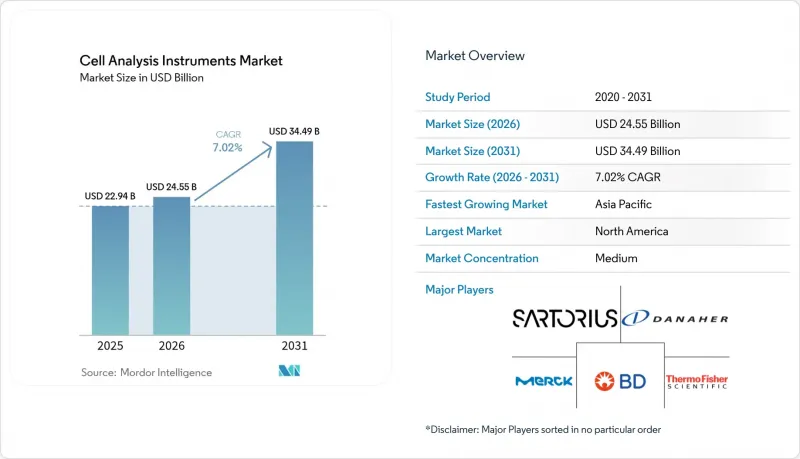
Mordor Intelligence에 의하면, 세포 분석 기기 시장 규모는 2025년 229억 4,000만 달러에서 2026년에는 245억 5,000만 달러로 확대되어 2026년부터 2031년까지 CAGR 7.02%로 성장을 지속하여, 2031년에는 344억 9,000만 달러에 이를 것으로 예측됩니다.
본 보고서는 제품별(기기(현미경, 유세포분석기 등) 및 소모품), 용도별(세포 계수, 세포 생존율, 세포 동정 등), 최종 사용자별(학술·연구 기관, 제약·바이오기술 기업 등), 지역별(북미, 유럽, 아시아태평양 등)로 분류되어 있습니다. 시장 예측은 금액(달러) 기준으로 제시되어 있습니다.
전 세계 세포 분석 기기 시장 동향 및 인사이트
만성 질환 유병률 증가
암, 심혈관 질환, 대사성 질환의 사례 수가 증가하고 있어 의료 시스템은 조기 발견을 우선시할 수밖에 없으며, 증상이 나타나기 전에 미묘한 표현형 변화를 밝혀낼 수 있는 고처리량 세포 프로파일링 플랫폼에 대한 수요가 높아지고 있습니다. FDA가 2024년에 승인한 ‘Shield’ 혈액 검사(대장암 검출 정확도 83%)는 다중 매개변수 세포 분석이 주류인 선별 검사를 어떻게 뒷받침하고 있는지를 보여줍니다. AI를 활용한 조직병리학 알고리즘은 침윤성 유방암의 패턴을 식별하는 데 있어 현재 수동 판독을 능가하는 성능을 발휘하고 있습니다. 2030년까지 35-45세 여성의 70%를 선별 검사해야 하는 자궁경부암 검진 프로그램에서는 병리 전문의 부족을 보완하기 위해 자동 슬라이드 리더가 도입되고 있습니다. 이러한 활용 사례는 임상 현장에서의 도입이 기술의 유효성을 입증하고, 나아가 세포 분석 기기 시장에 대한 추가 투자를 유도하는 선순환을 공고히 하고 있습니다.
생명공학 및 세포 치료 파이프라인의 확대
2024년 현재 미국에서 진행 중인 1,200건 이상의 세포 및 유전자 치료 임상시험이 공정 내 관리를 위한 스펙트럼 소터, 하이컨텐츠 이미저 및 GMP 등급 유세포 분석기 구매를 촉진하고 있습니다. 로슈가 포세이다 테라퓨틱스(Poseida Therapeutics)를 10억-15억 달러 규모로 인수한 것은 규모 확대 시 엄격한 세포 표현형 분석이 필요한 동종 CAR-T 플랫폼을 확보하려는 움직임이 치열함을 여실히 보여주고 있습니다. 텐포인트 테라퓨틱스는 2025년 말까지 망막 세포 치료제의 첫 인체 임상시험을 실시할 계획이며, 이에 따라 분석 수요는 종양학의 범위를 넘어 확대되고 있습니다. 위탁 개발·제조 기관(CDMO)은 중소 바이오기술 기업의 역량 부족을 보완하고, 여러 고객을 지원하기 위한 분석 제품군을 구축함에 따라 장비 판매를 견인하고 있습니다. 그 결과, 세포 분석 기기 시장에서는 GMP 환경에 최적화된 장비 플랫폼과 소모품 키트 모두에서 성장이 예상됩니다.
주력 장비의 높은 자본 비용
최첨단 스펙트럼 유세포 분석기, 하이컨텐츠 이미저 및 질량 유세포 분석 플랫폼은 대개 50만 달러 이상의 가격으로 책정되어 있어, 많은 교육 병원이나 공립 대학에게는 감당하기 어려운 가격입니다. NIH는 ‘고성능 장비 보조금’을 통해 이러한 격차를 해소하기 위해 노력하고 있으며, 단일 장비당 75만-200만 달러를 지원하고 있습니다. 그러나 지원 대상 제안 건수는 여전히 이용 가능한 자금을 크게 상회하고 있으며, 그 증거로 Bio-Rad사의 2025년 1분기 학술 기관 대상 매출이 전년 동기 대비 5.4% 감소한 점을 들 수 있습니다. 공동 이용 시설은 가동률을 높여주지만, 대기 시간이 길어져 실험 일정에 차질을 빚을 수도 있습니다. 환율 변동과 수입 관세는 개발도상국 시장의 비용을 더욱 상승시켜 단위 출하 대수를 억제하고, 미충족 의료 수요가 가장 빠르게 증가하고 있는 지역에서 세포 분석 기기 시장 침투를 둔화시키고 있습니다.
부문별 분석
소모품은 2025년 매출의 58.72%를 차지하며, 연구실이 장비의 수명 주기 전반에 걸쳐 분석 키트, 시약, 일회용 카트리지를 재주문하기 때문에 예측 가능한 이익률을 가져다줍니다. 그럼에도 불구하고, 주력 장비의 출시가 매출 성장을 견인하고 있습니다. BD사의 ‘FACSDiscover S8’ 스펙트럼 소터는 고속 이미징과 기존 형광 기술을 융합하여, 이 부문에서 최초로 표현형에 기반한 선별을 가능하게 합니다. 요코가와(Yokogawa)의 ‘CellVoyager CQ3000’은 sCMOS 카메라를 활용한 오가노이드의 라이브 3D 이미징을 제공하여, 단일 플레이트에서의 분석 능력을 확대되고 있습니다. 새로운 광로와 내장 AI로 인해 프로토콜이 단축됨에 따라, 각 연구소에서는 일반적인 7년의 감가상각 기간보다 더 빨리 구형 하드웨어를 교체하고 있으며, 이로 인해 장비의 연평균 성장률(CAGR)은 11.94%에 달하고 있습니다. 분광광도계, 마이크로어레이 및 첨단 현미경은 규정 준수 문서 작성을 자동화하는 클라우드 기반 분석 대시보드에 연결되며, 지속적인 소프트웨어 구독을 확보함으로써 공급업체들은 세포 분석 기기 시장에서의 입지를 더욱 공고히 하고 있습니다.
부수적인 효과로 인해 소모품에 대한 수요가 더욱 강화되고 있습니다. AI를 활용한 분석에서는 한 번의 측정으로 더 많은 바이오마커를 다중 측정하는 경우가 많아 시약 사용량이 증가합니다. 스펙트럼 유세포 분석법에는 좁은 발광 빈에 최적화된 독자적인 염료 패널이 필요하며, 이 기술의 채택은 소모품 매출로 직접 이어집니다. 이러한 모든 요인이 결합되어 소모품은 판매량의 기반을 계속 유지하는 한편, 고가의 하드웨어는 세포 분석 기기 업계의 연간 매출에서 변동 요인으로 남을 것으로 확실시됩니다.
지역별 분석
북미는 2025년 매출의 40.21%를 차지하며 계속해서 주도적인 위치를 유지하고 있습니다. 그 배경에는 NIH(미국 국립보건원)가 제공하는 건당 75만-200만 달러 규모의 하이엔드 장비 보조금과 2025 회계연도 NSF(미국 국립과학재단)의 생명공학 예산 4억 2,100만 달러가 있습니다. 견조한 벤처 자금, 성숙한 바이오의약품 클러스터, 그리고 조기 도입을 선호하는 문화가 맞물려 북미의 연구소들은 다른 지역보다 앞서 AI 기반 분석 플랫폼을 도입하게 되었습니다. 캐나다 연방 혁신 기금과 멕시코에서의 계약 제조의 급속한 확대도 이 지역 수요를 뒷받침하고 있습니다. 시마즈 제작소의 멕시코 신규 자회사는 2028년까지 150%의 사업 성장을 목표로 하고 있으며, 이는 장비 공급업체가 이 시장에 대해 가지고 있는 자신감을 보여줍니다. 현재 북미의 세포 분석 기기 시장 규모는 하이엔드 장비, 바이오프로세스 분석 및 클라우드 연결형 데이터 서비스를 전문으로 하는 공급업체들을 뒷받침하고 있습니다.
아시아태평양은 2031년까지 연평균 성장률(CAGR)이 11.75%로 가장 높은 성장률을 기록하고 있습니다. 중국이 동남아시아로의 바이오의약품 투자에 중점을 두고 있으며, 전 세계 희토류 생산량의 90%를 장악하고 있다는 점은 광학 부품공급 안정성에 영향을 미치고 있습니다. 인도가 ‘쿼드(Quad)’의 바이오 제조 허브가 되는 것을 목표로 하고 있어, 해당 지역에서는 폐쇄형 GMP 준수 분석 스위트에 대한 수요가 예상됩니다. 일본의 니콘과 요코가와 전기는 최첨단 이미저를 공급하고 있으며, 이는 국내 도입 촉진으로 이어지고 있습니다. 한편, 한국은 정밀의료 인프라에 막대한 투자를 하고 있습니다. 그 결과, 세포 분석 기기 시장은 아시아의 다양한 경제권에서 제조 비용 측면의 우위와 미개척된 거대한 임상 부문이라는 두 가지 이점을 모두 누리고 있습니다.
유럽에서는 독일, 영국, 프랑스의 제약 산업 집적에 힘입어 견실한 도입 실적을 유지하고 있습니다. 조정된 연구 자금과 IVDR(체외진단 의료기기 규정) 도입이 맞물려 완만하지만 안정적인 수요 추세가 확보되고 있습니다. 동유럽 국가들은 EU의 구조 기금을 활용하여 실험실 인프라의 현대화를 추진하고 있으며, 향후 판매 대수 증가가 예상되는 분야로 부상하고 있습니다. 한편, 중동 및 아프리카에서는 기술 이전 협정과 연계되는 사례가 많아 병리 검사실 및 생명과학 교육 시설의 현대화가 본격화되고 있습니다. 이러한 지역에서는 정부가 탄화수소 의존형 경제에서 벗어나 경제 다각화를 추진함에 따라, 세계 세포 분석 기기 시장에서의 점유율은 작지만 증가 추세를 보이고 있습니다.
기타 혜택:
- 엑셀 형식 시장 예측(ME) 시트
- 3개월간의 애널리스트 지원
자주 묻는 질문
목차
제1장 서론
제2장 조사 방법
제3장 주요 요약
제4장 시장 구도
제5장 시장 규모와 성장 예측
제6장 경쟁 구도
제7장 시장 기회와 향후 전망
JHS 26.09.07According to Mordor Intelligence, the cell analysis instruments market size is expected to grow from USD 22.94 billion in 2025 to USD 24.55 billion in 2026 and is forecast to reach USD 34.49 billion by 2031 at 7.02% CAGR over 2026-2031.
This report is Segmented by Product (Instruments [Microscopes, Flow Cytometers, and More], and Consumables), Application (Cell Counting, Cell Viability, Cell Identification, and More), End-User (Academic and Research Institutes, Pharmaceutical & Biotechnology Companies, and More), and Geography (North America, Europe, Asia-Pacific, and More). The Market Forecasts are Provided in Terms of Value (USD).
Global Cell Analysis Instruments Market Trends and Insights
Rise in chronic disease prevalence
Growing cancer, cardiovascular, and metabolic disorder caseloads force health systems to prioritise early detection, pushing demand for high-throughput cellular profiling platforms that can uncover subtle phenotypic changes before symptoms manifest. The FDA's 2024 approval of the Shield blood-based assay-with 83% colorectal cancer detection accuracy-demonstrates how multiparametric cell analysis supports mainstream screening. AI-enhanced histopathology algorithms now outperform manual reads in identifying invasive breast-tumour patterns. Cervical-cancer programmes that must screen 70% of women aged 35-45 by 2030 are adopting automated slide readers to compensate for pathologist shortages. These use cases cement a feedback loop in which clinical adoption validates technology and, in turn, draws further investment into the cell analysis instruments market.
Expansion of biotech and cell-therapy pipelines
More than 1,200 active US cell- and gene-therapy trials in 2024 propel purchases of spectral sorters, high-content imagers, and GMP-grade flow cytometers for in-process control. Roche's USD 1.0-1.5 billion acquisition of Poseida Therapeutics highlights the rush to secure allogeneic CAR-T platforms that require rigorous cell phenotyping during scale-up. Tenpoint Therapeutics plans first-in-human retinal cell therapy studies by late 2025, widening analytical demand beyond oncology. Contract development and manufacturing organisations (CDMOs) fill capability gaps for smaller biotechs, bolstering instrument sales as they build analytical suites to serve multiple clients. Consequently, the cell analysis instruments market sees growth in both instrument platforms and consumable kits optimised for GMP environments.
High capital cost of flagship instruments
State-of-the-art spectral flow cytometers, high-content imagers, and mass cytometry platforms often list above USD 500,000, pricing out many teaching hospitals and public universities. NIH attempts to bridge the gap with High-End Instrumentation grants that award USD 750,000-2 million for single items. Yet the number of eligible proposals still far exceeds available funds, evidenced by Bio-Rad's 5.4% year-over-year decline in academic sales during Q1 2025. Shared-use cores improve utilisation but lengthen queue times, occasionally compromising experimental timelines. Currency swings and import levies amplify costs in developing markets, dampening unit shipments and slowing cell analysis instruments market penetration where unmet medical need is rising fastest.
Other drivers and restraints analyzed in the detailed report include:
- Falling single-cell sequencing costs
- AI-enabled image analysis boosting throughput
- Complex multi-jurisdiction regulatory path
For complete list of drivers and restraints, kindly check the Table Of Contents.
Segment Analysis
Consumables generated 58.72% of 2025 revenue and deliver predictable margins because laboratories reorder assay kits, reagents, and disposable cartridges throughout an instrument's life cycle. Flagship instrument launches nevertheless propel top-line growth; the BD FACSDiscover S8 spectral sorter marries high-speed imaging with traditional fluorescence to enable phenotype-based sorting, a first for the category. Yokogawa's CellVoyager CQ3000 offers live 3-D imaging of organoids using sCMOS cameras, broadening single-plate analytical capacity. As new optical paths and on-board AI shorten protocols, laboratories replace older hardware earlier than the typical seven-year depreciation curve, supporting a 11.94% CAGR for instruments. Spectrophotometers, microarrays, and advanced microscopes plug into cloud-based analytic dashboards that automate compliance documentation, securing recurring software subscriptions that anchor vendors deeper into the cell analysis instruments market.
Second-order effects further reinforce consumable demand. AI-assisted assays often multiplex more biomarkers per run, increasing reagent pull-through. Spectral flow cytometry requires proprietary dye panels optimised for narrow emission bins, converting technique adoption directly into consumable sales. Collectively, these drivers ensure that consumables remain the volume backbone, while big-ticket hardware remains the swing factor in annual revenue for the cell analysis instruments industry.
Complete Report Scope:
- By Product
- Instruments
- Microscopes
- Flow Cytometers
- Spectrophotometers
- Cell Microarrays
- Other Instruments
- Consumables
- Instruments
- By Application
- Cell Counting
- Cell Viability
- Cell Identification
- Target Identification
- PCR / qPCR
- Other Applications
- By End-User
- Academic & Research Institutes
- Pharmaceutical & Biotechnology Companies
- Contract Research & CDMO
- Other End-Users
- Geography
- North America
- United States
- Canada
- Mexico
- Europe
- Germany
- United Kingdom
- France
- Italy
- Spain
- Rest of Europe
- Asia-Pacific
- China
- Japan
- India
- South Korea
- Australia
- Rest of Asia-Pacific
- Middle East and Africa
- GCC
- South Africa
- Rest of Middle East and Africa
- South America
- Brazil
- Argentina
- Rest of South America
- North America
Geography Analysis
North America retains leadership with 40.21% of 2025 revenue, anchored by NIH High-End Instrumentation grants of USD 750,000-2 million per award and USD 421 million in NSF biotechnology budget for fiscal 2025. Robust venture funding, a mature biopharma cluster, and early-adopter culture pushed laboratories to adopt AI-enabled analytical platforms ahead of other regions. Canada's federal innovation funds and Mexico's burgeoning contract-manufacturing footprint add to regional demand; Shimadzu's new Mexican subsidiary aims for 150% business growth by 2028, signalling instrument vendors' confidence in the market. The current cell analysis instruments market size for North America supports vendors specialising in premium instrumentation, bioprocess analytics, and cloud-connected data services.
Asia-Pacific registers the highest growth rate at 11.75% CAGR through 2031. China's pivot toward Southeast Asian biopharma investments and control of 90% global rare-earth output influences supply security for optical components. India's ambition to become a Quad biomanufacturing hub positions the region for demand in closed, GMP-compliant analytical suites. Japan's Nikon and Yokogawa supply cutting-edge imagers that feed back into domestic adoption, while South Korea invests heavily in precision-medicine infrastructure. Consequently, the cell analysis instruments market enjoys both manufacturing cost advantages and large untapped clinical segments across Asia's diverse economies.
Europe maintains a solid installed base thanks to clustered pharma activity in Germany, the United Kingdom, and France. Coordinated research funding, combined with IVDR roll-out, ensures a stable if moderate demand trajectory. Eastern European nations look to EU structural funds to modernise laboratory infrastructure, creating future unit-growth pockets. Meanwhile, the Middle East and Africa begin to modernise pathology labs and life-science education facilities, often bundled with technology-transfer agreements. These regions contribute a small but rising share of the global cell analysis instruments market as governments diversify away from hydrocarbon-driven economies.
- Beckton Dickinson
- Danaher Corp. (Beckman Coulter Life Sciences)
- Thermo Fisher Scientific
- Merck
- Sartorius
- Miltenyi Biotec
- Agilent Technologies
- Bio-Rad Laboratories
- GE Healthcar
- PerkinElmer (Revvity)
- 10x Genomics
- Luminex (DiaSorin)
- Olympus
- Sysmex
- Promega
- Terumo
- Stem Cell Technologies
- Chemometec A/S
- Countstar (Ruiyu Biotech)
Additional Benefits:
- The market estimate (ME) sheet in Excel format
- 3 months of analyst support
TABLE OF CONTENTS
1 Introduction
- 1.1 Study Assumptions & Market Definition
- 1.2 Scope of the Study
2 Research Methodology
3 Executive Summary
4 Market Landscape
- 4.1 Market Overview
- 4.2 Market Drivers
- 4.2.1 Rise In Chronic Disease Prevalence
- 4.2.2 Expansion Of Biotech & Cell-Therapy Pipelines
- 4.2.3 Falling Single-Cell Sequencing Costs
- 4.2.4 Government Funding For Life-Science Tools
- 4.2.5 AI-Enabled Image-Analysis Boosting Throughput
- 4.2.6 Growing Demand For Closed, GMP-Compliant Microfluidic Systems
- 4.3 Market Restraints
- 4.3.1 High Capital Cost Of Flagship Instruments
- 4.3.2 Complex Multi-Jurisdiction Regulatory Path
- 4.3.3 Shortage Of Bio-Informatic Talent For Multi-Omics Workflows
- 4.3.4 Supply-Chain Risk For Rare Earth Optics & Detectors
- 4.4 Porter's Five Forces
- 4.4.1 Threat of New Entrants
- 4.4.2 Bargaining Power of Buyers
- 4.4.3 Bargaining Power of Suppliers
- 4.4.4 Threat of Substitutes
- 4.4.5 Intensity of Competitive Rivalry
5 Market Size & Growth Forecasts (Value, USD)
- 5.1 By Product
- 5.1.1 Instruments
- 5.1.1.1 Microscopes
- 5.1.1.2 Flow Cytometers
- 5.1.1.3 Spectrophotometers
- 5.1.1.4 Cell Microarrays
- 5.1.1.5 Other Instruments
- 5.1.2 Consumables
- 5.1.1 Instruments
- 5.2 By Application
- 5.2.1 Cell Counting
- 5.2.2 Cell Viability
- 5.2.3 Cell Identification
- 5.2.4 Target Identification
- 5.2.5 PCR / qPCR
- 5.2.6 Other Applications
- 5.3 By End-User
- 5.3.1 Academic & Research Institutes
- 5.3.2 Pharmaceutical & Biotechnology Companies
- 5.3.3 Contract Research & CDMO
- 5.3.4 Other End-Users
- 5.4 Geography
- 5.4.1 North America
- 5.4.1.1 United States
- 5.4.1.2 Canada
- 5.4.1.3 Mexico
- 5.4.2 Europe
- 5.4.2.1 Germany
- 5.4.2.2 United Kingdom
- 5.4.2.3 France
- 5.4.2.4 Italy
- 5.4.2.5 Spain
- 5.4.2.6 Rest of Europe
- 5.4.3 Asia-Pacific
- 5.4.3.1 China
- 5.4.3.2 Japan
- 5.4.3.3 India
- 5.4.3.4 South Korea
- 5.4.3.5 Australia
- 5.4.3.6 Rest of Asia-Pacific
- 5.4.4 Middle East and Africa
- 5.4.4.1 GCC
- 5.4.4.2 South Africa
- 5.4.4.3 Rest of Middle East and Africa
- 5.4.5 South America
- 5.4.5.1 Brazil
- 5.4.5.2 Argentina
- 5.4.5.3 Rest of South America
- 5.4.1 North America
6 Competitive Landscape
- 6.1 Market Concentration
- 6.2 Market Share Analysis
- 6.3 Company Profiles (includes Global level Overview, Market level overview, Core Segments, Financials as available, Strategic Information, Market Rank/Share for key companies, Products & Services, and Recent Developments)
- 6.3.1 Becton, Dickinson and Company
- 6.3.2 Danaher Corp. (Beckman Coulter Life Sciences)
- 6.3.3 Thermo Fisher Scientific Inc.
- 6.3.4 Merck KGaA
- 6.3.5 Sartorius AG
- 6.3.6 Miltenyi Biotec
- 6.3.7 Agilent Technologies
- 6.3.8 Bio-Rad Laboratories
- 6.3.9 GE Healthcar
- 6.3.10 PerkinElmer (Revvity)
- 6.3.11 10x Genomics
- 6.3.12 Luminex (DiaSorin)
- 6.3.13 Olympus Corporation
- 6.3.14 Sysmex Corporation
- 6.3.15 Promega Corporation
- 6.3.16 Terumo BCT
- 6.3.17 STEMCELL Technologies
- 6.3.18 Chemometec A/S
- 6.3.19 Countstar (Ruiyu Biotech)
7 Market Opportunities & Future Outlook
- 7.1 White-space & Unmet-need Assessment