

|
시장보고서
상품코드
2123511
수막염 진단 검사 시장 : 점유율 분석, 업계 동향과 통계, 성장 예측(2026-2031년)Meningitis Diagnostic Testing - Market Share Analysis, Industry Trends & Statistics, Growth Forecasts (2026 - 2031) |
||||||
 Mordor Intelligence
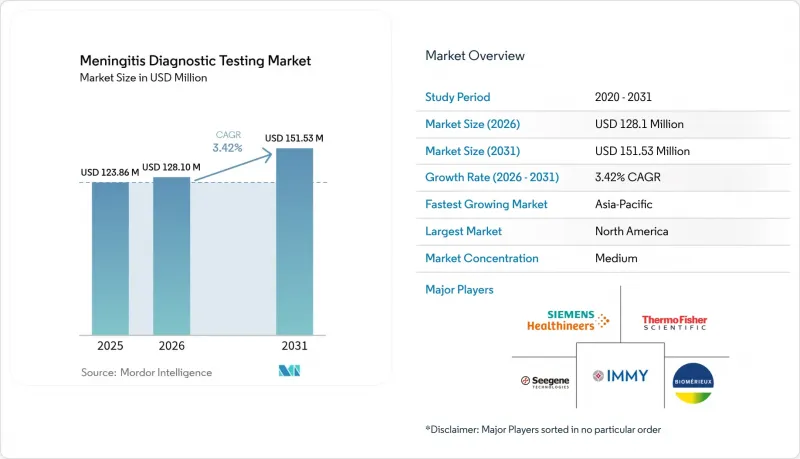
Mordor Intelligence에 의하면, 수막염 진단 검사 시장 규모는 2025년에 1억 2,386만 달러로 평가되었고 2026년 1억 2,810만 달러에서 2031년까지 1억 5,153만 달러에 이를 것으로 예측되며, 예측 기간(2026-2031년) CAGR은 3.42%를 나타낼 전망입니다.
본 보고서는 검사 유형(라텍스 응집법, 래터럴 플로우 분석법 등), 기술(분자진단, 면역 측정법 등), 검체 유형(뇌척수액, 혈액/혈청 등),병원체(세균, 바이러스 등), 최종 사용자(병원, 진단센터 등), 지역(북미 등)별로 분류되어 있습니다. 시장 전망은 금액(달러) 기준으로 제시되어 있습니다.
전 세계 수막염 진단 검사 시장 동향 및 인사이트
전 세계 수막염 발병률 상승
감시 결과에 따르면, 백신의 발전에도 불구하고 세균성 수막염의 치사율은 여전히 10-15%에 달하는 것으로 확인되었습니다. 사하라 사막 이남의 아프리카에서는 2023-2024년 시즌에 2,370건의 의심 사례와 178명의 사망자가 보고되어, 진단 수요가 여전히 높다는 사실이 부각되고 있습니다. 폐렴구균(Streptococcus pneumoniae) 및 수막구균(Neisseria meningitidis)의 약물 내성 증가로 인해 병원체의 신속한 동정이 시급한 과제가 되고 있습니다. 아시아태평양에서는 감시 체계가 미흡하여 여전히 진단 건수가 부족한 상황이며, 검사 체계가 확충된다면 잠재적인 수요가 존재할 것으로 시사되고 있습니다. 도시화와 기후 변화로 인해 감염 경로가 변화할 가능성이 있어, 집단 감염 억제를 위해서는 조기 발견이 필수적입니다. 이러한 요인들이 복합적으로 작용하여 수막염 진단 검사 시장은 꾸준한 성장 궤도를 유지하고 있습니다.
증후군별 멀티플렉스 PCR 패널의 도입 확대
현재 병원 시스템에서는 1회의 뇌척수액 검체로 최대 14종의 수막염 병원체를 1시간 이내에 검출할 수 있는 패널이 선호되고 있습니다. BioFire FilmArray 패널을 도입한 학술 의료 센터에서는 항생제 투여 기간의 중앙값을 3일에서 2일로 단축하는 동시에, 투여량의 단계적 감량률을 46% 향상시켰습니다. 배제 진단의 신속화로 병상 회전율이 향상되어 가치 기반 의료가 촉진됩니다. B군 연쇄상구균 배양 음성 사례에서 민감도가 100%를 초과하기 때문에 소아 병동에서는 안심감이 높아지고 있습니다. 비용 상쇄 연구에 따르면, 입원 기간 단축으로 인한 절감 효과가 키트 비용을 상회하는 것으로 나타났습니다. 이러한 운영상의 이점으로 인해 다중 PCR이 일상 진료에 정착하며, 수막염 진단 검사 시장을 주도하고 있습니다.
다중 분자진단 장치의 높은 설비 투자(CAPEX) 및 운영 비용(OPEX)
PCR 시스템의 가격은 10만-30만 달러, 카트리지 1개당 비용은 50-150달러에 달하고, 소규모 검사실에서는 도입이 어렵습니다. 에티오피아의 한 병원에서는 임상적 이점이 분명함에도 불구하고 FilmArray 시약비가 연간 예산을 초과한다는 보고가 있습니다. 리스 제도는 존재하지만, 자금 조달 능력이 있는 기관은 극히 드뭅니다. 검사 건수가 적은 시설에서는 고정비를 상각할 수 없어, 가격이 수막염 진단 검사 시장의 걸림돌이 되고 있습니다.
부문 분석
CRISPR 분석법은 6.49%라는 역대 최고 연평균 성장률(CAGR)을 기록하고 있지만, PCR은 2025년 매출의 42.87%를 계속 차지하고 있습니다. 수막염 진단 검사 시장은 임상의들이 그 민감도를 신뢰하고 있으며, 병원 검사실이 이미 호환 가능한 사이클러를 보유하고 있기 때문에 계속해서 PCR에 의존하고 있습니다. 그러나 CRISPR-Cas 스플릿 루시페라제 법을 사용하면 현재 뇌척수액(CSF)에서 20분 만에 아토몰 수준의 핵산을 직접 검출할 수 있게 되어, 증후군별 패널의 광범위한 검사 범위에 필적하는 성능을 발휘하고 있습니다. 전력 공급이 보장되지 않는 지역의 아웃리치 활동에서는 래터럴 플로우 방식의 검사 스트립이 여전히 중요한 역할을 하고 있습니다. 분자진단의 특이성이 높아짐에 따라 ELISA의 점유율은 점차 감소하고 있습니다. 또한, 증식을 억제하는 항생제로 사전 치료를 받은 환자가 이송되는 사례가 증가하고 있어 배양법의 점유율은 더욱 축소되고 있습니다.
수요는 신속한 배제 진단으로 이동하고 있습니다. 다중 등온 분석법에서는 수막염균(Neisseria meningitidis)을 10 fg 수준에서 검출할 수 있게 되어, 아프리카의 집단 감염에 대한 분류 진단을 지원하고 있습니다. 라텍스 응집법은 민감도의 한계가 남아 있기는 하지만, 상온 보관이 가능하기 때문에 현장 텐트에서의 검사에서 여전히 가치가 있습니다. 배양 플레이트를 판독하는 인공지능(AI) 이미지 분석 기술은 검출을 자동화함으로써 기존의 워크플로우를 개선할 것으로 기대되며, 그 결과 기존 기술과 신기술이 공존하여 수막염 진단 검사 시장 내에서 다층적인 기회를 창출하고 있습니다.
2031년까지 중소득국 병원에서 CRISPR의 보급이 PCR의 주도적 지위에 도전할 것으로 보이지만, 저기술과 첨단 기술 솔루션이 공존하고 있다는 점은 구매자의 다양성을 반영합니다. 따라서 각 벤더는 3차 의료기관을 위한 고도로 복잡한 검사 패널과 아웃리치용 견고한 래터럴 플로우 검사 키트 간의 균형을 유지하면서 다양한 제품 포트폴리오를 유지하고 있습니다. 이 두 가지 축을 기반으로 한 전략을 통해 대상 시장 규모가 확대되고, 단일 기술에 의존하는 위험이 완화됩니다.
2025년에는 분자진단이 49.12%의 점유율을 차지했지만, NGS는 연평균 성장률(CAGR) 6.88%를 기록하며 주요 혁신 기업으로서의 입지를 확고히 하고 있습니다. 한 병원의 코호트 조사에서 메타유전체 시퀀싱의 양성률은 60.6%에 달한 반면, 기존의 뇌척수액(CSF) 검사법에서는 20.2%에 그쳤습니다. 원인을 알 수 없거나 복합 감염을 특정하는 데 적합하기 때문에 원인 불명의 뇌염이 빈번하게 발생하는 신경과 중환자실(ICU)에서 도입이 확대되고 있습니다. 면역 측정법은 교육이 거의 필요하지 않기 때문에 현장 진단(point-of-care)에서 틈새 역할을 유지하고 있습니다. 한편, 기존의 배양법은 처리 능력이 저하되었음에도 불구하고, 약물 감수성 프로파일링에는 여전히 필수적입니다.
현재 NGS는 소용량 벤치탑 시퀀서에서도 6시간 이내에 실용적인 리드 데이터를 생성할 수 있게 되어, 임상의는 입원 직후 단계에서 치료 방침을 결정할 수 있게 되었습니다. 클라우드 기반 바이오인포매틱스 포털이 분석을 처리함으로써 현장 인력에 대한 의존도가 낮아지고 있습니다. 그러나 시료당 비용은 여전히 평균 175달러로, 연구센터 외에서의 일상적인 이용에는 한계가 있습니다. 예측 기간 동안 시약 가격 하락과 샘플 단위 과금형 비즈니스 모델로 인해 NGS는 일상적인 미생물 검사에 더욱 보급될 것이며, 시퀀싱 용도에 특화된 수막염 진단 검사 시장 규모를 확대할 것으로 전망됩니다.
지역별 분석
북미는 2025년 매출의 37.65%를 차지했는데, 이는 보험사의 보장 범위 확대와 감염병 검사를 신속하게 승인하는 FDA의 승인 절차가 뒷받침한 결과입니다. 병원에서는 신속 검사 패널을 스튜어드십 대시보드에 통합함으로써 평균 입원 일수를 단축하고 병상 여유 용량을 확보하고 있습니다. 캐나다에서는 주 정부 차원의 검사실 현대화 보조금을 통해 보험 적용 범위를 확대하고 있는 반면, 멕시코의 ‘세그로 포플라르’ 개혁을 통해 자금이 지역 진단 허브에 배분되고 있습니다. 주도적인 입장에 있는 주체들과 예산 긴축으로 인해, 성숙한 시장에서 지속 가능한 검사량을 유지하기 위해 시약 가격에 대한 협상이 진행되고 있습니다.
아시아태평양은 2031년까지 연평균 성장률(CAGR) 5.95%를 기록하며 가장 큰 성장 동력이 되고 있습니다. 중국은 ‘건강 중국 2030’ 계획에 따라 병원 검사실 자동화에 자금을 투입하고 있으며, 차세대 염기서열 분석(NGS) 및 다중 PCR 도입을 촉진하고 있습니다. 인도는 ‘아유슈만 바라트’ 계획에 따라 신생아 선별검사를 확대하고, 일상적인 세균 검사 패널의 수를 늘리고 있습니다. 일본은 소아 병동에서의 신속한 바이러스 감별을 중시하여 항생제 오남용을 줄이고 있습니다. 동남아시아 국가들은 COVID-19 이후 뇌수막염 감시 체계를 강화하고, 백신 프로그램을 더 정밀한 진단을 통한 확정 진단과 연계하고 있습니다. 이러한 노력들이 맞물려 해당 지역의 뇌수막염 진단 검사 시장을 확대되고 있습니다.
유럽에서는 항생제 내성 감시 목록이 분자진단 수요를 견인하며 꾸준한 성장이 나타나고 있습니다. 독일과 프랑스에서는 메타유전체 시퀀싱에 대한 보험 적용 시험이 진행 중이며, 영국에서는 국민보건서비스(NHS) 전체에서 현장 진단용 키트에 대해 가치 기반 조달이 이루어지고 있습니다. 동유럽의 현대화 보조금은 시약의 안정성을 뒷받침하는 콜드체인 구축에 자금을 지원하고 있습니다. 유럽질병예방통제센터(ECDC)를 통한 국경을 초월한 데이터 공유로 검사 프로토콜이 통일되어 공급업체에 규모의 경제 효과가 발생하고 있습니다. 그 결과, 단일 지불자 제도 하에서 가격 압박이 지속되고 있음에도 불구하고 시장 침투는 견조한 추세를 보이고 있습니다.
기타 혜택:
- 엑셀 형식 시장 예측(ME) 시트
- 3개월간의 애널리스트 지원
자주 묻는 질문
목차
제1장 서론
제2장 조사 방법
제3장 주요 요약
제4장 시장 구도
제5장 시장 규모와 성장 예측
제6장 경쟁 구도
제7장 시장 기회와 향후 전망
JHS 26.09.07According to Mordor Intelligence, the meningitis diagnostic testing market size was valued at USD 123.86 million in 2025 and estimated to grow from USD 128.1 million in 2026 to reach USD 151.53 million by 2031, at a CAGR of 3.42% during the forecast period (2026-2031).
This report is Segmented by Test Type (Latex Agglutination Test, Lateral Flow Assay, and More), Technology (Molecular Diagnostics, Immunoassays and More), Sample Type (Cerebrospinal Fluid, Blood/Serum and More), Pathogen (Bacterial, Viral and More) End-User (Hospital, Diagnostics Centers, and More), and Geography (North America and More). The Market Forecasts are Provided in Terms of Value (USD).
Global Meningitis Diagnostic Testing Market Trends and Insights
Rise In Global Meningitis Incidence
Surveillance confirms that bacterial meningitis still claims 10-15% case-fatality despite vaccine progress.Sub-Saharan Africa reported 2,370 suspected cases and 178 deaths in the 2023-2024 season, underscoring the persisting diagnostic need. Antimicrobial resistance in Streptococcus pneumoniae and Neisseria meningitidis increases urgency for rapid pathogen identification. Asia-Pacific remains under-diagnosed owing to weak surveillance, hinting at latent volume once labs scale up. Urbanization and climate shifts may alter transmission patterns, making early detection integral to outbreak control. Together, these forces keep the meningitis diagnostic testing market on a steady growth track.
Growing Adoption Of Syndromic Multiplex PCR Panels
Hospital systems now favor panels that detect up to 14 meningitis pathogens from one CSF specimen in under an hour. Academic centers adopting the BioFire FilmArray panel trimmed median antibiotic courses from 3 days to 2 days while boosting de-escalation rates by 46%. Faster rule-out improves bed turnover and supports value-based care. Pediatric wards gain assurance, as sensitivity for Group B Streptococcus tops 100% in culture-negative cases. Cost-offset studies find savings through shorter stays that outweigh kit expense. These operational wins move multiplex PCR into routine practice, lifting the meningitis diagnostic testing market.
High CAPEX/OPEX Of Multiplex Molecular Instruments
PCR systems range from USD 100,000 to 300,000 and charge USD 50-150 per cartridge, locking out small laboratories. Ethiopian hospitals report FilmArray reagent costs exceeding annual budgets even when clinical benefits are clear. Leasing schemes exist, but few institutions possess financing capacity. Low-volume sites cannot amortize fixed costs, making price a brake on the meningitis diagnostic testing market.
Other drivers and restraints analyzed in the detailed report include:
- Hospital Stewardship Programs Targeting Rapid Rule-Out
- Decentralization Toward Point-Of-Care Testing In Low-Resource Settings
- Limited CSF Sample Availability In Pediatric Settings
For complete list of drivers and restraints, kindly check the Table Of Contents.
Segment Analysis
CRISPR assays log the fastest 6.49% CAGR yet PCR retains 42.87% of 2025 revenue. The meningitis diagnostic testing market continues to lean on PCR because clinicians trust its sensitivity, and hospital labs already own compatible cyclers. However, CRISPR-Cas split-luciferase methods now detect attomolar nucleic acid directly from CSF in 20 minutes, matching syndromic panel breadth. Lateral-flow strips stay relevant in outreach campaigns where no electricity is guaranteed. ELISA gradually declines as molecular specificity rises. Culture's share erodes further when patients arrive pre-treated with antibiotics that inhibit growth.
Demand shifts toward rapid rule-out: multiplexed isothermal assays reach 10 fg detection of Neisseria meningitidis, aiding outbreak triage in the African belt. Latex agglutination still gives value in field tents because it stores ambient, though sensitivity limits remain. Artificial-intelligence imaging that reads culture plates promises to salvage legacy workflows by automating detection, so legacy and novel technologies coexist, creating layered opportunities within the meningitis diagnostic testing market.
By 2031, CRISPR penetration in mid-income hospitals will challenge PCR's leadership, yet the coexistence of low-tech and high-tech solutions reflects buyer heterogeneity. Vendors therefore maintain mixed portfolios, balancing high-complexity panels for tertiary centers with robust lateral-flow kits for outreach. This dual strategy enlarges addressable volumes and mitigates single-technology risk.
Molecular diagnostics represented 49.12% share in 2025, but NGS's 6.88% CAGR positions it as a prime disruptor. Metagenomic sequencing achieved 60.6% positivity versus 20.2% for conventional CSF methods in one hospital cohort. Its aptitude for unknown or mixed infections drives adoption in neurologic ICUs where unexplained encephalitis persists. Immunoassays defend niche point-of-care roles thanks to minimal training needs, while classic culture remains essential for susceptibility profiling even as throughput declines.
NGS now returns actionable reads in <6 hours on low-capacity benchtop sequencers, letting clinicians target therapy within the admission window. Cloud bioinformatics portals handle analytics, reducing local staffing dependencies. However, costs per sample still average USD 175, limiting routine use outside research centers. Over the forecast, reagent price drops and pay-per-sample business models are likely to send NGS deeper into routine microbiology, lifting the meningitis diagnostic testing market size devoted to sequencing applications.
Complete Report Scope:
- By Test Type
- Latex Agglutination Tests
- Lateral-Flow Assay
- PCR Assay
- ELISA Tests
- Culture Test
- CRISPR-based Assay
- By Technology
- Molecular Diagnostics
- Immunoassays
- Microbiology / Culture
- Next-Generation Sequencing
- By Sample Type
- Cerebrospinal Fluid (CSF)
- Blood / Serum
- Nasopharyngeal Swab
- Others (Urine, Saliva)
- By Pathogen
- Bacterial
- Viral
- Fungal
- Parasitic
- By End User
- Hospitals
- Diagnostic Centers
- Academic & Research Labs
- Others (POC Clinics, Military, NGOs)
- By Geography
- North America
- United States
- Canada
- Mexico
- Europe
- Germany
- United Kingdom
- France
- Italy
- Spain
- Rest of Europe
- Asia-Pacific
- China
- Japan
- India
- Australia
- South Korea
- Rest of Asia-Pacific
- Middle East and Africa
- GCC
- South Africa
- Rest of Middle East and Africa
- South America
- Brazil
- Argentina
- Rest of South America
- North America
Geography Analysis
North America commanded 37.65% revenue in 2025, enabled by payer coverage and FDA pathways that fast-track infectious disease assays. Hospitals integrate rapid panels into stewardship dashboards, trimming average length of stay and unlocking bed capacity. Canada expands coverage through provincial lab modernization grants, while Mexico's Seguro Popular reforms channel funds to regional diagnostic hubs. Despite leadership, budget scrutiny prompts negotiations on reagent pricing to maintain sustainable volumes in mature markets.
Asia-Pacific is the top growth engine at 5.95% CAGR through 2031. China funds hospital laboratory automation in its Healthy China 2030 plan, boosting uptake of NGS and multiplex PCR. India scales newborn screening under Ayushman Bharat, increasing routine bacterial panels. Japan emphasizes rapid viral differentiation in pediatric wards to cut antibiotic misuse. Southeast Asian nations upgrade meningitis surveillance post-COVID-19, aligning vaccine programs with better diagnostic confirmation. These initiatives collectively swell the meningitis diagnostic testing market in the region.
Europe posts steady gains as antimicrobial resistance watchlists drive molecular demand. Germany and France pilot metagenomic sequencing reimbursement, and the United Kingdom applies value-based procurement for point-of-care kits across the National Health Service. Eastern European modernization grants fund cold-chain upgrades that support reagent stability. Cross-border data sharing through the European Centre for Disease Prevention and Control harmonizes testing protocols, providing scale benefits to suppliers. Market uptake thus remains consistent, though pricing pressures persist under single-payer systems.
- Abbott Laboratories
- Beckton Dickinson
- bioMerieux
- Bio-Rad Laboratories
- Danaher
- Elitech Group
- Roche
- GenMark Diagnostics
- Hologic
- IMMY
- DiaSorin
- Oxford Nanopore Technologies
- QIAGEN
- Seegene
- Siemens Healthineers
- Thermo Fisher Scientific
- Trinity Biotech
- Tosoh
- Meridian Bioscience
- Quanterix Corporation
Additional Benefits:
- The market estimate (ME) sheet in Excel format
- 3 months of analyst support
TABLE OF CONTENTS
1 Introduction
- 1.1 Study Assumptions and Market Definition
- 1.2 Scope of the Study
2 Research Methodology
3 Executive Summary
4 Market Landscape
- 4.1 Market Overview
- 4.2 Market Drivers
- 4.2.1 Rise In Global Meningitis Incidence
- 4.2.2 Growing Adoption Of Syndromic Multiplex PCR Panels
- 4.2.3 Hospital Stewardship Programs Targeting Rapid Rule-Out
- 4.2.4 Decentralization Toward Point-Of-Care (POC) Testing In Low-Resource Settings
- 4.2.5 National Newborn Screening Mandates For Bacterial Meningitis
- 4.2.6 Pandemic-Driven Investment In Molecular Infrastructure
- 4.3 Market Restraints
- 4.3.1 High CAPEX/OPEX Of Multiplex Molecular Instruments
- 4.3.2 Limited CSF Sample Availability In Paediatric Settings
- 4.3.3 Persisting Reimbursement Gaps For Rapid POC Tests
- 4.3.4 Cold-Chain Logistics Constraints In LMICs
- 4.4 Value / Supply-Chain Analysis
- 4.5 Regulatory Landscape
- 4.6 Technology Outlook
- 4.7 Porter's Five Forces Analysis
- 4.7.1 Bargaining Power of Suppliers
- 4.7.2 Bargaining Power of Buyers
- 4.7.3 Threat of New Entrants
- 4.7.4 Threat of Substitutes
- 4.7.5 Intensity of Competitive Rivalry
5 Market Size and Growth Forecasts (Value-USD)
- 5.1 By Test Type
- 5.1.1 Latex Agglutination Tests
- 5.1.2 Lateral-Flow Assay
- 5.1.3 PCR Assay
- 5.1.4 ELISA Tests
- 5.1.5 Culture Test
- 5.1.6 CRISPR-based Assay
- 5.2 By Technology
- 5.2.1 Molecular Diagnostics
- 5.2.2 Immunoassays
- 5.2.3 Microbiology / Culture
- 5.2.4 Next-Generation Sequencing
- 5.3 By Sample Type
- 5.3.1 Cerebrospinal Fluid (CSF)
- 5.3.2 Blood / Serum
- 5.3.3 Nasopharyngeal Swab
- 5.3.4 Others (Urine, Saliva)
- 5.4 By Pathogen
- 5.4.1 Bacterial
- 5.4.2 Viral
- 5.4.3 Fungal
- 5.4.4 Parasitic
- 5.5 By End User
- 5.5.1 Hospitals
- 5.5.2 Diagnostic Centers
- 5.5.3 Academic & Research Labs
- 5.5.4 Others (POC Clinics, Military, NGOs)
- 5.6 By Geography
- 5.6.1 North America
- 5.6.1.1 United States
- 5.6.1.2 Canada
- 5.6.1.3 Mexico
- 5.6.2 Europe
- 5.6.2.1 Germany
- 5.6.2.2 United Kingdom
- 5.6.2.3 France
- 5.6.2.4 Italy
- 5.6.2.5 Spain
- 5.6.2.6 Rest of Europe
- 5.6.3 Asia-Pacific
- 5.6.3.1 China
- 5.6.3.2 Japan
- 5.6.3.3 India
- 5.6.3.4 Australia
- 5.6.3.5 South Korea
- 5.6.3.6 Rest of Asia-Pacific
- 5.6.4 Middle East and Africa
- 5.6.4.1 GCC
- 5.6.4.2 South Africa
- 5.6.4.3 Rest of Middle East and Africa
- 5.6.5 South America
- 5.6.5.1 Brazil
- 5.6.5.2 Argentina
- 5.6.5.3 Rest of South America
- 5.6.1 North America
6 Competitive Landscape
- 6.1 Market Concentration
- 6.2 Market Share Analysis
- 6.3 Company profiles (includes Global level Overview, Market level overview, Core Segments, Financials as available, Strategic Information, Market Rank/Share for key companies, Products and Services, and Recent Developments)
- 6.3.1 Abbott
- 6.3.2 Becton, Dickinson and Company
- 6.3.3 bioMerieux
- 6.3.4 Bio-Rad Laboratories
- 6.3.5 Danaher
- 6.3.6 ELITechGroup
- 6.3.7 F. Hoffmann-La Roche Ltd.
- 6.3.8 GenMark Diagnostics
- 6.3.9 Hologic Inc.
- 6.3.10 IMMY
- 6.3.11 DiaSorin S.p.A.
- 6.3.12 Oxford Nanopore Technologies
- 6.3.13 QIAGEN N.V.
- 6.3.14 Seegene Inc.
- 6.3.15 Siemens Healthineers
- 6.3.16 Thermo Fisher Scientific
- 6.3.17 Trinity Biotech
- 6.3.18 Tosoh Corporation
- 6.3.19 Meridian Bioscience
- 6.3.20 Quanterix Corporation
7 Market Opportunities and Future Outlook
- 7.1 White-Space and Unmet-Need Assessment


