|
시장보고서
상품코드
2123535
수술실용 장비 시장 : 점유율 분석, 업계 동향과 통계, 성장 예측(2026-2031년)Operating Room Equipment - Market Share Analysis, Industry Trends & Statistics, Growth Forecasts (2026 - 2031) |
||||||
 Mordor Intelligence
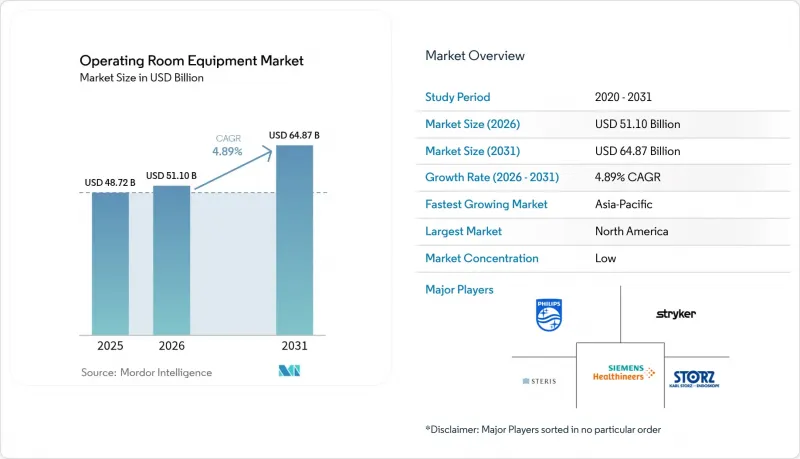
Mordor Intelligence에 의하면, 수술실용 장비 시장 규모는 2025년 487억 2,000만 달러, 2026년 511억 달러에서 2031년까지 648억 7,000만 달러로 확대될 것으로 예측되고 있어 2026년부터 2031년까지 연평균 복합 성장률(CAGR)은 4.89%를 나타낼 전망입니다.
본 보고서는 제품별(마취 장치, 수술용 영상 진단 시스템 등), 이동 방식별(고정식/내장형, 모듈식/레트로핏형, 이동식/휴대형), 최종 사용자별(병원, 외래수술센터(ASC) 등), 외과 전문 분야별(일반외과, 정형외과 등),지역별(북미, 유럽 등)로 분류되어 있습니다. 시장 예측은 금액(달러) 기준으로 제시되어 있습니다.
전 세계 수술실용 장비 시장 동향 및 인사이트
수술이 필요한 만성 질환의 발생률 증가
심혈관 질환, 종양 질환, 대사성 질환의 유병률이 높아짐에 따라 전 세계 연간 수술 건수가 증가하고 있으며, 기존 수술실 인프라에 부담이 가중되고 있을 뿐만 아니라, 턴어라운드 타임(수술 회전 시간)과 마취 노출 시간 단축을 목적으로 한 조달 계획이 가속화되고 있습니다. 미국, 독일, 일본, 중국의 고령화로 인해 수술 사례의 평균 복잡도가 높아지고 있으며, CT 및 혈관조영 기능을 통합한 하이브리드 수술실에 대한 수요가 증가하고 있습니다. 병원에서는 생리학적 데이터를 전자 차트에 직접 전송하는 첨단 환자 모니터를 도입하여 만성 질환 관리 및 수술 후 경과 관찰에 활용하고 있습니다. 따라서 장기적인 수요 곡선은 경제 사이클이라기보다는 인구 동향과 밀접하게 연동되어 있습니다. 수술 전후 분석 기능이나 소모품을 내구성이 뛰어난 하드웨어와 세트로 판매하는 공급업체는 만성 질환 사례 수가 증가함에 따라 시장 점유율을 확보할 수 있는 입장에 있습니다.
팬데믹 이후 선택적 수술의 밀려난 수요가 수술실 업그레이드를 가속화
영국 국민보건서비스(NHS England) 보고서에 따르면, 2024년 9월 기준 757만 건의 수술 대기 건수가 존재하며, 이는 팬데믹 이전의 약 2배 규모로, 야간 및 주말 수술실 운영에 지속적인 부담을 주고 있습니다. 프랑스와 미국에서도 유사한 병목 현상이 발생하고 있으며, 장시간 가동을 상정하여 설계되지 않은 구형 마취 워크스테이션의 한계가 드러나고 있습니다. 이러한 상황에 대응하기 위해 각국의 보건부는 대상 범위를 좁힌 설비 투자 보조금을 지급했습니다. 영국에서는 2024-2025 회계연도에 수술실 현대화를 위해 15억 파운드를 특정 용도로 배정했을 뿐만 아니라, 병원 측에서는 현금 흐름을 유지하면서 장비 교체를 가속화하는 ‘리스 투 오너(Lease-to-Own)’ 방식의 자금 조달을 협상했습니다. 2024년에는 반도체 부족으로 인해 납기 기간이 18-24개월로 늘어났으나, 2026년 초에는 재고가 정상화되었습니다. 이에 따라 공급업체들은 미납 주문을 처리하며 수익이 급증하는 결과를 가져왔습니다. 이러한 수익 급증은 대기 목록이 정상화되는 2027년경에는 둔화될 전망입니다. 미납 주문은 일시적인 것이기 때문에 제조업체는 며칠 내에 도입 가능한 모듈식 업그레이드를 중시하고 있으며, 연기되었던 의료 수요의 급증세가 가라앉은 후에도 장기간 지속될 우려가 있는 10년 단위의 계약은 피하고 있습니다.
수술실용 장비의 높은 자본 비용 및 유지 관리 비용
완전히 통합된 하이브리드 수술실의 비용은 500만-800만 달러이며, 연간 유지보수 계약비는 구매 가격의 8-12%가 추가되므로, 영업 이익률이 5% 미만으로 운영되는 지역 병원에게는 큰 부담이 되고 있습니다. 리스를 이용하면 초기 비용 부담은 줄어들지만, 잔존 가치에 대한 위험은 공급업체로 이전됩니다. 공급업체는 영상 진단 소프트웨어가 18개월마다 출시되는 시장에서 감가상각액을 예측해야 합니다. 인도의 ‘일반 재정 규칙’에 따르면 250만 루피를 초과하는 입찰은 분할되므로 수량 할인이 적용되지 않아 단가가 10-15% 상승하고 있습니다. 라틴아메리카에서는 수입 관세가 20-30% 추가되어, 의료 기관들은 권장 사용 연한을 훨씬 초과하여 자산을 계속 사용해야만 하는 상황에 처해 있습니다. 자본 부족은 구조적인 문제이므로, 각 벤더들은 임상 성능을 저해하지 않으면서 진입 장벽을 낮추는 모듈식 애드온이나 인증 리퍼비시 프로그램에서 비즈니스 기회를 모색하고 있습니다.
부문 분석
2025년, 마취 장치는 성숙한 도입 기반과 엄격한 가스 공급 규제로 인해 수술실용 장비 시장 점유율의 54.54%를 차지했습니다. 병원들이 탄소 배출 감축 목표 달성과 비용 절감을 추구하는 가운데, 휘발성 마취제 사용량을 최대 50%까지 줄여주는 저유량 워크스테이션이 입찰을 통해 채택되고 있습니다. 대조적으로, 이동식 콘빔 CT에서 수술 중 MRI에 이르는 외과용 영상 진단 시스템은 연평균 성장률(CAGR) 10.25%로 확대되고 있습니다. 이러한 속도로 인해 영상 진단 분야에서 비롯된 수술실용 장비 시장 규모는 전체 시장의 성장률을 훨씬 웃도는 속도로 확대되고 있습니다. 전기 메스, 수술대, 조명 기구는 한 자릿수 중반의 성장에 그치고 있지만, 콜로라도주, 로드아일랜드주, 오리건주에서 의무화된 연기 배출 대책으로 인해 전용 흡입 시스템에 대한 수요가 회복되고 있습니다.
이러한 성장 동향은 자본 배분의 재조정을 시사합니다. 병원들은 리스나 장기 서비스를 통해 유지 관리할 수 있는 마취 장치와 같은 인프라의 기본 제품보다, 영상 진단이나 내비게이션과 같이 수술을 가능하게 하는 기술을 우선시하고 있습니다. 2024년 FDA 승인을 받은 GE 헬스케어의 ‘OEC 3D’ 모바일 C-암은 하이브리드 수술실에서 영상 진단을 자본 비용을 60% 절감하여 실현함으로써 모듈식 지출 패턴에 부합합니다. 반면, FDA 및 ISO의 엄격한 기준으로 인해 마취 장비의 혁신은 완만한 속도에 그치고 있으며, 시장 점유율은 유지되고 있지만 성장의 상한선이 설정되어 있습니다. 이러한 상반된 동향이 맞물리면서 수술실용 장비 시장은 제품 라인별로 다양한 양상을 계속 보이고 있습니다.
고정형 장비는 2025년 매출의 57.54%를 차지하며, 건설 초기부터 붐, 층류 천장, 가스 파이프라인이 통합된 신축 병원에 정착되어 있습니다. 그러나 모듈형 및 리모델링 솔루션은 연평균 7.65%의 성장이 예상되며, 보류되었던 타워형 프로젝트에서 전환된 자본을 가동 중단 시간을 최소화하는 단계적 업그레이드에 활용하고 있습니다. 이러한 변화로 인해 모듈형 패키지에 기인한 수술실용 장비 시장 규모는 확대되는 한편, 1제곱피트당 평균 프로젝트 비용은 절감됩니다.
게팅게(Getinge)사의 ‘Maquet Moduevo’는 기존 시공 방식으로는 6주가 소요되는 반면, 48시간 만에 설치가 가능하여 병원은 하루 약 1만 달러의 수술 수익 손실을 절감할 수 있습니다. 이동식 장비는 외래수술센터(ASC)나 재난 구호 현장에서 서서히 보급되고 있지만, 감염 관리 규정(ISO 14644 클린룸 규격)에서는 표면이 매끄러운 고정식 설비가 권장되고 있습니다. OECD 국가 전체에서 신규 병원 건설에 대한 지출이 둔화되는 가운데, 리모델링 업체들의 수술실용 장비 시장 점유율이 확대되면서 리드타임, 설치 비용 및 유지보수 보증을 둘러싼 경쟁이 격화될 것입니다.
지역별 분석
북미는 2025년에 매출 점유율 39.23%를 차지하며, 메디케어 어드밴티지 가입률이 대상 인구의 50%를 초과하고, 플로리다주나 텍사스주 등에서는 주민 6만 명당 1곳의 ASC가 입지해 있다는 점을 배경으로 계속해서 주도적인 지위를 유지하고 있습니다. 이 지역의 병원에서는 캘리포니아주와 뉴욕주가 정한 탄소 배출 목표를 준수하기 위해 할로겐 램프와 구형 마취 워크스테이션의 교체가 진행되고 있으며, 이는 수술실용 장비 시장의 성장세를 더욱 뒷받침하고 있습니다. 그러나 2025년에는 네트워크 연결형 수술실 플랫폼을 위한 사이버 보안 보험료가 전년 대비 18% 급등함에 따라, 시설 측에서는 보안 강화 대책이 마련될 때까지 네트워크 연결형 장비 도입을 연기하는 움직임이 나타나고 있습니다. 캐나다도 유사한 경향을 보이고 있으나, 규모는 더 작으며, 주 차원의 일괄 구매 프로그램으로 인해 입찰 주기가 24개월로 연장되었습니다.
아시아태평양은 중국의 ‘제14차 5개년 계획’이 병원 건설에 2,000억 위안(280억 달러)을 배정하고,인도의 ‘생산 연계형 인센티브(PLI)’ 제도가 국산 장비에 대해 5%의 보조금을 지급함에 따라, 2031년까지 연평균 6.12%의 성장이 예상됩니다. 중국 내 수술용 로봇 도입 대수는 2024년에 35% 증가하여 약 400대에 달했습니다. 이는 국내 공급업체들이 유럽 및 미국의 경쟁사보다 40-50% 저렴한 가격을 책정하고 있는 것이 뒷받침하고 있습니다. 인도의 양극화된 시장에서는 대도시권의 민간 병원 체인이 미국이나 EU의 고급 브랜드를 수입하는 반면, 2급 도시의 공립 시설은 ‘메이크 인 인디아(Make in India)’ 할당 기준을 충족하기 위해 현지 제조업체에 의존하고 있습니다. 일본에서는 고령화가 진행되면서 저침습 수술실에 대한 수요가 증가하고 있지만, 엄격한 진료 보수 기준으로 인해 이익률이 압박받고 있어 병원 측은 비용을 분산시키기 위해 의료장비 서비스형 계약(Equipment-as-a-Service)을 협상하고 있습니다.
유럽에서는 양극화된 추세가 관찰됩니다. 서유럽 시장에서는 긴축 재정과 EU 의료장비 규정(MDR) 재인증에 따른 마찰로 인해 의료장비의 사용 수명이 계획된 주기를 초과하여 연장되면서, 단기적인 수요가 둔화되고 있습니다. 한편, 폴란드와 루마니아 등 동유럽 회원국들은 EU의 결속 기금을 활용하여 수술실 개보수를 추진하고 있으며, 수술실 의료장비 시장에서 해당 지역의 점유율을 확대되고 있습니다. 중동에서는 사우디아라비아의 ‘비전 2030’ 의료 분야 내에서 의료 관광을 위해 이중 언어 시각화 인터페이스를 탑재한 40개의 신규 병원에 자금이 지원되고 있습니다. 남미는 브라질이 중심이 되고 있으며, 해당 국가의 ‘시스테마 우니코 데 사우데(SUS)’를 통해 1,200개의 공립 수술실이 LED 조명 및 저유량 마취 장치로 교체되고 있습니다. 한편, 대륙의 다른 지역에서는 관세로 인한 가격 급등이 성장세를 둔화시키고 있습니다. 이러한 각 지역의 동향이 복합적으로 작용함에 따라, 지역별 특수한 사정이 있음에도 불구하고 수술실용 장비 시장 전체의 성장은 견조한 추세를 보이고 있습니다.
기타 혜택:
- 엑셀 형식 시장 예측(ME) 시트
- 3개월간의 애널리스트 지원
자주 묻는 질문
목차
제1장 서론
제2장 조사 방법
제3장 주요 요약
제4장 시장 구도
제5장 시장 규모와 성장 예측
제6장 경쟁 구도
제7장 시장 기회와 향후 전망
JHS 26.09.07According to Mordor Intelligence, the operating room equipment market size is projected to expand from USD 48.72 billion in 2025 and USD 51.10 billion in 2026 to USD 64.87 billion by 2031, registering a CAGR of 4.89% between 2026 to 2031.
This report is Segmented by Product (Anesthesia Devices, Surgical Imaging Systems, and More), Mobility (Fixed/In-built, Modular/Retrofit, Mobile/Portable), End User (Hospitals, Ambulatory Surgical Centers, and More), Surgical Specialty (General Surgery, Orthopedic Surgery, and More), and Geography (North America, Europe, and More). The Market Forecasts are Provided in Terms of Value (USD).
Global Operating Room Equipment Market Trends and Insights
Growing Incidence of Chronic Diseases Requiring Surgeries
Escalating prevalence of cardiovascular, oncologic, and metabolic disorders is raising the annual global surgical volume, stretching legacy OR infrastructure and catalyzing procurement plans aimed at cutting turnover time and anesthesia exposure. Aging populations in the United States, Germany, Japan, and China have pushed average surgical case complexity higher, favoring hybrid rooms equipped with integrated CT or angiography. Hospitals are purchasing advanced patient monitors that stream physiologic data directly into electronic health records, aiding chronic-condition management and postoperative follow-up. The long-term demand curve therefore aligns squarely with demographic trends rather than economic cycles. Vendors that bundle perioperative analytics and consumables with durable hardware are positioned to capture wallet share as chronic-disease caseloads rise.
Post-Pandemic Elective-Surgery Backlog Accelerating OR Upgrades
NHS England reported 7.57 million open pathways as of September 2024, roughly double pre-pandemic volume and a level that continues to strain evening and weekend OR sessions. Similar bottlenecks in France and the United States are exposing limits of older anesthesia workstations whose maintenance cycles were never designed for extended hours. To keep pace, health ministries released targeted capital grants-the United Kingdom ring-fenced GBP 1.5 billion for theater modernization in FY 2024-2025-while hospitals negotiated lease-to-own financing that preserves cash flow yet accelerates equipment refresh. Semiconductor shortages dragged delivery timelines to 18-24 months during 2024, but inventories normalized in early 2026, enabling vendors to clear backorders and generate a revenue spike that should taper by 2027 when waiting lists normalize. Because backlogs are temporary, manufacturers emphasize modular upgrades that install in days, avoiding decade-long commitments that may outlast deferred-care surges.
High Capital & Maintenance Costs of OR Equipment
A fully integrated hybrid suite costs USD 5-8 million, and annual service contracts add 8-12% of purchase price, squeezing community hospitals that run on sub-5% operating margins. Leasing eases upfront outlay but shifts residual-value risk to suppliers, who must guess depreciation in a market where imaging software releases every 18 months. India's General Financial Rules split tenders above INR 2.5 million, undermining volume discounts and inflating per-unit prices by 10-15%. In Latin America, import tariffs tack on another 20-30%, forcing facilities to stretch assets well past recommended lifespan. Because capital scarcity is structural, vendors see opportunity in modular add-ons and certified refurbishment programs that lower entry thresholds without sacrificing clinical performance.
Other drivers and restraints analyzed in the detailed report include:
- Increasing Adoption of Minimally Invasive & Image-Guided Surgeries
- Carbon-Neutral Procurement Mandates Driving LED & Low-Energy OR Retrofits
- EU-MDR 2027 Re-Certification Bottleneck Delaying Device Refresh Cycles
For complete list of drivers and restraints, kindly check the Table Of Contents.
Segment Analysis
Anesthesia devices accounted for 54.54% of operating room equipment market share in 2025, owing to mature installed bases and strict gas-delivery regulations. Low-flow workstations that cut volatile-anesthetic use by up to 50% are winning tenders as hospitals chase carbon targets and cost savings. In contrast, surgical imaging systems, from mobile cone-beam CT to intraoperative MRI, are expanding at 10.25% CAGR; this pace lifts the operating room equipment market size attributed to imaging far faster than aggregate growth. Electrosurgical units, tables, and lights trail with mid-single-digit gains, though mandated smoke evacuation in Colorado, Rhode Island, and Oregon is reviving demand for specialized suction systems.
Growth dynamics signal a capital-allocation rebalance. Hospitals favor procedure-enabling technologies such as imaging and navigation over infrastructure staples like anesthesia that can be leased or maintained through long-term service. GE HealthCare's OEC 3D mobile C-arm, cleared by FDA in 2024, delivers hybrid-suite imaging at 60% lower capital cost, aligning with modular spending patterns. Meanwhile, strict FDA and ISO standards keep anesthesia-device innovation slow, preserving share but capping upside. Collectively, these diverging trajectories ensure the operating room equipment market remains heterogeneous across product lines.
Fixed installations held 57.54% of 2025 revenue, cemented in new-build hospitals that embed booms, laminar-flow ceilings, and gas pipelines from day one. Yet modular and retrofit solutions are forecast to rise 7.65% annually, capturing capital redirected from shelved tower projects into phased upgrades that minimize downtime. This shift enlarges the operating room equipment market size attributed to modular packages while trimming average project costs per square foot.
Getinge's Maquet Moduevo can be installed in 48 hours, versus six weeks for traditional builds, saving hospitals roughly USD 10,000 in lost procedure revenue per day. Mobile equipment sees modest uptake in ASCs and disaster-relief settings, but infection-control rules-ISO 14644 cleanroom grades-favor fixed assets with flush surfaces. As greenfield hospital spending decelerates across OECD countries, retrofit providers will shoulder a greater portion of the operating room equipment market, tightening competition on lead-time, installation cost, and maintenance guarantees.
Complete Report Scope:
- By Product
- Anesthesia Devices
- Surgical Imaging Systems
- Electrosurgical Devices
- Operating Tables
- Surgical & Exam Lights
- Patient Monitors
- Medical Pendants & Booms
- Smoke Evacuation Systems
- Other OR Equipment
- By Mobility
- Fixed / In-built
- Modular / Retrofit
- Mobile / Portable
- By End User
- Hospitals
- Ambulatory Surgical Centers
- Out-patient Facilities / Specialty Clinics
- By Surgical Specialty
- General Surgery
- Orthopedic Surgery
- Cardiovascular Surgery
- Neurosurgery
- Gynecology & Urology
- ENT & Others
- By Geography
- North America
- United States
- Canada
- Mexico
- Europe
- Germany
- United Kingdom
- France
- Italy
- Spain
- Rest of Europe
- Asia-Pacific
- China
- India
- Japan
- Australia
- South Korea
- Rest of Asia-Pacific
- Middle East and Africa
- GCC
- South Africa
- Rest of Middle East and Africa
- South America
- Brazil
- Argentina
- Rest of South America
- North America
Geography Analysis
North America, with 39.23% revenue share in 2025, maintains leadership on the back of Medicare Advantage penetration exceeding 50% of eligible lives and ASC density of one center per 60,000 residents in states such as Florida and Texas. Hospitals in the region continue to replace halogen lights and legacy anesthesia workstations to comply with state carbon targets in California and New York, adding momentum to the operating room equipment market. Cybersecurity-insurance premiums for connected OR platforms, however, jumped 18% year-on-year in 2025, nudging facilities to delay networked-device rollouts until hardening policies are in place. Canada tracks a similar pattern but at smaller scale, with provincial bulk-buy programs extending tender cycles to 24 months.
Asia-Pacific is projected to grow at 6.12% through 2031 as China's 14th Five-Year Plan assigns CNY 200 billion (USD 28 billion) to hospital construction and India's Production-Linked Incentive scheme offers 5% subsidies on domestically made devices. Chinese surgical-robot installations climbed 35% in 2024 to about 400 units, aided by domestic vendors pricing 40-50% below Western rivals. India's split market sees metro private chains importing premium U.S. and EU brands, while tier-2 public facilities rely on local manufacturers to meet make-in-India quotas. Japan's aging populace drives demand for minimally invasive suites, yet strict fee schedules cap margins, so hospitals negotiate equipment-as-a-service deals to spread cost.
Europe displays a two-speed trajectory. Western markets face austerity budgets and EU MDR re-certification frictions that extend device life beyond planned cycles, softening short-term demand. Eastern members such as Poland and Romania leverage EU Cohesion Funds to retrofit ORs, expanding regional share of the operating room equipment market. In the Middle East, Saudi Arabia's Vision 2030 healthcare pillar funds 40 new hospitals that embed bilingual visualization interfaces for medical tourism. South America hinges on Brazil, where Sistema Unico de Saude upgrades 1,200 public ORs with LED lights and low-flow anesthesia; tariff-inflated prices slow momentum elsewhere on the continent. Together these regional narratives keep overall operating room equipment market growth resilient despite local idiosyncrasies.
- Baxter
- Conmed
- Dragerwerk
- GE Healthcare
- Getinge
- Intuitive Surgical
- Karl Storz
- Koninklijke Philips
- Medtronic
- Mindray
- Olympus
- Siemens Healthineers
- Skytron
- Smiths Group
- STERIS
- Stryker
- Zimmer Biomet
Additional Benefits:
- The market estimate (ME) sheet in Excel format
- 3 months of analyst support
TABLE OF CONTENTS
1 Introduction
- 1.1 Study Assumptions & Market Definition
- 1.2 Scope of the Study
2 Research Methodology
3 Executive Summary
4 Market Landscape
- 4.1 Market Overview
- 4.2 Market Drivers
- 4.2.1 Growing incidence of chronic diseases requiring surgeries
- 4.2.2 Rising number of hospitals & government funding
- 4.2.3 Increasing adoption of minimally-invasive & image-guided surgeries
- 4.2.4 Post-pandemic elective-surgery backlog accelerating OR upgrades
- 4.2.5 Carbon-neutral procurement mandates driving LED & low-energy OR retrofits
- 4.2.6 SaaS-based surgical-visualization subscriptions enabling mid-tier upgrades
- 4.3 Market Restraints
- 4.3.1 High capital & maintenance costs of OR equipment
- 4.3.2 Shortage of skilled peri-operative personnel
- 4.3.3 Escalating cybersecurity-insurance premiums for connected OR platforms
- 4.3.4 EU-MDR 2027 re-certification bottleneck delaying device refresh cycles
- 4.4 Supply-Chain Analysis
- 4.5 Regulatory Landscape
- 4.6 Technological Outlook
- 4.7 Porter's Five Forces
- 4.7.1 Threat of New Entrants
- 4.7.2 Bargaining Power of Buyers
- 4.7.3 Bargaining Power of Suppliers
- 4.7.4 Threat of Substitutes
- 4.7.5 Intensity of Competitive Rivalry
5 Market Size & Growth Forecasts (Value, USD)
- 5.1 By Product
- 5.1.1 Anesthesia Devices
- 5.1.2 Surgical Imaging Systems
- 5.1.3 Electrosurgical Devices
- 5.1.4 Operating Tables
- 5.1.5 Surgical & Exam Lights
- 5.1.6 Patient Monitors
- 5.1.7 Medical Pendants & Booms
- 5.1.8 Smoke Evacuation Systems
- 5.1.9 Other OR Equipment
- 5.2 By Mobility
- 5.2.1 Fixed / In-built
- 5.2.2 Modular / Retrofit
- 5.2.3 Mobile / Portable
- 5.3 By End User
- 5.3.1 Hospitals
- 5.3.2 Ambulatory Surgical Centers
- 5.3.3 Out-patient Facilities / Specialty Clinics
- 5.4 By Surgical Specialty
- 5.4.1 General Surgery
- 5.4.2 Orthopedic Surgery
- 5.4.3 Cardiovascular Surgery
- 5.4.4 Neurosurgery
- 5.4.5 Gynecology & Urology
- 5.4.6 ENT & Others
- 5.5 By Geography
- 5.5.1 North America
- 5.5.1.1 United States
- 5.5.1.2 Canada
- 5.5.1.3 Mexico
- 5.5.2 Europe
- 5.5.2.1 Germany
- 5.5.2.2 United Kingdom
- 5.5.2.3 France
- 5.5.2.4 Italy
- 5.5.2.5 Spain
- 5.5.2.6 Rest of Europe
- 5.5.3 Asia-Pacific
- 5.5.3.1 China
- 5.5.3.2 India
- 5.5.3.3 Japan
- 5.5.3.4 Australia
- 5.5.3.5 South Korea
- 5.5.3.6 Rest of Asia-Pacific
- 5.5.4 Middle East and Africa
- 5.5.4.1 GCC
- 5.5.4.2 South Africa
- 5.5.4.3 Rest of Middle East and Africa
- 5.5.5 South America
- 5.5.5.1 Brazil
- 5.5.5.2 Argentina
- 5.5.5.3 Rest of South America
- 5.5.1 North America
6 Competitive Landscape
- 6.1 Market Concentration
- 6.2 Market Share Analysis
- 6.3 Company Profiles (includes Global level Overview, Market level overview, Core Segments, Financials as available, Strategic Information, Market Rank/Share for key companies, Products & Services, and Recent Developments)
- 6.3.1 Baxter International Inc.
- 6.3.2 Conmed Corporation
- 6.3.3 Dragerwerk AG & Co. KGaA
- 6.3.4 GE HealthCare
- 6.3.5 Getinge AB
- 6.3.6 Intuitive Surgical Inc.
- 6.3.7 Karl Storz SE & Co. KG
- 6.3.8 Koninklijke Philips N.V.
- 6.3.9 Medtronic plc
- 6.3.10 Mindray Medical International
- 6.3.11 Olympus Corporation
- 6.3.12 Siemens Healthineers AG
- 6.3.13 Skytron LLC
- 6.3.14 Smith & Nephew plc
- 6.3.15 STERIS plc
- 6.3.16 Stryker Corporation
- 6.3.17 Zimmer Biomet Holdings Inc.
7 Market Opportunities & Future Outlook
- 7.1 White-space & Unmet-Need Assessment