

|
시장보고서
상품코드
2123551
가변율 기술(VRT) 시장 : 시장 점유율 분석, 업계 동향 및 통계, 성장 예측(2026-2031년)Variable Rate Technology - Market Share Analysis, Industry Trends & Statistics, Growth Forecasts (2026 - 2031) |
||||||
 Mordor Intelligence
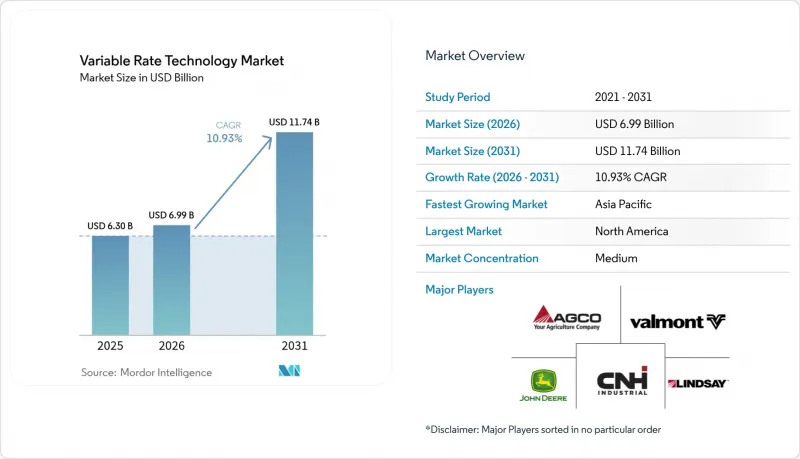
Mordor Intelligence에 의하면, 2026년 가변율 기술(VRT) 시장 규모는 69억 9,000만 달러로 추정되고, 2025년 63억 달러에서 확대해, 2031년에는 117억 4,000만 달러에 이를 것으로 예측됩니다.
2026년부터 2031년까지 연평균 성장률(CAGR) 10.93%로 성장할 것으로 전망됩니다.
본 보고서는 작물 유형별(곡물 등), 용도별(비료, 작물 보호용 화학약품 등), 제공 형태별(하드웨어 등), 도입 방법별(지도 기반 가변율 기술 등), 농장 규모별(대규모 농장 등), 지역별(북미, 유럽 등)로 분류되어 있습니다. 시장 전망은 금액(달러) 기준으로 제시되어 있습니다.
세계의 가변율 기술(VRT) 시장 동향 및 인사이트
농장의 급속한 디지털화
미국 농장의 61%는 이미 실시간 농업 데이터를 클라우드 플랫폼으로 전송하는 정밀 농업용 하드웨어를 활용하고 있습니다. 각 장비 제조업체들은 인력 필요성을 줄이고 시비 정확도를 향상시키는 자율형 솔루션에 수십억 달러 규모의 예산을 할당하고 있으며, 존 디어(John Deere)가 10년에 걸쳐 국내에서 시행하는 200억 달러 규모의 제조 계획이 그 좋은 예입니다. 유럽의 정책 역시 농업용 새로운 디지털 전략을 우선시하며, 커넥티드 기기에 대한 지속적인 자금 지원을 확보하고 있습니다. AI 기반 알고리즘에 의해 형성되는 폐쇄형 피드백을 통해 시비 처방이 지속적으로 조정됨에 따라, 가변율 기술 시장은 정적인 지도에서 자기 학습형 시스템으로 전환되고 있습니다. 그러나 대규모 농장과 소규모 농장 간에 벌어지는 디지털 격차가 기술의 공평한 보급을 위협하고 있습니다.
정부의 보조금 및 장려책
정책 입안자들은 보조금, 리베이트, 친환경 제도를 활용하여 도입 비용을 지원하고 있습니다. 미국 농무부(USDA)의 ‘기후 스마트 상품(Climate-Smart Commodities)’ 이니셔티브는 상세한 생산 데이터, 나아가 정밀한 투입 관리 도구가 필요한 프로젝트에 31억 달러를 투자하고 있습니다. 호주의 ‘온팜 커넥티비티 프로그램(On-Farm Connectivity Program)’은 스마트 관개 장치 비용의 절반을 부담하고 있는 반면, 인도의 ‘디지털 농업 미션(Digital Agriculture Mission)’은 연결 인프라에 6,000 크롤(7억 2,289만 달러)을 배정하고 있습니다. 유럽의 ‘공통 농업 정책(CAP)’에서는 직접 지급액의 최소 25%를 가변 비율 시비를 장려하는 친환경 제도에 할당하고 있습니다. 이러한 보조금은 특히 첨단 기술 투자로 인해 과거 현금 흐름에 제약을 받았던 중규모 농장에 있어 진입 장벽을 낮추는 역할을 하고 있습니다.
가변 비료 시비 대응 기계의 높은 설비 투자액
손익분기점은 대부분의 경우 연간 매출액 10만 유로(114,923.51 달러)를 초과하는 경제 규모를 갖춘 농장에서부터 시작됩니다. 따라서 소규모 농장에서는 설비 구입 비용 부담이 커 진입이 어렵습니다. AgDirect와 같은 금융 기관은 업계 특화형 대출을 제공하고 있지만, 재무 기반이 취약한 가족 경영 농장의 경우 담보와 관련된 장벽이 여전히 남아 있습니다. 이를 해결하기 위한 방안으로 ‘서비스형 장비(Equipment-as-a-Service)’ 계약이 활용되고 있으며, 이를 통해 소유 대수가 아닌 관리 대상 농지 면적에 따라 비용을 분산시킬 수 있습니다.
부문 분석
2025년에는 곡물이 수익의 37.18%를 차지했으며, 가변율 기술(VRT) 시장의 기반으로서 그 입지를 확고히 했습니다. 이 광대한 농지에서 재배되는 작물은 수십 년에 걸친 처방 매핑의 혜택을 받아, 광대한 구획 전체에 걸쳐 질소, 인, 파종 밀도를 미세 조정할 수 있게 되었습니다. 면화, 담배, 특수 섬유와 같은 상업용 작물은 14.27%의 연평균 성장률(CAGR)이 예상되어 가장 빠른 성장을 보이고 있습니다. 이는 높은 수익률 덕분에 고성능 센서 및 장비 탑재형 AI의 도입이 정당화되기 때문입니다. 상업용 작물 가변 시비율 기술(VRT) 시장 규모는 마이크로니어 값이나 잎 등급과 같은 정밀도를 중시하는 품질 연계형 가격 책정 방식의 보급에 따라 확대될 것으로 예측됩니다. 다중 스펙트럼 카메라를 통한 작물의 스트레스 상태에 대한 지속적인 모니터링은 실시간 모델에 데이터를 제공하여, 수 분 이내에 칼륨 시비나 엽면 살포 등의 조치를 취할 수 있게 합니다. 이러한 신속한 대응을 통해 생산자는 계약 보너스를 획득하고, 등급에 따른 감점을 완화할 수 있습니다. 곡물은 계속해서 도입 대수의 기반을 지탱하겠지만, 고급 기능의 보급 속도를 주도하는 것은 특수 작물 부문입니다.
2세대 토양 분광 분석 기술을 통해, 유지종자나 콩류의 윤작에서 비료의 미량 시비를 뒷받침하는 영양소 방출 곡선 측정이 가능해졌습니다. 단백질이나 유분 함량이 농장 출하 가격에 직접적인 영향을 미치는 브라질과 인도에서는 이 기술의 도입이 특히 빠르게 진행되고 있습니다. 과일 수출업체들이 브릭스 수치나 색상의 허용 범위를 더욱 엄격하게 요구함에 따라, 가변율 기술 시장은 과수원과 포도밭으로의 보급을 더욱 확대되고 있습니다. 각 공급업체는 수액 분석 및 관개량 제어를 구독 서비스에 통합하고 있으며, 이를 통해 소규모 과수 농가도 장비를 직접 구매하지 않고도 고급 분석 기능을 이용할 수 있게 되었습니다.
2025년에는 질소 이용 효율의 향상으로 인해 대부분의 기후대에서 신속한 투자 회수가 예상에 따라, 비료가 31.25%의 시장 점유율을 차지했습니다. 가변율 관개는 물 부족의 심화와 계절별 취수량에 대한 규제 상한선을 반영하여, 2031년까지 연평균 성장률(CAGR) 16.55%를 기록할 전망입니다. 캘리포니아주에서 실시된 시험에서는 정밀 피벗 관개를 통해 수확량 감소 없이 물 사용량을 25% 절감할 수 있었으며, 아몬드 및 피스타치오 과수원에서 그 경제성이 입증되었습니다. 저압 노즐로 개조하는 비용을 지원하는 보조금 프로그램의 뒷받침에 힘입어, 관개 장비 분야의 가변율 기술 시장 규모는 2031년까지 10억 7,000만 달러의 증분 매출을 창출할 것으로 예측됩니다. 작물 보호를 위한 살포도 이에 뒤이어 진행되고 있으며, 컴퓨터 비전을 통한 잡초 식별로 제초제 사용량이 최대 80%까지 감소하고 있습니다. 이러한 성과에 더해, 수확량 모니터링 용도이 데이터 피드백 루프를 완성하여 향후 시비 계획을 최적화하는 동시에 분석 소프트웨어 구독 갱신의 기반을 공고히 하고 있습니다.
무선 토양 프로브와 클라우드 대시보드의 통합을 통해 증발산량 예측 및 향후 강우 확률을 고려한 관개 결정이 가능해집니다. 이 예측 기능은 펌프의 수명을 연장하고 에너지 수요를 줄임으로써 자원 효율성에 대한 가치 제안을 강화합니다. 비료 살포에서는 현재, 살포량 제어 장치와 동기화되는 휴대용 검사 키트를 통한 실시간 엽육 분석을 활용하여, 정적인 살포 지도를 시즌 전반에 걸친 동적인 일정으로 전환하고 있습니다. 생물학적 작물 보호 자재 분야의 제품 혁신은 센서 기반의 가변 시비 알고리즘에 의존하는 정밀한 미량 시비의 필요성을 더욱 높이고 있습니다.
지역별 분석
2025년 가변율 기술 시장 매출의 38.62%를 북미가 차지했습니다. 농업 기계의 높은 보급률, 지원적인 자금 조달 환경, 미국 농무부(USDA)의 기후 스마트 조달 규정이 수요의 기반이 되고 있습니다. 보조금 제도는 입증된 영양염류 감축에 대해 보상을 제공함으로써, 노즐 수준의 로그를 기록하는 스마트 농기구의 도입을 촉진하고 있습니다. 중서부 및 프레리 지역 일부에서는 농촌 지역의 광대역 인프라 구축이 지연되고 있지만, 위성 통신망의 확대로 2026년까지 서비스 범위가 확대될 것으로 예측됩니다. 오하이오 주립대학교의 실험에 따르면, 가변 시비를 통한 질소 시비와 드론을 이용한 작물 밀도 측정을 결합함으로써 수확량이 6% 향상된 것으로 나타났으며, 이는 지속적인 투자를 뒷받침하는 실증 데이터가 되고 있습니다. 딜러 생태계는 차량 정비 및 데이터 분석을 수행하는 공인 기술자를 공급하고 있으며, 이는 서비스 사업의 성장 추세를 뒷받침하고 있습니다.
아시아태평양은 가장 빠르게 성장하고 있으며, 각국 정부가 현대화 투자에 디지털 농업 조항을 포함시키고 있는 만큼 2031년까지 연평균 성장률(CAGR) 13.65%를 기록할 전망입니다. 중국의 최신 5개년 계획은 저탄소 및 고효율 농업을 추진하고 있으며, 이는 목표에 맞춘 투입 자재 공급과 밀접하게 연계되어 있습니다. 인도의 Aadhaar(국민 식별 번호)와 연계된 농가 등록 제도는 센서 키트에 대한 보조금 지급을 간소화하고 있는 반면, 일본의 농림수산성은 벼 재배에 특화된 가변 비율 파종 시험에 공동 투자하고 있습니다. 이 지역의 소규모 농지 구조는 마을 기업이가 운영하는 공유형 드론 서비스 등 창의적인 해결책을 낳고 있습니다. 호주와 중국 북부의 물 부족은 가변 비율 관개 도입을 가속화하여 국경을 초월한 지식 이전과 하드웨어 수입을 촉진하고 있습니다.
유럽에서는 광범위한 기후 정책에 가변율 기술 도입이 포함되어 있습니다. 2023-2027년 공동 농업 정책(CAP)에는 2,695억 유로(3,124억 달러)가 배정되었으며, 그 중 거의 절반이 비료 침출 및 농약 비산 감축을 포함한 기후 목표에 할당되었습니다. 각 회원국은 직접 지급금의 최소 25%를 환경 대책에 충당해야 하며, 그 중 다수는 정밀 시비를 적격 관행으로 꼽고 있습니다. 네덜란드 등 일부 국가에서는 센서 설치 비용의 최대 40%를 지원하는 디지털화 보조금을 마련하여 도입을 가속화하고 있습니다. 데이터 주권에 관한 규제로 인해 플랫폼이 일반 데이터 보호 규정(GDPR(EU 개인정보보호규정))의 의무를 준수함에 따라 규정 준수 비용이 증가하고 있습니다. 그럼에도 불구하고, 독일의 ‘5G Testbed Agriculture’와 같은 컨소시엄 프로젝트는 안전한 연결성에 대한 신뢰를 빠르게 높이고 있으며, 범유럽 탄소 이니셔티브는 살포량 제어 장치에서 생성되는 추적 가능한 투입 데이터에 의존하고 있습니다.
기타 혜택 :
- 엑셀 형식 시장 예측(ME) 시트
- 3개월간의 애널리스트 지원
자주 묻는 질문
목차
제1장 서론
제2장 조사 방법
제3장 주요 요약
제4장 시장 구도
제5장 시장 규모 및 성장 예측
제6장 경쟁 구도
제7장 시장 기회 및 향후 전망
AJY 26.09.11According to Mordor Intelligence, variable rate technology market size in 2026 is estimated at USD 6.99 billion, growing from 2025 value of USD 6.30 billion with 2031 projections showing USD 11.74 billion, growing at 10.93% CAGR over 2026-2031.
This report is Segmented by Crop Type (Cereals and Grains and More), by Application (Fertilizers, Crop-Protection Chemicals, and More), by Offering (Hardware and More), by Implementation Method (Map-Based VRT and More), by Farm Size (Large Farms and More) and by Geography (North America, Europe, and More). The Market Forecasts are Provided in Terms of Value (USD).
Global Variable Rate Technology Market Trends and Insights
Rapid Digitalization of Farms
Sixty-one percent of United States farms already rely on precision hardware that feeds real-time agronomic data into cloud platforms. Equipment makers allocate multibillion-dollar budgets to autonomous solutions that lower labor needs and refine application accuracy, illustrated by John Deere's decade-long USD 20 billion domestic manufacturing plan. European policy likewise prioritizes an upcoming digital strategy for agriculture, ensuring sustained funding for connected devices. Closed feedback loops created by AI-driven algorithms continuously adjust prescriptions, moving the variable rate technology market beyond static maps toward self-learning systems. Yet a widening digital divide between large and small farms threatens equitable technology uptake.
Government Subsidies and Incentive Schemes
Policymakers use grants, rebates, and eco-schemes to underwrite adoption costs. The USDA Climate-Smart Commodities initiative channels USD 3.1 billion into projects that necessitate granular production data and, by extension, precision input tools. Australia's On-Farm Connectivity Program covers half the cost of smart irrigation devices, while India's Digital Agriculture Mission earmarks INR 6,000 crore (USD 722.89 million) for connected infrastructure. Europe's Common Agricultural Policy directs at least 25% of direct payments toward eco-schemes that reward variable-rate fertilization. These subsidies lower entry barriers, especially for mid-size farms whose cash flows were once restricted by high-tech spending.
High Capital Expenditure of VRT-Ready Machinery
Profitability breakeven often starts at economic farm sizes above EUR 100,000 (USD 114,923.51), leaving smaller operations priced out of equipment purchases. Lenders such as AgDirect offer sector-specific loans, yet collateral hurdles persist for family farms with thin balance sheets. As a workaround, equipment-as-a-service contracts spread costs across acres serviced rather than units owned.
Other drivers and restraints analyzed in the detailed report include:
- Rising Agricultural Labor Shortage
- Satellite NB-IoT-Enabled Sub-Acre Prescriptions
- Patchy Rural Connectivity Infrastructure
For complete list of drivers and restraints, kindly check the Table Of Contents.
Segment Analysis
In 2025, cereals and grains represented 37.18% of revenues, cementing their role as the foundation of the variable rate technology market. These broad-acre crops benefit from decades of prescription mapping that fine-tunes nitrogen, phosphorus, and seeding density across large tracts. Commercial crops such as cotton, tobacco, and specialty fibers deliver the fastest gains with a 14.27% CAGR outlook, as higher margins justify premium sensors and on-equipment AI. Variable rate technology market size for commercial crops is anticipated to climb in tandem with quality-linked pricing schemes that reward precise micronaire or leaf grade. Continuous monitoring of plant stress via multispectral cameras feeds real-time models that initiate potassium or foliar-feed interventions within minutes. This responsiveness helps producers capture contract bonuses and reduce grade-related downgrades. Cereals will keep anchoring installed base volumes, yet specialty segments set the pace for advanced feature uptake.
Second-generation soil spectroscopy now measures nutrient release curves that underpin fertilizer micro-dosing in oilseed and pulse rotations. Adoption is especially strong in Brazil and India, where protein and oil content directly influence farm-gate prices. The variable rate technology market further penetrates orchard and vineyard operations as fruit exporters demand tighter Brix and color tolerances. Providers bundle sap analysis and irrigation rate control into subscription services so smaller acreage fruit farms can access high-end analytics without outright equipment purchases.
Fertilizers held a 31.25% market share in 2025 because nitrogen efficiency improvements deliver quick paybacks in most climatic zones. Variable-rate irrigation is poised for a 16.55% CAGR by 2031, reflecting escalating water scarcity and regulatory caps on seasonal withdrawals. In California trials, precision pivots cut water use by 25% with no yield penalty, validating the economics for almond and pistachio groves. The variable rate technology market size for irrigation equipment is forecast to add USD 1.07 billion in incremental sales by 2031, buoyed by subsidy programs that reimburse low-pressure nozzle retrofits. Crop-protection spraying follows close behind as computer-vision weed identification slashes herbicide volumes by up to 80%. Added to these gains, yield monitoring applications complete the data feedback loop that refines future prescriptions and anchors subscription renewals for analytics software.
Integration of wireless soil probes with cloud dashboards enables irrigation decisions that account for evapotranspiration forecasts and future rainfall probability. This predictive capability extends pump life and trims energy demand, reinforcing the resource-efficiency value proposition. Fertilizer applications now leverage real-time tissue testing via portable lab kits that sync to rate controllers, converting static maps into season-long dynamic schedules. Product innovation in biological crop-protection inputs further amplifies the need for precise micro-dosing that hinges on sensor-driven variable rate algorithms.
Complete Report Scope:
- By Crop Type
- Cereals and Grains
- Fruits and Vegetables
- Oilseeds and Pulses
- Commercial Crops
- By Application
- Fertilizers
- Crop-protection Chemicals
- Soil Sensing
- Yield Monitoring
- Irrigation
- Others (variable-rate seeding/planting, variable-rate lime and soil-amendment application)
- By Offering
- Hardware
- Software
- Services
- By Implementation Method
- Map-based VRT
- Sensor-based VRT
- By Farm Size
- Large Farms (greater than 1,000 ha)
- Medium Farms (200-1,000 ha)
- Small Farms (less than 200 ha)
- By Geography
- North America
- United States
- Canada
- Mexico
- Rest of North America
- Europe
- Germany
- France
- United Kingdom
- Italy
- Spain
- Russia
- Rest of Europe
- Asia-Pacific
- China
- Japan
- India
- South Korea
- Australia
- Rest of Asia-Pacific
- Middle East
- Turkey
- Saudi Arabia
- United Arab Emirates
- Rest of Middle East
- Africa
- South Africa
- Egypt
- Nigeria
- Rest of Africa
- North America
Geography Analysis
North America generated 38.62% of 2025 revenue for the variable rate technology market. Strong machinery penetration, supportive financing, and USDA climate-smart procurement rules anchor demand. Subsidy frameworks reward documented nutrient reductions, spurring the adoption of smart implements that capture nozzle-level logs. Rural broadband lags in parts of the Midwest and Prairie provinces, yet satellite link rollouts promise coverage boosts by 2026. Ohio State trials show a 6% yield lift when VR nitrogen intersects with drone stand counts, proof points that validate ongoing investment. Dealer ecosystems supply certified technicians who maintain fleets and interpret data, underscoring the service growth narrative.
Asia-Pacific is the fastest climber, tracking a 13.65% CAGR to 2031 as governments attach digital farming clauses to modernization spending. China's latest Five-Year Plan promotes low-carbon, high-efficiency agriculture that dovetails with targeted input delivery. India's Aadhaar-linked Farmer Registry simplifies subsidy disbursement for sensor kits, while Japan's Food and Agriculture Ministry co-funds paddy-specific variable rate seeding trials. The region's small-plot structure sparks creative solutions, including shared-service drones operated by village entrepreneurs. Water scarcity across Australia and Northern China accelerates variable-rate irrigation uptake, driving cross-border knowledge transfer and hardware imports.
Europe embeds variable rate technology adoption within sweeping climate policy. The Common Agricultural Policy for 2023-27 allocates EUR 269.5 billion (USD 312.4 billion), nearly half aimed at climate objectives that include reduced fertilizer leaching and pesticide drift. Each member state must earmark at least 25% of direct payments for eco-schemes, many of which list precision application as a qualifying practice. Countries such as the Netherlands fund digitization grants that reimburse up to 40% of sensor installations, hastening implementation. Data sovereignty rules raise compliance costs as platforms adapt to General Data Protection Regulation obligations. Nonetheless, consortium projects like Germany's 5G Testbed Agriculture expedite confidence in secure connectivity, and Pan-European carbon initiatives depend on traceable input data generated by rate controllers.
- Deere & Company
- AGCO Corporation
- CNH Industrial N.V.
- Valmont Industries, Inc.
- Lindsay Corporation
- EarthOptics
- Hexagon AB
- CropX Technologies
- TeeJet Technologies (Spraying Systems)
- DJI
- DroneDeploy
- The Climate Corporation (Bayer AG)
- EOS Data Analytics,Inc
- SoilOptix
- Frontier Agriculture Ltd
Additional Benefits:
- The market estimate (ME) sheet in Excel format
- 3 months of analyst support
TABLE OF CONTENTS
1 Introduction
- 1.1 Study Assumptions and Market Definition
- 1.2 Scope of the Study
2 Research Methodology
3 Executive Summary
4 Market Landscape
- 4.1 Market Overview
- 4.2 Market Drivers
- 4.2.1 Rapid digitalization of farms
- 4.2.2 Government subsidies and incentive schemes
- 4.2.3 Rising agriculture labour shortage
- 4.2.4 Satellite NB-IoT-enabled sub-acre prescriptions
- 4.2.5 Carbon credit monetization demanding input traceability
- 4.2.6 On-equipment AI chips for offline VRT analytics
- 4.3 Market Restraints
- 4.3.1 High capital expenditure of VRT-ready machinery
- 4.3.2 Patchy rural connectivity infrastructure
- 4.3.3 Data ownership and sharing ambiguities
- 4.3.4 Shortage of VRT skilled agronomic service providers
- 4.4 Regulatory Landscape
- 4.5 Technological Outlook
- 4.6 Porter's Five Forces Analysis
- 4.6.1 Threat of New Entrants
- 4.6.2 Bargaining Power of Buyers
- 4.6.3 Bargaining Power of Suppliers
- 4.6.4 Threat of Substitutes
- 4.6.5 Intensity of Competitive Rivalry
5 Market Size and Growth Forecasts (Value)
- 5.1 By Crop Type
- 5.1.1 Cereals and Grains
- 5.1.2 Fruits and Vegetables
- 5.1.3 Oilseeds and Pulses
- 5.1.4 Commercial Crops
- 5.2 By Application
- 5.2.1 Fertilizers
- 5.2.2 Crop-protection Chemicals
- 5.2.3 Soil Sensing
- 5.2.4 Yield Monitoring
- 5.2.5 Irrigation
- 5.2.6 Others (variable-rate seeding/planting, variable-rate lime and soil-amendment application)
- 5.3 By Offering
- 5.3.1 Hardware
- 5.3.2 Software
- 5.3.3 Services
- 5.4 By Implementation Method
- 5.4.1 Map-based VRT
- 5.4.2 Sensor-based VRT
- 5.5 By Farm Size
- 5.5.1 Large Farms (greater than 1,000 ha)
- 5.5.2 Medium Farms (200-1,000 ha)
- 5.5.3 Small Farms (less than 200 ha)
- 5.6 By Geography
- 5.6.1 North America
- 5.6.1.1 United States
- 5.6.1.2 Canada
- 5.6.1.3 Mexico
- 5.6.1.4 Rest of North America
- 5.6.2 Europe
- 5.6.2.1 Germany
- 5.6.2.2 France
- 5.6.2.3 United Kingdom
- 5.6.2.4 Italy
- 5.6.2.5 Spain
- 5.6.2.6 Russia
- 5.6.2.7 Rest of Europe
- 5.6.3 Asia-Pacific
- 5.6.3.1 China
- 5.6.3.2 Japan
- 5.6.3.3 India
- 5.6.3.4 South Korea
- 5.6.3.5 Australia
- 5.6.3.6 Rest of Asia-Pacific
- 5.6.4 Middle East
- 5.6.4.1 Turkey
- 5.6.4.2 Saudi Arabia
- 5.6.4.3 United Arab Emirates
- 5.6.4.4 Rest of Middle East
- 5.6.5 Africa
- 5.6.5.1 South Africa
- 5.6.5.2 Egypt
- 5.6.5.3 Nigeria
- 5.6.5.4 Rest of Africa
- 5.6.1 North America
6 Competitive Landscape
- 6.1 Market Concentration
- 6.2 Strategic Moves
- 6.3 Market Share Analysis
- 6.4 Company Profiles (includes Global level Overview, Market level overview, Core Segments, Financials as available, Strategic Information, Market Rank/Share, Products and Services, Recent Developments)
- 6.4.1 Deere & Company
- 6.4.2 AGCO Corporation
- 6.4.3 CNH Industrial N.V.
- 6.4.4 Valmont Industries, Inc.
- 6.4.5 Lindsay Corporation
- 6.4.6 EarthOptics
- 6.4.7 Hexagon AB
- 6.4.8 CropX Technologies
- 6.4.9 TeeJet Technologies (Spraying Systems)
- 6.4.10 DJI
- 6.4.11 DroneDeploy
- 6.4.12 The Climate Corporation (Bayer AG)
- 6.4.13 EOS Data Analytics,Inc
- 6.4.14 SoilOptix
- 6.4.15 Frontier Agriculture Ltd


