

|
시장보고서
상품코드
2123562
인공심장판막 시장 : 시장 점유율 분석, 업계 동향 및 통계, 성장 예측(2026-2031년)Prosthetic Heart Valve - Market Share Analysis, Industry Trends & Statistics, Growth Forecasts (2026 - 2031) |
||||||
 Mordor Intelligence
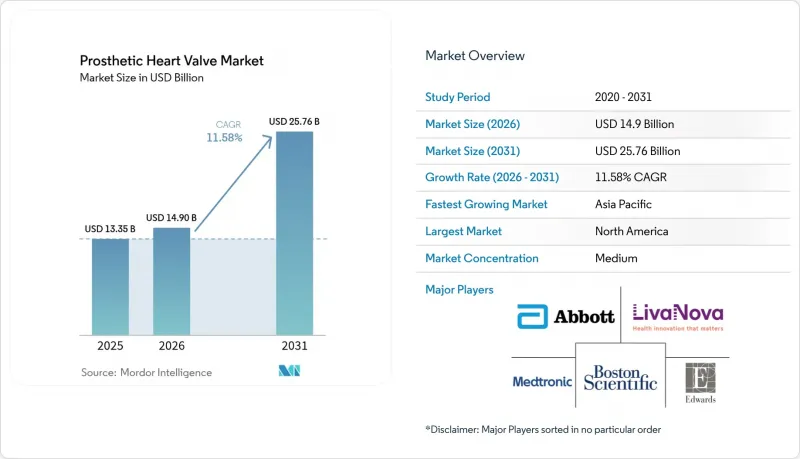
Mordor Intelligence에 의하면, 2026년 인공심장판막 시장 규모는 149억 달러로 추정되고, 2025년 133억 5,000만 달러에서 확대해, 2031년에는 257억 6,000만 달러에 이를 것으로 예측됩니다.
2026-2031년 연평균 성장률(CAGR) 11.58%로 성장할 것으로 전망됩니다.
본 보고서는 판막 유형별(기계식 심장 판막, 조직·생체 인공심장판막, 기타), 부위별(승모판막, 대동맥판막, 삼첨판막, 폐동맥판막), 삽입 방법별(외과적, 경카테터, 봉합 불필요), 최종 사용자별(3차 의료 병원, 심장 전문 의료 센터, 기타), 지역별(북미, 유럽, 아시아태평양, 기타)로 분류되어 있습니다. 시장 예측은 금액(달러)으로 표시되어 있습니다.
세계의 인공심장판막 시장 동향 및 인사이트
TAVR/TAVI 적응증 확대
2025년 5월, 무증상 중증 대동맥판막 협착증에 대한 에드워즈사의 ‘SAPIEN 3’ 플랫폼이 FDA 승인을 받음에 따라 ‘경과 관찰’이라는 개념이 사라졌고, 임상의는 증상이 나타나기 전에 개입할 수 있게 되었습니다. EARLY TAVR 연구 데이터에 따르면, 3.8년의 추적 기간 동안 조기 치료군의 유해 사건 발생률은 26.8%였던 반면, 경과 관찰군은 45.3%였으며, 이를 통해 적극적인 치료의 유효성이 입증되어 대상 환자층이 실질적으로 2배로 확대되었습니다. 에드워즈사는 2025년 TAVR 매출을 41억-44억 달러로 평가되었으며, 애보트사 등 경쟁사들도 저위험 환자를 확보하기 위해 ENVISION 연구를 시작했습니다. 민간 보험사는 일반적으로 메디케어의 선례를 따르기 때문에 메디케어·메디케이드 서비스 센터(CMS)의 보험 적용 결정이 도입의 향방을 좌우하게 됩니다. 보험 적용 범위가 확대됨에 따라 시술 건수가 증가하고, 인공 심장판막 시장에서 경카테터 치료법의 우위가 더욱 공고해질 것으로 보입니다.
규제상 신속 심사 및 ‘브레이크스루(Breakthrough)’ 지정
2024년 9월 현재, ‘브레이크스루’ 지정을 받은 의료기기는 사상 최고치인 1,041건에 달했습니다. 승인된 128개 제품은 이 제도를 통해 승인까지의 기간이 3-5년에서 약 18-24개월로 단축되었음을 입증하고 있습니다. 에드워즈사의 삼첨판 ‘EVOQUE’는 브레이크스루 지정을 활용하여 2024년 2월에 승인을 획득했습니다. 한편, 4C 메디컬사의 폴리머 제 ‘AltaValve’는 2건의 ‘브레이크스루’ 지정을 받았습니다. 유럽에서도 유사한 긴급성이 나타나, 2025년 4월에는 SAPIEN M3에 대해 세계 최초의 대퇴동맥 경유 승모판막 장치로서 CE 마크가 부여되었습니다. 조기에 지정을 획득한 기업은 시장 출시 속도라는 우위를 확보함으로써, 인공심장판막 시장에서 수익과 브랜드 포지셔닝을 향상시킬 수 있습니다.
TAVR 기기와 시술의 높은 비용
미국의 민간 보험사는 TAVR에 대해 중앙값 7만 1,312달러를 보상하고 있으며, 이는 메디케어의 3만 7,865달러를 상회합니다. Aetna는 8만 4,190달러로 가장 높은 금액을 지급하며, 뉴잉글랜드 지역과 태평양 연안 지역 간에는 가격 차이가 2배에 달할 전망입니다. 유럽과 북미를 합치면 TAVR에 연간 20억 달러 이상을 지출하고 있어 예산에 부담을 주고 있습니다. 신흥 시장에서는 기기의 가격이 1인당 연간 의료비 지출을 초과하는 경우도 있어 더 큰 장벽에 직면해 있습니다. 스페인의 QALY(질 조정 생존년)당 증분 비용-효과 비율은 6,952유로로 기준치를 밑돌고 있지만, 지급 기관의 제약으로 인해 당장 보급이 확대되지는 않을 전망입니다. 각 제조업체들은 금액 기준 계약을 검토하고 있으나, 여전히 높은 가격이 인공심장판막 시장의 발목을 잡고 있습니다.
부문 분석
경카테터 심장 판막은 2025년 매출의 45.10%를 차지했으며, 모든 위험 프로파일에서 구제 요법에서 1차 선택 요법으로 빠르게 전환되고 있음을 보여줍니다. 이 부문은 입원 기간을 단축하고 적응증을 확대하는 간소화된 시술을 통해 인공심장판막 시장의 기반을 형성하고 있습니다. 폴리머 판막은 가장 빠르게 성장하는 틈새 시장으로, 2031년 연평균 성장률(CAGR)이 17.74%를 나타낼 것으로 예측됩니다. 이는 항응고 요법 없이도 석회화를 방지하는 소재가 활동적인 환자층에게 호응을 얻고 있기 때문입니다. 생체 판막은 여전히 기존 수술에서 중요한 위치를 차지하고 있지만, 기계 판막은 내구성을 중시하고 평생 항응고 요법을 수용하는 일부 젊은 환자들에게 여전히 최적의 선택지로 남아 있습니다. 무증상 환자를 위한 에드워즈(Edwards)사의 ‘SAPIEN 3’ 및 ‘EVOQUE’ 삼첨판 시스템 등의 규제 승인 성공에 힘입어, 경카테터 치료법은 계속해서 최전선에 자리 잡고 있습니다. 폴리머 판막 분야의 혁신 기업인 Foldax와 4C Medical은 내구성에 대한 기대치를 재정의하며 경쟁적 차별화를 촉진하고 있습니다. 디바이스 플랫폼이 여러 부위를 지원함에 따라 임상적 수용도가 확대되고 있으며, 이는 인공심장판막 시장이 카테터 기반 치료로 이동하는 추세를 뒷받침하고 있습니다.
봉합이 필요 없는 플랫폼은 크로스 클램프 시간을 단축하고 향후 판막 내 판막(V-in-V) 시술을 용이하게 함으로써 개흉 수술과 카테터 기술의 경계를 모호하게 만들고 있습니다. 이러한 하이브리드 방식의 진화는 수술에 대한 통제권을 놓치지 않으면서도 더 신속한 시술을 원하는 외과의사들의 관심을 끌고 있습니다. 리바노바(Rivanova)사의 ‘퍼시벌 플러스(Perceval Plus)’와 같은 신속 전개형 판막은 처리 능력과 치료 성과 간의 균형을 중시하는 의료 기관들로부터 지지를 받고 있으며, 인공심장판막 시장 전체에서 점유율을 서서히 확대되고 있습니다.
대동맥판막은 확립된 증거와 효율화된 보험 급여 절차의 뒷받침을 받아 2025년에는 매출의 56.02%를 차지했습니다. 대동맥판막협착증의 유병률은 연령이 증가함에 따라 상승하기 때문에 환자 수요는 여전히 견조하지만, 고소득 시장에서의 보급률이 안정화되면서 성장세는 완만해지고 있습니다. 삼첨판 치료는 에드워즈사의 ‘EVOQUE’ 승인 및 애보트사의 ‘TriClip’ 임상시험 성공에 힘입어 예측 연평균 성장률(CAGR)이 14.92%로, 모든 부위 중 가장 높은 성장세를 보이고 있습니다. SAPIEN M3의 CE 마크 획득으로 대퇴동맥 경로를 통한 치료가 가능해짐에 따라, 승모판 치료 프로그램도 탄력을 받고 있습니다. 전문 기업들은 유출로가 확장된 환자를 위한 ‘Venus P-valve’ 등의 기기를 통해 폐동맥 분야 수요에 대응하고 있습니다.
대동맥판막 제품 부문에서 인공 심장판막 시장 점유율은 삼첨판막과 승모판막의 성장세가 기존 제품의 판매량을 상회함에 따라 소폭 축소될 것으로 예측됩니다. 경카테터 삼첨판막 수술에 대한 ‘증거 개발(Evidence Development)’을 바탕으로 한 CMS의 보험 적용으로 인해 미국 내 보급이 가속화될 것으로 보입니다. 동시에, 아시아태평양의 기업들은 Venus Medtech의 승모판 플랫폼 등 현지 해부학적 특성에 적합한 부위 특화형 기기를 개발하고 있어, 경쟁 구도에 다양성을 더하고 있습니다. 부위별 특화가 진행되는 가운데, 각 제조업체는 해부학적 특징의 미묘한 차이에 맞춘 규제 승인 일정과 임상시험을 확보하며, 인공심장판막 시장에서 지속적인 성장의 기반을 다지고 있습니다.
지역별 분석
북미는 2025년 매출의 42.10%를 차지했으며, 확립된 환급 제도, 견고한 임상 인프라, 조기 도입자로서의 인식을 통해 주도적인 위치를 공고히 하고 있습니다. CMS에 의한 보험 적용 범위 확대가 시술 건수 증가를 견인하고 있으며, 민간 보험사들도 대체로 메디케어의 방침을 따르고 있어 폭넓은 접근성이 확보되고 있습니다. 미국에서는 2037년까지 8,650명의 심장 전문의가 부족할 것으로 예상되며, 수련 체계가 가속화되지 않으면 이러한 제약이 시술 건수 증가세를 둔화시킬 가능성이 있습니다. 캐나다는 각 주의 통합된 의료 제도와 TAVR 시술 건수 증가의 혜택을 받고 있습니다. 멕시코에서는 현대화가 진행 중인 민간 부문과 국경 간 의료 관광이 틈새 성장 요인으로 작용하고 있습니다.
아시아태평양은 인프라 투자, 규제 조화, 국내 혁신에 힘입어 2031년까지 연평균 성장률(CAGR) 13.90%로 가장 높은 성장률을 보이고 있습니다. 중국 국가약품감독관리국(NMPA)의 MicroPort ‘VitaFlow Liberty Flex’ 승인으로 국산 경카테터 치료 옵션이 확대되고 있습니다. 일본과 한국은 고령화 사회와 국민건강보험 제도를 활용하여 TAVR의 보급을 가속화하고 있습니다. 인도에서는 대도시권을 넘어 심장 질환 치료 프로그램이 확대되고 있어 장기적인 성장 가능성을 보여주고 있습니다. 동아시아 환자들에게서 나타나는 대동맥판막 고리가 작다는 등의 해부학적 차이로 인해, 지역에 특화된 판막 크기 선정이 필요하며, 이에 따라 현지 연구개발이 강화되고 있습니다. 호주는 임상시험의 거점 역할을 하며, 지역으로의 기술 이전과 근거 창출을 지원하고 있습니다.
유럽은 협력적인 규제와 견고한 임상의 네트워크에 힘입어 균형 잡힌 성장 전망을 유지하고 있습니다. 독일, 영국, 프랑스, 이탈리아, 스페인은 오랜 기간 이어져 온 TAVR 프로그램과 표준화된 교육 커리큘럼을 바탕으로 시술 건수의 기반을 형성하고 있습니다. 에드워즈사의 ‘SAPIEN M3’가 CE 마크를 획득한 것은 대퇴동맥을 통한 승모판 치환 솔루션의 발판으로서 유럽의 역할을 강조하는 것입니다. 동유럽은 뒤처져 있지만, 경제 수렴에 따라 따라잡을 가능성을 내포하고 있습니다. 한편, 중동 및 아프리카 및 남미는 소규모 기반에서 성장하고 있습니다. 우수한 의료 센터에 대한 선별적 투자를 통해 의사를 양성하고 치료 실적을 입증하는 지역 허브가 형성되면서, 인공 심장판막 시장으로의 접근성이 점차 확대되고 있습니다.
기타 혜택
- 엑셀 형식 시장 예측(ME) 시트
- 3개월간의 애널리스트 지원
자주 묻는 질문
목차
제1장 서론
제2장 조사 방법
제3장 주요 요약
제4장 시장 구도
제5장 시장 규모 및 성장 예측
제6장 경쟁 구도
제7장 시장 기회 및 향후 전망
AJY 26.09.11According to Mordor Intelligence, prosthetic heart valve market size in 2026 is estimated at USD 14.9 billion, growing from 2025 value of USD 13.35 billion with 2031 projections showing USD 25.76 billion, growing at 11.58% CAGR over 2026-2031.
This report is Segmented by Valve Type (Mechanical Heart Valve, Bioprosthetic Heart Valve, and More), Position (Mitral, Aortic, Tricuspid, and Pulmonary), Delivery Method (Surgical, Transcatheter and Sutureless), End-User (Tertiary-Care Hospitals, Cardiac Specialty Centers, and More), and Geography (North America, Europe, Asia Pacific and More). The Market Forecasts are Provided in Terms of Value (USD).
Global Prosthetic Heart Valve Market Trends and Insights
Expanding Indications for TAVR/TAVI
The May 2025 FDA approval of Edwards' SAPIEN 3 platform for asymptomatic severe aortic stenosis removes the "watchful waiting" mindset, allowing clinicians to intervene before symptom onset. EARLY TAVR data showed 26.8% adverse events with early treatment versus 45.3% under surveillance during 3.8-year follow-up, validating proactive therapy and effectively doubling the addressable pool. Edwards forecasts TAVR sales of USD 4.1-4.4 billion in 2025, and rivals such as Abbott have launched the ENVISION trial to capture lower-risk patients. Centers for Medicare & Medicaid Services (CMS) coverage decisions will shape adoption because private payers typically mirror Medicare precedent. As coverage broadens, procedure volumes rise, reinforcing the prosthetic heart valve market's shift toward transcatheter dominance.
Regulatory Fast-Tracks & Breakthrough Designations
Breakthrough device designations hit a record 1,041 by September 2024; 128 authorized products demonstrate how the pathway compresses approvals from 3-5 years to around 18-24 months. Edwards' EVOQUE tricuspid valve capitalized on breakthrough status to secure February 2024 clearance, while 4C Medical's polymer AltaValve holds two breakthrough labels. Europe parallels this urgency, granting the world's first transfemoral mitral CE mark to SAPIEN M3 in April 2025. Companies that lock in early designations gain speed-to-market advantages, boosting revenue and brand positioning within the prosthetic heart valve market.
High TAVR Device & Procedure Costs
Commercial US payers reimburse a median USD 71,312 for TAVR, versus Medicare's USD 37,865; Aetna tops at USD 84,190, and prices vary two-fold between New England and Pacific regions. Europe and North America together spend over USD 2 billion annually on TAVR, pressuring budgets. Emerging markets face larger hurdles, as devices can exceed annual per-capita healthcare outlays. Spain's incremental cost-effectiveness ratio of EUR 6,952 per QALY is below threshold, but payer constraints limit immediate uptake. Manufacturers are exploring value-based contracts, yet high prices remain a brake on the prosthetic heart valve market.
Other drivers and restraints analyzed in the detailed report include:
- Polymeric Valve R&D Breakthroughs
- AI-Guided Patient Selection & Sizing Tools
- Durability Concerns in Younger Cohorts
For complete list of drivers and restraints, kindly check the Table Of Contents.
Segment Analysis
Transcatheter heart valves accounted for 45.10% of 2025 revenue, underlining their rapid shift from salvage therapy to first-line option across risk profiles. This segment anchors the prosthetic heart valve market through streamlined procedures that shorten hospital stays and widen eligibility. Polymeric valves represent the fastest-growing niche, delivering an 17.74% CAGR through 2031 because materials resist calcification without anticoagulation, appealing to active patients. Tissue valves retain relevance for conventional surgery, while mechanical devices remain the choice for select younger users who accept lifelong anticoagulation in exchange for durability. Regulatory wins, such as Edwards' SAPIEN 3 for asymptomatic patients and the EVOQUE tricuspid system, keep transcatheter solutions at the forefront. Polymeric innovators Foldax and 4C Medical are reshaping durability expectations, catalyzing competitive differentiation. Clinical acceptance broadens as device platforms address multiple positions, reinforcing the prosthetic heart valve market's direction toward catheter-based therapy.
Sutureless platforms blur the line between open surgery and catheter techniques by offering shorter cross-clamp times and facilitating future valve-in-valve interventions. This hybrid evolution attracts surgeons who seek faster procedures without relinquishing operative control. Rapid-deployment valves, such as LivaNova's Perceval Plus, appeal to institutions balancing throughput and outcomes, prompting incremental share gains within the broader prosthetic heart valve market.
Aortic valves represented 56.02% of revenue in 2025, buttressed by a mature evidence base and streamlined reimbursement pathways. Patient demand remains strong because aortic stenosis prevalence rises with age, yet growth moderates as penetration in high-income markets stabilizes. Tricuspid interventions recorded a 14.92% forecast CAGR, the fastest among all positions, buoyed by Edwards' EVOQUE approval and trial success for Abbott's TriClip. Mitral programs gain momentum as the SAPIEN M3 CE mark unlocks the transfemoral approach. Specialized firms address pulmonary needs with devices such as the Venus P-valve for enlarged outflow tracts.
The prosthetic heart valve market share for aortic products is expected to narrow modestly as tricuspid and mitral growth outpaces traditional volumes. CMS coverage under Evidence Development for transcatheter tricuspid procedures will accelerate US uptake. Simultaneously, Asia-Pacific companies craft position-specific devices suited to local anatomies, such as Venus Medtech's mitral platform, diversifying competitive dynamics. As position specialization deepens, manufacturers secure regulatory timelines and clinical trials tailored to anatomical nuance, anchoring durable growth within the prosthetic heart valve market.
Complete Report Scope:
- By Valve Type
- Mechanical Heart Valve
- Tissue/Bioprosthetic Heart Valve
- Transcatheter Heart Valve (TAVR/TMVR/TTVR/TPVR)
- Polymeric/Next-Gen Heart Valve
- By Position
- Aortic
- Mitral
- Tricuspid
- Pulmonary
- By Delivery Method
- Surgical (SAVR/SMVR)
- Transcatheter
- Sutureless/Rapid-deployment
- By End-user
- Tertiary-care Hospitals
- Cardiac Specialty Centers
- Ambulatory Surgical Centers
- Geography
- North America
- United States
- Canada
- Mexico
- Europe
- Germany
- United Kingdom
- France
- Italy
- Spain
- Rest of Europe
- Asia-Pacific
- China
- Japan
- India
- South Korea
- Australia
- Rest of Asia-Pacific
- Middle East and Africa
- GCC
- South Africa
- Rest of Middle East and Africa
- South America
- Brazil
- Argentina
- Rest of South America
- North America
Geography Analysis
North America accounted for 42.10% of 2025 revenue, cementing its leadership through established reimbursement, robust clinical infrastructure, and early adopter mindsets. CMS coverage expansions drive procedure growth, and private insurers generally mirror Medicare's stance, ensuring broad access. The United States faces a looming 8,650-cardiologist shortfall by 2037, a constraint that may dampen procedure growth if training pipelines do not accelerate. Canada benefits from integrated provincial health systems and rising TAVR volumes. Mexico's modernizing private sector and cross-border medical tourism represent niche growth contributors.
Asia-Pacific delivers the fastest 13.90% CAGR through 2031, propelled by infrastructure investment, regulatory harmonization, and domestic innovation. China's National Medical Products Administration (NMPA) approval of MicroPort's VitaFlow Liberty Flex expands home-grown transcatheter options. Japan and South Korea leverage ageing populations and universal coverage to accelerate uptake. India exhibits long-term potential as cardiac programmes expand beyond metro hubs. Anatomical differences, notably smaller aortic annuli in East Asian patients, necessitate region-specific valve sizing and reinforce local R&D. Australia functions as a clinical trial nucleus, supporting regional skill transfer and evidence generation.
Europe sustains a balanced growth outlook, underpinned by coordinated regulation and strong clinician networks. Germany, United Kingdom, France, Italy, and Spain anchor procedural volumes, supported by long-standing TAVR programmes and standardized curricula. Edwards' SAPIEN M3 CE mark emphasises Europe's role as a launch pad for transfemoral mitral solutions. Eastern Europe lags but offers catch-up potential as economies converge. Meanwhile, the Middle East, Africa, and South America grow from a small base; selective investments in centres of excellence create regional hubs that train physicians and demonstrate outcomes, progressively widening access to the prosthetic heart valve market.
- Edward Lifesciences
- Medtronic
- Abbott Laboratories
- Boston Scientific
- Artivion (CryoLife)
- LivaNova
- MicroPort CardioFlow
- Jenavalve Technology
- Foldax Inc.
- Lepu Medical
- On-X Life Technologies
- Terumo Corp.
- Colibri Heart Valve
- TTK Healthcare
- Meril Life Sciences
- Teleflex (Chordis)
- NaviGate Cardiac Structures
- Peijia Medical
- Xeltis NV
Additional Benefits:
- The market estimate (ME) sheet in Excel format
- 3 months of analyst support
TABLE OF CONTENTS
1 Introduction
- 1.1 Study Assumptions & Market Definition
- 1.2 Scope of the Study
2 Research Methodology
3 Executive Summary
4 Market Landscape
- 4.1 Market Overview
- 4.2 Market Drivers
- 4.2.1 Aging Population & Rising VHD Prevalence
- 4.2.2 Expanding Indications For TAVR/TAVI
- 4.2.3 Regulatory Fast-Tracks & Breakthrough Designations
- 4.2.4 Reimbursement Expansion In Middle-Income Countries
- 4.2.5 Polymeric Valve R&D Breakthroughs
- 4.2.6 AI-Guided Patient Selection & Sizing Tools
- 4.3 Market Restraints
- 4.3.1 High TAVR Device & Procedure Costs
- 4.3.2 Durability Concerns In Younger Cohorts
- 4.3.3 Limited Cath-Lab Capacity Outside Tier-1 Cities
- 4.3.4 Surge In Valve-In-Valve Re-Interventions
- 4.4 Technological Outlook
- 4.5 Porter's Five Forces
- 4.5.1 Threat of New Entrants
- 4.5.2 Bargaining Power of Buyers
- 4.5.3 Bargaining Power of Suppliers
- 4.5.4 Threat of Substitutes
- 4.5.5 Intensity of Competitive Rivalry
5 Market Size & Growth Forecasts (Value, USD)
- 5.1 By Valve Type
- 5.1.1 Mechanical Heart Valve
- 5.1.2 Tissue/Bioprosthetic Heart Valve
- 5.1.3 Transcatheter Heart Valve (TAVR/TMVR/TTVR/TPVR)
- 5.1.4 Polymeric/Next-Gen Heart Valve
- 5.2 By Position
- 5.2.1 Aortic
- 5.2.2 Mitral
- 5.2.3 Tricuspid
- 5.2.4 Pulmonary
- 5.3 By Delivery Method
- 5.3.1 Surgical (SAVR/SMVR)
- 5.3.2 Transcatheter
- 5.3.3 Sutureless/Rapid-deployment
- 5.4 By End-user
- 5.4.1 Tertiary-care Hospitals
- 5.4.2 Cardiac Specialty Centers
- 5.4.3 Ambulatory Surgical Centers
- 5.5 Geography
- 5.5.1 North America
- 5.5.1.1 United States
- 5.5.1.2 Canada
- 5.5.1.3 Mexico
- 5.5.2 Europe
- 5.5.2.1 Germany
- 5.5.2.2 United Kingdom
- 5.5.2.3 France
- 5.5.2.4 Italy
- 5.5.2.5 Spain
- 5.5.2.6 Rest of Europe
- 5.5.3 Asia-Pacific
- 5.5.3.1 China
- 5.5.3.2 Japan
- 5.5.3.3 India
- 5.5.3.4 South Korea
- 5.5.3.5 Australia
- 5.5.3.6 Rest of Asia-Pacific
- 5.5.4 Middle East and Africa
- 5.5.4.1 GCC
- 5.5.4.2 South Africa
- 5.5.4.3 Rest of Middle East and Africa
- 5.5.5 South America
- 5.5.5.1 Brazil
- 5.5.5.2 Argentina
- 5.5.5.3 Rest of South America
- 5.5.1 North America
6 Competitive Landscape
- 6.1 Market Concentration
- 6.2 Market Share Analysis
- 6.3 Company Profiles (includes Global level Overview, Market level overview, Core Segments, Financials as available, Strategic Information, Market Rank/Share for key companies, Products & Services, and Recent Developments)
- 6.3.1 Edwards Lifesciences
- 6.3.2 Medtronic plc
- 6.3.3 Abbott Laboratories
- 6.3.4 Boston Scientific Corp.
- 6.3.5 Artivion (CryoLife)
- 6.3.6 LivaNova PLC
- 6.3.7 MicroPort CardioFlow
- 6.3.8 Jenavalve Technology
- 6.3.9 Foldax Inc.
- 6.3.10 Lepu Medical
- 6.3.11 On-X Life Technologies
- 6.3.12 Terumo Corp.
- 6.3.13 Colibri Heart Valve
- 6.3.14 TTK Healthcare
- 6.3.15 Meril Life Sciences
- 6.3.16 Teleflex (Chordis)
- 6.3.17 NaviGate Cardiac Structures
- 6.3.18 Peijia Medical
- 6.3.19 Xeltis NV
7 Market Opportunities & Future Outlook
- 7.1 White-space & Unmet-need Assessment


