|
시장보고서
상품코드
2123575
정맥내 면역글로불린 시장 : 시장 점유율 분석, 업계 동향 및 통계, 성장 예측(2026-2031년)Global Intravenous Immunoglobulin - Market Share Analysis, Industry Trends & Statistics, Growth Forecasts (2026 - 2031) |
||||||
 Mordor Intelligence
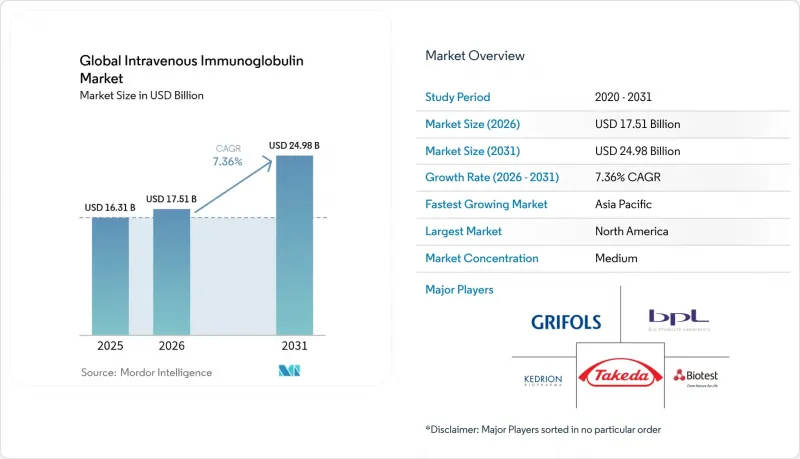
Mordor Intelligence에 의하면, 정맥내 면역글로불린 시장 규모는 2025년 163억 1,000만 달러로 평가되었고, 2026년에는 175억 1,000만 달러로 추정되고, 2026-2031년 CAGR 7.36%로 성장을 지속할 전망이며, 2031년에는 249억 8,000만 달러에 이를 것으로 예측됩니다.
본 보고서에서는 산업을 면역글로불린 등급별(IgG, IgA, IgM, 기타), 용도별(저감마글로불린혈증, 만성 염증성 탈수초성 다발신경염, 원발성 면역결핍증, 기타), 최종 사용자별(병원, 전문 클리닉·신경과 센터, 기타), 지역별(북미, 유럽, 아시아태평양, 기타)로 분류하고 있습니다. 시장 예측은 금액(달러) 기준으로 제시되어 있습니다.
세계의 정맥내 면역글로불린 시장 동향 및 인사이트
고령 인구 증가
노화에 따른 면역 기능 저하로 인해 감염증 및 자가면역 질환 발병 위험이 높아지며, 이것이 정맥내 면역글로불린 시장의 장기적인 수요를 뒷받침하고 있습니다. 아시아태평양에서는 급속한 인구 고령화에 더해 진단 기술의 보급과 보험 적용 범위 확대가 맞물려 그 영향이 가장 두드러지게 나타나고 있습니다. 또한, 이러한 인구 통계학적 동향은 암 치료에 따른 이차성 면역결핍증 증가를 초래하고 있으며, 이는 사용량의 추가적인 증가로 이어지고 있습니다. 일본의 의료 기술 지출 동향은 고령화가 전문 치료 소비를 얼마나 촉진하고 있는지를 여실히 보여주고 있습니다. 이러한 요인들이 복합적으로 작용하여 향후 10년 동안 분획 제조업체들에게 예측 가능한 수요 파이프라인이 형성될 전망입니다.
면역글로불린 요법의 도입 확대
만성 염증성 탈수초성 다발 신경염에 대한 다케다 제약의 ‘GAMMAGARD LIQUID’ 등에 대한 규제 당국의 승인은 면역 조절 작용의 폭넓은 유용성을 입증하며, 임상의들의 수용을 가속화했습니다. 자가면역성 뇌염 및 패혈증에 관한 새로운 데이터가 신뢰성을 뒷받침하고, 일부 고소득 시장에서 보험 환급 요건이 완화됨에 따라 적응증 외 처방이 촉진되고 있습니다. 이러한 근거를 바탕으로 새로운 환자군이 형성되고 투여 기간이 연장됨에 따라, 정맥내 면역글로불린 시장 전체의 소비량이 증가하고 있습니다.
엄격한 규제 승인 및 기증자 선별 기준
엄격한 기증자 적격성 기준과 철저한 검증 절차로 인해 리드타임이 길어지고 간접비가 증가하고 있습니다. 특히 규제 당국의 모니터링이 여전히 엄격한 유럽연합(EU)과 미국에서 이러한 경향이 두드러집니다. 로트 출하 요건 및 바이러스 안전성 기준은 자본 및 문서화 부담을 가중시켜, 정맥내 면역글로불린 시장에 신규 진입하는 기업의 진출 속도를 늦출 가능성이 있습니다.
부문 분석
2025년, IgG는 정맥내 면역글로불린 시장의 74.12%를 차지했으며, 이 부문은 2031년까지 연평균 성장률(CAGR) 8.17%로 성장할 전망입니다. 이는 보충 요법과 면역 조절 요법 모두에서 IgG가 얼마나 필수적인지를 여실히 보여줍니다. 그리폴스(Grifols)의 정제 공정은 일관되게 98% 이상의 IgG 순도를 달성하여 브랜드 차별화를 강화하고 있습니다. 고농도 제제의 등장으로 점적 시간이 단축되어 병원의 일정 관리 부담이 줄어들었을 뿐만 아니라 환자의 편의성도 향상되고 있습니다.
각 제조업체들은 수율 향상과 비용 절감을 목적으로 연속 크로마토그래피를 우선적으로 채택하고 있으며, 이로 인해 정맥내 면역글로불린 시장 전체의 이익률이 더욱 향상되고 있습니다. ‘Yimmugo’나 ‘ALYGLO’와 같은 신규 브랜드에 대한 규제 당국의 승인은 경쟁을 심화시키는 한편, 공급 안정성을 보다 광범위하게 확보하는 결과로 이어지고 있습니다. IgA와 IgM은 점막 질환 및 보체 매개 질환에 초점을 맞춘 틈새 시장 지위를 유지하고 있습니다.
지역별 분석
북미는 오랜 기간에 걸친 보험 적용과 광범위한 혈장 수집 인프라 덕분에 2025년 정맥내 면역글로불린 시장에서 41.92%의 점유율을 유지했습니다. 메디케어 정책이 사용 기준을 정하고 있으며, 민간 보험사들도 이를 대체로 따르고 있어 수요 예측이 가능해졌고, 신제품의 신속한 도입이 촉진되고 있습니다. 전문적인 정맥 주사 네트워크와 성숙해 가는 재택 서비스 덕분에 환자의 편의성과 업무 효율성이 향상되고 있습니다.
아시아태평양은 2031년까지 연평균 성장률(CAGR) 8.03%로 가장 빠르게 성장하고 있습니다. 중국의 ‘국가 약가 상환 목록’에 대한 협상으로 2024년에는 IVIG 가격이 평균 63% 인하되어, 그동안 치료를 받지 못했던 환자층에게도 치료 기회가 확대되었습니다. 일본에서는 의료기술평가(HTA) 재검토를 통해 혁신적인 생물학적 제제에 대한 자금 지원이 유지되고 있는 반면, 인도에서는 생산 연계형 인센티브를 통해 국내 분획 능력이 촉진되고 있습니다. 이 모든 요인이 정맥내 면역글로불린 시장의 기반을 확대되고 있습니다.
유럽에서는 안정적인 성장이 나타나고 있지만, 미국산 혈장 공급에 대한 의존도가 취약성을 부각시키고 있습니다. ESG를 중시하는 자급자족 정책과 집중 조달로 인해, 제조업체에게는 기증자층의 다양화와 투명성 향상이 요구되고 있습니다. 외래에서 점적 투여로 단계적으로 전환하는 것은 입원 비용 절감과 정맥내 면역글로불린 시장 전체의 품질 기준 유지를 목적으로 하고 있습니다.
기타 혜택
- 엑셀 형식 시장 예측(ME) 시트
- 3개월간의 애널리스트 지원
자주 묻는 질문
목차
제1장 서론
제2장 조사 방법
제3장 주요 요약
제4장 시장 구도
제5장 시장 규모 및 성장 예측
제6장 경쟁 구도
제7장 시장 기회 및 향후 전망
AJY 26.09.11According to Mordor Intelligence, the intravenous immunoglobulin market size is expected to grow from USD 16.31 billion in 2025 to USD 17.51 billion in 2026 and is forecast to reach USD 24.98 billion by 2031 at 7.36% CAGR over 2026-2031.

This report Segments the Industry Into by Type (IgG, Iga, Igm, and Others), by Application (Hypogammaglobulinemia, Chronic Inflammatory Demyelinating Polyneuropathy, Primary Immunodeficiency, and More), End User (Hospitals, Specialty Clinics & Neurology Centers, and More), and Geography (North America, Europe, Asia-Pacific, and More). The Market Forecasts are Provided in Terms of Value (USD).
Global Intravenous Immunoglobulin Market Trends and Insights
Rise in Geriatric Population
Age-related immune decline increases susceptibility to infections and autoimmune disorders, which sustains long-term demand within the intravenous immunoglobulin market. Asia-Pacific feels the effect most, as rapid population ageing aligns with broader diagnostic reach and insurance coverage. The demographic trend also amplifies secondary immunodeficiencies linked with cancer therapies, further lifting usage. Japan's medical technology spending trajectory underscores how ageing catalyzes specialty-therapy consumption. Together these factors form a predictable volume pipeline for fractionators over the next decade.
Increased Adoption of Immunoglobulin Therapy
Regulatory approvals such as Takeda's GAMMAGARD LIQUID for chronic inflammatory demyelinating polyneuropathy have validated broader immunomodulatory utility and accelerated clinician acceptance. Emerging data in autoimmune encephalitis and sepsis reinforce confidence, encouraging off-label prescribing as reimbursement loosens in several high-income markets. The evidence base unlocks new patient pools and extends dosing durations, thereby raising overall consumption inside the intravenous immunoglobulin market.
Stringent Regulatory Approval & Donor-Screening Norms
Tight donor eligibility rules and exhaustive validation steps lengthen lead times and add overhead, especially in the European Union and United States, where regulatory scrutiny remains intense. Batch-release requirements and viral safety benchmarks impose capital and documentation burdens that may decelerate new-entrant progress inside the intravenous immunoglobulin market.
Other drivers and restraints analyzed in the detailed report include:
- Rising Prevalence of Immunodeficiency & Bleeding Disorders
- Advancements in Plasma-Fractionation Technology
- High Therapy & Cold-Chain Costs
For complete list of drivers and restraints, kindly check the Table Of Contents.
Segment Analysis
IgG commanded 74.12% of the intravenous immunoglobulin market in 2025, and the segment is growing at an 8.17% CAGR to 2031, which underlines how indispensable IgG remains for both replacement and immunomodulation. Grifols' purification process consistently delivers >=98% IgG purity, strengthening brand differentiation. High-strength formulations now shorten infusion time, easing hospital scheduling pressures and improving patient comfort.
Manufacturers have prioritized continuous chromatography to boost yield and lower cost, which further bolsters margins across the intravenous immunoglobulin market. Regulatory clearances for new brands such as Yimmugo and ALYGLO increase competitive dynamics yet simultaneously assure broader supply security. IgA and IgM retain niche status focused on mucosal and complement-mediated disorders.
Complete Report Scope:
- By Immunoglobulin Class
- IgG
- IgA
- IgM
- Others
- By Application
- Hypogammaglobulinemia
- Chronic Inflammatory Demyelinating Polyneuropathy (CIDP)
- Primary Immunodeficiency Diseases (PID)
- Myasthenia Gravis
- Multifocal Motor Neuropathy
- Other Applications
- By End User
- Hospitals
- Specialty Clinics & Neurology Centers
- Home-Care Settings
- Geography
- North America
- United States
- Canada
- Mexico
- Europe
- Germany
- United Kingdom
- France
- Italy
- Spain
- Rest of Europe
- Asia-pacific
- China
- Japan
- India
- Australia
- South Korea
- Rest of Asia-pacific
- Middle East and Africa
- GCC
- South Africa
- Rest of Middle East and Africa
- South America
- Brazil
- Argentina
- Rest of South America
- North America
Geography Analysis
North America kept 41.92% of the intravenous immunoglobulin market in 2025 due to long-standing insurer coverage and extensive plasma collection infrastructure. Medicare policies outline usage criteria that commercial payers largely mirror, facilitating predictable demand and rapid adoption of new formulations. Specialized infusion networks and maturing home-based services advance patient convenience and operational efficiency.
Asia-Pacific is growing fastest at an 8.03% CAGR through 2031. China's National Reimbursement Drug List negotiations produced average IVIG price reductions of 63% in 2024, opening therapy to previously unreachable cohorts. Japan's revised health technology assessments uphold funding for innovative biologics, while India's production-linked incentives stimulate local fractionation capacity, all of which enlarge the intravenous immunoglobulin market base.
Europe shows stable progression, yet supply dependence on United States plasma highlights vulnerability. ESG-driven self-sufficiency policies and centralized procurement place pressure on manufacturers to diversify donor pools and enhance transparency. Gradual shifts toward outpatient infusions aim to reduce hospitalization costs and maintain quality benchmarks across the intravenous immunoglobulin market.
- Takeda Pharmaceutical Co.
- CSL Behring
- Grifols
- Octapharma
- Baxter
- Kedrion Biopharma
- Biotest
- Bio Products Laboratory
- LFB Group
- China Biologic Products Holdings
- Shanghai RAAS Blood Products
- Hualan Biological Engineering
- ADMA Biologics
- Emergent Bio Solutions
- Kamada Ltd
- GC Biopharma
- Intas Pharmaceuticals (Lonza Tie-up)
- BioTest Pharma (US)
- South African National Blood Service
- Sanquin Plasma Products
Additional Benefits:
- The market estimate (ME) sheet in Excel format
- 3 months of analyst support
TABLE OF CONTENTS
1 Introduction
- 1.1 Study Assumptions & Market Definition
- 1.2 Scope of the Study
2 Research Methodology
3 Executive Summary
4 Market Landscape
- 4.1 Market Overview
- 4.2 Market Drivers
- 4.2.1 Rise in Geriatric Population
- 4.2.2 Increased Adoption of Immunoglobulin Therapy
- 4.2.3 Rising Prevalence of Immunodeficiency & Bleeding Disorders
- 4.2.4 Advancements in Plasma-fractionation Technology
- 4.2.5 Off-label Neuro-logical Use & Relaxed Reimbursement in Asia
- 4.2.6 Regional Plasma-collection Hubs Driving Supply Security
- 4.3 Market Restraints
- 4.3.1 Stringent Regulatory Approval & Donor-screening Norms
- 4.3.2 High Therapy & Cold-chain Costs
- 4.3.3 Shift toward Subcutaneous Ig (SCIG) Reducing IVIG Volumes
- 4.3.4 ESG Scrutiny of Plasma Sourcing Raising Compliance Costs
- 4.4 Value / Supply-Chain Analysis
- 4.5 Regulatory Landscape
- 4.6 Technological Outlook
- 4.7 Porter's Five Forces Analysis
- 4.7.1 Threat of New Entrants
- 4.7.2 Bargaining Power of Buyers
- 4.7.3 Bargaining Power of Suppliers
- 4.7.4 Threat of Substitutes
- 4.7.5 Competitive Rivalry
5 Market Size & Growth Forecasts (Value - USD)
- 5.1 By Immunoglobulin Class
- 5.1.1 IgG
- 5.1.2 IgA
- 5.1.3 IgM
- 5.1.4 Others
- 5.2 By Application
- 5.2.1 Hypogammaglobulinemia
- 5.2.2 Chronic Inflammatory Demyelinating Polyneuropathy (CIDP)
- 5.2.3 Primary Immunodeficiency Diseases (PID)
- 5.2.4 Myasthenia Gravis
- 5.2.5 Multifocal Motor Neuropathy
- 5.2.6 Other Applications
- 5.3 By End User
- 5.3.1 Hospitals
- 5.3.2 Specialty Clinics & Neurology Centers
- 5.3.3 Home-Care Settings
- 5.4 Geography
- 5.4.1 North America
- 5.4.1.1 United States
- 5.4.1.2 Canada
- 5.4.1.3 Mexico
- 5.4.2 Europe
- 5.4.2.1 Germany
- 5.4.2.2 United Kingdom
- 5.4.2.3 France
- 5.4.2.4 Italy
- 5.4.2.5 Spain
- 5.4.2.6 Rest of Europe
- 5.4.3 Asia-pacific
- 5.4.3.1 China
- 5.4.3.2 Japan
- 5.4.3.3 India
- 5.4.3.4 Australia
- 5.4.3.5 South Korea
- 5.4.3.6 Rest of Asia-pacific
- 5.4.4 Middle East and Africa
- 5.4.4.1 GCC
- 5.4.4.2 South Africa
- 5.4.4.3 Rest of Middle East and Africa
- 5.4.5 South America
- 5.4.5.1 Brazil
- 5.4.5.2 Argentina
- 5.4.5.3 Rest of South America
- 5.4.1 North America
6 Competitive Landscape
- 6.1 Market Concentration
- 6.2 Market Share Analysis
- 6.3 Company Profiles
- 6.3.1 Takeda Pharmaceutical Co.
- 6.3.2 CSL Behring
- 6.3.3 Grifols SA
- 6.3.4 Octapharma AG
- 6.3.5 Baxter International Inc.
- 6.3.6 Kedrion SpA
- 6.3.7 Biotest AG
- 6.3.8 Bio Products Laboratory Ltd
- 6.3.9 LFB Group
- 6.3.10 China Biologic Products Holdings
- 6.3.11 Shanghai RAAS Blood Products
- 6.3.12 Hualan Biological Engineering
- 6.3.13 ADMA Biologics Inc.
- 6.3.14 Emergent BioSolutions Inc.
- 6.3.15 Kamada Ltd
- 6.3.16 GC Pharma
- 6.3.17 Intas Pharmaceuticals (Lonza Tie-up)
- 6.3.18 BioTest Pharma (US)
- 6.3.19 South African National Blood Service
- 6.3.20 Sanquin Plasma Products