|
시장보고서
상품코드
2123615
백혈구 성분채집 시장 : 시장 점유율 분석, 업계 동향 및 통계, 성장 예측(2026-2031년)Leukapheresis - Market Share Analysis, Industry Trends & Statistics, Growth Forecasts (2026 - 2031) |
||||||
 Mordor Intelligence
Mordor Intelligence에 의하면, 백혈구 성분채집 시장 규모는 2025년에 2억 2,981만 달러로 평가되었고, 2026년 2억 5,192만 달러에서 2031년까지 3억 9,863만 달러에 이를 것으로 예측되며, 예측 기간(2026-2031년) CAGR은 9.62%를 나타낼 전망입니다.
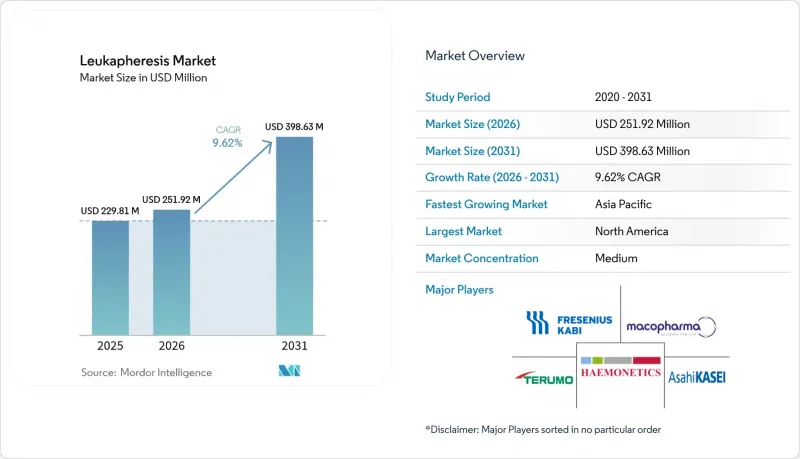
본 보고서는 제품 유형별(백혈구 성분채집(아페레시스 장치 등) 및 백혈구 성분채집용 일회용 제품), 용도별(치료용 및 연구용), 최종 사용자별(혈액센터·헌혈 클리닉, 병원·이식센터, 기타), 지역별(북미, 유럽, 아시아태평양, 기타)로 세분화되어 있습니다. 시장 예측은 금액(달러) 기준으로 제시되어 있습니다.
세계의 백혈구 성분채집 시장 동향 및 인사이트
백혈병 및 관련 고백혈구증 발생률 증가
급성 골수성 백혈병의 발생률 곡선은 계속 상승하고 있으며, 전 세계 환자 수는 1990년 7만 9,372건에서 2021년 14만 4,645건으로 증가했으며, 2040년까지 18만 4,287건에 달할 것으로 전망됩니다. 백혈구 수가 10만/µL을 초과하는 상태로 정의되는 백혈구 증가증은 호흡 곤란 및 신경학적 합병증을 예방하기 위해 긴급한 백혈구 감소 요법이 필요합니다. 이에 따라 백혈구 성분채집은 선택적 치료에서 표준 응급 처치로 전환되었습니다. 남성 환자의 발생률은 여성보다 급격히 증가하고 있으며, 80-84세 성인의 사례 밀도가 가장 높습니다. 현재 의료 시스템의 프로토콜에 따라 조건을 충족하는 백혈병 환자는 자동으로 혈구 분리 유닛으로 배정되며, 당일 시술이 보장될 뿐만 아니라 백혈구 성분채집 시장에서 3차 의료기관 전체의 시술 건수가 안정적으로 정착되어 있습니다.
고수율·연구용 등급 백혈구 팩에 대한 수요 증가
CAR-T 및 자연살해(NK) 세포 제조업체들로부터 1회 채취당 100억 개 이상의 단핵세포를 제공하는 백혈구 팩에 대한 지정이 점점 더 늘어나고 있습니다. 제조 실패율은 원료의 품질과 직접적인 상관관계가 있으며, 품질에 문제가 있는 백혈구 팩은 30만 달러 규모의 제조 로트를 무효화시킬 가능성이 있습니다. 현재 500건 이상의 진행 중인 임상시험이 기증자 유래 면역 세포에 의존하고 있으며, 동종 “오프 더 쉘프(off-the-shelf)” 치료법으로의 전환에 따라 지속적인 수요가 증가하고 있습니다. 자동화된 연속 유동 원심 분리를 통해 백혈구 농도의 허용 범위를 엄격하게 확보하고 적혈구 혼입을 줄임으로써, 다운스트림 공정의 농축 과정을 효율화합니다. AI 스케줄링 소프트웨어가 지원하는 표준화된 기증자 선별 알고리즘을 통해 시설별 처리 능력이 향상되어, 공급업체는 직원에게 과도한 부담을 주지 않고도 증가하는 백혈구 팩 주문에 대응할 수 있게 됩니다.
치료용 백혈구 성분채집에 수반되는 높은 비용
단회 투여 CAR-T 요법의 환자 부담금은 일반적으로 50만 달러를 초과하며, 복잡한 소아 환자의 경우 100만 달러에 달하기도 하는데, 그 초기 비용의 상당 부분을 백혈구 성분채집이 차지하고 있습니다. 독립적인 민간 채취 센터는 병원 내 시설에 비해 32% 저렴한 비용으로 운영되고 있지만, 저·중소득 지역의 대부분에는 그러한 시설이 부족합니다. 장비의 감가상각비, 일회용 키트, 의무화된 멸균 감사가 기본 비용을 끌어올리고 있습니다. 메디케어의 2025년 규정에 따라 환급 대상의 정의는 확대되었지만, 많은 공적 의료 제도에서는 여전히 급여 공백이 남아 있습니다(aabb.org). 지급 기관들이 포괄 지급 모델에 대해 입장을 조율할 때까지는 가격에 민감한 지역에서는 고액의 시술 비용이 수요를 억제할 것으로 예측됩니다.
부문 분석
백혈구 성분채집 시장은 각 시설이 광학 감지 센서가 장착된 연속 유동식 플랫폼으로 교체를 진행함에 따라 2026-2031년 연평균 성장률(CAGR) 10.37%로 확대되고 있습니다. 2025년 백혈구 성분채집 시장 규모는 1억 1,334만 달러에 달할 것으로 예상되며, 예측 기간 동안 일회용 제품 시장의 성장률을 상회할 전망입니다. Spectra Optia의 알고리즘 탑재 인터페이스와 FDA 승인을 받은 ‘Rika Plasma Donation System V2.1’은 기기 차원의 혁신을 상징합니다. 현재 제품 파이프라인에는 혈액내과 병동 및 응급실에서 포인트 오브 케어(Point-of-Care) 방식으로 백혈구를 제거하기 위한 휴대용 병상용 장치가 포함되어 있습니다.
일회용 제품은 단일 사용에 따른 안전성 프로파일과 지속적인 수익 모델 덕분에 2025년 백혈구 성분채집 시장에서 50.68%의 점유율을 유지했습니다. 검사 건수 증가로 키트 판매가 안정화되어 제조업체의 현금 흐름이 강화되는 한편, 프라이밍 시간을 단축하는 통합 튜브 세트에 대한 투자가 촉진되고 있습니다. 백혈구 제거 필터는 여전히 성숙한 틈새 시장이지만, 많은 혈액은행의 프로토콜에서 여전히 보편적인 백혈구 제거를 의무화하고 있어 수요는 지속되고 있습니다. 컬럼과 세포 분리기는 특수한 병원체 저감 워크플로우를 지원하지만, 그 보급은 학술 기관에 집중되어 있습니다. 전반적으로, 일회용 제품을 자본 설비 임대와 세트로 판매함으로써 고객 충성도를 확보하고, 백혈구 성분채집 시장에서 이 부문의 선도적 입지를 공고히 하고 있습니다.
지역별 분석
2025년, 북미는 45.20%의 점유율로 백혈구 성분채집 시장을 주도했습니다. 미국의 주도적 위상은 FDA 규제의 명확성과 2024년 아파미트레젠 오토로이셀 및 오베카부타젠 오토로이셀의 승인을 포함하여 타의 추종을 불허하는 CAR-T 치료제 승인 건수에 기인합니다. 2025년 메디케어(Medicare)의 치료용 아페레시스 보상 범위 확대는 경제적 실행 가능성을 더욱 강화하고 있습니다. 캐나다와 멕시코는 국경을 넘는 임상 검사 네트워크와 기증자 물류 효율화를 위한 공동 제조 이니셔티브를 통해 기여하고 있습니다. 테르모 BCT나 헤모네틱스와 같은 의료기기 제조업체들이 이 지역에 집중되어 있어 기술 도입 주기가 가속화되고, 백혈구 성분채집 시장에서 북미의 우위가 유지되고 있습니다.
유럽은 성숙해 가고 있지만 여전히 역동적인 시장을 유지하고 있습니다. EMA(유럽의약품청)의 지침은 CAR-T 제품에 대한 일관된 평가 절차를 제공하며, 고성능 백혈구 성분채집 시스템에 대한 꾸준한 수요를 촉진하고 있습니다. 유럽 혈액 연합(European Blood Alliance)은 200만 명의 추가 자발적 기증자 확보를 추진하고 있으며, 혈소판 수율과 기증자의 편의성을 극대화하는 연속 유동식 플랫폼의 도입을 각 시설에 장려하고 있습니다. 독일, 프랑스, 영국에서는 국가 암 대책 계획과 연계된 통합형 아페레시스 시설에 대한 투자가 진행되고 있는 반면, 이탈리아와 스페인에서는 지역별 세포 치료 거점 확충이 추진되고 있습니다. 공급망의 회복력, 특히 콜드체인 운송의 탄력성은 투자 우선 과제로 대두되고 있으며, 이를 통해 시술 처리 능력을 안정화하고 있습니다.
아시아태평양은 2031년까지 연평균 성장률(CAGR) 11.02%로 가장 빠른 성장세를 기록할 전망입니다. 일본에서는 고령자 의료 서비스가 프리미엄 장비의 보급을 주도하고 있는 반면, 인도에서는 하이데라바드와 벵갈루루에 정부 지원 세포 치료 클러스터가 조성되어 그 혜택을 누리고 있습니다. 호주와 한국의 규제 당국은 FDA의 RMAT 지정에 준하는 신속 심사 절차를 도입하여 조기 상용화를 촉진하고 있습니다. 전반적으로, 인프라 현대화와 현지 생산에 대한 우대 조치가 맞물리면서 아시아는 백혈구 성분채집 시장에서 기술 수입처에서 완전히 통합된 공급망 허브로 전환되고 있습니다.
기타 혜택
- 엑셀 형식 시장 예측(ME) 시트
- 3개월간의 애널리스트 지원
자주 묻는 질문
목차
제1장 서론
제2장 조사 방법
제3장 주요 요약
제4장 시장 구도
제5장 시장 규모 및 성장 예측
제6장 경쟁 구도
제7장 시장 기회 및 향후 전망
AJY 26.09.11According to Mordor Intelligence, the leukapheresis market size was valued at USD 229.81 million in 2025 and estimated to grow from USD 251.92 million in 2026 to reach USD 398.63 million by 2031, at a CAGR of 9.62% during the forecast period (2026-2031).
This report is Segmented by Product Type (Leukapheresis Devices [Apheresis Devices, and More], and Leukapheresis Disposables), Application (Therapeutic Applications and Research Applications), End User (Blood Centers & Donor Clinics, Hospitals & Transplant Centers, and More), and Geography (North America, Europe, Asia-Pacific, and More). The Market Forecasts are Provided in Terms of Value (USD).
Global Leukapheresis Market Trends and Insights
Rising Incidence of Leukemia and Associated Hyperleukocytosis
Incidence curves for acute myeloid leukemia continue to climb, with global cases moving from 79,372 in 1990 to 144,645 in 2021 and trending toward 184,287 by 2040. Hyperleukocytosis, defined as white-blood-cell counts above 100,000/µl, demands urgent cytoreduction to prevent respiratory distress and neurologic complications. Leukapheresis has therefore transitioned from elective therapy to standard emergency intervention. Male patients register steeper growth in incidence than females, while adults aged 80-84 exhibit the highest case density. Health-system protocols now automatically route eligible leukemia admissions to apheresis units, ensuring same-day access and cementing procedure volumes across tertiary centers in the leukapheresis market.
Growing Need for High-Yield, Research-Grade Leukopaks
CAR-T and natural-killer-cell manufacturers increasingly specify leukopaks that deliver 10 billion or more mononuclear cells per collection. Manufacturing failure rates correlate directly with starting-material quality; a compromised leukopak can invalidate a USD 300,000 manufacturing run. Over 500 active clinical trials now depend on donor-derived immune cells, and the pivot toward allogeneic "off-the-shelf" therapies elevates recurring demand. Automated continuous-flow centrifugation secures tight leukocyte concentration windows and reduces red-cell contamination, streamlining downstream enrichment. Standardized donor-screening algorithms supported by AI scheduling software raise per-center capacity, enabling suppliers to meet escalating leukopaks requisitions without overtaxing staff.
High Costs Associated with Therapeutic Leukapheresis Procedures
Patient invoices for single-dose CAR-T therapies routinely exceed USD 500,000 and reach USD 1 million in complex pediatric cases, with leukapheresis comprising a meaningful early share. Stand-alone private collection centers operate 32% cheaper than hospital-based settings, yet most low- and middle-income regions lack such facilities. Equipment depreciation, single-use kits, and mandatory sterility audits inflate baseline costs. Although Medicare's 2025 rule broadened reimbursement definitions, coverage gaps linger in many public systems aabb.org. Until payors harmonize around bundled-payment models, high procedural outlay will temper demand in price-sensitive geographies.
Other drivers and restraints analyzed in the detailed report include:
- Rapid Expansion of CAR-T and Other Cell & Gene-Therapy Manufacturing Facilities
- Widespread Uptake of Continuous-Flow Apheresis Systems
- Shortage of Skilled Apheresis Professionals
For complete list of drivers and restraints, kindly check the Table Of Contents.
Segment Analysis
Leukapheresis devices are expanding at a 10.37% CAGR from 2026-2031 as centers upgrade to continuous-flow platforms with optical-detection sensors. The leukapheresis market size for devices equaled USD 113.34 million in 2025 and is positioned to outpace disposables growth through the forecast. Spectra Optia's algorithmic interface and the FDA-cleared Rika Plasma Donation System V2.1 exemplify device-level innovation. Product pipelines now include portable bedside units that target point-of-care leukoreduction in hematology wards and emergency departments.
Disposables retained 50.68% of leukapheresis market share in 2025 due to their single-use safety profile and recurring-revenue model. Elevated procedure volumes ensure consistent kit sales, reinforcing manufacturer cash flows and incentivizing investment in integrated tubing sets that cut priming times. Leukoreduction filters remain a mature niche, yet demand persists because many blood-bank protocols still enforce universal leukocyte reduction. Columns and cell separators support specialized pathogen-reduction workflows, though their penetration concentrates in academic centers. Overall, packaging disposables with capital-equipment leases locks in account loyalty, anchoring the segment's leadership within the leukapheresis market.
Complete Report Scope:
- By Product Type
- Leukapheresis Devices
- Apheresis Devices
- Leukapheresis Columns & Cell Separators
- Leukoreduction Filters
- Leukapheresis Disposables
- Leukapheresis Devices
- By Application
- Therapeutic Applications
- Research Applications
- By End User
- Blood Centers & Donor Clinics
- Hospitals & Transplant Centers
- Academic & Research Institutes
- Cell- & Gene-Therapy Manufacturers
- By Geography
- North America
- United States
- Canada
- Mexico
- Europe
- Germany
- United Kingdom
- France
- Italy
- Spain
- Rest of Europe
- Asia-Pacific
- China
- Japan
- India
- Australia
- South Korea
- Rest of Asia-Pacific
- Middle East & Africa
- GCC
- South Africa
- Rest of Middle East & Africa
- South America
- Brazil
- Argentina
- Rest of South America
- North America
Geography Analysis
North America led the leukapheresis market with a 45.20% share in 2025. U.S. leadership stems from FDA regulatory clarity and unmatched CAR-T approval volume, including the 2024 clearances of afamitresgene autoleucel and obecabtagene autoleucel. Medicare's 2025 reimbursement expansion for therapeutic apheresis further bolsters financial viability. Canada and Mexico contribute through cross-border clinical-trial networks and joint manufacturing initiatives that streamline donor logistics. Concentration of device makers such as Terumo BCT and Haemonetics within the region speeds tech adoption cycles, sustaining North America's prime position in the leukapheresis market.
Europe remains a mature yet dynamic arena. EMA guidelines deliver consistent evaluation pathways for CAR-T products, fostering steady demand for high-performance leukapheresis systems. The European Blood Alliance campaigns for two million additional voluntary donors, incentivizing centers to adopt continuous-flow platforms that maximize platelet yield and donor comfort. Germany, France, and the United Kingdom invest in integrated apheresis suites tied to national cancer plans, while Italy and Spain expand regional cell-therapy nodes. Supply-chain resilience, particularly in cold-chain trucking, dominates investment agendas and stabilizes procedure throughput.
Asia Pacific posts the fastest growth at an 11.02% CAGR to 2031. Japan's advanced geriatric care drives premium device uptake, whereas India benefits from government-backed cell-therapy clusters in Hyderabad and Bengaluru. Regulatory authorities in Australia and South Korea introduce accelerated review pathways mirroring FDA's RMAT designation, catalyzing early commercial rollouts. Overall, infrastructure modernization, coupled with local manufacturing incentives, transitions Asia from technology import destination to fully integrated supply-chain hub in the leukapheresis market.
- Terumo Blood & Cell Technologies
- Fresenius
- Haemonetics
- Asahi Kasei
- B. Braun
- MacoPharma
- Baxter
- Stem Cell Technologies
- BioIVT
- StemExpress
- HemaCare Corporation
- Grifols BioSupplies
- Charles River
- Lonza Group
- Medica S.p.A.
- Infomed
- Therakos (Mallinckrodt)
- Kawasumi Laboratories
- Cerus
- Teratec Japan
Additional Benefits:
- The market estimate (ME) sheet in Excel format
- 3 months of analyst support
TABLE OF CONTENTS
1 Introduction
- 1.1 Study Assumptions & Market Definition
- 1.2 Scope of the Study
2 Research Methodology
3 Executive Summary
4 Market Landscape
- 4.1 Market Overview
- 4.2 Market Drivers
- 4.2.1 Rising Incidence of Leukemia and Associated Hyperleukocytosis
- 4.2.2 Growing Need for High-Yield, Research-Grade Leukopaks
- 4.2.3 Rapid Expansion of Car-T And Other Cell & Gene Therapy Manufacturing Facilities
- 4.2.4 Widespread Uptake of Continuous-Flow Apheresis Systems
- 4.2.5 Shift Toward Point-of-Care Leukoreduction at the Bedside
- 4.2.6 AI-Driven Donor Management and Scheduling Tools
- 4.3 Market Restraints
- 4.3.1 High Costs Associated with Therapeutic Leukapheresis Procedures
- 4.3.2 Regulatory Complexity in Donor Recruitment and Cross-Border Biologics Movement
- 4.3.3 Shortage of Skilled Apheresis Professionals
- 4.3.4 Viability Loss of Harvested Cells During Long-Distance Cold-Chain Transport
- 4.4 Porter's Five Forces Analysis
- 4.4.1 Threat of New Entrants
- 4.4.2 Bargaining Power of Buyers
- 4.4.3 Bargaining Power of Suppliers
- 4.4.4 Threat of Substitute Products
- 4.4.5 Intensity of Competitive Rivalry
5 Market Size & Growth Forecasts (Value in USD)
- 5.1 By Product Type
- 5.1.1 Leukapheresis Devices
- 5.1.1.1 Apheresis Devices
- 5.1.1.2 Leukapheresis Columns & Cell Separators
- 5.1.1.3 Leukoreduction Filters
- 5.1.2 Leukapheresis Disposables
- 5.1.1 Leukapheresis Devices
- 5.2 By Application
- 5.2.1 Therapeutic Applications
- 5.2.2 Research Applications
- 5.3 By End User
- 5.3.1 Blood Centers & Donor Clinics
- 5.3.2 Hospitals & Transplant Centers
- 5.3.3 Academic & Research Institutes
- 5.3.4 Cell- & Gene-Therapy Manufacturers
- 5.4 By Geography
- 5.4.1 North America
- 5.4.1.1 United States
- 5.4.1.2 Canada
- 5.4.1.3 Mexico
- 5.4.2 Europe
- 5.4.2.1 Germany
- 5.4.2.2 United Kingdom
- 5.4.2.3 France
- 5.4.2.4 Italy
- 5.4.2.5 Spain
- 5.4.2.6 Rest of Europe
- 5.4.3 Asia-Pacific
- 5.4.3.1 China
- 5.4.3.2 Japan
- 5.4.3.3 India
- 5.4.3.4 Australia
- 5.4.3.5 South Korea
- 5.4.3.6 Rest of Asia-Pacific
- 5.4.4 Middle East & Africa
- 5.4.4.1 GCC
- 5.4.4.2 South Africa
- 5.4.4.3 Rest of Middle East & Africa
- 5.4.5 South America
- 5.4.5.1 Brazil
- 5.4.5.2 Argentina
- 5.4.5.3 Rest of South America
- 5.4.1 North America
6 Competitive Landscape
- 6.1 Market Concentration
- 6.2 Market Share Analysis
- 6.3 Company Profiles (includes Global level Overview, Market level overview, Core Segments, Financials as available, Strategic Information, Market Rank/Share for key companies, Products & Services, and Recent Developments)
- 6.3.1 Terumo Blood & Cell Technologies
- 6.3.2 Fresenius SE & Co. KGaA
- 6.3.3 Haemonetics Corporation
- 6.3.4 Asahi Kasei Medical Co. Ltd
- 6.3.5 B. Braun Melsungen AG
- 6.3.6 Macopharma
- 6.3.7 Baxter International
- 6.3.8 STEMCELL Technologies
- 6.3.9 BioIVT
- 6.3.10 StemExpress
- 6.3.11 HemaCare Corporation
- 6.3.12 Grifols BioSupplies
- 6.3.13 Charles River Laboratories
- 6.3.14 Lonza Group
- 6.3.15 Medica S.p.A.
- 6.3.16 Infomed SA
- 6.3.17 Therakos (Mallinckrodt)
- 6.3.18 Kawasumi Laboratories
- 6.3.19 Cerus Corporation
- 6.3.20 Teratec Japan
7 Market Opportunities & Future Outlook
- 7.1 White-space & Unmet-need Assessment