|
시장보고서
상품코드
2123627
수술 장비 시장 : 점유율 분석, 업계 동향과 통계, 성장 예측(2026-2031년)Surgical Equipment - Market Share Analysis, Industry Trends & Statistics, Growth Forecasts (2026 - 2031) |
||||||
 Mordor Intelligence
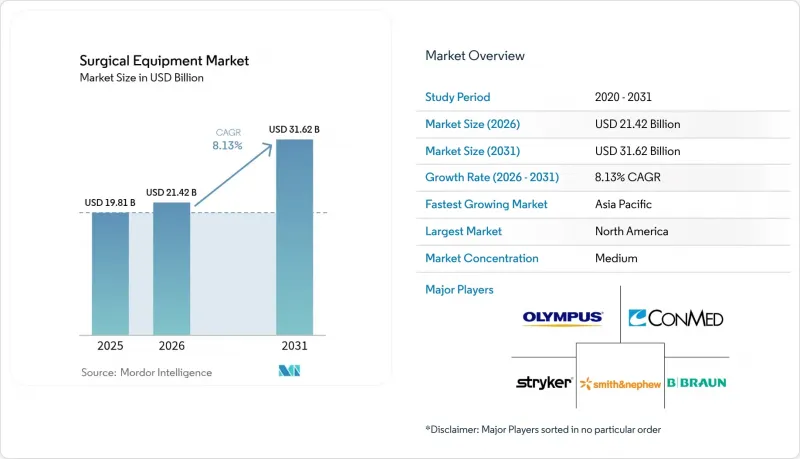
Mordor Intelligence에 의하면, 수술 장비 시장 규모는 2025년 198억 1,000만 달러에서 2026년에는 214억 2,000만 달러로 확대되어 2026년부터 2031년까지 CAGR 8.13%로 성장을 지속하여, 2031년에는 316억 2,000만 달러에 이를 것으로 예측됩니다.
본 보고서는 제품별(휴대용 수술 기구, 전동·전기 수술 장비, 봉합사 등), 용도별(정형외과·외상, 심혈관·흉부외과 등), 최종 사용자별(병원, 외래수술센터(ASC) 등),지역별(북미, 유럽, 아시아태평양, 중동 및 아프리카, 남미)로 분류되어 있습니다. 시장 예측은 금액(달러) 기준으로 제시되어 있습니다.
세계 수술 장비 시장 동향 및 인사이트
고령화와 만성 질환 유병률 증가가 수술 건수 증가를 주도
수술 건수는 꾸준히 증가하고 있으며, 연간 약 2억 3,500만 건의 대수술이 시행되고 있습니다. 세계 인구의 고령화와 만성 질환 부담 증가에 따라 정형외과, 순환기, 종양 외과 수술이 증가분의 대부분을 차지하고 있습니다. 각 제조업체는 범용성이 높은 광범위한 세트를 제공하는 대신, 수술 건수가 많은 전문 분야에 맞춘 기구를 개발함으로써 이에 대응하고 있으며, 이를 통해 처리 능력 향상과 폐기물 감축을 도모하고 있습니다. 정형외과 수술은 연평균 7.2%의 속도로 증가하고 있으며, 이는 전동 톱, 드릴, 내비게이션 지원 장치에 대한 수요를 뒷받침하고 있습니다. 심혈관 중재술은 연평균 5.8%의 속도로 확대되고 있으며, 영상 진단 기능과 최소 침습 수술 기능을 결합한 하이브리드 수술실에 대한 투자를 촉진하고 있습니다. 그 결과, 매일 빈번하게 사용해도 견딜 수 있는 신뢰성이 높은 수술 유형별 전용 시스템에 대한 수요가 지속되고 있습니다.
교통사고 및 기타 사고 증가
교통사고나 직장에서의 외상으로 인해 응급 상황에서 신속한 처치가 가능한 골절 고정 기구, 휴대용 영상 진단 장치 및 내비게이션 시스템에 대한 수요가 계속 증가하고 있습니다. 기존의 플레이트와 나사 외에도, 외상 외과 의사들은 현재 나사 삽입을 실시간으로 안내하고, 수술 시간을 단축하며, 재수술을 최소화할 수 있는 통합 플랫폼을 원하고 있습니다. 병원들이 중증 환자 대응 센터를 확충하고 외상 대응 키트를 상비함에 따라, 의료기기 제조업체들은 정형외과 분야 내에서 외상 전용 부문을 개척하고 있으며, 그 성장률은 일반 정형수술 장비를 상회하고 있습니다.
첨단 수술 시스템의 고액 초기 투자 및 유지 관리 비용
최고급 로봇 플랫폼의 가격은 200만 달러를 초과하기도 하며, 연간 유지보수 계약비가 추가로 10-15% 가산됩니다. 소규모 병원이나 외래수술센터(ASC)에서는 구매를 미루거나, 이용 상황에 따라 비용이 발생하는 종량제 모델을 요구하는 경우가 많습니다. 리스, 이익 분배, 리스크 풀 계약을 통해 진입 장벽은 점차 완화되고 있지만, 자본 집약적인 시스템은 여전히 대규모 대학 부속 병원에 집중되어 있습니다.
부문 분석
2025년 현재, 봉합사, 스테이플러 및 기타 봉합 기기는 수술 장비 시장 점유율의 37.86%를 차지하고 있으며, 모든 전문 분야에서 필수적인 역할을 하고 있음이 부각되고 있습니다. 결찰 작업이 필요 없는 바브가 달린 봉합사는 제왕절개 봉합 시간을 평균 1분 43초 단축하여 워크플로우에서 그 가치를 입증하고 있습니다. 존슨앤드존슨의 ‘ECHELON ENDOPATH 스테이플 라인 보강재’는 생체 재료의 발전이 조직을 보호하고 누출을 어떻게 줄일 수 있는지를 보여줍니다.
전동 및 전기 수술 시스템은 2031년까지 연평균 성장률(CAGR) 8.45%로 확대될 것으로 예측됩니다. 메드트로닉(Medtronic)사의 ‘LigaSure Maryland jaw blend’와 같은 기구는 절단과 혈관 봉합을 동시에 수행하여 수술 절차를 단축하고 부수적인 손상을 줄여줍니다. 리트랙터, 핸드헬드 집게, 수술 전동 기구는 여전히 필수적인 기본 기구이지만, 에너지, 영상 진단, 연기 흡입 기능을 통합한 콘솔이 새로운 영역으로 부상하며 무균 영역의 효율성을 높이고 있습니다. 외래 진료 센터가 공간 효율성을 높이기 위해 다기능 타워를 도입함에 따라, 전동식 의료기기 시장 규모는 더욱 성장세를 보일 것으로 전망됩니다.
지역별 분석
북미는 유리한 환급 제도와 로봇·AI 탑재 시스템의 조기 도입에 힘입어 2025년 매출의 35.12%를 차지했습니다. 병원은 비용 압박에 시달리고 있지만, ASC(외래수술센터)는 보험사의 인센티브와 환자들의 당일 수술 선호도를 반영하여 호황을 누리고 있습니다. 설비 현대화에 따른 지연이 지속되면서 장비의 평균 수명이 연장되고 있으며, 의료 서비스 제공업체들은 서비스 계약이나 렌탈 모델로 전환하고 있습니다. 그럼에도 불구하고, 미국 및 캐나다의 의료시설은 차세대 로봇 수술 및 디지털 수술실의 실증 무대로 계속 자리 잡고 있습니다.
유럽은 견고한 공공 의료 제도를 기반으로 한 폭넓은 시장 상황을 보이고 있습니다. 독일, 프랑스, 영국이 최소 침습 플랫폼 도입을 주도하고 있습니다. 새로운 의료기기 규제로 인해 시판 후 감시가 강화되면서 규정 준수 비용은 상승하고 있지만, 환자 안전성은 향상되고 있습니다. 기존 인프라를 쇄신하고 있는 남유럽 및 동유럽 시장은 중가대의 범용성이 높은 기기가 지지를 얻으며, 추격 성장을 이끄는 거점이 되고 있습니다.
아시아태평양은 가장 성장세가 두드러지는 지역으로, 2031년까지 연평균 성장률(CAGR) 8.69%로 확대되고 있습니다. 중국은 현재 로봇 수술실 구매국 중 2위를 차지하고 있으며, 현지 예산에 맞춘 설계를 제공하는 국내 제조업체의 지원을 받고 있습니다. 일본은 1인당 수술 건수에서 선두를 달리고 있는 반면, 인도는 세제 혜택 및 승인 절차의 효율화를 통해 의료기기 도입률을 연간 15%로 높이는 것을 목표로 하고 있습니다. 동남아시아 국가들에서는 지방의 주요 도시에 수술실이 증설되고 있으며, 현지 교육 및 서비스 보증을 포함한 턴키 방식의 패키지형 의료기기 세트에 대한 수요가 증가하고 있습니다.
중동 및 아프리카 및 남미에서는 각국 정부가 수술 인프라에 막대한 의료 예산을 배정하고 있어 장기적인 성장 가능성이 전망됩니다. 브라질과 걸프협력회의(GCC) 회원국의 민간 병원 체인은 로봇 수술 시스템의 초기 도입자로서, 공공 의료 기관이 따라잡기를 목표로 하는 벤치마크를 확립하고 있습니다.
기타 혜택:
- 엑셀 형식 시장 예측(ME) 시트
- 3개월간의 애널리스트 지원
자주 묻는 질문
목차
제1장 서론
제2장 조사 방법
제3장 주요 요약
제4장 시장 구도
제5장 시장 규모와 성장 예측
제6장 경쟁 구도
제7장 시장 기회와 향후 전망
JHS 26.09.07According to Mordor Intelligence, the surgical equipment market size is expected to grow from USD 19.81 billion in 2025 to USD 21.42 billion in 2026 and is forecast to reach USD 31.62 billion by 2031 at 8.13% CAGR over 2026-2031.
This report is Segmented by Product (Handheld Surgical Instruments, Powered & Electrosurgical Devices, Sutures, and More), Application (Orthopedic & Trauma, Cardiovascular & Thoracic, and More), End User (Hospitals, Ambulatory Surgical Centers, and More), and Geography (North America, Europe, Asia-Pacific, Middle East & Africa, South America). The Market Forecasts are Provided in Terms of Value (USD).
Global Surgical Equipment Market Trends and Insights
Rising Surgical Procedure Volumes Driven by Aging & Chronic-Disease Prevalence
Procedure counts continue to climb, with roughly 235 million major operations performed each year. Orthopedic, cardiovascular, and oncology surgeries account for much of the incremental volume as global populations age and the burden of chronic disease rises. Manufacturers are responding by tailoring instruments to high-volume specialties rather than offering broad, general-purpose sets, improving throughput and reducing waste. Orthopedic procedures are growing 7.2% annually, spurring demand for powered saws, drills, and navigation aids. Cardiovascular interventions are advancing 5.8% per year, prompting investment in hybrid operating rooms that combine imaging and minimally invasive capabilities. The net effect is a sustained need for reliable, procedure-specific systems that can withstand heavy daily utilization.
Rising Number of Road and Other Accidents
Road-traffic injuries and workplace trauma continue to elevate demand for fracture fixation hardware, portable imaging, and navigation systems that enable rapid intervention in emergency settings. Beyond traditional plates and screws, trauma surgeons now seek integrated platforms capable of guiding screw placement in real time, shortening operative windows, and limiting repeat surgeries. Device makers have carved out a dedicated trauma segment within orthopedics, with growth outpacing general orthopedic equipment as hospitals expand major-injury centers and stock trauma-ready kits.
High Capital and Maintenance Costs of Advanced Surgical Systems
A top-tier robotic platform can cost more than USD 2 million, with annual service contracts adding 10-15%. Smaller hospitals and ASCs often defer purchases or seek pay-per-use models that link expenses to utilization. Leasing, profit-sharing, and risk-pooling agreements are gradually easing barriers, yet capital-intense systems remain concentrated in large academic centers.
Other drivers and restraints analyzed in the detailed report include:
- Accelerated Shift Toward Minimally Invasive & Robotic-Assisted Surgeries
- Growth of Ambulatory Surgical Centers and Outpatient Care Models
- Stringent Regulatory Approval & Compliance Requirements
For complete list of drivers and restraints, kindly check the Table Of Contents.
Segment Analysis
Sutures, staplers, and other closure devices held 37.86% of the surgical equipment market share in 2025, underlining their universal role across specialties. Barbed sutures that eliminate knot-tying have shaved an average 1 minute 43 seconds off cesarean section closure times, demonstrating workflow value. Johnson & Johnson's ECHELON ENDOPATH Staple Line Reinforcement illustrates how biomaterial advances can protect tissue and reduce leaks.
Powered and electrosurgical systems are projected to expand at an 8.45% CAGR through 2031. Instruments such as Medtronic's LigaSure Maryland jaw blend cutting and vessel-sealing, cutting operative steps, and collateral damage. Retractors, handheld forceps, and surgical power tools remain essential staples, but the frontier lies in integrated consoles that merge energy, imaging, and smoke evacuation, streamlining the sterile field. The surgical equipment market size for powered devices is likely to gain further momentum as outpatient centers adopt multifunction towers for space efficiency.
Complete Report Scope:
- By Product
- Handheld Surgical Instruments
- Forceps & Graspers
- Scalpels & Blades
- Retractors & Dilators
- Powered & Electrosurgical Devices
- High-frequency Electrosurgery Units
- Ultrasonic & Plasma Energy Systems
- Surgical Power Tools
- Sutures, Staplers & Wound Closure
- Absorbable Sutures
- Non-absorbable Sutures
- Manual Staplers
- Sealants & Tissue Adhesives
- Others
- Handheld Surgical Instruments
- By Application
- Orthopedic & Trauma
- Cardiovascular & Thoracic
- Obstetrics & Gynecology
- Neurosurgery & Spine
- Plastic, Cosmetic & Burn Reconstruction
- Gastrointestinal & Bariatric
- Other Surgeries
- By End User
- Hospitals
- Ambulatory Surgical Centers
- Specialty Clinics & Physician Offices
- By Geography
- North America
- United States
- Canada
- Mexico
- Europe
- Germany
- United Kingdom
- France
- Italy
- Spain
- Rest of Europe
- Asia-Pacific
- China
- Japan
- India
- Australia
- South Korea
- Rest of Asia-Pacific
- Middle East & Africa
- GCC
- South Africa
- Rest of Middle East & Africa
- South America
- Brazil
- Argentina
- Rest of South America
- North America
Geography Analysis
North America held 35.12% of 2025 revenue, driven by favorable reimbursement and early adoption of robotic and AI-enabled systems. Hospitals are under cost pressure, but ASCs are flourishing, reflecting payer incentives and patient preference for same-day procedures. Ongoing capital modernization delays have increased the average equipment life cycle, pushing providers toward service contracts and rental models. Nonetheless, U.S. and Canadian centers remain the proving ground for next-generation robotic and digital-surgery suites.
Europe presents a broad landscape anchored by robust public health systems. Germany, France, and the United Kingdom spearhead uptake of minimally invasive platforms. New Medical Device Regulations strengthen post-market oversight, raising compliance costs yet bolstering patient safety. Southern and Eastern European markets, upgrading legacy infrastructure, represent catch-up growth pockets where mid-priced, versatile instruments gain favor.
Asia-Pacific is the fastest-growing zone, advancing at an 8.69% CAGR through 2031. China is now the second-largest buyer of robotic theaters, supported by domestic manufacturers who tailor designs to local budgets. Japan leads in procedure volumes per capita, while India targets 15% annual device adoption via tax incentives and streamlined approvals. Southeast Asian nations are adding surgical suites in provincial hubs, fueling demand for turnkey, bundled equipment packages that include on-site training and service warranties.
The Middle East & Africa and South America offer long-range potential as governments allocate larger health budgets to surgical infrastructure. Private-sector hospital chains in Brazil and the Gulf Cooperation Council are early adopters of robotic systems, setting benchmarks that public facilities strive to match.
- Medtronic
- Johnson & Johnson
- Stryker
- B. Braun
- Olympus
- Boston Scientific
- Smiths Group
- Zimmer Biomet
- Conmed
- Intuitive Surgical
- Siemens Healthineers
- 3M
- Frankenman International Ltd.
- Meril Life Science
- Teleflex
- Karl Storz
- Arthrex
- Alcon
- Steris plc
- Surgical Holdings Ltd.
Additional Benefits:
- The market estimate (ME) sheet in Excel format
- 3 months of analyst support
TABLE OF CONTENTS
1 Introduction
- 1.1 Study Assumptions & Market Definition
- 1.2 Scope of the Study
2 Research Methodology
3 Executive Summary
4 Market Landscape
- 4.1 Market Overview
- 4.2 Market Drivers
- 4.2.1 Rising Surgical Procedure Volumes Driven by Aging & Chronic-disease Prevalence
- 4.2.2 Rising Number of Road and Other Accidents
- 4.2.3 Accelerated Shift Toward Minimally Invasive & Robotic-assisted Surgeries
- 4.2.4 Growth of Ambulatory Surgical Centers and Outpatient Care Models
- 4.2.5 Increasing Adoption of Disposable & Single-use Instruments
- 4.2.6 Expanding Healthcare Infrastructure & Capital Expenditure in Emerging Economies
- 4.3 Market Restraints
- 4.3.1 High Capital and Maintenance Costs of Advanced Surgical Systems
- 4.3.2 Stringent Regulatory Approval & Compliance Requirements
- 4.3.3 Shortage of Skilled Surgical Workforce Limiting Technology Uptake
- 4.3.4 Budget Constraints Delaying Equipment Upgrades
- 4.4 Technological Outlook
- 4.5 Porter's Five Forces Analysis
- 4.5.1 Threat of New Entrants
- 4.5.2 Bargaining Power of Buyers
- 4.5.3 Bargaining Power of Suppliers
- 4.5.4 Threat of Substitutes
- 4.5.5 Intensity of Competitive Rivalry
5 Market Size & Growth Forecasts (Value in USD)
- 5.1 By Product
- 5.1.1 Handheld Surgical Instruments
- 5.1.1.1 Forceps & Graspers
- 5.1.1.2 Scalpels & Blades
- 5.1.1.3 Retractors & Dilators
- 5.1.2 Powered & Electrosurgical Devices
- 5.1.2.1 High-frequency Electrosurgery Units
- 5.1.2.2 Ultrasonic & Plasma Energy Systems
- 5.1.2.3 Surgical Power Tools
- 5.1.3 Sutures, Staplers & Wound Closure
- 5.1.3.1 Absorbable Sutures
- 5.1.3.2 Non-absorbable Sutures
- 5.1.3.3 Manual Staplers
- 5.1.3.4 Sealants & Tissue Adhesives
- 5.1.3.5 Others
- 5.1.1 Handheld Surgical Instruments
- 5.2 By Application
- 5.2.1 Orthopedic & Trauma
- 5.2.2 Cardiovascular & Thoracic
- 5.2.3 Obstetrics & Gynecology
- 5.2.4 Neurosurgery & Spine
- 5.2.5 Plastic, Cosmetic & Burn Reconstruction
- 5.2.6 Gastrointestinal & Bariatric
- 5.2.7 Other Surgeries
- 5.3 By End User
- 5.3.1 Hospitals
- 5.3.2 Ambulatory Surgical Centers
- 5.3.3 Specialty Clinics & Physician Offices
- 5.4 By Geography
- 5.4.1 North America
- 5.4.1.1 United States
- 5.4.1.2 Canada
- 5.4.1.3 Mexico
- 5.4.2 Europe
- 5.4.2.1 Germany
- 5.4.2.2 United Kingdom
- 5.4.2.3 France
- 5.4.2.4 Italy
- 5.4.2.5 Spain
- 5.4.2.6 Rest of Europe
- 5.4.3 Asia-Pacific
- 5.4.3.1 China
- 5.4.3.2 Japan
- 5.4.3.3 India
- 5.4.3.4 Australia
- 5.4.3.5 South Korea
- 5.4.3.6 Rest of Asia-Pacific
- 5.4.4 Middle East & Africa
- 5.4.4.1 GCC
- 5.4.4.2 South Africa
- 5.4.4.3 Rest of Middle East & Africa
- 5.4.5 South America
- 5.4.5.1 Brazil
- 5.4.5.2 Argentina
- 5.4.5.3 Rest of South America
- 5.4.1 North America
6 Competitive Landscape
- 6.1 Market Concentration
- 6.2 Market Share Analysis
- 6.3 Company Profiles (includes Global level Overview, Market level overview, Core Segments, Financials as available, Strategic Information, Market Rank/Share for key companies, Products & Services, and Recent Developments)
- 6.3.1 Medtronic
- 6.3.2 Johnson & Johnson (Ethicon)
- 6.3.3 Stryker Corporation
- 6.3.4 B. Braun Melsungen AG
- 6.3.5 Olympus Corporation
- 6.3.6 Boston Scientific Corporation
- 6.3.7 Smith & Nephew plc
- 6.3.8 Zimmer Biomet Holdings Inc.
- 6.3.9 CONMED Corporation
- 6.3.10 Intuitive Surgical Inc.
- 6.3.11 Siemens Healthineers AG
- 6.3.12 3M
- 6.3.13 Frankenman International Ltd.
- 6.3.14 Meril Life Sciences Pvt. Ltd.
- 6.3.15 Teleflex Incorporated
- 6.3.16 Karl Storz SE & Co. KG
- 6.3.17 Arthrex Inc.
- 6.3.18 Alcon Inc.
- 6.3.19 Steris plc
- 6.3.20 Surgical Holdings Ltd.
7 Market Opportunities & Future Outlook
- 7.1 White-space & Unmet-need Assessment