

|
시장보고서
상품코드
2123643
세포 기반 면역치료 시장 : 시장 점유율 분석, 업계 동향 및 통계, 성장 예측(2026-2031년)Cell Based Immunotherapy - Market Share Analysis, Industry Trends & Statistics, Growth Forecasts (2026 - 2031) |
||||||
 Mordor Intelligence
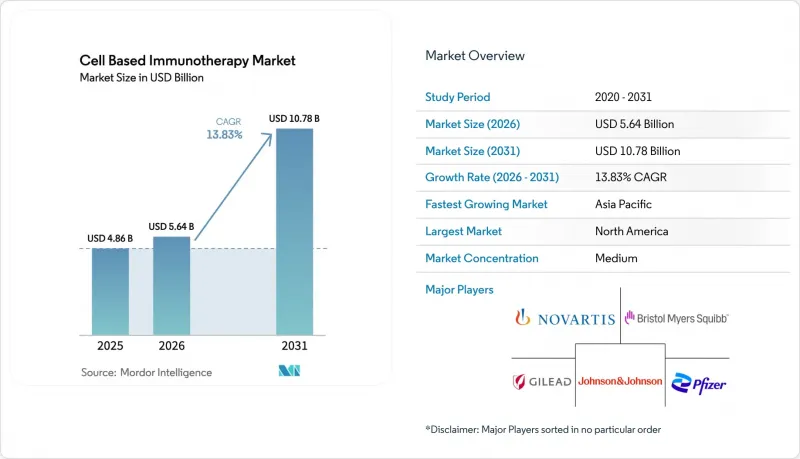
Mordor Intelligence에 의하면, 세포 기반 면역치료 시장 규모는 2025년 48억 6,000만 달러로 평가되었고, 2026년에는 56억 4,000만 달러로 추정되고, 2031년까지 107억 8,000만 달러에 이를 것으로 예상되며, 2026-2031년 CAGR 13.83%로 성장할 전망입니다.
본 보고서는 세포 유래별(자가 유래, 동종 유래), 세포 유형별(CAR-T 세포, TCR-T 세포, CAR-NK 세포, 종양 침윤 림프구), 주요 적응증별(B세포성 악성 종양, 전립선암, 기타), 최종 사용자별(병원, 기타), 지역별(북미, 유럽, 아시아태평양, 중동 및 아프리카, 남미)로 분류되어 있습니다. 시장 전망은 금액(달러) 기준으로 제시되어 있습니다.
세계의 세포 기반 면역치료 시장 동향 및 인사이트
암 유병률의 급증과 조기 치료 단계에서의 사용 승인
2024년, 전 세계 신규 암 발병 건수는 2,000만 건에 달했으며, 이에 따라 규제 당국은 미만성 대세포형 B세포 림프종에 대한 2차 치료용 CAR-T 요법의 사용을 승인했습니다. 이로 인해 체력이 양호한 환자의 상당 부분이 세포 기반 면역치료 시장으로 이동했습니다. 미국 FDA의 예스카르타(Yescarta) 적응증 확대로 인해 대상 환자의 40%가 치료 단계를 한 단계 앞당기게 되었습니다. 동시에 유럽의약품청(EMA)도 이에 발맞추어 포도상 림프종에 대한 2차 치료제로 ‘킴리아(Kymriah)’에 조건부 승인을 부여했습니다. 실세계 데이터에 따르면, 2차 치료군에서 CAR-T 치료군의 24개월 무재발 생존율은 52%인 반면, 3차 치료군에서는 31%에 그치고 있습니다. 임상시험 수행 기관들은 이러한 규제상의 추세가 2027년까지 지속될 것으로 전망하며, 더 이른 치료 단계를 평가 지표로 삼은 등록 연구 설계를 재검토하고 있습니다.
유전자 편집 및 바이러스 벡터 공학의 급속한 발전
CRISPR, 염기 편집, 최적화된 렌티바이러스 시스템 덕분에 세포의 효능이 향상되었으며, 1회 투여당 제조 비용이 35% 절감되었습니다. Caribou의 TRAC 편집을 이용한 동종 CAR-T 요법은 1상 임상시험에서 이식편 대 숙주 질환 없이 68%의 완전 반응률을 달성하여, 지속성을 높이기 위한 원스텝 편집의 실현 가능성을 부각시켰습니다. 아데노연관바이러스(AAV)의 혈청형 공학 분야에서 이루어진 병행 혁신을 통해 Sana BioTechnology의 생체 내 CAR 접근법이 가능해졌으며, 비인간 영장류에서 체외 조작 없이 T 세포의 80%에 도입하는 데 성공했습니다. 이러한 진전으로 인해 신규 진출기업에 대한 기술적 장벽이 낮아지면서, 1세대 자가 유래 CAR-T 치료법을 다루는 기존 기업들 간의 경쟁이 격화되고 있습니다.
복잡하고 취약한 공급망과 전문 인력 부족
콜드체인 문제와 인력 부족이 여전히 배치 불합격을 유발하고 있습니다. 전 세계 조사에 따르면, 수탁 제조업체의 68%에서 공정 개발 직책이 공석이며, 채용에 소요되는 기간의 중앙값은 9개월 이상입니다. 2024년 배치 불합격 사례 중 12%는 동결보존 시 온도 편차가 원인이었습니다. 학술 프로그램 확충은 더디게 진행되고 있으며, 렌티바이러스 제조 커리큘럼을 제공하는 대학은 고작 14곳에 불과합니다. 길리어드(Gilead)가 벡터 제조를 사내에서 직접 수행하거나, 노바티스(Novartis)가 펜실베이니아 대학교와 공동으로 기술자 양성 아카데미를 운영하는 등 수직 통합을 위한 노력으로도 이 격차를 메우려면 수년이 소요될 전망입니다.
부문 분석
2025년, 자가 유래 치료법은 세포 기반 면역 치료 시장 점유율의 72.31%를 차지했습니다. 이는 2024년에 총 1만 8,000명 이상의 환자를 치료한 4개의 시판 CAR-T 브랜드에 힘입은 결과입니다. 환자 특이적 제품은 이식편 대 숙주 질환(GVHD)의 위험이 전혀 없으며, 40만 달러가 넘는 정가가 책정되어 있습니다. 그러나 이러한 제품은 14-28일의 제조 기간이 소요되며, 그 기간 동안 환자의 15-20%에서 병세가 진행됩니다. 반면, 연평균 성장률(CAGR) 14.14%로 확대될 것으로 예상되는 동종 유래 부문은 이러한 지연을 피할 수 있습니다. TRAC, B2M, CIITA 유전자좌가 편집된 기증자 세포는 질환이 확인되는 즉시 ‘오프더쉘프’ 투여용으로 비축할 수 있습니다.
동종 유래 프로그램에서는 이미 백혈구 분리 채혈 후 3일 이내에 환자에게 투여가 이루어지고 있으며, 림프종의 초기 임상시험에서 75%의 전체 반응률이 나타났습니다. 규제 당국은 현재 스폰서가 특정 자가 유래 제품의 안전성 평가 지표를 외삽하는 것을 허용하고 있어, 이를 통해 개발 과정이 합리화되고 있습니다. 24개월을 초과하는 지속성은 여전히 중요한 미지수이며, 보험사들은 반복 투여에 따른 누적 비용의 높음을 인식하고 있습니다. 그럼에도 불구하고, 재고 모델의 운영상의 간편성으로 인해 수탁 제조업체에게는 동종 유래 전용 생산 라인을 구축할 유인이 작용하고 있습니다.
CAR-T 플랫폼은 혈액 악성 종양용 FDA 승인 제품 6개 품목에 힘입어 2025년 매출의 64.73%를 차지했습니다. 제조 인프라는 확립되어 있으며, 채혈부터 투여까지 소요되는 시간은 2020년 이후 거의 절반으로 줄었습니다. 세포의 침윤 능력이 낮고 항원이 불균일하기 때문에 고형암의 반응률은 한 자릿수에 머물고 있습니다. 연평균 성장률(CAGR) 15.07%로 예측되는 CAR-NK 프로그램은 HLA 매칭이 필요하지 않으며, CRS(사이토카인 방출 증후군)나 신경독성의 징후도 아직 보고된 바 없어, 기성(오프더쉘프) 제품 후보로서 매력적입니다.
iPS 세포 유래 CAR-NK 제제는 진행성 난소암에서 심각한 독성 없이 63%의 객관적 반응률을 달성하여, 그 타고난 세포 독성이 입증되었습니다. 종양 침윤 림프구(TIL) 요법은 틈새 시장에 머물러 있지만, 2024년에 전이성 흑색종에 대해 미국에서 첫 승인을 획득하여, 네오항원이 풍부한 종양에 대한 치료 옵션을 제공합니다. TCR-T 제제는 활막육종 분야에서 주목받고 있으며, 향후 CAR로는 표적화할 수 없는 세포 내 항원을 표적화할 가능성이 있지만, HLA 제한으로 인해 대상 환자 집단은 제한적입니다.
지역별 분석
북미는 2025년 전 세계 매출의 44.26%를 차지했습니다. 이는 FDA 승인 제품 6개, 진행 중인 임상시험 180건, 고가의 정가를 뒷받침하는 성과 연동형 상환 제도에 힘입은 결과입니다. 2024년, 미국에서는 9,500명의 환자가 치료를 받았으며, 그중 60%는 현재 시설 내에 자동 제조 설비를 가동 중인 15개의 환자 수가 많은 치료 센터에서 치료를 받았습니다. 캐나다는 승인된 제품이 단 3개에 불과하고, 3차 치료에 대한 보험 적용이 제한되어 있어 뒤처지고 있습니다. 한편, 멕시코에서의 접근성은 미국 의료시설을 방문하는 의료 관광객으로만 제한된 상태입니다.
아시아태평양은 가장 빠르게 성장하고 있으며, 연평균 성장률(CAGR)은 16.21%로 예측됩니다. 2024년, 중국 규제 당국은 수입품보다 가격을 낮추기 위해 120만 위안(약 16만 5,000달러)의 가격으로 8개의 국산 CAR-T 제품을 승인했습니다. 일본에서는 조건부 승인 제도를 통해 심사 기간이 18개월 단축되어 임상시험 개시가 촉진되고 있습니다. 인도와 호주는 아직 초기 단계이지만, 2027년까지 국내 생산에 사용할 공적 자금을 확보해 두어 장기적인 성장 가능성을 시사하고 있습니다.
독일은 가치 기반 가격 책정을 채택한 반면, 영국은 비용 대비 효과 관점에서 주요 제품 1개를 기각했으나, 기밀로 진행 중인 리베이트 협상 결과를 기다리고 있는 상태입니다. 이탈리아와 스페인에서는 지역별 예산 배분 사정으로 인해 EMA(유럽의약품청) 승인 후 환급까지 최대 2년 지연될 가능성이 있습니다. 중동 및 아프리카와 남미는 수요의 불과 6%만을 차지하지만, 두바이의 ‘센터 오브 엑설런스(Center of Excellence)’ 모델과 브라질의 우선 심사 제도는 현지 생산 능력이 정비됨에 따라 점진적인 성장이 예상을 시사합니다.
기타 혜택
- 엑셀 형식 시장 예측(ME) 시트
- 3개월간의 애널리스트 지원
자주 묻는 질문
목차
제1장 서론
제2장 조사 방법
제3장 주요 요약
제4장 시장 구도
제5장 시장 규모 및 성장 예측
제6장 경쟁 구도
제7장 시장 기회 및 향후 전망
AJY 26.09.11According to Mordor Intelligence, the cell based immunotherapy market size is expected to increase from USD 4.86 billion in 2025 to USD 5.64 billion in 2026 and reach USD 10.78 billion by 2031, growing at a CAGR of 13.83% over 2026-2031.

This report is Segmented by Cell Source (Autologous, Allogeneic), Cell Type (CAR-T Cells, TCR-T Cells, CAR-NK Cells, Tumor-Infiltrating Lymphocytes), Primary Indication (B-Cell Malignancies, Prostate Cancer, and More), End User (Hospitals, and More), and Geography (North America, Europe, Asia-Pacific, Middle East & Africa, South America). Market Forecasts are Provided in Terms of Value (USD).
Global Cell Based Immunotherapy Market Trends and Insights
Surging Cancer Prevalence and Earlier-Line Use Approvals
Global cancer incidence reached 20 million new cases in 2024, and regulators responded by green-lighting the use of second-line CAR-T therapy in diffuse large B-cell lymphoma, shifting a sizable share of fitter patients into the cell-based immunotherapy market. The U.S. FDA's expanded label for Yescarta moved 40% of eligible patients forward by one therapy line. At the same time, the European Medicines Agency followed with conditional approval for Kymriah in second-line follicular lymphoma. Real-world evidence now shows a 24-month progression-free survival rate of 52% in second-line CAR-T cohorts, compared to 31% in third-line cohorts. Sponsors are redesigning registrational trials around earlier-line endpoints, anticipating that this regulatory momentum will hold through 2027.
Rapid Advances in Gene-Editing and Viral-Vector Engineering
CRISPR, base-editing, and optimized lentiviral systems are enhancing cell potency and reducing the cost of goods by 35% per dose. Caribou's TRAC-edited allogeneic CAR-T therapy delivered a 68% complete response rate with no graft-versus-host disease in Phase 1, highlighting the feasibility of single-step edits to enhance persistence. Parallel innovations in adeno-associated virus serotype engineering enabled Sana Biotechnology's in vivo CAR approach, which transduced 80% of T cells in non-human primates without ex vivo manipulation. These advances are lowering technical barriers for smaller entrants and intensifying competition for first-generation autologous incumbents.
Complex, Fragile Supply Chain & Specialized Talent Shortages
Cold-chain mishaps and workforce gaps continue to trigger batch failures. A global survey found that 68% of contract manufacturers had unfilled process development roles, with a median hiring time of over 9 months. Cryopreservation excursions caused 12% of 2024 batch rejections. Academic programs are scaling slowly; only 14 universities offer lentiviral-production curricula. Vertical integration efforts such as Gilead internalizing vector production and Novartis co-running a technician academy with the University of Pennsylvania will take several years to close the gap.
Other drivers and restraints analyzed in the detailed report include:
- Expanding Reimbursement Frameworks for Commercial CAR-T Launches
- Big-Pharma M&A, Licensing Deals, and Capacity Build-Outs
- Cytokine-Release-Syndrome (CRS) Risk & Associated Liability Costs
For complete list of drivers and restraints, kindly check the Table Of Contents.
Segment Analysis
Autologous therapies accounted for 72.31% of the cell-based immunotherapy market share in 2025, driven by four commercial CAR-T brands that collectively treated over 18,000 patients in 2024. Patient-specific products carry zero graft-versus-host risk and have commanded list prices above USD 400,000. Yet they rely on 14-28 day manufacturing windows, during which 15-20% of patients progress. The allogeneic segment, projected to expand at a 14.14% CAGR, circumvents these delays. Donor cells edited at the TRAC, B2M, and CIITA loci can be banked for off-the-shelf dosing as soon as the disease is confirmed.
Allogeneic programs are already infusing patients within 3 days of leukapheresis and are demonstrating an overall response rate of 75% in early lymphoma trials. Regulators now permit sponsors to extrapolate specific autologous safety endpoints, thereby streamlining the development process. Persistence beyond 24 months remains a crucial unknown, and payers are aware of the higher cumulative cost associated with repeat dosing. Even so, the operational simplicity of inventory models is incentivizing contract manufacturers to carve out allogeneic-dedicated suites.
CAR-T platforms accounted for 64.73% of 2025 revenue, driven by six FDA-approved products for hematologic malignancies. Manufacturing infrastructure is established, and vein-to-vein times have almost halved since 2020. Nonetheless, low trafficking and antigen heterogeneity cap solid-tumor response rates at single digits. CAR-NK programs, forecast for a 15.07% CAGR, sidestep HLA matching and have yet to register any CRS or neurotoxicity signals, making them attractive as off-the-shelf candidates.
Induced-pluripotent-stem-cell-derived CAR-NK products achieved a 63% objective response in advanced ovarian cancer without severe toxicities, validating their innate cytotoxicity. Tumor-infiltrating lymphocyte (TIL) therapy occupies a smaller niche but won its first U.S. approval in 2024 for metastatic melanoma, providing an option for neoantigen-rich tumors. TCR-T products gained traction in synovial sarcoma and could eventually target intracellular antigens inaccessible to CARs, although HLA restriction limits addressable populations.
Complete Report Scope:
- By Cell Source
- Autologous
- Allogeneic
- By Cell Type
- CAR-T Cells
- TCR-T Cells
- CAR-NK Cells
- Tumor-Infiltrating Lymphocytes (TIL)
- By Primary Indication
- B-cell Malignancies
- Prostate Cancer
- Renal Cell Carcinoma
- Liver Cancer
- Other Indications
- By End User
- Hospitals
- Specialty Cancer Centers
- Academic & Research Institutes
- By Geography
- North America
- United States
- Canada
- Mexico
- Europe
- Germany
- United Kingdom
- France
- Italy
- Spain
- Rest of Europe
- Asia-Pacific
- China
- Japan
- India
- Australia
- South Korea
- Rest of Asia-Pacific
- Middle East & Africa
- GCC
- South Africa
- Rest of Middle East & Africa
- South America
- Brazil
- Argentina
- Rest of South America
- North America
Geography Analysis
North America generated 44.26% of global revenue in 2025, supported by six FDA-approved products, 180 active trials, and outcomes-based reimbursement that underwrites high list prices. In 2024, the United States treated 9,500 patients, 60% of whom received therapy at 15 high-volume centers that now operate automated on-site manufacturing facilities. Canada lags with only three approved products and third-line coverage limits, while Mexico's access remains confined to medical tourists traveling to U.S. sites.
The Asia-Pacific region is the fastest-growing, with a 16.21% CAGR forecast. In 2024, China's regulator cleared eight domestic CAR-T products, priced at CNY 1.2 million (approximately USD 165,000), to undercut imports. Japan's conditional pathway cuts 18 months off review timelines, fueling trial starts. India and Australia are still in their early stages but have earmarked public funds for domestic manufacturing by 2027, indicating longer-term upside.
Germany embraced value-based pricing, whereas the United Kingdom rejected one leading product for cost-effectiveness, pending confidential rebates. Italy and Spain face regional budget allocations that can delay reimbursement up to two years after an EMA green light. Middle East & Africa and South America represent just 6% of demand, though Dubai's center-of-excellence model and Brazil's priority reviews hint at incremental growth as local capacity emerges.
- Adaptimmune Therapeutics plc
- Allogene Therapeutics
- Atara Biotherapeutics Inc.
- Autolus Therapeutics plc
- Bluebird Bio
- Bristol-Myers Squibb
- Cabaletta Bio Inc.
- Caribou Biosciences Inc.
- Celyad Oncology SA
- Roche
- Gamida Cell Ltd
- Gilead Sciences
- Johnson & Johnson
- JW Therapeutics Co. Ltd
- Legend Biotech Corp.
- Lonza Group
- Miltenyi Biotec B.V. & Co. KG
- Mustang Bio Inc.
- Novartis
- Orca Bio Inc.
- Pfizer
- Precision BioSciences Inc.
- Sorrento Therapeutics
- Tessa Therapeutics Ltd
Additional Benefits:
- The market estimate (ME) sheet in Excel format
- 3 months of analyst support
TABLE OF CONTENTS
1 Introduction
- 1.1 Study Assumptions & Market Definition
- 1.2 Scope of the Study
2 Research Methodology
3 Executive Summary
4 Market Landscape
- 4.1 Market Overview
- 4.2 Market Drivers
- 4.2.1 Surging Cancer Prevalence and Earlier-Line Use Approvals
- 4.2.2 Rapid Advances in Gene-Editing & Viral-Vector Engineering
- 4.2.3 Expanding Reimbursement Frameworks for Commercial CAR-T Launches
- 4.2.4 Big-Pharma M&A, Licensing Deals, and Capacity Build-Outs
- 4.2.5 Point-Of-Care Micro-Factories Slashing Vein-To-Vein Cycle-Time
- 4.2.6 In-Vivo CAR Payload Delivery Platforms Eliminating Lymphodepletion
- 4.3 Market Restraints
- 4.3.1 Complex, Fragile Supply Chain & Specialized Talent Shortages
- 4.3.2 Cytokine-Release-Syndrome (CRS) Risk & Associated Liability Costs
- 4.3.3 Viral-Vector Raw-Material Bottlenecks Constraining Scale-Up
- 4.3.4 Regulatory Uncertainty Around In-Vivo Gene-Delivery Vectors
- 4.4 Regulatory Landscape
- 4.5 Technological Outlook
- 4.6 Porter's Five Forces Analysis
- 4.6.1 Threat of New Entrants
- 4.6.2 Bargaining Power of Buyers
- 4.6.3 Bargaining Power of Suppliers
- 4.6.4 Threat of Substitutes
- 4.6.5 Competitive Rivalry
5 Market Size & Growth Forecasts
- 5.1 By Cell Source
- 5.1.1 Autologous
- 5.1.2 Allogeneic
- 5.2 By Cell Type
- 5.2.1 CAR-T Cells
- 5.2.2 TCR-T Cells
- 5.2.3 CAR-NK Cells
- 5.2.4 Tumor-Infiltrating Lymphocytes (TIL)
- 5.3 By Primary Indication
- 5.3.1 B-cell Malignancies
- 5.3.2 Prostate Cancer
- 5.3.3 Renal Cell Carcinoma
- 5.3.4 Liver Cancer
- 5.3.5 Other Indications
- 5.4 By End User
- 5.4.1 Hospitals
- 5.4.2 Specialty Cancer Centers
- 5.4.3 Academic & Research Institutes
- 5.5 By Geography
- 5.5.1 North America
- 5.5.1.1 United States
- 5.5.1.2 Canada
- 5.5.1.3 Mexico
- 5.5.2 Europe
- 5.5.2.1 Germany
- 5.5.2.2 United Kingdom
- 5.5.2.3 France
- 5.5.2.4 Italy
- 5.5.2.5 Spain
- 5.5.2.6 Rest of Europe
- 5.5.3 Asia-Pacific
- 5.5.3.1 China
- 5.5.3.2 Japan
- 5.5.3.3 India
- 5.5.3.4 Australia
- 5.5.3.5 South Korea
- 5.5.3.6 Rest of Asia-Pacific
- 5.5.4 Middle East & Africa
- 5.5.4.1 GCC
- 5.5.4.2 South Africa
- 5.5.4.3 Rest of Middle East & Africa
- 5.5.5 South America
- 5.5.5.1 Brazil
- 5.5.5.2 Argentina
- 5.5.5.3 Rest of South America
- 5.5.1 North America
6 Competitive Landscape
- 6.1 Market Concentration
- 6.2 Market Share Analysis
- 6.3 Company Profiles (includes Global level Overview, Market-level Overview, Core Segments, Financials, Strategic Information, Market Rank/Share, Products & Services, Recent Developments)
- 6.3.1 Adaptimmune Therapeutics plc
- 6.3.2 Allogene Therapeutics Inc.
- 6.3.3 Atara Biotherapeutics Inc.
- 6.3.4 Autolus Therapeutics plc
- 6.3.5 Bluebird Bio Inc.
- 6.3.6 Bristol Myers Squibb Co.
- 6.3.7 Cabaletta Bio Inc.
- 6.3.8 Caribou Biosciences Inc.
- 6.3.9 Celyad Oncology SA
- 6.3.10 F. Hoffmann-La Roche Ltd
- 6.3.11 Gamida Cell Ltd
- 6.3.12 Gilead Sciences Inc.
- 6.3.13 Johnson & Johnson
- 6.3.14 JW Therapeutics Co. Ltd
- 6.3.15 Legend Biotech Corp.
- 6.3.16 Lonza Group Ltd
- 6.3.17 Miltenyi Biotec B.V. & Co. KG
- 6.3.18 Mustang Bio Inc.
- 6.3.19 Novartis AG
- 6.3.20 Orca Bio Inc.
- 6.3.21 Pfizer Inc.
- 6.3.22 Precision BioSciences Inc.
- 6.3.23 Sorrento Therapeutics Inc.
- 6.3.24 Tessa Therapeutics Ltd
7 Market Opportunities & Future Outlook
- 7.1 White-space & Unmet-need Assessment


