

|
시장보고서
상품코드
2123648
치료 약물 모니터링 시장 : 점유율 분석, 업계 동향과 통계, 성장 예측(2026-2031년)Therapeutic Drug Monitoring - Market Share Analysis, Industry Trends & Statistics, Growth Forecasts (2026 - 2031) |
||||||
 Mordor Intelligence
Mordor Intelligence에 의하면, 치료 약물 모니터링 시장 규모는 2025년에 13억 6,000만 달러로 평가되었고 2026년 14억 8,000만 달러에서 2031년까지 22억 9,000만 달러에 이를 것으로 추정되고 있어 예측 기간(2026-2031년) CAGR은 9.03%를 나타낼 전망입니다.
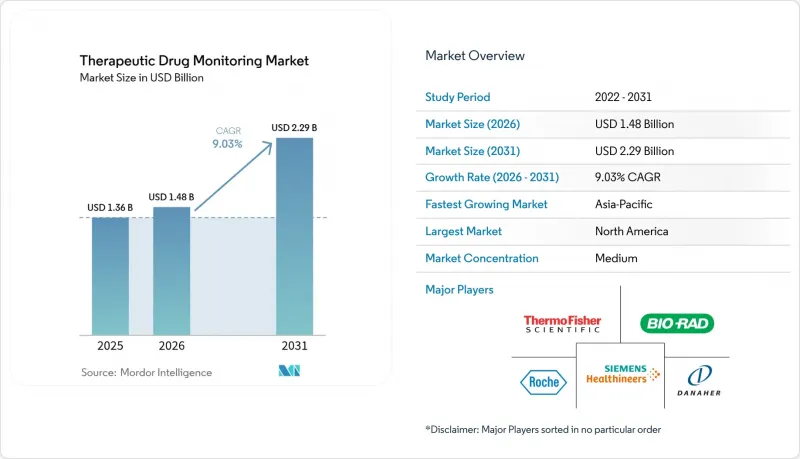
본 보고서는 기술별(면역측정법, 단백질체학 등), 약물 분류별(항부정맥제, 면역억제제 등), 최종 사용자별(병원 검사실, 독립·참조 검사 기관 등), 지역별로 분류되어 있습니다. 시장 규모 및 전망은 금액(달러)으로 표시되어 있습니다.
전 세계 치료 약물 모니터링 시장 동향 및 인사이트
암, HIV, 자가면역질환, 심장질환의 유병률 증가
암 치료 프로토콜에서는 저분자 키나제 억제제와 단일클론 항체의 병용이 점점 증가하고 있으며, 치료 범위가 좁아지고 있기 때문에 종양 억제의 불충분함이나 용량 제한 독성을 피하기 위해서는 혈청 농도의 정밀한 관리가 필수적입니다. HIV 치료에서 장시간 작용형 카보테그라비르-릴피비린 병용 요법은 모니터링 범위를 매일 경구 투여를 넘어 확대시켜, 월간 또는 격월 간격으로 지속적인 트로프 농도 확인을 필요로 합니다. 자가면역 질환 치료에서는 현재 생물학적 질환 수정제가 일상적으로 사용되고 있으나, 이러한 약물의 클리어런스율은 항약물 항체 형성에 따라 변동합니다. 치료 약물 모니터링은 원발성 무효와 면역원성에 의한 유효성 상실을 구별하기 위한 근거 기반의 수단을 제공합니다. 고령화에 따른 심혈관 질환 증가로 인해, 의인성 독성을 피하기 위한 디곡신 및 항부정맥제의 혈중 농도 검사 수요가 확대되고 있습니다. 이러한 질병 부담이 맞물려 시장에 안정적인 환자 집단을 형성하고 있으며, 이는 검사 건수의 예측 가능한 증가를 뒷받침하고 있습니다.
임상시험 확대 및 동반진단의 의무화
규제 당국은 현재 주요 임상시험에서 다양한 유전자형 및 동반 질환 프로파일에 걸친 용량 최적화에 대한 근거를 요구하고 있으며, 치료 약물 모니터링이 시험 프로토콜에 확고하게 포함되어 있습니다. 따라서 후원사는 LC-MS/MS 분석과 약리유전체학 알고리즘을 통합한 ‘검체에서 인사이트로’ 워크플로우를 도입하여, 적응형 투여군 실시를 가능하게 하고 후기 단계의 중도 탈락률을 낮추고 있습니다. 분산형 임상시험 모델에 따라 우편 발송 방식의 건조 혈액 스팟 키트 도입이 가속화되고 있으며, 데이터의 신뢰성을 유지하면서 시설 방문을 최소화하고 있습니다. 임상시험에서의 양호한 실적은 이후 혈청 농도에 관한 지침을 명시한 시판 후 적응증 확대에 반영되어, 궁극적으로 일상적인 임상 수요의 확대로 이어집니다. 이러한 피드백 루프를 통해 임상 개발 비용은 시장 전체의 검사 키트 제조업체 및 서비스 실험실에게 지속 가능한 수익원으로 전환됩니다.
LC-MS/MS 플랫폼의 자본 비용 및 서비스 계약 비용
엔트리 레벨 트리플 쿼드러폴 시스템의 정가는 30만-50만 달러이며, 연간 유지보수 계약비로 5만 달러가 추가되므로 저·중소득국의 2차 의료기관 및 민간 검사 기관의 예산을 압박하고 있습니다. 선진국 시장이라 할지라도 재무 관리 위원회는 구매를 승인하기 전에 확실한 이용 예측을 요구하고 있습니다. 도입 비용이 높아 외부 위탁 검사가 지속되고, 결과적으로 검사 결과 반환까지 시간이 길어져 임상적 가치가 즉시 발휘되기 어렵기 때문에 일상적인 검사에의 도입이 지연되고 있습니다. 공동 구매 컨소시엄이나 시약 대여 모델을 통해 현금 흐름의 제약은 부분적으로 완화되고 있지만, 여전히 많은 기관이 특이도가 낮은 면역 측정법에 의존하고 있어, 치료 약물 모니터링 시장 전체에서 키나아제 억제제나 면역 요법 등 교차 반응에 민감한 용도가 제한되고 있습니다.
부문 분석
면역측정법은 치료 약물 모니터링 시장 규모에서 가장 큰 수익 점유율을 차지하고 있으며, 2025년에는 58.74%의 점유율을 유지할 것으로 전망됩니다. 기존 화학 분석 라인과의 통합, 일관된 보험 환급 코드, 그리고 기술자들의 익숙함이 이러한 우위를 뒷받침하고 있습니다. 그러나 바이오센서 및 웨어러블 플랫폼은 간질액에서 약물 농도를 현장에서 측정할 수 있게 해주는 전기화학적 변환 기술의 발전에 힘입어 9.74%의 연평균 성장률(CAGR)을 기록하고 있습니다. 질량 분석법과 면역 화학법을 결합한 하이브리드 기술은 저분자 항암제까지 검사 항목을 확대하고 있어 기존 기술의 중요성을 더욱 높이고 있습니다.
단백질 결합에 의한 간섭, 훅 효과 및 교차 반응성의 제약으로 인해 3차 의료 기관에서는 복잡한 투여 요법에 대해 크로마토그래피 및 LC-MS/MS 솔루션으로의 전환이 진행되고 있으며, 이로 인해 여러 공급업체 간의 경쟁이 격화되고 있습니다. 한편, 연속 측정형 웨어러블 기기의 프로토타입 개발은 1분 미만의 샘플링 간격을 실현할 전망이며, 치료 약물 모니터링 시장의 패러다임을 간헐적인 채혈에서 동적인 약동학 프로파일링으로 재정의하고 있습니다. 벤처 캐피탈의 지원을 받는 스타트업 기업들은 제약 기업과 제휴하여, 기기를 서방형 주사제와 결합함으로써 임상 검증을 가속화하고 있습니다. 규제 방향이 명확해짐에 따라, 경쟁의 향방은 분석 감도뿐만 아니라 사용 편의성, 데이터 보안 아키텍처, 그리고 알고리즘에 기반한 투여 지침에 점점 더 좌우될 것입니다.
지역별 분석
2025년 치료 약물 모니터링 시장 규모에서 북미가 차지하는 41.80%의 비중은 확립된 보험 환급 제도, 광범위한 이식 프로그램, 그리고 약리유전학 분야의 리더십에 기인합니다. 유럽도 비슷한 성숙도를 보이고 있지만, 통합 조달 및 성과 연동형 가격 책정을 우선시하는 비용 억제 압력에 직면해 있습니다. 아시아태평양은 2031년까지 연평균 성장률(CAGR) 10.27%를 나타낼 것으로 예측되며, 이는 병원 건설 붐, 임상시험 유입 및 각국의 정밀의료 이니셔티브를 반영한 것입니다. 중국은 공공 부문의 인프라 자금과 국내 LC-MS/MS 제조를 촉진하는 엄격한 규제 개혁을 결합하여 이 지역의 검사 건수 증가를 주도하고 있습니다. 일본에서는 초고령화 사회로 인해 1인당 검사 실시율이 높은 수준을 유지하고 있는 반면, 인도에서는 건강보험 적용 범위가 확대됨에 따라 환자들이 필수 모니터링 검사 패널을 이용할 수 있는 기회가 넓어지고 있습니다. 중동 및 남미에서는 검사실 자동화 공급업체들이 정부 기관과 협력하여 진단 역량을 현대화하고 있어, 도입은 초기 단계이지만 가속화되고 있으며, 이러한 노력이 치료 약물 모니터링 시장을 점차 확대시키고 있습니다.
기타 혜택:
- 엑셀 형식 시장 예측(ME) 시트
- 3개월간의 애널리스트 지원
자주 묻는 질문
목차
제1장 서론
제2장 조사 방법
제3장 주요 요약
제4장 시장 구도
제5장 시장 규모와 성장 예측
제6장 경쟁 구도
제7장 시장 기회와 향후 전망
JHS 26.09.07According to Mordor Intelligence, the therapeutic drug monitoring market size was valued at USD 1.36 billion in 2025 and estimated to grow from USD 1.48 billion in 2026 to reach USD 2.29 billion by 2031, at a CAGR of 9.03% during the forecast period (2026-2031).
This report is Segmented by Technology (Immunoassays, Proteomic, and More), Drug Class (Antiarrhythmic Drugs, Immunosuppressants, and More), End-User (Hospital Laboratories, Independent / Reference Laboratories, and More), and Geography. The Market Sizes and Forecasts are Provided in Terms of Value (USD).
Global Therapeutic Drug Monitoring Market Trends and Insights
Rising Prevalence of Oncology, HIV, Autoimmune & Cardiac Cases
Cancer protocols increasingly pair small-molecule kinase inhibitors with monoclonal antibodies, creating narrow therapeutic margins that mandate precise serum-level control to avoid suboptimal tumor inhibition or dose-limiting toxicity . Long-acting cabotegravir-rilpivirine combinations for HIV expand monitoring horizons beyond daily oral dosing, requiring confirmation of sustained trough concentrations over monthly or bi-monthly intervals. Autoimmune conditions now routinely employ biologic disease-modifying agents whose clearance rates vary with anti-drug antibody formation, and therapeutic drug monitoring provides an evidence-based path to differentiate primary non-response from immunogenic loss of efficacy. Cardiovascular cases driven by aging populations reinforce volume growth for digoxin and antiarrhythmic level checks to avert iatrogenic toxicity. Together, these disease burdens add consistent patient cohorts to the market, underpinning predictable test-volume increases.
Expansion of Clinical Trials & Companion-Diagnostic Mandates
Regulators now expect dose-optimization evidence across diverse genotypes and comorbidity profiles during pivotal trials, firmly embedding therapeutic drug monitoring into study protocols. Sponsors therefore integrate sample-to-insight workflows that merge LC-MS/MS analytics with pharmacogenomic algorithms, enabling adaptive dosing arms and reducing late-stage attrition. Decentralized trial models accelerate adoption of mailed dried-blood-spot kits, preserving data fidelity while minimizing site visits. Positive experience in trials subsequently informs post-marketing label expansions that specify serum-level guidance, which in turn grows routine clinical demand. The feedback loop converts clinical-development spending into durable revenue streams for assay manufacturers and service laboratories across the market.
Capital & Service-Contract Costs of LC-MS/MS Platforms
Entry-level triple-quadrupole systems list at USD 300,000-500,000, and annual maintenance contracts add USD 50,000, stretching budgets of secondary hospitals and private labs in low- and middle-income economies . Even in developed markets, fiscal stewardship committees demand robust utilization forecasts before approving purchases. High acquisition thresholds perpetuate send-out testing, lengthening turnaround times and diminishing immediate clinical value, which in turn slows routine test adoption. Pooled-purchasing consortia and reagent-rental models partially mitigate cash-flow constraints, yet many facilities remain reliant on less specific immunoassays, limiting cross-reactivity-sensitive applications such as kinase inhibitors and immunotherapies across the therapeutic drug monitoring market.
Other drivers and restraints analyzed in the detailed report include:
- Automation & High-Throughput Immunoassay Adoption in Core Labs
- Low-Cost Dried-Blood-Spot Sampling Enabling Remote TDM
- Shortage of Skilled Clinical Toxicologists in Emerging Nations
For complete list of drivers and restraints, kindly check the Table Of Contents.
Segment Analysis
Immunoassays generated the largest revenue portion of the therapeutic drug monitoring market size, holding a 58.74% share in 2025. Integration into legacy chemistry lines, consistent reimbursement coding, and technician familiarity sustain this lead. However, biosensor and wearable platforms are recording a 9.74% CAGR, underpinned by electrochemical transduction advances that enable in-situ drug-level readouts from interstitial fluid. Mass-spectrometry-linked immunochemical hybrids widen menus to encompass small-molecule oncology agents, further reinforcing the incumbent technology's relevance.
Protein-binding interference, hook effects, and cross-reactivity limitations have propelled tertiary centers toward chromatographic and LC-MS/MS solutions for complex regimens, fortifying multivendor competition. Continuous wearables prototype pipelines, meanwhile, promise sub-minute sampling intervals, redefining therapeutic drug monitoring market paradigms from episodic draws to dynamic pharmacokinetic profiling. Venture-backed start-ups align with pharmaceutical sponsors to pair devices with long-acting injectables, accelerating clinical validation. As regulatory pathways clarify, competitive dynamics will increasingly hinge on usability, data-security architecture, and algorithmic dosing guidance rather than analytical sensitivity alone.
Complete Report Scope:
- By Technology
- Immunoassays
- ELISA
- Chemiluminescence Immunoassay (CLIA)
- Fluorescence & Other IA Formats
- Proteomic / LC-MS/MS
- Chromatography (GC, HPLC)
- Biosensor-Based & Wearables
- Other Technologies
- Immunoassays
- By Drug Class
- Antiarrhythmic Drugs
- Antiepileptic Drugs
- Immunosuppressants
- Antibiotics (e.g., Vancomycin, Aminoglycosides)
- Antipsychotics & Mood Stabilizers
- Oncology & Targeted Therapies
- Other Drug Classes
- By End-user
- Hospital Laboratories
- Independent / Reference Laboratories
- Academic & Research Institutes
- Point-of-Care / Patient Self-Testing
- Contract Research & CRO Labs
- By Geography
- North America
- United States
- Canada
- Mexico
- Europe
- Germany
- United Kingdom
- France
- Italy
- Spain
- Rest of Europe
- Asia-Pacific
- China
- Japan
- India
- South Korea
- Australia
- Rest of Asia-Pacific
- Middle East
- GCC
- South Africa
- Rest of Middle East
- South America
- Brazil
- Argentina
- Rest of South America
- North America
Geography Analysis
North America's 41.80% contribution to the therapeutic drug monitoring market size in 2025 stems from entrenched reimbursement, extensive transplant programs, and pharmacogenomic leadership. Europe mirrors this maturity, albeit under cost-containment pressures that prioritize consolidated procurement and outcome-based pricing. Asia-Pacific exhibits a 10.27% CAGR through 2031, reflecting hospital construction booms, clinical-trial inflows, and national precision-health initiatives. China commands the region's volume uplift, coupling public-sector infrastructure funding with stringent regulatory reforms that encourage local LC-MS/MS manufacturing. Japan's super-aged demographics sustain high per-capita test ratios, while India's expanding health-insurance coverage widens patient access to essential monitoring panels. Middle East and South America show nascent yet accelerating adoption curves as laboratory automation vendors partner with government agencies to modernize diagnostic capabilities, an endeavor that incrementally enlarges the therapeutic drug monitoring market.
- Abbott Laboratories
- Thermo Fisher Scientific
- F. Hoffmann-La Roche Ltd (Roche Diagnostics)
- Siemens Healthineers
- Danaher Corp (Beckman Coulter)
- Bio-Rad Laboratories
- Chromsystems Instruments & Chemicals
- Randox Laboratories
- Alpco Diagnostics
- ARK Diagnostics
- DiaSorin
- bioMerieux
- Tecan Group
- Waters Corporation
- Agilent Technologies
- Hitachi High-Tech Corp.
- Bruker Corp.
- JEOL Ltd.
- Quotient Ltd.
- LabCorp (Covance Labs)
Additional Benefits:
- The market estimate (ME) sheet in Excel format
- 3 months of analyst support
TABLE OF CONTENTS
1 Introduction
- 1.1 Study Assumptions & Market Definition
- 1.2 Scope of the Study
2 Research Methodology
3 Executive Summary
4 Market Landscape
- 4.1 Market Overview
- 4.2 Market Drivers
- 4.2.1 Rising prevalence of oncology, HIV, autoimmune & cardiac cases
- 4.2.2 Expansion of clinical trials & companion-diagnostic mandates
- 4.2.3 Automation & high-throughput immunoassay adoption in core labs
- 4.2.4 Low-cost dried-blood-spot sampling enabling remote TDM
- 4.2.5 Integration of pharmacogenomic data with TDM algorithms
- 4.2.6 Wearable micro-fluidic biosensors for real-time drug-level tracking
- 4.3 Market Restraints
- 4.3.1 Capital & service-contract costs of LC-MS/MS platforms
- 4.3.2 Shortage of skilled clinical toxicologists in emerging nations
- 4.3.3 Fragmented reimbursement coding for TDM panels
- 4.3.4 Data-exchange gaps between LIS & decision-support software
- 4.4 Value / Supply-Chain Analysis
- 4.5 Regulatory Landscape
- 4.6 Technological Outlook
- 4.7 Porter's Five Forces Analysis
- 4.7.1 Threat of New Entrants
- 4.7.2 Bargaining Power of Buyers
- 4.7.3 Bargaining Power of Suppliers
- 4.7.4 Threat of Substitute Products
- 4.7.5 Intensity of Competitive Rivalry
5 Market Size & Growth Forecasts (Value - USD million)
- 5.1 By Technology
- 5.1.1 Immunoassays
- 5.1.1.1 ELISA
- 5.1.1.2 Chemiluminescence Immunoassay (CLIA)
- 5.1.1.3 Fluorescence & Other IA Formats
- 5.1.2 Proteomic / LC-MS/MS
- 5.1.3 Chromatography (GC, HPLC)
- 5.1.4 Biosensor-Based & Wearables
- 5.1.5 Other Technologies
- 5.1.1 Immunoassays
- 5.2 By Drug Class
- 5.2.1 Antiarrhythmic Drugs
- 5.2.2 Antiepileptic Drugs
- 5.2.3 Immunosuppressants
- 5.2.4 Antibiotics (e.g., Vancomycin, Aminoglycosides)
- 5.2.5 Antipsychotics & Mood Stabilizers
- 5.2.6 Oncology & Targeted Therapies
- 5.2.7 Other Drug Classes
- 5.3 By End-user
- 5.3.1 Hospital Laboratories
- 5.3.2 Independent / Reference Laboratories
- 5.3.3 Academic & Research Institutes
- 5.3.4 Point-of-Care / Patient Self-Testing
- 5.3.5 Contract Research & CRO Labs
- 5.4 By Geography
- 5.4.1 North America
- 5.4.1.1 United States
- 5.4.1.2 Canada
- 5.4.1.3 Mexico
- 5.4.2 Europe
- 5.4.2.1 Germany
- 5.4.2.2 United Kingdom
- 5.4.2.3 France
- 5.4.2.4 Italy
- 5.4.2.5 Spain
- 5.4.2.6 Rest of Europe
- 5.4.3 Asia-Pacific
- 5.4.3.1 China
- 5.4.3.2 Japan
- 5.4.3.3 India
- 5.4.3.4 South Korea
- 5.4.3.5 Australia
- 5.4.3.6 Rest of Asia-Pacific
- 5.4.4 Middle East
- 5.4.4.1 GCC
- 5.4.4.2 South Africa
- 5.4.4.3 Rest of Middle East
- 5.4.5 South America
- 5.4.5.1 Brazil
- 5.4.5.2 Argentina
- 5.4.5.3 Rest of South America
- 5.4.1 North America
6 Competitive Landscape
- 6.1 Market Concentration
- 6.2 Market Share Analysis
- 6.3 Company Profiles (includes Global level Overview, Market level overview, Core Segments, Financials, Strategic Information, Market Rank/Share, Products & Services, Recent Developments)
- 6.3.1 Abbott Laboratories
- 6.3.2 Thermo Fisher Scientific
- 6.3.3 F. Hoffmann-La Roche Ltd (Roche Diagnostics)
- 6.3.4 Siemens Healthineers
- 6.3.5 Danaher Corp (Beckman Coulter)
- 6.3.6 Bio-Rad Laboratories
- 6.3.7 Chromsystems Instruments & Chemicals
- 6.3.8 Randox Laboratories
- 6.3.9 Alpco Diagnostics
- 6.3.10 ARK Diagnostics
- 6.3.11 DiaSorin S.p.A.
- 6.3.12 bioMerieux SA
- 6.3.13 Tecan Group
- 6.3.14 Waters Corporation
- 6.3.15 Agilent Technologies
- 6.3.16 Hitachi High-Tech Corp.
- 6.3.17 Bruker Corp.
- 6.3.18 JEOL Ltd.
- 6.3.19 Quotient Ltd.
- 6.3.20 LabCorp (Covance Labs)
7 Market Opportunities & Future Outlook
- 7.1 White-space & Unmet-Need Assessment


