|
시장보고서
상품코드
2123655
유방 재건 시장 : 점유율 분석, 업계 동향과 통계, 성장 예측(2026-2031년)Breast Reconstruction - Market Share Analysis, Industry Trends & Statistics, Growth Forecasts (2026 - 2031) |
||||||
 Mordor Intelligence
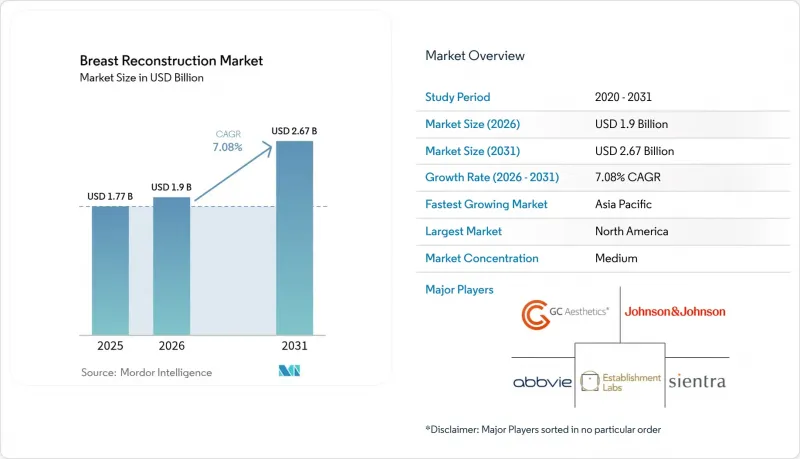
Mordor Intelligence에 의하면, 유방 재건 시장 규모는 2025년 17억 7,000만 달러에서 2026년에는 19억 달러로 확대되어 2026년부터 2031년까지 CAGR 7.08%로 성장을 지속하여, 2031년까지 26억 7,000만 달러에 이를 것으로 예측됩니다.
본 보고서는 제품 유형별(유방 임플란트, 조직 확장기 등), 소재별(실리콘, 식염수 등), 재건 수술 방식별(임플란트를 이용한 재건 등), 최종 사용자별(병원, 외래 진료 센터 등),용도별(유방 절제술 후 암 재건 등), 지역별(북미, 유럽 등)로 분류되어 있습니다. 시장 예측은 금액(달러) 기준으로 제시되어 있습니다.
전 세계 유방 재건 시장 동향 및 인사이트
유방암 발생률 증가
세계보건기구(WHO)는 2050년까지 연간 320만 건의 신규 유방암 진단이 예상된다고 예측하고 있으며, 이는 현재 수준 대비 38% 증가한 수치입니다. 아시아에서는 2022년에 98만 5,400건의 신규 사례가 보고되었으며, 이 수치는 2050년까지 140만 건을 넘어설 것으로 예측됩니다. 50세 미만의 젊은 여성과 아시아계 미국인 및 태평양 섬 주민 인구층에서 발병률이 급격히 상승하고 있으며, 이에 따라 생존 기간이 길어지고 재건 수술을 받는 비율도 높아지고 있습니다. 중국과 인도에서는 가치 중심의 병원 시스템이 임플란트를 이용한 수술이나 하이브리드 수술을 위한 새로운 수술 일정을 마련하고 있어, 대규모이자 비용 대비 효과가 높은 솔루션을 제공할 수 있는 의료기기 제조업체에게 새로운 성장 기회가 생겨나고 있습니다. 따라서 인구 증가는 단순한 수치상의 문제에 그치지 않고, 평생에 걸친 재수술 위험을 최소화하는 내구성이 높고 합병증이 적은 임플란트로의 제품 구성 수요 전환을 가져오고 있습니다.
확대되는 보험 적용 의무와 인지도
‘여성 건강 및 암 환자 권리법(Women’s Health and Cancer Rights Act)’은 미국의 모든 단체 건강보험 플랜에서 종합적인 재건 혜택을 보장하고 있으며, 2025년 2월에 DIEP 및 GAP 피판술 청구 코드가 유지되게 된 것은s Health and Cancer Rights Act)」는 미국의 단체 건강보험 플랜 전반에 걸쳐 종합적인 재건 혜택을 보장하고 있으며, 2025년 2월에 DIEP 및 GAP 피판술의 청구 코드가 유지되게 된 것은 선진적인 자가 조직 이식 기술에 대한 규제 당국의 노력을 뒷받침하고 있습니다. 캘리포니아주가 2024년 7월에 시행한 메디컬(Medi-Cal) 정책 개정 등 주 차원의 노력을 통해 저소득층 환자의 임플란트 수술 접근성이 확대되고 있습니다. 주요 민간 보험사들은 재건 수술을 ‘의학적으로 필요한 시술’로 재정의하고, 대칭성 교정 수술 및 합병증 관리도 급여 대상에 포함시켰습니다. 외래 진료 센터가 가치 기반 지불 모델을 채택함에 따라, 외과의들은 수술 시간과 후속 재수술을 줄이는 기술을 도입할 경제적 인센티브를 얻게 되었으며, 코히시브 겔 임플란트와 결합된 AI 기반 크기 결정 소프트웨어에 대한 수요가 가속화되고 있습니다.
신흥 시장의 높은 수술 및 의료기기 비용
동남아시아에서 임플란트 재건술의 평균 본인 부담금은 연소득 중앙값의 45%를 초과하여, 주요 대도시권 이외 지역에서의 보급을 제한하고 있습니다. 현지 보험사는 첨단 생체 재료 비용을 거의 보상하지 않아, 외과의사들은 재수술 위험이 높은 생리식염수 임플란트에 의존할 수밖에 없는 상황에 처해 있습니다. 다국적 의료기기 제조업체들은 이러한 비용에 민감한 지역에 진출하기 위해 현지 생산을 확대하거나 단계적인 가격 체계를 제공해야 합니다. 인도와 태국에서 시행되고 있는 저소득층 환자를 위한 재건 수술 지원 정부 시범 프로그램은 초기 단계에서 긍정적인 결과를 보이고 있지만, 그 범위는 여전히 제한적입니다.
부문 분석
2025년, 유방 재건 시장에서 유방 임플란트는 42.98%의 점유율을 유지했습니다. 이는 외과의들 사이에서 널리 인정받고 있으며, 예측 가능한 결과를 얻을 수 있기 때문입니다. 그러나 3D 바이오 프린팅을 통한 스캐폴드 및 재생의료용 임플란트는 연평균 성장률(CAGR) 14.64%로 성장하고 있으며, 이는 이물 반응을 최소화하고 환자 개개인에 맞춘 형태를 구현하는 조직공학 플랫폼으로의 전환을 시사합니다. 기존의 조직 확장기는 여전히 단계적 재건의 가교 역할을 하고 있지만, 대흉근 앞쪽을 이용한 단일 단계 수술이 보급됨에 따라 그 역할은 점차 축소되고 있습니다.
유방 재건 업계에서는 재수술률을 낮추는 의료기기의 가치가 점점 더 높아지고 있습니다. AI를 활용한 크기 결정 소프트웨어는 코히시브 젤 임플란트와 결합하여 맞춤형 윤곽을 구현하며, 폴리-4-하이드록시부틸레이트(P4HB)로 제작된 스캐폴드는 자연스러운 조직 침투를 촉진합니다. BD사가 실시한 GalaFLEX LITE에 관한 STANCE 임상시험에서는 재수술 시 발생하는 54%의 캡슐 수축 재발에 대처하는 생체 흡수성 메쉬가 주목받고 있습니다. 이러한 혁신으로 인해 병원의 조달 기준은 장기적인 비용 절감과 환자 보고 결과(PRO)를 중시하는 방향으로 변화하고 있습니다.
실리콘은 수십 년에 걸친 개선과 대용량 옵션에 대한 최근 FDA 승인을 바탕으로 2025년에는 유방 재건 시장 점유율의 45.05%를 차지했습니다. 그러나 외과의사들이 혈관화된 조직의 통합을 촉진하고 만성 염증을 완화하는 소재를 찾는 가운데, 생체 유래 메쉬는 연평균 성장률(CAGR) 8.74%로 성장을 주도하고 있습니다. 생리식염수 임플란트는 특정 안전성 문제를 우려하는 환자에게 여전히 유용하지만, 점차 시장 점유율이 떨어지고 있습니다.
한편, 합성 메쉬의 경우 체내 잔류성 및 감염 위험에 대한 감시가 강화되면서 생분해성 대체재에 대한 수요가 증가하고 있습니다. 임플란트 공급망의 환경 영향에 대한 조사에서도 탄소 배출량이 적은 생체 유래 소재나 생분해성 소재가 긍정적으로 평가받고 있으며, 병원의 ESG 목표에 부합하는 조달 방침이 추진되고 있습니다.
지역별 분석
북미는 연방 정부의 보험 적용 의무화와 전문의 자격을 취득한 성형외과 의사들의 긴밀한 네트워크에 힘입어, 2025년에는 37.25%의 점유율로 유방 재건 시장을 주도했습니다. 또한, 이 지역에서는 많은 중요한 임상시험이 진행되고 있어 차세대 임플란트 및 생체 유래 메쉬를 조기에 접할 수 있게 되었습니다. AI를 활용한 수술 전 계획 도구가 대형 병원 시스템 및 당일 수술센터에 보급됨에 따라 시장 확대는 견조한 추세를 보일 것으로 예측됩니다.
아시아태평양은 가장 성장세가 두드러지는 지역으로, 2031년까지 연평균 성장률(CAGR)은 8.85%로 예측됩니다. 유방암 발병률 증가, 중산층 소득 확대, 재건 수술에 대한 문화적 수용 확대가 수술 건수를 끌어올리고 있지만, 일본의 즉시 재건률이 11.2%에 그친다는 점은 잠재적인 성장 여지를 시사합니다. 중국과 인도에서는 유방 절제술 치료비를 지원하는 정부의 이니셔티브이 점차 재건 수술로 확대되고 있어, 비용 효율이 뛰어난 임플란트와 현지에서 제조된 메쉬의 보급에 길이 열리고 있습니다.
유럽에서는 기본적인 의료 접근성을 보장하는 국민건강보험 제도 하에서 완만한 성장이 지속되고 있지만, 수술 수혜율은 국가마다 차이가 있습니다. 라틴아메리카 및 중동 및 아프리카는 여전히 발전 중인 시장이며, 그 성장은 외과 의료 인프라 구축과 의료 종사자 교육 파트너십에 달려 있습니다. 생산의 현지화를 도모하고, 제품 포트폴리오를 해당 지역의 보험 급여 수준에 맞출 수 있는 다국적 기업이 선점 우위를 확보하게 될 것입니다.
기타 혜택:
- 엑셀 형식 시장 예측(ME) 시트
- 3개월간 애널리스트 지원
자주 묻는 질문
목차
제1장 서론
제2장 조사 방법
제3장 주요 요약
제4장 시장 구도
제5장 시장 규모와 성장 예측
제6장 경쟁 구도
제7장 시장 기회와 향후 전망
JHS 26.09.07According to Mordor Intelligence, the breast reconstruction market size is expected to grow from USD 1.77 billion in 2025 to USD 1.9 billion in 2026 and is forecast to reach USD 2.67 billion by 2031 at 7.08% CAGR over 2026-2031.
This report is Segmented by Product (Breast Implants, Tissue Expanders, and More), Material Type (Silicone, Saline, and More), Reconstruction Technique (Implant-Based, and More), End User (Hospitals, Ambulatory Care Centers, and More), Application (Post-Mastectomy Cancer Reconstruction, and More), and Geography (North America, Europe, and More). The Market Forecasts are Provided in Terms of Value (USD).
Global Breast Reconstruction Market Trends and Insights
Rising Incidence Of Breast Cancer
The World Health Organization projects 3.2 million new breast-cancer diagnoses per year by 2050, up 38% from current levels. Asia accounted for 985,400 new cases in 2022, a number expected to cross 1.4 million by 2050. Younger women under 50 and Asian American/Pacific Islander populations have shown the steepest incidence upticks, leading to longer survivorship and higher reconstruction uptake. In China and India, value-driven hospital systems are opening new operating-room slots for implant-based and hybrid procedures, creating white-space growth pockets for device makers able to offer cost-effective solutions at scale. The demographic expansion is therefore not merely numerical; it also shifts product-mix demand toward durable, low-complication implants that minimize lifetime revision risk.
Growing Reimbursement Mandates & Awareness
The Women's Health and Cancer Rights Act guarantees comprehensive reconstruction benefits across US group health plans, and February 2025 billing-code preservation for DIEP and GAP flaps underscores regulator commitment to advanced autologous techniques. State-level actions, such as California's July 2024 Medi-Cal policy update, broaden access to implant procedures for lower-income patients. Major private payers have redefined reconstruction as medically necessary, covering symmetry surgeries and complication management. As ambulatory centers embrace value-based payment models, surgeons gain financial incentives to adopt technologies that reduce operative time and downstream revisions, accelerating demand for AI-guided sizing software paired with cohesive-gel implants.
High Procedure & Device Costs In Emerging Markets
Average out-of-pocket costs for implant reconstruction in Southeast Asia exceed 45% of median annual income, limiting uptake outside major urban centers. Local payers seldom reimburse advanced biomaterials, forcing surgeons to rely on saline implants that carry higher revision risk. Multinational device firms must localize manufacturing or offer tiered price structures to penetrate these cost-sensitive regions. Government pilot programs in India and Thailand to subsidize reconstruction for low-income patients have shown positive early results but remain limited in scope.
Other drivers and restraints analyzed in the detailed report include:
- Advancements In Cohesive-Gel & Gummy-Bear Implants
- Surge In Nipple-Sparing & Pre-Pectoral Mastectomies
- Implant-Safety Concerns (BIA-ALCL, Capsular Contracture)
For complete list of drivers and restraints, kindly check the Table Of Contents.
Segment Analysis
Breast implants retained 42.98% share of the breast reconstruction market in 2025, driven by broad surgeon familiarity and predictable outcomes. Yet 3-D bioprinted scaffolds and regenerative implants are growing at a 14.64% CAGR, signaling a pivot to tissue-engineering platforms that minimize foreign-body responses and enable personalized shapes. Traditional tissue expanders still bridge staged reconstructions, but their role is narrowing as pre-pectoral, single-stage procedures gain popularity.
The breast reconstruction industry increasingly values devices that reduce revision rates. AI-guided sizing software pairs with cohesive-gel implants to deliver custom profiles, while poly-4-hydroxybutyrate scaffolds support natural tissue ingrowth. BD's STANCE trial on GalaFLEX LITE highlights bioabsorbable meshes that address the 54% capsular-contracture recurrence in revision surgeries. Such innovations are reshaping hospital procurement criteria toward long-term cost savings and patient-reported outcomes.
Silicone held 45.05% of breast reconstruction market share in 2025, backed by decades of refinement and recent FDA clearances for larger-volume options. Biologic mesh, however, leads growth at 8.74% CAGR as surgeons seek materials that promote vascularized tissue integration and reduce chronic inflammation. Saline implants remain relevant for patients with specific safety concerns but are gradually losing ground.
In parallel, synthetic meshes face heightened scrutiny over permanence and infection risk, spurring demand for biodegradable alternatives. Research into environmental footprints of implant supply chains also favors biologic and biodegradable materials with lower carbon impacts, aligning procurement policies with hospital ESG targets.
Complete Report Scope:
- By Product
- Breast Implants
- Tissue Expanders
- Acellular Dermal Matrices (Biologic, Synthetic)
- 3-D Bioprinted Scaffolds & Regenerative Implants
- Other Adjunct Products (NAC prosthetics, fixation devices)
- By Material Type
- Silicone
- Saline
- Autologous Tissue
- Biologic Mesh
- Synthetic Mesh
- By Reconstruction Technique
- Implant-based
- Autologous Tissue
- Hybrid
- By End User
- Hospitals
- Ambulatory Surgery Centers
- Specialty Aesthetic Clinics
- By Application
- Post-mastectomy Cancer Reconstruction
- Prophylactic Mastectomy
- Trauma & Congenital Deformity
- Geography
- North America
- United States
- Canada
- Mexico
- Europe
- Germany
- United Kingdom
- France
- Italy
- Spain
- Rest of Europe
- Asia-Pacific
- China
- Japan
- India
- South Korea
- Australia
- Rest of Asia-Pacific
- Middle East and Africa
- GCC
- South Africa
- Rest of Middle East and Africa
- South America
- Brazil
- Argentina
- Rest of South America
- North America
Geography Analysis
North America led the breast reconstruction market with 37.25% share in 2025, underpinned by federal coverage mandates and a dense network of board-certified plastic surgeons. The region also hosts many pivotal trials, allowing earlier access to next-generation implants and biologic meshes. Market expansion is expected to remain steady as AI-guided planning tools penetrate large hospital systems and ambulatory surgery centers.
Asia-Pacific is the fastest-growing region, forecast at 8.85% CAGR through 2031. Rising breast-cancer prevalence, expanding middle-class incomes, and cultural normalization of reconstruction fuel procedure volumes, while Japan's immediate-reconstruction rate of 11.2% illustrates latent upside. Government initiatives to subsidize mastectomy care in China and India are slowly being extended to reconstruction, opening a path for cost-optimized implants and locally manufactured meshes.
Europe sustains moderate growth under universal healthcare frameworks that ensure baseline access, though procedure uptake varies by country. Latin America and the Middle East/Africa remain nascent markets, with growth contingent on surgical-infrastructure build-out and clinician-training partnerships. Multinational firms that localize production and align product portfolios with regional reimbursement tiers will capture early mover advantages.
- AbbVie (ALLERGAN)
- Johnson & Johnson
- Sientra
- Establishment Labs
- GC Aesthetics plc
- Polytech Health & Aesthetics
- RTI Surgical
- Groupe Sebbin
- Integra LifeSciences
- Silimed
- Laboratoires Expanscience
- Ideal Implant Inc.
- BellaSeno GmbH
- CollPlant Biotechnologies
- Stratasys
- HansBiomed Co. Ltd.
- Motiva USA LLC
- Tissue Regenix
- Decomedical S.r.l.
- Implantech Associates
Additional Benefits:
- The market estimate (ME) sheet in Excel format
- 3 months of analyst support
TABLE OF CONTENTS
1 Introduction
- 1.1 Study Assumptions & Market Definition
- 1.2 Scope of the Study
2 Research Methodology
3 Executive Summary
4 Market Landscape
- 4.1 Market Overview
- 4.2 Market Drivers
- 4.2.1 Rising Incidence Of Breast Cancer
- 4.2.2 Growing Reimbursement Mandates & Awareness
- 4.2.3 Advancements In Cohesive-Gel & Gummy-Bear Implants
- 4.2.4 Surge In Nipple-Sparing & Pre-Pectoral Mastectomies
- 4.2.5 3-D Bioprinted Regenerative Implants Entering Clinical Trials
- 4.2.6 AI-Guided Imaging & Sizing Reducing Revision Surgeries
- 4.3 Market Restraints
- 4.3.1 High Procedure & Device Costs In Emerging Markets
- 4.3.2 Implant-Safety Concerns (BIA-ALCL, Capsular Contracture)
- 4.3.3 Shortage Of Microsurgical Expertise For Autologous Flaps
- 4.3.4 ESG-Driven Silicone & ADM Supply-Chain Disruptions
- 4.4 Technological Outlook
- 4.5 Porter's Five Forces
- 4.5.1 Threat of New Entrants
- 4.5.2 Bargaining Power of Buyers
- 4.5.3 Bargaining Power of Suppliers
- 4.5.4 Threat of Substitutes
- 4.5.5 Intensity of Competitive Rivalry
5 Market Size & Growth Forecasts (Value, USD)
- 5.1 By Product
- 5.1.1 Breast Implants
- 5.1.2 Tissue Expanders
- 5.1.3 Acellular Dermal Matrices (Biologic, Synthetic)
- 5.1.4 3-D Bioprinted Scaffolds & Regenerative Implants
- 5.1.5 Other Adjunct Products (NAC prosthetics, fixation devices)
- 5.2 By Material Type
- 5.2.1 Silicone
- 5.2.2 Saline
- 5.2.3 Autologous Tissue
- 5.2.4 Biologic Mesh
- 5.2.5 Synthetic Mesh
- 5.3 By Reconstruction Technique
- 5.3.1 Implant-based
- 5.3.2 Autologous Tissue
- 5.3.3 Hybrid
- 5.4 By End User
- 5.4.1 Hospitals
- 5.4.2 Ambulatory Surgery Centers
- 5.4.3 Specialty Aesthetic Clinics
- 5.5 By Application
- 5.5.1 Post-mastectomy Cancer Reconstruction
- 5.5.2 Prophylactic Mastectomy
- 5.5.3 Trauma & Congenital Deformity
- 5.6 Geography
- 5.6.1 North America
- 5.6.1.1 United States
- 5.6.1.2 Canada
- 5.6.1.3 Mexico
- 5.6.2 Europe
- 5.6.2.1 Germany
- 5.6.2.2 United Kingdom
- 5.6.2.3 France
- 5.6.2.4 Italy
- 5.6.2.5 Spain
- 5.6.2.6 Rest of Europe
- 5.6.3 Asia-Pacific
- 5.6.3.1 China
- 5.6.3.2 Japan
- 5.6.3.3 India
- 5.6.3.4 South Korea
- 5.6.3.5 Australia
- 5.6.3.6 Rest of Asia-Pacific
- 5.6.4 Middle East and Africa
- 5.6.4.1 GCC
- 5.6.4.2 South Africa
- 5.6.4.3 Rest of Middle East and Africa
- 5.6.5 South America
- 5.6.5.1 Brazil
- 5.6.5.2 Argentina
- 5.6.5.3 Rest of South America
- 5.6.1 North America
6 Competitive Landscape
- 6.1 Market Concentration
- 6.2 Market Share Analysis
- 6.3 Company Profiles (includes Global level Overview, Market level overview, Core Segments, Financials as available, Strategic Information, Market Rank/Share for key companies, Products & Services, and Recent Developments)
- 6.3.1 AbbVie (ALLERGAN)
- 6.3.2 Johnson & Johnson (Mentor Worldwide)
- 6.3.3 Sientra Inc.
- 6.3.4 Establishment Labs SA
- 6.3.5 GC Aesthetics plc
- 6.3.6 Polytech Health & Aesthetics GmbH
- 6.3.7 RTI Surgical Inc.
- 6.3.8 Groupe Sebbin SAS
- 6.3.9 Integra LifeSciences
- 6.3.10 Silimed
- 6.3.11 Laboratories Arion
- 6.3.12 Ideal Implant Inc.
- 6.3.13 BellaSeno GmbH
- 6.3.14 CollPlant Biotechnologies
- 6.3.15 Stratasys Ltd.
- 6.3.16 HansBiomed Co. Ltd.
- 6.3.17 Motiva USA LLC
- 6.3.18 Tissue Regenix Group plc
- 6.3.19 Decomedical S.r.l.
- 6.3.20 Implantech Associates
7 Market Opportunities & Future Outlook
- 7.1 White-space & Unmet-need Assessment