

|
시장보고서
상품코드
2123659
의약품 의료기기 복합 제품 시장 : 시장 점유율 분석, 업계 동향 및 통계, 성장 예측(2026-2031년)Drug Device Combination Products - Market Share Analysis, Industry Trends & Statistics, Growth Forecasts (2026 - 2031) |
||||||
 Mordor Intelligence
Mordor Intelligence에 의하면, 의약품 의료기기 복합 제품 시장 규모는 2025년에 1,407억 달러로 평가되었고, 2026년 1,487억 8,000만 달러에서 2031년까지 1,965억 4,000만 달러에 이를 것으로 예측되며, 예측 기간(2026-2031년) CAGR은 5.74%를 나타낼 전망입니다.
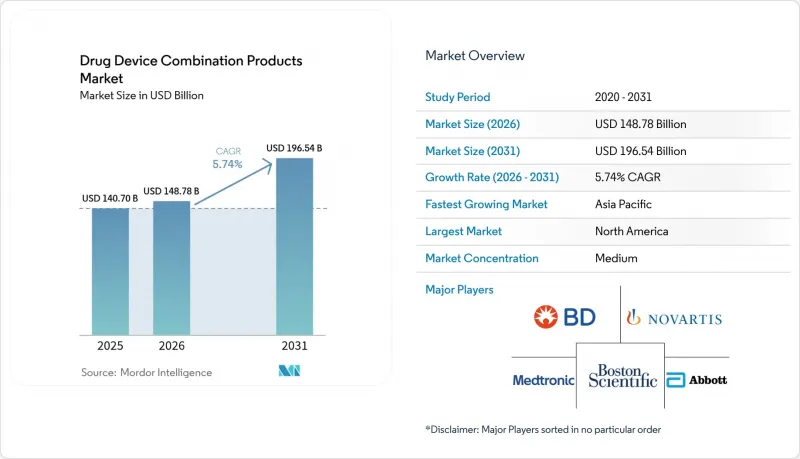
본 보고서는 제품별(약물 방출 스텐트, 경피 흡수 패치, 주입 펌프, 기타), 용도별(심혈관 질환, 당뇨병, 암 치료, 기타), 최종 사용자별(병원 및 클리닉, 기타), 투여 경로별(경구, 비경구, 기타), 지역별(북미, 유럽, 기타)로 분류되어 있습니다. 시장 예측은 금액(달러) 기준으로 제시되어 있습니다.
세계의 의약품 의료기기 복합 제품 시장 동향 및 인사이트
만성 질환의 부담 증가가 표적화된 병용 요법 수요를 견인
심혈관 질환은 전 세계적으로 6억 5,500만 명에게 영향을 미치고 있으며, 기계적 지원과 국소 약물 요법을 융합한 약물 방출형 스텐트 및 약물 코팅 풍선에 대한 수요를 뒷받침하고 있습니다. FDA 승인을 받은 AGENT 파클리탁셀 코팅 풍선은 코팅되지 않은 기기에 비해 주요 심혈관 이상 반응을 11.1% 감소시켜 통합 플랫폼의 임상적 우월성을 입증하고 있습니다. 연속 혈당 모니터링과 자동 인슐린 투여를 결합한 당뇨병 치료 솔루션은 현재 70%의 혈당 조절률을 달성하여 기존 치료법을 훨씬 능가하고 있습니다. 종양학 부문에서는 84%의 진단 정확도를 실현하고 재수술을 억제하는 ‘Lumisight’와 같은 수술 중 영상 약물 하이브리드 제품으로의 전환이 진행되고 있습니다. 이러한 사례들은 의약품 의료기기 복합 제품 시장의 혁신 기업들이 정밀 진단과 치료를 결합함으로써 장기적인 비용을 어떻게 절감하고 있는지를 보여줍니다.
급속한 고령화가 진행되며 자가 투여형 제제의 보급이 가속화되고 있습니다.
2030년까지 전 세계 65세 이상 인구는 7억 7,100만 명에 달할 것으로 예측되며, 손재주 저하를 보완해 주는 사용하기 쉬운 의료기기에 대한 수요가 높아지고 있습니다. Ypsomed의 ‘YpsoDose’와 같은 자동 주사기는 음성 및 시각적 신호를 통해 고령자의 사용을 지원하고 있습니다. 재택 간호 현장(이미 연평균 성장률(CAGR) 6.56%로 가장 빠르게 성장하고 있는 최종 사용자층)에서는 엔벡타(Envecta)사의 스마트폰 연동형 인슐린 시스템과 같은 패치 펌프가 활용되어, 환자가 안전하게 자가 투여를 할 수 있게 되었습니다. 실시간 복약 순응도 데이터는 만성 질환 환자의 절반에게 영향을 미치는 복약 순응도 저하 문제를 해결합니다. FDA의 인체공학 지침은 제조업체에 고령자가 처음부터 올바르게 사용할 수 있는 설계를 권장하고 있습니다.
다수의 기관에서 규정을 준수해야 하는 상황이 비용 증가와 지연을 초래합니다.
유럽의 MDR 및 IVDR 확대에 따라 문서화 부담이 증가하여, 이전 규제에 비해 승인까지 8-12개월이 소요되고 있습니다. 인증 기관의 심사로 인해 복합 의료기기 개발 기업의 규정 준수 비용은 25-40% 증가했습니다. FDA와 EMA의 분류 기준 차이로 인해 중복 연구가 불가피합니다. 한편, 아세안(ASEAN)의 조화 노력에도 불구하고 아시아태평양에서는 여전히 규제가 분열된 상태가 지속되고 있습니다. 상호 인정 제도가 없어 기업들은 별도의 품질 관리 시스템을 유지해야 하며, 이로 인해 간접비가 증가하여 의약품 의료기기 복합 제품 시장에서 새로운 치료법의 세계 진출이 지연되고 있습니다.
부문 분석
약물 방출형 스텐트는 재협착 감소에 관한 수십 년에 걸친 증거를 반영하여, 2025년에는 24.10%의 점유율로 1위를 유지했습니다. 폴리머 기술의 지속적인 발전으로 약물 방출 기간이 180일을 넘어 연장됨에 따라, 의약품 의료기기 복합 제품 시장에서 이 부문의 우위가 유지되고 있습니다. 한편, 프리필드 주사기는 바이오의약품 사용량이 증가하고 스마트 센서가 지불자를 위해 주사 기록을 남기게 됨에 따라 2031년까지 연평균 성장률(CAGR) 6.21%를 기록할 전망입니다. 연결 규격이 성숙해지고, 가치 기반 의료(Value-Based Care)에서 복약 순응도 추적이 중요하게 평가됨에 따라, 프리필드 시스템 분야의 의약품 의료기기 복합 제품 시장 규모는 현저히 확대될 것으로 예측됩니다.
경피 흡수 패치는 현재 고분자 물질 투여에 마이크로니들을 채택하고 있으며, 체중 감량 요법 부문으로 확대되고 있습니다. 오토인젝터는 인체공학적 개선을 통해 성장을 이루고 있는 반면, 웨어러블 인젝터는 기저 인슐린 투여를 눈에 띄지 않는 패치형 경험으로 변화시키고 있습니다. 모바일 앱과 연동되는 커넥티드 흡입기는 기존 기기에 비해 천식 관리 점수를 43% 개선했습니다. 보스턴 사이언티피크가 인터라 종양학을 인수함에 따라, 간동맥암에 대한 점적 투여용 주입 펌프가 소형화되어 의약품 의료기기 복합 제품 시장에서 해당 기업의 입지를 강화하고 있습니다.
심혈관 치료는 약물 방출형 스텐트, 코팅 풍선, 부정맥 관리용 임플란트를 주력 제품으로 하여 2025년 매출의 35.02%를 차지했습니다. 펄스 필드 절제술은 심장 치료의 새로운 개척 분야로, 이 부문은 의약품 의료기기 복합 제품 시장에서 주력 분야로 자리매김하고 있습니다. 한편, 통증 관리 부문은 이식형 신경 조절 요법이 오피오이드 이외의 대안을 제공하고 보험 적용 범위도 확대됨에 따라 연평균 성장률(CAGR) 6.31%의 성장 궤도에 올라 있습니다. 만성 통증 유병률이 증가함에 따라, 신경 조절 시스템 분야의 의약품 의료기기 복합 제품 시장 규모는 급속히 확대될 것으로 예측됩니다.
당뇨병 부문은 센서와 펌프를 결합한 생태계를 통해 견조한 성장세를 유지하고 있습니다. 호흡기 질환 부문에서는 디지털 흡입기 및 폐고혈압용 신약이 기여하고 있습니다. 종양학 부문은 약물 투여 위치에 대한 즉각적인 피드백을 얻을 수 있는 영상 유도형 약물 전달 방식으로 전환되고 있습니다. 비만 치료용 임플란트와 정신 건강용 패치는 의약품 의료기기 복합 제품 산업을 더욱 다각화할 가능성이 있는 신흥 카테고리입니다.
지역별 분석
북미는 FDA의 명확한 규제 체계와 높은 의료비 지출에 힘입어 2025년에는 전 세계 매출의 40.12%를 차지했습니다. 존슨앤드존슨이 125억 달러에 쇼크웨이브 메디컬을 인수하는 등 대규모 M&A는 심장 중재 시술 부문의 포트폴리오를 확충하여 이 지역의 우위를 더욱 공고히 하고 있습니다. 디지털 헬스 부문에서의 제휴가 활발해지면서, 연결형 혈당 모니터링 생태계 구축을 가능하게 하고, 의약품 의료기기 복합 제품 시장의 기반을 더욱 공고히 하고 있습니다.
아시아태평양은 2031년까지 연평균 성장률(CAGR) 6.66%로 가장 높은 성장률을 보일 전망입니다. 중국, 인도, 베트남의 제조 클러스터를 통해 무균 조립 비용이 대폭 절감되는 한편, 아세안(ASEAN) 의료기기 지침과 같은 노력을 통해 국경 간 등록 절차가 효율화되고 있습니다. 각국 정부는 연구개발(R&D)에 대한 자금 지원 및 세제 혜택 조치를 시행하고 있으며, 지역 내 CDMO(위탁 개발·제조 기관)가 전 세계 아웃소싱 계약을 수주함으로써 시장 진출 범위를 확대되고 있습니다. 싱가포르와 한국은 효율적인 윤리 심사 절차를 통해 임상시험 활동을 유치하고 있습니다.
유럽에서는 MDR(의료기기 규정)과 관련된 행정 절차가 있음에도 불구하고 완만한 진전이 이어지고 있습니다. 독일, 스위스, 아일랜드의 혁신 허브는 커넥티드 흡입기 및 디지털 신경 조절 부문을 주도하고 있습니다. 민관 협력을 통해 데이터 활용형 의료기기에 대한 보험 급여를 통합하는 시범 프로그램이 지원되고 있으며, 이 지역은 의약품 의료기기 복합 제품 산업에서 여전히 필수적인 존재로 자리 잡고 있습니다.
기타 혜택
- 엑셀 형식 시장 예측(ME) 시트
- 3개월간의 애널리스트 지원
자주 묻는 질문
목차
제1장 서론
제2장 조사 방법
제3장 주요 요약
제4장 시장 구도
제5장 시장 규모 및 성장 예측
제6장 경쟁 구도
제7장 시장 기회 및 향후 전망
AJY 26.09.11According to Mordor Intelligence, the drug device combination products market size was valued at USD 140.7 billion in 2025 and estimated to grow from USD 148.78 billion in 2026 to reach USD 196.54 billion by 2031, at a CAGR of 5.74% during the forecast period (2026-2031).
This report is Segmented by Product (Drug-Eluting Stents, Transdermal Patches, Infusion Pumps, and More), Application (Cardiovascular Diseases, Diabetes, Cancer Therapy, and More), End-User (Hospitals and Clinics, and More), Route of Administration (Oral, Parenteral, and More), and Geography (North America, Europe, and More). The Market Forecasts are Provided in Terms of Value (USD).
Global Drug Device Combination Products Market Trends and Insights
Growing Burden of Chronic Illnesses Driving Demand for Targeted Combination Therapies
Cardiovascular disease affects 655 million people worldwide, sustaining demand for drug-eluting stents and drug-coated balloons that unite mechanical support with localized pharmacotherapy. The FDA-cleared AGENT paclitaxel-coated balloon cut major adverse cardiac events by 11.1% versus uncoated devices, reinforcing the clinical edge of integrated platforms . Diabetes solutions that couple continuous glucose monitoring with automated insulin dosing now achieve 70% glycemic-control rates, far higher than traditional regimens. Oncology is moving toward intra-operative imaging-drug hybrids such as Lumisight, which delivers 84% diagnostic accuracy and limits repeat surgeries. These examples show how drug device combination products market innovators lower long-term costs by pairing precision diagnostics with therapy .
Rapidly Ageing Population Boosting Uptake of Self-Administered Delivery Formats
The global population aged 65+ will reach 771 million by 2030, amplifying need for easy-to-use devices that offset declining dexterity. Autoinjectors like Ypsomed's YpsoDose use audio-visual cues to aid seniors. Home care settings-already the fastest-growing end-user at a 6.56% CAGR-benefit from patch pumps such as Embecta's smartphone-enabled insulin system that lets patients treat themselves safely. Real-time adherence data address non-compliance, which affects half of chronic-disease patients. The FDA's human-factors guidance steers manufacturers toward designs that older adults can use correctly on first attempt.
Multicentre Regulatory Compliance Adds Cost & Delays
Europe's MDR and IVDR expansions raise documentation burdens, adding 8-12 months to approvals versus earlier rules. Notified-body reviews elevate compliance costs 25-40% for combination developers. Divergent FDA-EMA classifications force duplicate studies, while Asia-Pacific remains fragmented despite ASEAN harmonization efforts. Without mutual recognition, firms must maintain separate quality systems, inflating overhead and slowing global roll-out of novel therapies within the drug device combination products market.
Other drivers and restraints analyzed in the detailed report include:
- Breakthroughs in Minimally-Invasive & Smart Delivery Platforms
- US FDA's Expedited Combo-Product Pathways Shortening Time-to-Market
- High Recall Rates Linked to Sterility / Dose Accuracy
For complete list of drivers and restraints, kindly check the Table Of Contents.
Segment Analysis
Drug-eluting stents retained leadership with a 24.10% share in 2025, reflecting decades of evidence for reduced restenosis. Continued polymer advances extend drug elution beyond 180 days, preserving the segment's dominance in the drug device combination products market. Prefilled syringes, however, are charting a 6.21% CAGR through 2031 as biologics volumes climb and smart sensors log injection events for payers. The drug device combination products market size for prefilled systems is projected to climb markedly as connectivity standards mature and value-based care rewards adherence tracking.
Transdermal patches now use microneedles for macromolecules, expanding into weight-loss therapies. Autoinjectors grow on ergonomic refinements, while wearable injectors turn basal-insulin delivery into a discreet patch experience. Connected inhalers that pair with mobile apps improved asthma-control scores 43% versus conventional devices. Infusion pumps miniaturize for hepatic-artery cancer infusions following Boston Scientific's Intera Oncology buy, strengthening its presence inside the drug device combination products market.
Cardiovascular therapies claimed 35.02% of 2025 revenue, anchored by drug-eluting stents, coated balloons, and rhythm-management implants. Pulsed-field ablation represents the next cardiac frontier and keeps the segment a mainstay in the drug device combination products market. Pain management, however, is on a 6.31% CAGR path as implantable neuromodulation offers a non-opioid alternative and garners insurance coverage. The drug device combination products market size for neuromodulation systems is projected to rise quickly as chronic-pain prevalence climbs.
Diabetes maintains robust momentum through sensor-pump ecosystems. Respiratory disorders benefit from digital inhalers and novel formulations for pulmonary hypertension. Oncology is shifting toward imaging-guided drug delivery that provides immediate feedback on therapeutic placement. Obesity implants and mental-health patches represent emerging categories that could further diversify the drug device combination products industry.
Complete Report Scope:
- By Product
- Drug-Eluting Stents
- Transdermal Patches
- Infusion Pumps
- Drug-Coated Balloons
- Inhalers
- Prefilled Syringes
- Wearable Injectors
- Autoinjectors
- Others
- By Application
- Cardiovascular Diseases
- Diabetes
- Cancer Therapy
- Respiratory Disorders
- Pain Management
- Others
- By End-User
- Hospitals and Clinics
- Ambulatory Surgical Centers
- Home Care Settings
- Others
- By Route of Administration
- Oral
- Parenteral
- Transdermal
- Implantable
- Others
- By Geography
- North America
- United States
- Canada
- Mexico
- Europe
- Germany
- United Kingdom
- France
- Italy
- Spain
- Rest of Europe
- Asia-Pacific
- China
- Japan
- India
- Australia
- South Korea
- Rest of Asia-Pacific
- Middle East and Africa
- GCC
- South Africa
- Rest of Middle East and Africa
- South America
- Brazil
- Argentina
- Rest of South America
- North America
Geography Analysis
North America contributed 40.12% of global revenue in 2025, supported by the FDA's clear regulatory architecture and high healthcare spending. Large acquisitions, such as Johnson & Johnson's USD 12.5 billion Shockwave Medical buy, augment cardiac-intervention portfolios and reinforce regional dominance. Digital-health partnerships flourish, enabling connected glucose-monitoring ecosystems that further entrench the drug device combination products market.
Asia-Pacific delivers the fastest 6.66% CAGR through 2031. Manufacturing clusters in China, India, and Vietnam slash sterile-assembly costs, while initiatives like the ASEAN Medical Device Directive streamline cross-border registration. Governments fund R&D tax incentives, and regional CDMOs win global outsourcing contracts, broadening market reach. Singapore and South Korea attract clinical-trial activity through efficient ethics-approval cycles.
Europe continues moderate progress despite MDR-related paperwork. Innovation hubs in Germany, Switzerland, and Ireland lead in connected inhalers and digital neuromodulation. Public-private alliances support pilot programs that integrate reimbursement for data-enabled devices, keeping the region integral to the drug device combination products industry.
- Abbott Laboratories
- Medtronic
- Boston Scientific
- Johnson & Johnson
- Novartis
- GlaxoSmithKline
- Beckton Dickinson
- Terumo
- Stryker
- W. L. Gore & Associates
- Abbvie
- Viatris
- Cook Group
- Hisamitsu Pharmaceutical
- Teva Pharmaceutical Industries
- Solventum
- Phillips-Medisize
- Ypsomed
- AstraZeneca
- Novo Nordisk
Additional Benefits:
- The market estimate (ME) sheet in Excel format
- 3 months of analyst support
TABLE OF CONTENTS
1 Introduction
- 1.1 Study Assumptions & Market Definition
- 1.2 Scope of the Study
2 Research Methodology
3 Executive Summary
4 Market Landscape
- 4.1 Market Overview
- 4.2 Market Drivers
- 4.2.1 Growing Burden Of Chronic Illnesses Driving Demand for Targeted Combination Therapies
- 4.2.2 Rapidly Ageing Population Boosting Uptake of Self-Administered Delivery Formats
- 4.2.3 Breakthroughs In Minimally-Invasive & Smart Delivery Platforms
- 4.2.4 US FDA's Expedited Combo-Product Pathways Shortening Time-To-Market
- 4.2.5 Connected Inhalers & Patches Enabling Payer-Mandated Adherence Analytics
- 4.2.6 Low-Cost Sterile Assembly Capacity Scaling Up Across Asia Lowers ASPs.
- 4.3 Market Restraints
- 4.3.1 Multicentre Regulatory Compliance Adds Cost & Delays
- 4.3.2 High Recall Rates Linked to Sterility / Dose Accuracy
- 4.3.3 Tight Supply of Specialty Polymers Compatible with Apis
- 4.3.4 Absence Of Unified Reimbursement Codes for Digital Combo Devices
- 4.4 Regulatory Landscape
- 4.5 Technological Outlook
- 4.6 Porters Five Forces Analysis
- 4.6.1 Threat of New Entrants
- 4.6.2 Bargaining Power of Buyers
- 4.6.3 Bargaining Power of Suppliers
- 4.6.4 Threat of Substitutes
- 4.6.5 Intensity of Rivalry
5 Market Size & Growth Forecasts (Value, USD)
- 5.1 By Product
- 5.1.1 Drug-Eluting Stents
- 5.1.2 Transdermal Patches
- 5.1.3 Infusion Pumps
- 5.1.4 Drug-Coated Balloons
- 5.1.5 Inhalers
- 5.1.6 Prefilled Syringes
- 5.1.7 Wearable Injectors
- 5.1.8 Autoinjectors
- 5.1.9 Others
- 5.2 By Application
- 5.2.1 Cardiovascular Diseases
- 5.2.2 Diabetes
- 5.2.3 Cancer Therapy
- 5.2.4 Respiratory Disorders
- 5.2.5 Pain Management
- 5.2.6 Others
- 5.3 By End-User
- 5.3.1 Hospitals and Clinics
- 5.3.2 Ambulatory Surgical Centers
- 5.3.3 Home Care Settings
- 5.3.4 Others
- 5.4 By Route of Administration
- 5.4.1 Oral
- 5.4.2 Parenteral
- 5.4.3 Transdermal
- 5.4.4 Implantable
- 5.4.5 Others
- 5.5 By Geography
- 5.5.1 North America
- 5.5.1.1 United States
- 5.5.1.2 Canada
- 5.5.1.3 Mexico
- 5.5.2 Europe
- 5.5.2.1 Germany
- 5.5.2.2 United Kingdom
- 5.5.2.3 France
- 5.5.2.4 Italy
- 5.5.2.5 Spain
- 5.5.2.6 Rest of Europe
- 5.5.3 Asia-Pacific
- 5.5.3.1 China
- 5.5.3.2 Japan
- 5.5.3.3 India
- 5.5.3.4 Australia
- 5.5.3.5 South Korea
- 5.5.3.6 Rest of Asia-Pacific
- 5.5.4 Middle East and Africa
- 5.5.4.1 GCC
- 5.5.4.2 South Africa
- 5.5.4.3 Rest of Middle East and Africa
- 5.5.5 South America
- 5.5.5.1 Brazil
- 5.5.5.2 Argentina
- 5.5.5.3 Rest of South America
- 5.5.1 North America
6 Competitive Landscape
- 6.1 Market Concentration
- 6.2 Market Share Analysis
- 6.3 Company Profiles (includes Global level Overview, Market level overview, Core Segments, Financials as available, Strategic Information, Market Rank/Share for key companies, Products & Services, and Recent Developments)
- 6.3.1 Abbott Laboratories
- 6.3.2 Medtronic plc
- 6.3.3 Boston Scientific Corporation
- 6.3.4 Johnson & Johnson
- 6.3.5 Novartis AG
- 6.3.6 GlaxoSmithKline plc
- 6.3.7 Becton, Dickinson and Company
- 6.3.8 Terumo Corporation
- 6.3.9 Stryker Corporation
- 6.3.10 W. L. Gore & Associates, Inc.
- 6.3.11 AbbVie
- 6.3.12 Viatris Inc. (Mylan)
- 6.3.13 Cook Medical
- 6.3.14 Hisamitsu Pharmaceutical
- 6.3.15 Teva Pharmaceutical Industries
- 6.3.16 Solventum
- 6.3.17 Phillips-Medisize
- 6.3.18 Ypsomed AG
- 6.3.19 AstraZeneca plc
- 6.3.20 Novo Nordisk
7 Market Opportunities & Future Outlook
- 7.1 White-space & Unmet-Need Assessment


