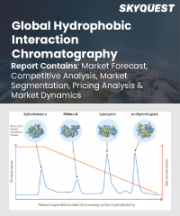
|
시장보고서
상품코드
2123667
소수성 상호작용 크로마토그래피 시장 : 점유율 분석, 업계 동향과 통계, 성장 예측(2026-2031년)Hydrophobic Interaction Chromatography - Market Share Analysis, Industry Trends & Statistics, Growth Forecasts (2026 - 2031) |
||||||
 Mordor Intelligence
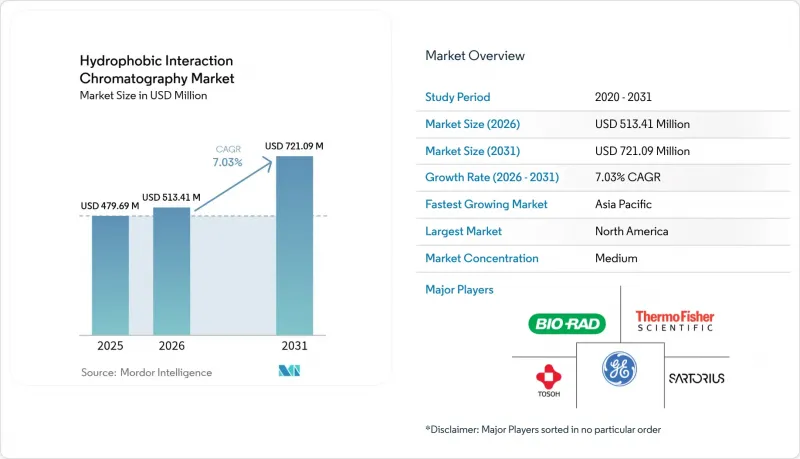
Mordor Intelligence에 의하면, 소수성 상호작용 크로마토그래피(HIC) 시장 규모는 2025년 4억 7,969만 달러에서 2026년에는 5억 1,341만 달러로 확대되어 2026년부터 2031년까지 CAGR 7.03%로 성장을 지속하여, 2031년까지 7억 2,109만 달러에 이를 것으로 예측됩니다.
본 보고서는 제품별(컬럼(축류식, 방사류식) 및 수지(아가로스계 등)), 기술별(기존 HIC 등),샘플 유형별(단일클론 항체, 항체-약물 복합체 등), 최종 사용자(제약 및 바이오의약품 기업 등), 지역(북미, 유럽 등)별로 분류되어 있습니다. 시장 규모 및 전망은 금액(달러)으로 표시되어 있습니다.
세계 소수성 상호작용 크로마토그래피 시장 동향 및 인사이트
단일클론 항체 수요 증가
항체 역가의 상승으로 인해 상업용 바이오리액터의 평균 생산량은 5 g/L를 초과하여, 이로 인해 다운스트림 공정의 병목 현상이 심화되고 있습니다. 현재 이 과제를 해결할 수 있는 것은 검증된 견고성을 갖춘 소수성 상호작용 크로마토그래피(HIC) 워크플로우뿐입니다. 제조 경제성 분석에 따르면, 정제 공정이 총 제조 비용의 80%를 차지하는 경우도 있어, 제품 품질을 유지하면서 HIC 공정의 수를 줄이고 처리 능력을 높이는 데 경영진의 관심이 높아지고 있습니다. 후지필름이 노스캐롤라이나주에서 추진하는 12억 달러 규모의 확장 계획만 보더라도, 항체 전용으로 16만 리터의 생산 능력이 추가됨에 따라 HIC용 수지 및 컬럼에 대한 지역적 수요가 즉시 증가하고 있습니다. 호스트 세포 단백질의 규격이 100ppm 미만으로 낮아지는 추세에 따라, HIC의 정제 능력은 공정 인증의 최종 단계에서 필수적인 요소가 되고 있습니다. 이러한 파급 효과로 인해, 중기 계획 주기 동안 소수성 상호작용 크로마토그래피 시장 공급업체들은 안정적인 두 자릿수 매출 성장을 기록할 것으로 예측됩니다.
전 세계 바이오의약품 생산 능력의 급증
아시아태평양 각국 정부는 GMP 공장에 대한 우대 조치를 시행하고 있으며, 이 지역의 스테인리스 스틸 사용량은 다른 어느 지역보다 빠르게 증가하고 있습니다. 이로 인해 정제 인프라에는 지속적인 수요 격차가 발생하고 있습니다. 삼성바이오로직스와 롯데바이오로직스는 대규모 시설에 총 48억 달러 이상을 투자하고 있으며, 양사 모두 대규모 HIC 스위트를 갖춘 최첨단 다운스트림 홀을 핵심으로 하는 시설을 건설하고 있습니다. 의약품 검사 협력 체계(PICS)에 따른 표준화가 진전되면서 사양의 모호성이 해소되고 있어, 구매자들은 최저 비용의 구형 장비가 아닌 고성능 소수성 크로마토그래피 시장을 겨냥한 장비를 자유롭게 선택할 수 있게 되었습니다. Cytiva의 인천 신공장 등 컬럼 및 수지의 현지 생산을 통해 리드 타임 단축과 환율 리스크 저감이 도모되고 있어, 다국적 기업들은 조달처를 이 지역으로 재조정하고 있습니다. 그 결과, 생산 능력 증대가 수지 수요 증가와 직결되어, 소수성 상호작용 크로마토그래피 업계의 수익 기반을 강화하고 있습니다.
다운스트림 처리 분야의 숙련된 인력 부족
인더스트리 4.0 추진에는 데이터 사이언스 역량이 필수적이지만, 이러한 인력은 여전히 부족하여 기업이 연속식 HIC 라인을 도입할 때 임금 상승이나 프로젝트 지연을 초래하고 있습니다. Python이나 R과 같은 프로그래밍 언어는 현재 크로마토그래피 데이터 처리에 있어 기본 요건이 되었지만, 이러한 기술을 갖춘 공정 엔지니어는 극히 일부에 불과하여 검증 기간이 장기화되고 있습니다. 파일럿 규모에서는 인건비가 원자재비를 훨씬 웃돌기 때문에 인력 부족은 영업이익률을 직접적으로 압박하고 있으며, 소수성 상호작용 크로마토그래피 시장의 신규 도입을 지연시키고 있습니다. 벤더가 주최하는 교육 프로그램이 인력 부족을 부분적으로 보완하고 있지만, 신흥 시장에서의 설비 확충 속도는 여전히 인재 양성 속도를 앞지르고 있어, 이로 인해 단기적인 보급이 둔화될 가능성이 있습니다. 교육 과정이 발전하기 전까지는 기술 부족이 소수성 상호작용 크로마토그래피 시장의 성장세를 즉각적으로 억제하는 요인이 될 것입니다.
부문 분석
2025년 매출의 40.62%를 차지하는 컬럼이 주류를 이루는 이유는 최종 사용자가 검증된 자동화 스크립트와 호환성이 뛰어나고 수정 없이 규제 당국의 신청 요건을 충족하는 장비를 선호하기 때문입니다. 대구경 축방향 구성이 여전히 대량 도입의 주류를 이루고 있지만, 처리 능력과 압력 손실의 상충 관계가 경제성을 좌우하는 상황에서는 방사형 설계의 인기가 높아지고 있습니다. 최종 사용자는 견고한 충전재 무결성 시험과 검증된 세척 프로토콜을 중시하며, 다른 장비가 더 높은 용량을 내세운다 하더라도 정평이 난 컬럼 브랜드를 선택합니다. 따라서 소수성 상호작용 크로마토그래피 시장은 기존 설치 형태를 중심으로 형성되어 있습니다. 또한 컬럼은 제3자 스키드 통합업체가 구축한 광범위한 네트워크의 혜택을 받아, 여러 공장에 걸친 조달 및 검증 절차를 간소화하고 있습니다. 그 결과, 규모 안정성과 익숙한 제어 인터페이스 덕분에 운영자의 교육 부담이 줄어들어, 심각한 인력 부족 상황에서 결정적인 요인이 되고 있습니다. 막 모듈이 소량 생산 공정에서 점차 점유율을 확대하고 있지만, 배치 크기가 2,000 L를 초과하는 경우 수지 재사용을 통해 장기적인 캠페인 기간 동안 설비 투자를 상각할 수 있기 때문에 컬럼이 여전히 표준적인 선택지로 남아 있습니다. 수지 내부의 확산에 따른 제약이 여전히 유속의 상한을 결정하고 있지만, 각 공급업체들은 현재 시스템의 유체역학적 특성을 변경하지 않고도 체적 생산성을 두 배로 높이기 위해 비드 구조를 최적화하고 있습니다. 규제 당국이 하드웨어의 전면적인 교체에 대해 신중한 입장을 유지하고 있기 때문에 인접한 형식이 보급되더라도 컬럼은 소수성 상호작용 크로마토그래피 시장에서 계속해서 중심적인 위치를 차지할 것입니다.
수지는 저염 농도에서 선택성 향상을 목표로 하는 혼합 모드 리간드의 급속한 보급으로 인해 연평균 성장률(CAGR) 9.52%라는 가장 높은 성장 궤도를 보이고 있습니다. 아갈로스 매트릭스는 생체 적합성을 무기로 높은 시장 점유율을 차지하고 있는 반면, 폴리머 비드는 알칼리 세척이나 고압 처리가 요구되는 분야에서 입지를 다지고 있습니다. 각 제조업체는 ESG 보고 의무에 따라 합성 경로를 단축하고, 리드 타임을 단축하며, 탄소 강도를 낮추는 리간드 화학에 막대한 투자를 하고 있습니다. 퓨로라이트(Purolite)사가 펜실베이니아주에 건설한 1억 5,000만 달러 규모의 아가로스 수지 제조 거점은 북미 내 현지 공급을 대폭 확대하고, 지정학적 리스크를 저감하는 동시에 지역 창고망을 통해 서비스 수준을 향상시킬 것입니다. 구매자들은 이러한 탄력성에 대해 수량과 가격을 고정하는 다년간의 이중 조달 계약으로 보답하고 있으며, 이로 인해 소모품 조달 팀에게 소수성 상호작용 크로마토그래피 시장 규모는 안정적입니다. 업스트림 공정의 밀도가 계속 높아지는 가운데, 동적인 생산 능력이 조달 평가 지표로 자리 잡고 있으며, 따라서 수지 혁신은 소수성 상호작용 크로마토그래피의 총 잠재 시장을 형성하는 결정적인 변수로 남아 있습니다.
수십 년에 걸친 공정 특성 평가 데이터와 풍부한 규제상의 선례가 존재합니다. 공정 이전의 위험은 여전히 낮으며, 그 신뢰성 덕분에 품질 관리 팀은 익숙한 염도 구배 워크플로우를 계속 유지하기로 선택하고 있습니다. 기존 바이오의약품 포트폴리오의 검증 문서는 신제품의 템플릿으로도 활용되어, 이를 통해 개발 일정을 단축하고 컨설팅 비용을 절감하고 있습니다. 따라서 소수성 상호작용 크로마토그래피 시장은 페닐이나 부틸과 같은 확립된 리간드에 의존하고 있으며, 이러한 리간드의 견고성은 여러 주기의 세척 프로토콜 하에서 충분히 이해되고 있습니다. 전환 비용은 소모품에 그치지 않고 전자 배치 기록의 모든 항목에 영향을 미치기 때문에 재무 팀은 프로세스의 전면적인 재설계보다는 단계적인 프로세스 강화를 선호하는 경향이 있습니다. 연속식 설계 내에서도 기존의 충전층은 전환 밸브 매트릭스에 원활하게 통합되어 있어, 이를 통해 기존의 도입 기반이 더욱 보호됩니다.
소수성-전하 유도 크로마토그래피(HCIC)는 소수성 상호작용과 정전기적 상호작용을 결합하여, 개발자가 중성에 가까운 pH에서 불안정한 유효 성분을 용출할 수 있게 해주기 때문에 가장 빠르게 성장하고 있는 기술입니다. 바이러스 벡터 및 ADC 제품에 대한 규제 당국에의 신청 사례가 증가하고 있어, 후기 단계에서 예상치 못한 문제를 방지하는 품질 관리 부문에 대한 신뢰도 높아지고 있습니다. 단백질 연구자들은 HCIC가 극단적인 염 농도나 pH를 필요로 하지 않으면서도 미세한 글리코폼의 차이를 규명할 수 있다는 점을 높이 평가했습니다. 이를 통해 제품의 열화를 방지하고 효능을 유지할 수 있기 때문입니다. 현재 각 공급업체는 예측 시뮬레이션 도구를 제공하고 있으며, 수지 스크리닝 기간을 수개월에서 수주로 단축함으로써 개발 일정이 촉박한 상황에서도 소수성 상호작용 크로마토그래피의 이용 사례를 확대되고 있습니다. 점점 더 많은 바이오의약품 기업들이 고도로 변형된 항체 골격으로 전환함에 따라, HCIC의 차별화된 선택성은 재주문을 확보하고 플랫폼으로서의 채택으로 가는 길을 열어주고 있습니다.
지역별 분석
북미는 2025년 매출의 37.12%를 차지하고 있으며, 혁신 기업, 수탁 제조업체, 도구 공급업체가 다수 존재합니다. 이러한 기업들이 인근에 밀집해 있어 공급망이 단축되고 서비스 대응 속도가 향상되고 있습니다. 미국 식품의약국(FDA)은 연속 제조를 권장하고 있습니다. FDA는 인라인 모니터링에 대한 기대치를 명확히 하는 지침을 발표했으며, 이를 통해 파일럿 단계 및 상업 생산 현장에서 막 기반 연속 HIC를 채택하는 기업들을 뒷받침하고 있습니다. 미국 연방 정부의 인센티브(최근 생물제제 인프라에 대한 세액 공제 등)는 실질적인 자본 비용을 절감하여, 고처리량 컬럼 스키드에 대한 수주를 뒷받침하고 있습니다. 캐나다는 항체 제조 시설에 대한 보완적 투자를 추진하고 있는 반면, 멕시코는 지역적인 충전 및 마무리 허브를 구축하여 수지 수요를 증가시키고 있습니다. 이러한 네트워크가 상호 연계됨에 따라 국경을 넘는 물류로 리드 타임이 단축되어, 소수성 상호작용 크로마토그래피(HIC) 시장의 기반이 더욱 견고해지고 있습니다.
유럽은 유럽의약품청(EMA)의 조화로운 프레임워크에 힘입어 여전히 강력한 시장을 유지하고 있습니다. 이 프레임워크는 새로운 정제 기술에 대한 신속한 상호 승인을 촉진하고 있습니다. 독일의 생명공학 클러스터 집중과 탄소 배출 감축 목표가 맞물리면서, 공급업체들은 ISO 14064 보고에 적합한 저용매 HIC 워크플로우를 설계해야 하는 압박을 받고 있습니다. 영국은 브렉시트 이후 생명과학 분야의 위상을 유지하기 위해 첨단 치료법 신청을 신속하게 처리하고 있습니다. 이 중 상당수는 바이러스 벡터의 정제가 필요하며, 여기서 HIC가 핵심적인 역할을 수행하고 있습니다. 남유럽 국가들은 EU 부흥 기금을 활용하여 바이오의약품 제조 공장의 현대화를 추진하고 있으며, 수출 품질 기준을 충족하기 위해 자동화된 HIC 공정을 도입하고 있습니다. 또한 환경·사회·지배구조(ESG) 규제로 인해 제조업체들은 화학적 발자국이 작은 수지를 채택할 수밖에 없으며, 이는 해당 지역의 소수성 상호작용 크로마토그래피(HIC) 업계 동향을 더욱 형성하고 있습니다.
아시아태평양은 중국, 인도, 한국이 바이오의약품 자급자족을 확보하고 수탁 제조 수요를 확보하기 위해 경쟁하는 가운데, 10.85%라는 가장 높은 연평균 성장률(CAGR)을 기록하고 있습니다. 삼성바이오로직스와 롯데바이오로직스가 대표하는 대규모 캠퍼스형 프로젝트는 업스트림 공정, 다운스트림 공정, 충전 및 마무리 공정을 단일 거점으로 통합하여 수지 및 컬럼에 대한 장기적인 수요를 공고히 하고 있습니다. 각국 정부는 투자 회수 기간을 단축하기 위해 세제 혜택 및 가속 상각을 확대하고 있으며, 한편 현지 규제 당국은 ‘의약품 검사 협력 제도(PICS)’ 준수를 권장함으로써 수출 통관 절차를 원활하게 하고 있습니다. 일본의 혁신 기업들은 공정 개발에 엄격한 기준을 도입하고, 세계 공급업체와 협력하여 막식 HIC 솔루션의 시범 사업을 전개함으로써 지역 전체로 기술이 확산되도록 촉진하고 있습니다. 동남아시아 국가들에서는 소규모 다제품 대응 플랜트가 증가하고 있으며, 이로 인해 모듈식이며 납기 기간이 짧은 패키지를 제공하는 소수성 상호작용 크로마토그래피(HIC) 시장 공급업체들에게 고객 기반이 확대되고 있습니다.
기타 혜택:
- 엑셀 형식 시장 예측(ME) 시트
- 3개월간의 애널리스트 지원
자주 묻는 질문
목차
제1장 서론
제2장 조사 방법
제3장 주요 요약
제4장 시장 구도
제5장 시장 규모와 성장 예측
제6장 경쟁 구도
제7장 시장 기회와 향후 전망
JHS 26.09.07According to Mordor Intelligence, the hydrophobic interaction chromatography market size is expected to grow from USD 479.69 million in 2025 to USD 513.41 million in 2026 and is forecast to reach USD 721.09 million by 2031 at 7.03% CAGR over 2026-2031.
This report is Segmented by Product (Columns {Axial Flow, Radial Flow} and Resins {Agarose-Based and More), Technology (Classical HIC, and More), Sample Type (Monoclonal Antibodies, Antibody-Drug Conjugates, and More), End User (Pharma & Biopharma Companies, and More), and Geography (North America, Europe, and More). The Market Sizes and Forecasts are Provided in Terms of Value (USD).
Global Hydrophobic Interaction Chromatography Market Trends and Insights
Growing Demand for Monoclonal Antibodies
Rising antibody titers have moved average commercial bioreactor campaigns above 5 g/L, which intensifies downstream bottlenecks that only hydrophobic interaction chromatography market workflows currently address with proven robustness. Manufacturing economics reveal that purification at times consumes 80% of the total cost of goods, sharpening management focus on fewer, higher capacity HIC steps that retain product quality. Fujifilm's USD 1.2 billion North Carolina expansion alone adds 160,000 L dedicated to antibodies and immediately lifts regional demand for HIC resins and columns. Host-cell protein specifications trending below 100 ppm make the polishing power of HIC indispensable for late-stage process qualification. The knock-on effect is steady double-digit revenue visibility for hydrophobic interaction chromatography market suppliers through mid-term planning cycles.
Surge in Global Biopharma Manufacturing Capacity
Asia-Pacific governments are pouring incentives into GMP plants, and the region's stainless-steel volume is rising faster than anywhere else, opening a persistent gap for purification infrastructure.Samsung Biologics and Lotte Biologics together earmark more than USD 4.8 billion for large-scale facilities, each engineered around state-of-the-art downstream halls that feature sizable HIC suites. Harmonized standards under the Pharmaceutical Inspection Co-operation Scheme are eliminating specification ambiguity, so buyers are free to select higher-performance hydrophobic chromatography market equipment rather than the lowest-cost legacy gear. Local production of columns and resins, such as Cytiva's new plant in Incheon, reduces lead times and foreign-exchange exposure, prompting multinationals to re-balance sourcing toward the region. As a result, capacity increments translate directly to resin pull-through, strengthening the hydrophobic interaction chromatography industry revenue base.
Shortage of Skilled Downstream Processing Talent
Industry 4.0 initiatives mandate data-science competencies that remain scarce, driving wage inflation and project delays when firms roll out continuous HIC trains. Programming languages such as Python and R are now basic requirements for chromatography data handling, yet only a fraction of process engineers possess such skills, lengthening validation timelines. Labor costs outstrip raw-material spending by an order of magnitude at pilot scale, so unfilled roles directly dent operating margins and slow new hydrophobic interaction chromatography market installations. Vendor-hosted academies partially close gaps, but emerging-market buildouts still outpace talent development, which could temper near-term uptake. Until curricula evolve, the skills deficit will be an immediate drag on the hydrophobic interaction chromatography market momentum.
Other drivers and restraints analyzed in the detailed report include:
- Advances in High-Throughput HIC Resins & Columns
- Rising R&D Spending on Antibody-Drug Conjugates
- Availability of Alternative Chromatography Modes
For complete list of drivers and restraints, kindly check the Table Of Contents.
Segment Analysis
Columns dominate with 40.62% 2025 revenue because end-users favor equipment that pairs well with validated automation scripts and meets agency filings without amendments. Large axial configurations still headline high-volume installations, though radial designs gain popularity where throughput pressure drop trade-offs tilt economics. End-users lean on robust pack integrity testing and proven cleaning protocols, choosing established column brands even when alternate devices advertise higher capacity, thus anchoring the hydrophobic interaction chromatography market around legacy footprints. Columns also benefit from a wide network of third-party skid integrators, simplifying procurement and validation across multi-plant networks. In turn, scale stability and familiar control interfaces lessen operator training burdens, a decisive factor amid acute workforce shortages. Though membrane modules nibble at small-lot processes, columns remain the default when batch sizes exceed 2,000 L because resin reuse amortizes capital outlays over longer campaigns. Resin internal diffusion constraints continue to set flowrate ceilings, but suppliers are now optimizing bead architecture to double volumetric productivity without altering system hydraulics. As regulatory bodies stay cautious about wholesale hardware swaps, columns will remain centre-stage in the hydrophobic interaction chromatography market even as adjacent formats proliferate.
Resins underpin the highest growth trajectory at 9.52% CAGR due to rapid adoption of mixed-mode ligands pursuing better selectivity at lower salt. Agarose matrices command premium share on biocompatibility, while polymeric beads claim ground where alkaline cleaning or high pressure demands apply. Manufacturers channel heavy investment into ligand chemistry that uses shorter synthesis paths, cutting lead times and reducing carbon intensity in keeping with ESG reporting duties. Purolite's USD 150 million Pennsylvania site for agarose resin greatly enlarges North America's local supply, trims geopolitical risk, and elevates service levels through regional warehousing. Buyers reward such resilience with multi-year dual-sourcing agreements that lock volume and price, stabilizing the hydrophobic interaction chromatography market size for consumables sourcing teams. As upstream densities keep trending higher, dynamic capacity becomes the procurement scorecard; hence resin innovation remains the decisive variable that shapes the total addressable hydrophobic interaction chromatography market.
With decades of process characterization data and copious regulatory precedents. Process transfer risk remains low, and that reliability convinces quality leadership teams to stay with familiar salt-gradient workflows. Validation documentation from older biologics portfolios doubles as a template for new products, which compresses development calendars and curbs consulting spend. The hydrophobic interaction chromatography market, therefore, leans on established ligands like phenyl and butyl, whose robustness is thoroughly understood under multi-cycle cleaning regimens. Switching costs extend beyond consumables, touching every line in electronic batch records, so finance teams often prefer incremental process bolstering instead of full re-engineering. Even within continuous designs, classical packed beds nest comfortably inside switching valve matrices, further protecting their installed base.
Hydrophobic-charge induction chromatography is the fastest climber because it marries hydrophobic and electrostatic interactions, letting developers elute sensitive payloads at near-neutral pH. Its growing dossier of regulatory filings for viral vector and ADC products elevates confidence among quality functions that guard against late-stage surprises. Protein scientists appreciate HCIC for resolving subtle glycoform differences without extreme salt or pH, which avoids product degradation and preserves potency. Vendors now supply predictive simulation tools that shorten resin screening to weeks, not months, expanding the hydrophobic interaction chromatography market use case in strained development timelines. As more biopharmas pivot toward highly modified antibody scaffolds, HCIC's differentiated selectivity secures repeating orders and paves the way for platform adoption.
Complete Report Scope:
- By Product
- Columns
- Axial flow columns
- Radial flow columns
- Resins
- Agarose-based resins
- Polymer-based resins
- Silica-based resins
- Buffers
- Kosmotropic salts
- Additives & modifiers
- Columns
- By Technology
- Classical HIC
- Hydrophobic-Charge Induction Chromatography (HCIC)
- Mixed-mode HIC resins
- By Sample Type
- Monoclonal antibodies
- Antibody-drug conjugates
- Vaccines
- Viral vectors & gene-therapy products
- Other recombinant proteins
- By End-User
- Pharma & Biopharma Companies
- Contract Development & Manufacturing Orgs (CDMOs)
- Contract Research Organizations (CROs)
- Academic & Research Institutes
- By Geography
- North America
- United States
- Canada
- Mexico
- Europe
- Germany
- United Kingdom
- France
- Italy
- Spain
- Rest of Europe
- Asia Pacific
- China
- Japan
- India
- South Korea
- Australia
- Rest of Asia Pacific
- Middle East and Africa
- GCC
- South Africa
- Rest of Middle East and Africa
- South America
- Brazil
- Argentina
- Rest of South America
- North America
Geography Analysis
North America commands 37.12% of 2025 revenue and holds a deep bench of innovators, contract manufacturers, and tool suppliers whose proximity shortens supply chains and speeds service response. The Food and Drug Administration endorses continuous manufacturing. It publishes guidance that clarifies expectations for in-line monitoring, thereby emboldening adopters of membrane-based continuous HIC in pilot and commercial settings. United States federal incentives, including recent tax credits for biologics infrastructure, lower effective capital cost, and underpin orders for high-throughput column skids. Canada pursues complementary investments in antibody facilities, while Mexico advances regional fill-finish hubs that create incremental resin demand. As these networks interlink, cross-border logistics keeps lead times short and deepens the hydrophobic interaction chromatography market footprint.
Europe remains a powerhouse driven by the European Medicines Agency's harmonized framework, which facilitates quick mutual recognition of new purification technologies. Germany's concentration of biotech clusters, coupled with carbon-reduction targets, pushes suppliers to design low-solvent HIC workflows suited for ISO 14064 reporting. The United Kingdom safeguards its post-Brexit life-sciences status by fast-tracking advanced therapy applications, many requiring viral vector purification where HIC plays a central role. Southern European states leverage EU recovery funds to modernize biologics plants, inserting automated HIC steps to meet export quality tiers. Environmental, social, and governance (ESG) rules also force manufacturers to adopt resins with lower chemical footprints, further shaping the regional hydrophobic interaction chromatography industry narrative.
Asia-Pacific delivers the fastest 10.85% CAGR as China, India, and South Korea race to secure biopharma self-sufficiency and capture contract manufacturing flows. Massive campus-style projects, typified by Samsung Biologics and Lotte Biologics, integrate upstream, downstream, and fill-finish units in a single site, locking in long-term resin and column demand. Governments extend tax holidays and accelerated depreciation to shorten payback periods, while local regulators endorse Pharmaceutical Inspection Co-operation Scheme alignment, smoothing export clearance. Japanese innovators inject process-development rigor and collaborate with global suppliers to pilot membrane HIC solutions, seeding technology spill-overs region-wide. Southeast Asian nations add smaller multiproduct plants, thereby broadening customer bases for hydrophobic interaction chromatography market suppliers that offer modular, quick-turnaround packages.
- Bio-Rad Laboratories
- Danaher
- GE Healthcare Life Sciences
- Sartorius
- Thermo Fisher Scientific
- Merck KGaA (MilliporeSigma)
- Tosoh Bioscience LLC
- Waters Corporation
- Agilent Technologies
- Shimadzu
- YMC Co. Ltd.
- Sepax Technologies Inc.
- Repligen
- KNAUER Wissenschaftliche Gerate GmbH
- JNC
- Bio-Works Technologies AB
- Pall
- Phenomenex Inc.
- ChromaTan Corporation
- Daicel Chiral Technologies
Additional Benefits:
- The market estimate (ME) sheet in Excel format
- 3 months of analyst support
TABLE OF CONTENTS
1 Introduction
- 1.1 Study Assumptions & Market Definition
- 1.2 Scope of the Study
2 Research Methodology
3 Executive Summary
4 Market Landscape
- 4.1 Market Overview
- 4.2 Market Drivers
- 4.2.1 Growing Demand For Monoclonal Antibodies
- 4.2.2 Surge In Global Biopharma Manufacturing Capacity
- 4.2.3 Advances In High-Throughput HIC Resins & Columns
- 4.2.4 Rising R&D Spending On Antibody-Drug Conjugates
- 4.2.5 Continuous-Processing Adoption Needs HIC Membranes
- 4.2.6 Regulatory Push For Low-Salt Purification Workflows
- 4.3 Market Restraints
- 4.3.1 Shortage Of Skilled Downstream Processing Talent
- 4.3.2 Availability Of Alternative Chromatography Modes
- 4.3.3 High Cost Of Premium HIC Equipment & Consumables
- 4.3.4 Shift Toward Single-Use Affinity Membranes Bypassing HIC
- 4.4 Supply-Chain Analysis
- 4.5 Regulatory Landscape
- 4.6 Technological Outlook
- 4.6.1 Evolution of hydrophobic-charge induction chromatography
- 4.6.2 Radial-flow & membrane-based HIC platforms
- 4.7 Porter's Five Forces Analysis
- 4.7.1 Threat of New Entrants
- 4.7.2 Bargaining Power of Buyers
- 4.7.3 Bargaining Power of Suppliers
- 4.7.4 Threat of Substitutes
- 4.7.5 Intensity of Competitive Rivalry
5 Market Size & Growth Forecasts (Value)
- 5.1 By Product
- 5.1.1 Columns
- 5.1.1.1 Axial flow columns
- 5.1.1.2 Radial flow columns
- 5.1.2 Resins
- 5.1.2.1 Agarose-based resins
- 5.1.2.2 Polymer-based resins
- 5.1.2.3 Silica-based resins
- 5.1.3 Buffers
- 5.1.3.1 Kosmotropic salts
- 5.1.3.2 Additives & modifiers
- 5.1.1 Columns
- 5.2 By Technology
- 5.2.1 Classical HIC
- 5.2.2 Hydrophobic-Charge Induction Chromatography (HCIC)
- 5.2.3 Mixed-mode HIC resins
- 5.3 By Sample Type
- 5.3.1 Monoclonal antibodies
- 5.3.2 Antibody-drug conjugates
- 5.3.3 Vaccines
- 5.3.4 Viral vectors & gene-therapy products
- 5.3.5 Other recombinant proteins
- 5.4 By End-User
- 5.4.1 Pharma & Biopharma Companies
- 5.4.2 Contract Development & Manufacturing Orgs (CDMOs)
- 5.4.3 Contract Research Organizations (CROs)
- 5.4.4 Academic & Research Institutes
- 5.5 By Geography
- 5.5.1 North America
- 5.5.1.1 United States
- 5.5.1.2 Canada
- 5.5.1.3 Mexico
- 5.5.2 Europe
- 5.5.2.1 Germany
- 5.5.2.2 United Kingdom
- 5.5.2.3 France
- 5.5.2.4 Italy
- 5.5.2.5 Spain
- 5.5.2.6 Rest of Europe
- 5.5.3 Asia Pacific
- 5.5.3.1 China
- 5.5.3.2 Japan
- 5.5.3.3 India
- 5.5.3.4 South Korea
- 5.5.3.5 Australia
- 5.5.3.6 Rest of Asia Pacific
- 5.5.4 Middle East and Africa
- 5.5.4.1 GCC
- 5.5.4.2 South Africa
- 5.5.4.3 Rest of Middle East and Africa
- 5.5.5 South America
- 5.5.5.1 Brazil
- 5.5.5.2 Argentina
- 5.5.5.3 Rest of South America
- 5.5.1 North America
6 Competitive Landscape
- 6.1 Market Concentration
- 6.2 Market Share Analysis
- 6.3 Company Profiles (includes Global level Overview, Market level overview, Core Segments, Financials as available, Strategic Information, Market Rank/Share for key companies, Products & Services, Recent Developments)
- 6.3.1 Bio-Rad Laboratories Inc.
- 6.3.2 Danaher (Cytiva)
- 6.3.3 GE Healthcare Life Sciences
- 6.3.4 Sartorius AG
- 6.3.5 Thermo Fisher Scientific Inc.
- 6.3.6 Merck KGaA (MilliporeSigma)
- 6.3.7 Tosoh Bioscience LLC
- 6.3.8 Waters Corporation
- 6.3.9 Agilent Technologies Inc.
- 6.3.10 Shimadzu Corporation
- 6.3.11 YMC Co. Ltd.
- 6.3.12 Sepax Technologies Inc.
- 6.3.13 Repligen Corporation
- 6.3.14 KNAUER Wissenschaftliche Gerate GmbH
- 6.3.15 JNC Corporation
- 6.3.16 Bio-Works Technologies AB
- 6.3.17 Pall Corporation
- 6.3.18 Phenomenex Inc.
- 6.3.19 ChromaTan Corporation
- 6.3.20 Daicel Chiral Technologies
7 Market Opportunities & Future Outlook
- 7.1 White-space & Unmet-need Assessment