

|
시장보고서
상품코드
2123760
지역 난방 : 시장 점유율 분석, 업계 동향 및 통계, 성장 예측(2026-2031년)District Heating - Market Share Analysis, Industry Trends & Statistics, Growth Forecasts (2026 - 2031) |
||||||
 Mordor Intelligence
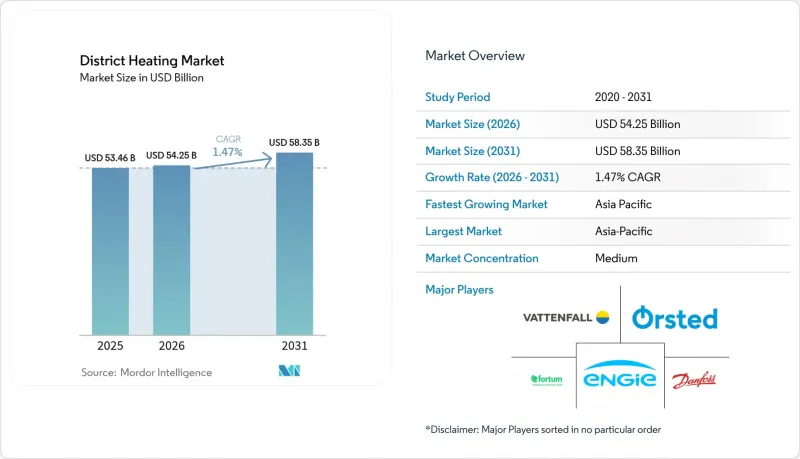
지역 난방 시장 규모는 2025년에 534억 6,000만 달러로 평가되었습니다. 2026년 542억 5,000만 달러에서 2031년까지 583억 5,000만 달러에 이를 것으로 예상되며, 예측 기간(2026-2031년) CAGR은 1.47%를 나타낼 전망입니다.
본 보고서는 플랜트 유형(보일러 플랜트, 열병합발전(CHP) 등), 열원(석탄, 천연가스 등), 용도(주거, 상업, 산업), 공급 온도대(고온, 저온 등) 및 지역별로 분류되어 있습니다. 본 보고서에서는 시장 전망 및 시장 규모(달러)를 제시하고 있습니다.
세계의 지역 난방 시장 동향 및 인사이트
EU 전역에서 화석 연료 보일러의 단계적 폐지 의무화가 개조 수요를 촉진하고 있습니다.
유럽연합(EU)의 석유 및 가스 보일러 금지 조치가 가속화되면서, 개조 수요가 지역 열공급 시장으로 유입되고 있습니다. 회원국들은 2030년까지 4,000만 가구 이상을 추가로 연결하는 것을 목표로 하고 있으며, 이를 통해 기존 가스 공급망의 ‘좌초 자산’ 위험을 줄이고 있습니다. 개별 히트펌프 설치에 공간적 제약이 있는 고밀도 도시 지역에서는 개조 프로그램이 특히 매력적입니다. 새로운 규정에 따라 대규모 데이터센터는 폐열을 도시 열공급망에 공급해야 할 의무가 부과되었으며, 이를 통해 부하의 다양화와 수익 안정성이 향상되고 있습니다. 따라서 덴마크, 독일, 프랑스의 유틸리티자들은 건물 소유주의 의무를 이행하고 탄소 중립 열 공급에 대한 EU 혁신 기금의 보조금을 활용하기 위해 저온 열 공급망 확장을 우선시하고 있습니다.
중국의 초저배출 CHP로의 전환
중국의 청정 난방 정책은 지역 열 공급 시장을 전기 보일러, 히트 펌프, 저배출 CHP 시설로 구성된 하이브리드 구조로 이끌고 있습니다. 허베이성과 산둥성에서 진행된 시범 프로젝트에서는 기존 석탄 화력 설비와 비교해 미세먼지 배출량이 90% 가까이 감소한 것으로 입증되었으며, 한편 계통 연계형 히트 펌프는 재생에너지 설비의 가동률을 향상시키고 있습니다. 학술연구에서 제시된 ‘저석탄 시나리오’에 따르면, 2030년까지 중국의 지역 난방 수요의 34%를 전기 기술로 충당할 수 있게 되어 동남아시아로의 설비 수출 길이 열릴 것으로 예측됩니다. 이에 따라 각 성 당국은 대기질 목표와 피크 절감 목표를 조화시키기 위해, 옥상 태양광 발전 및 축열 시스템에 대한 우대 조치를 지역 난방 공급 면허와 연계하여 제공합니다.
미국 저인구밀도 지역의 고액 계통 연계비
미국 교외 지역의 새로운 지역 난방 공급 라인은 800유로/kW를 넘는 계통 연계 요금에 직면해 있어, 인구 밀도가 낮은 지역에서는 프로젝트의 실현 가능성을 저해하고 있습니다. 주별 규제의 차이와 연방 정부의 인센티브 부재가 재무적 위험을 증폭시켜, 탈탄소화 잠재력이 높음에도 불구하고 도입 진전을 늦추고 있습니다. 수익 보장 없이 장기 융자를 담보할 수 있을 만큼의 재정적 여력을 갖춘 지방 공영 사업자는 거의 없습니다. 캘리포니아주의 ‘기후 촉매 프로그램(Climate Catalyst Program)’은 데이터센터의 열 재이용 계획에 대한 위험 감축에 착수하고 있지만, 그 성과를 중서부나 북동부로 확대하기 위해서는 보다 광범위한 정책 조화가 필요합니다. 명확한 요금 체계가 확립되지 않아 잠재 고객들이 주저하고 있으며, 캠퍼스나 군사 시설 이외의 지역에서의 네트워크 구축이 더뎌지고 있습니다.
부문별 분석
폐열 회수 스테이션은 2026년부터 2031년까지 연평균 성장률(CAGR) 4.57%로 확대될 것으로 예상되며, 이는 지역 열 공급 시장 전체의 성장률을 크게 상회하는 수치입니다. 이 프로젝트의 경제성은 1차 연료비 절감에 더해, 탈탄소화 특성을 수익화하는 새로운 기업용 전력 구매 계약(CPPA) 모델에 의해 뒷받침되고 있습니다. 대조적으로, CHP(열전병급)는 2025년 시점에서 지역 열 공급 시장 점유율의 61.35%를 유지했으며, 베이스로드 공급 및 계통 조정 서비스 분야에서 지역 열 공급 시장 규모를 지탱하고 있습니다. 자산 운영 사업자는 현재 열 저장 시스템을 CHP와 결합하여 가동 시간을 피크 가격대 시간대로 이동시킴으로써, 잉여 재생에너지 발전을 흡수할 수 있도록 하고 있습니다. 열 전용 보일러실은 피크 수요의 평준화나, 완전한 CHP 사이클이 경제적으로 타당하지 않은 소규모 네트워크에서 틈새 시장으로서의 가치를 지닙니다.
지역 열 공급 시장에서는 모듈식 히트 펌프 클러스터 및 데이터센터와의 연동에 대한 관심이 높아지고 있습니다. 이는 공급 온도를 낮추고, 유연하며 다방면으로 대응 가능한 구성을 가능하게 합니다. 산업 시설에서는 공정 냉각과 증기 생성을 동시에 수행할 수 있다는 점에서 이러한 시스템이 높이 평가받고 있으며, 지자체는 공급원의 다변화를 통해 회복탄력성을 높이고 있습니다. 표준화된 스키드 설계를 통해 건설 기간이 단축되어, 인프라 펀드에 매력적인 ‘건설·소유·운영·양도(BOOT)’ 계약이 가능해집니다. 예측 기간 동안, 층상 버퍼 탱크의 도입으로 주간 부하 변동이 평준화되어 운영비 절감과 변동성이 큰 재생에너지의 도입률 향상이 기대됩니다.
재생에너지는 지역 열 공급 시장에서 가장 빠르게 성장하는 구성 요소가 될 것으로 예측되며, 연평균 성장률(CAGR) 5.42%를 달성하여 기존 네트워크에 지열 더블렛, 농업용 바이오매스 보일러, 태양열 발전소가 추가될 전망입니다. 유럽의 도시들은 지열 시추 위험을 국가 보증 기금에 포함시킴으로써 자금 조달 비용을 절감하고 프로젝트 승인을 가속화하고 있습니다. 태양열의 성장은 2023년 한 해 동안 가동을 시작한 28개의 대규모 시설에 의해 주도되고 있으며, 청정 열의 지역 난방 시장 규모에 139 MWth를 추가하고 있습니다. 천연가스는 2025년에도 여전히 지역 난방 공급 시장 규모의 44.10%를 차지하고 있지만, 탄소 가격의 급등과 메탄 누출에 대한 감시에 직면해 있습니다.
산업 폐열은 재생에너지의 추가 통합이 실현될 때까지 그 격차를 메우는 ‘가교’ 자원으로 부상하고 있습니다. 경제성은 배관 거리나 온도 상승 폭에 따라 달라지지만, 탄소 가격 상승으로 인해 투자 회수 기간이 단축되고 있습니다. 소형 모듈형 원자로(SMR)를 이용한 원자력 열은 공정용 증기 용도 측면에서 정책 입안자들의 관심을 끌고 있지만, 여전히 입지 승인 여부에 좌우되고 있습니다. 전반적으로 열원의 다양화는 지정학적 위험을 줄여주며, 지역 열공급 산업으로의 자본 유입을 점점 더 좌우하게 될 EU의 택소노미 규정에도 부합합니다.
지역별 분석
북미의 지역 열 공급 시장은 캠퍼스 내 증기 네트워크에서 산업 및 데이터센터의 폐열을 회수하는 혼합 온도 시스템으로 전환되고 있습니다. 워싱턴주의 벨링햄 워터프론트 재개발과 같은 프로젝트에서는 기존 가스 보일러에 비해 4배나 효율적인 열 네트워크가 도입되었습니다. 그러나 이 지역에서는 교외 지역으로의 확산을 저해하는 높은 계통 연계 요금이 과제로 대두되고 있으며, 더 큰 잠재력을 끌어내기 위해서는 통일된 인센티브와 요금 제도 개혁이 필요하다는 점이 부각되고 있습니다. 캘리포니아주에서는 데이터센터의 폐열 회수를 주 정부 자금 지원 대상으로 하는 새로운 법이 제정되어, 새로운 성장의 길을 여는 선진적인 정책의 한 예가 되고 있습니다.
유럽은 광범위한 기존 배관망과 야심찬 탈탄소화 의무화 덕분에 지역 열 공급 시장에서 여전히 가장 큰 점유율을 차지하고 있습니다. 덴마크는 모범 사례를 보여주고 있으며, 이 국가 데이터센터의 63%가 폐열 인수 계약을 계획하고 있습니다. 독일은 2030년까지 열 공급망에서 재생에너지 및 재생 열의 비율을 50%로 늘리는 것을 목표로 하고 있으며, 이로 인해 바이오매스 가스화 설비, 지열, 대규모 태양열 발전소에 대한 수요가 촉진되고 있습니다. 소유 형태의 다양성-덴마크에서는 지자체, 네덜란드에서는 민간-은 다양한 투자 모델을 창출하고 있지만, 전반적으로 기술적 리더십과 수출 능력을 유지하고 있습니다.
중국을 중심으로 한 아시아태평양은 지역 난방 시장에서 가장 큰 양적 성장이 예상됩니다. 시장 지향적 개혁에 힘입어 2003년 이후 중국의 난방 기업의 총요소생산성은 최대 7.4% 향상되었으며, 더 깨끗한 연료로의 전환을 위한 기반이 마련되었습니다. 일본과 한국은 높은 부하율을 활용한 고밀도 도시 네트워크 구축을 추진하고 있는 반면, 튀르키예와 뉴질랜드는 심층 지열 공급을 시범적으로 도입하고 있습니다. 현재 지역 정책에서는 대기질 목표와 재생에너지 도입을 연계하여, 네트워크의 확대와 현대화를 가속화하는 통합적인 계획을 추진하고 있습니다.
기타 혜택 :
- 엑셀 형식 시장 예측(ME) 시트
- 3개월간의 애널리스트 지원
자주 묻는 질문
목차
제1장 서론
제2장 조사 방법
제3장 주요 요약
제4장 시장 구도
제5장 시장 규모 및 성장 예측
제6장 경쟁 구도
제7장 시장 기회 및 향후 전망
KTH 26.09.16According to Mordor Intelligence, the district heating market size was valued at USD 53.46 billion in 2025 and estimated to grow from USD 54.25 billion in 2026 to reach USD 58.35 billion by 2031, at a CAGR of 1.47% during the forecast period (2026-2031).
This report is Segmented by Plant Type (Boiler Plant, Combined Heat and Power (CHP), and More), Heat Source (Coal, Natural Gas, and More), Application (Residential, Commercial, and Industrial), Distribution Temperature Tier (High, Low and More) and by Geography. The Report Offers Market Forecasts and Size in Value (USD)
Global District Heating Market Trends and Insights
Mandated Phase-out of Fossil Boilers Across EU Boosting Retrofits
The European Union's accelerated ban on oil and gas boilers is funneling retrofit demand into the district heating market. Member states aim to connect more than 40 million additional households by 2030, reducing stranded-asset risk for legacy gas grids. Retrofit programs are especially appealing in dense cities where individual heat pumps face space constraints. New rules compel large data centers to feed excess heat into municipal grids, enhancing load diversity and revenue security. Utilities in Denmark, Germany and France are therefore prioritizing low-temperature network expansion to satisfy building-owner obligations and to tap EU Innovation Fund grants for carbon-neutral heat.
China's Ultra-low-emission CHP Conversions
China's clean-heating policy is steering the district heating market toward a hybrid portfolio of electric boilers, heat pumps and low-emission CHP facilities. Pilot projects in Hebei and Shandong demonstrate particulate-matter cuts near 90% compared with earlier coal units, while grid-connected heat pumps improve capacity-factor utilization of renewable power. The low-coal scenario outlined by academic research suggests electric technologies could supply 34% of China's district-heat load by 2030, unlocking equipment exports to Southeast Asia. Provincial authorities are therefore bundling rooftop solar and thermal-storage incentives with district-heat licenses to align air-quality targets and peak-shaving goals.
High grid-connection fees in low-density U.S. regions
New district-heating lines in suburban America face connection fees above €800/kW, undermining project feasibility where density is low. Fragmented state regulations and lack of federal incentives amplify financial risk, slowing adoption despite high decarbonization potential. Few municipal utilities possess the balance-sheet strength to underwrite long-tenor loans without revenue guarantees. The Climate Catalyst Program in California has begun to de-risk data-center heat-reuse schemes, but broader policy harmonization is required to transplant those gains to the Midwest and Northeast. Without a clear tariff model, prospective customers hesitate, dampening network build-out beyond campus and military installations.
Other drivers and restraints analyzed in the detailed report include:
- Municipal Waste-to-energy Integration in Nordic & Benelux Cities
- 4th and 5th-generation low-temperature networks using data-center waste heat
- Uncertain gas-price-cap regimes in Eastern Europe affecting CHP economics
For complete list of drivers and restraints, kindly check the Table Of Contents.
Segment Analysis
Waste-heat recovery stations are forecast to expand at a 4.57% CAGR from 2026-2031, well above the overall district heating market. Project economics benefit from avoided primary-fuel costs and new corporate-power-purchase-agreement models that monetise decarbonization attributes. In contrast, CHP retained 61.35% of the district heating market share in 2025, anchoring the district heating market size for baseload supply and grid-balancing services. Asset operators are now pairing thermal storage with CHP to shift run-times toward peak-price hours and to accommodate surplus renewable generation. Heat-only boiler houses hold niche value for peak-shaving and for small networks where full CHP cycles are uneconomic.
The district heating market sees heightened interest in modular heat-pump clusters and data-center tie-ins, which reduce distribution temperatures and enable flexible, multi-vector configurations. Industrial sites appreciate these systems for simultaneous process cooling and steam-raising, while municipalities gain resilience from supply diversification. Standardised skid designs shorten construction cycles and unlock Build-Own-Operate-Transfer contracts attractive to infrastructure funds. Over the forecast period, integration of stratified buffer tanks is expected to smooth diurnal load swings, reducing operational expenditure and permitting higher variable-renewable-energy penetration.
Renewables are projected to be the fastest-growing component of the district heating market, delivering a 5.42% CAGR and adding geothermal doublets, agro-biomass boilers and solar-thermal fields to existing grids. European cities are bundling geothermal drilling risk into national guarantee funds, cutting financing costs and accelerating project sanction. Solar-thermal growth is propelled by 28 large fields commissioned in 2023 alone, adding 139 MWth to the district heating market size for clean heat. Natural gas, while still holding 44.10% of the district heating market size in 2025, faces carbon-price escalation and methane-leak scrutiny.
Industrial waste heat is emerging as a bridge resource, filling gaps until deeper renewable integration materialises. Economics depend on pipeline distance and temperature lift, but rising carbon prices improve payback. Nuclear-based heat using small modular reactors garners policymaker interest for process-steam applications yet remains contingent on siting approvals. Overall, heat-source diversification lowers geopolitical exposure and aligns with EU taxonomy rules that will increasingly shape capital flows into the district heating industry.
Complete Report Scope:
- By Plant Type
- Boiler
- Combined Heat and Power (CHP)
- Heat-Only Boiler
- Waste-Heat Recovery Plants
- By Heat Source
- Coal
- Natural Gas
- Renewables
- Biomass
- Geothermal
- Solar Thermal
- Industrial Waste-Heat
- Oil and Petroleum Products
- Nuclear (SMR-based heat)
- By Distribution Temperature Tier
- High Temperature (> 100 °C)
- Medium Temperature (80-100 °C)
- Low Temperature (< 80 °C, 4G/5G)
- By Network Type
- Closed-Loop
- Open-Loop
- By Plant Capacity
- less than equals to 50 MWth
- 51-200 MWth
- 201-500 MWth
- greater than equals to 500 MWth
- By Ownership Model
- Public Utility
- Private Utility
- Public-Private Partnership
- By Application
- Residential
- Commercial
- Industrial
- Public and Institutional
- By Geography
- North America
- United States
- Canada
- Mexico
- South America
- Brazil
- Argentina
- Rest of South America
- Europe
- Germany
- Sweden
- Denmark
- Finland
- United Kingdom
- France
- Rest of Europe
- Asia-Pacific
- China
- Japan
- South Korea
- India
- Rest of Asia-Pacific
- Middle East
- Saudi Arabia
- United Arab Emirates
- Turkey
- Rest of Middle East
- Africa
- South Africa
- Egypt
- Rest of Africa
- North America
Geography Analysis
North America's district heating market is pivoting from campus-based steam networks to mixed-temperature systems that recover industrial and data-center waste heat. Projects such as the Bellingham Waterfront redevelopment in Washington showcase heat networks four times more efficient than legacy gas boilers. Yet the region grapples with high grid-connection fees that dampen suburban uptake, highlighting the need for harmonised incentives and tariff reform to unlock broader potential. California's new statute qualifying data-center heat capture for state finance exemplifies progressive policy carving out new corridors of growth.
Europe continues to command the largest share of the district heating market owing to extensive legacy pipework and ambitious decarbonization mandates. Denmark illustrates best practice, with 63% of its data centers planning surplus-heat offtake agreements. Germany targets 50% renewable and recycled heat in its grids by 2030, stimulating demand for biomass gasifiers, geothermal, and large-scale solar-thermal parks. Ownership diversity-municipal in Denmark, private in the Netherlands-yields heterogeneous investment models but collectively sustains technology leadership and export capability.
Asia-Pacific, anchored by China, offers the strongest volumetric growth prospects for the district heating market. Market-oriented reforms have lifted total-factor productivity among Chinese heating enterprises by up to 7.4% since 2003, setting the stage for cleaner fuel substitution. Japan and South Korea pursue dense urban networks that capitalise on high load factors, while Turkey and New Zealand pilot deep-geothermal feeds. Regional policy now links air-quality targets with renewables uptake, encouraging integrated planning that accelerates network expansion and modernisation.
- Vattenfall AB
- ENGIE SA
- Fortum Oyj
- Orsted A/S
- Danfoss A/S
- Veolia Environnement SA
- Statkraft AS
- NRG Energy Inc.
- Keppel Corporation Ltd.
- SP Group
- Korean District Heating Corp.
- Copenhagen Energy
- Logstor A/S
- Vital Energi Ltd.
- Alfa Laval AB
- Ramboll Group A/S
- Shinryo Corporation
- FVB Energy Inc.
- FortisBC Energy Inc.
- Kelag Waerme GmbH
- Empower Energy Solutions (Dubai)
- Helen Oy
Additional Benefits:
- The market estimate (ME) sheet in Excel format
- 3 months of analyst support
TABLE OF CONTENTS
1 INTRODUCTION
- 1.1 Study Assumptions and Market Definition
- 1.2 Scope of the Study
2 RESEARCH METHODOLOGY
3 EXECUTIVE SUMMARY
4 MARKET LANDSCAPE
- 4.1 Market Overview
- 4.2 Market Drivers
- 4.2.1 Mandated phase-out of fossil boilers across EU boosting retrofits (Europe)
- 4.2.2 China's ultra-low-emission CHP conversions (Asia)
- 4.2.3 Municipal waste-to-energy integration in Nordic and Benelux cities
- 4.2.4 4-/5-Generation low-temperature networks using data-center waste heat (N.America and Europe)
- 4.2.5 Geothermal heat tenders in Turkey and Hungary cutting LCOH < €25/MWh
- 4.2.6 Off-site industrial process-heat PPAs in petro-chemical clusters (US and EU)
- 4.3 Market Restraints
- 4.3.1 High grid-connection fees (> €800/kW) in low-density U.S. regions
- 4.3.2 Uncertain gas-price-cap regimes in Eastern Europe affecting CHP economics
- 4.3.3 Skilled-labour shortages delaying low-temperature retrofits (DE and UK)
- 4.3.4 Heat-user lock-in perceptions limiting green-bond financing
- 4.4 Value / Supply-Chain Analysis
- 4.5 Regulatory and Government Initiatives Outlook
- 4.6 Technological Outlook and Key Innovations
- 4.7 Investment Analysis
- 4.8 Impact of COVID-19 on District Heating
- 4.9 Porter's Five Forces Analysis
- 4.9.1 Bargaining Power of Suppliers
- 4.9.2 Bargaining Power of Consumers
- 4.9.3 Threat of New Entrants
- 4.9.4 Threat of Substitute Products
- 4.9.5 Intensity of Competitive Rivalry
5 MARKET SIZE AND GROWTH FORECASTS (VALUE)
- 5.1 By Plant Type
- 5.1.1 Boiler
- 5.1.2 Combined Heat and Power (CHP)
- 5.1.3 Heat-Only Boiler
- 5.1.4 Waste-Heat Recovery Plants
- 5.2 By Heat Source
- 5.2.1 Coal
- 5.2.2 Natural Gas
- 5.2.3 Renewables
- 5.2.3.1 Biomass
- 5.2.3.2 Geothermal
- 5.2.3.3 Solar Thermal
- 5.2.3.4 Industrial Waste-Heat
- 5.2.4 Oil and Petroleum Products
- 5.2.5 Nuclear (SMR-based heat)
- 5.3 By Distribution Temperature Tier
- 5.3.1 High Temperature (> 100 °C)
- 5.3.2 Medium Temperature (80-100 °C)
- 5.3.3 Low Temperature (< 80 °C, 4G/5G)
- 5.4 By Network Type
- 5.4.1 Closed-Loop
- 5.4.2 Open-Loop
- 5.5 By Plant Capacity
- 5.5.1 less than equals to 50 MWth
- 5.5.2 51-200 MWth
- 5.5.3 201-500 MWth
- 5.5.4 greater than equals to 500 MWth
- 5.6 By Ownership Model
- 5.6.1 Public Utility
- 5.6.2 Private Utility
- 5.6.3 Public-Private Partnership
- 5.7 By Application
- 5.7.1 Residential
- 5.7.2 Commercial
- 5.7.3 Industrial
- 5.7.4 Public and Institutional
- 5.8 By Geography
- 5.8.1 North America
- 5.8.1.1 United States
- 5.8.1.2 Canada
- 5.8.1.3 Mexico
- 5.8.2 South America
- 5.8.2.1 Brazil
- 5.8.2.2 Argentina
- 5.8.2.3 Rest of South America
- 5.8.3 Europe
- 5.8.3.1 Germany
- 5.8.3.2 Sweden
- 5.8.3.3 Denmark
- 5.8.3.4 Finland
- 5.8.3.5 United Kingdom
- 5.8.3.6 France
- 5.8.3.7 Rest of Europe
- 5.8.4 Asia-Pacific
- 5.8.4.1 China
- 5.8.4.2 Japan
- 5.8.4.3 South Korea
- 5.8.4.4 India
- 5.8.4.5 Rest of Asia-Pacific
- 5.8.5 Middle East
- 5.8.5.1 Saudi Arabia
- 5.8.5.2 United Arab Emirates
- 5.8.5.3 Turkey
- 5.8.5.4 Rest of Middle East
- 5.8.6 Africa
- 5.8.6.1 South Africa
- 5.8.6.2 Egypt
- 5.8.6.3 Rest of Africa
- 5.8.1 North America
6 COMPETITIVE LANDSCAPE
- 6.1 Market Concentration
- 6.2 Strategic Moves and Developments
- 6.3 Market Share Analysis
- 6.4 Company Profiles (includes Global level Overview, Market level overview, Core Segments, Financials as available, Strategic Information, Market Rank/Share for key companies, Products and Services, Recent Developments)
- 6.4.1 Vattenfall AB
- 6.4.2 ENGIE SA
- 6.4.3 Fortum Oyj
- 6.4.4 Orsted A/S
- 6.4.5 Danfoss A/S
- 6.4.6 Veolia Environnement SA
- 6.4.7 Statkraft AS
- 6.4.8 NRG Energy Inc.
- 6.4.9 Keppel Corporation Ltd.
- 6.4.10 SP Group
- 6.4.11 Korean District Heating Corp.
- 6.4.12 Copenhagen Energy
- 6.4.13 Logstor A/S
- 6.4.14 Vital Energi Ltd.
- 6.4.15 Alfa Laval AB
- 6.4.16 Ramboll Group A/S
- 6.4.17 Shinryo Corporation
- 6.4.18 FVB Energy Inc.
- 6.4.19 FortisBC Energy Inc.
- 6.4.20 Kelag Waerme GmbH
- 6.4.21 Empower Energy Solutions (Dubai)
- 6.4.22 Helen Oy
7 MARKET OPPORTUNITIES AND FUTURE OUTLOOK
- 7.1 White-space and Unmet-Need Assessment


