

|
시장보고서
상품코드
2124881
유럽의 지역 난방 : 시장 점유율 분석, 업계 동향 및 통계, 성장 예측(2026-2031년)Europe District Heating - Market Share Analysis, Industry Trends & Statistics, Growth Forecasts (2026 - 2031) |
||||||
 Mordor Intelligence
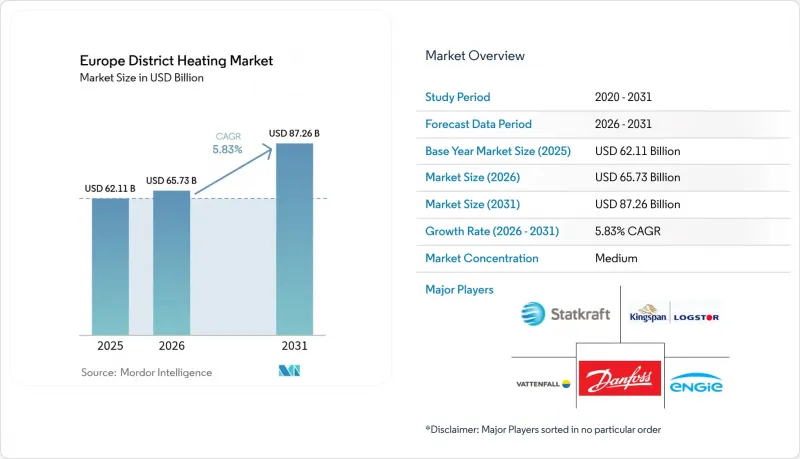
Mordor Intelligence에 의하면, 2026년 유럽의 지역 난방 시장 규모는 657억 3,000만 달러로 추정되고 2025년 621억 1,000만 달러에서 확대해, 2031년에는 872억 6,000만 달러에 이를 것으로 예측됩니다.
2026-2031년 동안 연평균 성장률(CAGR) 5.83%로 성장할 것으로 전망됩니다.
본 보고서는 열원(화석 연료, 재생에너지, 기타), 플랜트 유형(열전병급, 보일러식 플랜트, 대규모 히트 펌프, 기타), 공급 기술(단열 처리된 강관, 연질 플라스틱 배관, 기타), 최종 사용자(주거용, 상업용, 기타), 지역별로 분류되어 있습니다. 시장 전망은 금액(달러) 기준으로 제시되어 있습니다.
유럽의 지역 난방 시장 동향 및 인사이트
스칸디나비아의 4세대 저온 네트워크 급속한 구축
스칸디나비아의 유틸리티자들은 기존 시스템보다 20-45°C 낮은 온도에서 가동되는 4세대 네트워크를 표준화하고 있으며, 이를 통해 배열 손실을 최대 30% 절감하고, 주변 열 및 폐열 자원을 비용 효율적으로 활용할 수 있게 되었습니다. 룬드의 ‘Cool DH’나,스웨덴의 180억 스웨덴 크로나 규모 ‘EcoDataCenter 2’와 같은 프로젝트에서는 대규모 히트펌프(COP>4.0)와 재활용된 산업용 열을 결합함으로써 연료비를 대폭 절감하는 동시에, 향후 열 공급망 확장을 위한 앵커 부하를 창출하고 있습니다. 북유럽의 설계 기준은 현재 EU 기술 사양의 기초가 되고 있으며, 중부 유럽으로의 기술 이전을 가속화하고 있습니다.
독일과 네덜란드에서의 가정용 가스 보일러 단계적 폐지 의무화
독일의 ‘건축물 에너지법’에 따르면, 2024년 이후 신규 난방 시스템에서 재생에너지 비율을 65%로 의무화하고 있으며, 이로 인해 신규 화석연료 보일러는 사실상 배제되고, 토지가 제한된 도심 지역에서 지역 열 공급망 연결이 급증하고 있습니다. 네덜란드도 이에 발맞추어 2025년까지 신축 주택에 대한 완전한 전기화를 의무화하고, 2026년까지 리모델링 대상 건물에 하이브리드 히트펌프 도입을 의무화함으로써 인구 밀도가 높은 지자체에서 네트워크의 경제성을 강화하고 있습니다. 재생에너지 기반 난방 지원을 위해 연방 및 지방 자치단체로부터 최대 2만 1,000유로(약 2만 4,700달러)의 보조금이 지급되며, 이를 통해 8년 이내에 투자 회수가 가능합니다.
구형 3세대 네트워크의 고액 개보수 비용
중·동유럽의 배관망에서는 노후화된 보일러 철거 및 배관 교체에 1미터당 500-800유로의 비용이 소요되어, 지자체의 부채 한도를 압박하고 있으며, 계획되었던 전환이 수년 단위로 연기되는 원인이 되고 있습니다.
부문별 분석
2025년, 유럽의 지역 난방 시장에서 화석 연료는 51.45%의 점유율을 유지했습니다. 이는 주로 탄소 가격이 낮은 상황에서는 여전히 경제적인, 정착된 가스 및 석탄 보일러의 사용이 지속되고 있기 때문입니다. 그러나 재생에너지는 2031년까지 연평균 성장률(CAGR) 10.8%라는 가장 높은 성장률을 기록할 전망입니다. 이는 기존 난로와 호환되는 바이오매스 혼소, 파노니아 분지의 풍부한 지열 에너지, 산업 폐열 인수 계약 증가가 원동력이 되고 있습니다. 북유럽의 전력망에서는 재생에너지 도입률이 이미 42.6%를 넘어, EU의 다른 지역에 선례가 되고 있습니다. 현재 비용이 20-50유로/MWh인 태양열 발전소는 스페인과 프랑스에서 급속히 규모를 확대하고 있으며, 계절별 저장을 통해 여름철 수요 감소를 상쇄하고 있습니다. 하이브리드 방식에서는 바이오매스를 이용한 베이스로드와 고온 히트펌프를 결합함으로써, 새로운 배출 감축 목표를 충족하는 화석 연료를 사용하지 않는 조절형 열 공급을 실현하고 있습니다.
지역별로 보면, 헝가리와 크로아티아의 지열 시범 시추공이 EU의 현대화 보조금을 받고 있는 반면, 이탈리아와 독일에서는 200°C의 대수층을 대상으로 한 심층 시추 장비 시험이 진행되고 있습니다. 데이터센터의 폐열도 재생에너지 포트폴리오에 포함되어, 4GDH 회로에 65-80°C의 안정적인 열류를 공급하고 있습니다. 계절적 간헐성에 대응하기 위해 덴마크에서는 용량 10만 m³를 초과하는 저수 피트 저장 탱크 건설이 진행되고 있으며, 그 결과 한계 공급 비용이 5-7유로/MWh 절감되었습니다.
2025년, 유럽의 지역 난방 시장에서 열병합 발전(CHP) 설비의 점유율은 56.75%를 유지했습니다. 이는 두 가지 에너지원공급과 전력 계통의 균형 조정에서 보여주는 유연성이 높이 평가되었기 때문입니다. 한편, 재생 가능 전력 가격 하락과 COP를 5 이상으로 끌어올리는 냉매 기술의 발전에 힘입어 대형 히트 펌프는 연평균 성장률(CAGR) 14.05%로 확대되고 있습니다. 베를린의 75MW 하수 열펌프는 집중형 전기 난방으로의 전환을 상징합니다. 하이브리드 발전소에서는 겨울철 피크 수요에 대응하는 CHP 터빈과 계절 변화에 대응하는 가변 속도 열펌프를 결합하여, 네트워크의 회수 온도를 55°C 이하로 최적화하고 있습니다.
북유럽의 각 OEM 기업들은 생산 능력을 확대하고 있으며, 스웨덴에 신설된 50만 대 규모의 공장은 2027년까지 자본 비용을 500유로/kW 이하로 낮출 수 있는 규모의 경제를 실현할 조짐을 보이고 있습니다. 덴마크 연구 기관이 개발한 CO2 기반 시스템은 가연성 문제로 인해 합성 냉매 사용이 제한되는 고밀도 도시 지역을 대상으로 합니다. 전력 회사는 기존 자산을 보호하면서 배출 계수를 낮추기 위해 기존 CHP 설비에 연소 후 이산화탄소 포집 장치를 추가 설치하고 있습니다.
기타 혜택
- 엑셀 형식 시장 예측(ME) 시트
- 3개월간의 애널리스트 지원
자주 묻는 질문
목차
제1장 서론
제2장 조사 방법
제3장 주요 요약
제4장 시장 구도
제5장 시장 규모 및 성장 예측
제6장 경쟁 구도
제7장 시장 기회 및 향후 전망
KTH 26.09.14According to Mordor Intelligence, european district heating market size in 2026 is estimated at USD 65.73 billion, growing from 2025 value of USD 62.11 billion with 2031 projections showing USD 87.26 billion, growing at 5.83% CAGR over 2026-2031.
This report is Segmented by Heat Source (Fossil Fuels, Renewable Energy, and More), Plant Type (Combined Heat and Power, Boiler-Based Plants, and Large-Scale Heat Pumps), Distribution Technology (Pre-Insulated Steel Pipes, Flexible Plastic Piping, and More), End User (Residential, Commercial, and More), and Geography. The Market Forecasts are Provided in Terms of Value (USD).
Europe District Heating Market Trends and Insights
Rapid Build-out of 4th-Gen Low-Temperature Networks in Scandinavia
Scandinavian utilities are standardizing 4th-generation networks that operate 20-45 °C below legacy systems, reducing distribution losses by up to 30% and enabling the cost-effective use of ambient and waste-heat resources. Projects such as Lund's Cool DH and Sweden's SEK 18 billion EcoDataCenter 2 combine large-scale heat pumps (COP> 4.0) with recycled industrial heat, slashing fuel costs while creating anchor loads for future grid extensions. Nordic design codes now form the basis of EU technical specifications, accelerating technology transfer into Central Europe.
Mandatory Phase-out of Individual Gas Boilers in Germany and Netherlands
Germany's Building Energy Act obliges new heating systems to source 65% renewable energy from 2024, effectively eliminating new fossil boilers and triggering a surge in district heating connections in land-constrained urban cores. The Netherlands follows with a fully electric mandate for new builds by 2025 and hybrid heat-pump requirements for retrofits by 2026, reinforcing network economics in dense municipalities. Federal and local grants of up to EUR 21,000 (about USD 24,700) for renewable heating support payback periods under eight years.
High Retrofit Costs for Legacy 3rd-Gen Networks
Central- and Eastern-European grids require EUR 500-800 per meter to re-pipe and decouple outdated boilers, stretching municipal debt envelopes and causing multi-year postponements of planned conversions.
Other drivers and restraints analyzed in the detailed report include:
- EU Carbon Border Adjustment Mechanism Accelerating Industrial Switching
- Surging Data-Centre Waste-Heat Recovery Contracts in Northern Europe
- Lengthy Concession-Award Cycles and Municipal Tender Delays
For complete list of drivers and restraints, kindly check the Table Of Contents.
Segment Analysis
Fossil fuels retained 51.45% of the European district heating market share in 2025, primarily due to the continued use of entrenched gas and coal boilers, which remain economical when carbon prices are low. However, renewables post the fastest 10.8% CAGR to 2031, driven by the compatibility of biomass co-firing with existing furnaces, the abundance of geothermal energy in the Pannonian Basin, and growing industrial-waste heat offtake contracts. Nordic grids already surpass 42.6% renewable penetration, setting a precedent for the rest of the bloc. Solar-thermal fields, now costing EUR 20-50/MWh, scale quickly in Spain and France, smoothing summer demand dips through seasonal storage. Hybrid setups combine biomass baseloads with high-temperature heat pumps, enabling fossil-free, dispatchable heat that meets new emission reduction targets.
Geographically, geothermal pilot wells in Hungary and Croatia gain EU modernization grants, while Italy and Germany test deep-drilling rigs for 200 °C aquifers. Data-center waste heat joins the renewable basket, supplying stable 65-80 °C streams into 4GDH circuits. Seasonal intermittency drives the buildup of water-pit storage tanks with a capacity exceeding 100,000 m3 in Denmark, resulting in a 5-7 EUR/MWh reduction in marginal supply costs.
Combined heat and power units retained a 56.75% share of the European district heating market size in 2025, valued for dual energy streams and grid-balancing flexibility. Yet large heat pumps expand at 14.05% CAGR, spurred by cheaper renewable electricity and refrigerant advances that lift COPs above 5. Berlin's 75 MW wastewater heat pump underscores a shift toward centralized electrified heat. Hybrid plants blend CHP turbines for winter peaks with variable-speed heat pumps for shoulder seasons, optimizing network return temperatures below 55 °C.
Nordic OEMs are ramping up production capacity; Sweden's new 500,000-unit factory signals economies of scale that will push capital costs below EUR 500/kW by 2027. CO2-based systems from Danish research institutes target dense urban neighborhoods, where flammability limits the use of synthetic refrigerants. Utilities retrofit existing CHPs with post-combustion carbon capture to protect sunk assets while reducing emission factors.
Complete Report Scope:
- By Heat Source
- Fossil Fuels
- Renewable Energy (Biomass, Geothermal, Solar-Thermal)
- Industrial and Data-Centre Waste Heat
- By Plant Type
- Combined Heat and Power (CHP)
- Boiler-Based Plants
- Large-Scale Heat Pumps
- By Distribution Technology
- Pre-insulated Steel Pipes
- Flexible Plastic Piping
- Substations and Heat Exchangers
- Control and Monitoring Systems
- By End User
- Residential
- Commercial
- Industrial
- Public and Institutional
- By Country
- Germany
- France
- Austria
- Sweden
- United Kingdom
- Italy
- Rest of Europe
List of Companies Covered in this Report:
- Vattenfall AB
- Engie SA
- Danfoss A/S
- Veolia Environnement SA
- Fortum Oyj
- Statkraft AS
- E.ON SE
- Logstor A/S
- Vital Energi Ltd
- Goteborg Energi
- Alfa Laval AB
- Ramboll Group A/S
- Kelvion Holding GmbH
- Savosolar Oyj
- Isoplus Piping Systems
- Uponor Infra Oy
- Thermaflex International
- REHAU AG
- Cory Group
- Cetetherm AB
- NIBE Industrier AB
Additional Benefits:
- The market estimate (ME) sheet in Excel format
- 3 months of analyst support
TABLE OF CONTENTS
1 INTRODUCTION
- 1.1 Study Assumptions and Market Definition
- 1.2 Scope of the Study
2 RESEARCH METHODOLOGY
3 EXECUTIVE SUMMARY
4 MARKET LANDSCAPE
- 4.1 Market Overview
- 4.2 Market Drivers
- 4.2.1 Rapid Build-out of 4th-Gen Low-Temperature Networks in Scandinavia
- 4.2.2 Mandatory Phase-out of Individual Gas Boilers in Germany and Netherlands
- 4.2.3 EU Carbon Border Adjustment Mechanism Accelerating Industrial Switching
- 4.2.4 Surging Data-Centre Waste-Heat Recovery Contracts in Northern Europe
- 4.2.5 District Cooling Synergies in Southern Europe's Urban Redevelopments
- 4.2.6 Green-Bond Financing Windows Driving Municipal Network Expansions
- 4.3 Market Restraints
- 4.3.1 High Retrofit Costs for Legacy 3rd-Gen Networks
- 4.3.2 Lengthy Concession-Award Cycles and Municipal Tender Delays
- 4.3.3 Skills Shortage in Large-Diameter Pre-insulated Pipe Welding
- 4.3.4 Competing On-Site Heat-Pump Economics in Mild-Climate Zones
- 4.4 Industry Value Chain Analysis
- 4.5 Regulatory Outlook
- 4.5.1 Government Initiatives and Programs on District Heating/Cooling Transition
- 4.6 Technological Outlook
- 4.6.1 Development of District Heating Technology
- 4.7 Porter's Five Forces Analysis
- 4.7.1 Bargaining Power of Suppliers
- 4.7.2 Bargaining Power of Buyers
- 4.7.3 Threat of New Entrants
- 4.7.4 Threat of Substitute Products
- 4.7.5 Intensity of Competitive Rivalry
- 4.8 Impact of Macroeconomic Trends on the Market
- 4.9 Investment Analysis
5 MARKET SIZE AND GROWTH FORECASTS (VALUE)
- 5.1 By Heat Source
- 5.1.1 Fossil Fuels
- 5.1.2 Renewable Energy (Biomass, Geothermal, Solar-Thermal)
- 5.1.3 Industrial and Data-Centre Waste Heat
- 5.2 By Plant Type
- 5.2.1 Combined Heat and Power (CHP)
- 5.2.2 Boiler-Based Plants
- 5.2.3 Large-Scale Heat Pumps
- 5.3 By Distribution Technology
- 5.3.1 Pre-insulated Steel Pipes
- 5.3.2 Flexible Plastic Piping
- 5.3.3 Substations and Heat Exchangers
- 5.3.4 Control and Monitoring Systems
- 5.4 By End User
- 5.4.1 Residential
- 5.4.2 Commercial
- 5.4.3 Industrial
- 5.4.4 Public and Institutional
- 5.5 By Country
- 5.5.1 Germany
- 5.5.2 France
- 5.5.3 Austria
- 5.5.4 Sweden
- 5.5.5 United Kingdom
- 5.5.6 Italy
- 5.5.7 Rest of Europe
6 COMPETITIVE LANDSCAPE
- 6.1 Market Concentration
- 6.2 Strategic Moves
- 6.3 Market Share Analysis
- 6.4 Company Profiles
- 6.4.1 Vattenfall AB
- 6.4.2 Engie SA
- 6.4.3 Danfoss A/S
- 6.4.4 Veolia Environnement SA
- 6.4.5 Fortum Oyj
- 6.4.6 Statkraft AS
- 6.4.7 E.ON SE
- 6.4.8 Logstor A/S
- 6.4.9 Vital Energi Ltd
- 6.4.10 Goteborg Energi
- 6.4.11 Alfa Laval AB
- 6.4.12 Ramboll Group A/S
- 6.4.13 Kelvion Holding GmbH
- 6.4.14 Savosolar Oyj
- 6.4.15 Isoplus Piping Systems
- 6.4.16 Uponor Infra Oy
- 6.4.17 Thermaflex International
- 6.4.18 REHAU AG
- 6.4.19 Cory Group
- 6.4.20 Cetetherm AB
- 6.4.21 NIBE Industrier AB
7 MARKET OPPORTUNITIES AND FUTURE OUTLOOK
- 7.1 White-space and Unmet-Need Assessment


