
|
시장보고서
상품코드
2123783
손발톱진균증 치료 시장 : 점유율 분석, 업계 동향과 통계, 성장 예측(2026-2031년)Global Onychomycosis Treatment - Market Share Analysis, Industry Trends & Statistics, Growth Forecasts (2026 - 2031) |
||||||
 Mordor Intelligence
Mordor Intelligence에 의하면, 손발톱진균증 치료 시장 규모는 2025년에 35억 1,000만 달러로 평가되었고 2026년 36억 6,000만 달러에서 2031년까지 44억 9,000만 달러에 이를 것으로 예측되며, 예측 기간(2026-2031년) CAGR은 4.19%를 나타낼 전망입니다.
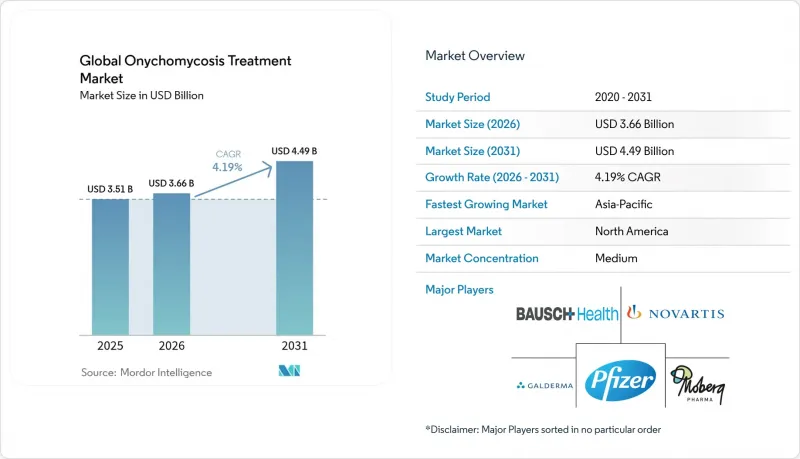
본 보고서는 치료 유형(의료기기를 이용한 치료, 알릴아민계, 아졸계, 기타 약물을 이용한 치료), 병원체 유형(피부사상균, 비피부사상균, 효모균),질환 유형(원위 손발톱 하부형, 백색 표재형 등), 지역(북미, 남미 등)별로 분류되어 있습니다. 시장 예측은 금액(달러) 기준으로 제시되어 있습니다.
전 세계 손발톱진균증 치료 시장 동향 및 인사이트
당뇨병 유병률 증가 및 고령화
고령자 및 당뇨병 환자는 새로 진단되는 손발톱진균증 사례의 상당 부분을 차지하고 있으며, 이는 손발톱진균증 치료 시장의 자기 증폭적 기반을 형성하고 있습니다. 당뇨병 환자는 감염 위험이 4.7배 더 높으며, 신경 손상으로 인해 자가 발견이 늦어지는 경우가 많아 결과적으로 진균이 손발톱의 더 깊은 구조로 침투하게 됩니다. 싱가포르와 같은 국가에서는 이러한 문제가 두드러지게 나타나고 있습니다. 2형 당뇨병 환자의 약 3분의 1이 적어도 하나의 합병증을 보고하고 있으며, 그중 13.3%의 사례에서 신경 손상이 확인되고 있습니다. 태평양 제도 일부 지역에서는 족병 의료 서비스가 제한적이기 때문에 임상적 수요가 공급을 초과하는 미개척 시장 기회가 존재합니다. 아시아태평양 전체의 도시화는 생활습관병 증가를 가속화하는 동시에 가처분 소득도 증가시키고 있어, 처방약과 클리닉에서의 고급 치료 모두에 대해 지속적인 수요 곡선을 만들어내고 있습니다.
족병 진료 클리닉에서의 레이저 기기 보급 확대
임상의들은 간 기능 모니터링 요건을 피할 수 있는 비전신 요법을 원하는 환자들 수요에 부응하기 위해 Nd:YAG 및 다이오드 레이저 플랫폼을 점점 더 많이 도입하고 있습니다. 치유율에 대한 증거는 여전히 일관되지 않지만, 부유한 도시 지역에 집중된 비보험 진료 현장에서는 발톱 외관 개선 효과가 큰 매력으로 작용하고 있습니다. 광역학 치료와 결합된 프로토타입 다이오드 시스템은 소규모 연구에서 완전한 치유를 보여주며 전문가들의 신뢰를 높이고 있습니다. Welnax BioClear와 같은 휴대용 가정용 레이저는 치료 접근성을 넓히고 1회 치료당 비용을 절감하고 있으며, 이러한 혁신은 손발톱진균증 치료 시장의 기기 매출을 끌어올릴 것으로 기대됩니다. 또한, 진료소에서는 레이저를 당뇨병성 족부 관리 패키지에 포함시킴으로써, 복잡한 약물 요법을 받고 있는 환자의 안전성을 향상시키고 있습니다.
높은 재발률과 치료 실패율
치료 기간이 길고 치유 확률이 중간 수준이기 때문에 환자의 지속적인 치료 의지가 저하되어 재발 가능성이 높아집니다. 에피나코나졸에 대한 24개월간의 연구에서 유효 치유율은 불과 22.6%에 그쳐, 진균학적 및 임상적 완치를 동시에 달성하는 데 어려움이 있음을 여실히 드러냈습니다. 열대 기후에서는 재감염 위험이 높기 때문에 의료진은 관해 기간을 연장하기 위해 신발 살균, 습도 관리, 정기적인 예방 조치와 같은 환경적 대책을 철저히 이행해야 합니다.
부문 분석
2025년에는 의약품이 매출의 85.02%를 차지했습니다. 알릴아민계 약물은 손톱의 케라틴에 강력하게 결합하여 수 주에 걸쳐 살균 작용을 발휘하기 때문에 여전히 주요 약물 군으로 남아 있습니다. 아졸계 약물은 더 넓은 항균 스펙트럼을 가지고 있지만, 내성이 증가하고 있어 의사들은 병용 요법을 선호하는 경향이 있으며, 난치성 사례에서는 경구용 테르비나핀과 외용 에피나코나졸을 병용하기도 합니다. 손발톱진균증 치료 시장 규모는 꾸준히 확대될 것으로 예상되지만, 의료기기가 성숙해짐에 따라 그 시장 점유율은 축소될 가능성이 있습니다.
Nd:YAG 레이저와 다이오드 레이저를 필두로 하는 의료기기는 연평균 성장률(CAGR) 5.08%로 성장할 전망입니다. 클리닉에서는 간 질환이나 약물 상호작용으로 인해 전신 요법을 받을 수 없는 환자에게 이러한 기기를 권장하고 있습니다. 파일럿 시험에 따르면, 레이저 치료는 눈에 띄는 개선 효과를 앞당기는 것으로 나타났으며, 이는 외모를 중요시하는 소비자들에게 호응을 얻고 있는 미용상의 이점입니다. 새로운 플랫폼에서는 고주파와 초음파의 침투 효과를 결합하여, 외용 유효 성분이 더 깊숙이 침투하도록 하고 있습니다. 제조업체는 시술 후 관리 키트를 세트로 판매하여, 손발톱진균증 치료 업계에서 지속적인 제품 매출을 확보하고 있습니다. 의료기기 제조업체와 제약사의 제휴를 통해 유통망이 확대되고, 메시지의 일관성이 확보되고 있습니다.
지역별 분석
북미는 광범위한 보험 적용 범위와 높은 진료소 밀도 덕분에 2025년에 전 세계 매출의 42.41%를 차지했습니다. 미국의 임상의들은 전신 투여용 정제와 진료소 내 레이저 치료를 일상적으로 병행하고 있어, 환자 1인당 2개의 수익원을 창출하고 있습니다. 캐나다의 손발톱진균증 치료 시장 규모는 9,360만 캐나다 달러(6,890만 달러)에 달하며, 신규 래커제에 대한 독점권 계약이 이를 뒷받침하고 있습니다. 멕시코에서는 당뇨병 클리닉이 만성 질환 관리 패키지에 손발톱 건강 관리 모듈을 포함시킴에 따라 처방량이 증가하고 있습니다.
아시아태평양은 5.71%라는 가장 높은 연평균 성장률(CAGR)을 기록하고 있습니다. 중국과 인도에는 방대한 당뇨병 환자층이 존재하여, 치료 보급률이 낮더라도 상당한 수요로 이어집니다. 일본과 한국의 병원들은 피부과 분야가 성숙해 있음을 반영하여 나노 래커를 조기에 도입하고 있습니다. 태국과 말레이시아로의 의료 관광 유입으로 인해 의료기기를 활용한 시술이 증가하며, 손발톱진균증 치료 시장의 지역별 매출을 끌어올리고 있습니다. 정부의 원격의료 제도를 통해 외딴 지역의 주도 전문의의 조언을 받을 수 있게 되어, 도시와 지방 간의 의료 격차가 줄어들고 있습니다.
유럽은 계속해서 안정적인 주축으로 자리 잡고 있습니다. 통일된 CE 마킹 덕분에 혁신적인 외용제의 다국적 출시가 가속화되고 있습니다. 스웨덴의 Terclara사는 출시 불과 1개월 만에 금액 기준 시장 점유율 36%를 차지하며, 유럽에서 고품질 치료법에 대한 수용도가 높음을 입증했습니다. 남유럽의 습한 해안 지역에서는 재발률이 높아 안정적인 재구매 주기가 유지되고 있습니다. 동유럽 시장에서는 제네릭 의약품의 도입이 급속히 진행되고 있지만, 가처분 소득 증가로 인해 편의성이 높은 브랜드 제품에 대한 수요가 확대될 여지가 생기고 있습니다.
기타 혜택:
- 엑셀 형식 시장 예측(ME) 시트
- 3개월간 애널리스트 지원
자주 묻는 질문
목차
제1장 서론
제2장 조사 방법
제3장 주요 요약
제4장 시장 구도
제5장 시장 규모와 성장 예측
제6장 경쟁 구도
제7장 시장 기회와 향후 전망
JHS 26.09.07According to Mordor Intelligence, the onychomycosis treatment market size was valued at USD 3.51 billion in 2025 and estimated to grow from USD 3.66 billion in 2026 to reach USD 4.49 billion by 2031, at a CAGR of 4.19% during the forecast period (2026-2031).
This report is Segmented by Treatment Type (Device-Based Treatments, Medication-Based Treatment Including Allylamines, Azoles, Other Classes), Pathogen Type (Dermatophytes, Non-Dermatophyte Molds, Yeasts), Disease Type (Distal Subungual, White Superficial, and More), and Geography (North America, South America, and More). The Market Forecasts are Provided in Terms of Value (USD).
Global Onychomycosis Treatment Market Trends and Insights
Rising Prevalence of Diabetes & Aging Population
Older adults and people living with diabetes drive a substantial proportion of new onychomycosis diagnoses, creating a self-reinforcing base for the onychomycosis treatment market. Diabetic patients show a 4.7-fold higher infection risk, and neuropathy often delays self-detection, allowing fungi to penetrate deeper nail structures. Countries such as Singapore illustrate the challenge; nearly one-third of type 2 diabetics report at least one complication, with neuropathy present in 13.3% of cases. Limited podiatry services in parts of the Pacific Islands highlight untapped volume opportunities where clinical need exceeds supply. Urbanization across Asia-Pacific accelerates lifestyle diseases and simultaneously increases disposable income, producing a sustained demand curve for both prescription drugs and premium in-clinic procedures.
Greater Adoption of Laser-Based Devices in Podiatry Clinics
Clinicians increasingly integrate Nd:YAG and diode laser platforms to meet patient demand for non-systemic solutions that circumvent hepatic monitoring requirements. Although cure-rate evidence remains heterogeneous, cosmetic nail improvement proves attractive in cash-pay settings concentrated in affluent urban markets. Prototype diode systems combined with photodynamic therapy have demonstrated complete clearance in small studies, bolstering professional confidence. Portable home-use lasers such as Welnax BioClear democratize access and lower treatment-episode costs, an innovation expected to boost device revenues within the onychomycosis treatment market. Clinics also bundle lasers into diabetic foot-care packages, improving safety profiles for patients on complex drug regimens.
High Recurrence & Treatment Failure Rates
Long treatment courses and moderate cure probabilities dampen patient persistence and raise relapse likelihood. Twenty-four-month efinaconazole studies delivered only 22.6% effective cure, underscoring the challenge of achieving both mycological and clinical clearance. Tropical climates sustain higher reinfection pressure, meaning practitioners must stress environmental interventions-shoe sterilization, humidity control, and periodic prophylactic applications-to prolong remission.
Other drivers and restraints analyzed in the detailed report include:
- Expanding E-pharmacy Penetration in Emerging Markets
- Launch of High-Penetration Nail Lacquers with Nanocarriers
- Growing Azole & Allylamine Resistance Among Dermatophytes
For complete list of drivers and restraints, kindly check the Table Of Contents.
Segment Analysis
Medication products generated 85.02% of revenue in 2025. Allylamines remain the predominant class because they bind tightly to nail keratin and deliver fungicidal action over weeks. Azoles supply broader spectrum but rising resistance pushes physicians toward combination protocols, sometimes pairing oral terbinafine with topical efinaconazole for stubborn cases. The onychomycosis treatment market size for medications is forecast to expand steadily, yet its proportional slice could shrink as devices mature.
Device modalities, led by Nd:YAG and diode lasers, are on track for a 5.08% CAGR. Clinics pitch them to patients who cannot tolerate systemic therapy due to liver disease or drug interactions. Pilot trials suggest lasers speed visible clearing, a cosmetic win that resonates with image-conscious consumers. New platforms blend radiofrequency with ultrasound permeation, driving topical actives deeper. Manufacturers bundle post-procedure maintenance kits, ensuring recurring product sales within the onychomycosis treatment industry. Collaborations between device firms and pharmaceutical companies broaden distribution and align messaging.
Complete Report Scope:
- By Treatment Type
- Device-based Treatments
- Medication-Based Treatment
- Allylamines
- Azoles
- Other Classes
- By Pathogen Type
- Dermatophytes
- Non-dermatophyte Molds
- Yeasts
- By Disease Type
- Distal Subungual Onychomycosis
- White Superficial Onychomycosis
- Proximal Subungual Onychomycosis
- Total Dystrophic Onychomycosis
- By Geography
- North America
- United States
- Canada
- Mexico
- South America
- Brazil
- Argentina
- Rest of South America
- Europe
- Germany
- United Kingdom
- France
- Italy
- Spain
- Rest of Europe
- Asia-Pacific
- China
- Japan
- India
- South Korea
- Australia
- Rest of Asia-Pacific
- Middle East and Africa
- GCC
- South Africa
- Rest of Middle East and Africa
- North America
Geography Analysis
North America captured 42.41% of global revenue in 2025 thanks to broad insurance coverage and high clinic density. U.S. clinicians routinely blend systemic pills with in-office laser sessions, creating two revenue layers per patient. Canada's onychomycosis treatment market size stands at CAD 93.6 million (USD 68.9 million), buoyed by exclusive rights deals for novel lacquers. Mexico shows accelerating prescription volumes as diabetes clinics incorporate nail health modules into chronic-care bundles.
Asia-Pacific posts the fastest 5.71% CAGR. China and India host vast diabetic cohorts where even low therapy uptake translates into sizable demand. Japanese and South Korean hospitals adopt nanolacquers early, reflecting mature dermatology sectors. Inward medical tourism to Thailand and Malaysia adds incremental device procedures, elevating regional receipts for the onychomycosis treatment market. Government telemedicine schemes distribute specialist advice to remote provinces, shrinking urban-rural care gaps.
Europe remains a stable pillar. Harmonised CE marking speeds multi-country launches of innovative topicals. Sweden's Terclara seized 36% value share within its first month, proving European receptiveness to premium treatments. Southern Europe's humid coastline sustains high relapse rates, maintaining steady repeat-purchase cycles. Eastern European markets adopt generics aggressively, yet rising disposable income opens space for branded convenience formats.
- Pfizer
- Novartis
- Bausch Health
- Galderma
- Johnson & Johnson
- Bayer
- GlaxoSmithKline
- Sun Pharmaceuticals Industries
- Cipla
- Teva Pharmaceutical Industries
- Kaken Pharmaceutical Co. Ltd.
- Moberg Pharma
- Taisho Pharmaceutical Co. Ltd.
- Zeria Pharmaceutical Co. Ltd.
- Hikma Pharmaceuticals
- Cutera
- Photocure ASA
- Viamet Pharmaceuticals Holdings LLC
- Medimetriks Pharmaceuticals
- Merz Pharma
Additional Benefits:
- The market estimate (ME) sheet in Excel format
- 3 months of analyst support
TABLE OF CONTENTS
1 Introduction
- 1.1 Study Assumptions & Market Definition
- 1.2 Scope of the Study
2 Research Methodology
3 Executive Summary
4 Market Landscape
- 4.1 Market Overview
- 4.2 Market Drivers
- 4.2.1 Rising prevalence of diabetes & aging population
- 4.2.2 Greater adoption of laser-based devices in podiatry clinics
- 4.2.3 Expanding e-pharmacy penetration in emerging markets
- 4.2.4 Launch of high-penetration nail lacquers with nanocarriers (2025+)
- 4.2.5 FDA fast-track incentives for antifungal first-in-class molecules
- 4.2.6 Inclusion of onychomycosis screening in corporate wellness plans
- 4.3 Market Restraints
- 4.3.1 High recurrence & treatment failure rates
- 4.3.2 Growing azole & allylamine resistance among dermatophytes
- 4.3.3 Limited reimbursement for cosmetic-driven procedures
- 4.3.4 Safety concerns over off-label systemic use in pediatrics
- 4.4 Value / Supply-Chain Analysis
- 4.5 Regulatory Landscape
- 4.6 Technological Outlook
- 4.7 Porter's Five Forces
- 4.7.1 Bargaining Power of Suppliers
- 4.7.2 Bargaining Power of Buyers
- 4.7.3 Threat of New Entrants
- 4.7.4 Threat of Substitutes
- 4.7.5 Competitive Rivalry
5 Market Size & Growth Forecasts (Value, USD million)
- 5.1 By Treatment Type
- 5.1.1 Device-based Treatments
- 5.1.2 Medication-Based Treatment
- 5.1.2.1 Allylamines
- 5.1.2.2 Azoles
- 5.1.2.3 Other Classes
- 5.2 By Pathogen Type
- 5.2.1 Dermatophytes
- 5.2.2 Non-dermatophyte Molds
- 5.2.3 Yeasts
- 5.3 By Disease Type
- 5.3.1 Distal Subungual Onychomycosis
- 5.3.2 White Superficial Onychomycosis
- 5.3.3 Proximal Subungual Onychomycosis
- 5.3.4 Total Dystrophic Onychomycosis
- 5.4 By Geography
- 5.4.1 North America
- 5.4.1.1 United States
- 5.4.1.2 Canada
- 5.4.1.3 Mexico
- 5.4.2 South America
- 5.4.2.1 Brazil
- 5.4.2.2 Argentina
- 5.4.2.3 Rest of South America
- 5.4.3 Europe
- 5.4.3.1 Germany
- 5.4.3.2 United Kingdom
- 5.4.3.3 France
- 5.4.3.4 Italy
- 5.4.3.5 Spain
- 5.4.3.6 Rest of Europe
- 5.4.4 Asia-Pacific
- 5.4.4.1 China
- 5.4.4.2 Japan
- 5.4.4.3 India
- 5.4.4.4 South Korea
- 5.4.4.5 Australia
- 5.4.4.6 Rest of Asia-Pacific
- 5.4.5 Middle East and Africa
- 5.4.5.1 GCC
- 5.4.5.2 South Africa
- 5.4.5.3 Rest of Middle East and Africa
- 5.4.1 North America
6 Competitive Landscape
- 6.1 Market Concentration
- 6.2 Market Share Analysis
- 6.3 Company Profiles (includes Global level Overview, Market level overview, Core Segments, Financials as available, Strategic Information, Market Rank/Share for key companies, Products & Services, and Recent Developments)
- 6.3.1 Pfizer Inc.
- 6.3.2 Novartis AG
- 6.3.3 Bausch Health Companies Inc.
- 6.3.4 Galderma SA
- 6.3.5 Johnson & Johnson Services Inc.
- 6.3.6 Bayer AG
- 6.3.7 GlaxoSmithKline plc
- 6.3.8 Sun Pharmaceutical Industries Ltd.
- 6.3.9 Cipla Ltd.
- 6.3.10 Teva Pharmaceutical Industries Ltd.
- 6.3.11 Kaken Pharmaceutical Co. Ltd.
- 6.3.12 Moberg Pharma AB
- 6.3.13 Taisho Pharmaceutical Co. Ltd.
- 6.3.14 Zeria Pharmaceutical Co. Ltd.
- 6.3.15 Hikma Pharmaceuticals plc
- 6.3.16 Cutera Inc.
- 6.3.17 Photocure ASA
- 6.3.18 Viamet Pharmaceuticals Holdings LLC
- 6.3.19 Medimetriks Pharmaceuticals Inc.
- 6.3.20 Merz Pharma GmbH & Co. KGaA
7 Market Opportunities & Future Outlook
- 7.1 White-space & unmet-need assessment