
|
시장보고서
상품코드
2123792
환자 중심 헬스케어 앱 시장 : 점유율 분석, 업계 동향과 통계, 성장 예측(2026-2031년)Patient-centric Health Care App - Market Share Analysis, Industry Trends & Statistics, Growth Forecasts (2026 - 2031) |
||||||
 Mordor Intelligence
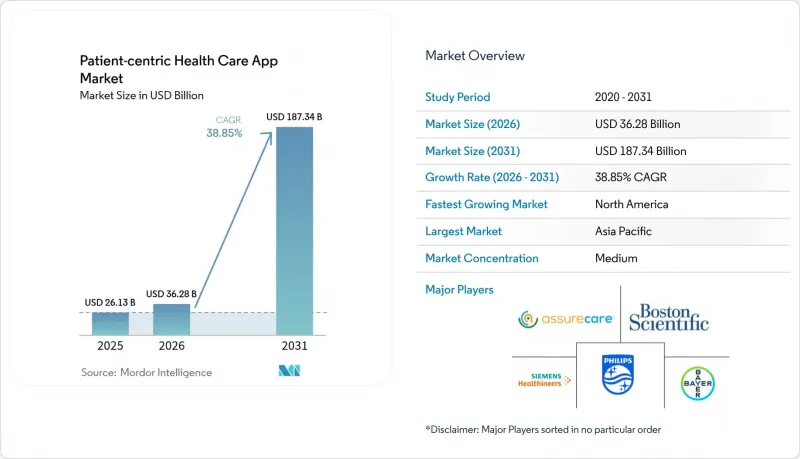
Mordor Intelligence에 의하면, 환자 중심 헬스케어 앱 시장 규모는 2025년에 261억 3,000만 달러로 평가되었고 2026년에는 362억 8,000만 달러에서 성장하여 2031년까지 1,873억 4,000만 달러에 이를 것으로 추정되고 있습니다.
예측 기간(2026-2031년) 동안 연평균 성장률(CAGR)은 38.85%가 될 것으로 전망됩니다.
본 보고서는 작동 모드(스마트폰 앱, 웹 앱, 하이브리드 앱), 용도(웰니스 관리 등), 최종 사용자(환자의 자가 이용 등), 배포 플랫폼(iOS, Android, 크로스 플랫폼/프로그레시브 웹 앱), 지역(북미, 유럽,아시아태평양, 중동 및 아프리카, 남미)별로 분류되어 있습니다. 시장 예측은 금액(달러) 기준으로 제시되어 있습니다.
전 세계 환자 중심 헬스케어 앱 시장 동향 및 인사이트
만성 질환 부담 증가와 고령화
현재 비전염성 질환은 전 세계 사망 원인의 74%를 차지하고 있으며, 공중보건 당국은 의료 기관 밖에서의 지속적인 모니터링을 장려하고 있습니다. 중국에서 2,883명을 대상으로 실시된 시험 데이터에 따르면, 앱을 활용한 당뇨병 관리 프로그램을 통해 공복 혈당 수치가 1.68 mmol/L, HbA1c가 0.45% 감소했으며, 특히 치료 순응도가 높은 사용자에서는 더욱 뚜렷한 효과가 확인되었습니다. 노보노르디스크는 투여 데이터를 코칭 앱에 직접 전송하는 ‘커넥티드 펜’ 기술을 중심으로 상업적 제휴를 구축하고 있으며, 제약 수익을 측정 가능한 치료 준수율과 연동시키고 있습니다. 테라독 헬스(TerraDoc Health)의 보고에 따르면, 이 회사의 당뇨병 프로그램 참가자의 58%가 1년 후 관해 수준의 HbA1c 수치에 도달했고, 고혈압 환자의 88%가 혈압 개선 또는 유지에 성공하여, 디지털 접근 방식이 약물 요법을 보완하는 효과적인 수단임이 입증되었습니다. 평균 수명이 늘어나는 가운데, 이러한 결과는 보험사들이 예산을 예방적 디지털 참여에 할당하고 있는 이유를 뒷받침합니다.
모바일 및 클라우드 연결 분야의 기술 발전
아시아태평양에서는 5G의 확산과 임상 등급 신호를 실시간으로 스트리밍하는 엣지 컴퓨팅 시범 사업의 지원에 힘입어 2023년에 모바일 경제의 가치가 8,800억 달러 증가했습니다. 미국 식품의약국(FDA)은 검증 시험에서 95%의 민감도와 98%의 특이도를 달성한 심방세동 감지 알고리즘이 탑재된 오므론의 연결형 혈압계를 승인했습니다. Epic Systems사는 2025년까지 2억 8,000만 건의 환자 기록을 정부 지원 TEFCA 네트워크에 통합하겠다고 약속했으며, 이는 저지연 데이터 교환을 위한 전국적인 백본 네트워크를 구축하게 될 것입니다. 스마트폰용 카메라 앱 ‘FibriCheck’는 심방세동 감지에서 98.3%의 민감도를 보여 FDA 심사를 통과했습니다. 이를 통해 일반 소비자용 기기라도 Class II 의료기기 기준을 충족할 수 있음이 입증되었습니다. 이러한 성과들은 전반적으로 환자 중심 헬스케어 앱 시장을 뒷받침하는 기술 기반을 강화하는 것입니다.
상호 운용성 및 데이터 표준화의 부재
2024년 말 기준으로, 확장된 USCDI+ 암 데이터 요소를 지원하겠다고 공약한 인증 IT 벤더는 불과 6개사에 그쳐, 데이터 의미론의 통일을 향한 진전이 더딘 실태가 여실히 드러나고 있습니다. 세쿼이아 프로젝트의 로드맵에는 2025년에 QHIN 간 FHIR 시범 사업이 예정되어 있지만, 이는 진정한 플러그 앤 플레이 방식의 데이터 교환이 향후 몇 차례의 예산 주기 동안 부분적인 수준에 그칠 것임을 의미합니다. 환자들은 여전히 다운로드 포털, 로그인 정보, PDF 형식의 퇴원 요약서 등을 여기저기서 번갈아 사용해야 하며, 이는 참여형 앱이 의존하는 시간 경과에 따른 전체적인 상황 파악을 복잡하게 만들고 있습니다. 거버넌스 기관이 공통 식별자 및 버전 관리를 철저히 시행하기 전까지는 이러한 파편화가 환자 중심 헬스케어 앱 시장의 성장을 저해할 것입니다.
부문 분석
2025년, iOS 및 Android 스토어의 전 세계 보급 범위를 배경으로, 스마트폰용 프로그램이 환자 중심 헬스케어 앱 시장 점유율의 45.12%를 차지했습니다. 의료 시스템이 기기 분절화에 따른 비용을 피할 수 있는 ‘한 번 코드를 작성하면 어디서나 배포 가능’이라는 경제성을 추구하는 가운데, 하이브리드 앱은 2031년까지 연평균 성장률(CAGR) 41.02%를 달성할 전망입니다. 또한 상호 호환성 덕분에 규제가 엄격한 환경에서 매우 중요한 개인정보 보호 업데이트 및 보안 패치 적용도 간소화됩니다. Epic사의 접근 방식, 즉 클라우드 마이크로서비스에서 의사 결정 로직을 가져오는 네이티브 모바일 프론트엔드는 하이브리드 스택이 사용자 인터페이스를 재작성하지 않고도 신흥 AI 모듈을 어떻게 통합할 수 있는지를 보여줍니다. 그 결과, 하이브리드 툴체인을 채택한 개발자들은 환자 중심 헬스케어 앱 시장에서 단일 플랫폼에 의존하는 경쟁사들보다 더 빠르게 사업을 확장할 수 있는 입장에 있습니다.
이러한 전환은 보험사 측의 요구 사항에 의해서도 마찬가지로 뒷받침되고 있습니다. 건강 보험 플랜에서는 가입자가 선호하는 통신 수단을 선택할 수 있도록 문자 메시지 서비스, 앱 푸시 알림, 이메일과 같은 다중 채널을 통한 연락을 점점 더 요구하고 있습니다. 하이브리드 프레임워크는 이러한 메시징 채널 간에 비즈니스 로직을 재사용함으로써 업그레이드에 소요되는 시간을 단축합니다. 의료 제공 기관이 참여도에 연동된 가치 기반 보너스를 추구하는 가운데, 저비용의 크로스 플랫폼 구축에 대한 수요가 지속적인 두 자릿수 수익 성장을 뒷받침할 것입니다.
웰니스 관리는 체중 감량 코칭, 수면 추적, 예방 의료 알림의 부침에 힘입어 2025년에는 환자 중심 헬스케어 앱 시장 규모의 38.02%를 차지했습니다. 그러나 규제 측면의 움직임으로 인해 관심은 증거 기반의 ‘정신 건강 및 마음챙김’으로 이동하고 있으며, 2031년까지 연평균 성장률(CAGR) 42.11%로 급성장할 것으로 예측됩니다. FDA는 우울증 치료제 ‘Rejoyn’과 만성 불면증 치료제 ‘SleepioRx’를 승인함으로써, 소프트웨어를 치료법으로 활용하는 길을 공식적으로 열었습니다. 디지털 인지행동치료 프로그램을 위한 CMS 청구 코드는 보험 급여의 정당성을 한층 더 높여주며, 고용주가 건강 복리후생 패키지에 구독형 앱을 포함하도록 장려하고 있습니다. 또한, 본인 부담 결제에 적극적인 소비자의 존재 역시 잠재적인 고객 기반을 확대시키고 있습니다. 특히, 비동기형 채팅이나 명상 세션을 ‘편안한 공간’으로 느끼는 Z세대 사용자들 사이에서 이러한 경향이 두드러집니다. 이러한 요인들이 결합되면서, 환자 중심 헬스케어 앱 시장에서 정신 건강 관련 활용 사례는 계속해서 혁신의 최전선에 자리 잡고 있습니다.
지역별 분석
북미는 2025년에도 41.78%의 점유율을 유지했습니다. 이는 TEFCA에 기반한 상호운용성 규칙과 FDA의 성숙한 디지털 치료제 프레임워크에 힘입은 결과입니다. CMS는 2025년 요금표에 ‘고급 1차 진료 관리(GPCM1-3)’ 코드를 추가하여, 원격 코칭 및 생체 측정 모니터링이 위험 계층화 된 정액제 하에서 청구될 수 있도록 보장했습니다. Epic사가 2025년까지 고객 기반을 TEFCA로 전환하겠다는 공약을 통해 2억 8,000만 건의 개인 기록에 대해 고정밀 데이터 피드가 제공될 예정이며, 이 지역은 성과 연계형 계약의 시험장이 될 것입니다. 하지만 소규모 진료소 의료진의 저항과 농촌 지역의 광대역 격차 해소 지연이 이 지역의 성장 한계를 억제하고 있습니다.
아시아태평양은 모바일 우선 의료 시스템 구축과 디지털 서비스를 국민 건강보험 정책에 통합하려는 정부의 이니셔티브에 힘입어 연평균 성장률(CAGR) 39.95%로 가장 빠르게 성장하고 있는 지역입니다. 인도의 헬스테크 시장은 2025년에 250억 달러에 달할 전망이며, 원격의료가 거래 건수를 견인하고, AI를 활용한 방사선 영상 진단이 지방 병원의 처리 능력을 향상시키고 있습니다. 중국이 WHO가 지원하는 ‘디지털 헬스 세계 이니셔티브’에 참여함에 따라 표준화가 가속화되는 한편, 통신사들은 원격 수술 시범 사업에서의 지연을 줄이기 위해 병원 캠퍼스를 위한 프라이빗 5G 도입을 모색하고 있습니다. 동남아시아의 투자 동향-Halodoc의 1억 달러 규모 시리즈 E 자금 조달 및 Doctor Anywhere의 4,080만 달러 자금 조달-은 벤처 투자에 대한 의욕이 여전히 높음을 보여주고 있으며, 다국적 기업들이 인터페이스를 인도네시아어와 태국어로 현지화하고 있는 이유를 뒷받침하고 있습니다.
유럽에서는 ‘유럽 건강 데이터 공간(European Health Data Space)’ 프로그램 하에서 15% 중반대의 꾸준한 성장이 나타나고 있습니다. 독일은 클래스 II 디지털 치료 기기의 승인을 주도하고 있으며, 영국은 국민보건서비스(NHS)의 트리아지 라인에 AI 알고리즘을 통합하고 있습니다. 통일된 개인정보 보호 규제로 인해 국경을 초월한 확산이 가속화되고 있지만, 지역별 보상 규정의 차이로 인해 도입 현황에는 여전히 편차가 나타나고 있습니다. 중동 및 아프리카 및 남미에서는 스마트폰 보급률 상승에 따라 장기적인 성장 여지가 있지만, 인프라 및 디지털 리터러시의 제약으로 인해 수익화가 지연되고 있으며, 환자 중심 헬스케어 앱 시장에서 이들 지역은 ‘제2의 물결’로 자리매김하고 있습니다.
기타 혜택:
- 엑셀 형식 시장 예측(ME) 시트
- 3개월간의 애널리스트 지원
자주 묻는 질문
목차
제1장 서론
제2장 조사 방법
제3장 주요 요약
제4장 시장 구도
제5장 시장 규모와 성장 예측
제6장 경쟁 구도
제7장 시장 기회와 향후 전망
JHS 26.09.07According to Mordor Intelligence, the patient centric healthcare app market size was valued at USD 26.13 billion in 2025 and estimated to grow from USD 36.28 billion in 2026 to reach USD 187.34 billion by 2031, at a CAGR of 38.85% during the forecast period (2026-2031).
This report is Segmented by Mode of Operation (Phone-Based, Web-Based, and Hybrid Apps), Application (Wellness Management, and More), End User (Patients Self-Use, and More), Delivery Platform (iOS, Android, Cross-Platform/Progressive Web Apps), and Geography (North America, Europe, Asia-Pacific, Middle East & Africa, South America). The Market Forecasts are Provided in Terms of Value (USD).
Global Patient-centric Health Care App Market Trends and Insights
Rising Burden of Chronic Diseases and Aging Population
Non-communicable illnesses now account for 74% of worldwide deaths, prompting public-health authorities to push continuous monitoring outside clinical walls. Data from a 2,883-person trial in China showed that an app-enabled diabetes program lowered fasting glucose by 1.68 mmol/L and HbA1c by 0.45 percentage points, with stronger outcomes among high-adherence users. Novo Nordisk has built commercial alliances around connected-pen technology that transmits dose data directly to coaching apps, aligning pharmaceutical revenue with measurable adherence. Teladoc Health reports that 58% of participants in its diabetes program reach remission-level A1c after one year, while 88% of hypertension users improve or maintain blood pressure, validating digital pathways as complements to pharmacotherapy. As life expectancy lengthens, these results underscore why payers are tilting budgets toward proactive digital engagement.
Technological Advancements in Mobile and Cloud Connectivity
Asia-Pacific added USD 880 billion in mobile-economy value in 2023, buoyed by 5G roll-outs and edge-compute pilots that stream clinical-grade signals in real time. The U.S. Food and Drug Administration cleared OMRON's connected blood-pressure monitor featuring atrial-fibrillation algorithms that achieved 95% sensitivity and 98% specificity in validation studies. Epic Systems pledged to plug 280 million patient records into the government-backed TEFCA network by 2025, opening a national spine for low-latency data exchange. Smartphone-camera application FibriCheck passed FDA review with 98.3% sensitivity for atrial-fibrillation detection, proving that consumer devices can meet Class II medical-device thresholds. Collectively, these milestones reinforce the technology stack that underpins the patient centric healthcare app market.
Lack of Interoperability and Data Standardization
Only six certified IT vendors had committed to extended USCDI+ Cancer data elements by late 2024, underscoring the slow march toward uniform data semantics. The Sequoia Project's roadmap schedules QHIN-to-QHIN FHIR pilots for 2025, meaning that true plug-and-play exchange will remain partial for several budget cycles. Patients still juggle download portals, login credentials, and PDF discharge summaries, complicating the longitudinal views that engagement apps depend on. Until governance bodies enforce common identifiers and version control, fragmentation will temper growth in the patient centric healthcare app market.
Other drivers and restraints analyzed in the detailed report include:
- Growing Acceptance of Digital Health Post-Pandemic
- Transition Toward Value-Based Care and Outcome-Linked Reimbursements
- Clinician Resistance Due to Workflow Integration Challenges
For complete list of drivers and restraints, kindly check the Table Of Contents.
Segment Analysis
Phone-Based programs controlled 45.12% of patient centric healthcare app market share in 2025, benefiting from the global reach of iOS and Android storefronts. Hybrid Apps are on track for a 41.02% CAGR to 2031 as healthcare systems seek code-once-deploy-anywhere economics that sidestep device-fragmentation costs. Cross-compatibility also simplifies privacy updates and security patching, critical in regulated environments. Epic's approach-native mobile front ends that draw decision logic from cloud micro-services-illustrates how hybrid stacks absorb emerging AI modules without rewriting user interfaces. Consequently, developers aligned to hybrid toolchains are positioned to expand faster than single-platform peers inside the patient centric healthcare app market.
The pivot is equally fueled by payer requirements. Health plans increasingly demand multi-channel outreach-short message service, app push, and email-so that members can select their preferred modality. Hybrid frameworks reuse business logic across those messaging pipes, cutting upgrade time. As provider organizations chase value-based bonuses tied to engagement, demand for lower-cost cross-platform builds will support sustained double-digit revenue expansion.
Wellness Management commanded 38.02% of patient centric healthcare app market size in 2025, propelled by weight-loss coaching, sleep tracking, and preventive-care reminders. Regulatory momentum, however, is shifting attention to evidence-based Mental Health & Mindfulness, forecast to surge at 42.11% CAGR through 2031. The FDA cleared Rejoyn for depression and SleepioRx for chronic insomnia, formalizing software-as-therapy pathways. CMS billing codes for digital cognitive-behavioral programs further legitimize reimbursement, encouraging employers to include subscription apps in health benefits packages. Consumer willingness to pay out-of-pocket also expands the total addressable base, especially among Gen Z users for whom asynchronous chat and meditation sessions are comfort zones. These factors combine to keep mental-health use-cases at the vanguard of innovation within the patient centric healthcare app market.
Complete Report Scope:
- By Mode Of Operation
- Phone-Based
- Web-Based
- Hybrid Apps
- By Application
- Wellness Management
- Disease & Treatment Management
- Mental Health & Mindfulness
- Medication Adherence
- Other Applications
- By End User
- Patients (Self-Use)
- Providers / Clinics
- Payers
- Pharma & Med-Tech Sponsors
- By Delivery Platform
- IOS
- Android
- Cross-Platform / Progressive Web Apps
- Geography
- North America
- United States
- Canada
- Mexico
- Europe
- Germany
- United Kingdom
- France
- Italy
- Spain
- Rest of Europe
- Asia-Pacific
- China
- Japan
- India
- Australia
- South Korea
- Rest of Asia-Pacific
- Middle East & Africa
- GCC
- South Africa
- Rest of Middle East & Africa
- South America
- Brazil
- Argentina
- Rest of South America
- North America
Geography Analysis
North America retained 41.78% share in 2025, anchored by TEFCA-driven interoperability rules and the FDA's mature digital-therapeutic frameworks. CMS added Advanced Primary Care Management codes (GPCM1-3) to its 2025 fee schedule, ensuring that remote coaching and biometric monitoring can bill under risk-stratified capitations. Epic's pledge to onboard its customer base to TEFCA by 2025 will extend high-fidelity data feeds to 280 million individual records, making the region a test bed for outcome-based contracts. Nonetheless, clinician resistance in smaller practices and persistent rural broadband gaps temper the region's growth ceiling.
Asia-Pacific is the fastest-growing cluster at a 39.95% CAGR, propelled by mobile-first health-system builds and government mandates that fold digital services into universal-coverage agendas. India's health-tech economy is on track to hit USD 25 billion in 2025, with telemedicine leading transaction counts and AI-driven radiology reads improving throughput at district hospitals. China's inclusion in the WHO-backed Global Initiative on Digital Health accelerates standardization, while operators explore private 5G for hospital campuses to cut latency in remote-surgery pilots. Southeast Asian deal-flow-Halodoc's USD 100 million Series E and Doctor Anywhere's USD 40.8 million raise-signals continued venture appetite, underscoring why multinationals are localizing interfaces into Bahasa and Thai.
Europe registers steady mid-teens expansion under the European Health Data Space program, with Germany leading Class II digital-therapeutic clearances and the United Kingdom embedding AI algorithms in National Health Service triage lines. Harmonized privacy rules expedite cross-border roll-outs, yet adoption remains uneven due to localized reimbursement rules. The Middle East & Africa and South America offer long-run upside as smartphone penetration climbs, but infrastructure and digital-literacy constraints delay revenue realization, positioning them as secondary waves for the patient centric healthcare app market.
- Apple Inc. (CareKit)
- Google LLC (Fit/Health Connect)
- Koninklijke Philips
- Teladoc Health
- Epic Systems Corp. (MyChart)
- Merck
- Pfizer
- Novartis
- Bayer
- Oracle Health (Cerner)
- Athenahealth
- AssureCare LLC (IPatientCare)
- MobileSmith Health
- Mfine
- MyFitnessPal Inc.
- Omada Health
- Babylon Holdings Ltd.
Additional Benefits:
- The market estimate (ME) sheet in Excel format
- 3 months of analyst support
TABLE OF CONTENTS
1 Introduction
- 1.1 Study Assumptions & Market Definition
- 1.2 Scope Of The Study
2 Research Methodology
3 Executive Summary
4 Market Landscape
- 4.1 Market Overview
- 4.2 Market Drivers
- 4.2.1 Rising Burden of Chronic Diseases and Aging Population
- 4.2.2 Technological Advancements in Mobile and Cloud Connectivity
- 4.2.3 Growing Acceptance of Digital Health Post-Pandemic
- 4.2.4 Transition Toward Value-Based Care and Outcome-Linked Reimbursements
- 4.2.5 Increasing Focus on Patient Engagement and Adherence Solutions
- 4.2.6 Strategic Collaborations Between Pharmaceutical and Health-Tech Companies
- 4.3 Market Restraints
- 4.3.1 Lack Of Interoperability and Data Standardization
- 4.3.2 Clinician Resistance Due to Workflow Integration Challenges
- 4.3.3 Evolving Regulatory Framework for Artificial Intelligence and Digital Health
- 4.3.4 Persistent Digital Divide And Limited Access in Low-Resource Settings
- 4.4 Regulatory Landscape
- 4.5 Technological Outlook
- 4.6 Porter's Five Forces Analysis
- 4.6.1 Threat Of New Entrants
- 4.6.2 Bargaining Power Of Buyers
- 4.6.3 Bargaining Power Of Suppliers
- 4.6.4 Threat Of Substitutes
- 4.6.5 Intensity Of Competitive Rivalry
5 Market Size & Growth Forecasts (Value, USD)
- 5.1 By Mode Of Operation
- 5.1.1 Phone-Based
- 5.1.2 Web-Based
- 5.1.3 Hybrid Apps
- 5.2 By Application
- 5.2.1 Wellness Management
- 5.2.2 Disease & Treatment Management
- 5.2.3 Mental Health & Mindfulness
- 5.2.4 Medication Adherence
- 5.2.5 Other Applications
- 5.3 By End User
- 5.3.1 Patients (Self-Use)
- 5.3.2 Providers / Clinics
- 5.3.3 Payers
- 5.3.4 Pharma & Med-Tech Sponsors
- 5.4 By Delivery Platform
- 5.4.1 IOS
- 5.4.2 Android
- 5.4.3 Cross-Platform / Progressive Web Apps
- 5.5 Geography
- 5.5.1 North America
- 5.5.1.1 United States
- 5.5.1.2 Canada
- 5.5.1.3 Mexico
- 5.5.2 Europe
- 5.5.2.1 Germany
- 5.5.2.2 United Kingdom
- 5.5.2.3 France
- 5.5.2.4 Italy
- 5.5.2.5 Spain
- 5.5.2.6 Rest of Europe
- 5.5.3 Asia-Pacific
- 5.5.3.1 China
- 5.5.3.2 Japan
- 5.5.3.3 India
- 5.5.3.4 Australia
- 5.5.3.5 South Korea
- 5.5.3.6 Rest of Asia-Pacific
- 5.5.4 Middle East & Africa
- 5.5.4.1 GCC
- 5.5.4.2 South Africa
- 5.5.4.3 Rest of Middle East & Africa
- 5.5.5 South America
- 5.5.5.1 Brazil
- 5.5.5.2 Argentina
- 5.5.5.3 Rest of South America
- 5.5.1 North America
6 Competitive Landscape
- 6.1 Market Concentration
- 6.2 Market Share Analysis
- 6.3 Company Profiles (Includes Global Level Overview, Market Level Overview, Core Segments, Financials As Available, Strategic Information, Market Rank/Share, Products & Services, Recent Developments)
- 6.3.1 Apple Inc. (CareKit)
- 6.3.2 Google LLC (Fit/Health Connect)
- 6.3.3 Koninklijke Philips N.V.
- 6.3.4 Teladoc Health Inc.
- 6.3.5 Epic Systems Corp. (MyChart)
- 6.3.6 Merck & Co. Inc.
- 6.3.7 Pfizer Inc.
- 6.3.8 Novartis AG
- 6.3.9 Bayer AG
- 6.3.10 Oracle Health (Cerner)
- 6.3.11 Athenahealth Inc.
- 6.3.12 AssureCare LLC (IPatientCare)
- 6.3.13 MobileSmith Health
- 6.3.14 Mfine Pvt. Ltd
- 6.3.15 MyFitnessPal Inc.
- 6.3.16 Omada Health Inc.
- 6.3.17 Babylon Holdings Ltd.
7 Market Opportunities & Future Outlook
- 7.1 White-Space & Unmet-Need Assessment