|
시장보고서
상품코드
2123990
컨버티드 연포장 시장 : 시장 점유율 분석, 업계 동향 및 통계, 성장 예측(2026-2031년)Converted Flexible Packaging - Market Share Analysis, Industry Trends & Statistics, Growth Forecasts (2026 - 2031) |
||||||
 Mordor Intelligence
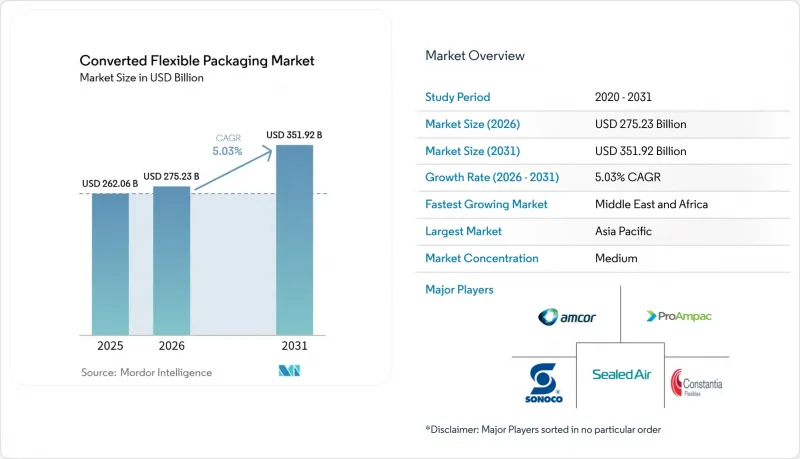
Mordor Intelligence에 의하면, 컨버티드 연포장 시장 규모는 2025년에 2,620억 6,000만 달러로 평가되었고, 2026년 2,752억 3,000만 달러에서 2031년까지 3,519억 2,000만 달러에 이를 것으로 예측되며, 예측 기간(2026-2031년) CAGR은 5.03%를 나타낼 전망입니다.
본 보고서는 소재별(플라스틱 필름, 종이 및 판지, 알루미늄 포일, 바이오플라스틱), 포장 형태별(파우치, 롤 스톡·리딩 필름 등), 최종 이용 산업별(식품, 의약품 및 헬스케어, 퍼스널케어 및 화장품 등), 유통 채널별(직접 판매, 간접 판매) 및 지역별로 분류되어 있습니다. 시장 전망은 금액(달러) 기준으로 제시되어 있습니다.
세계의 컨버티드 연포장 시장 동향 및 인사이트
외출 시 식품 및 음료 소비의 급증
도시 지역의 라이프스타일로 인해 식사 시간이 점점 단축되면서, 바로 먹을 수 있는 스낵, 1인분 음료, 재밀봉 가능한 파우치에 대한 수요가 증가하고 있습니다. 미국 농무부(USDA)의 2024년 식품 동향 데이터에 따르면, 미국 소비자의 50% 이상이 휴대성과 포장상의 환경 정보를 겸비한 제품을 원하고 있는 것으로 나타났습니다. 이에 각 브랜드는 트레이나 병에 비해 운송 비용을 절감할 수 있는 경량 스탠드업 파우치를 채택하여, 옴니채널 유통에서 부피 중량 요금을 줄이려고 하고 있습니다. HP Indigo 200K와 같은 디지털 인쇄기는 아트워크를 신속하게 변경할 수 있게 해 주어, 지역 브랜드가 판대금에 운영 자금을 묶이지 않고 한정 맛 제품의 시험 판매를 진행할 수 있도록 지원하고 있습니다. FDA의 ‘New Era of Smarter Food Safety Blueprint(더 스마트한 식품 안전의 새로운 시대)’에 기반한 규제 당국의 감시 강화로 인해, 소비자에게 직접 배송되는 패키지의 무결성이 중요시되면서, 높은 차단성과 재밀봉이 가능한 솔루션에 대한 컨버티드 연포장 시장 수요가 더욱 높아지고 있습니다.
전자상거래가 보호용 우편 포장재 수요를 가속화
택배 업체들은 영양 보충제, 의류, 소형 전자기기의 취급량이 증가함에 따라, 골판지 상자에서 상품을 보호하면서도 포장 중량을 줄일 수 있는 기포가 들어간 우편 봉투나 재활용 가능한 폴리에틸렌 배송 봉투로 전환하고 있습니다. 2024년 연포장 협회(FPA)의 생애주기 평가(LCA)에 따르면, 폴리에틸렌 메일백은 동등한 경질 판지 상자에 비해 온실가스 배출량이 적고, 화석 에너지 사용량이 47% 적은 것으로 확인되었습니다. 아마존과 몬디가 공동 개발한, 일반 가정에서 재활용이 가능한 메일용 봉투는 2024년에 3개의 지속가능성 상을 수상하며, 보다 환경 친화적인 라스트 마일 솔루션이 브랜드 가치를 높인다는 사실을 입증했습니다. 미국 농무부의 대두 유래 바이오폴리머에 관한 연구에 따르면, 향후 시장 진출기업들은 낙하 시험 성능을 저해하지 않으면서도 보호용 우편 봉투를 퇴비화 가능한 소재로 전환할 수 있을 것으로 보입니다.
복잡한 다층 재활용 인프라의 과제
보증금 반환 제도는 병을 대상으로 하고 있지만, 필름류는 거의 대상이 되지 않아 소비자들은 라미네이트 처리된 스낵이나 의약품 포장을 재활용할 수단이 없는 상태입니다. EU의 PPWR(플라스틱 포장 폐기물 규정)은 2029년 병 회수 목표를 정하고 있지만, 유연한 형태의 포장에 대해서는 언급하지 않아 규정 준수 측면에서 불확실성을 야기하고 있습니다. 몬델리즈나 암콜과 같은 선진적인 재활용 제휴 기업들은 화학 재활용 소재를 80% 사용한 캐드버리 포장지를 제공하고 있어 기술적 실현 가능성은 입증되었으나, 그 실현은 아직 대규모화되지 않은 열분해 시설에 의존하고 있습니다. 100억 달러를 초과하는 자본 수요로 인해 동남아시아와 라틴아메리카의 인프라 구축이 지연되어 순환 경제로의 전환이 더뎌질 가능성이 있습니다.
부문별 분석
플라스틱 필름은 확립된 압출 성형 설비와 스낵, 유제품, 전자상거래 배송용 봉투 분야에서의 실적을 바탕으로 2025년 컨버티드 연포장 시장에서 38.14%의 점유율을 유지했습니다. 이 카테고리 내에서 폴리에틸렌은 냉동 식품 및 스트레치 푸드 용도로 사용되는 반면, 폴리프로필렌은 EU 지침 2025/40에 기반한 재활용 가능성 목표를 지원하는 단일 소재 이니셔티브를 통해 입지를 강화하고 있습니다. 폴리에틸렌 테레프탈레이트(PET)는 커피 등 높은 차단성이 요구되는 틈새 시장을 점유하고 있지만, 그 다층 구조의 특성상 생산자 책임 회수(EPR) 부담이 증가하고 있습니다. 알루미늄 포일은 100% 수분 및 산소 차단성이 필수적인 의약품 및 인스턴트 음료 분야에서 여전히 없어서는 안 될 소재입니다.
바이오플라스틱은 규모는 작지만, ASTM의 가정용 퇴비화 가능 초안 규격 WK81525를 충족하는 전분 블렌드 및 PLA의 발전에 힘입어 연평균 성장률(CAGR) 7.62%로 성장을 지속하고 있습니다. 세계 주요 수지 제조업체와 현지 스타트업의 투자는 2030년까지 공급량을 두 배로 늘릴 가능성이 있는 생산 능력 확대를 시사하고 있습니다. 사탕수수 유래 에탄올 가격의 안정과 정책적 인센티브에 힘입어, 화석 유래 폴리머에 대한 비용 프리미엄은 점차 축소되고 있습니다. 각 식품 브랜드는 지자체에 의한 유기물 수거 시스템 도입 확대에 발맞추어, 청과물 및 1회용 커피 포드에 퇴비화 가능한 필름을 활용하고 있습니다. 그 결과, 재활용 소재 함유율 의무화 기준이 재활용이 어려운 라미네이트 소재의 대체재로 재생 가능 소재의 도입을 촉진함에 따라, 바이오플라스틱을 사용한 컨버티드 연포장 시장 규모는 성장세를 보이고 있습니다.
2025년에는 파우치가 컨버티드 연포장 시장의 61.63%를 차지하며 시장을 휩쓸었습니다. 이는 진열대에서의 가시성을 최적화하고, 충전 전에 평평한 상태로 출하할 수 있는 스탠드업형이 주도한 결과이며, 이를 통해 운송 시 배출량을 대폭 줄이고 있습니다. 스파우트가 달린 파우치는 바로 마실 수 있는 스포츠 음료 분야로 확대되고 있는 반면, 레토르트 대응 유형은 상온 보관이 가능한 반려동물사료 및 유아식을 타겟으로 하고 있습니다. 디지털 인쇄는 SKU의 계층화를 가속화하여, 높은 최소 주문 수량(MOQ) 없이도 시즌 한정 디자인이나 인플루언서와의 협업을 가능하게 하고 있습니다. 롤 스톡 및 뚜껑용 필름은 스낵 및 요거트의 고속 성형·충진·밀봉 라인을 뒷받침하며, 설비 투자의 상각이 진행되고 있는 분야에서 입지를 유지하고 있습니다.
파우치용 컨버티드 연포장 시장 규모는 PET/호일과의 차단 성능 격차를 해소하는 단일 PE 라미네이트 기술의 발전으로 인해 2031년까지 연평균 성장률(CAGR) 7.01%로 확대될 것으로 예측됩니다. 내부에 바이오 코팅이 적용된 종이 스탠드업 파우치가 프리미엄 그라놀라 및 과자류에 등장하며, 플라스틱 감축 노력에 부응하고 있습니다. 봉지와 자루는 곡물 및 화학 약품의 대량 운송에 대응하고 있지만, 전자상거래에서의 채택이 더딘 탓에 그 확대는 제한적입니다. 특수한 형태나 지퍼가 달린 포장은 경쟁이 치열한 매장에서 차별화를 꾀하며, 재밀봉 기능은 식품 폐기물을 줄여줍니다. 이는 많은 소매업체가 주목하고 있는 지표입니다. 옴니채널 커머스로 인해 기존 업계의 경계가 모호해지는 가운데, 파우치의 다용도성은 그 성장 궤도를 확고히 하고 있습니다.
지역별 분석
아시아태평양은 수지부터 필름에 이르는 통합된 복합 생산 체제, 방대한 소비자층, 그리고 기동성이 뛰어난 가공업체 생태계를 배경으로 2025년에는 39.62%의 점유율로 시장을 주도했습니다. 중국의 연포장 생산액은 2023년에 1,213억 4,000만 위안으로, 스낵 과자 수출과 즉석식품의 보급 확대에 힘입어 2027년까지 연평균 성장률(CAGR) 7.16%로 성장할 전망입니다. 인도에서는 포장 식품의 보급에 따라 수요가 확대되고 있으나, 생산 능력이 이를 따라가지 못하고 있어 그 격차를 수입이 메우는 형태로, UFlex사는 2024년 1분기에 368억 2,500만 루피의 순매출을 기록했습니다. BOPP/BOPET 필름공급 과잉이 가격 면에서 역풍으로 작용하고 있지만, 장기적인 펀더멘털은 여전히 견고합니다.
북미에서는 성숙한 재활용 인프라와 전자상거래의 보급이 호재로 작용하고 있습니다. 주 차원의 EPR(생산자 책임 회수) 법에 따라 각 브랜드사는 단일 소재 파우치로 전환을 추진하고 있는 한편, 멕시코만 연안을 강타한 허리케인으로 인한 폴리머 조달 리스크를 배경으로 공급망 다각화가 경영진의 중요 과제로 자리 잡고 있습니다. 디지털 인쇄 도입은 전 세계적으로 앞서 나가고 있으며, ePac사가 북미 23개 거점에서 소량 생산에 대응하는 체제를 확충함에 따라 해당 지역의 기술 수준이 향상되고 있습니다.
유럽에서는 엄격한 PPWR(플라스틱 포장 폐기물 규제)과 급등하는 EPR(생산자 책임 회수) 수수료로 인해 순환 경제 혁신의 최전선에 서 있습니다. 독일의 소매업체들은 2028년까지 자체 브랜드 연포장재에 재활용 소재 함유율을 최소 30%로 규정하고 있어, 이에 따라 화학적 재활용에 대한 연구 개발이 가속화되고 있습니다. 영국은 2024년에 요금 체계를 공식적으로 수립하여 다층 라미네이트의 즉각적인 재설계를 촉구하고 있습니다. 동유럽은 서유럽 브랜드에게 비용 경쟁력 있는 생산 거점이 되고 있지만, EU의 재활용 가능성 관련 지침을 준수해야 합니다.
중동 및 아프리카은 걸프 국가들의 외식 산업 확대와 아프리카 FMCG 시장의 제도화에 힘입어 8.51%라는 가장 높은 연평균 성장률(CAGR)을 기록하고 있습니다. ‘사우디 비전 2030’은 식량 자급률 42%를 목표로 하고 있으며, 이에 따라 파우치 및 뚜껑용 필름 생산 라인이 필요해지고 있습니다. 나이지리아의 소형 봉지 식수 시장은 여전히 LDPE 필름을 대량으로 소비하고 있지만, 환경 보호 기관은 더 두껍고 재활용 가능한 구조로의 전환을 추진하고 있습니다.
남미에서는 완만한 성장이 나타나고 있으며, 브라질 농업 기업의 수출이 커피 및 육류용 배리어 백 수요를 뒷받침하고 있습니다. 아르헨티나의 통화 변동으로 인해 자본 유입은 제한되고 있지만, Grupo HZ와 같은 지역 기업들은 차별화를 꾀하기 위해 레이저 스코어링 및 수성 잉크에 대한 투자를 계속하고 있습니다.
기타 혜택 :
- 엑셀 형식 시장 예측(ME) 시트
- 3개월간의 애널리스트 지원
자주 묻는 질문
목차
제1장 서론
제2장 조사 방법
제3장 주요 요약
제4장 시장 구도
제5장 시장 규모 및 성장 예측
제6장 경쟁 구도
제7장 시장 기회 및 향후 전망
AJY 26.09.11According to Mordor Intelligence, the converted flexible packaging market size was valued at USD 262.06 billion in 2025 and estimated to grow from USD 275.23 billion in 2026 to reach USD 351.92 billion by 2031, at a CAGR of 5.03% during the forecast period (2026-2031).
This report is Segmented by Material (Plastic Film, Paper and Paperboard, Aluminum Foil, and Bioplastics), Packaging Format (Pouches, Rollstock and Lidding Films, and More), End-Use Industry (Food, Pharmaceutical and Healthcare, Personal Care and Cosmetics, and More), Distribution Channel (Direct Sales, and Indirect Sales), and Geography. The Market Forecasts are Provided in Terms of Value (USD).
Global Converted Flexible Packaging Market Trends and Insights
Surge in On-the-Go Food and Beverage Consumption
Urban lifestyles continue to compress mealtimes, prompting higher demand for ready-to-eat snacks, single-serve beverages, and resealable pouches. USDA 2024 food trend data showed more than 50% of U.S. consumers seek products that combine portability and environmental information on the pack. Brands respond with lightweight stand-up pouches that lower shipping costs versus trays and jars, decreasing dimensional weight fees for omnichannel distribution. Digital presses such as HP Indigo 200K allow rapid artwork changes, helping regional brands trial limited-edition flavors without tying up working capital in plates. Regulatory scrutiny under the FDA's New Era of Smarter Food Safety Blueprint elevates pack integrity during direct-to-consumer fulfillment, further reinforcing the converted flexible packaging market demand for high-barrier, resealable solutions.
E-commerce Accelerating Demand for Protective Mailer Formats
Parcel carriers process rising volumes of nutraceuticals, apparel and small electronics, prompting a pivot from corrugate to bubble mailers and recyclable polyethylene shippers that protect items while shrinking package weight. A 2024 Flexible Packaging Association LCA confirmed that poly mailers show lower greenhouse-gas footprints and 47% less fossil energy use than comparable rigid cartons. Amazon and Mondi co-developed curbside-recyclable mailers that won three sustainability awards in 2024, proving the brand equity upside of greener last-mile solutions. U.S. Department of Agriculture research into soy-based biopolymers indicates future entrants could shift protective mailers toward compostable substrates without compromising drop-test performance.
Complex Multi-Layer Recycling Infrastructure Gaps
Deposit-return schemes cover bottles but rarely target films, leaving consumers without pathways to recycle laminated snack or pharma packs. EU PPWR sets 2029 bottle collection targets but is silent on flexible formats, creating compliance uncertainty. Advanced recycling alliances, such as Mondelez and Amcor, delivering Cadbury wrappers with 80% chemically recycled content, prove technical viability yet hinge on unscaled pyrolysis hubs. Capital needs exceeding USD 10 billion may delay infrastructure roll-out in Southeast Asia and LatAm, slowing circularity progress.
Other drivers and restraints analyzed in the detailed report include:
- Adoption of High-Barrier Mono-Material Films for Recyclability
- Advanced Digital Printing Enabling Low-MOQ SKU Proliferation
- Crude-Oil Price Volatility Affecting Polymer Costs
For complete list of drivers and restraints, kindly check the Table Of Contents.
Segment Analysis
Plastic films retained 38.14% converted flexible packaging market share in 2025 due to entrenched extrusion assets and proven performance in snack, dairy and e-commerce mailer applications. Within this cohort, polyethylene serves frozen foods and stretch hooding, whereas polypropylene gains traction via mono-material initiatives that support recyclability targets under EU 2025/40. Polyethylene terephthalate occupies high-barrier niches like coffee, but its multilayered nature intensifies EPR penalties. Aluminum foil remains critical for pharmaceuticals and instant beverages where 100% moisture-oxygen barrier is non-negotiable.
Bioplastics, although from a smaller base, chart a 7.62% CAGR anchored by starch-blend and PLA advancements that satisfy ASTM backyard-compostable draft standard WK81525. Investments by global resin majors and local start-ups signal capacity ramps that could double supply by 2030. Cost premiums over fossil polymers are narrowing, aided by sugarcane ethanol price stability and policy incentives. Food brands exploit compostable films for produce and single-serve coffee pods, aligning with municipal organics collection roll-outs. The converted flexible packaging market size for bioplastics, therefore, gains momentum as mandatory recycled-content thresholds spur trials of renewable substitutes for hard-to-recycle laminates.
Pouches dominated with 61.63% converted flexible packaging market share in 2025, driven by stand-up models that optimize shelf visibility and ship flat pre-fill, slashing freight emissions. Spout pouches expand into ready-to-drink sports beverages, while retortable variants target ambient pet food and baby food. Digital printing accelerates SKU tiering, enabling seasonal artwork and influencer collaborations without high MOQs. Rollstock and lidding films support high-speed form-fill-seal lines in snacks and yogurt, holding ground where capital equipment is amortized.
The converted flexible packaging market size for pouches is forecast to rise 7.01% CAGR through 2031 as mono-PE laminate breakthroughs close barrier gaps versus PET/foil. Paper-based stand-up pouches with internal bio-coatings debut in premium granola and confectionery, appealing to plastic reduction pledges. Bags and sacks address bulk grains and chemicals, yet slower e-commerce uptake caps expansion. Shaped and zipper formats provide differentiation in crowded aisles, and reseal features curb food waste, a metric tracked by many retailers. As omnichannel commerce blurs traditional trade boundaries, pouch versatility secures its growth trajectory.
Complete Report Scope:
- By Material
- Plastic Film
- Polyethylene
- Polypropylene
- Polyethylene Terephthalate
- Other Plastic Films
- Paper and Paperboard
- Aluminum Foil
- Bioplastics
- Plastic Film
- By Packaging Format
- Pouches
- Rollstock and Lidding Films
- Bags and Sacks
- Other Packaging Formats
- By End-use Industry
- Food
- Bakery
- Dairy
- Confectionery
- Ready Meals
- Other Food Products
- Beverage
- Non-Alcoholic
- Alcoholic
- Pharmaceutical and Healthcare
- Personal Care and Cosmetics
- Household Products
- Other End-use Industries
- Food
- By Distribution Channel
- Direct Sales Channel
- Indirect Sales Channel
- By Geography
- North America
- United States
- Canada
- Mexico
- Europe
- Germany
- United Kingdom
- France
- Italy
- Spain
- Netherlands
- Rest of Europe
- Asia-Pacific
- China
- Japan
- India
- South Korea
- Australia
- Singapore
- Rest of Asia-Pacific
- Middle East and Africa
- Middle East
- Saudi Arabia
- United Arab Emirates
- Turkey
- Rest of Middle East
- Africa
- South Africa
- Nigeria
- Egypt
- Rest of Africa
- Middle East
- South America
- Brazil
- Argentina
- Rest of South America
- North America
Geography Analysis
Asia-Pacific led with 39.62% share in 2025 on the back of integrated resin-to-film complexes, populous consumer bases, and agile converter ecosystems. China's flexible packaging output hit RMB 121.34 billion in 2023 and is poised for 7.16% CAGR through 2027, buoyed by snack exports and rising ready-meal adoption. Indian demand advances alongside packaged food uptake, yet capacity lags, prompting UFlex to report INR 36,825 million net revenue in Q1 2024 as imports fill gaps. Oversupply of BOPP/BOPET films creates pricing headwinds, but long-term fundamentals remain intact.
North America benefits from a mature recycling infrastructure and e-commerce penetration. State-level EPR legislation drives brand conversions to mono-material pouches, while polymer sourcing risks from Gulf Coast hurricanes keep supply-chain diversification on executive agendas. Digital printing adoption leads globally, with ePac scaling 23 North American sites to service short runs, which raises the region's technology benchmark.
Europe's stringent PPWR and escalating EPR fees place it at the forefront of circular-economy innovation. German retailers stipulate minimum 30% recycled content in private-label flexible packs by 2028, accelerating R&D in chemical recycling. The United Kingdom formalized fee schedules in 2024, compelling immediate redesign of multilayer laminates. Eastern Europe serves as cost-competitive production base for Western brands, yet must align with EU recyclability directives.
The Middle East and Africa post the fastest 8.51% CAGR, buoyed by Gulf food-service expansion and African FMCG formalization. Saudi Vision 2030 targets 42% local food self-sufficiency, necessitating pouch and lidding film lines. Nigeria's sachet water market remains a high-volume user of LDPE film, though environmental agencies push for thicker, recyclable structures.
South America records moderate growth, with Brazil's agribusiness exports supporting barrier bag demand for coffee and meat. Argentina's currency volatility tempers capital imports, yet regional players such as Grupo HZ continue to invest in laser scoring and water-based inks for differentiation.
- Amcor Plc
- Sealed Air Corporation
- Mondi Group
- Constantia Flexibles
- Sonoco Products Company
- ProAmpac
- Transcontinental Inc.
- Huhtamaki Oyj
- Coveris Holdings SA
- Uflex Ltd.
- Bemis (Amcor Flexibles)
- Bischof + Klein SE & Co. KG
- FlexPak Services LLC
- Winpak Ltd.
- Glenroy Inc.
- Clondalkin Group
- Printpack Inc.
- AR Packaging (Graphic Packaging)
- AptarGroup Inc.
Additional Benefits:
- The market estimate (ME) sheet in Excel format
- 3 months of analyst support
TABLE OF CONTENTS
1 INTRODUCTION
- 1.1 Study Assumptions and Market Definition
- 1.2 Scope of the Study
2 RESEARCH METHODOLOGY
3 EXECUTIVE SUMMARY
4 MARKET LANDSCAPE
- 4.1 Market Overview
- 4.2 Market Drivers
- 4.2.1 Surge in on-the-go food and beverage consumption
- 4.2.2 E-commerce accelerating demand for protective mailer formats
- 4.2.3 Adoption of high-barrier mono-material films for recyclability
- 4.2.4 Advanced digital printing enabling low-MOQ SKU proliferation
- 4.2.5 Government bans on rigid plastics in fresh-produce channels
- 4.3 Market Restraints
- 4.3.1 Complex multi-layer recycling infrastructure gaps
- 4.3.2 Crude-oil price volatility affecting polymer costs
- 4.3.3 Extended-Producer-Responsibility (EPR) fees squeezing margins
- 4.3.4 BOPP/BOPET film overcapacity driving price wars
- 4.4 Supply Chain Analysis
- 4.5 Regulatory Landscape
- 4.6 Technological Outlook
- 4.7 Porter's Five Forces Analysis
- 4.7.1 Threat of New Entrants
- 4.7.2 Bargaining Power of Buyers
- 4.7.3 Bargaining Power of Suppliers
- 4.7.4 Threat of Substitutes
- 4.7.5 Intensity of Competitive Rivalry
- 4.8 Impact of Macroeconomic Factors on the Market
5 MARKET SIZE AND GROWTH FORECASTS (VALUES)
- 5.1 By Material
- 5.1.1 Plastic Film
- 5.1.1.1 Polyethylene
- 5.1.1.2 Polypropylene
- 5.1.1.3 Polyethylene Terephthalate
- 5.1.1.4 Other Plastic Films
- 5.1.2 Paper and Paperboard
- 5.1.3 Aluminum Foil
- 5.1.4 Bioplastics
- 5.1.1 Plastic Film
- 5.2 By Packaging Format
- 5.2.1 Pouches
- 5.2.2 Rollstock and Lidding Films
- 5.2.3 Bags and Sacks
- 5.2.4 Other Packaging Formats
- 5.3 By End-use Industry
- 5.3.1 Food
- 5.3.1.1 Bakery
- 5.3.1.2 Dairy
- 5.3.1.3 Confectionery
- 5.3.1.4 Ready Meals
- 5.3.1.5 Other Food Products
- 5.3.2 Beverage
- 5.3.2.1 Non-Alcoholic
- 5.3.2.2 Alcoholic
- 5.3.3 Pharmaceutical and Healthcare
- 5.3.4 Personal Care and Cosmetics
- 5.3.5 Household Products
- 5.3.6 Other End-use Industries
- 5.3.1 Food
- 5.4 By Distribution Channel
- 5.4.1 Direct Sales Channel
- 5.4.2 Indirect Sales Channel
- 5.5 By Geography
- 5.5.1 North America
- 5.5.1.1 United States
- 5.5.1.2 Canada
- 5.5.1.3 Mexico
- 5.5.2 Europe
- 5.5.2.1 Germany
- 5.5.2.2 United Kingdom
- 5.5.2.3 France
- 5.5.2.4 Italy
- 5.5.2.5 Spain
- 5.5.2.6 Netherlands
- 5.5.2.7 Rest of Europe
- 5.5.3 Asia-Pacific
- 5.5.3.1 China
- 5.5.3.2 Japan
- 5.5.3.3 India
- 5.5.3.4 South Korea
- 5.5.3.5 Australia
- 5.5.3.6 Singapore
- 5.5.3.7 Rest of Asia-Pacific
- 5.5.4 Middle East and Africa
- 5.5.4.1 Middle East
- 5.5.4.1.1 Saudi Arabia
- 5.5.4.1.2 United Arab Emirates
- 5.5.4.1.3 Turkey
- 5.5.4.1.4 Rest of Middle East
- 5.5.4.2 Africa
- 5.5.4.2.1 South Africa
- 5.5.4.2.2 Nigeria
- 5.5.4.2.3 Egypt
- 5.5.4.2.4 Rest of Africa
- 5.5.4.1 Middle East
- 5.5.5 South America
- 5.5.5.2 Brazil
- 5.5.5.3 Argentina
- 5.5.5.4 Rest of South America
- 5.5.1 North America
6 COMPETITIVE LANDSCAPE
- 6.1 Market Concentration
- 6.2 Strategic Moves
- 6.3 Market Share Analysis
- 6.4 Company Profiles (includes Global level Overview, Market level overview, Core Segments, Financials, Strategic Information, Market Rank/Share, Products and Services, Recent Developments)
- 6.4.1 Amcor Plc
- 6.4.2 Sealed Air Corporation
- 6.4.3 Mondi Group
- 6.4.4 Constantia Flexibles
- 6.4.5 Sonoco Products Company
- 6.4.6 ProAmpac
- 6.4.7 Transcontinental Inc.
- 6.4.8 Huhtamaki Oyj
- 6.4.9 Coveris Holdings SA
- 6.4.10 Uflex Ltd.
- 6.4.11 Bemis (Amcor Flexibles)
- 6.4.12 Bischof + Klein SE & Co. KG
- 6.4.13 FlexPak Services LLC
- 6.4.14 Winpak Ltd.
- 6.4.15 Glenroy Inc.
- 6.4.16 Clondalkin Group
- 6.4.17 Printpack Inc.
- 6.4.18 AR Packaging (Graphic Packaging)
- 6.4.19 AptarGroup Inc.
7 MARKET OPPORTUNITIES AND FUTURE OUTLOOK
- 7.1 White-space and Unmet-need Assessment