|
시장보고서
상품코드
2124007
채혈관 시장 : 시장 점유율 분석, 업계 동향 및 통계, 성장 예측(2026-2031년)Blood Collection Tubes - Market Share Analysis, Industry Trends & Statistics, Growth Forecasts (2026 - 2031) |
||||||
 Mordor Intelligence
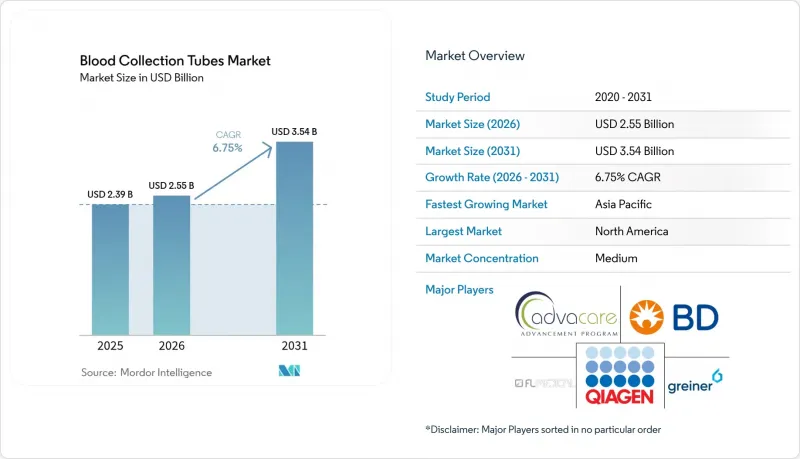
Mordor Intelligence에 의하면, 2026년 채혈관 시장 규모는 25억 5,000만 달러로 추정되고, 2025년 23억 9,000만 달러에서 확대해, 2031년에는 35억 4,000만 달러에 이를 것으로 예측됩니다.
2026-2031년 연평균 성장률(CAGR)은 6.75%를 나타낼 것으로 전망됩니다.
본 보고서는 제품 유형별(혈청 분리용 튜브 등), 재질별(플라스틱 튜브 및 유리 튜브), 방식별(진공식 채혈관 및 비진공식/주사기 채혈용 튜브), 용도별(진단 등), 최종 사용자별(병원 및 진료소 등), 지역별(북미, 유럽, 아시아태평양 등)로 분류되어 있습니다. 시장 예측은 금액(달러) 기준으로 제시되어 있습니다.
세계의 채혈관 시장 동향 및 인사이트
만성 질환 유병률 증가
당뇨병, 심혈관 질환, 암의 발생률 상승으로 인해 정기적인 모니터링의 필요성이 높아지면서, 병원 및 외래 진료 시설에서의 채혈관 수요가 지속적으로 증가하고 있습니다. 유럽과 북미의 고령화는 기초 수요를 확대시키고 있는 반면, 신흥 경제국에서는 그동안 부족했던 지침에 기반한 진단이 도입되고 있습니다. WHO의 환자 혈액 관리 프레임워크는 빈혈 감소 및 모자 보건 프로그램에서 신뢰할 수 있는 검체 품질이 필수적임을 강조하고 있습니다. 불안정한 바이오마커를 안정화시키는 새로운 화학 성분의 채혈관을 통해 만성 질환 관리 검사 항목이 확대되고 있습니다. AI를 활용한 플랫폼이 보급됨에 따라 조기 발견의 기회가 넓어지고 있으며, 분석 대상 물질의 무결성을 보호하는 고품질 채혈관이 필수적이어서, 이에 따라 채혈관 시장의 상승세가 더욱 강화되고 있습니다.
진단 검사 건수의 확대
팬데믹 이후의 개혁으로 인해, 검사실 및 현장 진단(Point-of-Care) 검사 항목은 영구적으로 확대되었습니다. 현재, 고처리량 검사 패널은 연례 건강검진, 만성 질환의 경과 관찰, 그리고 표적 선별 검사에 통합되어 있으며, 각각 1회의 내원 시 여러 유형의 채혈관이 필요합니다. Truvian Health사의 벤치탑형 기기 등 휴대용 분석 장비는 핵심 검사실과의 일치율이 98%에 달하여, 약국 및 지역 진료소로 진단 서비스가 확대되는 데 기여하고 있습니다. 정밀의료의 추진으로 검체의 복잡성은 더욱 증가하고 있습니다. 임상의들은 RNA, cfDNA 또는 미량 원소 분석용으로 설계된 채혈관이 필요한 바이오마커 검사 세트를 요구하기 때문입니다. 이처럼 검사 빈도가 높아짐에 따라 채혈관 소비량은 직접적으로 증가하여 전 세계 채혈관 시장의 성장을 견인하고 있습니다.
부적절한 혈액 취급으로 인한 감염 위험
산업안전보건 당국은 날카로운 물품 관리를 의무화하고 있지만, 교육의 불균형으로 인해 자원이 제한된 병원에서는 바늘 찔림 사고의 위험이 높아지고 있습니다. OSHA(미국 산업안전보건청)는 천자 방지 용기의 사용과 즉시 폐기를 요구하고 있으며, 이는 운영 비용 증가로 이어지고 있습니다. 2024년에는 이상 기후로 인해 미국에서 1만 9,000건 이상의 헌혈이 중단되면서, 채혈 물류의 취약성이 드러났고, 오염 위험을 높일 가능성이 부각되었습니다. 한편, FDA는 규격에 맞지 않는 플라스틱 주사기에 대한 감시를 강화하고 있으며, 이는 제품 출시 지연으로 이어질 수 있는 더욱 엄격한 감독 체제의 신호입니다. 이러한 요인들이 복합적으로 작용하여, 인프라와 규정 준수 예산이 여전히 부족한 지역에서는 시장 확대가 억제되고 있습니다.
부문 분석
혈청 분리용 튜브는 전 세계 실험실의 일상적인 생화학 검사 패널을 기반으로 2025년에도 38.12%의 점유율을 유지했습니다. 그러나 재생 의학 프로토콜과 세포 치료 워크플로우를 배경으로, 혈장 분리용 튜브 시장은 2031년까지 연평균 성장률(CAGR) 8.53%로 성장할 전망입니다. 혈소판 농축 혈장이 정형외과 및 피부과 임상 현장에서 지지를 얻음에 따라, 치료 용도는 연평균 성장률(CAGR) 9.33%로 성장을 지속하고, 있습니다. 성장 인자를 농축하는 새로운 한외여과법이 등장함에 따라 이 수요 곡선은 더욱 가파르게 상승하고 있으며, 채혈관 시장에서 특수 튜브의 존재감이 커지고 있습니다.
모세관식 미세 채혈 제품은 분석 범위를 저해하지 않으면서 채혈량을 줄여주는 ‘MiniDraw’와 같은 기기에 힘입어 소아과 및 현장 진단(Point-of-Care) 분야에서 틈새 시장을 개척하고 있습니다. EDTA 튜브는 혈액학 분야에서 여전히 필수적이며, 신속 혈청용 제품은 검사 결과의 신속한 확인이 임상 조치를 좌우하는 응급 상황의 요구를 충족시키고 있습니다. 이러한 동향들이 맞물려 균형 잡히면서도 성장 지향적인 포트폴리오가 형성되고 있으며, 이 부문이 채혈관 시장 전체의 성장에 실질적으로 기여할 것으로 확실시되고 있습니다.
플라스틱 채혈관은 파손되기 어렵고 비용이 저렴하기 때문에 2025년에는 채혈관 시장 점유율의 54.92%를 차지했습니다. 그러나 지속가능성에 관한 규제와 미량 원소 분석에서 뛰어난 분석 대상 물질의 안정성에 힘입어, 유리 튜브의 연평균 성장률(CAGR)은 8.63%로 가장 높은 성장세를 보일 것으로 예측됩니다. EU의 ‘포장 및 포장 폐기물 규정’에서는 2030년까지 재활용 가능성을 의무화하고 있어, 플라스틱의 내구성과 유리와 같은 수증기 차단성을 결합한 하이브리드 튜브의 연구 개발이 촉진되고 있습니다.
고급 케모PET의 변형 제품은 생물학적 안전성 지침을 충족하면서도 화학적 비활성 측면에서 유리와 대등한 수준에 이르고, 과도기적인 중간 해결책으로서의 입지를 확립하고 있습니다. 덴마크에서 진행 중인 재활용 시범 사업은 일회용 플라스틱과 관련된 규제적 제재를 완화할 가능성이 있는 순환형 프로그램의 유망성을 보여주고 있습니다. 이러한 소재 전환이 탄력을 받음에 따라 조달 기준이 재구성되고, 채혈관 시장 내 경쟁이 더욱 치열해지고 있습니다.
지역별 분석
북미는 2025년에 매출 점유율의 35.02%를 차지한 것으로 평가되었으며, 이러한 위상은 성숙한 진단 인프라와 자동화의 조기 도입에 힘입은 것입니다. 2026년에 시행될 FDA의 품질 관리 시스템 규정은 ISO 13485:2016 요건과의 조화를 도모하고, 의료기기 승인 절차를 간소화함으로써 국내 생산 및 수출을 촉진할 것입니다. BD사가 미국 내 생산 능력에 25억 달러를 투자하겠다고 밝힌 것은 해당 지역의 견조한 수요에 대한 확신을 뒷받침합니다. 2024년에 발생한 기상 조건으로 인한 헌혈량 부족은 향후 인프라 투자 방향을 좌우할 수 있는 회복력 부족을 여실히 드러냈습니다.
아시아태평양은 중국의 ‘건강 중국 2030’에 기반한 의료 확대와 인도의 검사 네트워크 확충을 원동력으로 삼아, 2031년까지 연평균 성장률(CAGR) 7.28%를 나타낼 것으로 예측됩니다. 테르모의 1,500만 달러 규모의 현지화 투자는 이 지역의 규모와 규제상 인센티브가 주는 매력을 보여줍니다. 1인당 지출 증가와 정부의 AI 집중 투자로 인해 첨단 채혈·검사 시스템의 비약적인 보급이 가능해지면서, 이 지역은 채혈관 시장의 성장을 견인하는 원동력으로서의 입지를 확고히 하고 있습니다.
유럽은 지속가능성에 관한 정책적 리더십에 힘입어 견고한 시장 점유율을 유지하고 있습니다. ‘포장 및 포장 폐기물에 관한 규정’은 소재 혁신을 촉진하고 있으며, EU 각 센터 간의 혈소판 용해액 표준화를 위한 협력 체제를 통해 고품질의 치료용 원료가 확보되고 있습니다. 2025년까지 혈장 자급률을 25%로 높이겠다는 영국 국민보건서비스(NHS)의 목표는 확실한 국내 수요 증가를 시사하는 한편, 동유럽의 비교적 소규모 시장에서는 인프라 현대화에 따라 단계적인 수요 증가가 예상됩니다. 이러한 지역들이 종합적이고 균형 잡힌 수요 구성을 형성하고 있으며, 이것이 전 세계 채혈관 시장의 견고한 전망을 뒷받침하고 있습니다.
기타 혜택 :
- 엑셀 형식 시장 예측(ME) 시트
- 3개월간의 애널리스트 지원
자주 묻는 질문
목차
제1장 서론
제2장 조사 방법
제3장 주요 요약
제4장 시장 구도
제5장 시장 규모 및 성장 예측
제6장 경쟁 구도
제7장 시장 기회 및 향후 전망
AJY 26.09.11According to Mordor Intelligence, the blood collection tubes market size in 2026 is estimated at USD 2.55 billion, growing from 2025 value of USD 2.39 billion with 2031 projections showing USD 3.54 billion, growing at 6.75% CAGR over 2026-2031.
This report is Segmented by Product Type (Serum-Separating Tubes, and More), Material (Plastic Tubes and Glass Tubes), Method (Vacuum Blood Collection Tubes and Non-Vacuum/Syringe-Based Tubes), Application (Diagnostics, and More), End-User (Hospitals & Clinics, and More), and Geography (North America, Europe, Asia-Pacific, and More). The Market Forecasts are Provided in Terms of Value (USD).
Global Blood Collection Tubes Market Trends and Insights
Growing Prevalence of Chronic Diseases
Rising incidences of diabetes, cardiovascular ailments, and cancer elevate routine monitoring needs, causing sustained uplift in tube volumes across hospital and outpatient sites. Aging populations in Europe and North America extend baseline demand, whereas emerging economies adopt guideline-based diagnostics that were previously scarce. WHO's patient-blood-management framework underscores reliable specimen quality as essential for anemia reduction and maternal-health programs. Novel tube chemistries that stabilize fragile biomarkers widen the testing menu for chronic-care pathways. As AI-driven platforms gain traction, early-stage detection expands, and high-quality tubes that guard analyte integrity become indispensable, thereby reinforcing the upward trajectory of the blood collection tubes market.
Expansion of Diagnostic Testing Volume
Post-pandemic reforms have permanently enlarged laboratory and point-of-care test menus. High-throughput panels now accompany annual wellness checks, chronic-disease reviews, and targeted screening, each requiring multiple tube types per encounter. Portable analyzers such as Truvian Health's benchtop unit deliver 98% agreement against core labs, pushing diagnostic reach into pharmacies and community clinics. Precision-medicine initiatives further intensify specimen complexity, as clinicians request biomarker suites that depend on tubes engineered for RNA, cfDNA, or trace elements. This escalating test intensity directly multiplies unit consumption, reinforcing the growth of the blood collection tubes market worldwide.
Risk of Infection from Improper Blood Handling
Occupational-safety agencies mandate sharps controls, yet uneven training raises exposure to needlestick injuries in resource-constrained hospitals. OSHA calls for puncture-proof containers and immediate disposal, adding operational cost. Extreme weather disrupted over 19,000 U.S. donations in 2024, revealing fragility in collection logistics that can escalate contamination risk. Meanwhile, the FDA increased surveillance on substandard plastic syringes, signaling tougher oversight that can delay product releases. Together, these factors temper market expansion where infrastructure and compliance budgets remain thin.
Other drivers and restraints analyzed in the detailed report include:
- Technological Advancements in Vacuum Collection Systems
- Rapid Growth of Point-of-Care Testing Market
- Price Sensitivity and Reimbursement Constraints
For complete list of drivers and restraints, kindly check the Table Of Contents.
Segment Analysis
Serum-separating formats retained 38.12% share in 2025, anchored in routine chemistry panels across global labs. However, plasma-separating tubes will expand at 8.53% CAGR through 2031 on the back of regenerative-medicine protocols and cell-therapy workflows. Therapeutic applications claim 9.33% CAGR as platelet-rich plasma gains clinical favor for orthopedics and dermatology. Emerging ultrafiltration methods that enrich growth factors sharpen this demand curve and elevate the profile of specialized tubes within the blood collection tubes market.
Capillary micro-collection products are carving a niche in pediatric and point-of-care settings, buoyed by devices such as MiniDraw that reduce draw volumes without compromising analytical scope. EDTA tubes remain indispensable for hematology; rapid-serum variants fill emergency needs where turnaround time dictates clinical action. Collectively, these dynamics foster a balanced but growth-tilted portfolio, ensuring the segment contributes materially to overall blood collection tubes market growth.
Plastic retained 54.92% of the blood collection tubes market share in 2025 due to breakage resistance and lower cost. Yet glass tubes are slated for the fastest 8.63% CAGR, propelled by sustainability mandates and superior analyte stability in trace-element studies. The EU's Packaging and Packaging Waste Regulation compels recyclability by 2030, prompting R&D in hybrid tubes that fuse plastic robustness with glass-like vapor barriers.
Advanced chemo-PET variants now rival glass for chemical inertness while staying within biosafety guidelines, positioning them as a mid-transition solution. Recycling pilots in Denmark show promise for circular programs that may blunt regulatory penalties linked to single-use plastics. As these material shifts gain momentum, they reshape procurement criteria and reinforce the competitive stakes in the blood collection tubes market.
Complete Report Scope:
- By Product Type
- Serum-Separating Tubes
- EDTA Tubes
- Plasma-Separating Tubes
- Rapid Serum Tubes
- Capillary Micro-Collection Tubes
- Other Product Types
- By Material
- Plastic Tubes
- Glass Tubes
- By Method
- Vacuum Blood Collection Tubes
- Non-Vacuum / Syringe-Based Tubes
- By End-User
- Hospitals & Clinics
- Diagnostic Laboratories
- Blood Banks & Transfusion Centers
- Point-of-Care / Home-Care Settings
- By Application
- Diagnostics
- Therapeutics (Transfusion / Cell-therapy)
- Geography
- North America
- United States
- Canada
- Mexico
- Europe
- Germany
- United Kingdom
- France
- Italy
- Spain
- Rest of Europe
- Asia-Pacific
- China
- Japan
- India
- Australia
- South Korea
- Rest of Asia-Pacific
- Middle East & Africa
- GCC
- South Africa
- Rest of Middle East & Africa
- South America
- Brazil
- Argentina
- Rest of South America
- North America
Geography Analysis
North America commanded 35.02% revenue share in 2025, a position underpinned by mature diagnostics infrastructure and early adoption of automation. The FDA's Quality Management System Regulation, effective 2026, harmonizes requirements with ISO 13485:2016 and simplifies device clearances, encouraging domestic production and exports. BD's pledge to invest USD 2.5 billion in U.S. capacity underscores confidence in steady regional demand. Weather-related donation shortfalls during 2024 spotlight resiliency gaps that may shape future infrastructure spending.
Asia-Pacific is projected to clock a 7.28% CAGR to 2031, powered by healthcare expansions under China's "Healthy China 2030" and India's widening lab networks. Terumo's USD 15 million localization spend demonstrates the pull of regional scale and regulatory incentives. Rising per-capita outlays and government focus on AI enable leapfrog adoption of advanced collection and testing systems, positioning the region as the dynamo of blood collection tubes market growth.
Europe holds a robust share, strengthened by policy leadership in sustainability. The Packaging and Packaging Waste Regulation catalyzes material innovation, and collaborative platelet-lysate standardization across EU centers ensures high-quality therapeutic inputs. The NHS target of 25% plasma self-sufficiency by 2025 signals dependable domestic uptake, whereas smaller Eastern European markets offer incremental gains as infrastructure modernizes. Collectively, these geographies forge a balanced demand mix that underpins the global blood collection tubes market's resilient outlook.
- Beckton Dickinson
- Greiner Bio One International
- Terumo
- Sarstedt
- QIAGEN
- F.L. Medical Srl
- AdvaCare
- Narang Medical
- Hindustan Syringes & Medical Devices
- DWK Life Sciences (Wheaton)
- RAM Scientific Inc.
- Nipro
- Sekisui Medical Co., Ltd.
- Medtronic
- Danaher Corp. (Radiometer)
- Cardinal Health
- Shenzhen Kanghua Bio-medical (KHB)
- Greiner AG Holding
- BD Vacutainer Systems
Additional Benefits:
- The market estimate (ME) sheet in Excel format
- 3 months of analyst support
TABLE OF CONTENTS
1 Introduction
- 1.1 Study Assumptions & Market Definition
- 1.2 Scope of the Study
2 Research Methodology
3 Executive Summary
4 Market Landscape
- 4.1 Market Overview
- 4.2 Market Drivers
- 4.2.1 Growing Prevalence of Chronic Diseases
- 4.2.2 Expansion of Diagnostic Testing Volume
- 4.2.3 Rising Surgical and Trauma Procedure Rates
- 4.2.4 Increasing Government Blood Donation Initiatives
- 4.2.5 Technological Advancements in Vacuum Collection Systems
- 4.2.6 Rapid Growth of Point-Of-Care Testing Market
- 4.3 Market Restraints
- 4.3.1 Risk of Infection From Improper Blood Handling
- 4.3.2 Price Sensitivity and Reimbursement Constraints
- 4.3.3 Regulatory Pressure on Single-Use Plastics
- 4.3.4 Volatility in Raw Material Supply Chains
- 4.4 Regulatory Landscape
- 4.5 Porter's Five Forces Analysis
- 4.5.1 Threat of New Entrants
- 4.5.2 Bargaining Power of Buyers
- 4.5.3 Bargaining Power of Suppliers
- 4.5.4 Threat of Substitutes
- 4.5.5 Competitive Rivalry
5 Market Size & Growth Forecasts (Value, USD)
- 5.1 By Product Type
- 5.1.1 Serum-Separating Tubes
- 5.1.2 EDTA Tubes
- 5.1.3 Plasma-Separating Tubes
- 5.1.4 Rapid Serum Tubes
- 5.1.5 Capillary Micro-Collection Tubes
- 5.1.6 Other Product Types
- 5.2 By Material
- 5.2.1 Plastic Tubes
- 5.2.2 Glass Tubes
- 5.3 By Method
- 5.3.1 Vacuum Blood Collection Tubes
- 5.3.2 Non-Vacuum / Syringe-Based Tubes
- 5.4 By End-User
- 5.4.1 Hospitals & Clinics
- 5.4.2 Diagnostic Laboratories
- 5.4.3 Blood Banks & Transfusion Centers
- 5.4.4 Point-of-Care / Home-Care Settings
- 5.5 By Application
- 5.5.1 Diagnostics
- 5.5.2 Therapeutics (Transfusion / Cell-therapy)
- 5.6 Geography
- 5.6.1 North America
- 5.6.1.1 United States
- 5.6.1.2 Canada
- 5.6.1.3 Mexico
- 5.6.2 Europe
- 5.6.2.1 Germany
- 5.6.2.2 United Kingdom
- 5.6.2.3 France
- 5.6.2.4 Italy
- 5.6.2.5 Spain
- 5.6.2.6 Rest of Europe
- 5.6.3 Asia-Pacific
- 5.6.3.1 China
- 5.6.3.2 Japan
- 5.6.3.3 India
- 5.6.3.4 Australia
- 5.6.3.5 South Korea
- 5.6.3.6 Rest of Asia-Pacific
- 5.6.4 Middle East & Africa
- 5.6.4.1 GCC
- 5.6.4.2 South Africa
- 5.6.4.3 Rest of Middle East & Africa
- 5.6.5 South America
- 5.6.5.1 Brazil
- 5.6.5.2 Argentina
- 5.6.5.3 Rest of South America
- 5.6.1 North America
6 Competitive Landscape
- 6.1 Market Concentration
- 6.2 Market Share Analysis
- 6.3 Company Profiles (includes Global level Overview, Market level overview, Core Business Segments, Financials, Headcount, Key Information, Market Rank, Market Share, Products and Services, and analysis of Recent Developments)
- 6.3.1 Becton, Dickinson & Company
- 6.3.2 Greiner Bio-One International GmbH
- 6.3.3 Terumo Corporation
- 6.3.4 Sarstedt AG & Co. KG
- 6.3.5 Qiagen N.V.
- 6.3.6 F.L. Medical Srl
- 6.3.7 AdvaCare Pharma
- 6.3.8 Narang Medical Limited
- 6.3.9 Hindustan Syringes & Medical Devices Ltd
- 6.3.10 DWK Life Sciences (Wheaton)
- 6.3.11 RAM Scientific Inc.
- 6.3.12 Nipro Medical Corporation
- 6.3.13 Sekisui Medical Co., Ltd.
- 6.3.14 Medtronic plc
- 6.3.15 Danaher Corp. (Radiometer)
- 6.3.16 Cardinal Health Inc.
- 6.3.17 Shenzhen Kanghua Bio-medical (KHB)
- 6.3.18 Greiner AG Holding
- 6.3.19 BD Vacutainer Systems
7 Market Opportunities & Future Outlook
- 7.1 White-space & Unmet-Need Assessment