|
시장보고서
상품코드
2124024
성형 펄프 포장 시장 : 점유율 분석, 업계 동향과 통계, 성장 예측(2026-2031년)Molded Pulp Packaging - Market Share Analysis, Industry Trends & Statistics, Growth Forecasts (2026 - 2031) |
||||||
 Mordor Intelligence
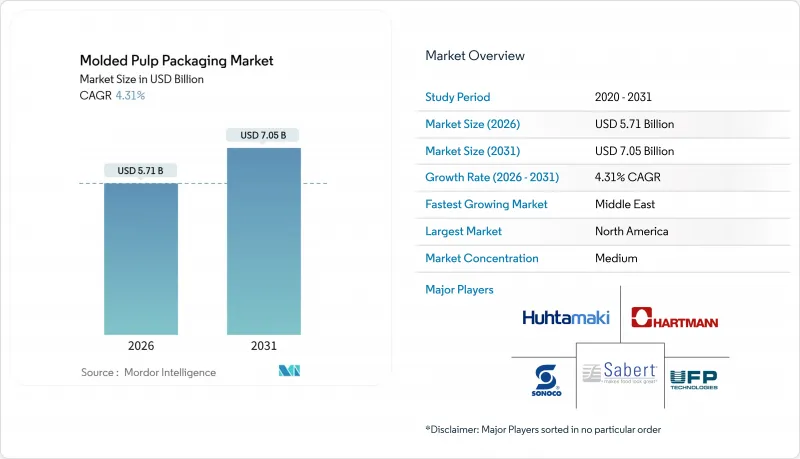
Mordor Intelligence에 의하면, 성형 펄프 포장 시장 규모는 2026년에 57억 1,000만 달러가 되어, 2031년까지 70억 5,000만 달러에 이르고, CAGR 4.31%로 확대될 것으로 예측됩니다.

본 보고서는 섬유 유형(재생 섬유, 버진 섬유, 혼합 섬유), 제품 유형(트레이, 그릇·컵, 클램쉘, 접시, 용기·뚜껑),성형 유형(두꺼운 성형, 트랜스퍼 성형, 열성형, 가공·얇은 성형), 최종 사용자 산업(식품 포장, 외식 산업, 소비자 가전, 헬스케어, 산업용, 퍼스널케어), 지역별로 분류되어 있습니다. 시장 예측은 금액(달러)으로 표시되어 있습니다.
전 세계 성형 펄프 포장 시장 동향 및 인사이트
일회용 플라스틱에 대한 규제 및 금지 조치
법규에 따라 성형 펄프 포장 시장 전체의 조달 우선순위가 재검토되고 있습니다. 유럽연합(EU)의 2030년 재활용 가능성 규정과 캘리포니아주의 SB 54는 모두 발포 폴리스티렌을 금지하고 있으며, 이로 인해 성형 펄프는 비용 중심의 선택지에서 규정 준수를 위한 필수 요건으로 단숨에 위상이 높아졌습니다. 인도에서 19유형의 플라스틱 제품에 대한 금지 조치는 외식 산업 수요를 더욱 심화시키고 있지만, 시행 기준이 지역에 따라 다르기 때문에 여러 관할 구역에 걸친 규정 준수 대응은 복잡해지고 있습니다. 독자적인 금형 및 인증 자원을 보유한 통합형 제조업체는 서로 다른 면제 규정과 앞당겨진 일정을 극복하는 데 있어 가장 유리한 입장에 있으며, 이로 인해 규모 확대와 수직 통합으로 시장 전환이 더욱 가속화되고 있습니다.
기업의 넷제로 및 플라스틱 중립에 대한 약속
소매업체와 브랜드의 노력에 힘입어, 지속가능성에 관한 슬로건은 성형 펄프 포장 시장에 유리한 구체적인 공급업체의 의무로 전환되고 있습니다. 유니레버는 버진 플라스틱을 50% 감축하는 것을 목표로 하고 있으며, 월마트의 ‘프로젝트 기가톤(Project Gigaton)’에서는 재활용 가능한 포장이 공급업체의 평가 기준에 포함되었고, 아마존의 ‘프러스트레이션 프리(Frustration-Free)’ 프로그램을 통해 수백만 메트르톤의 플라스틱 충전재가 제거되었습니다. 이러한 연쇄적인 요건으로 인해 계약 포장업체들은 가격 면에서 비싸더라도 성형 펄프 금형을 채택할 수밖에 없게 되었습니다. 왜냐하면 상품 진열은 더 이상 단위당 비용뿐만 아니라 ESG 지표에 달려 있기 때문입니다.
폐골판지(OCC) 및 버진 펄프의 가격 변동
폐골판지(OCC) 및 침엽수 펄프 가격의 변동은 가공업체의 이익률을 압박하고, 고정 가격 계약을 복잡하게 만들고 있습니다. 헤지 수단이 없는 성형 펄프 포장 시장의 많은 소규모 사업자들은 몇 달 만에 원자재 비용을 3배까지 끌어올릴 가능성이 있는 비용 급등을 감당할 수밖에 없습니다. 주요 공급업체들이 시행하고 있는 제지 거래에 대한 수직 통합은 중요한 방어 수단으로 부상하고 있지만, 지역 생산자들은 여전히 위험에 노출되어 있으며, 때때로 생산 능력을 중단하기도 하여 수요가 급증하는 바로 그 시점에 공급이 부족해지는 상황이 발생합니다.
부문 분석
각 변환업체들이 재생 펄프의 경제성과 버진 펄프의 강도 사이의 균형을 모색하는 가운데, 혼합 섬유의 배합은 2031년까지 연평균 성장률(CAGR) 8.5%를 나타낼 것으로 예측되며, 이는 섬유 유형 중 가장 높은 성장률입니다. 2025년 수요의 70.3%를 재생 펄프 등급이 차지하고 있으며, 이는 성숙한 공급망과 버진 펄프에 비해 30-40%의 비용 우위를 반영한 것입니다. 그러나 냉장 및 의료 용도에서 차단 성능을 요구하는 브랜드 소유주들은 내구성 기준을 충족하기 위해 추가 비용을 부담하더라도 60대 40의 혼합 비율을 지정하는 경향이 강해지고 있습니다. 이미 재생 펄프 함유율 75%로 가동 중인 인도의 펄프 공장은 급성장하는 경제권에서도 재생 펄프의 흐름이 확대될 수 있음을 보여주고 있습니다. 한편, 오염 위험이 허용되지 않는 클래스 II 의료용 포장 분야에서는 버진 펄프가 여전히 일정한 지위를 유지하고 있으며, 성형 펄프 포장 시장에서는 이 세 가지 유형의 펄프가 공존하고 있습니다.
지역에 따라 선호도는 다릅니다. 북미의 가공업체들은 골판지의 강도를 희생하지 않으면서도 소매업체의 지속가능성 감사 요건을 충족하기 위해 혼합 배합을 선호하는 경향이 있습니다. 반면, 아시아의 생산자들은 가격을 중시하는 푸드서비스 수요에 부응하기 위해 여전히 재생재만을 사용한 배합을 선호하고 있습니다. 사전 선별된 재생 원료를 확보하는 수직 통합형 인수를 통해 강도 저하를 초래하지 않으면서 재생재 비율을 높일 수 있게 되어, 통합형 기업에 비용 면에서의 우위를 가져다주고 있습니다. 신기술에 의한 건조 에너지 절감이 가공 비용을 낮추면서, 재활용 등급이 여전히 판매량의 주류를 이루는 한편, 혼합 제품의 성형 펄프 포장 시장 규모는 꾸준히 확대될 것으로 예측됩니다.
2025년 매출의 41.2%를 트레이가 차지하며, 특히 계란 및 청과물 용도가 주도하고 있지만, 보울과 컵은 연평균 성장률(CAGR) 9.1%로 성장하여 다른 어떤 제품군보다 높은 성장률을 보일 것으로 예측됩니다. 생산자 책임 확대법이 시행되고 있는 주의 패스트푸드점에서는 폴리스티렌 재질의 클램쉘 용기에서 성형 펄프 재질의 보울이나 커피용 뚜껑으로의 전환이 진행되고 있으며, 전용 금형 라인에 대한 투자가 확대되고 있습니다. 유럽에서는 재사용 가능한 용기의 시범 도입이 시작되면서 클램쉘 용기의 판매량이 위축되고 있지만, 한편으로는 폴리스티렌 사용 금지 규정을 준수하는 섬유계 뚜껑이 커피숍에서 채택됨에 따라 용기와 뚜껑에 대한 수요는 증가하고 있습니다.
외식 산업 조사 데이터에 따르면, 몰드 펄프는 지속 가능한 일회용 제품 중 ‘압도적인 승자’로 평가받고 있으며, 이러한 추세는 세계 체인의 구매 부서에도 확산되고 있습니다. 일회용 플라스틱에 부과되는 규정 준수 비용으로 인해, 가정 쓰레기로 재활용이 가능하다는 점이 수익성의 중요한 요소가 되어, 몰드 펄프의 단가가 더 높더라도 전환이 가속화되고 있습니다. PFAS 무함유 코팅에 대한 수상 실적은 신제품 라인의 타당성을 입증하고 유사 제품 출시를 뒷받침하며, 그릇과 컵이 성형 펄프 포장 시장에서 가장 빠르게 성장하는 분야로 자리매김할 것임을 확실히 하고 있습니다.
지역별 분석
북미는 소매업체의 조기 의무화 및 주 차원의 확대된 생산자 책임 법안 덕분에 2025년에 전 세계 매출의 46.56%를 차지했습니다. 계란 및 농산물용 시장이 포화 상태에 가까워짐에 따라 성장세는 둔화되고 있지만, 캘리포니아주의 플라스틱 25% 감축 규정과 같은 정책적 호재 덕분에 도입 곡선은 여전히 상승 추세를 유지하고 있습니다. 캐나다의 폴리스티렌 재질 테이크아웃 식기 금지 및 멕시코시티의 퇴비화 가능성 요건은 미국의 동향을 반영하고 있으며, 도시 지역의 재활용 프로그램이 성숙해 가는 가운데서도 이 지역의 성장세는 유지되고 있습니다.
중동은 2031년까지 연평균 성장률(CAGR) 8.4%를 기록할 전망이며, 이는 세계에서 가장 빠른 속도입니다. 사우디아라비아의 ‘비전 2030’ 목표와 아랍에미리트(UAE)의 ‘순환형 경제 정책’은 아시아산 수입품을 대체하기 위한 2억 6,600만 달러 규모의 공장 건설을 포함한 대규모 현지 투자를 촉진하고 있습니다. 지역 골판지 원지 제조업체들의 업스트림 공정에서의 노력이 원료 확보로 이어져, 세계 펄프 가격 급등에 대한 완충 역할을 하는 국내 공급망을 확립하고 있습니다.
유럽은 EU 전역에 적용되는 2030년 재활용 의무화의 혜택을 받고 있으며, 독일, 프랑스, 영국이 외식 산업 및 소매 업계에서 성형 펄프 도입을 주도하고 있습니다. 아시아태평양에서는 여전히 상황이 제각각입니다. 인도는 포장 수요의 급증, 전자상거래 보급률 상승, 그리고 엄격한 플라스틱 폐기물 규제로 인해 수요를 견인하는 역할을 하고 있습니다. 반면, 동남아시아의 일부 국가에서는 재활용 인프라가 미비하여 여전히 저렴한 플라스틱에 의존하고 있습니다. 남미와 아프리카에서는 진척 상황에 차이가 보이지만, 플라스틱 관련 규정 준수 비용이 치솟는 가운데 패스트푸드점이나 산업용 수출을 위한 성형 펄프에 대한 관심이 높아지고 있습니다.
기타 혜택:
- 엑셀 형식 시장 예측(ME) 시트
- 3개월간의 애널리스트 지원
자주 묻는 질문
목차
제1장 서론
제2장 조사 방법
제3장 주요 요약
제4장 시장 구도
제5장 시장 규모와 성장 예측
제6장 경쟁 구도
제7장 시장 기회와 향후 전망
JHS 26.09.07According to Mordor Intelligence, the molded pulp packaging market size stands at USD 5.71 billion in 2026 and is projected to reach USD 7.05 billion by 2031, advancing at a 4.31% CAGR.
This report is Segmented by Fiber Type (Recycled, Virgin, and Blended), Product Type (Trays, Bowls and Cups, Clamshells, Plates, and Containers and Lids), Molded Type (Thick Wall, Transfer Molded, Thermoformed, and Processed/Slim Wall), End-User Industry (Food Packaging, Foodservice, Consumer Electronics, Healthcare, Industrial, and Personal Care), and Geography. Market Forecasts are in Value (USD).
Global Molded Pulp Packaging Market Trends and Insights
Regulatory Bans On Single-Use Plastics
Legislation is redefining procurement priorities across the molded pulp packaging market. The European Union's 2030 recyclability rule and California's SB 54 both outlaw expanded polystyrene, instantly elevating molded pulp from cost-driven option to compliance necessity. India's ban on 19 plastic items deepens demand in foodservice, while varying enforcement standards make multi-jurisdiction compliance complex. Integrated producers that command their own tooling and certification resources are best positioned to navigate divergent exemptions and accelerated timelines, reinforcing the market's shift toward scale and vertical control.
Corporate Net-Zero And Plastic-Neutral Pledges
Retailer and brand commitments translate sustainability rhetoric into hard supplier mandates that favor the molded pulp packaging market. Unilever targets a 50% cut in virgin plastic, Walmart's Project Gigaton embeds recyclable packaging in supplier scorecards, and Amazon's frustration-free program removed millions of metric tons of plastic fillers. These cascading requirements compel contract packers to adopt molded pulp tooling even at a pricing premium because shelf access now hinges on ESG metrics, not just cents per unit.
Price Volatility Of OCC And Virgin Fiber
Fluctuating old-corrugated-container and softwood-pulp prices compress converter margins and complicate fixed-price contracts. Without hedging tools, many smaller players in the molded pulp packaging market absorb cost spikes that can push material expense up threefold within months. Vertical integration into paper trading, as executed by leading suppliers, is emerging as a key defense, yet regional producers remain exposed and occasionally shutter capacity, tightening supply just as demand surges.
Other drivers and restraints analyzed in the detailed report include:
- Cost Advantage Versus EPS And Thermoformed Plastic
- E-Commerce Demand For Curbside-Recyclable Fillers
- Perceived Poor Barrier And Print Performance Versus Coated Plastic
For complete list of drivers and restraints, kindly check the Table Of Contents.
Segment Analysis
Blended fiber formulations are projected to record an 8.5% CAGR through 2031, the fastest among fiber types, as converters balance recycled-fiber economics with virgin-fiber strength. Recycled grades controlled 70.3% of 2025 demand, reflecting mature supply chains and a 30-40% cost discount to virgin pulp. Yet brand owners seeking barrier performance for refrigerated or medical applications increasingly specify 60-40 blends, absorbing the surcharge to meet durability metrics. India's pulp mills, already operating at 75% recycled content, showcase the scalability of recycled streams even in fast-growing economies. Conversely, virgin fiber retains a foothold in Class II medical packaging, where contamination risk is unacceptable, ensuring that all three fiber types coexist within the molded pulp packaging market.
Regional preferences differ. North American converters gravitate toward blended recipes to satisfy retailer sustainability audits without sacrificing carton strength, whereas Asian producers still favor recycled-only mixes to serve price-led foodservice demand. Vertical acquisitions that secure pre-sorted recycled feedstock enable higher recycled ratios without strength loss, giving integrated players a cost edge. As drying-energy cuts from emerging technology shrink processing overhead, the molded pulp packaging market size for blended products is expected to expand steadily, even as recycled grades remain the volume anchor.
Trays generated 41.2% of 2025 revenue, led by egg and produce applications, but bowls and cups are forecast to grow at 9.1% CAGR, outpacing every other product family. Quick-service restaurants in states with extended producer responsibility laws are shifting from polystyrene clamshells to molded pulp bowls and coffee lids, redirecting capital toward dedicated tooling lines. Clamshell volumes face pressure from nascent reusable-container pilots in Europe, whereas containers and lids gain from coffee-shop adoption of fiber-based covers that comply with polystyrene bans.
Foodservice survey data crowns molded pulp the "clear winner" among sustainable disposables, a sentiment that filters through purchasing portals of global chains. Compliance fees attached to single-use plastics have turned curbside recyclability into a bottom-line lever, accelerating conversion even when molded pulp commands a higher unit price. Awards for PFAS-free coatings validate new product lines and spur copy-cat launches, ensuring that bowls and cups remain the fastest-advancing slice of the molded pulp packaging market.
Complete Report Scope:
- By Fiber Type
- Recycled Fiber
- Virgin Fiber
- Blended Fiber
- By Product Type
- Trays
- Bowls and Cups
- Clamshells
- Plates
- Containers and Lids
- Other Product Types
- By Molded Type
- Thick Wall
- Transfer Molded
- Thermoformed
- Processed / Slim Wall
- By End-User Industry
- Food Packaging
- Foodservice
- Consumer Electronics
- Healthcare and Medical Devices
- Industrial Goods
- Personal Care and Cosmetics
- Other End-User Industries
- By Geography
- North America
- United States
- Canada
- Mexico
- Europe
- Germany
- United Kingdom
- France
- Italy
- Spain
- Russia
- Rest of Europe
- Asia-Pacific
- China
- Japan
- India
- South Korea
- Australia
- Rest of Asia-Pacific
- Middle East
- Saudi Arabia
- United Arab Emirates
- Turkey
- Rest of Middle East
- Africa
- South Africa
- Nigeria
- Rest of Africa
- South America
- Brazil
- Argentina
- Rest of South America
- North America
Geography Analysis
North America captured 46.56% of global sales in 2025 thanks to early retailer mandates and state-level extended producer responsibility laws. Growth is moderating as egg and produce applications near saturation, yet policy tailwinds such as California's 25% plastic-reduction rule keep the adoption curve positive. Canada's ban on polystyrene foodservice ware and Mexico City's compostability requirement echo U.S. shifts, sustaining regional momentum even as urban recycling programs mature.
The Middle East is set to post an 8.4% CAGR through 2031, the fastest worldwide. Saudi Arabia's Vision 2030 targets and the UAE's Circular Economy Policy have catalyzed large-scale local investments, including a USD 266 million plant aimed at displacing Asian imports. Upstream moves by regional containerboard producers secure feedstock, anchoring domestic supply chains that buffer against global pulp price spikes.
Europe benefits from the bloc-wide 2030 recyclability mandate, with Germany, France, and the United Kingdom at the forefront of molded pulp adoption in foodservice and retail. Asia-Pacific remains a mixed picture: India's packaging boom, rising e-commerce penetration, and strict plastic-waste rules make it a demand engine, whereas several Southeast Asian nations still rely on cheap plastic amid under-developed recycling infrastructure. South America and Africa show patchier progress but register rising interest in molded pulp for quick-service restaurants and industrial exports as compliance costs for plastics escalate.
- Brodrene Hartmann A/S
- Huhtamaki Oyj
- UFP Technologies, Inc.
- Sabert Corporation
- Henry Molded Products, Inc.
- Keiding, Inc.
- Pacific Pulp Molding, Inc.
- Protopak Engineering Corporation
- EnviroPAK Corporation
- Maspack Ltd.
- CKF Inc.
- Moulded Fibre Products Ltd.
- Cellulopack Packaging S.L.
- FiberCel Packaging, LLC
- Greenpack (Yulin) Environmental Technology Co., Ltd.
- Dongguan Flyway Packaging Co., Ltd.
- Shenzhen Maider Packaging Co., Ltd.
- Qingdao Xinya Molded Pulp Packaging Co., Ltd.
- Taiwan Pulp Molding Co., Ltd.
- Nippon Molded Pulp Co., Ltd.
- Vegware Ltd.
- Earthpac Ltd.
- Papelyco S.A.
- PulpaPack SAS
- Western Pulp Products Co.
Additional Benefits:
- The market estimate (ME) sheet in Excel format
- 3 months of analyst support
TABLE OF CONTENTS
1 INTRODUCTION
- 1.1 Study Assumptions and Market Definition
- 1.2 Scope of the Study
2 RESEARCH METHODOLOGY
3 EXECUTIVE SUMMARY
4 MARKET LANDSCAPE
- 4.1 Market Overview
- 4.2 Market Drivers
- 4.2.1 Regulatory Bans on Single-Use Plastics in More Than 100 Countries
- 4.2.2 Corporate Net-Zero and Plastic-Neutral Pledges Driving Retailer Mandates
- 4.2.3 Cost Advantage Versus EPS and Thermoformed Plastic
- 4.2.4 E-Commerce Demand for Protective, Curb-Side-Recyclable Fillers
- 4.2.5 Line-Speed Gains From Dry-Formed Technology Cutting Unit Costs
- 4.2.6 PFAS-Free Legislation Boosting Molded Pulp for Foodservice
- 4.3 Market Restraints
- 4.3.1 Price Volatility of OCC and Virgin Fiber Feedstocks
- 4.3.2 Perceived Poor Barrier and Print Performance Versus Coated Plastic
- 4.3.3 Limited Color-Pulp Recycling Streams in Municipal MRFs
- 4.3.4 High Energy Load During Hot-Press Finishing in Some Plants
- 4.4 Industry Value Chain Analysis
- 4.5 Regulatory Landscape
- 4.6 Technological Outlook
- 4.7 Impact of Macroeconomic Factors
- 4.8 Porter's Five Forces Analysis
- 4.8.1 Threat of New Entrants
- 4.8.2 Bargaining Power of Suppliers
- 4.8.3 Bargaining Power of Buyers
- 4.8.4 Threat of Substitutes
- 4.8.5 Competitive Rivalry
5 MARKET SIZE AND GROWTH FORECASTS (VALUE)
- 5.1 By Fiber Type
- 5.1.1 Recycled Fiber
- 5.1.2 Virgin Fiber
- 5.1.3 Blended Fiber
- 5.2 By Product Type
- 5.2.1 Trays
- 5.2.2 Bowls and Cups
- 5.2.3 Clamshells
- 5.2.4 Plates
- 5.2.5 Containers and Lids
- 5.2.6 Other Product Types
- 5.3 By Molded Type
- 5.3.1 Thick Wall
- 5.3.2 Transfer Molded
- 5.3.3 Thermoformed
- 5.3.4 Processed / Slim Wall
- 5.4 By End-User Industry
- 5.4.1 Food Packaging
- 5.4.2 Foodservice
- 5.4.3 Consumer Electronics
- 5.4.4 Healthcare and Medical Devices
- 5.4.5 Industrial Goods
- 5.4.6 Personal Care and Cosmetics
- 5.4.7 Other End-User Industries
- 5.5 By Geography
- 5.5.1 North America
- 5.5.1.1 United States
- 5.5.1.2 Canada
- 5.5.1.3 Mexico
- 5.5.2 Europe
- 5.5.2.1 Germany
- 5.5.2.2 United Kingdom
- 5.5.2.3 France
- 5.5.2.4 Italy
- 5.5.2.5 Spain
- 5.5.2.6 Russia
- 5.5.2.7 Rest of Europe
- 5.5.3 Asia-Pacific
- 5.5.3.1 China
- 5.5.3.2 Japan
- 5.5.3.3 India
- 5.5.3.4 South Korea
- 5.5.3.5 Australia
- 5.5.3.6 Rest of Asia-Pacific
- 5.5.4 Middle East
- 5.5.4.1 Saudi Arabia
- 5.5.4.2 United Arab Emirates
- 5.5.4.3 Turkey
- 5.5.4.4 Rest of Middle East
- 5.5.5 Africa
- 5.5.5.1 South Africa
- 5.5.5.2 Nigeria
- 5.5.5.3 Rest of Africa
- 5.5.6 South America
- 5.5.6.1 Brazil
- 5.5.6.2 Argentina
- 5.5.6.3 Rest of South America
- 5.5.1 North America
6 COMPETITIVE LANDSCAPE
- 6.1 Market Concentration
- 6.2 Strategic Moves
- 6.3 Market Share Analysis
- 6.4 Company Profiles (includes Global level Overview, Market level overview, Core Segments, Financials as available, Strategic Information, Market Rank/Share for key companies, Products and Services, and Recent Developments)
- 6.4.1 Brodrene Hartmann A/S
- 6.4.2 Huhtamaki Oyj
- 6.4.3 UFP Technologies, Inc.
- 6.4.4 Sabert Corporation
- 6.4.5 Henry Molded Products, Inc.
- 6.4.6 Keiding, Inc.
- 6.4.7 Pacific Pulp Molding, Inc.
- 6.4.8 Protopak Engineering Corporation
- 6.4.9 EnviroPAK Corporation
- 6.4.10 Maspack Ltd.
- 6.4.11 CKF Inc.
- 6.4.12 Moulded Fibre Products Ltd.
- 6.4.13 Cellulopack Packaging S.L.
- 6.4.14 FiberCel Packaging, LLC
- 6.4.15 Greenpack (Yulin) Environmental Technology Co., Ltd.
- 6.4.16 Dongguan Flyway Packaging Co., Ltd.
- 6.4.17 Shenzhen Maider Packaging Co., Ltd.
- 6.4.18 Qingdao Xinya Molded Pulp Packaging Co., Ltd.
- 6.4.19 Taiwan Pulp Molding Co., Ltd.
- 6.4.20 Nippon Molded Pulp Co., Ltd.
- 6.4.21 Vegware Ltd.
- 6.4.22 Earthpac Ltd.
- 6.4.23 Papelyco S.A.
- 6.4.24 PulpaPack SAS
- 6.4.25 Western Pulp Products Co.
7 MARKET OPPORTUNITIES AND FUTURE OUTLOOK
- 7.1 White-Space and Unmet-Need Assessment