

|
시장보고서
상품코드
2124041
무선 테스트 시장 : 시장 점유율 분석, 업계 동향 및 통계, 성장 예측(2026-2031년)Wireless Testing - Market Share Analysis, Industry Trends & Statistics, Growth Forecasts (2026 - 2031) |
||||||
 Mordor Intelligence
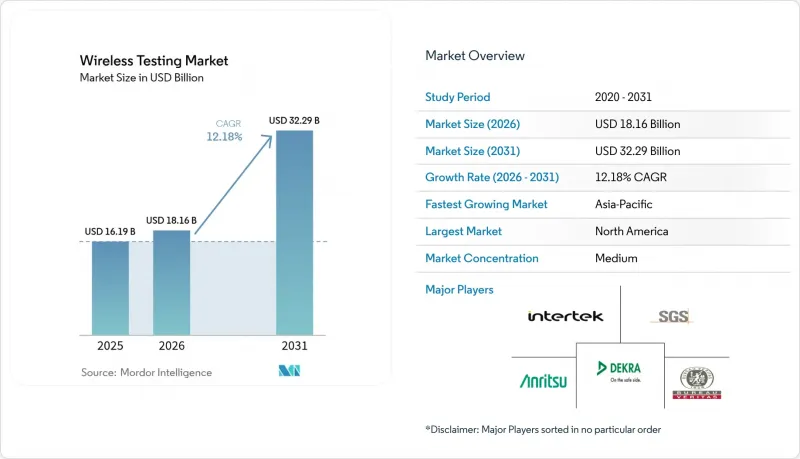
Mordor Intelligence에 의하면, 무선 테스트 시장 규모는 2025년 161억 9,000만 달러로 평가되었고, 2026년에는 181억 6,000만 달러로 추정되고, 2026-2031년 CAGR 12.18%로 성장을 지속할 전망이며, 2031년에는 322억 9,000만 달러에 이를 것으로 예측됩니다.
본 보고서는 제공 분야별(장비(무선 기기 시험 및 무선 네트워크 시험) 및 서비스), 기술별(블루투스, Wi-Fi, GPS/GNSS, 4G/LTE, 5G, 기타(2G, 3G, Zigbee, UWB 등)), 용도별(가전제품, 자동차, IT 및 통신, 에너지 및 전력, 의료기기, 항공우주 및 방위, 기타 용도), 그리고 지역별로 분류되어 있습니다.
세계의 무선 테스트 시장 동향 및 인사이트
5G 인프라의 급속한 확대
세계 통신 사업자들은 2030년까지 아시아태평양에서만 5G 구축에 2,590억 달러를 투자할 계획이며, 이에 따라 무선 통신 시험 시장은 매시브 MIMO의 처리량과 빔포밍의 정확도를 거의 실시간으로 벤치마킹할 수 있는초광대역·다중 안테나 보정 환경으로 나아가고 있습니다. 일본의 NTT 도코모, KDDI, 소프트뱅크는 전 국민을 커버하기 위해 총 130억 달러 이상의 예산을 편성하고 있으며, 이에 따라 테스트 랩은 현지의 극한 기후 조건을 재현한 온도 제어 챔버 내에서 네트워크 슬라이싱의 지연이나 Open RAN의 상호 운용성을 시뮬레이션해야 합니다. 이 통신 사업자들은 현재 RF 지표, 클라우드 네이티브 코어 통합, 그리고 서비스 수준의 핵심 성과 지표(KPI)를 아우르는 종합적인 검증을 요구하고 있습니다. 채널 에뮬레이션, 트래픽 생성, 사이버 보안 스캔을 단일 무선 테스트 사이클 내에서 통합할 수 있는 벤더가 고액 계약을 수주하고 있습니다. 비지상파 네트워크와 같은 5G-Advanced 기능이 현실화됨에 따라, 위성 링크와 지상파 링크를 결합한 시나리오 기반 테스트가 필수 조건으로 자리 잡고 있으며, 이는 무선 테스트 시장에 새로운 수익원을 창출하고 있습니다.
AI 기반 자가 복구형 네트워크에는 예측적 테스트 분석이 필요합니다.
현재 네트워크 오케스트레이션 제품군에는 대규모 언어 모델(LLM) 에이전트가 통합되어 있어, 사람의 개입 없이 셀 매개변수 자동 조정, 장애 복구, 트래픽 우회를 자율적으로 수행합니다. 따라서 테스트 전략은 정적인 회귀 스크립트에서 확률적 트래픽 부하 하에서의 동작 예측으로 전환되고 있습니다. VIAVI Solutions와 노스이스턴 대학교는 처리량이 저하되기 몇 분 전에 이상을 감지하는 도시 규모의 디지털 트윈을 운영함으로써 이러한 변화를 입증하고 있습니다. 인증 워크플로우에서는 수천 건에 달하는 시뮬레이션된 장애 사건 전반에 걸쳐 AI의 의사결정 경로, 훈련 데이터의 무결성, 그리고 모델의 편향을 검증해야 합니다. 이러한 복잡성으로 인해 평균 계약 규모는 확대되고 있으며, 구매자는 일회성 장치 승인보다는 서비스 형태의 지속적인 검증을 요구하고 있습니다. 하드웨어 인 더 루프(Hardware-in-the-Loop), 컨테이너화된 에뮬레이션 및 설명 가능한 AI 대시보드를 결합한 공급업체들이 무선 테스트 시장의 경쟁에서 새로운 기준을 제시하고 있습니다.
첨단 시험 장비와 숙련된 인력에 드는 높은 비용
첨단 5G 채널 에뮬레이터와 mm파 신호 발생기는 현재 대당 100만 달러를 초과하며, 5년간의 수명 주기 지원 계약으로 인해 총 소유 비용이 40% 더 추가되고 있습니다. 테스트의 복잡성이 증가함에 따라, 인증을 받은 RF 엔지니어의 연봉은 6자리 수에 달하고 있으며, 신흥 경제국의 많은 국내 연구소에서는 이에 상응하는 급여를 지급할 수 없습니다. 키사이트(Keysight)와 같은 시장 선도 기업들은 2024 회계연도에 49억 8,000만 달러의 매출을 기록했으며, 이는 부품 일괄 조달 및 여러 거점에서의 자산 활용을 가능하게 하는 규모의 경제 이점을 여실히 보여줍니다. 공유 챔버의 가동 시간을 임대할 수밖에 없는 소규모 경쟁사들은 이익률이 낮고 투자 회수 기간이 길어지고 있습니다. 이러한 비용 불균형은 업계 재편을 촉진하고 있으며, 인수 주도형 플랫폼이 지역 실험실을 세계 네트워크로 통합하고 인력과 장비를 공유하는 움직임이 진행되고 있습니다.
부문 분석
2025년에는 장비 부문이 115억 달러의 매출을 기록하며 무선 테스트 시장 점유율의 71.02%를 차지했으나, 2031년까지 연평균 성장률(CAGR) 11.05%로 성장할 관리형 테스트 서비스에 추월당하고 있어 그 지배력은 약화되고 있습니다. 자본 집약적인 신호 발생기, 무선 통신 시험실, 채널 에뮬레이터는 모든 시험소의 기반을 형성하고 있지만, 펌웨어 업데이트 주기가 매년 도래함에 따라 구매자들은 소유의 타당성에 대해 점점 더 의문을 품게 되고 있습니다. 그 결과, 고객이 설비 투자 예산보다 신속한 인증 획득을 우선시함에 따라, 매니지드 서비스에 기인한 무선 테스트 시장 규모가 그 격차를 좁혀 나갈 것입니다. Tier 1 벤더들은 클라우드 연동형 분석 대시보드를 번들로 제공하여 합격/불합격 지표를 거의 실시간으로 원격 모니터링할 수 있게 함으로써 이러한 전환을 지원하고 있습니다. 이와 동시에, 애리조나주에 위치한 2,170만 달러 규모의 VALOR 연구소와 같은 정부 자금 지원 시설에서는 전문적인 Open-RAN 상호운용성 제품군에 대한 구독 기반 접근을 개방하여 성과 기반 계약으로의 전환을 가속화하고 있습니다. 장비 제조업체의 경우, 렌탈 프로그램이나 사용량 기반 가격 책정을 통해 자사 제품과의 경쟁을 완화하면서 가동률을 높게 유지할 수 있게 됩니다.
전문 서비스 제공업체는 AI를 활용한 테스트 스크립트 생성 및 자동화된 보고서 템플릿을 활용하여 프로젝트 사이클 타임을 대폭 단축하고 있습니다. 이러한 민첩성은 몇 달 이내에 세계 시장에 진출해야 하는 다중 표준 지원 IoT 기기를 출시하는 스타트업 기업의 요구에 부합합니다. 반면, 전통 있는 휴대폰 제조업체들은 지적 재산을 보호하기 위해 여전히 최고급 장비를 구매하고 있으며, 시장 점유율이 하락하고 있음에도 불구하고 장비 부문은 여전히 상당한 절대 수익을 유지하고 있습니다. 전반적으로 이러한 양극화된 수요가 무선 테스트 시장을 지탱하는 한편, 하드웨어 임대, 규정 준수 관리, 공유 인프라를 활용한 지속적인 회귀 테스트를 융합한 하이브리드 비즈니스 모델을 촉진하고 있습니다.
지역별 분석
북미는 5G의 조기 도입, 막대한 국방 예산, 그리고 Tier 1 장비 공급업체들의 견고한 생태계 덕분에 2025년에 매출의 32.18%를 차지했습니다. 키사이트가 2024년에 기록한 49억 8,000만 달러의 매출은 차세대 오실로스코프와 채널 에뮬레이터를 끊임없이 선보이고 있는 이 지역의 연구 개발(R&D) 투자의 깊이를 여실히 보여줍니다. 연방 정부의 지원은 국내 연구 기관을 강화하고 있으며, 그 일례로 미국 통신정보국(NTIA)이 VIAVI사의 Open-RAN 테스트 센터에 2,170만 달러를 지원하여, 미래를 내다보는 검증 환경에 대한 지역 내 접근성을 보장하고 있습니다. 자동차 및 항공우주 업계의 주요 기업들은 생산 거점 내에 보안이 강화된 사설 5G 네트워크를 통합함으로써 수요를 더욱 확대하고 있으며, 이러한 추세로 인해 복잡한 규정 준수 프로젝트가 지역 서비스 제공업체에 집중되고 있습니다.
아시아태평양은 연평균 성장률(CAGR) 12.63%를 나타낼 것으로 예측되며, 가장 빠르게 성장하는 지역으로 부상하고 있습니다. 차이나 모바일, 차이나 유니콤, 차이나 텔레콤 등 3사는 2025년 중 총 30억 달러가 넘는 5G-Advanced로 업그레이드할 계획이며, 여기에는 40만 기의 기지국 개조가 포함됩니다. 각 기지국에서는 빔포밍 및 엣지 컴퓨팅 지연에 대한 수용성 측정이 필요합니다. 일본의 통신 사업자들은 도시 지역의 고밀도 커버리지와 Open-RAN 시범 사업에 추가로 140억 달러를 배정하여, 이를 통해 실험실 및 현장 시험 활동이 병행되고 있습니다. 한국이나 대만 등 제조업이 활발한 경제권에서는 반도체 팹 전체에 민간 중파대 네트워크가 구축되어 있어, Wi-Fi 7, 5G 및 산업용 TSN 프로토콜 간의 복잡한 공존성 검증이 필요합니다. 그 결과, 지역 인증 기관들은 급증하는 업무량에 대응하기 위해 다중 표준 지원 시험실과 AI를 활용한 로그 분석 엔진에 투자하고 있으며, 이에 따라 무선 통신 시험 시장은 두 자릿수 성장을 유지하고 있습니다.
유럽은 여전히 전 세계 규제 체계를 주도하는 역할을 맡고 있습니다. ‘무선기기 지침’의 2025년 8월 시행 예정인 사이버 보안 조항에서는 RF 및 EMC 검사 외에도 보안 심사가 의무화되어, 이에 따라 시험 범위가 확대되고 프로젝트 일정이 장기화되고 있습니다. 독일에는 Rohde & Schwarz와 같은 주요 제조업체가 거점을 두고 있으며, 이 회사는 2024 회계연도 매출이 29억 3,000만 유로(31억 3,000만 달러)에 달했다고 보고하고 있으며,턴키 방식의 블루투스 및 Wi-Fi 시험 스위트 확충을 지속하고 있습니다. 북유럽 국가들은 사설 5G 포트 및 광산 현장에의 도입을 선도하고 있으며, 북극권 환경 하에서의 무선 간섭 연구를 촉진하고 있습니다. 남유럽에서는 스마트 계량기 도입이 가속화되고 있으며, 에너지 분야 수요와 통신 테스트 아키텍처가 결합되고 있습니다. 이러한 노력들이 결합되어 유럽 수요를 안정시키고, 궁극적으로 테스트 기준의 조화를 이끌어내는 세계 표준화 노력을 뒷받침하며, 무선 테스트 시장 전체에 이익을 가져다주고 있습니다.
기타 혜택 :
- 엑셀 형식 시장 예측(ME) 시트
- 3개월간의 애널리스트 지원
자주 묻는 질문
목차
제1장 서론
제2장 조사 방법
제3장 주요 요약
제4장 시장 구도
제5장 시장 규모 및 성장 예측
제6장 경쟁 구도
제7장 시장 기회 및 향후 전망
AJY 26.09.11According to Mordor Intelligence, the wireless testing market size is expected to grow from USD 16.19 billion in 2025 to USD 18.16 billion in 2026 and is forecast to reach USD 32.29 billion by 2031 at 12.18% CAGR over 2026-2031.
This report is Segmented by Offering (Equipment [Wireless Device Testing and Wireless Network Testing] and Services), Technology (Bluetooth, Wi-Fi, GPS/GNSS, 4G/LTE, 5G, and Other [2G, 3G, Zigbee, UWB Etc. ]), Application (Consumer Electronics, Automotive, IT and Telecommunication, Energy and Power, Medical Devices, Aerospace and Defense, Other Applications), and Geography
Global Wireless Testing Market Trends and Insights
Rapid Expansion of 5G Infrastructure
Global operators plan to invest USD 259 billion in 5G roll-outs across Asia-Pacific alone by 2030, pushing the wireless testing market toward ultra-wideband, multi-antenna calibration environments that can benchmark massive-MIMO throughput and beam-forming accuracy in near-real time. Japan's NTT DOCOMO, KDDI, and SoftBank together budget more than USD 13 billion to reach nationwide population coverage, forcing test labs to simulate network-slicing latency and Open RAN interoperability within temperature-controlled chambers that mirror local climatic extremes. These operators now demand holistic validation that covers RF metrics, cloud-native core integration, and service-level key performance indicators. Vendors able to blend channel emulation, traffic generation, and cybersecurity scanning inside a single over-the-air test cycle are capturing premium contracts. As 5G-Advanced capabilities such as non-terrestrial networking materialize, scenario-based testing that blends satellite and terrestrial links is becoming table-stakes, pulling fresh revenue into the wireless testing market.
AI-Driven Self-Healing Networks Needing Predictive Test Analytics
Network orchestration suites now embed large-language-model agents that autonomously tune cell parameters, recover from outages, and reroute traffic, all without human triggers. Test strategies, therefore, pivot from static regression scripts to behavioural prediction under stochastic traffic loads. VIAVI Solutions and Northeastern University illustrate this shift by running a city-scale digital twin that spots anomalies minutes before they degrade throughput. Certification workflows must certify AI decision-paths, training-data integrity, and model bias across thousands of simulated failure events. This complexity lifts average engagement sizes, with buyers asking for continuous validation as a service rather than once-off device approvals. Providers that combine hardware-in-the-loop, containerized emulation, and explainable-AI dashboards are driving new benchmarks for wireless testing market competitiveness.
High Cost of Advanced Test Equipment and Skilled Labour
Advanced 5G channel emulators and millimeter-wave signal generators now surpass USD 1 million per station, with lifetime support contracts adding 40% to ownership cost over five years. As test complexity rises, certified RF engineers command six-figure salaries that many domestic labs in emerging economies cannot match. Market leaders such as Keysight generated USD 4.98 billion in fiscal 2024 revenue, underscoring scale advantages that allow bulk component sourcing and multi-site asset utilization. Smaller competitors left to rent time on shared chambers face thin margins and elongated payback periods. This cost asymmetry encourages industry consolidation, with acquisition-driven platforms integrating regional labs into global networks to pool talent and equipment.
Other drivers and restraints analyzed in the detailed report include:
- Growing Demand for Cloud Computing and IoT Devices
- Surge in Private 5G/Industrial Wireless Networks
- RF-Component Supply-Chain Volatility Delaying Calibration Cycles
For complete list of drivers and restraints, kindly check the Table Of Contents.
Segment Analysis
Equipment generated USD 11.5 billion in 2025, equal to 71.02% of wireless testing market share, but its grip is loosening as managed testing services outpace at an 11.05% CAGR through 2031. Capital-intensive signal generators, over-the-air chambers, and channel emulators form the backbone of every lab, yet buyers increasingly question ownership when firmware refresh cycles arrive annually. The wireless testing market size attributable to managed services will therefore close the gap as customers prioritize fast certification turnarounds over capital budgets. Tier-one vendors help this transition by bundling cloud-linked analytics dashboards, enabling remote monitoring of pass-fail metrics in near real time. In parallel, government-funded facilities such as the USD 21.7 million VALOR lab in Arizona open subscription-based access to specialty Open-RAN interoperability suites, accelerating the shift toward outcome-based engagements. For equipment makers, rental programs and usage-based pricing mitigate cannibalization while keeping utilization rates high.
Professional service providers leverage AI-assisted test-script generation and automated report templates to slash project cycle times. This agility resonates with start-ups launching multi-standard IoT gadgets that must secure global market entry within months. Meanwhile, established handset brands still purchase top-end gear to protect intellectual property, ensuring the equipment segment retains sizable absolute revenue even as its share declines. Overall, dual-track demand sustains the wireless testing market while encouraging hybrid business models that blend hardware leasing, managed compliance, and continuous regression testing on shared infrastructure.
Complete Report Scope:
- By Offering
- Equipment
- Wireless Device Testing
- Oscilloscopes
- Signal Generators
- Spectrum Analysers
- Network Analysers
- Wireless Network Testing
- Network Testers
- Network Scanners
- OTA Testers
- Wireless Device Testing
- Services
- Testing and Certification
- Managed Testing Services
- Calibration and Support
- Equipment
- By Technology
- Bluetooth
- Wi-Fi
- GPS/GNSS
- 4G/LTE
- 5G
- Other (2G, 3G, Zigbee, UWB etc.)
- By Application
- Consumer Electronics
- Automotive
- IT and Telecommunication
- Energy and Power
- Medical Devices
- Aerospace and Defence
- Other Applications
- By Geography
- North America
- United States
- Canada
- Mexico
- South America
- Brazil
- Argentina
- Rest of South America
- Europe
- Germany
- United Kingdom
- France
- Italy
- Spain
- Russia
- Rest of Europe
- Asia-Pacific
- China
- India
- Japan
- South Korea
- Rest of Asia-Pacific
- Middle East and Africa
- Middle East
- GCC
- Turkey
- Rest of Middle East
- Africa
- South Africa
- Egypt
- Nigeria
- Rest of Africa
- Middle East
- North America
Geography Analysis
North America commanded 32.18% revenue in 2025 thanks to early 5G rollouts, large defense budgets, and an entrenched ecosystem of tier-one equipment vendors. Keysight's USD 4.98 billion 2024 revenue underlines the depth of local R&D expenditure that continually spins off next-generation oscilloscopes and channel emulators. Federal support strengthens domestic labs, exemplified by the National Telecommunications and Information Administration backing VIAVI's Open-RAN test center with USD 21.7 million, guaranteeing local access to future-proof validation environments. Automotive and aerospace primes further amplify demand by integrating secure private 5G networks inside production campuses, a trend that funnels complex compliance projects into regional service providers.
Asia-Pacific is shaping up as the fastest-growing territory, with a projected 12.63% CAGR. China Mobile, China Unicom, and China Telecom together plan more than USD 3 billion in 5G-Advanced upgrades during 2025, including 400,000 base-station refits that each require acceptance measurements for beamforming and edge-computing latency. Japan's operators allocate an additional USD 14 billion for dense-urban coverage and Open-RAN pilots, creating parallel streams of lab and field-test activity. Manufacturing-heavy economies such as South Korea and Taiwan overlay private mid-band grids across chip fabs, spawning intricate coexistence checks between Wi-Fi 7, 5G, and industrial TSN protocols. Consequently, regional certification houses invest in multi-standard chambers and AI-enabled log-analysis engines to absorb surging workload, ensuring the wireless testing market maintains double-digit growth.
Europe retains a pivotal role by anchoring global regulatory frameworks. The Radio Equipment Directive's August 2025 cybersecurity clauses mandate security vetting alongside RF and EMC checks, broadening test engagement scope and extending project timetables. Germany hosts leading manufacturers such as Rohde & Schwarz, which reported EUR 2.93 billion (USD 3.13 billion) in fiscal 2024 revenue and continues expanding turnkey Bluetooth and Wi-Fi suites. Nordic countries pioneer private 5G ports and mining sites, stimulating over-the-air interference studies under arctic conditions. Southern Europe accelerates smart-meter deployments, linking energy-sector needs with telecom test architectures. Together, these initiatives stabilize European demand and feed global standardization efforts that ultimately harmonize testing criteria, benefiting the wider wireless testing market.
- Keysight Technologies Inc.
- Rohde and Schwarz GmbH and Co KG
- Anritsu Corporation
- VIAVI Solutions Inc.
- SGS SA
- Bureau Veritas SA
- Intertek Group plc
- DEKRA SE
- UL Solutions Inc.
- TUV SUD AG
- TUV Rheinland AG
- TUV Nord AG
- National Instruments (NI)
- Spirent Communications plc
- Teledyne LeCroy Inc.
- Fortive (Tektronix)
- EXFO Inc.
- LitePoint (Teradyne)
- Cobham Limited
- Emite
- Tektronix
Additional Benefits:
- The market estimate (ME) sheet in Excel format
- 3 months of analyst support
TABLE OF CONTENTS
1 INTRODUCTION
- 1.1 Study Assumptions and Market Definition
- 1.2 Scope of the Study
2 RESEARCH METHODOLOGY
3 EXECUTIVE SUMMARY
4 MARKET LANDSCAPE
- 4.1 Market Overview
- 4.2 Market Drivers
- 4.2.1 Increasing adoption of smartphones and smart wearables
- 4.2.2 Growing demand for cloud computing and IoT devices
- 4.2.3 Rapid expansion of 5G infrastructure
- 4.2.4 Regulatory mandates for device certification and safety
- 4.2.5 Surge in private 5G/industrial wireless networks
- 4.2.6 AI-driven self-healing networks needing predictive test analytics
- 4.3 Market Restraints
- 4.3.1 Lack of standardisation in connectivity protocols
- 4.3.2 High cost of advanced test equipment and skilled labour
- 4.3.3 RF-component supply-chain volatility delaying calibration cycles
- 4.3.4 Heightened cybersecurity compliance lengthening test approvals
- 4.4 Value/Supply-Chain Analysis
- 4.5 Regulatory Landscape
- 4.6 Technological Outlook
- 4.6.1 6G, AI-based automation, digital twins
- 4.7 Porter's Five Forces Analysis
- 4.7.1 Bargaining Power of Suppliers
- 4.7.2 Bargaining Power of Consumers
- 4.7.3 Threat of New Entrants
- 4.7.4 Threat of Substitutes
- 4.7.5 Intensity of Competitive Rivalry
- 4.8 Impact of COVID-19 and macro-economic shocks
5 MARKET SIZE AND GROWTH FORECASTS (VALUE)
- 5.1 By Offering
- 5.1.1 Equipment
- 5.1.1.1 Wireless Device Testing
- 5.1.1.1.1 Oscilloscopes
- 5.1.1.1.2 Signal Generators
- 5.1.1.1.3 Spectrum Analysers
- 5.1.1.1.4 Network Analysers
- 5.1.1.2 Wireless Network Testing
- 5.1.1.2.1 Network Testers
- 5.1.1.2.2 Network Scanners
- 5.1.1.2.3 OTA Testers
- 5.1.1.1 Wireless Device Testing
- 5.1.2 Services
- 5.1.2.1 Testing and Certification
- 5.1.2.2 Managed Testing Services
- 5.1.2.3 Calibration and Support
- 5.1.1 Equipment
- 5.2 By Technology
- 5.2.1 Bluetooth
- 5.2.2 Wi-Fi
- 5.2.3 GPS/GNSS
- 5.2.4 4G/LTE
- 5.2.5 5G
- 5.2.6 Other (2G, 3G, Zigbee, UWB etc.)
- 5.3 By Application
- 5.3.1 Consumer Electronics
- 5.3.2 Automotive
- 5.3.3 IT and Telecommunication
- 5.3.4 Energy and Power
- 5.3.5 Medical Devices
- 5.3.6 Aerospace and Defence
- 5.3.7 Other Applications
- 5.4 By Geography
- 5.4.1 North America
- 5.4.1.1 United States
- 5.4.1.2 Canada
- 5.4.1.3 Mexico
- 5.4.2 South America
- 5.4.2.1 Brazil
- 5.4.2.2 Argentina
- 5.4.2.3 Rest of South America
- 5.4.3 Europe
- 5.4.3.1 Germany
- 5.4.3.2 United Kingdom
- 5.4.3.3 France
- 5.4.3.4 Italy
- 5.4.3.5 Spain
- 5.4.3.6 Russia
- 5.4.3.7 Rest of Europe
- 5.4.4 Asia-Pacific
- 5.4.4.1 China
- 5.4.4.2 India
- 5.4.4.3 Japan
- 5.4.4.4 South Korea
- 5.4.4.5 Rest of Asia-Pacific
- 5.4.5 Middle East and Africa
- 5.4.5.1 Middle East
- 5.4.5.1.1 GCC
- 5.4.5.1.2 Turkey
- 5.4.5.1.3 Rest of Middle East
- 5.4.5.2 Africa
- 5.4.5.2.1 South Africa
- 5.4.5.2.2 Egypt
- 5.4.5.2.3 Nigeria
- 5.4.5.2.4 Rest of Africa
- 5.4.5.1 Middle East
- 5.4.1 North America
6 COMPETITIVE LANDSCAPE
- 6.1 Market Concentration
- 6.2 Strategic Moves
- 6.3 Market Share Analysis
- 6.4 Company Profiles (includes Global level Overview, Market level overview, Core Segments, Financials as available, Strategic Information, Market Rank/Share for key companies, Products and Services, and Recent Developments)
- 6.4.1 Keysight Technologies Inc.
- 6.4.2 Rohde and Schwarz GmbH and Co KG
- 6.4.3 Anritsu Corporation
- 6.4.4 VIAVI Solutions Inc.
- 6.4.5 SGS SA
- 6.4.6 Bureau Veritas SA
- 6.4.7 Intertek Group plc
- 6.4.8 DEKRA SE
- 6.4.9 UL Solutions Inc.
- 6.4.10 TUV SUD AG
- 6.4.11 TUV Rheinland AG
- 6.4.12 TUV Nord AG
- 6.4.13 National Instruments (NI)
- 6.4.14 Spirent Communications plc
- 6.4.15 Teledyne LeCroy Inc.
- 6.4.16 Fortive (Tektronix)
- 6.4.17 EXFO Inc.
- 6.4.18 LitePoint (Teradyne)
- 6.4.19 Cobham Limited
- 6.4.20 Emite
- 6.4.21 Tektronix
7 MARKET OPPORTUNITIES AND FUTURE OUTLOOK
- 7.1 White-space and Unmet-need Assessment


