
|
시장보고서
상품코드
2124043
신원 확인(ID) 시장 : 시장 점유율 분석, 업계 동향 및 통계, 성장 예측(2026-2031년)Identity (ID) Verification - Market Share Analysis, Industry Trends & Statistics, Growth Forecasts (2026 - 2031) |
||||||
 Mordor Intelligence
Mordor Intelligence에 의하면, 신원 확인 시장 규모는 2025년 141억 9,000만 달러로 평가되었고, 2026년에는 157억 8,000만 달러로 추정되고, 2026-2031년 CAGR 11.18%로 성장을 지속할 전망이며, 2031년에는 268억 달러에 이를 것으로 예측됩니다.
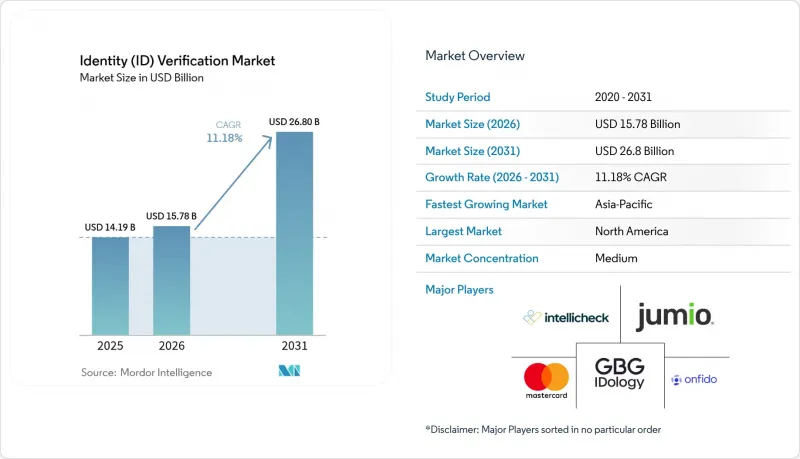
본 보고서는 배포 방식별(온프레미스, 클라우드), 솔루션 유형별(서류·신원 인증, 생체 인증 등), 최종 사용자 산업별(금융 서비스(BFSI), 소매 및 전자상거래 등), 조직 규모별(대기업, 중소기업(SME)), 지역별로 분류되어 있습니다. 시장 예측은 금액(달러) 기준으로 제시되어 있습니다.
세계의 신원 확인(ID) 시장 동향 및 인사이트력
사이버 사기 증가와 규제 당국의 과징금
부정 계좌 개설은 2024년에 금융 거래의 2.1%에 달했으며, 2년 전의 1.27%에서 급증했습니다. 감지된 부정 사례의 약 42.5%가 현재 생성형 AI를 활용하고 있으며, 이로 인해 은행들은 합성 ID나 딥페이크 음성을 실시간으로 감지하는 다층적인 방어 체계를 도입할 수밖에 없게 되었습니다. 규제 당국의 태도도 마찬가지로 강경쟁니다. 2023년, 전 세계 금융 기관들은 KYC 관련 벌금으로 66억 달러를 지불했습니다. 위험 증가와 벌금 증대라는 이중의 압박으로 인해 구매자들은 문서 감식, 생체 인증을 통한 생체 감지, 지속적인 행동 모니터링을 단일 API로 통합한 엔터프라이즈급 오케스트레이션 플랫폼으로의 전환을 서두르고 있습니다.
원격 온보딩 및 e-KYC 의무화의 급증
아시아태평양 소비자의 78%는 새로운 금융 앱을 이용하기 전에 디지털 신원 확인이 필수적이라고 생각합니다. 규제 당국은 이러한 추세를 법제화하고 있습니다. EU는 모든 회원국에 24개월 이내에 ‘디지털 ID 지갑’을 발급할 것을 의무화하고 있으며, 이를 통해 전자 KYC가 사실상 제도화될 것입니다. 미국 상위 10대 은행 중 한 곳이 음성 인증을 도입한 후, 신원 확인을 자동화한 조직에서는 서비스 데스크 처리 시간을 최대 45초 단축할 수 있었던 것으로 확인되었습니다. 또한, 검증된 인증 정보가 제공업체 간에 상호 이용 가능해지면 네트워크 효과가 발생하여 온보딩 재절차에 따른 마찰이 절반으로 줄어들고, 플랫폼의 규모의 경제가 강화됩니다.
분산된 전 세계 규제 기준
KYC 규정은 국가마다 다를 뿐만 아니라, 같은 지역 내에서도 은행 감독 당국에 따라 다를 수 있어 플랫폼은 병행된 신원 확인 흐름과 데이터 거주지 아키텍처를 운영할 수밖에 없습니다. 미국은 이식성을 중시하는 반면, EU의 GDPR(EU 개인정보보호규정)은 현지화를 추진하여 통합된 클라우드 배포를 복잡하게 만들고 있습니다. 아시아에서는 일본이 금융청(FSA)의 라이선스를 필수로 요구하는 반면, 한국은 가상화폐 거래소에 은행과의 제휴를 요구하고 있습니다. 컴플라이언스 팀이 이러한 제각각인 상황을 처리함에 따라 사업 확장 일정은 길어지고 운영 비용은 상승합니다.
부문 분석
2025년에는 클라우드 도입이 신원 확인 시장의 65.12% 점유율을 차지한 것으로 평가되었으며, 기업들이 자본 집약적인 서버보다 유연한 이용을 선호함에 따라 연평균 성장률(CAGR) 12.72%로 확대되고 있습니다. 클라우드 도입과 관련된 신원 확인 시장 규모는 디지털 은행 및 긱 경제 플랫폼에서 API의 급속한 보급을 반영하여 2031년까지 187억 달러에 달할 것으로 예측됩니다. 지속적인 모델 업데이트, 위협 정보의 중앙 집중식 관리, 다운타임 제로 패치 적용을 통해 클라우드는 표준 아키텍처로서의 입지를 확고히 하고 있습니다. 온프레미스 환경이 필수적인 경우는 법령에 따라 로컬에서 데이터 처리가 의무화되어 있는 경우뿐이지만, 그러한 관할 구역이라 하더라도 공급자가 인증된 지역 센터를 개설하면 클라우드 이용이 허용됩니다.
복원력 또한 촉진요인 중 하나입니다. 마스터카드는 연간 1,430억 건의 거래를 분석하고 이상 감지 스코어링 루틴을 업데이트함으로써 모든 테넌트에 즉각적인 이점을 제공합니다. 또한 클라우드 허브는 검증 가능한 인증 정보 및 모바일 운전면허증과의 통합을 간소화하여 프로젝트 소요 기간을 몇 개월에서 몇 주로 단축합니다. 엣지 데이터센터가 보급됨에 따라 지연에 대한 우려는 줄어들고 있으며, 왕복 시간이 1초 미만이어야 하는 생체 인식 비디오 스트림에서도 클라우드 도입이 가능해졌습니다.
생체 인증 엔진은 2025년에 신원 확인 시장 점유율의 35.84%를 차지했으며, 2031년까지 연평균 성장률(CAGR) 12.86%를 기록하며 서류에만 의존하는 접근 방식을 능가하는 성장세를 보이고 있습니다. 생체 인증 방식과 관련된 신원 확인 시장 규모는 백그라운드 동영상 프레임 내에서 눈에 보이지 않는 방식으로 작동하는 수동형 생체 감지 기술에 힘입어 2031년까지 101억 달러를 넘어설 것으로 예측됩니다. 각 벤더사는 얼굴, 음성, 행동 신호를 결합하여 지속적인 인증을 실현함으로써 계정 탈취 공격의 표면을 축소하고 있습니다.
서류에 의한 확인은 앞으로도 계속되겠지만, 점차 2차 절차로서의 역할이 강화될 전망입니다. Aware와 같은 제공업체는 육안으로는 인식할 수 없는 GPU로 렌더링된 인공물을 감지하는 실시간 합성 미디어 감지 기술을 출시하고 있습니다. 다중 모드 생체 인증을 도입한 금융 기관에서는 정확도가 250% 향상되었다고 보고되고 있으며, 이를 통해 수동 심사 비용이 절감되고 고객 전환율이 향상되고 있습니다. 지식 기반 질문이나 정적 데이터베이스 조회는 현재 저위험 연령 확인과 같은 틈새 이용 사례로 제한되어 있습니다.
지역별 분석
북미는 적극적인 부정 방지 대책과 생체 인증의 조기 도입에 힘입어 2025년에도 신원 확인 시장에서 32.43%의 점유율을 유지했습니다. 미국에서는 2025년 5월부터 TSA(교통안전청) 검문소에서 전국적으로 모바일 운전면허증 수용을 계획하고 있으며, 이는 디지털 인증 정보에 대한 연방 정부의 신뢰를 보여줍니다. 캐나다의 오픈 뱅킹 로드맵은 크로스 플랫폼 간 본인 인증 정보의 이식성을 더욱 가속화하고 있습니다.
아시아태평양은 싱가포르의 핀테크 샌드박스, 인도의 아다르(Aadhaar)와 연계된 결제 인프라, 그리고 일본 금융청의 암호화폐 규제에 힘입어 연평균 성장률(CAGR) 11.52%라는 눈부신 성장을 보이고 있습니다. Trulioo사는 싱가포르 지사 개설 후 사업자의 신원 확인률 90%를 달성하며, 이 지역 내 KYC API에 대한 수요가 높음을 보여주고 있습니다. 스마트폰 보급률 상승과 실시간 결제 방식의 확대에 힘입어, 예측 기간 동안 APAC은 최대의 증분 수익원이 될 전망입니다.
기타 혜택 :
- 엑셀 형식 시장 예측(ME) 시트
- 3개월간의 애널리스트 지원
자주 묻는 질문
목차
제1장 서론
제2장 조사 방법
제3장 주요 요약
제4장 시장 구도
제5장 시장 규모 및 성장 예측
제6장 경쟁 구도
제7장 시장 기회 및 향후 전망
AJY 26.09.11According to Mordor Intelligence, the identity verification market size is expected to grow from USD 14.19 billion in 2025 to USD 15.78 billion in 2026 and is forecast to reach USD 26.8 billion by 2031 at 11.18% CAGR over 2026-2031.
This report is Segmented by Deployment (On-Premises, Cloud), Solution Type (Document / ID Verification, Biometric Verification, and More), End User Industry (Financial Services (BFSI), Retail and E-Commerce, and More), Organization Size (Large Enterprises, Small and Medium Enterprises (SMEs)), and by Geography. The Market Forecasts are Provided in Terms of Value (USD).
Global Identity (ID) Verification Market Trends and Insights
Increasing Cyber-Fraud and Regulatory Fines
Fraudulent account openings spiked to 2.1% of financial transactions in 2024, a sharp rise from 1.27% two years earlier.An estimated 42.5% of detected fraud events now leverage generative AI, which forces banks to deploy multi-layer defences that spot synthetic IDs and deepfake voices in real time. Regulators are equally assertive: global institutions paid USD 6.6 billion in KYC-related penalties during 2023. The combined pressure of higher risk and higher fines is pushing buyers toward enterprise-grade orchestration platforms that integrate document forensics, biometric liveness, and continuous behavioural monitoring in a single API.
Surge in Remote Onboarding and e-KYC Mandates
Seventy-eight percent of APAC consumers deem digital identity checks essential before using new financial apps. Regulators are codifying that preference: the EU requires every member state to issue a Digital Identity Wallet within 24 months, effectively institutionalising electronic KYC. Organisations that automate verification cut service-desk handle times by up to 45 seconds, as a top-10 US bank confirmed after rolling out voice authentication. Network effects then arise when verified credentials become transferable across providers, halving repeat onboarding friction and reinforcing platform scale advantages.
Fragmented Global Regulatory Standards
KYC rules vary not only by country but sometimes by banking supervisor inside the same region, forcing platforms to run parallel verification flows and data-residency architectures. The United States stresses portability, whereas EU GDPR pushes localisation, complicating unified cloud deployments. In Asia, Japan insists on FSA licences while South Korea demands bank partnerships for cryptocurrency exchanges. As compliance teams juggle this patchwork, expansion timetables lengthen and operating costs rise.
Other drivers and restraints analyzed in the detailed report include:
- AI-Driven Accuracy Improvements in Document Forensics
- Cross-Border Digital ID Interoperability Pilots
- Deepfake and Generative-AI Spoofing Threats
For complete list of drivers and restraints, kindly check the Table Of Contents.
Segment Analysis
Cloud deployment captured 65.12% identity verification market share in 2025 and is expanding at a 12.72% CAGR as firms prefer elastic consumption to capital-heavy servers. The identity verification market size associated with cloud deployments is projected to reach USD 18.7 billion by 2031, reflecting rapid API adoption among digital banks and gig-economy platforms. Continuous model updates, centralised threat-intel sharing, and zero-downtime patching position cloud as the reference architecture. On-premise remains mandatory only where statutes mandate local data processing, yet even those jurisdictions accept cloud when providers open certified regional centres.
Resilience is another driver. Mastercard analyses 143 billion annual transactions to update anomaly-scoring routines that instantly benefit every tenant. Cloud hubs also simplify integration with verifiable credentials and mobile driver's licenses, cutting project timelines from months to weeks. As edge data centres proliferate, latency concerns fade, allowing cloud adoption even for biometric video streams that demand sub-second round-trip times.
Biometric engines held 35.84% of identity verification market share in 2025 and post a 12.86% CAGR through 2031, outpacing document-only approaches. The identity verification market size tied to biometric modalities is forecast to surpass USD 10.1 billion by 2031, driven by passive liveness that operates invisibly in background video frames. Vendors blend facial, voice, and behavioural signals to deliver continuous authentication, narrowing the attack surface for account takeover.
Document checks will persist yet increasingly act as a secondary step. Providers like Aware release real-time synthetic-media detection that flags GPU-rendered artefacts invisible to the naked eye Aware. Financial institutions deploying multi-modal biometrics report 250% accuracy gains, which lowers manual review cost and boosts customer conversion. Knowledge-based questions and static database lookups now serve niche use cases such as low-risk age gating.
Complete Report Scope:
- By Deployment
- On-premise
- Cloud
- By Solution Type
- Document / ID Verification
- Biometric Verification
- Authentication and Liveness
- Others
- By End-user Industry
- Financial Services (BFSI)
- Retail and E-commerce
- Government and Public Sector
- Healthcare
- Telecom and IT
- Others
- By Organization Size
- Large Enterprises
- Small and Medium Enterprises (SMEs)
- By Geography
- North America
- United States
- Canada
- Mexico
- South America
- Brazil
- Argentina
- Rest of South America
- Europe
- Germany
- United Kingdom
- France
- Italy
- Spain
- Rest of Europe
- Asia-Pacific
- China
- Japan
- India
- South Korea
- Southeast Asia
- Rest of Asia-Pacific
- Middle East and Africa
- Middle East
- Saudi Arabia
- United Arab Emirates
- Turkey
- Rest of Middle East
- Africa
- South Africa
- Nigeria
- Egypt
- Rest of Africa
- Middle East
- North America
Geography Analysis
North America retained 32.43% identity verification market share in 2025, buoyed by aggressive fraud enforcement and early biometric rollouts. The United States plans nationwide mobile driver's license acceptance at TSA checkpoints from May 2025, signalling federal confidence in digital credentials. Canada's open-banking roadmap further accelerates cross-platform identity portability.
Asia-Pacific stands out with 11.52% CAGR, propelled by Singapore's fintech sandbox, India's Aadhaar-linked payment rails, and Japan's FSA crypto rules. Trulioo reached a 90% business-verification rate after opening its Singapore hub, illustrating demand for regional KYC APIs. Rising smartphone penetration and real-time payment schemes make APAC the largest incremental revenue pool over the forecast horizon.
- Mastercard
- Onfido
- GBG (Idology)
- Intellicheck
- Jumio
- Trulioo
- Mitek Systems
- Veriff
- IBM
- AuthenticID
- Experian
- TransUnion
- LexisNexis Risk Solutions
- Pindrop
- ComplyCube
- Nuance Communications
- Thales Group
- IDEMIA
- Okta
- Ping Identity
- Equifax
- NEC Corporation
- Acuant
- Persona
Additional Benefits:
- The market estimate (ME) sheet in Excel format
- 3 months of analyst support
TABLE OF CONTENTS
1 INTRODUCTION
- 1.1 Study Assumptions and Market Definition
- 1.2 Scope of the Study
2 RESEARCH METHODOLOGY
3 EXECUTIVE SUMMARY
4 MARKET LANDSCAPE
- 4.1 Market Overview
- 4.2 Market Drivers
- 4.2.1 Increasing cyber-fraud and regulatory fines
- 4.2.2 Surge in remote onboarding and e-KYC mandates
- 4.2.3 AI-driven accuracy improvements in document forensics
- 4.2.4 Cross-border digital ID interoperability pilots
- 4.2.5 Fintech inclusion programmes in emerging markets
- 4.2.6 Rise of verifiable credentials and Web3 identity wallets
- 4.3 Market Restraints
- 4.3.1 Fragmented global regulatory standards
- 4.3.2 Deepfake and generative-AI spoofing threats
- 4.3.3 High integration cost for legacy core systems
- 4.3.4 Data-sovereignty barriers limiting cloud roll-outs
- 4.4 Supply-Chain Analysis
- 4.5 Regulatory Landscape
- 4.6 Technological Outlook
- 4.7 Porter's Five Forces
- 4.7.1 Bargaining Power of Suppliers
- 4.7.2 Bargaining Power of Buyers
- 4.7.3 Threat of New Entrants
- 4.7.4 Threat of Substitutes
- 4.7.5 Degree of Competition
- 4.8 Assesment of Macroeconomic Factors on the market
5 MARKET SIZE AND GROWTH FORECASTS (VALUE)
- 5.1 By Deployment
- 5.1.1 On-premise
- 5.1.2 Cloud
- 5.2 By Solution Type
- 5.2.1 Document / ID Verification
- 5.2.2 Biometric Verification
- 5.2.3 Authentication and Liveness
- 5.2.4 Others
- 5.3 By End-user Industry
- 5.3.1 Financial Services (BFSI)
- 5.3.2 Retail and E-commerce
- 5.3.3 Government and Public Sector
- 5.3.4 Healthcare
- 5.3.5 Telecom and IT
- 5.3.6 Others
- 5.4 By Organization Size
- 5.4.1 Large Enterprises
- 5.4.2 Small and Medium Enterprises (SMEs)
- 5.5 By Geography
- 5.5.1 North America
- 5.5.1.1 United States
- 5.5.1.2 Canada
- 5.5.1.3 Mexico
- 5.5.2 South America
- 5.5.2.1 Brazil
- 5.5.2.2 Argentina
- 5.5.2.3 Rest of South America
- 5.5.3 Europe
- 5.5.3.1 Germany
- 5.5.3.2 United Kingdom
- 5.5.3.3 France
- 5.5.3.4 Italy
- 5.5.3.5 Spain
- 5.5.3.6 Rest of Europe
- 5.5.4 Asia-Pacific
- 5.5.4.1 China
- 5.5.4.2 Japan
- 5.5.4.3 India
- 5.5.4.4 South Korea
- 5.5.4.5 Southeast Asia
- 5.5.4.6 Rest of Asia-Pacific
- 5.5.5 Middle East and Africa
- 5.5.5.1 Middle East
- 5.5.5.1.1 Saudi Arabia
- 5.5.5.1.2 United Arab Emirates
- 5.5.5.1.3 Turkey
- 5.5.5.1.4 Rest of Middle East
- 5.5.5.2 Africa
- 5.5.5.2.1 South Africa
- 5.5.5.2.2 Nigeria
- 5.5.5.2.3 Egypt
- 5.5.5.2.4 Rest of Africa
- 5.5.5.1 Middle East
- 5.5.1 North America
6 COMPETITIVE LANDSCAPE
- 6.1 Market Concentration
- 6.2 Strategic Moves
- 6.3 Market Share Analysis
- 6.4 Company Profiles (includes Global level Overview, Market level overview, Core Segments, Financials as available, Strategic Information, Market Rank/Share for key companies, Products and Services, and Recent Developments)
- 6.4.1 Mastercard
- 6.4.2 Onfido
- 6.4.3 GBG (Idology)
- 6.4.4 Intellicheck
- 6.4.5 Jumio
- 6.4.6 Trulioo
- 6.4.7 Mitek Systems
- 6.4.8 Veriff
- 6.4.9 IBM
- 6.4.10 AuthenticID
- 6.4.11 Experian
- 6.4.12 TransUnion
- 6.4.13 LexisNexis Risk Solutions
- 6.4.14 Pindrop
- 6.4.15 ComplyCube
- 6.4.16 Nuance Communications
- 6.4.17 Thales Group
- 6.4.18 IDEMIA
- 6.4.19 Okta
- 6.4.20 Ping Identity
- 6.4.21 Equifax
- 6.4.22 NEC Corporation
- 6.4.23 Acuant
- 6.4.24 Persona
7 MARKET OPPORTUNITIES AND FUTURE OUTLOOK
- 7.1 White-space and Unmet-Need Assessment