

|
시장보고서
상품코드
2124089
인코더 시장 : 점유율 분석, 업계 동향과 통계, 성장 예측(2026-2031년)Encoder - Market Share Analysis, Industry Trends & Statistics, Growth Forecasts (2026 - 2031) |
||||||
 Mordor Intelligence
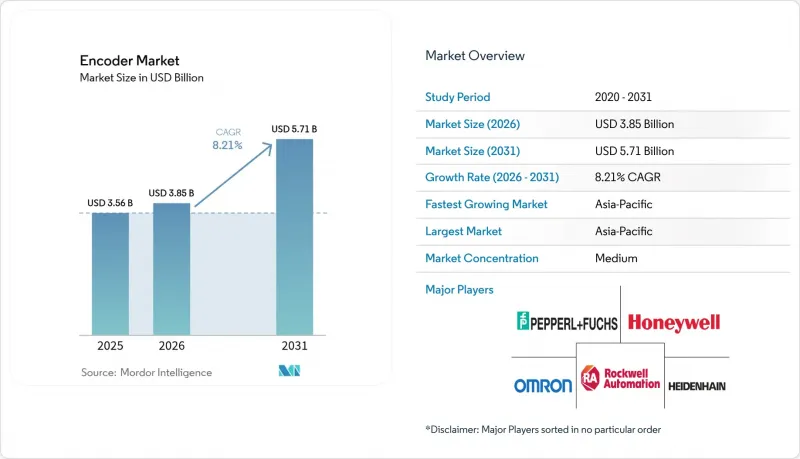
Mordor Intelligence에 의하면, 2026년 인코더 시장 규모는 38억 5,000만 달러로 추정되고 있어 2025년 35억 6,000만 달러에서 성장하여 2031년에는 57억 1,000만 달러에 이를 것으로 예측됩니다. 2026년부터 2031년까지 CAGR은 8.21%를 나타낼 전망입니다.
본 보고서는 유형(로터리 및 리니어), 기술(광학식, 자기식 등), 출력 신호(인크리멘탈, 앱솔루트), 최종 사용자 산업(자동차, 전자 등) 및 지역별로 분류되어 있습니다. 시장 전망은 금액(달러) 기준으로 제시되어 있습니다.
세계 인코더 시장 동향 및 인사이트
EU 내 협업 로봇 도입
독일, 프랑스, 북유럽 국가들의 공장에서 협동 로봇(코봇)의 보급이 확대됨에 따라, 사람과 로봇의 안전한 상호 작용을 보장하기 위해서는 서브미크론 수준의 피드백이 요구되고 있습니다. 현재 각 OEM 업체들은 힘 제한 기준을 충족하기 위해 분해능 1 nm, 시스템 정밀도 ±4µm의 인코더를 사양으로 지정하고 있으며, 이를 통해 로봇은 미세한 접촉도 감지하여 밀리초 단위로 정지할 수 있게 됩니다. 레니쇼의 RESOLUTE 시리즈와 같은 고해상도 앱솔루트 광학식 인코더는 이러한 기준을 충족하고 최대 100 m/s의 속도에 대응할 수 있으므로, 자동화 공급업체는 작업자의 안전을 해치지 않으면서도 처리량을 향상시킬 수 있습니다. 따라서 ISO/TS 15066 준수 시스템의 도입이 확대됨에 따라 판매량은 증가하고 있음에도 불구하고, 엔코더 시장 전체의 평균 판매 가격은 상승하고 있습니다.
중국의 스마트 포장 라인
중국의 전자 및 제약 업계 포장 업체들은 1분당 수백 개의 유닛을 처리하면서 100nm 미만의 공차로 부품을 위치시키는 라인을 운영하고 있습니다. 진동, 온도 변동 및 공기 중의 미세 입자로 인해 라인 구축 업체들은 견고한 하우징을 갖춘 광학식 스케일을 채택하거나, 나노미터 수준의 정밀도를 유지하면서 유도식 형식으로 전환할 수밖에 없게 되었습니다. 각 확장 프로젝트에서는 일반적으로 여러 축에 대한 피드백이 지정되므로, 이 분야의 성장은 인코더 출하 대수를 크게 끌어올리고 있습니다. 완전 자동화 공장에 대한 지방 정부의 보조금으로 인해 중견 제조업체의 설비 투자 장벽이 낮아지면서 수요가 더욱 확대되고 있습니다.
분진이 많은 아세안 지역 제철소에서 발생하는 광학식 오염으로 인한 고장
고로 베이에서 미세 입자가 낙하하면 기존의 코드 디스크를 가려 갑작스러운 위치 정보 손실이나 예기치 않은 정지를 유발합니다. 시설 관리자들은 현재 가동 시간을 희생하지 않고 이물질을 처리할 수 있는 자기식 또는 유도식 센싱으로 전환하고 있으며, 이로 인해 광학식 모델의 교체 수요가 억제되어 중공업 틈새 시장의 엔코더 시장 매출이 소폭 둔화되고 있습니다.
부문 분석
2025년, 로터리식 장치가 인코더 시장 매출의 72.65%를 차지했습니다. 이는 사실상 모든 서보 모터와 로봇의 관절에 각도 피드백이 필요하기 때문입니다. 확고한 사용자 기반, 폭넓은 샤프트 크기 라인업, 시판되는 드라이브와의 직접적인 호환성 덕분에 수요는 견조한 추세를 보이고 있습니다. 한편, 리니어 엔코더는 반도체 스테퍼, 리소그래피 스테이지, 직접 드라이브 테이블에서 마찰 없는 직선 운동이 우선시됨에 따라 2031년까지 연평균 성장률(CAGR) 7.28%를 기록할 전망입니다. 리니어 솔루션용 엔코더 시장 규모는공작기계 제조업체들이 볼 스크류 기구를 에어 베어링이나 자기 부상 슬라이드로 대체하는 추세에 힘입어, 2025년 9억 7,366만 달러에서 2031년에는 14억 8,000만 달러로 확대될 전망입니다. 또한, 적층 가공(애디티브 매뉴팩처링)의 성장도 서브미크론 단위의 정밀도로 Z축의 폐쇄 루프 제어를 가능하게 하는 리니어 스케일 수요를 뒷받침하고 있습니다.
레니쇼의 ‘FORTiS’와 같은 밀폐형 설계의 채택이 확대되면서, 절삭유를 많이 사용하는 머시닝 센터의 가동 중단 시간을 줄이고 있습니다. 한편, 초고진공형은 EUV 리소그래피 챔버에서 점유율을 확대되고 있습니다. 기존 설비의 개조가 로터리형 엔코더 수요를 뒷받침하는 한편, 새로 도입되는 자본 설비에는 스핀들 위치용 로터리 센서와 캐리지 구동용 리니어 센서를 결합한 듀얼 센서가 점점 더 많이 채택되고 있어,어느 하위 카테고리의 점유율도 잠식하지 않으면서 엔코더 시장 전체의 출하 대수를 끌어올리고 있습니다.
2025년에는 웨이퍼 스테퍼, 좌표 측정기, 하이엔드 코봇에 필요한 1nm 해상도 모델에 힘입어 광학식 엔코더의 매출 점유율은 51.85%를 유지했습니다. 자기식 엔코더가 기존 해상도와의 격차를 좁혀감에 따라, 2031년까지 광학식 장치 시장 점유율은 소폭 하락할 가능성이 있습니다. 자기식 장치는 오일 미스트, 분진, 급격한 온도 변화에 대한 내성이 뛰어나며, 철강, 광업, 풍력 터빈 분야에서 총 소유 비용을 절감하기 때문에 연평균 성장률(CAGR) 8.17%로 성장하고 있습니다. 닛폰덴산이 최근 출시한 배터리 불필요한 절대형 자기식 엔코더는 슈퍼커패시터를 탑재하고 유지보수 주기가 필요 없으므로 이용 사례를 더욱 확대되고 있습니다.
정전용량식 및 유도식 플랫폼은 명확하게 정의된 틈새 시장을 차지하고 있습니다. 정전용량식 인코더는 MRI 침대나 반도체 이온 주입 장치에서 전자기 간섭에 내성이 있는 반면, 유도식 솔루션은 완전 밀폐형 하우징 덕분에 식품 등급이나 세척 구역에서 널리 채택되고 있습니다. 각 공급업체들은 광학식 코드 스트립과 자기식 기준 트랙을 융합한 하이브리드 스택의 연구 개발에 자금을 투자하고 있으며, 나노미터 단위의 반복 정밀도를 저해하지 않으면서도 큰 축 방향 편차에도 대응하고 있습니다. 이러한 융합으로 인해 인코더 시장의 차별화는 순수한 센싱의 물리적 특성이 아닌 펌웨어, 진단 기능 및 연결성에 중점을 두게 될 것입니다.
지역별 분석
아시아태평양은 2025년에 전 세계 매출의 35.25%로 1위를 차지하고, 2031년까지 연평균 성장률(CAGR) 9.45%를 유지할 것으로 보입니다. 중국 정부의 스마트 팩토리 및 화합물 반도체 팹에 대한 정책 지원에 힘입어, 연안 지역 각 성에 엔코더 수주가 계속해서 집중되고 있습니다. 일본의 로봇 도입 대수는 근로자 1만 명당 420대를 초과하며, 기존 서보 장치의 설치 공간에 적합한 SIL 인증 피드백 부품에 대한 수요는 견조한 추세를 보이고 있습니다. 인도의 PLI(생산 연계형 인센티브) 제도에 따른 지원이 가장 급속한 수요 증가를 주도하고 있으며, 해당 제도 하에서 자금 지원을 받은 새로운 CNC, PCB, 의료기기 생산 라인에 엔코더 수주가 이어지고 있습니다. 따라서 아시아태평양의 엔코더 시장 규모는 2025년 12억 6,000만 달러에서 2031년에는 21억 6,000만 달러로 확대될 전망입니다.
북미와 유럽을 합치면 2025년 매출의 약 절반을 차지하며, 그 원동력은 항공우주, 의료용 로봇 및 정밀 가공 분야입니다. 미국은 임상 등급 수요를 뒷받침하는 핵심 시장입니다. 존슨앤드존슨 메드테크의 ‘OTTAVA(TM)’ 수술 플랫폼은 서브mm급 재현성을 확보하기 위해 모든 로봇 팔에 초소형 광학 인코더를 탑재하고 있습니다. 독일과 스위스공급업체들은 고정밀 저울을 전 세계로 수출하고 있으며, 생산 대수가 동쪽으로 이동하는 상황 속에서도 유럽은 혁신의 거점으로서의 역할을 확고히 하고 있습니다. 협동 로봇 도입에 대한 EU의 보조금으로 인해 1나노미터급 피드백 솔루션으로 수익이 유도되어, 지역 전체의 평균 판매 가격이 상승하고 있습니다.
라틴아메리카와 중동 및 아프리카는 여전히 기여도가 낮은 지역이지만, 기존 공장(브라운필드)에서 자동 컨베이어, 팔레타이저, 보틀링 라인의 개조가 진행됨에 따라 안정적인 한 자릿수 성장을 기록하고 있습니다. 브라질의 자동차 조립 제조업체와 멕시코의 1차 공급업체는 현재, 보다 광범위한 ‘인더스트리 4.0’으로의 전환의 일환으로 모터 드라이브에 자기식 엔코더를 추가하고 있습니다. 걸프 연안 국가의 석유 생산 기업들은 주변 온도 125°C를 견디고 클래스 1 디비전 2 구역 인증을 획득한, 내환경성이 뛰어난 유도식 및 자기식 설계를 지정하고 있습니다. 이러한 수요 증가에 따라 전 세계 인코더 시장은 다양화되고 있으며, 특정 지역의 경기 순환적 침체로부터 공급업체를 보호하는 역할을 하고 있습니다.
기타 혜택:
- 엑셀 형식 시장 예측(ME) 시트
- 3개월간의 애널리스트 지원
자주 묻는 질문
목차
제1장 서론
제2장 조사 방법
제3장 주요 요약
제4장 시장 구도
제5장 시장 규모와 성장 예측
제6장 경쟁 구도
제7장 시장 기회와 향후 전망
JHS 26.09.07According to Mordor Intelligence, the encoder market size in 2026 is estimated at USD 3.85 billion, growing from 2025 value of USD 3.56 billion with 2031 projections showing USD 5.71 billion, growing at 8.21% CAGR over 2026-2031.
This report is Segmented by Type (Rotary and Linear), Technology (Optical, Magnetic, and More), Output Signal (Incremental, Absolute), End-User Industry (Automotive, Electronics, and More), and Geography. The Market Forecasts are Provided in Terms of Value (USD).
Global Encoder Market Trends and Insights
EU adoption of collaborative robots
Wider use of cobots in German, French, and Nordic plants requires sub-micron feedback to guarantee safe human-robot interaction. OEMs now specify encoders with 1 nm resolution and +-4 µm system accuracy to meet force-limiting norms, enabling robots to detect the slightest contact and halt within milliseconds. High-resolution absolute optics such as Renishaw's RESOLUTE line meet these thresholds and support speeds up to 100 m/s, letting automation suppliers increase throughput without compromising worker protection. Broader deployment of ISO / TS 15066-compliant systems is therefore lifting average selling prices across the encoder market even as unit volumes climb .
China's smart packaging lines
Electronics and pharmaceutical packagers in China run lines that position parts at sub-100 nm tolerances while cycling hundreds of units per minute. Vibration, thermal fluctuation, and airborne particulates force line builders to blend optical scales with rugged housings or shift to inductive formats that still deliver nanometer-grade precision. Each expansion project typically specifies multiple axes of feedback, so growth in this vertical materially raises encoder shipments. Provincial subsidies for fully automated factories amplify demand by lowering capital hurdles for mid-tier manufacturers.
Optical contamination failures in dust-intensive ASEAN steel mills
Particulate fallout in blast-furnace bays obstructs traditional code discs, leading to sudden position loss and unscheduled outages. Facility managers now pivot toward magnetic or inductive sensing that tolerates debris without sacrificing uptime, curbing replacement demand for optical models and marginally slowing encoder market revenue in heavy-industry niches .
Other drivers and restraints analyzed in the detailed report include:
- Functional-safety (SIL 2/3) rules in Japanese process industries
- PLI-backed CNC machine-tool growth in India
- Suzhou & Shenzhen low-cost magnetic IC encoders driving price erosion
For complete list of drivers and restraints, kindly check the Table Of Contents.
Segment Analysis
Rotary devices generated 72.65% of encoder market revenue in 2025 as virtually every servo motor and robot joint needs angular feedback. Their entrenched base, wide shaft-size offerings, and direct compatibility with off-the-shelf drives keep demand buoyant. Linear encoders, however, post a 7.28% CAGR to 2031 as semiconductor steppers, lithography stages, and direct-drive tables prioritise friction-free translation. The encoder market size for linear solutions is set to climb from USD 973.66 million in 2025 to USD 1.48 billion in 2031, propelled by machine-tool builders replacing ball-screw rigs with air-bearing or magnetic levitation slides. Growth in additive manufacturing also favours linear scales that provide closed-loop z-axis control at sub-micron granularity.
Emerging use of enclosed designs such as Renishaw's FORTiS reduces downtime in coolant-rich machining centres, while ultra-high-vacuum variants capture share in EUV lithography chambers. Although retrofits sustain rotary volumes, new-build capital equipment increasingly incorporates dual sensors-rotary for spindle position and linear for carriage motion raising overall encoder market shipments without cannibalising either sub-category.
Optical encoders retained 51.85% revenue in 2025, driven by 1 nm resolution models required in wafer steppers, coordinate-measuring machines, and high-end cobots. The encoder market share for optical units may slip marginally by 2031 as magnetic options cut the historical resolution gap. Magnetic devices expand at an 8.17% CAGR because they withstand oil mist, dust, and wide temperature swings, lowering total cost of ownership in steel, mining, and wind-turbine applications. Battery-free absolute magnetics recently launched by Nidec further widen use cases by eliminating supercapacitors and maintenance cycles .
Capacitive and inductive platforms occupy well-defined niches: capacitive encoders resist electromagnetic interference for MRI beds and semiconductor ion implanters, whereas inductive solutions thrive in food-grade or wash-down zones thanks to fully sealed housings. Suppliers devote R&D dollars to hybrid stacks that blend optical code strips with magnetic reference tracks, handling high axial misalignment without loss of nanometric repeatability. This convergence should keep encoder market differentiation centred on firmware, diagnostics, and connectivity rather than pure sensing physics.
Complete Report Scope:
- By Type
- Rotary
- Linear
- By Technology
- Optical
- Magnetic
- Capacitive
- Inductive
- Other Technologies
- By Output Signal
- Incremental
- Absolute
- By End-user Industry
- Automotive
- Electronics and Semiconductor
- Industrial
- Textile
- Printing Machinery
- Medical Devices
- Energy and Power
- Aerospace and Defense
- Other End-user Industries
- By Geography
- North America
- United States
- Canada
- Mexico
- South America
- Brazil
- Argentina
- Rest of South America
- Europe
- Germany
- United Kingdom
- France
- Italy
- Spain
- Rest of Europe
- Asia-Pacific
- China
- Japan
- South Korea
- India
- Australia
- New Zealand
- Rest of Asia-Pacific
- Middle East and Africa
- United Arab Emirates
- Saudi Arabia
- South Africa
- Rest of Middle East and Africa
- North America
Geography Analysis
Asia-Pacific led with 35.25% of global revenue in 2025 and sustains a 9.45% CAGR through 2031. Chinese policy backing for smart factories and compound-semiconductor fabs continues to funnel encoder orders into coastal provinces. Japan's installed robot base exceeds 420 units per 10,000 workers, keeping demand resilient for SIL-rated feedback components that fit legacy servo footprints. India's PLI tranche drives the fastest incremental gains, with encoder call-offs attaching to new CNC, PCB, and medical-device lines financed under the scheme. The encoder market size in Asia-Pacific therefore moves from USD 1.26 billion in 2025 toward USD 2.16 billion in 2031.
North America and Europe together represent roughly half of 2025 turnover, powered by aerospace, medical robotics, and precision machining. The United States anchors clinical-grade demand: Johnson & Johnson MedTech's OTTAVA(TM) surgical platform integrates ultra-compact optical encoders on every robotic arm to secure sub-millimetre repeatability. German and Swiss suppliers export high-accuracy scales worldwide, cementing Europe's role as an innovation hub even as unit volumes migrate East. EU subsidies for collaborative-robot deployment channel revenue toward 1 nm-class feedback solutions, lifting average selling price across the region.
Latin America and the Middle East & Africa remain smaller contributor regions yet post steady single-digit growth as brownfield plants retrofit automated conveyors, palletisers, and bottling lines. Brazilian auto assemblers and Mexican Tier-1 suppliers now add magnetic encoders to motor drives as part of broader Industry 4.0 overhauls. Gulf-state oil producers specify ruggedised inductive and magnetic designs rated to 125 °C ambient and certified for Class 1 Div 2 zones. This uptake diversifies the global encoder market and cushions suppliers against cyclical slowdowns in any one geography.
- Omron Corporation
- Dr. Johannes Heidenhain GmbH
- Honeywell International
- Rockwell Automation Inc.
- Pepperl+Fuchs SE
- Panasonic Holdings Corp.
- Baumer Holding AG
- Sensata Technologies (Hengstler and Dynapar)
- Renishaw plc
- SICK AG
- Maxon Group
- FAULHABER Drive Systems
- Allied Motion Technologies
- AMETEK (Haydon Kerk, Maurey)
- Canon Precision Inc.
- CUI Devices
- TE Connectivity
- Posital FRABA B.V.
- Tamagawa Seiki Co., Ltd.
Additional Benefits:
- The market estimate (ME) sheet in Excel format
- 3 months of analyst support
TABLE OF CONTENTS
1 INTRODUCTION
- 1.1 Study Assumptions and Market Definition
- 1.2 Scope of the Study
2 RESEARCH METHODOLOGY
3 EXECUTIVE SUMMARY
4 MARKET LANDSCAPE
- 4.1 Market Overview
- 4.2 Market Drivers
- 4.2.1 EU Adoption of Collaborative Robots Driving High-Precision Encoders
- 4.2.2 Chinas Smart Packaging Lines Requiring Sub-Micron Resolution Encoders
- 4.2.3 Functional-Safety (SIL 2/3) Regulations in Japanese Process Industries
- 4.2.4 PLI-Backed CNC Machine-Tool Growth in India Elevating Rotary Encoder Demand
- 4.2.5 OEM Migration to Integrated Motor-Encoder Modules in US Medical Robotics
- 4.3 Market Restraints
- 4.3.1 Optical Contamination Failures in Dust-Intensive ASEAN Steel Mills
- 4.3.2 Suzhou and Shenzhen Low-Cost Magnetic IC Encoders Driving Price Erosion
- 4.3.3 US-EU Export Controls Limiting Ultra-Precision Encoders for China Lithography
- 4.4 Regulatory Outlook
- 4.5 Porter's Five Forces Analysis
- 4.5.1 Bargaining Power of Suppliers
- 4.5.2 Bargaining Power of Buyers
- 4.5.3 Threat of New Entrants
- 4.5.4 Threat of Substitutes
- 4.5.5 Intensity of Competitive Rivalry
5 MARKET SIZE AND GROWTH FORECASTS (VALUE)
- 5.1 By Type
- 5.1.1 Rotary
- 5.1.2 Linear
- 5.2 By Technology
- 5.2.1 Optical
- 5.2.2 Magnetic
- 5.2.3 Capacitive
- 5.2.4 Inductive
- 5.2.5 Other Technologies
- 5.3 By Output Signal
- 5.3.1 Incremental
- 5.3.2 Absolute
- 5.4 By End-user Industry
- 5.4.1 Automotive
- 5.4.2 Electronics and Semiconductor
- 5.4.3 Industrial
- 5.4.4 Textile
- 5.4.5 Printing Machinery
- 5.4.6 Medical Devices
- 5.4.7 Energy and Power
- 5.4.8 Aerospace and Defense
- 5.4.9 Other End-user Industries
- 5.5 By Geography
- 5.5.1 North America
- 5.5.1.1 United States
- 5.5.1.2 Canada
- 5.5.1.3 Mexico
- 5.5.2 South America
- 5.5.2.1 Brazil
- 5.5.2.2 Argentina
- 5.5.2.3 Rest of South America
- 5.5.3 Europe
- 5.5.3.1 Germany
- 5.5.3.2 United Kingdom
- 5.5.3.3 France
- 5.5.3.4 Italy
- 5.5.3.5 Spain
- 5.5.3.6 Rest of Europe
- 5.5.4 Asia-Pacific
- 5.5.4.1 China
- 5.5.4.2 Japan
- 5.5.4.3 South Korea
- 5.5.4.4 India
- 5.5.4.5 Australia
- 5.5.4.6 New Zealand
- 5.5.4.7 Rest of Asia-Pacific
- 5.5.5 Middle East and Africa
- 5.5.5.1 United Arab Emirates
- 5.5.5.2 Saudi Arabia
- 5.5.5.3 South Africa
- 5.5.5.4 Rest of Middle East and Africa
- 5.5.1 North America
6 COMPETITIVE LANDSCAPE
- 6.1 Strategic Moves
- 6.2 Vendor Positioning Analysis
- 6.3 Company Profiles {includes Global-level Overview, Market-level Overview, Core Segments, Financials as available, Strategic Information, Products and Services, Recent Developments}
- 6.3.1 Omron Corporation
- 6.3.2 Dr. Johannes Heidenhain GmbH
- 6.3.3 Honeywell International
- 6.3.4 Rockwell Automation Inc.
- 6.3.5 Pepperl+Fuchs SE
- 6.3.6 Panasonic Holdings Corp.
- 6.3.7 Baumer Holding AG
- 6.3.8 Sensata Technologies (Hengstler and Dynapar)
- 6.3.9 Renishaw plc
- 6.3.10 SICK AG
- 6.3.11 Maxon Group
- 6.3.12 FAULHABER Drive Systems
- 6.3.13 Allied Motion Technologies
- 6.3.14 AMETEK (Haydon Kerk, Maurey)
- 6.3.15 Canon Precision Inc.
- 6.3.16 CUI Devices
- 6.3.17 TE Connectivity
- 6.3.18 Posital FRABA B.V.
- 6.3.19 Tamagawa Seiki Co., Ltd.
7 MARKET OPPORTUNITIES AND FUTURE OUTLOOK
- 7.1 White-space and Unmet-Need Assessment


