

|
시장보고서
상품코드
2124108
히드라진 시장 : 시장 점유율 분석, 업계 동향 및 통계, 성장 예측(2026-2031년)Hydrazine - Market Share Analysis, Industry Trends & Statistics, Growth Forecasts (2026 - 2031) |
||||||
 Mordor Intelligence
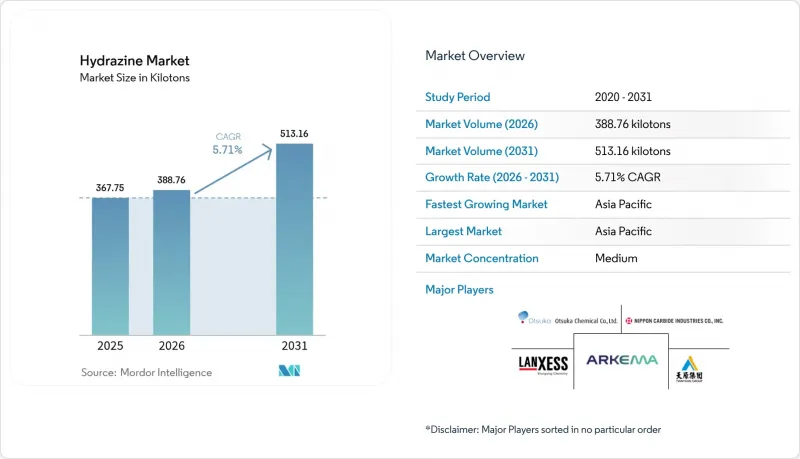
Mordor Intelligence에 의하면, 히드라진 시장 규모는 2025년에 367.75 킬로톤으로 평가되었고, 2026년 388.76 킬로톤에서 2031년까지 513.16 킬로톤에 이를 것으로 예측되며, 예측 기간(2026-2031년) CAGR은 5.71%를 나타낼 전망입니다.
본 보고서는 유형별(히드라진 수화물, 질산히드라진, 황산히드라진, 기타), 용도별(부식 방지제, 폭발물, 로켓 연료, 의약품 원료 등), 최종 사용자 산업별(의약품, 농약 등), 지역별(아시아태평양, 북미, 유럽, 남미, 중동 및 아프리카)로 분류되어 있습니다. 시장 예측은 수량(톤) 기준으로 제시되어 있습니다.
세계의 히드라진 시장 동향 및 인사이트
농약 분야 수요 증가
중국, 인도, 브라질에서 농업의 집약화가 진행됨에 따라 농약 소비량은 높은 수준을 유지하고 있으며, 히드라진은 말레산 히드라지드, 이소옥사졸리디논 및 기타 생장 조절제 유효 성분에 있어 필수적인 중간체로 자리매김하고 있습니다. 중국의 주요 제조업체들은 국내 시장과 수출 시장 모두에 공급할 수 있는 20만 톤이 넘는 전용 생산 능력을 보유하고 있어 제제 제조업체에 안정적인 공급을 뒷받침하고 있습니다. 나노기술을 응용한 히드라진 유도체에 대한 연구 결과, 저용량으로도 해충을 완전히 박멸할 수 있음이 입증되어, 효능을 유지하면서 환경 부하를 저감할 수 있는 가능성이 제시되었습니다. 이러한 지역에서는 식량 안보에 대한 규제적 중요성이 당면한 환경 규제에 따른 금지 조치보다 우선시되고 있기 때문에 히드라진 시장은 견조한 추세를 보이고 있습니다.
의약품 중간체로서의 활용 확대
히드라진 골격은 항결핵제, 항염증제, 항우울제의 분자를 선택적으로 합성할 수 있게 하며, 최근의 공정 혁신을 통해 온화하고 용매 효율이 높은 조건에서 89-97%의 수율을 얻고 있습니다. 피롤히드라존 등의 임상 후보 화합물은 치료 농도에서 결핵균(Mycobacterium tuberculosis)을 억제하기 때문에 미국 및 인도의 의약품 원료(API) 제조업체들 사이에서 수요가 확대되고 있습니다. 독성에 대한 우려를 해소하기 위해 각 제조업체는 히드라진의 대량 취급을 피하면서, 그 독특한 친핵성을 활용하는 간접적인 합성 경로의 확대를 추진하고 있습니다. 그 결과, 제약 분야는 히드라진 시장에서 앞으로도 가장 빠르게 성장하는 사용자층으로 남을 것으로 예측됩니다.
높은 독성과 규제 강화
히드라진은 유럽화학물질청(ECHA)의 ‘고위험 물질(SVHC)’ 목록에 등재되어 있으며, 엄격한 허가 요건과 직업적 노출 한계치가 설정되어 있습니다. 규정을 준수하기 위해서는 밀폐형 이송 라인, 스크러버 시스템 및 지속적인 공기 모니터링이 요구되며, 이는 독일, 프랑스 및 미국의 제제 제조업체들의 운영 비용을 상승시키고 있습니다. 또한, 간독성 및 발암성과 관련된 법적 책임으로 인해 보험사는 보험료를 인상할 수밖에 없으며, 이는 신규 진입을 저해하는 요인이 되고 있습니다. 현재 아시아태평양의 규제는 비교적 완만하지만, 다국적 기업 고객들로부터 전 세계적인 규정 준수가 점점 더 요구되고 있어, 전 세계적으로 더 높은 안전 기준이 점차 확산되고 있습니다.
부문 분석
히드라진 수화물은 2025년 히드라진 시장의 판매량의 60.17%를 차지한 것으로 평가되었으며, 부문 중 가장 높은 5.89%의 연평균 성장률(CAGR)을 보일 것으로 전망됩니다. 수화물 등급이 선호되는 이유는 무수 물질에 비해 증기압이 낮고, ISO 탱크를 통한 물류가 간소화되며, 규제 인증 취득이 원활하기 때문입니다. 보일러 수처리, 폴리머 발포 및 API 합성 플랜트에서는 현장의 위험 프로파일을 낮추기 위해 수화물 전용 저장 시설이 설치되어 있어, 이는 수요의 안정성을 높이고 있습니다. 황산히드라진 등의 특수 염은 보다 엄격한 화학량론적 제어가 필수적인 전자 및 분석 분야에서 이용되고 있습니다.
규제 당국은 현재 실행 가능한 경우 수화물 등급을 명시적으로 권장하고 있으며, 이는 제약 규정을 준수하기 위해 설계된 고순도·저금속 함유 배합에 대한 공급업체의 투자를 촉진하고 있습니다. 또한, 연료전지 개발업체들도 출력 밀도와 휘발성 관리의 균형을 유지하는 액체 운반체 프로토타입에 일수화물을 채택하는 경향이 있어, 이에 따라 수요가 점진적으로 증가하고 있습니다. 이러한 동향들이 결합되어 히드라진 수화물의 주도적 지위가 공고해졌으며, 무수 형태에 대한 임박한 규제의 전면적인 영향으로부터 이 부문을 보호함으로써 더 광범위한 히드라진 시장을 뒷받침하고 있습니다.
지역별 분석
아시아태평양은 2025년에 55.51%의 시장 점유율을 차지하며 히드라진 시장을 독점했으며, 2031년까지 연평균 성장률(CAGR) 6.05%라는 가장 높은 성장률을 나타낼 것으로 예측됩니다. 중국에서는 암모니아 원료부터 하류 농약에 이르는 통합된 밸류체인이 비용 면에서 우위를 점하고 있는 반면, 인도에서는 제약 산업의 확장으로 고순도 수화물의 수입이 증가하고 있습니다. 안전상의 우려에도 불구하고, 국내 특수 화학제품 생산에 대한 정부의 지원책이 생산 능력의 추가 확대를 뒷받침하고 있습니다.
북미는 성숙해 가면서도 계속 진화하는 시장으로 남아 있습니다. 규제 준수로 인해 운영 비용은 상승하고 있지만, 방위용도 및 부식 방지 계약이 히드라진의 기초 소비량을 지탱하고 있습니다. 2024년 Calca Solutions가 사모펀드에 인수된 것은 안정적인 자유 현금 흐름과 차세대 고체 로켓 모터 프로그램에 따른 미래 수요 증가에 대한 투자자들의 신뢰를 뒷받침하는 것입니다.
유럽은 REACH 승인에 대한 압박이 높아지는 가운데 가장 심각한 과제에 직면해 있습니다. 일부 중견 배합 제조업체들은 라이선스 취득 지연을 피하기 위해 생산 능력을 축소하거나 튀르키예 및 동유럽의 계열사로 조달처를 전환하고 있습니다. 전반적으로 규제 체제의 차이로 인해 아시아태평양은 가속화되는 반면, 유럽은 재편이 진행되고, 북미는 리스크 관리와 전략적 필요성 사이에서 균형을 맞추는 등 양극화된 히드라진 시장이 형성되고 있습니다.
기타 혜택 :
- 엑셀 형식 시장 전망(ME) 시트
- 3개월간의 애널리스트 지원
자주 묻는 질문
목차
제1장 서론
제2장 조사 방법
제3장 주요 요약
제4장 시장 구도
제5장 시장 규모 및 성장 예측
제6장 경쟁 구도
제7장 시장 기회 및 향후 전망
AJY 26.09.11According to Mordor Intelligence, the hydrazine market size was valued at 367.75 kilotons in 2025 and estimated to grow from 388.76 kilotons in 2026 to reach 513.16 kilotons by 2031, at a CAGR of 5.71% during the forecast period (2026-2031).
This report is Segmented by Type (Hydrazine Hydrate, Hydrazine Nitrate, Hydrazine Sulfate, and Other Types), Application (Corrosion Inhibitor, Explosives, Rocket Fuel, Medicinal Ingredient, and More), End-User Industry (Pharmaceuticals, Agrochemicals, and More), and Geography (Asia-Pacific, North America, Europe, South America, and Middle-East and Africa). The Market Forecasts are Provided in Terms of Volume (Tons).
Global Hydrazine Market Trends and Insights
Rising Demand from Agrochemicals
Escalating agricultural intensification in China, India, and Brazil keeps pesticide consumption high, and hydrazine remains the indispensable intermediate for maleic hydrazide, isoxazolidinone, and other growth-regulator actives. Large Chinese producers report dedicated capacities above 200,000 tons that feed both domestic and export pipelines, supporting supply security for formulating companies. Research into nano-engineered hydrazine derivatives achieves full pest mortality at lower dosage, signaling potential for reduced environmental loading while preserving efficacy. Regulatory focus on food security in these regions outweighs immediate environmental bans, thus sustaining the hydrazine market.
Growing Use as Pharmaceutical Intermediate
Hydrazine scaffolds enable the selective synthesis of anti-tubercular, anti-inflammatory, and antidepressant molecules, and recent process innovations deliver 89-97% yields under mild, solvent-efficient conditions. Clinical candidates such as pyrrole hydrazones inhibit Mycobacterium tuberculosis at therapeutic concentrations, widening demand among active pharmaceutical ingredient (API) manufacturers in the United States and India. To tackle toxicity concerns, producers are scaling indirect routes that avoid bulk hydrazine handling, yet still leverage its unique nucleophilic profile. As a result, the pharmaceutical segment is expected to remain the fastest-growing user base within the hydrazine market.
Highly Toxic Nature and Tightening Regulations
Hydrazine features on the European Chemicals Agency's Substances of Very High Concern list, triggering strict authorization and occupational exposure limits. Compliance now demands sealed transfer lines, scrubber systems, and continuous air monitoring, pushing operating costs higher for formulators across Germany, France, and the United States. Liability linked to liver toxicity and carcinogenicity also forces insurers to raise premiums, discouraging new entrants. Although Asia-Pacific regulations are comparatively lenient today, multinational customers increasingly require global compliance, slowly extending higher safety standards worldwide.
Other drivers and restraints analyzed in the detailed report include:
- Increasing Adoption as Blowing Agent in Polymer Foams
- Expansion of Water-Treatment Infrastructure
- Shift Toward Green Monopropellants in Space
For complete list of drivers and restraints, kindly check the Table Of Contents.
Segment Analysis
Hydrazine hydrate accounted for 60.17% of 2025 volume within the hydrazine market and recorded the segment-leading 5.89% CAGR outlook. Preference for aqueous grades stems from lower vapor pressure, simplified ISO-tank logistics, and smoother regulatory certification versus anhydrous material. Boiler-water treatment, polymer foaming, and API synthesis plants install dedicated hydrate storage to reduce on-site risk profiles, reinforcing demand stability. Specialty salts such as hydrazine sulfate serve electronics and analytical niches where tighter stoichiometric control is essential.
Regulators now explicitly recommend hydrate grades when feasible, catalyzing supplier investments in high-purity, low-metal formulations engineered for pharmaceutical compliance. Fuel-cell developers also gravitate toward monohydrate for liquid-carrier prototypes that balance power density with managed volatility, sustaining incremental offtake. Collectively, these trends entrench hydrazine hydrate's leadership and shield the segment from the full force of impending restrictions on anhydrous forms, supporting the broader hydrazine market.
Complete Report Scope:
- By Type
- Hydrazine Hydrate
- Hydrazine Nitrate
- Hydrazine Sulfate
- Other Types
- By Application
- Corrosion Inhibitor
- Explosives
- Rocket Fuel
- Medicinal Ingredient
- Precursor To Pesticides
- Blowing Agent
- Other Applications
- By End-user Industry
- Pharmaceuticals
- Agrochemicals
- Industrial
- Other End-user Industries
- Geography
- Asia-Pacific
- China
- India
- Japan
- South Korea
- Malaysia
- Thailand
- Indonesia
- Vietnam
- Rest of Asia-Pacific
- North America
- United States
- Canada
- Mexico
- Europe
- Germany
- United Kingdom
- Italy
- France
- Spain
- NORDIC Countries
- Turkey
- Russia
- Rest of Europe
- South America
- Brazil
- Argentina
- Colombia
- Rest of South America
- Middle-East and Africa
- Saudi Arabia
- Qatar
- United Arab Emirates
- Nigeria
- Egypt
- South Africa
- Rest of Middle-East and Africa
- Asia-Pacific
Geography Analysis
Asia-Pacific dominated the hydrazine market with a 55.51% hydrazine market share in 2025 and is forecast to post the fastest 6.05% CAGR through 2031. China's integrated value chain, from ammonia feedstock to downstream pesticides, confers cost leadership, while India's pharmaceutical build-out boosts high-purity hydrate imports. Government incentives for local specialty-chemical production stimulate further capacity additions despite safety headwinds.
North America remains a mature yet evolving arena. Regulatory compliance elevates operating costs, but defense applications and corrosion-control contracts sustain baseline hydrazine consumption. The 2024 private-equity acquisition of Calca Solutions underscores investor belief in steady free cash flow and future volume support from next-generation solid rocket motor programs.
Europe confronts the stiffest hurdles as REACH authorization pressures escalate. Several mid-tier formulators have trimmed capacity or shifted sourcing to affiliates in Turkey and Eastern Europe to circumvent licensing delays. Collectively, divergent regulatory regimes create a two-speed hydrazine market in which Asia-Pacific accelerates while Europe consolidates and North America balances between risk management and strategic necessity.
- Acuro Organics Limited
- Arkema
- BroadPharm
- Calca Solutions (AE Industrial Partners)
- Gujarat Alkalies and Chemicals Limited
- HPL Additives Limited
- Lanxess
- Loba Chemie Pvt. Ltd.
- MERU CHEM PVT.LTD.
- Nippon Carbide Industries Co., Inc.
- Otsuka Chemical Co.,Ltd.
- Yibin Tianyuan Group
Additional Benefits:
- The market estimate (ME) sheet in Excel format
- 3 months of analyst support
TABLE OF CONTENTS
1 Introduction
- 1.1 Study Assumptions and Market Definition
- 1.2 Scope of the Study
2 Research Methodology
3 Executive Summary
4 Market Landscape
- 4.1 Market Overview
- 4.2 Market Drivers
- 4.2.1 Rising Demand from Agrochemicals
- 4.2.2 Growing Use as Pharmaceutical Intermediate
- 4.2.3 Increasing Adoption as Blowing Agent in Polymer Foams
- 4.2.4 Expansion of Water-Treatment Infrastructure
- 4.2.5 Hydrazine-Based Hydrogen Carrier for Fuel-Cell Systems
- 4.3 Market Restraints
- 4.3.1 Highly Toxic Nature and Tightening Regulations
- 4.3.2 Volatility in Ammonia Prices
- 4.3.3 Shift Toward Green Monopropellants (HAN/H2O2) in Space
- 4.4 Value Chain Analysis
- 4.5 Porter's Five Forces
- 4.5.1 Bargaining Power of Suppliers
- 4.5.2 Bargaining Power of Buyers
- 4.5.3 Threat of New Entrants
- 4.5.4 Threat of Substitutes
- 4.5.5 Degree of Competition
5 Market Size and Growth Forecasts (Volume)
- 5.1 By Type
- 5.1.1 Hydrazine Hydrate
- 5.1.2 Hydrazine Nitrate
- 5.1.3 Hydrazine Sulfate
- 5.1.4 Other Types
- 5.2 By Application
- 5.2.1 Corrosion Inhibitor
- 5.2.2 Explosives
- 5.2.3 Rocket Fuel
- 5.2.4 Medicinal Ingredient
- 5.2.5 Precursor To Pesticides
- 5.2.6 Blowing Agent
- 5.2.7 Other Applications
- 5.3 By End-user Industry
- 5.3.1 Pharmaceuticals
- 5.3.2 Agrochemicals
- 5.3.3 Industrial
- 5.3.4 Other End-user Industries
- 5.4 Geography
- 5.4.1 Asia-Pacific
- 5.4.1.1 China
- 5.4.1.2 India
- 5.4.1.3 Japan
- 5.4.1.4 South Korea
- 5.4.1.5 Malaysia
- 5.4.1.6 Thailand
- 5.4.1.7 Indonesia
- 5.4.1.8 Vietnam
- 5.4.1.9 Rest of Asia-Pacific
- 5.4.2 North America
- 5.4.2.1 United States
- 5.4.2.2 Canada
- 5.4.2.3 Mexico
- 5.4.3 Europe
- 5.4.3.1 Germany
- 5.4.3.2 United Kingdom
- 5.4.3.3 Italy
- 5.4.3.4 France
- 5.4.3.5 Spain
- 5.4.3.6 NORDIC Countries
- 5.4.3.7 Turkey
- 5.4.3.8 Russia
- 5.4.3.9 Rest of Europe
- 5.4.4 South America
- 5.4.4.1 Brazil
- 5.4.4.2 Argentina
- 5.4.4.3 Colombia
- 5.4.4.4 Rest of South America
- 5.4.5 Middle-East and Africa
- 5.4.5.1 Saudi Arabia
- 5.4.5.2 Qatar
- 5.4.5.3 United Arab Emirates
- 5.4.5.4 Nigeria
- 5.4.5.5 Egypt
- 5.4.5.6 South Africa
- 5.4.5.7 Rest of Middle-East and Africa
- 5.4.1 Asia-Pacific
6 Competitive Landscape
- 6.1 Market Concentration
- 6.2 Strategic Moves
- 6.3 Market Share (%)/Ranking Analysis
- 6.4 Company Profiles (includes Global level Overview, Market level overview, Core Segments, Financials as available, Strategic Information, Market Rank/Share for key companies, Products and Services, and Recent Developments)
- 6.4.1 Acuro Organics Limited
- 6.4.2 Arkema
- 6.4.3 BroadPharm
- 6.4.4 Calca Solutions (AE Industrial Partners)
- 6.4.5 Gujarat Alkalies and Chemicals Limited
- 6.4.6 HPL Additives Limited
- 6.4.7 Lanxess
- 6.4.8 Loba Chemie Pvt. Ltd.
- 6.4.9 MERU CHEM PVT.LTD.
- 6.4.10 Nippon Carbide Industries Co., Inc.
- 6.4.11 Otsuka Chemical Co.,Ltd.
- 6.4.12 Yibin Tianyuan Group
7 Market Opportunities and Future Outlook
- 7.1 Hydrazine as hydrogen-rich liquid fuel for next-gen fuel cells
- 7.2 Bio-route production via anammox bacteria


