

|
시장보고서
상품코드
2124116
타이어 재료 시장 : 점유율 분석, 업계 동향과 통계, 성장 예측(2026-2031년)Tire Material - Market Share Analysis, Industry Trends & Statistics, Growth Forecasts (2026 - 2031) |
||||||
 Mordor Intelligence
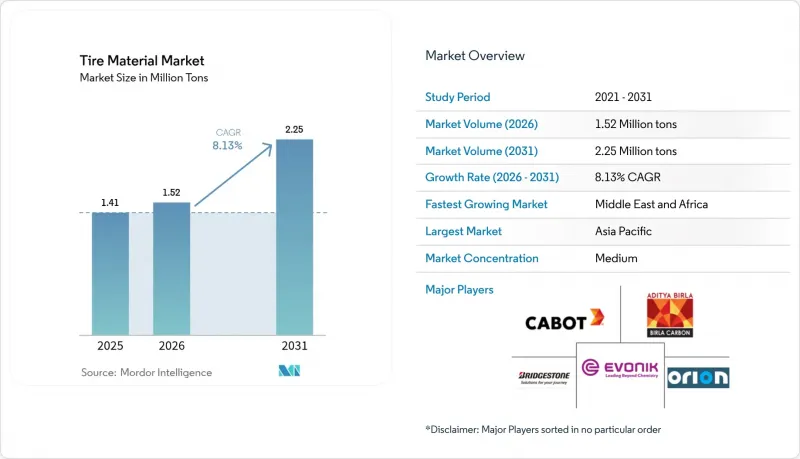
Mordor Intelligence에 의하면, 타이어 재료 시장 규모는 2025년 141만 톤에서 2026년에는 152만 톤으로 확대되어 2026년부터 2031년까지 CAGR 8.13%로 성장을 지속하여, 2031년에는 225만 톤에 이를 것으로 예측됩니다.
본 보고서는 소재 유형(엘라스토머, 보강용 필러, 가소제, 화학 약품, 금속 보강재, 섬유 보강재), 차종(승용차, 소형 상용차, 대형 트럭, 버스), 지역(아시아태평양, 북미, 유럽, 남미, 중동 및 아프리카)별로 분류되어 있습니다. 시장 예측은 수량(톤) 단위로 표시되어 있습니다.
세계 타이어 재료 시장 동향 및 인사이트
OEM의 저회전저항 컴파운드로의 전환
유럽연합(EU)에서는 6.5 kg/t을 초과하는 구름 저항에 대해 벌칙이 부과되며, 미국 CAFE 규정도 유사한 기준을 채택하고 있기 때문에 실리카를 풍부하게 함유한 트레드가 현재 기본 사양으로 채택되고 있습니다. 콘티넨탈의 ‘EcoContact 7’은 18-22%의 침전 실리카와 용액 SBR을 채택하여, 이를 통해 구름 저항을 15% 저감하고 전기차의 주행 거리를 3-4% 연장하고 있습니다. 그 대가로 가황 주기가 길어지고 타이어 1개당 1.50-2달러의 비용 증가가 발생하지만, 각 OEM 업체는 보증 지표를 유지하기 위해 이 비용을 흡수해야 합니다. ISO 28580 준수를 통해 주장되는 성능 향상이 실험실 검증 기준을 충족한다는 것이 보장됩니다. 그 결과, 실리카 수요는 전기차 보급 곡선을 따라 추이하고 있으며, 카본블랙 수요가 정체된 상황에서도 두 자릿수 수량 성장이 확실시되고 있습니다.
전자상거래의 급증으로 교체용 타이어의 주행 거리가 증가
라스트 마일 배송으로 인해 2024년 이후 소형 상용차의 주행 거리는 18-25% 증가했으며, 교체 주기는 32,000km 미만으로 단축되었습니다. 아마존의 전 세계 밴 차량만 보더라도 타이어는 10-12개월마다 교체되고 있으며, 이러한 교체 주기에는 인열 강도를 높이기 위해 천연 고무를 배합한 내구성이 뛰어난 카본블랙을 풍부하게 함유한 컴파운드가 적합합니다. 브리지스톤은 공급, 내장 센서, 분석 기능을 통합하여 차량 함대의 타이어 비용을 8-12% 절감하고 있습니다. 교체용 타이어는 표시 규제가 완화된 편이므로, 컴파운드 제조업체는 규제상의 마찰을 일으키지 않으면서 효율성보다 마모 수명을 우선시할 수 있습니다. 도시 물류가 성숙해짐에 따라, 이러한 요인으로 인해 특히 북미와 유럽에서 단기적인 운송량이 안정화되고 있습니다.
EU의 PFAS 금지 조치가 임박함에 따라, 불소계 첨가제 사용 제한
ECHA(유럽화학물질청)가 2025년 1월에 제안한 안건에 따르면, 불소계 폴리머의 가공 보조제를 5년 이내에 단계적으로 폐지하게 되어 있지만, 타이어 컴파운드 제조업체들은 이형력을 최대 40% 저감하기 위해 0.1-0.3%의 첨가량에 의존하고 있습니다. 브리지스톤은 이러한 가공 보조제를 배제할 경우 컴파운드의 점도가 15-20 MU 상승하고, 미가황 타이어의 보관 기간이 절반으로 줄어들기 때문에 해당 지역 전체에서 5,000만-8,000만 유로의 운전 자금 수요가 증가할 것이라고 경고하고 있습니다. 실리콘 기반의 대체품은 2-3배의 비용이 소요되며, 가황 시스템 전체의 재설계가 필요합니다. EU의 ‘지속가능성을 위한 화학물질 전략’에서는 필수 용도에 대한 면제 조치조차 향후 폐지될 가능성이 시사되고 있어, 타이어 제조업체들은 지금 당장 연구 개발을 가속화해야 하는 상황에 놓여 있습니다.
부문 분석
엘라스토머는 2025년 총량의 42.94%를 차지하며, 2031년까지 연평균 5.51%의 성장이 예상됩니다. 그 다음으로 필러 부문이 뒤를 잇고 있으며, 카본블랙이 여전히 필러 총량의 60%를 차지하고 있습니다. 한편, 각 OEM 업체들이 효율성 요건을 추구하는 가운데, 침전 실리카는 두 자릿수 성장을 기록하고 있습니다. 나머지 부분은 가소제, 화학 약품, 금속 보강재가 차지하고 있으며, REACH 규정을 준수하는 파라핀계 오일과 레이디얼 벨트의 스틸 코드에 대한 안정적인 수요가 이를 견인하고 있습니다.
중기적으로는 바이오 유래 가소제가 틈새 시장이지만 수익성이 높은 수요를 확보하고 있는 반면, 전도성 등급의 탄소 나노 소재는 분산 기술 노하우를 보유한 공급업체에게 새로운 수익원을 개척하고 있습니다. 에어리스 설계는 장기적으로 엘라스토머 사용량 증가를 억제하지만, 엔지니어링 열가소성 수지 및 내피로성 섬유 수요를 끌어올리고 있어, 타이어 1개당 재료 사용량이 점차 감소하고 있음에도 불구하고 타이어 재료 시장 전체 수요는 증가할 수 있음이 밝혀졌습니다.
지역별 분석
아시아태평양은 2025년 소비량의 52.34%를 차지하며 계속해서 주도적인 위치를 유지하고 있습니다. 하이난 섬의 플랜테이션에서 산둥성의 카본블랙 공장에 이르기까지, 중국의 수직 통합형 생태계 덕분에 평균 리드 타임은 48시간 이내로 억제되고 있습니다. 인도의 PLI(생산 연계 인센티브) 제도는 국내 컴파운딩 사업에 12억 달러를 투입하여 수출량에 따른 관세 환급을 실현하고 있습니다. 일본과 한국은 생산량은 적지만, 솔루션 SBR이나 액상 고무와 같은 특수 제품을 통해 높은 가격을 유지하고 있습니다. 아세안 거점은 관세가 없는 생고무와 7년간의 면세 조치를 바탕으로 성장하고 있지만, 물류 병목 현상으로 인해 이익률이 압박받고 있습니다.
북미 수요는 연간 주행 거리가 길고 경트럭이 주를 이루는 차량 구성에 힘입어 견인되고 있습니다. 멕시코 공장은 USMCA(미국·멕시코·캐나다 협정)에 따른 관세 면제 경로와 40-50%의 인건비 절감을 활용하여 미국 및 남미 시장 모두에 공급하고 있습니다. 캐나다의 눈용 타이어 연구 개발은 전 세계 고실리카 함유 올시즌 타이어 제품 라인에도 파급되고 있습니다.
유럽은 핸들링 성능 향상이 컴파운드 비용보다 우선시되는 프리미엄 및 울트라 하이 퍼포먼스 부문의 핵심을 이루고 있습니다. 중동 및 아프리카는 기반은 작지만, 사우디아라비아의 도로 건설과 UAE의 물류 기반 확충에 따라 트럭 대수가 증가함에 따라 2026년부터 2031년까지 연평균 성장률(CAGR) 5.88%로 가장 빠른 성장세를 보일 것으로 예측됩니다. 남미는 여전히 수입 보호 조치가 시행되고 있는 한편 환율이 불안정하며, 브라질의 현지 조달 규정이 있음에도 불구하고 고급 소재의 채택은 제한적입니다.
기타 혜택:
- 엑셀 형식 시장 예측(ME) 시트
- 3개월간의 애널리스트 지원
자주 묻는 질문
목차
제1장 서론
제2장 조사 방법
제3장 주요 요약
제4장 시장 구도
제5장 시장 규모와 성장 예측
제6장 경쟁 구도
제7장 시장 기회와 향후 전망
JHS 26.09.11According to Mordor Intelligence, the tire material market size is expected to grow from 1.41 million tons in 2025 to 1.52 million tons in 2026 and is forecast to reach 2.25 million tons by 2031 at 8.13% CAGR over 2026-2031.
This report is Segmented by Material Type (Elastomers, Reinforcing Fillers, Plasticizers, Chemicals, Metal Reinforcements, and Textile Reinforcements), Vehicle Type (Passenger Cars, Light Commercial Vehicles, Heavy Trucks, and Buses), and Geography (Asia-Pacific, North America, Europe, South America, and Middle East and Africa). Market Forecasts are Provided in Volume (Tons).
Global Tire Material Market Trends and Insights
OEM Shift Toward Low-Rolling-Resistance Compounds
Silica-rich treads now feature in baseline specifications because the European Union penalizes rolling resistance above 6.5 kg/ton, and U.S. CAFE rules follow a comparable threshold. Continental's EcoContact 7 adopts 18-22% precipitated silica and solution SBR, lowering rolling resistance by 15% and extending electric-vehicle range by 3-4%. The trade-off involves longer cure cycles and a USD 1.50-2.00 uplift per tire, which costs OEMs to absorb to protect warranty metrics. Compliance with ISO 28580 assures that the claimed gains withstand laboratory scrutiny. As a result, silica demand tracks electric-vehicle adoption curves, locking in double-digit volume growth even as carbon-black volumes flatten.
Surge in E-Commerce Boosting Replacement-Tire Mileage
Last-mile delivery has pushed light-commercial-vehicle mileage up 18-25% since 2024, cutting replacement intervals below 32,000 km. Amazon's global van fleet alone cycles tires every 10-12 months, a cadence that favors high-durability carbon-black-rich compounds blended with natural rubber for tear strength. Bridgestone bundles supply, embedded sensors, and analytics, slicing fleet tire expense by 8-12%. Because replacement tires face laxer labeling rules, compounders privilege wear life over efficiency without regulatory friction. As urban logistics matures, this driver stabilizes near-term tonnage, especially in North America and Europe.
Looming EU PFAS Ban Limiting Fluorinated Additives
ECHA's January 2025 proposal would phase out fluoropolymer processing aids within five years, yet tire compounders rely on 0.1-0.3% loadings to cut mold-release force by up to 40%. Bridgestone warns that removing the aids lifts compound viscosity by 15-20 MU and halves green-tire shelf life, raising working-capital needs by EUR 50-80 million across the region. Substitutes based on silicone cost two to three times more and require entire cure-system redesigns. The EU Chemical Strategy for Sustainability hints that even essential-use exemptions could sunset, pressuring tire makers to accelerate research and development now.
Other drivers and restraints analyzed in the detailed report include:
- Re-Industrialization of Southeast Asia Creating New Local Tire Plants
- Bio-Based Plasticizers Adopted to Meet VOC Limits
- Climate-Linked Leaf-Fall Disease Squeezing Natural-Rubber Supply
For complete list of drivers and restraints, kindly check the Table Of Contents.
Segment Analysis
Elastomers held 42.94% of the 2025 volume and are set to grow at 5.51% through 2031. The fillers segment follows, with carbon black still owning 60% of filler tonnage, though precipitated silica earns double-digit growth as OEMs chase efficiency mandates. Plasticizers, chemicals, and metal reinforcements fill the balance, driven by REACH-compliant paraffinic oils and the steady need for steel cord in radial belts.
In the medium term, bio-based plasticizers enjoy niche yet lucrative traction, while conductive-grade carbon nanomaterials open a fresh revenue stream for suppliers with dispersion know-how. Airless designs temper long-run elastomer tonnage growth, but they lift demand for engineered thermoplastics and fatigue-resistant fibers, proving that overall tire material market demand can rise even as per-tire material intensity inches downward.
Complete Report Scope:
- By Material Type
- Elastomers
- Natural Rubber
- Synthetic Rubber
- Reinforcing Fillers
- Carbon Black
- Silica
- Plasticizers
- Paraffinic Oil
- Naphthenic Oil
- Aromatic Oil
- Chemicals
- Sulfur
- Zinc Oxide
- Stearic Acid
- Metal Reinforcements
- Steel Cord
- Bead Wire
- Textile Reinforcements
- Nylon
- Polyester
- Others
- Elastomers
- By Vehicle Type
- Passenger Cars
- Light Commercial Vehicles (LCV)
- Heavy Trucks
- Buses
- By Geography
- Asia-Pacific
- China
- Japan
- India
- South Korea
- ASEAN Countries
- Rest of Asia-Pacific
- North America
- United States
- Canada
- Mexico
- Europe
- Germany
- United Kingdom
- France
- Italy
- Spain
- Turkey
- NORDIC Countries
- Russia
- Rest of Europe
- South America
- Brazil
- Argentina
- Rest of South America
- Middle-East and Africa
- Saudi Arabia
- United Arab Emirates
- South Africa
- Rest of Middle-East and Africa
- Asia-Pacific
Geography Analysis
Asia-Pacific retains leadership with 52.34% of 2025 consumption. China's vertically integrated ecosystem, from Hainan plantations to Shandong carbon-black plants, keeps average lead times under 48 hours. India's PLI scheme channels USD 1.2 billion into domestic compounding, unlocking duty rebates on export volumes. Japan and South Korea, though smaller in tonnage, command premium prices through solution SBR and liquid rubber specialities. ASEAN hubs grow on the back of tariff-free raw rubber and seven-year tax holidays, though logistics bottlenecks shave margins.
North America's demand is driven by high annual mileage and a light-truck-heavy vehicle mix. Mexican plants exploit USMCA duty-free corridors and 40-50% labor savings to feed both U.S. and South American markets. Canada's snow-tire research and development spills over into high-silica all-season lines worldwide.
Europe anchors premium and ultra-high-performance segments where compound cost is secondary to handling gains. The Middle East and Africa, at a small base, is anticipated to grow with the fastest CAGR of 5.88% during 2026-2031 as Saudi roadbuilding and UAE logistics muscles expand truck fleets. South America remains import-protected yet currency-volatile, limiting upscale material adoption despite Brazil's local-content rules.
- Bekaert
- Birla Carbon
- Bridgestone Corporation
- Cabot Corporation
- Continental AG
- Evonik
- Exxon Mobil Corporation
- JSR Corporation
- Kuraray Co., Ltd.
- LANXESS
- Linglong Tire
- Michelin
- Orion
- Sailun Group Co., Ltd.
- Sumitomo Rubber Industries, Ltd.
- Umicore
- Zhongce Rubber Group Co., Ltd.
Additional Benefits:
- The market estimate (ME) sheet in Excel format
- 3 months of analyst support
TABLE OF CONTENTS
1 Introduction
- 1.1 Study Assumptions and Market Definition
- 1.2 Scope of the Study
2 Research Methodology
3 Executive Summary
4 Market Landscape
- 4.1 Market Overview
- 4.2 Market Drivers
- 4.2.1 OEM shift toward low-rolling-resistance compounds
- 4.2.2 Surge in e-commerce boosting replacement-tire mileage
- 4.2.3 Re-industrialisation of Southeast Asia creating new local tire plants
- 4.2.4 Bio-based plasticizers (e.g., soybean oil) adopted to meet VOC limits
- 4.2.5 Demand for smart tires driving conductive rubber compound innovation
- 4.3 Market Restraints
- 4.3.1 Looming EU PFAS ban limiting fluorinated additives
- 4.3.2 Climate-linked leaf-fall disease squeezing natural-rubber supply
- 4.3.3 Airless tire architectures reducing material volumes per wheel
- 4.4 Value Chain Analysis
- 4.5 Porter's Five Forces
- 4.5.1 Bargaining Power of Suppliers
- 4.5.2 Bargaining Power of Buyers
- 4.5.3 Threat of New Entrants
- 4.5.4 Threat of Substitute Products
- 4.5.5 Degree of Competition
5 Market Size and Growth Forecasts (Volume)
- 5.1 By Material Type
- 5.1.1 Elastomers
- 5.1.1.1 Natural Rubber
- 5.1.1.2 Synthetic Rubber
- 5.1.2 Reinforcing Fillers
- 5.1.2.1 Carbon Black
- 5.1.2.2 Silica
- 5.1.3 Plasticizers
- 5.1.3.1 Paraffinic Oil
- 5.1.3.2 Naphthenic Oil
- 5.1.3.3 Aromatic Oil
- 5.1.4 Chemicals
- 5.1.4.1 Sulfur
- 5.1.4.2 Zinc Oxide
- 5.1.4.3 Stearic Acid
- 5.1.5 Metal Reinforcements
- 5.1.5.1 Steel Cord
- 5.1.5.2 Bead Wire
- 5.1.6 Textile Reinforcements
- 5.1.6.1 Nylon
- 5.1.6.2 Polyester
- 5.1.6.3 Others
- 5.1.1 Elastomers
- 5.2 By Vehicle Type
- 5.2.1 Passenger Cars
- 5.2.2 Light Commercial Vehicles (LCV)
- 5.2.3 Heavy Trucks
- 5.2.4 Buses
- 5.3 By Geography
- 5.3.1 Asia-Pacific
- 5.3.1.1 China
- 5.3.1.2 Japan
- 5.3.1.3 India
- 5.3.1.4 South Korea
- 5.3.1.5 ASEAN Countries
- 5.3.1.6 Rest of Asia-Pacific
- 5.3.2 North America
- 5.3.2.1 United States
- 5.3.2.2 Canada
- 5.3.2.3 Mexico
- 5.3.3 Europe
- 5.3.3.1 Germany
- 5.3.3.2 United Kingdom
- 5.3.3.3 France
- 5.3.3.4 Italy
- 5.3.3.5 Spain
- 5.3.3.6 Turkey
- 5.3.3.7 NORDIC Countries
- 5.3.3.8 Russia
- 5.3.3.9 Rest of Europe
- 5.3.4 South America
- 5.3.4.1 Brazil
- 5.3.4.2 Argentina
- 5.3.4.3 Rest of South America
- 5.3.5 Middle-East and Africa
- 5.3.5.1 Saudi Arabia
- 5.3.5.2 United Arab Emirates
- 5.3.5.3 South Africa
- 5.3.5.4 Rest of Middle-East and Africa
- 5.3.1 Asia-Pacific
6 Competitive Landscape
- 6.1 Market Concentration
- 6.2 Strategic Moves
- 6.3 Market Share(%)/Ranking Analysis
- 6.4 Company Profiles (includes Global Overview, Market Overview, Core Segments, Financials, Strategic Information, Products and Services, Recent Developments)
- 6.4.1 Bekaert
- 6.4.2 Birla Carbon
- 6.4.3 Bridgestone Corporation
- 6.4.4 Cabot Corporation
- 6.4.5 Continental AG
- 6.4.6 Evonik
- 6.4.7 Exxon Mobil Corporation
- 6.4.8 JSR Corporation
- 6.4.9 Kuraray Co., Ltd.
- 6.4.10 LANXESS
- 6.4.11 Linglong Tire
- 6.4.12 Michelin
- 6.4.13 Orion
- 6.4.14 Sailun Group Co., Ltd.
- 6.4.15 Sumitomo Rubber Industries, Ltd.
- 6.4.16 Umicore
- 6.4.17 Zhongce Rubber Group Co., Ltd.
7 Market Opportunities and Future Outlook
- 7.1 White-space and Unmet-Need Assessment


