|
시장보고서
상품코드
2124120
파이로필라이트 시장 : 시장 점유율 분석, 업계 동향 및 통계, 성장 예측(2026-2031년)Pyrophyllite - Market Share Analysis, Industry Trends & Statistics, Growth Forecasts (2026 - 2031) |
||||||
 Mordor Intelligence
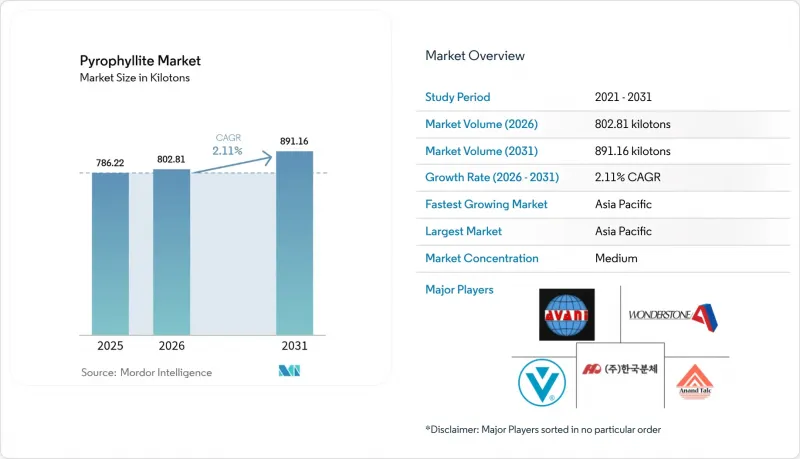
Mordor Intelligence에 의하면, 파이로필라이트 시장 규모는 2025년 786.22 킬로톤으로 평가되었고, 2026년에는 802.81 킬로톤으로 추정되고, 2031년까지 891.16 킬로톤에 이를 것으로 예상되며, 2026-2031년 CAGR 2.11%를 기록할 전망입니다.
본 보고서는 유형별(천연 파이로필라이트 및 기타 유형), 용도별(세라믹, 내화물, 충전재, 유리섬유, 고무 및 지붕재, 비료, 장식용 석재, 기타 용도), 지역별(아시아태평양, 북미, 유럽, 남미, 중동 및 아프리카)로 분류되어 있습니다. 시장 전망은 수량(톤) 단위로 표시됩니다.
세계의 파이로필라이트 시장 동향 및 인사이트
전기 아크 제강 분야의 내화물 수요 증가
전기 아크로는 직접적인 CO2 배출량을 줄이고 100% 스크랩 원료를 사용할 수 있기 때문에 고로 및 산소 전로법을 대체하고 있습니다. 각 용해 공정에서 내화물은 1,600°C의 열충격에 노출되기 때문에 탭홀, 래디, 랜더용 벽돌에는 극히 낮은 열팽창률, 뛰어난 슬래그 내성, 안정적인 알루미나·실리카 네트워크를 특징으로 하는 파이롤파이트 결합제가 점점 더 많이 채택되고 있습니다. 전 세계 전기 아크로(EAF)에 대한 설비 투자액은 2024년 6억 7,000만 달러에서 증가하여,연평균 성장률(CAGR) 11%로 2032년에는 12억 7,000만 달러에 달할 전망이며, 이는 내화물용 파이로필라이트 수요 증가와 직결됩니다. RHI 마그네시타에 의한 10억 달러 규모의 인수 열풍은 이러한 수요 증가에 대비한 광석 공급을 확보하기 위한 것이며, 한편 중국의 마그네사이트 수출 규제가 시행된다면 알루미나·규산염계 대체재의 적용 범위가 더욱 확대될 것입니다.
두꺼운 코팅층을 필요로 하는 산업용 코팅용 경량 광물 필러
해상 풍력 터빈 타워, LNG 탱크 및 해양 구조물에는 질량을 늘리지 않으면서 내식성을 발휘하는 두꺼운 코팅이 필요합니다. 파이로필라이트의 판상 결정 형태와 1.58의 굴절률은 더 적은 배합량으로도 탈크와 동등한 은폐력을 발휘하여, 1회 도장으로 400-600μm의 건조 도막 두께를 실현합니다. 또한, 2024년에 이산화티타늄(TiO₂) 가격이 40% 급등함에 따라 북미 및 유럽의 배합 기술자들도 이 광물을 이산화티타늄의 대체재로 채택하고 있습니다. 유리 섬유 제조업체들은 E-글라스 배치에 파이롤파이트를 혼합함으로써 용융 온도를 30-50°C 낮추고 있습니다. 이를 통해 천연가스 사용량을 줄일 수 있어 탈탄소화 목표에도 부합합니다. 이러한 요인들로 인해, 주로 2026년부터 2028년에 걸쳐 예측 연평균 성장률(CAGR)이 0.3포인트 상승할 전망입니다. 한편, 각 도료 제조업체들은 새로운 마스터배치의 도입을 추진하고 있습니다.
풍부한 대체 광물 : 활석, 카올린, 장석
탈크, 카올린, 장석은 필로필라이트와 최종 용도의 약 80%를 공유하며, 수백만 톤 규모의 규모의 경제를 누리고 있습니다. 카올린의 매출액은 조지아주, 콘월, 장쑤성에서의 저비용 채굴에 힘입어 2024년 48억 5,000만 달러에서 2030년까지 66억 7,000만 달러로 증가할 것으로 전망됩니다. 탈크는 계속해서 폴리머 및 종이의 표준 충전제로 사용되고 있는 반면, 장석은 여전히 가장 저렴한 세라믹용 플럭스입니다. 이러한 대체재가 존재하기 때문에 성능 요건이 허용하는 한 구매자들이 대체재를 채택함에 따라 파이로필라이트의 연평균 성장률(CAGR)은 0.4% 하락하고 있습니다.
부문 분석
2025년 총 공급량의 86.65%는 천연 등급이 차지했지만, 선광 처리된 및 합성 제품은 2031년까지 2.71%의 성장률을 기록하고 있습니다. 킹스 마운틴 및 오토스달산 천연 원료는 세라믹,내화물 및 충전재 용도로 톤당 200-350달러에 판매되고 있으나, 배터리 및 화장품 분야의 구매자들은 Fe₂O₃ 함량이 0.05% 미만으로 침출 처리된 농축물을 요구하고 있으며, 그 가격은 800-1,200달러입니다. QuantumScape사는 알루미나 함량에 대해 ±0.02%의 허용 오차를 규정하고 있으며, 이는 천연 광석과 합성 광석 모두를 대상으로 하는 부유 및 산 침출 공정을 결합해야만 달성할 수 있습니다.
하이브리드 처리를 통해 제품의 분류가 재정의되고 있습니다. 노스캐롤라이나주의 생산자는 소성 전에 자력 분리 공정을 추가하고 있는 반면, 일본의 상사는 화장품 용도로 분말에 실란계 화합물을 이용한 표면 처리를 하고 있습니다. 이러한 전환으로 인해 천연 광석이 수량 면에서 1위를 유지하고 있더라도 수익 구조는 변화하고 있습니다. 파이롤라파이트 시장에서는 합성 제품이 천연 제품보다 3-5배 높은 가격을 책정할 수 있는 것으로 보고되고 있으며, 이것이 가공업체들의 침출 및 소성 설비에 대한 설비 투자를 뒷받침하고 있습니다.
지역별 분석
아시아태평양은 2025년 소비량의 75.62%를 차지했으며, 2031년까지 연평균 2.78%의 속도로 확대될 전망입니다. 랴오닝성의 중국 채굴 및 내화물 연계 생태계가 그 수요의 대부분을 뒷받침하고 있으며, 인도의 세라믹 및 충전재 부문이 추가 수요를 견인하고 있습니다. 일본과 한국은 첨단 세라믹 및 분리기 연구 개발을 위해 철분 함량이 낮은 노스캐롤라이나산 정광을 톤당 600-900달러에 수입하고 있습니다.
2025년에는 노스캐롤라이나주의 두 사업 거점이 미국의 철강 제조업체 및 도료 제조업체에 공급을 하고 있었기 때문에 북미가 큰 시장 점유율을 차지했습니다. ‘인플레이션 억제법(Inflation Reduction Act)’에 따른 인센티브로 인해 2030년까지 국내 전기 아크로(EAF)를 통한 철강 생산량은 15-20% 증가할 것으로 예상되며, 이에 따라 해당 지역의 파이롤라파이트 수요도 증가할 것입니다. 유럽에서는 시장이 완만하게 성장하고 있으며, 독일과 스웨덴의 수소 용광로 시범 프로젝트가 새로운 저알칼리 내화물 수요를 불러일으키고 있습니다. 남유럽에서는 이탈리아와 스페인에 세라믹 분야 고객이 여전히 존재하는 반면, 북유럽의 해상 풍력 발전에 대한 투자가 코팅용 충전재 수요를 뒷받침하고 있습니다.
남미는 물론 중동 및 아프리카에서도 시장이 확대되고 있습니다. 남아프리카공화국의 생산량 대부분은 수출 시장용이지만, 철도 및 에너지 제약으로 인해 공급량에는 한계가 있습니다. 2010년 희토류 조치와 유사한 중국의 수출 할당제가 도입된다면, 구매자들은 노스캐롤라이나주나 남아프리카공화국으로 구매처를 전환할 것입니다. 인허가 절차의 지연을 고려할 때, 2031년까지 아시아태평양의 점유율이 70% 아래로 떨어질 가능성은 낮다고 볼 수 있습니다.
기타 혜택 :
- 엑셀 형식 시장 예측(ME) 시트
- 3개월간의 애널리스트 지원
자주 묻는 질문
목차
제1장 서론
제2장 조사 방법
제3장 주요 요약
제4장 시장 구도
제5장 시장 규모 및 성장 예측
제6장 경쟁 구도
제7장 시장 기회 및 향후 전망
AJY 26.09.09According to Mordor Intelligence, the pyrophyllite market size is expected to increase from 786.22 kilotons in 2025 to 802.81 kilotons in 2026 and reach 891.16 kilotons by 2031, growing at a CAGR of 2.11% over 2026-2031.
This report is Segmented by Type (Natural Pyrophyllite and Other Types), Application (Ceramics, Refractory, Filler Materials, Fiberglass, Rubber and Roofing, Fertilizers, Ornamental Stones, and Other Applications), and Geography (Asia-Pacific, North America, Europe, South America, and Middle East and Africa). Market Forecasts are Provided in Terms of Volume (Tons).
Global Pyrophyllite Market Trends and Insights
Rising Refractory Demand in Electric-Arc Steelmaking
Electric-arc furnaces displace blast-oxygen routes because they cut direct CO2 emissions and accept 100% scrap feedstocks. Every heat subjects refractories to 1,600 °C thermal shock, so tap-hole, ladle, and launder bricks increasingly rely on pyrophyllite binders that exhibit very low thermal expansion, excellent slag resistance, and stable alumina-silica networks. Global EAF capital spending rose from USD 670 million in 2024 and is slated to hit USD 1.27 billion by 2032 at an 11% CAGR, which feeds directly into refractory-grade pyrophyllite absorption. RHI Magnesita's USD 1 billion acquisition spree locks in ore supply for this wave, while any Chinese export restriction on magnesite would widen the application window for alumina-silicate alternatives.
Lightweight Mineral Fillers for High-Build Industrial Coatings
Offshore wind-turbine towers, LNG tanks, and marine structures need thick coatings that resist corrosion without adding mass. Pyrophyllite's platy habit and 1.58 refractive index deliver hiding power equivalent to talc at lower loading, enabling 400-600 μm dry-film thickness in one pass. North American and European formulators also substitute the mineral for titanium dioxide after 2024's 40% TiO2 price spike. Fiberglass manufacturers mix pyrophyllite into E-glass batches to lower the melting temperature by 30-50 °C, which trims natural-gas use and aligns with decarbonization goals. These factors add 0.3 percentage points to the forecast CAGR, mainly in 2026-2028, while paint lines qualify new masterbatches.
Abundant Substitute Minerals: Talc, Kaolin, Feldspar
Talc, kaolin, and feldspar serve roughly 80% of the same end uses and benefit from multi-million-ton economies of scale. Kaolin sales should climb from USD 4.85 billion in 2024 to USD 6.67 billion by 2030, bolstered by low-cost mining in Georgia, Cornwall, and Jiangsu. Talc continues as the default filler for polymers and paper, while feldspar remains the cheapest ceramic flux. These options shave 0.4 percentage points off pyrophyllite's CAGR as buyers substitute whenever performance requirements allow.
Other drivers and restraints analyzed in the detailed report include:
- Shift from Talc to Pyrophyllite in Cosmetics Amid Asbestos Litigation
- Solid-State Battery Ceramic Separators Needing High-Purity Al-Si Feedstocks
- Scarcity of Low-Iron, High-Al2O3 Ore Bodies
For complete list of drivers and restraints, kindly check the Table Of Contents.
Segment Analysis
Natural grades supplied 86.65% of 2025 tonnage, yet beneficiated and synthetic options are logging a 2.71% expansion through 2031. Natural feedstocks from Kings Mountain and Ottosdal sell at USD 200-350 per ton for ceramics, refractories, and filler uses, while battery and cosmetics buyers demand concentrates leached to <0.05% Fe2O3 that fetch USD 800-1,200. QuantumScape specifies +-0.02% tolerance on alumina, achievable only by flotation plus acid-leach routes that straddle natural and synthetic classes.
Hybrid processing is redefining product taxonomy. North Carolina producers are adding magnetic separation before calcination, while Japanese traders surface-treat powders with silanes for cosmetics. This migration shifts revenue even if natural ore retains volume leadership. The pyrophyllite market reports that synthetics can command three to five times natural pricing, supporting processors' capital spending on leach and calcine assets.
Complete Report Scope:
- By Type
- Natural Pyrophyllite
- Other Types
- By Application
- Ceramics
- Refractory
- Filler Materials (Paper, Paints, Insecticides)
- Fiberglass
- Rubber and Roofing
- Fertilizers (Soil Conditioners)
- Ornamental Stones
- Other Applications
- By Geography
- Asia-Pacific
- China
- India
- Japan
- South Korea
- Malaysia
- Thailand
- Indonesia
- Vietnam
- Rest of Asia-Pacific
- North America
- United States
- Canada
- Mexico
- Europe
- Germany
- United Kingdom
- France
- Italy
- Spain
- Nordic Countries
- Turkey
- Russia
- Rest of Europe
- South America
- Brazil
- Argentina
- Colombia
- Rest of South America
- Middle-East and Africa
- Saudi Arabia
- United Arab Emirates
- Qatar
- Egypt
- Nigeria
- South Africa
- Rest of Middle-East and Africa
- Asia-Pacific
Geography Analysis
Asia-Pacific possessed 75.62% of 2025 consumption and will advance at 2.78% to 2031. China's coupled mining-refractory ecosystem in Liaoning underpins most of that demand, and India's ceramics and filler sectors add further pull. Japan and South Korea import low-iron North Carolina concentrates at USD 600-900 per ton for advanced ceramics and separator research and development.
North America accounted for a significant market share in 2025 as two North Carolina operations feed U.S. steelmakers and coatings formulators. Inflation Reduction Act incentives should lift domestic EAF steel output 15-20% by 2030, nudging regional pyrophyllite uptake. Europe is witnessing moderate market growth, with Germany's and Sweden's hydrogen-furnace pilots sparking new low-alkali refractory demand. Southern Europe retains ceramics customers in Italy and Spain, while Nordic offshore-wind investments push coating fillers.
South America, plus the Middle East and Africa, are witnessing an expansion of the market. South African production goes mostly to export markets, but rail and energy constraints cap quantum. Any Chinese export quota, similar to the 2010 rare-earth move, would reroute buyers toward North Carolina and South Africa. Given permitting lags, Asia-Pacific is unlikely to drop below 70% share by 2031.
- Anand Talc
- Avani Group
- Hankook Mineral Powder Co. Ltd.
- Hebei Yayang Spodumene Co., Ltd.
- Idwala Industrial Holdings
- Jinhae Pyrophyllite
- Liaoyuan Pharmaceutical Co., Ltd.
- NINGBO INNO PHARMCHEM CO., LTD.
- PT Gunung Bale
- R.T. Vanderbilt Holding Company, Inc.
- RHI Magnesita
- SAMIROCK Company
- SEPRA
- SKKU Minerals
- Wonderstone
Additional Benefits:
- The market estimate (ME) sheet in Excel format
- 3 months of analyst support
TABLE OF CONTENTS
1 Introduction
- 1.1 Study Assumptions and Market Definition
- 1.2 Scope of the Study
2 Research Methodology
3 Executive Summary
4 Market Landscape
- 4.1 Market Overview
- 4.2 Market Drivers
- 4.2.1 Rising refractory demand in electric-arc steelmaking
- 4.2.2 Light-weight mineral fillers for high-build industrial coatings
- 4.2.3 Shift from talc to pyrophyllite in cosmetics amid asbestos litigation
- 4.2.4 Solid-state-battery ceramic separators needing high-purity Al-Si feedstocks
- 4.2.5 Low-alkali grades enabling hydrogen furnace refractories
- 4.3 Market Restraints
- 4.3.1 Abundant substitute minerals: talc, kaolin, feldspar
- 4.3.2 Scarcity of low-iron, high-Al2O3 ore bodies
- 4.3.3 High-energy intensity of fine-grinding and flotation circuit upgrades
- 4.4 Value Chain Analysis
- 4.5 Porter's Five Forces
- 4.5.1 Threat of New Entrants
- 4.5.2 Bargaining Power of Buyers
- 4.5.3 Bargaining Power of Suppliers
- 4.5.4 Threat of Substitute Products
- 4.5.5 Degree of Competition
5 Market Size and Growth Forecasts (Volume)
- 5.1 By Type
- 5.1.1 Natural Pyrophyllite
- 5.1.2 Other Types
- 5.2 By Application
- 5.2.1 Ceramics
- 5.2.2 Refractory
- 5.2.3 Filler Materials (Paper, Paints, Insecticides)
- 5.2.4 Fiberglass
- 5.2.5 Rubber and Roofing
- 5.2.6 Fertilizers (Soil Conditioners)
- 5.2.7 Ornamental Stones
- 5.2.8 Other Applications
- 5.3 By Geography
- 5.3.1 Asia-Pacific
- 5.3.1.1 China
- 5.3.1.2 India
- 5.3.1.3 Japan
- 5.3.1.4 South Korea
- 5.3.1.5 Malaysia
- 5.3.1.6 Thailand
- 5.3.1.7 Indonesia
- 5.3.1.8 Vietnam
- 5.3.1.9 Rest of Asia-Pacific
- 5.3.2 North America
- 5.3.2.1 United States
- 5.3.2.2 Canada
- 5.3.2.3 Mexico
- 5.3.3 Europe
- 5.3.3.1 Germany
- 5.3.3.2 United Kingdom
- 5.3.3.3 France
- 5.3.3.4 Italy
- 5.3.3.5 Spain
- 5.3.3.6 Nordic Countries
- 5.3.3.7 Turkey
- 5.3.3.8 Russia
- 5.3.3.9 Rest of Europe
- 5.3.4 South America
- 5.3.4.1 Brazil
- 5.3.4.2 Argentina
- 5.3.4.3 Colombia
- 5.3.4.4 Rest of South America
- 5.3.5 Middle-East and Africa
- 5.3.5.1 Saudi Arabia
- 5.3.5.2 United Arab Emirates
- 5.3.5.3 Qatar
- 5.3.5.4 Egypt
- 5.3.5.5 Nigeria
- 5.3.5.6 South Africa
- 5.3.5.7 Rest of Middle-East and Africa
- 5.3.1 Asia-Pacific
6 Competitive Landscape
- 6.1 Market Concentration
- 6.2 Strategic Moves
- 6.3 Market Share(%)/Ranking Analysis
- 6.4 Company Profiles (includes Global Overview, Market Overview, Core Segments, Financials, Strategic Information, Products and Services, Recent Developments)
- 6.4.1 Anand Talc
- 6.4.2 Avani Group
- 6.4.3 Hankook Mineral Powder Co. Ltd.
- 6.4.4 Hebei Yayang Spodumene Co., Ltd.
- 6.4.5 Idwala Industrial Holdings
- 6.4.6 Jinhae Pyrophyllite
- 6.4.7 Liaoyuan Pharmaceutical Co., Ltd.
- 6.4.8 NINGBO INNO PHARMCHEM CO., LTD.
- 6.4.9 PT Gunung Bale
- 6.4.10 R.T. Vanderbilt Holding Company, Inc.
- 6.4.11 RHI Magnesita
- 6.4.12 SAMIROCK Company
- 6.4.13 SEPRA
- 6.4.14 SKKU Minerals
- 6.4.15 Wonderstone
7 Market Opportunities and Future Outlook
- 7.1 White-space and Unmet-need Assessment