
|
시장보고서
상품코드
2124157
에어로졸 밸브 시장 : 점유율 분석, 업계 동향과 통계, 성장 예측(2026-2031년)Aerosol Valve - Market Share Analysis, Industry Trends & Statistics, Growth Forecasts (2026 - 2031) |
||||||
 Mordor Intelligence
Mordor Intelligence에 의하면, 에어로졸 밸브 시장 규모는 2025년 19억 3,000만 달러에서 2026년에는 20억 달러로 확대되어 2026년부터 2031년까지 CAGR 3.42%로 성장을 지속하여, 2031년까지 23억 6,000만 달러에 이를 것으로 예측됩니다.

본 보고서는 유형별(연속식 밸브, 정량식 밸브, 백-온-밸브), 재질별(알루미늄, 양철, 스테인리스 스틸, 플라스틱, 기타), 구성 부품별(하우징, 스템,스프링, 딥 튜브, 컵, 개스킷), 최종 사용자 산업별(퍼스널케어, 홈 케어, 헬스케어, 자동차·산업용, 기타) 및 지역별로 분류되어 있습니다. 시장 전망은 금액(달러) 기준으로 제시되어 있습니다.
세계 에어로졸 밸브 시장 동향 및 인사이트
화장품 및 퍼스널케어 분야의 활발한 수요
각 뷰티 브랜드는 균일한 미세 입자 분사와 정확한 도포가 요구되는 드라이 샴푸, 세팅 스프레이, 텍스처링 미스트 등의 제품을 라인업에 추가하고 있습니다. 소셜 미디어의 영향을 받은 ‘디지털 뷰티’ 고객들은 에어로졸 밸브가 구현하는 부드럽고 정밀한 분사를 중요하게 생각합니다. 밸브 공급업체들은 맞춤형 액추에이터 형태와 천연 성분이 함유된 제품에 대한 적합성 테스트를 통해 이에 대응하고 있으며, 퍼스널케어 브랜드들이 치열한 매장 경쟁에서 차별화를 꾀할 수 있도록 지원하고 있습니다.
의료 분야에서의 에어로졸 제품 도입 가속화
천식 및 만성폐쇄성폐질환(COPD) 유병률 증가에 따라, 전 세계적으로 정량 흡입기의 사용량이 증가하고 있습니다. 미국 환경보호청(EPA)은 흡입기에 사용되는 HFC-134a 및 HFC-227ea 추진제의 양이 2025년까지 1,595미터톤에 달할 것으로 예측했습니다. 이와 동시에, 병원 및 공공시설에서의 소독용 에어로졸 수요는 팬데믹 이전 수준을 계속해서 상회하고 있습니다. 이러한 의료 용도에서는 투여량의 정확성과 의약품 등급의 소재가 요구되므로, 밸브 제조업체는 높은 이익률을 확보할 수 있습니다.
엄격한 VOC 및 추진제 규제
2025년 1월에 개정된 미국의 에어로졸 및 코팅 규제는 제품 중량에 따른 반응성 한계치를 더욱 엄격하게 설정하고 보고 범위를 확대함에 따라, 각 브랜드는 제품의 재조성을 강요받거나 시장에서 철수해야 하는 상황에 몰리고 있습니다(epa.gov). 캘리포니아주 대기자원국(CARB)은 일일 VOC 감축 목표를 시행하고 있어, 이로 인해 규정 준수 비용이 증가하고 있습니다. 추진제의 기술 혁신은 진행되고 있으나, 중소기업은 제품 출시 지연 및 연구개발비 증가에 직면해 있습니다.
부문 분석
2025년, 에어로졸 밸브 시장에서 연속식 밸브는 고속 생산 라인과의 호환성과 매력적인 단가 경제성 덕분에 시장의 76.10%를 차지했습니다. 이들은 저비용과 견고한 내구성이 중시되는 대중 시장을 겨냥한 세정제, 윤활제, 도료용 첨가제 분야에서 압도적인 점유율을 차지하고 있습니다. 에어로졸 밸브 시장에서는 여전히 연속식이 판매량의 대부분을 차지하고 있지만, 안전성과 환경에 대한 기대가 높아짐에 따라 사용 후 플라스틱을 원료로 한 플라스틱 오버캡의 채택 등 설계상의 미세 조정이 진행되고 있습니다.
한편, 백-온-밸브(Bag-on-Valve) 기술은 4.50%라는 가장 높은 연평균 성장률(CAGR)을 기록하고 있습니다. 브랜드 소유주들은 추진제 감축을 통해 수명 주기 배출량이 감소하고, 의료용 스프레이나 프리미엄 자외선 차단제에 필수적인 360도 방향에서의 사용이 가능해지기 때문에 부품 비용 상승을 수용하고 있습니다. 이 하위 부문은 유럽의 에코디자인 규정과 미국 소매업체들이 채택하고 있는 재활용 소재 함유율 평가 기준의 혜택을 받고 있습니다. 채용이 확대됨에 따라, 백-온-밸브 어셈블리의 에어로졸 밸브 시장 규모는 2026년부터 2031년까지 현저히 확대될 전망입니다.
알루미늄은 뛰어난 차단 성능과 확립된 재활용 주기 덕분에 2025년 에어로졸 밸브 시장 점유율의 45.20%를 차지했습니다. 고압 흡입기나 자동차용 클리너에는 여전히 필수적인 소재입니다. 그럼에도 불구하고, 가공업체들이 더 높은 압력을 견딜 수 있는 다층 구조나 코팅이 적용된 PET 하우징을 개발하고 있어, 에어로졸 밸브 시장에서 플라스틱의 점유율은 연평균 4.56%의 속도로 확대되고 있습니다. Plastipak사의 ‘SprayPET Revolution’은 금속을 일절 사용하지 않는 폴리머 용기로, 완전한 재활용성을 유지하면서 경량화와 탄소 발자국 감소를 실현하고 있습니다.
선도적인 기업들은 소비자의 ‘투명성’에 대한 요구에 부응하여, 충전량을 한눈에 파악할 수 있는 투명한 하우징을 선보이고 있습니다. 하지만 산소 투과율을 극도로 낮게 유지해야 하는 분야에서는 알루미늄이 여전히 우위를 점하고 있습니다. 알루미늄 부품이 적용된 에어로졸 밸브 시장 규모는 성장률이 둔화되더라도 계속 확대될 전망인 반면, 플라스틱의 점유율 확대는 비용 효율성을 중시하는 퍼스널케어 및 홈 케어 제품에 의해 주도될 것입니다.
지역별 분석
유럽은 저VOC 및 재활용 가능한 포장을 장려하는 ‘그린 딜(Green Deal)’ 지침에 힘입어 2025년 매출의 32.60%를 차지했습니다. 각 제조업체는 지역 밀착형 연구 개발을 활용하여 백 온 밸브(bag-on-valve) 방식의 데오도란트와 경량 알루미늄 용기를 시장에 출시하고 있습니다. 소노코(Sonoco)사의 에비오시스(Evioss)사 인수는 현지 조달을 요구하는 유럽 브랜드에 대한 공급 안정성을 강화하고 있습니다. 지속적인 퍼스널케어 제품 소비와 선진적인 의약품 생산이 이 지역의 기반을 형성하고 있습니다.
아시아태평양은 연평균 성장률(CAGR) 4.61%로 가장 빠르게 성장하고 있는 지역입니다. 중국은 대규모 제조 능력을 제공하고, 일본과 한국은 첨단 엔지니어링 기술을 더하며, 동남아시아는 소비를 확대되고 있습니다. 현지 기업들은 수출 규제에 대응하기 위해 생산 라인을 업그레이드하고 있으며, 프리미엄 부문으로의 지역적 진출을 확대되고 있습니다. 또한 의료 인프라 구축이 가속화되고 있는 점도 흡입기용 밸브 수요를 뒷받침하여, 해당 지역의 에어로졸 밸브 시장을 확대시키고 있습니다.
북미는 특수 의약품 및 프리미엄 미용 제품에의 응용을 통해 여전히 큰 시장 점유율을 유지하고 있습니다. 혁신은 탄소 발자국 감축에 초점을 맞추고 있으며, 그 대표적인 예로 기존 캔에 비해 배출량을 50% 줄인다고 내세우는 Ball사의 ‘re:gen’ 에어로졸 캔이 있습니다. 공급망의 현지화와 재활용 의무화로 인해 폐쇄형 순환 방식에 따른 알루미늄 조달에 대한 투자가 촉진되고 있습니다. 남미 및 중동 및 아프리카는 아직 뒤처져 있지만, 도시화와 전자상거래의 발전으로 인해 편의성이 높은 스프레이 제품의 1인당 소비량이 증가하고 있어 미래성이 기대되고 있습니다.
기타 혜택:
- 엑셀 형식 시장 예측(ME) 시트
- 3개월간의 애널리스트 지원
자주 묻는 질문
목차
제1장 서론
제2장 조사 방법
제3장 주요 요약
제4장 시장 구도
제5장 시장 규모와 성장 예측
제6장 경쟁 구도
제7장 시장 기회와 향후 동향
JHS 26.09.11According to Mordor Intelligence, the aerosol valve market size is expected to grow from USD 1.93 billion in 2025 to USD 2 billion in 2026 and is forecast to reach USD 2.36 billion by 2031 at 3.42% CAGR over 2026-2031.
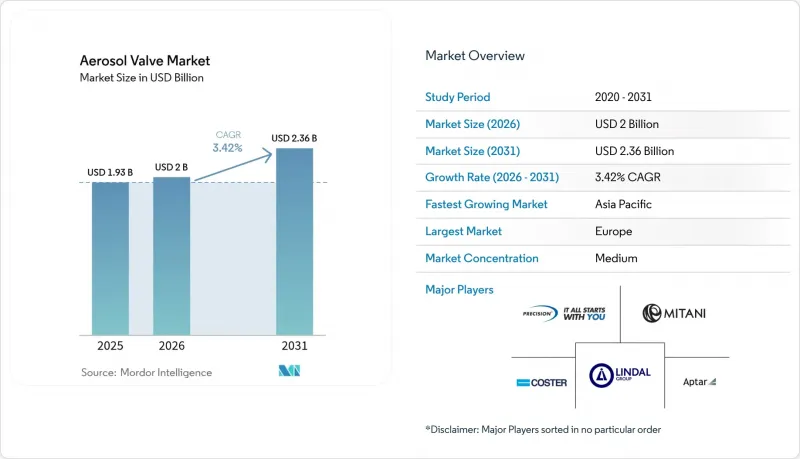
This report is Segmented by Type (Continuous Valve, Metered Valve, Bag-On-Valve), Material (Aluminum, Tinplate Steel, Stainless Steel, Plastic, Others), Component (Housing, Stem, Spring, Dip Tube, Cup and Gasket), End-User Industry (Personal Care, Home Care, Healthcare, Automotive and Industrial, Others), and Geography. The Market Forecasts are Provided in Terms of Value (USD).
Global Aerosol Valve Market Trends and Insights
Strong demand from cosmetics and personal care
Beauty brands are adding dry shampoos, setting sprays, and texturizing mists that need consistent particulate delivery and precise coverage. The social-media-influenced "digital beauty" customer values sleek, controlled dispensing, which aerosol valves provide. Valve suppliers are responding with custom actuator shapes and compatibility testing for natural formulations, helping personal care labels differentiate in crowded shelves.
Healthcare aerosol adoption acceleration
Global use of metered-dose inhalers is climbing alongside rising asthma and COPD incidence. The United States Environmental Protection Agency projects HFC-134a and HFC-227ea propellant use in inhalers reaching 1,595 metric tons by 2025. Parallel demand for disinfectant aerosols remains above pre-pandemic baselines in hospitals and public venues. These medical applications require dose accuracy and pharmaceutical-grade materials, allowing valve makers to capture premium margins.
Stringent VOC and propellant regulations
The January 2025 update to U.S. aerosol-coating rules tightened product-weighted reactivity limits and broadened reporting, pushing brands to reformulate or exit the market epa.gov. California's CARB enforces daily VOC reduction targets that elevate compliance costs. While propellant innovation is advancing, smaller firms face delayed launches and higher R&D outlays.
Other drivers and restraints analyzed in the detailed report include:
- Bag-on-valve technology momentum
- E-commerce private-label proliferation
- Alternative dispensing competition
For complete list of drivers and restraints, kindly check the Table Of Contents.
Segment Analysis
Continuous valves accounted for 76.10% of the aerosol valve market in 2025 due to high-speed line compatibility and attractive unit economics. They dominate mass-market cleaners, lubricants, and paint enhancers that reward low cost and robust durability. The aerosol valve market still relies on continuous formats for the bulk of volume, but safety and environmental expectations are nudging design tweaks such as plastic over-caps molded from post-consumer resin.
Bag-on-valve technology, however, posts the fastest 4.50% CAGR. Brand owners accept higher component costs because propellant reductions lower lifecycle emissions and enable 360-degree usage, essential for medical sprays and premium sunscreens. This subsegment benefits Europe's eco-design rules and U.S. retailers' recyclable-content scorecards. As adoption widens, the aerosol valve market size for bag-on-valve assemblies is on course to accelerate notably between 2026 and 2031.
Aluminum held 45.20% of aerosol valve market share in 2025 thanks to excellent barrier performance and an established recycling loop. It remains indispensable for high-pressure inhalers and automotive cleaners. The aerosol valve market nonetheless witnesses plastics growing 4.56% per year as processors develop multi-layer and coated PET housings that tolerate higher pressure. Plastipak's SprayPET Revolution, a metal-free polymer can, cuts weight and carbon footprint while staying fully recyclable.
First movers showcase transparent housings that reveal fill levels, aligning with consumer openness trends. Still, aluminum keeps an edge where oxygen transmission rates must stay extremely low. The aerosol valve market size for aluminum components will continue growing albeit slower, whereas plastic's share rise will stem from cost-sensitive personal and home-care SKUs.
Complete Report Scope:
- By Type
- Continuous Valve
- Metered Valve
- Bag-on-Valve
- By Material
- Aluminum
- Tinplate Steel
- Stainless Steel
- Plastic
- Others
- By Component
- Housing
- Stem
- Spring
- Dip Tube
- Cup and Gasket
- By End-User Industry
- Personal Care
- Home Care
- Healthcare
- Automotive and Industrial
- Others
- By Geography
- North America
- United States
- Canada
- Mexico
- South America
- Brazil
- Argentina
- Rest of South America
- Europe
- Germany
- United Kingdom
- France
- Italy
- Spain
- Russia
- Rest of Europe
- Asia-Pacific
- China
- Japan
- India
- South Korea
- Australia and New Zealand
- Rest of Asia-Pacific
- Middle East and Africa
- Middle East
- Saudi Arabia
- United Arab Emirates
- Turkey
- Rest of Middle East
- Africa
- South Africa
- Nigeria
- Egypt
- Rest of Africa
- Middle East
- North America
Geography Analysis
Europe generated 32.60% of 2025 revenue, underpinned by Green Deal directives that reward low-VOC and recyclable packaging. Producers leverage regional R&D to roll out bag-on-valve deodorants and aluminum-lightweight housings. Sonoco's integration of Eviosys strengthens supply security for European brands seeking local sourcing . Sustained personal-care consumption plus advanced pharma production anchor the region.
Asia-Pacific is the fastest-growing area at a 4.61% CAGR. China supplies scale manufacturing, Japan and South Korea add engineering rigor, and Southeast Asia grows consumption. Local firms upgrade lines to meet export compliance, broadening regional participation in premium segments. Accelerating healthcare infrastructure also fuels inhaler valve demand, enlarging the aerosol valve market in the region.
North America preserves a sizeable share through specialized pharmaceutical and premium beauty applications. Innovation centers on carbon-footprint reduction, exemplified by Ball's re:gen aerosol can that claims a 50% emission cut versus traditional cans. Supply-chain localization and recycling mandates encourage investment in closed-loop aluminum sourcing. South America and the Middle East & Africa trail but show promise as urbanization and e-commerce lift per-capita consumption of convenient spray products.
- AptarGroup Inc.
- Precision Valve Corporation
- Lindal Group Holding GmbH
- Coster Tecnologie Speciali S.p.A.
- Mitani Valve Co., Ltd.
- Summit Packaging Systems, Inc.
- Clayton Corporation
- Newman Green Inc.
- Koh-I-Noor Mlada Vozice a.s.
- Salvalco Ltd.
- Majesty Packaging Systems Limited
- Shanghai Sunhome Industrial Co., Ltd.
- EC Pack Industrial Limited
- C. Ehrensperger AG
- Aroma Industries FZCO
- Seung-il Corporation
- Yingbo Aerosol Valve (Zhongshan) Co., Ltd.
- Guangzhou Zhongpin Aerosol Valves Co., Ltd.
- Maruichi Co., Ltd.
- Weener Plastics Group GmbH
Additional Benefits:
- The market estimate (ME) sheet in Excel format
- 3 months of analyst support
TABLE OF CONTENTS
1 INTRODUCTION
- 1.1 Market Definition and Study Assumptions
- 1.2 Scope of the Study
2 RESEARCH METHODOLOGY
3 EXECUTIVE SUMMARY
4 MARKET LANDSCAPE
- 4.1 Market Overview
- 4.2 Market Drivers
- 4.2.1 Strong demand from cosmetics and personal care
- 4.2.2 Shift toward easy-to-handle packaging
- 4.2.3 Healthcare aerosol adoption (inhalers, disinfectants)
- 4.2.4 Bag-on-valve eco-friendly adoption
- 4.2.5 Automotive aftermarket aerosol surge
- 4.2.6 E-commerce private-label SKU proliferation
- 4.3 Market Restraints
- 4.3.1 Stringent VOC and propellant regulations
- 4.3.2 Alternative dispensing (trigger sprayers, pumps)
- 4.3.3 Specialty steel/spring supply-chain vulnerability
- 4.3.4 High cap-ex for digital serialization compliance
- 4.4 Value / Supply-Chain Analysis
- 4.5 Evaluation of Critical Regulatory Framework
- 4.6 Impact Assessment of Key Stakeholders
- 4.7 Technological Outlook
- 4.8 Porter's Five Forces Analysis
- 4.8.1 Bargaining Power of Suppliers
- 4.8.2 Bargaining Power of Consumers
- 4.8.3 Threat of New Entrants
- 4.8.4 Threat of Substitutes
- 4.8.5 Intensity of Competitive Rivalry
- 4.9 Impact of Macro-economic Factors
5 MARKET SIZE AND GROWTH FORECASTS (VALUE)
- 5.1 By Type
- 5.1.1 Continuous Valve
- 5.1.2 Metered Valve
- 5.1.3 Bag-on-Valve
- 5.2 By Material
- 5.2.1 Aluminum
- 5.2.2 Tinplate Steel
- 5.2.3 Stainless Steel
- 5.2.4 Plastic
- 5.2.5 Others
- 5.3 By Component
- 5.3.1 Housing
- 5.3.2 Stem
- 5.3.3 Spring
- 5.3.4 Dip Tube
- 5.3.5 Cup and Gasket
- 5.4 By End-User Industry
- 5.4.1 Personal Care
- 5.4.2 Home Care
- 5.4.3 Healthcare
- 5.4.4 Automotive and Industrial
- 5.4.5 Others
- 5.5 By Geography
- 5.5.1 North America
- 5.5.1.1 United States
- 5.5.1.2 Canada
- 5.5.1.3 Mexico
- 5.5.2 South America
- 5.5.2.1 Brazil
- 5.5.2.2 Argentina
- 5.5.2.3 Rest of South America
- 5.5.3 Europe
- 5.5.3.1 Germany
- 5.5.3.2 United Kingdom
- 5.5.3.3 France
- 5.5.3.4 Italy
- 5.5.3.5 Spain
- 5.5.3.6 Russia
- 5.5.3.7 Rest of Europe
- 5.5.4 Asia-Pacific
- 5.5.4.1 China
- 5.5.4.2 Japan
- 5.5.4.3 India
- 5.5.4.4 South Korea
- 5.5.4.5 Australia and New Zealand
- 5.5.4.6 Rest of Asia-Pacific
- 5.5.5 Middle East and Africa
- 5.5.5.1 Middle East
- 5.5.5.1.1 Saudi Arabia
- 5.5.5.1.2 United Arab Emirates
- 5.5.5.1.3 Turkey
- 5.5.5.1.4 Rest of Middle East
- 5.5.5.2 Africa
- 5.5.5.2.1 South Africa
- 5.5.5.2.2 Nigeria
- 5.5.5.2.3 Egypt
- 5.5.5.2.4 Rest of Africa
- 5.5.5.1 Middle East
- 5.5.1 North America
6 COMPETITIVE LANDSCAPE
- 6.1 Market Concentration
- 6.2 Strategic Moves
- 6.3 Market Share Analysis
- 6.4 Company Profiles (includes Global level Overview, Market level overview, Core Segments, Financials as available, Strategic Information, Market Rank/Share for key companies, Products and Services, and Recent Developments)
- 6.4.1 AptarGroup Inc.
- 6.4.2 Precision Valve Corporation
- 6.4.3 Lindal Group Holding GmbH
- 6.4.4 Coster Tecnologie Speciali S.p.A.
- 6.4.5 Mitani Valve Co., Ltd.
- 6.4.6 Summit Packaging Systems, Inc.
- 6.4.7 Clayton Corporation
- 6.4.8 Newman Green Inc.
- 6.4.9 Koh-I-Noor Mlada Vozice a.s.
- 6.4.10 Salvalco Ltd.
- 6.4.11 Majesty Packaging Systems Limited
- 6.4.12 Shanghai Sunhome Industrial Co., Ltd.
- 6.4.13 EC Pack Industrial Limited
- 6.4.14 C. Ehrensperger AG
- 6.4.15 Aroma Industries FZCO
- 6.4.16 Seung-il Corporation
- 6.4.17 Yingbo Aerosol Valve (Zhongshan) Co., Ltd.
- 6.4.18 Guangzhou Zhongpin Aerosol Valves Co., Ltd.
- 6.4.19 Maruichi Co., Ltd.
- 6.4.20 Weener Plastics Group GmbH
7 MARKET OPPORTUNITIES AND FUTURE TRENDS
- 7.1 White-space and Unmet-need Assessment