

|
시장보고서
상품코드
2124164
RF 프론트엔드 모듈 시장 : 점유율 분석, 업계 동향과 통계, 성장 예측(2026-2031년)RF Front End Module - Market Share Analysis, Industry Trends & Statistics, Growth Forecasts (2026 - 2031) |
||||||
 Mordor Intelligence
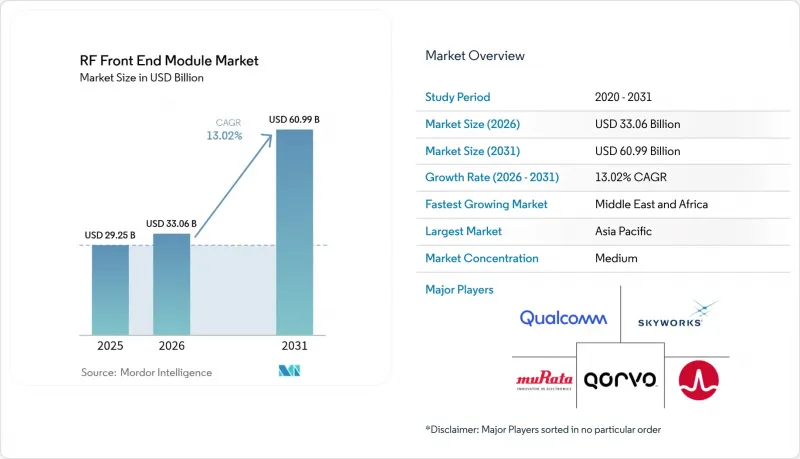
Mordor Intelligence에 의하면, RF 프론트엔드 모듈 시장 규모는 2025년 292억 5,000만 달러에서 2026년에는 330억 6,000만 달러로 확대되어 2026년부터 2031년까지 CAGR 13.02%로 성장을 지속하여, 2031년에는 609억 9,000만 달러에 이를 것으로 예측됩니다.
본 보고서는 구성 요소별(파워 앰프, 듀플렉서 및 다이플렉서, 필터,스위치, 저잡음 증폭기, 안테나 튜너), 용도별(소비자용 전자기기, 자동차, 무선통신, 산업용, 항공우주 및 방위, 기타 용도), 주파수 대역별(6GHz 미만, 기타), 지역별로 분류되어 있습니다. 시장 예측은 금액(달러) 기준으로 제시되어 있습니다.
세계 RF 프론트엔드 모듈 시장 동향 및 인사이트
6GHz 미만 대역 스마트폰에서의 5G 설계 채택 급증
통신 사업자의 서비스 전개에서는 광범위한 커버리지가 우선시되므로, 서브 6GHz 대역이 RF 프론트엔드 모듈 시장의 성장 동력이 되고 있습니다. Samsung Electronics가 SKY5 플랫폼을 채택함으로써 기판 면적을 30% 줄이면서도 배터리 사용 시간을 연장했습니다. 현재 디바이스 제조업체들은 프리미엄 등급을 정의할 때 카메라 화질과 마찬가지로 RF 성능도 평가 기준으로 삼고 있습니다. 제한된 실장 면적, 멀티밴드 캐리어 어그리게이션, 그리고 더욱 엄격해진 SAR 제한으로 인해 디스크리트 구성보다 통합형 FEM이 선호되고 있습니다. 알고리즘을 활용한 엔벨로프 트래킹 기술을 보유한 공급업체들은 전력 효율을 향상시키고 있으며, 이는 지속가능성 목표와도 부합합니다. 그 결과, 각 설계 채택이 생산 규모 확대로 이어지고, 이는 결국 단가 인하로 이어지는 선순환이 형성되고 있습니다.
고정 무선 액세스(FWA) CPE에서의 mm파 급속한 보급
2024년, 버라이즌의 서비스 제공 범위는 4,000만 가구로 확대되어 mm파 FWA의 경제적 타당성이 입증되었습니다. CPE 장치에는 더 큰 안테나가 탑재되기 때문에 1대당 4-8개의 mm파 RF 체인이 내장되어 있으며, 이는 스마트폰의 4배에 해당합니다. 노드당 부품 원가(BOM)가 높기 때문에 생산 대수가 중간 수준이라 하더라도 RF 프론트엔드 모듈 시장은 확대되고 있습니다. 정책 입안자들은 고정 통신 서비스에 우선적으로 주파수 대역을 할당하고 있으며, 이를 통해 간섭 위험이 감소하고 고정 설치형 빔 스티어링 안테나의 도입이 촉진되고 있습니다. 실외 설치형 장비의 방열 대책을 확립한 공급업체는 mmWave PA가 여전히 고가대의 평균 판매 가격(ASP)을 유지하고 있기 때문에 상당한 이익률을 확보할 수 있습니다.
BAW 필터 특허를 둘러싼 임박한 지적 재산권 부족
기반이 되는 BAW 특허의 유효 기간이 임박했음에도 불구하고, 그 이후의 기술 혁신은 정체되어 있습니다.GHz 대역에서 Q-팩터에 대한 리더십을 유지하기 위한 잔여 노하우를 보유한 공급업체는 극소수에 불과하기 때문에 라이선스 비용은 상승하고 있습니다. 새로운 주파수 대역을 추가하려는 OEM은 비싼 라이선스 비용을 지불하거나, 고온 환경에서 성능이 떨어질 가능성이 있는 TC-SAW로 전환하는 것 중 하나를 선택할 수밖에 없습니다. 특허 만료가 임박한 상황은 방어적 소송을 유발하고, 연구 개발 자금을 다른 곳으로 돌리고 있습니다. 신규 진출기업들은 높은 진입 장벽에 직면해 있으며, 이로 인해 기존 기업들의 협상력이 집중되면서 RF 프론트엔드 모듈 시장의 필터 부문에서 가격 하락세가 둔화되고 있습니다.
부문 분석
2025년 시점에서 필터는 RF 프론트엔드 모듈 시장의 33.78% 점유율을 차지하고 있으며, 주파수 대역 확대에 있어 여전히 필수적인 존재입니다. 한편, 안테나 튜너는 세분화된 주파수 대역 전체에 걸친 임피던스 정합이 설계상의 필수 요건이 됨에 따라, 해당 부문에서 가장 높은 연평균 성장률(CAGR) 13.98%로 성장을 지속하고, 있습니다. 하이브리드 FEM의 RF 프론트엔드 모듈 시장 규모는 스위치, LNA, 듀플렉서를 통합함으로써 삽입 손실이 감소하고 열 설계가 단순화되기 때문에 꾸준히 확대될 것으로 예측됩니다. 파워 앰프의 경우, 각 OEM 업체들이 컨트롤러와 번들로 판매함에 따라 평균 판매 가격(ASP) 하락에 직면하고 있지만, GaN 공정을 통해 고출력 틈새 시장에서 수익성은 유지되고 있습니다. 스위치는 캐리어 어그리게이션에 따른 안정적인 수요에 힘입어, 특히 미드밴드 단말기에서 3-CC 다운링크가 주류가 됨에 따라 그 수요가 증가하고 있습니다.
저잡음 증폭기(LNA)는 수신 감도가 피크 데이터 속도보다 더 중요하게 여겨지는 지방 지역의 통신 범위 확대 노력에 힘입어 성장하고 있습니다. 디스크리트형 듀플렉서는 레거시 LTE 대역에서는 여전히 중요하지만, 차세대 시분할 다중 접속(TDD) 방식의 도입으로 인해 특정 5G 주파수 대역에서의 탑재율은 감소하고 있습니다. Qorvo의 2024년 FEM 제품 라인은 기존 디스크리트 구성에 비해 PCB 실적를 40% 줄였으며, 폼 팩터의 우위가 단순한 부품 성능을 대체할 수 있음을 여실히 보여주고 있습니다. 그 결과, 부품 공급업체들은 기능당 모듈 수준 비용을 중시하는 OEM의 조달 전략에 맞추어 고도로 집적된 SIP를 우선시하도록 로드맵을 재검토하고 있습니다.
지역별 분석
아시아태평양은 중국의 휴대폰 생산 대수와 한국의 밀집된 5G 인프라 구축에 힘입어 2025년 RF 프론트엔드 모듈 시장에서 56.88%의 점유율을 유지했습니다. 갈륨 정제, 웨이퍼 제조, 모듈 조립을 아우르는 통합된 공급망을 통해 다른 지역에서는 찾아볼 수 없는 비용 및 리드타임 우위를 실현하고 있습니다. 일본의 10조 달러 규모의 반도체 프로그램은 지역 생태계의 회복력을 강화하고, 화합물 반도체 파일럿 라인에 자금을 지원하고 있습니다.
북미는 국방 예산과 5G의 조기 도입을 활용하여 고성능 설계 분야에서 리더십을 유지하고 있습니다. MACOM의 3억 4,500만 달러 규모의 GaN 사업 확장은 아시아와의 제조 격차를 해소하기 위한 여러 첨단 패키징 이니셔티브에 합류합니다. 그러나 소비자용 디바이스 생산량 측면에서는 여전히 부품 수입이 주류를 이루고 있어, OEM 각사는 국경을 넘는 물류 위험에 노출되어 있습니다.
중동 및 아프리카에서는 통신 사업자들이 4G를 건너뛰고 독립형 5G로 전환함에 따라 연평균 성장률(CAGR)이 13.95%로 성장을 지속하고, 있습니다. 정부의 디지털 경제 전략에 따라 통신 타워 및 주파수 대역에 자금이 투입되고 있지만, 단말기의 가격 경쟁력이 6GHz 미만 주파수 대역에 대한 집중 투자를 결정짓고 있습니다. 유럽에서는 자동차 업계와 인더스트리 4.0 수요가 견조하며, GDPR(EU 개인정보보호규정) 및 공급망 주권 확보의 관점에서 각 브랜드는 현지 조달을 강요받고 있습니다. 남미 및 아세안(ASEAN) 신흥 시장에서는 공급업체들이 미개척 가입자 수 증가를 추구하는 가운데 기술 이전이 진행되고 있습니다.
기타 혜택:
- 엑셀 형식 시장 예측(ME) 시트
- 3개월간의 애널리스트 지원
자주 묻는 질문
목차
제1장 서론
제2장 조사 방법
제3장 주요 요약
제4장 시장 구도
제5장 시장 규모와 성장 예측
제6장 경쟁 구도
제7장 시장 기회와 향후 전망
JHS 26.09.11According to Mordor Intelligence, the RF front-end module market size is expected to grow from USD 29.25 billion in 2025 to USD 33.06 billion in 2026 and is forecast to reach USD 60.99 billion by 2031 at 13.02% CAGR over 2026-2031.
This report is Segmented by Component (Power Amplifiers, Duplexers and Diplexers, Filters, Switches, Low-Noise Amplifiers, and Antenna Tuners), Application (Consumer Electronics, Automotive, Wireless Communication, Industrial, Aerospace and Defense, and Other Applications), Frequency Range (Sub-6 GHz, and More), and Geography. The Market Forecasts are Provided in Terms of Value (USD).
Global RF Front End Module Market Trends and Insights
Explosive 5G Design-Wins in Sub-6 GHz Smartphones
Carrier rollouts prioritize blanket coverage, making sub-6 GHz the volume engine for the RF front end module market. Samsung's adoption of the SKY5 platform trimmed board area by 30% while boosting battery endurance. Device makers now rate RF performance alongside camera quality when defining premium tiers. Tight footprints, multi-band carrier aggregation, and stricter SAR limits favor consolidated FEMs over discrete chains. Suppliers with algorithm-assisted envelope tracking add power efficiency, a point that resonates with sustainability targets. The result is a virtuous cycle in which every design win feeds production scale that, in turn, lowers per-unit cost.
Rapid mmWave Adoption in Fixed-Wireless Access (FWA) CPE
Verizon's service footprint grew to 40 million homes in 2024, confirming the economic logic of mmWave FWA. CPE devices accept bigger antennas, so each install embeds four to eight mmWave RF chains-up to 4X the smartphone content. Higher bill-of-materials value per node lifts the RF front end module market even with moderate unit volumes. Policy makers allocate spectrum preferentially to fixed services, reducing interference risk and facilitating beam-steering antennas that remain stationary. Suppliers that master thermal dissipation in outdoor units secure sizable margins, because mmWave PAs still command premium ASPs.
Looming IP Shortages for BAW Filter Patents
Foundational BAW patents near expiry, yet follow-on innovations have plateaued. Few suppliers hold the residual know-how for GHz-range Q-factor leadership, so licensing fees climb. OEMs trying to add new bands must either pay premiums or switch to TC-SAW, which can underperform in high-temperature use. Patent cliffs motivate defensive litigation that diverts R&D funds. Smaller entrants face high barriers, concentrating bargaining power with incumbents and slowing price erosion in the filter slice of the RF front end module market.
Other drivers and restraints analyzed in the detailed report include:
- OEM Push for Integrated Modem-to-Antenna Platforms
- GaAs Wafer Capacity Expansion in Taiwan and China
- Tight Gallium Supply Chain Amid Export Restrictions
For complete list of drivers and restraints, kindly check the Table Of Contents.
Segment Analysis
Filters controlled a 33.78% share of the RF front-end module market in 2025 and remain indispensable for band proliferation. Antenna tuners, however, post a category-leading 13.98% CAGR as impedance-matching across a fragmented spectrum turns into a design must-have. The RF front-end module market size for hybrid FEMs is projected to climb steadily because integrating switches, LNAs, and duplexers lowers insertion loss and simplifies thermal layout. Power amplifiers face ASP compression as OEMs bundle them with controllers, though GaN processes preserve margin in high-power niches. Switches enjoy steady pull from carrier aggregation, especially as 3-CC downlink becomes mainstream in mid-band devices.
Low-noise amplifiers ride coverage-extension campaigns in rural zones, where receiver sensitivity outweighs peak data rate. Discrete duplexers stay relevant for legacy LTE bands, but next-gen time-division duplex lowers their attach rate in select 5G frequencies. Qorvo's 2024 FEM line shaved 40% PCB footprint versus prior discrete builds, highlighting how form-factor wins can substitute for raw component performance. As a result, component vendors recalibrate roadmaps to favor highly integrated SIPs, aligning with OEM procurement strategies that reward module-level cost per function.
Complete Report Scope:
- By Component
- Power Amplifiers (PA)
- Duplexers and Diplexers
- Filters (SAW, BAW, TC-SAW)
- Switches
- Low-Noise Amplifiers (LNA)
- Antenna Tuners
- Integrated/Hybrid FEMs
- By Application
- Consumer Electronics (Smartphones, Wearables)
- Automotive (ADAS, V2X Communication)
- Wireless Communication (5G, Wi-Fi 6/6E)
- Industrial
- Aerospace and Defense
- Others Applications
- By Frequency Range
- Sub-6 GHz (FR1)
- mmWave (24-47 GHz, FR2)
- More than 47 GHz (6G R&D bands)
- By Geography
- North America
- United States
- Canada
- Mexico
- South America
- Brazil
- Argentina
- Chile
- Rest of South America
- Europe
- United Kingdom
- Germany
- France
- Italy
- Spain
- Rest of Europe
- Asia-Pacific
- China
- Japan
- India
- South Korea
- Australia
- Singapore
- Malaysia
- Rest of Asia-Pacific
- Middle East and Africa
- Middle East
- Saudi Arabia
- United Arab Emirates
- Turkey
- Rest of Middle East
- Africa
- South Africa
- Nigeria
- Rest of Africa
- Middle East
- North America
Geography Analysis
Asia-Pacific maintained 56.88% share of the RF front end module market in 2025, powered by China's handset output and South Korea's dense 5G builds. Integrated supply chains encompass raw gallium refining, wafer fabrication, and module assembly, yielding cost and cycle-time advantages few regions can match. Japan's USD 10 trillion semiconductor program strengthens local ecosystem resilience and funds compound semiconductor pilot lines.
North America leverages defense budgets and early 5G adoption to sustain high-performance design leadership. MACOM's USD 345 million GaN expansion joins multiple advanced-packaging initiatives aimed at closing the manufacturing gap with Asia. However, component imports still dominate the volume of consumer devices, exposing OEMs to cross-border logistics risk.
Middle East and Africa posts a 13.95% CAGR as operators bypass 4G and leapfrog to standalone 5G. Government digital-economy strategies fund towers and spectrum, but device affordability dictates a sub-6 GHz focus. Europe enjoys demand from the automotive and Industry 4.0, where GDPR and supply-chain sovereignty push brands to source locally. South America and emerging ASEAN markets absorb technology transfer as suppliers chase untapped subscriber growth.
- Skyworks Solutions, Inc.
- Qorvo, Inc.
- Murata Manufacturing Co., Ltd.
- Qualcomm Technologies, Inc.
- Broadcom Inc.
- NXP Semiconductors N.V.
- Infineon Technologies AG
- Taiyo Yuden Co., Ltd.
- TDK Corporation
- Skyworks Aerolab Pte. Ltd.
- Wisol Co., Ltd.
- Akoustis Technologies, Inc.
- Resonant Inc.
- pSemi Corporation
- Maxscend Microelectronics Co., Ltd.
- Unisoc (Shanghai) Technologies Co., Ltd.
- Jiangsu Hengxin Technology Co., Ltd.
- Kyocera Corporation
- RFHIC Corporation
- MACOM Technology Solutions Holdings, Inc.
- WIN Semiconductors Corp.
- Silterra Malaysia Sdn. Bhd.
- Optimum Semiconductor Technologies Inc.
- Finwave Semiconductor, Inc.
- UMC RF Solution Business Unit
- Tower Semiconductor Ltd.
Additional Benefits:
- The market estimate (ME) sheet in Excel format
- 3 months of analyst support
TABLE OF CONTENTS
1 INTRODUCTION
- 1.1 Study Assumptions and Market Definition
- 1.2 Scope of the Study
2 RESEARCH METHODOLOGY
3 EXECUTIVE SUMMARY
4 MARKET LANDSCAPE
- 4.1 Market Overview
- 4.2 Market Drivers
- 4.2.1 Explosive 5G design-wins in sub-6 GHz smartphones
- 4.2.2 Rapid mmWave adoption in fixed wireless access (FWA) CPE
- 4.2.3 OEM push for integrated modem-to-antenna platforms
- 4.2.4 GaAs wafer capacity expansion in Taiwan and China
- 4.2.5 Defense demand for GaN-based AESA radar modules
- 4.2.6 "Right-to-Repair" laws extending handset lifecycles (under-radar)
- 4.3 Market Restraints
- 4.3.1 Looming IP shortages for BAW filter patents
- 4.3.2 Talent gap in mmWave packaging engineers (under-radar)
- 4.3.3 Tight gallium supply chain amid export restrictions
- 4.3.4 On-device AI reducing RF Tx duty-cycle (under-radar)
- 4.4 Value Chain Analysis
- 4.5 Regulatory Landscape
- 4.6 Technological Outlook
- 4.7 Porter's Five Forces
- 4.7.1 Threat of New Entrants
- 4.7.2 Bargaining Power of Suppliers
- 4.7.3 Bargaining Power of Buyers
- 4.7.4 Threat of Substitutes
- 4.7.5 Industry Rivalry
5 MARKET SIZE AND GROWTH FORECASTS (VALUE)
- 5.1 By Component
- 5.1.1 Power Amplifiers (PA)
- 5.1.2 Duplexers and Diplexers
- 5.1.3 Filters (SAW, BAW, TC-SAW)
- 5.1.4 Switches
- 5.1.5 Low-Noise Amplifiers (LNA)
- 5.1.6 Antenna Tuners
- 5.1.7 Integrated/Hybrid FEMs
- 5.2 By Application
- 5.2.1 Consumer Electronics (Smartphones, Wearables)
- 5.2.2 Automotive (ADAS, V2X Communication)
- 5.2.3 Wireless Communication (5G, Wi-Fi 6/6E)
- 5.2.4 Industrial
- 5.2.5 Aerospace and Defense
- 5.2.6 Others Applications
- 5.3 By Frequency Range
- 5.3.1 Sub-6 GHz (FR1)
- 5.3.2 mmWave (24-47 GHz, FR2)
- 5.3.3 More than 47 GHz (6G R&D bands)
- 5.4 By Geography
- 5.4.1 North America
- 5.4.1.1 United States
- 5.4.1.2 Canada
- 5.4.1.3 Mexico
- 5.4.2 South America
- 5.4.2.1 Brazil
- 5.4.2.2 Argentina
- 5.4.2.3 Chile
- 5.4.2.4 Rest of South America
- 5.4.3 Europe
- 5.4.3.1 United Kingdom
- 5.4.3.2 Germany
- 5.4.3.3 France
- 5.4.3.4 Italy
- 5.4.3.5 Spain
- 5.4.3.6 Rest of Europe
- 5.4.4 Asia-Pacific
- 5.4.4.1 China
- 5.4.4.2 Japan
- 5.4.4.3 India
- 5.4.4.4 South Korea
- 5.4.4.5 Australia
- 5.4.4.6 Singapore
- 5.4.4.7 Malaysia
- 5.4.4.8 Rest of Asia-Pacific
- 5.4.5 Middle East and Africa
- 5.4.5.1 Middle East
- 5.4.5.1.1 Saudi Arabia
- 5.4.5.1.2 United Arab Emirates
- 5.4.5.1.3 Turkey
- 5.4.5.1.4 Rest of Middle East
- 5.4.5.2 Africa
- 5.4.5.2.1 South Africa
- 5.4.5.2.2 Nigeria
- 5.4.5.2.3 Rest of Africa
- 5.4.5.1 Middle East
- 5.4.1 North America
6 COMPETITIVE LANDSCAPE
- 6.1 Market Concentration
- 6.2 Strategic Moves
- 6.3 Market Share Analysis
- 6.4 Company Profiles (includes Global level Overview, Market level overview, Core Segments, Financials as available, Strategic Information, Market Rank/Share for key companies, Products and Services, and Recent Developments)
- 6.4.1 Skyworks Solutions, Inc.
- 6.4.2 Qorvo, Inc.
- 6.4.3 Murata Manufacturing Co., Ltd.
- 6.4.4 Qualcomm Technologies, Inc.
- 6.4.5 Broadcom Inc.
- 6.4.6 NXP Semiconductors N.V.
- 6.4.7 Infineon Technologies AG
- 6.4.8 Taiyo Yuden Co., Ltd.
- 6.4.9 TDK Corporation
- 6.4.10 Skyworks Aerolab Pte. Ltd.
- 6.4.11 Wisol Co., Ltd.
- 6.4.12 Akoustis Technologies, Inc.
- 6.4.13 Resonant Inc.
- 6.4.14 pSemi Corporation
- 6.4.15 Maxscend Microelectronics Co., Ltd.
- 6.4.16 Unisoc (Shanghai) Technologies Co., Ltd.
- 6.4.17 Jiangsu Hengxin Technology Co., Ltd.
- 6.4.18 Kyocera Corporation
- 6.4.19 RFHIC Corporation
- 6.4.20 MACOM Technology Solutions Holdings, Inc.
- 6.4.21 WIN Semiconductors Corp.
- 6.4.22 Silterra Malaysia Sdn. Bhd.
- 6.4.23 Optimum Semiconductor Technologies Inc.
- 6.4.24 Finwave Semiconductor, Inc.
- 6.4.25 UMC RF Solution Business Unit
- 6.4.26 Tower Semiconductor Ltd.
7 MARKET OPPORTUNITIES AND FUTURE OUTLOOK
- 7.1 White-space and Unmet-need Assessment


