|
시장보고서
상품코드
2124186
압력 제어 장비 시장 : 점유율 분석, 업계 동향과 통계, 성장 예측(2026-2031년)Pressure Control Equipment - Market Share Analysis, Industry Trends & Statistics, Growth Forecasts (2026 - 2031) |
||||||
 Mordor Intelligence
Mordor Intelligence에 의하면, 압력 제어 장비 시장 규모는 2025년 101억 달러에서 2026년에는 103억 1,000만 달러로 확대되어 2026년부터 2031년까지 CAGR 2.12%로 성장을 지속하여, 2031년에는 114억 6,000만 달러에 이를 것으로 예측됩니다.
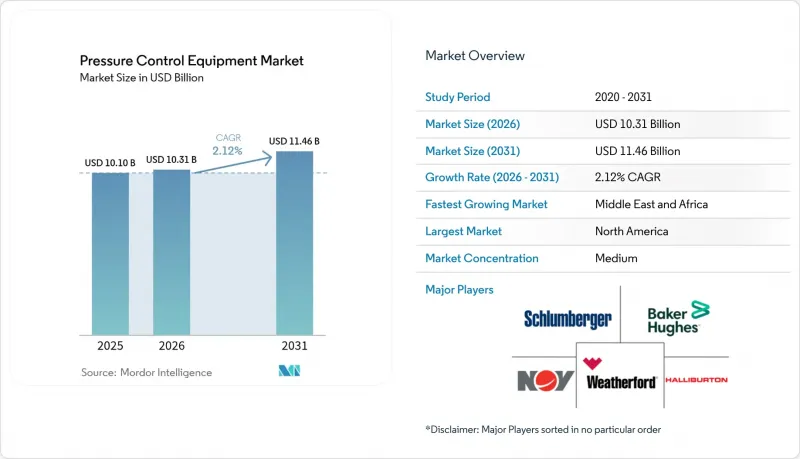
본 보고서는 구성 부품(밸브, 분출 방지 장치, 제어 헤드 등), 내압 등급(저압(10,000 psi 미만), 고압(10,000-20,000 psi) 등), 유정 유형(육상, 해양),운영 단계(시추, 완공, 개입, 생산), 지역별로 분류되어 있습니다. 시장 예측은 금액(달러) 기준으로 제시되어 있습니다.
전 세계 압력 제어 장비 시장 동향 및 인사이트
남미 지역의 심해·초심해 시추 프로젝트 증가
남미에서 심해 시추가 재개됨에 따라, 극한의 압력, 고농도 CO₂, 부식성 유체에 견딜 수 있는 압력 제어 장비가 요구되고 있습니다. SLB사가 페트로브라스와 체결한 8억 달러 규모의 계약은 브라질의 프레솔트 분지에 위치한 100개 이상의 유정을 대상으로 하며, 고사양 안전 밸브와 AI를 활용한 모니터링을 통합하고 있습니다. 우드사이드 에너지(Woodside Energy)의 트리온(Trion) 프로젝트에서는 수심 2,500m의 초심해 유정 18개에 대해 20 kpsi의 해저 시스템을 채택하고 있습니다. 베이커 휴즈(Baker Hughes)가 공급하는 플렉서블 파이프는 CO2로 인한 균열을 줄이기 위해 내식성 합금을 채택하고 있습니다. 운영사가 광구의 전체 수명 주기에 걸친 지원에 대해 ‘단일 창구’를 통한 책임 체계를 요구하는 가운데, 하드웨어와 서비스를 통합한 패키지가 애프터마켓 수익을 견인하고 있습니다.
고도의 제어 헤드가 필요한 관리 압력 시추(MPD)의 도입
관리 압력 시추(MPD)는 심해 분야의 틈새 기술에서 주류 기술로 전환되었습니다. 할리버튼과 세칼은 LOGIX의 자동화 기술과 Drilltronics를 통합하여, 실시간 압력 제어를 실현하는 최초의 자동 해저 시추 시스템을 도입했습니다. 웨더포드(Weatherford)의 ‘Victus Intelligent MPD’ 제품군은 사우디 아람코(Saudi Aramco) 및 오만 석유 개발 공사(PDO)와의 프로젝트를 수주하며, 육상에서의 보급이 확대되고 있음을 보여주고 있습니다. 현장 실적에 따르면, MPD 도입으로 비생산 시간이 92시간 단축되었고, 총 시추 시간이 7.4일 단축되었습니다. 제어 헤드에 내장된 AI 알고리즘이 유입 및 손실 현상을 예측함으로써 안전성을 높이고, 시추 비용을 절감하고 있습니다.
원유 가격 변동이 해양 설비 투자를 지연시킨다.
브렌트 원유 가격은 2025년에 평균 74달러/배럴이 될 것으로 예상되지만, 공급 과잉과 중국 수요 둔화를 배경으로 비관적인 전망에서는 65달러/배럴까지 하락할 가능성도 있습니다. 각 운영사들은 최종 투자 결정을 미루고 있으며, FPSO의 리드타임이 3년 이상 소요되는 점을 감안할 때, 심해 개발의 회복은 2026년 이후로 밀릴 전망입니다. 미국의 탐사·생산(E&P) 기업들은 2024년 설비 투자액을 617억-654억 달러로 축소하며, 절제된 지출 태도를 강조하고 있습니다. 설비 발주는 둔화되고 있으며, 특히 신형 초심해용 시추선에서 그 경향이 두드러집니다.
부문별 분석
밸브는 2025년 매출의 32.10%를 차지했습니다. 이는 시추, 완공, 생산 각 단계에서 안전 차단 기능을 위한 볼 밸브, 게이트 밸브, 초크 밸브의 각 유형가 필수적이기 때문입니다. 실시간 건전성 데이터를 제공하는 디지털 포지셔너를 통해 추가적인 수익 증가가 예상됩니다. 분출 방지 장치(BOP)는 초심해 분지에서 20 kpsi의 내압 능력이 의무화됨에 따라 2031년까지 연평균 성장률(CAGR) 2.44%로 성장할 전망입니다. MPD가 육상으로 전환됨에 따라 컨트롤 헤드 시장 점유율은 확대되고 있습니다. 엘라스토머를 강화한 환형 설계 덕분에 정기적인 씰 교체가 30% 감소합니다. 리그 소유주들이 인터페이스를 표준화하고 있기 때문에 어댑터 플랜지나 퀵 유니온과 같은 보완 제품도 안정적인 수요를 확보하고 있습니다.
공급업체의 혁신은 석유 및 가스 분야에 그치지 않습니다. 에머슨(Emerson)의 TESCOM HV-7000 수소 레귤레이터는 산업 전반에 걸친 다각화를 보여주고 있습니다. 크리스마스 트리, 특히 해저용 수직 단일 구멍형은 첨단 금속 소재 기술과 높은 센서 밀도 덕분에 고가대에서 거래되고 있습니다. 해저용 모델의 OEM 매출 총이익률은 25%를 초과하는 반면, 이에 상응하는 수상용 트리의 매출 총이익률은 17-19%에 그치고 있습니다. 밸브, 매니폴드, 디지털 트윈을 통합한 패키지는 고객 락인을 강화하고, 서비스 계약을 통한 지속적인 수익원을 개척하고 있습니다.
2025년에는 심해 부유식 플랫폼에 도입된 15 kpsi 스택을 핵심으로, 고압(10-20 kpsi) 시스템이 압력 제어 장비 시장의 56.55%를 차지했습니다. 이 등급 범주와 관련된 압력 제어 장비 시장 규모는 도입이 정점에 달함에 따라 한 자릿수 초반의 성장률로 확대될 전망입니다. 한편, 초고압(20 kpsi 초과) 솔루션은 셰브론의 ‘앵커’ 프로젝트와 BP의 20 kpsi 프로젝트에 힘입어 2031년까지 연평균 성장률(CAGR) 3.28%를 기록하며 모든 카테고리를 능가하는 성장률을 보일 것으로 예측됩니다.
OEM 업체들은 피로 강도 목표를 달성하기 위해 텅스텐 카바이드 인서트와 마르에이징 강 하우징을 채택한 램의 재설계를 진행하고 있습니다. 맥시미터(Maximeter)사의 8,000 바 시험 장비는 차세대 합금의 인증 절차를 가속화하고 있습니다. 저압(10 kpsi 미만) 장비는 기존의 육상 유정에서 여전히 중요성을 유지하고 있지만, 공급 과잉으로 인해 가격 면에서 압박을 받고 있습니다. 지역별 분석에 따르면, 북미에서는 고압화가 진행되고 있는 반면, 중동의 일부 지역에서는 기존 방식의 유전에서 여전히 10 kpsi 시스템이 도입되고 있습니다.
지역별 분석
북미는 퍼미안 분지의 셰일 시추 및 멕시코만 해저 개발을 견인력으로 2025년 매출의 38.55%를 차지했습니다. 시추 장비 가동 대수는 육상 600기, 부유식 25기가 평균이며, BOP 예비 부품 및 밸브 재제조에 대한 안정적인 주문이 유지되고 있습니다. 캐나다에서는 오일샌드 유지보수 프로젝트와 몬토니의 가스 시추로 점진적인 성장이 예상되며, 시추 장비 수는 연간 4-5% 증가할 것으로 전망됩니다. 한편, 멕시코의 트리온 프로젝트는 초심해 분야에서 새로운 수요를 창출하고 있습니다.
중동은 연평균 성장률(CAGR) 2.58%로 가장 빠르게 성장하고 있는 지역입니다. 사우디 아람코, ADNOC, PDO는 시추 장비 수를 2024년 412대에서 2028년 618대로 늘릴 전망이며, 이에 따라 고압 BOP 스택 및 디지털 초크 매니폴드의 수주가 촉진되고 있습니다. 해상 플랫폼에 도입된 실시간 밸브 진단 시스템 덕분에 가동 중단 시간이 18% 감소하여, 더 광범위한 도입이 촉진되고 있습니다. 이스라엘과 튀르키예에서는 가스 개발을 통해 지역의 성장세가 가속화되고 있습니다.
아시아태평양에서는 다양한 성장 요인이 나타나고 있습니다. 중국의 셰일가스 및 LNG 터미널 건설 확대, 인도의 탐사 추진에 따른 2028년까지 시추 장비 수가 111기에서 142기로 증가할 전망, 그리고 15 kpsi 작동식 밸브를 지정하는 한국의 신규 재기화 터미널 등이 그 예입니다. 지역 구매자들은 현지 조달률 향상을 요구하고 있으며, 이에 따라 각 OEM 기업들은 합작 투자 및 조립 라인 확장을 추진하고 있습니다. 호주는 노스웨스트 쉘프(Northwest Shelf)의 타이백(Tie-back) 사업에 대한 투자를 지속하고 있는 반면, 동남아시아의 국영 석유 기업들은 한계 유전의 재개발에 주력하고 있습니다.
유럽의 북해에서는 기존 시설의 개보수 및 수명 연장을 활용하여 설비 업그레이드를 유지하고 있습니다. 전기화 및 복합재 라이저 도입을 통해 플랫폼 배출량이 감소하여 EU의 탄소 배출 감축 목표와 부합하고 있습니다. 브라질을 제외한 라틴아메리카에서는 아르헨티나의 바카 무에르타 셰일가스 시범 프로젝트와 가이아나의 심해 개발 확대가 추진력을 제공합니다. 아프리카의 상황은 여전히 제각각입니다. 앙골라와 나미비아는 탐사 예산을 확보하고 있는 반면, 나이지리아는 재정적 불확실성에 직면해 있습니다.
기타 혜택:
- 엑셀 형식 시장 예측(ME) 시트
- 3개월간의 애널리스트 지원
자주 묻는 질문
목차
제1장 서론
제2장 조사 방법
제3장 주요 요약
제4장 시장 구도
제5장 시장 규모와 성장 예측
제6장 경쟁 구도
제7장 시장 기회와 향후 전망
JHS 26.09.11According to Mordor Intelligence, the pressure control equipment market size is expected to grow from USD 10.1 billion in 2025 to USD 10.31 billion in 2026 and is forecast to reach USD 11.46 billion by 2031 at 2.12% CAGR over 2026-2031.
This report is Segmented by Component (Valves, Blowout Preventers, Control Heads, and More), Pressure Rating (Low Pressure (Less Than 10000 Psi, High Pressure (10000-20000 Psi), and More)), Well Type (Onshore, Offshore), Operation Phase (Drilling, Completion, Intervention, Production), and Geography. The Market Forecasts are Provided in Terms of Value (USD).
Global Pressure Control Equipment Market Trends and Insights
Rising Deep- & Ultra-Deepwater Drilling Campaigns in South America
South America's deepwater renaissance demands pressure control equipment that withstands extreme pressures, high CO2 content, and corrosive fluids. SLB's USD 800 million contract with Petrobras covers more than 100 wells in Brazil's pre-salt basins, integrating high-spec safety valves and AI-enabled monitoring. Woodside Energy's Trion project relies on 20 kpsi subsea systems for 18 ultra-deepwater wells at 2,500 m water depth. Flexible pipe supplied by Baker Hughes uses corrosion-resistant alloys to mitigate CO2-induced cracking. Integrated hardware-plus-service packages spur aftermarket revenue as operators seek single-throat accountability for life-of-field support.
Adoption of Managed Pressure Drilling Requiring Advanced Control Heads
Managed pressure drilling (MPD) has moved from deepwater niche to mainstream technique. Halliburton and Sekal deployed the first automated on-bottom drilling system integrating LOGIX automation and Drilltronics for real-time pressure control. Weatherford's Victus Intelligent MPD suite won projects with Saudi Aramco and Petroleum Development Oman, illustrating onshore uptake. Field results show MPD cutting non-productive time by 92 hours and trimming total drilling time by 7.4 days. AI algorithms embedded in control heads predict influx or loss events, boosting safety and lowering well costs.
Crude-Oil Price Volatility Delaying Offshore CAPEX
Brent is expected to average USD 74/bbl in 2025, but bearish views place downside at USD 65/bbl amid oversupply and tepid Chinese demand. Operators defer final investment decisions, pushing deepwater recovery to 2026+ as FPSO lead times stretch three-plus years. US E&Ps cut 2024 capex to USD 61.7-65.4 billion, underscoring disciplined spend. Equipment orders slow, especially for new ultra-deepwater rigs.
Other drivers and restraints analyzed in the detailed report include:
- Stringent Safety Regulations Driving Replacement Cycles in North American Shale
- North Sea Brownfield Life-Extension Retrofits
- Rental Pressure-Control Packages Dampening New-Build Sales
For complete list of drivers and restraints, kindly check the Table Of Contents.
Segment Analysis
Valves generated 32.10% of 2025 revenue as every drilling, completion, and production phase depends on ball, gate, and choke variants for fail-safe isolation. Incremental gains arise from digital positioners that provide real-time health data. Blowout preventers expand at an 2.44% CAGR to 2031, propelled by mandatory 20 kpsi capability for ultra-deepwater basins. Control heads enjoy growing share as MPD moves onshore; annular designs with elastomer enhancements reduce routine seal changes by 30%. Complementary items like adapter flanges and quick unions capture steady demand as rig owners standardize interfaces.
Supplier innovation spans beyond oil and gas: Emerson's TESCOM HV-7000 hydrogen regulator signals cross-sector diversification. Christmas trees, particularly subsea vertical monobore styles, command premium price due to higher metallurgy and sensor density. OEM gross margins on subsea variants exceed 25% versus 17-19% on comparable surface trees. Integrated packages bundling valves, manifolds, and digital twins strengthen customer lock-in and open service-contract annuities.
High-pressure (10-20 kpsi) systems controlled 56.55% of pressure control equipment market share in 2025, anchored by 15 kpsi stacks deployed on deepwater floaters. The pressure control equipment market size tied to this rating tier will expand in low-single digits as adoption plateaus. Conversely, ultra-high-pressure (>20 kpsi) solutions outpace all categories at 3.28% CAGR to 2031, driven by Chevron's Anchor and BP's 20 kpsi projects.
OEMs are redesigning rams with tungsten-carbide inserts and maraging-steel housings to meet fatigue targets. Maximator's 8,000-bar test rigs accelerate qualification of next-gen alloys. Low-pressure (<10 kpsi) equipment retains relevance in legacy land wells yet faces pricing pressure due to oversupply. Regional split shows North America skewing toward higher pressures, while parts of Middle East still deploy 10 kpsi systems on conventional fields.
Complete Report Scope:
- By Component
- Valves
- Ball Valves
- Gate Valves
- Choke Valves
- Check Valves
- Blowout Preventers
- Annular BOP
- Ram BOP
- Control Heads
- Adapter Flanges
- Quick Unions
- Christmas Tree / Flow Tee
- Others (Pack-offs, Lubricators)
- Valves
- By Pressure Rating
- Low Pressure (less than 10 000 psi)
- High Pressure (10 000-20 000 psi)
- Ultra-High Pressure (greater than 20 000 psi)
- By Well Type
- Onshore
- Conventional Land Rigs
- Shale and Tight Formations
- Offshore
- Shallow-Water
- Deepwater
- Ultra-Deepwater
- Onshore
- By Operation Phase
- Drilling
- Completion
- Intervention / Work-over
- Production
- By Geography
- North America
- United States
- Canada
- Mexico
- Europe
- United Kingdom
- Germany
- France
- Italy
- Rest of Europe
- Asia-Pacific
- China
- Japan
- India
- South Korea
- Rest of Asia-Pacific
- Middle East
- Israel
- Saudi Arabia
- United Arab Emirates
- Turkey
- Rest of Middle East
- Africa
- South Africa
- Egypt
- Rest of Africa
- South America
- Brazil
- Argentina
- Rest of South America
- North America
Geography Analysis
North America captured 38.55% of 2025 revenue, led by Permian Basin shale drilling and Gulf of Mexico subsea developments. Rig activity averages 600 land and 25 floating rigs, sustaining steady call-off orders for BOP spares and valve refurbishments. Canada adds incremental growth through oil-sands sustaining projects and Montney gas drilling, with rig counts expected to rise 4-5% annually, while Mexico's Trion project brings new ultra-deepwater demand.
The Middle East is the fastest-growing region at 2.58% CAGR. Saudi Aramco, ADNOC, and PDO raise rig count from 412 in 2024 to a forecast 618 by 2028, spurring orders for high-pressure BOP stacks and digital choke manifolds. Real-time valve diagnostics installed on offshore platforms cut non-productive time by 18%, encouraging broader deployment. Israel and Turkey add to regional momentum through gas development.
Asia-Pacific shows diversified drivers: China's shale gas and LNG terminal build-out, India's exploration push lifting rigs from 111 to 142 by 2028, and South Korea's new regas terminals that specify 15 kpsi actuated valves. Regional buyers demand local content, prompting OEMs to expand joint ventures and assembly lines. Australia maintains investment in Northwest Shelf tie-backs, while Southeast Asian national oil companies focus on marginal-field redevelopment.
Europe's North Sea leverages brownfield retrofits and life-extension to sustain equipment upgrades. Electrification and composite risers reduce platform emissions, dovetailing with EU carbon objectives. Latin America beyond Brazil gains support from Argentina's Vaca Muerta shale pilots and Guyana's deepwater ramp-up. Africa remains mixed: Angola and Namibia attract exploration budgets, whereas Nigeria grapples with fiscal uncertainties.
- Schlumberger Ltd
- Baker Hughes Co.
- Halliburton Co.
- Weatherford International PLC
- NOV Inc.
- TechnipFMC PLC
- Emerson Electric Co.
- Hunting PLC
- FHE USA LLC
- GKD Industries Ltd
- Brace Tool Inc.
- Lee Specialties Inc.
- TIS Manufacturing Ltd
- Kirloskar Brothers Ltd
- IKM Pressure Control AS
- Aker Solutions ASA
- Allied Valves Inc.
- Control Flow Inc.
- Cameron International
- Nabors Industries Ltd
- Dril-Quip Inc.
- Forum Energy Technologies
- BOP Products LLC
- Advanced Pressure Systems
- Jiangsu Xinde Petroleum Machinery
Additional Benefits:
- The market estimate (ME) sheet in Excel format
- 3 months of analyst support
TABLE OF CONTENTS
1 INTRODUCTION
- 1.1 Study Assumptions and Market Definition
- 1.2 Scope of the Study
2 RESEARCH METHODOLOGY
3 EXECUTIVE SUMMARY
4 MARKET LANDSCAPE
- 4.1 Market Overview
- 4.2 Market Drivers
- 4.2.1 Rising Deep- and Ultra-Deepwater Drilling Campaigns in South America
- 4.2.2 Adoption of Managed Pressure Drilling Requiring Advanced Control Heads
- 4.2.3 Stringent Safety Regulations Driving Replacement Cycles in North American Shale
- 4.2.4 North Sea Brownfield Life-Extension Retrofits
- 4.2.5 Digital Valve Diagnostics Minimising NPT in Middle-East Offshore Assets
- 4.2.6 LNG Import-Terminal Expansion in Asia Boosting High-Pressure Transfer Valves
- 4.3 Market Restraints
- 4.3.1 Crude-Oil Price Volatility Delaying Offshore CAPEX
- 4.3.2 Rental Pressure-Control Packages Dampening New-Build Sales
- 4.3.3 Forged-Alloy Component Supply Bottlenecks Post-Ukraine Conflict
- 4.3.4 Skilled-Labour Shortage for 20k-psi Equipment Maintenance in Emerging Markets
- 4.4 Value / Supply-Chain Analysis
- 4.5 Regulatory Outlook
- 4.6 Technological Outlook
- 4.7 Porter's Five Forces Analysis
- 4.7.1 Bargaining Power of Suppliers
- 4.7.2 Bargaining Power of Buyers
- 4.7.3 Threat of New Entrants
- 4.7.4 Threat of Substitutes
- 4.7.5 Intensity of Competitive Rivalry
- 4.8 Investment Analysis
5 MARKET SIZE AND GROWTH FORECASTS (VALUE)
- 5.1 By Component
- 5.1.1 Valves
- 5.1.1.1 Ball Valves
- 5.1.1.2 Gate Valves
- 5.1.1.3 Choke Valves
- 5.1.1.4 Check Valves
- 5.1.2 Blowout Preventers
- 5.1.2.1 Annular BOP
- 5.1.2.2 Ram BOP
- 5.1.3 Control Heads
- 5.1.4 Adapter Flanges
- 5.1.5 Quick Unions
- 5.1.6 Christmas Tree / Flow Tee
- 5.1.7 Others (Pack-offs, Lubricators)
- 5.1.1 Valves
- 5.2 By Pressure Rating
- 5.2.1 Low Pressure (less than 10 000 psi)
- 5.2.2 High Pressure (10 000-20 000 psi)
- 5.2.3 Ultra-High Pressure (greater than 20 000 psi)
- 5.3 By Well Type
- 5.3.1 Onshore
- 5.3.1.1 Conventional Land Rigs
- 5.3.1.2 Shale and Tight Formations
- 5.3.2 Offshore
- 5.3.2.1 Shallow-Water
- 5.3.2.2 Deepwater
- 5.3.2.3 Ultra-Deepwater
- 5.3.1 Onshore
- 5.4 By Operation Phase
- 5.4.1 Drilling
- 5.4.2 Completion
- 5.4.3 Intervention / Work-over
- 5.4.4 Production
- 5.5 By Geography
- 5.5.1 North America
- 5.5.1.1 United States
- 5.5.1.2 Canada
- 5.5.1.3 Mexico
- 5.5.2 Europe
- 5.5.2.1 United Kingdom
- 5.5.2.2 Germany
- 5.5.2.3 France
- 5.5.2.4 Italy
- 5.5.2.5 Rest of Europe
- 5.5.3 Asia-Pacific
- 5.5.3.1 China
- 5.5.3.2 Japan
- 5.5.3.3 India
- 5.5.3.4 South Korea
- 5.5.3.5 Rest of Asia-Pacific
- 5.5.4 Middle East
- 5.5.4.1 Israel
- 5.5.4.2 Saudi Arabia
- 5.5.4.3 United Arab Emirates
- 5.5.4.4 Turkey
- 5.5.4.5 Rest of Middle East
- 5.5.5 Africa
- 5.5.5.1 South Africa
- 5.5.5.2 Egypt
- 5.5.5.3 Rest of Africa
- 5.5.6 South America
- 5.5.6.1 Brazil
- 5.5.6.2 Argentina
- 5.5.6.3 Rest of South America
- 5.5.1 North America
6 COMPETITIVE LANDSCAPE
- 6.1 Market Concentration
- 6.2 Strategic Moves
- 6.3 Market Share Analysis
- 6.4 Company Profiles {(includes Global-Level Overview, Market-Level Overview, Core Segments, Financials as available, Strategic Information, Market Rank/Share, Products and Services, Recent Developments)}
- 6.4.1 Schlumberger Ltd
- 6.4.2 Baker Hughes Co.
- 6.4.3 Halliburton Co.
- 6.4.4 Weatherford International PLC
- 6.4.5 NOV Inc.
- 6.4.6 TechnipFMC PLC
- 6.4.7 Emerson Electric Co.
- 6.4.8 Hunting PLC
- 6.4.9 FHE USA LLC
- 6.4.10 GKD Industries Ltd
- 6.4.11 Brace Tool Inc.
- 6.4.12 Lee Specialties Inc.
- 6.4.13 TIS Manufacturing Ltd
- 6.4.14 Kirloskar Brothers Ltd
- 6.4.15 IKM Pressure Control AS
- 6.4.16 Aker Solutions ASA
- 6.4.17 Allied Valves Inc.
- 6.4.18 Control Flow Inc.
- 6.4.19 Cameron International
- 6.4.20 Nabors Industries Ltd
- 6.4.21 Dril-Quip Inc.
- 6.4.22 Forum Energy Technologies
- 6.4.23 BOP Products LLC
- 6.4.24 Advanced Pressure Systems
- 6.4.25 Jiangsu Xinde Petroleum Machinery
7 MARKET OPPORTUNITIES AND FUTURE OUTLOOK
- 7.1 White-Space and Unmet-Need Assessment