
|
시장보고서
상품코드
2124221
인도의 스마트 TV 및 OTT 시장 : 시장 점유율 분석, 업계 동향 및 통계, 성장 예측(2026-2031년)India Smart TV And OTT - Market Share Analysis, Industry Trends & Statistics, Growth Forecasts (2026 - 2031) |
||||||
 Mordor Intelligence
Mordor Intelligence에 의하면, 인도의 스마트 TV 및 OTT 시장 규모는 2025년에 223억 9,000만 달러로 평가되었고, 2026년 263억 9,000만 달러에서 2031년에는 600억 5,000만 달러에 이를 것으로 예측되며, 예측 기간(2026-2031년) CAGR은 17.88%를 나타낼 전망입니다.
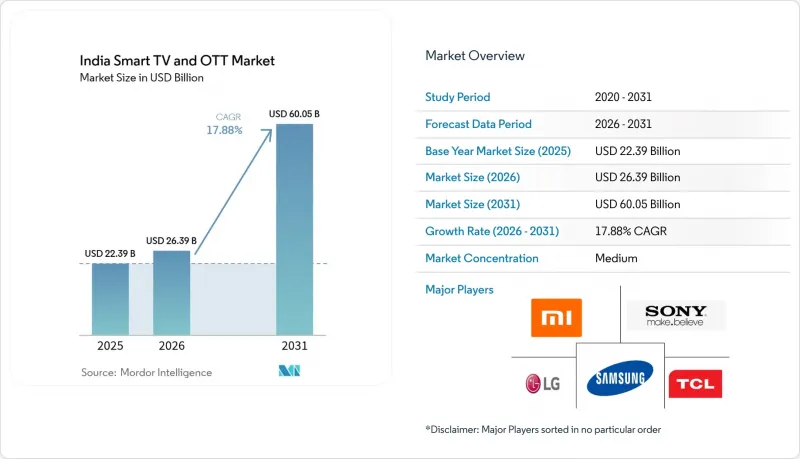
본 보고서는 OS 플랫폼별(Android TV, 독자 개발 리눅스, Fire OS, IndOS), 가격대별(INR)(6만 루피), 화면 크기별(32인치 이하, 33-43인치, 44-55인치, 55인치 이상과), 유통 채널별(온라인, 조직형 소매, 독립 딜러), 지역별(전국)로 분류되어 있습니다. 시장 예측은 금액(달러) 기준으로 제시되어 있습니다.
인도의 스마트 TV 및 OTT 시장 동향과 인사이트
가처분 소득 증가와 디지털화 진전
2024년에는 농촌 지역의 인터넷 사용자 수가 4억 4,200만 명을 넘어 처음으로 도시 지역을 상회했습니다. 이는 인도의 스마트 TV 및 OTT 시장에 더 큰 잠재적 수요가 존재함을 시사합니다. 2019년부터 2021년에 걸쳐 다차원적 빈곤율은 14.96%까지 하락하여 가계에 여유가 생기고, 수명이 긴 가전제품에 대한 지출이 가능해졌습니다. 정부가 운영하는 PMGDISHA 프로그램을 통해 약 6,400만 명의 시민에게 기본적인 디지털 기술을 교육함으로써, 스마트 TV 기능을 이용하는 데 있어 진입 장벽을 낮췄습니다. 가입자 1인당 월평균 무선 데이터 사용량은 21.30GB에 달했으며, 요금은 1GB당 8.31루피였습니다. 이는 10년 전의 268.97 루피에서 하락한 수치이며, HD 및 4K 스트리밍이 일상적인 습관으로 자리 잡았습니다. 이러한 사회경제적 변화가 인도 스마트 TV 및 OTT 시장의 수년에 걸친 꾸준한 성장의 원동력이 되고 있습니다.
스마트 TV의 평균 판매 가격(ASP) 하락과 PLI 제조 인센티브
PLI(생산 연계형 인센티브)에 따른 환급금이 패널 가격 변동을 상쇄했기 때문에 2023년 하반기 이후 오픈셀 비용이 20% 변동했음에도 불구하고 각 브랜드는 출시 가격을 유지할 수 있었습니다. 딕슨 테크놀로지스의 6억 달러 규모 디스플레이 모듈 사업 확장은 보다 광범위한 공급업체 생태계의 기반이 되고 있으며, 현재는 한국계 부품 공급업체도 120억 루피를 투자하여 원자재의 현지 조달을 추진하고 있습니다. 2025년 2월 연방 예산안에서는 오픈셀에 대한 관세가 0%로 인하되었으며, 소형 화면용 낮은 세율 구간이 유지되었습니다. 이에 따라 32인치를 초과하는 TV에는 28%의 GST가 부과됨에도 불구하고 비용 경쟁력이 유지되고 있습니다. 이러한 재정적 호재 덕분에 제조업체들은 이미 4-7%로 낮은 영업이익률을 훼손하지 않으면서도 적극적인 가격 책정을 할 수 있게 되었으며, 인도의 스마트 TV 및 OTT 시장에서 판매량 주도형 성장이 지속되고 있습니다.
패널에 대한 높은 GST(28%)와 관세
32인치를 초과하는 TV에 부과되는 28%의 GST 세율은 거실에서의 시청 습관상 대형 디스플레이가 선호됨에도 불구하고, 구매자들을 세제상 유리한 소형 스크린 쪽으로 몰아가고 있습니다. 2025-26년도 예산에서 인터랙티브 패널에 대한 관세가 20%로 인상됨에 따라, 판매량 확대를 주도하는 경우가 많은 교육 및 상업 부문이 압박을 받고 있습니다. IS 616:2017에 따른 적합성 검사로 인해 출시 주기가 몇 주 지연되고, 각 브랜드가 여러 기관의 승인을 받기 위해 분주히 움직이는 가운데 비용 압박이 더욱 가중되고 있습니다. 이러한 재정적·절차적 마찰로 인해 프리미엄 제품의 보급이 지연되며, 관세 합리화가 본격화될 때까지 인도의 스마트 TV 및 OTT 시장의 연평균 성장률(CAGR)이 몇 포인트 하락할 것으로 보입니다.
부문별 분석
2025년, 인도의 스마트 TV 및 OTT 시장 점유율에서 Android TV가 67.38%라는 압도적인 점유율을 차지했으나, 주 정부의 조달 및 데이터 주권에 대한 중시가 정착됨에 따라 IndOS의 출하 대수는 2031년까지 연평균 성장률(CAGR) 26.85%를 나타낼 것으로 예측됩니다. 이러한 전환을 뒷받침하는 것이 2025년 2월에 출시된 ‘JioTele OS’입니다. 이 OS에는 인도 각 언어에 최적화된 음성 AI와 스마트 홈 대시보드가 통합되어 있습니다. 예측 기간 동안 IndOS 탑재 기기와 관련된 인도의 스마트 TV 및 OTT 시장 규모는 급속히 확대될 것이며, 이는 국내 OEM 업체들에게 기존 세계 플랫폼에 대항하기 위한 전략적 발판이 될 전망입니다.
개발자들은 현지화된 스토어프론트의 상업적 이점을 인식하고 있는 반면, 규제 당국은 IndOS가 실현 가능한 투명한 코드 감사를 선호하고 있습니다. Android TV의 방대한 앱 라이브러리와 동등한 사용자 경험을 지속하는 것은 여전히 과제로 남아 있습니다. Fire OS는 아마존의 컨텐츠와 결제 서비스를 결합하여 틈새 시장을 유지하고 있으며, Tizen과 webOS는 하드웨어와 소프트웨어의 깊은 통합을 통해 프리미엄 부문에서의 가치를 유지하고, 리눅스 파생 버전은 경제적인 화이트 라벨 모델을 뒷받침하고 있습니다. 이러한 멀티플랫폼 환경은 인도의 스마트 TV 및 OTT 시장 전반에 걸쳐 기능 혁신과 가격 경쟁을 심화시키고 있습니다.
2025년에는 2만-4만 루피 가격대의 TV가 인도 스마트 TV 및 OTT 시장 규모의 41.60%를 차지했지만, 가구 소득 증가에 따라 6만 루피를 초과하는 기종은 2031년까지 연평균 성장률(CAGR) 23.70%를 나타낼 것으로 예측됩니다. 거주 공간의 확대와 QLED, OLED와 같은 첨단 디스플레이 기술에 대한 수요가 이 가격대의 상승을 뒷받침하고 있습니다. 삼성의 첸나이 공장 확장은 프리미엄 제품에 대한 수요 증가에 대응하기 위한 생산 능력 확충을 목적으로 하는 반면, 샤오미, TCL, 원플러스는 가격에 대한 민감도를 해치지 않으면서 중저가 제품의 강점을 상위 모델로 확대해 나가고 있습니다.
2만 루피 이하 가격대에서는 오픈셀 가격이 여전히 부품 원가의 60-65%를 차지하고 있어 이익률 압박에 시달리고 있습니다. 딕슨 테크놀로지스의 패널 국내 생산은 수입 의존도를 낮추고, 현지 브랜드가 비용을 비례적으로 인상하지 않고도 기능 세트를 확충할 수 있게 해줍니다. 4만-6만 루피 가격대는 HDR, 돌비 애트모스, 120Hz 재생 빈도가 합리적인 가격의 사치품이 되는 과도기의 ‘스위트 스팟’으로 부상하고 있습니다. 소비자들이 스마트 TV를 단순한 일회성 기기가 아닌 8년 동안 계속 사용할 자산으로 인식하게 됨에 따라, 내구성을 위해 다소 높은 가격을 지불하려는 의지가 높아지고 있으며, 이는 인도의 스마트 TV 및 OTT 시장을 견인하고 있습니다.
기타 혜택
- 엑셀 형식 시장 예측(ME) 시트
- 3개월간의 애널리스트 지원
자주 묻는 질문
목차
제1장 서론
제2장 조사 방법
제3장 주요 요약
제4장 시장 구도
제5장 시장 규모 및 성장 예측
제6장 경쟁 구도
제7장 시장 기회 및 향후 전망
AJY 26.09.11According to Mordor Intelligence, the India smart TV and OTT market size was valued at USD 22.39 billion in 2025 and estimated to grow from USD 26.39 billion in 2026 to reach USD 60.05 billion by 2031, at a CAGR of 17.88% during the forecast period (2026-2031).
This report is Segmented by OS Platform (Android TV, Proprietary Linux, Fire OS, Indos), Price Band (60k INR), Screen Size (<=32", 33-43", 44-55", >55"), Distribution Channel (Online, Organised Retail, Independent Dealers), and Geography (National Coverage). The Market Forecasts are Provided in Terms of Value (USD).
India Smart TV And OTT Market Trends and Insights
Rising Disposable Income and Digital Adoption
Rural internet users crossed 442 million in 2024, overtaking the urban base for the first time and signalling deeper addressable demand for the India smart TV and OTT market. Multidimensional poverty fell to 14.96% in 2019-21, freeing household budgets for long-life consumer electronics. Government-run PMGDISHA trained nearly 64 million citizens in basic digital skills, lowering entry barriers to smart TV features. Average monthly wireless data use reached 21.30 GB per subscriber at a tariff of INR 8.31 per GB, down from INR 268.97 ten years earlier, making HD and 4K streaming an everyday habit. These socioeconomic shifts underpin consistent multi-year growth momentum for the India smart TV and OTT market.
Falling Smart-TV ASPs and PLI Manufacturing Incentives
PLI reimbursements offset volatile panel prices, allowing brands to hold entry prices even as open-cell costs swung 20% since late-2023. Dixon Technologies' USD 600 million expansion into display modules anchors a broader supplier ecosystem that now includes Korean component vendors investing INR 1,200 crore to localize inputs. The February 2025 Union Budget trimmed customs duty on open cells to zero and preserved a lower slab for smaller screens, preserving cost competitiveness despite a 28% GST on TVs larger than 32 inches. These fiscal tailwinds let manufacturers price aggressively without eroding already thin 4-7% operating margins, sustaining volume-led growth in the India smart TV and OTT market.
High GST and Customs Duties on Panels
The 28% GST slab on televisions beyond 32 inches steers buyers toward tax-efficient smaller screens even though living-room habits favor bigger displays. Customs duty on interactive panels rose to 20% in Budget 2025-26, squeezing education and commercial segments that often ignite volume scale. Compliance testing under IS 616:2017 adds weeks to launch cycles and compounds cost pressure as brands juggle multiple bureau approvals. These fiscal and procedural frictions slow premium uptake and shave points off the India smart TV and OTT market CAGR until duty rationalization gains momentum.
Other drivers and restraints analyzed in the detailed report include:
- Broadband Data Boom and 5G Roll-outs
- Content Localisation in 12+ Languages
- Piracy and Password Sharing
For complete list of drivers and restraints, kindly check the Table Of Contents.
Segment Analysis
Android TV accounted for a dominant 67.38% of the India smart TV and OTT market share in 2025, yet IndOS shipments are forecast to grow at a 26.85% CAGR through 2031 as state procurement and data-sovereignty preferences take hold. This transition is supported by JioTele OS, launched in February 2025, which bundles voice AI and smart-home dashboards optimized for Indic languages. Over the forecast horizon, the India smart TV and OTT market size attached to IndOS devices is set to expand rapidly, providing domestic OEMs a strategic wedge against entrenched global platforms.
Developers recognize commercial upside in localized storefronts, while regulators prefer transparent code audits that IndOS can facilitate. Nonetheless, sustained user experience parity with Android TV's vast app library remains a gating factor. Fire OS keeps a niche by pairing Amazon content and retail wallets, Tizen and webOS preserve value at the premium end through deep hardware-software integration, and Linux derivatives power economical white-label models. The resulting multi-platform landscape intensifies feature innovation and price competition across the India smart TV and OTT market.
Televisions priced between 20,000-40,000 INR delivered 41.60% of the India smart TV and OTT market size in 2025, but units costing over 60,000 INR are projected to clock a 23.70% CAGR to 2031 as household incomes climb. Larger living spaces and demand for advanced display technologies such as QLED and OLED underpin this upward migration. Samsung's Chennai expansion aligns capacity with premium appetite, while Xiaomi, TCL, and OnePlus seek to stretch mid-range DNA upward without losing price sensitivity.
Margin pressure plagues the sub-20,000 INR tier because open-cell prices still represent 60-65% of the bill-of-materials. Domestic fabrication of panels by Dixon eases dependency on imports, allowing local brands to widen feature sets without proportionate cost hikes. The 40,000-60,000 INR tranche emerges as a transitional sweet spot where HDR, Dolby Atmos, and 120 Hz refresh rates become affordable luxury. As consumers increasingly treat smart TVs as eight-year assets rather than discretionary gadgets, their willingness to pay a premium for longevity fuels the India smart TV and OTT market.
Complete Report Scope:
- By OS Platform
- Android TV
- Proprietary Linux (Tizen/WebOS)
- Fire OS
- IndOS (Gov-backed)
- By Price Band (INR)
- < 20 k
- 20 k - 40 k
- 40 k - 60 k
- > 60 k
- By Screen Size
- <=32"
- 33 - 43"
- 44 - 55"
- > 55"
- By Distribution Channel
- Online (e-commerce)
- Organised Retail
- Independent Dealers
List of Companies Covered in this Report:
- Xiaomi Corporation
- Samsung Electronics Co., Ltd.
- LG Electronics Inc.
- Sony Group Corporation
- TCL Technology Group Corp.
- VU Technologies Private Ltd.
- Honor Device Co., Ltd.
- Panasonic Holdings Corp.
- Haier Smart Home Co., Ltd.
- OnePlus Technology (Shenzhen) Co., Ltd.
- Sansui Electric Co., Ltd.
- Realme Mobile Telecommunications (Shenzhen) Co., Ltd.
- Hisense Visual Technology Co., Ltd.
- Koninklijke Philips N.V.
- Skyworth Group Co., Ltd.
- Super Plastronics Pvt. Ltd.
- TPV Technology Limited
- Mirc Electronics Limited
- Infinix Mobility Limited
- Acer Incorporated (via Indkal Technologies Pvt. Ltd.)
- BPL Limited
Additional Benefits:
- The market estimate (ME) sheet in Excel format
- 3 months of analyst support
TABLE OF CONTENTS
1 INTRODUCTION
- 1.1 Study Assumptions and Market Definition
- 1.2 Scope of the Study
2 RESEARCH METHODOLOGY
3 EXECUTIVE SUMMARY
4 MARKET LANDSCAPE
- 4.1 Market Overview
- 4.2 Market Drivers
- 4.2.1 Rising disposable income and digital adoption
- 4.2.2 Falling smart-TV ASPs and PLI manufacturing incentives
- 4.2.3 Broadband data boom and 5G roll-outs
- 4.2.4 Content localisation in 12+ languages
- 4.2.5 Mandatory India TV OS (IndOS) standard (under-reported)
- 4.2.6 Super-app bundling of OTT + e-commerce (under-reported)
- 4.3 Market Restraints
- 4.3.1 High GST (28 %) and customs duties on panels
- 4.3.2 Piracy and password sharing
- 4.3.3 Rural grid-power unreliability (under-reported)
- 4.3.4 5 G spectrum cost overhang (under-reported)
- 4.4 Industry Value-Chain Analysis
- 4.5 Regulatory Landscape
- 4.6 Technological Outlook
- 4.7 Porter's Five Forces Analysis
- 4.7.1 Threat of New Entrants
- 4.7.2 Bargaining Power of Buyers
- 4.7.3 Bargaining Power of Suppliers
- 4.7.4 Threat of Substitutes
- 4.7.5 Competitive Rivalry
5 MARKET SIZE AND GROWTH FORECASTS
- 5.1 By OS Platform
- 5.1.1 Android TV
- 5.1.2 Proprietary Linux (Tizen/WebOS)
- 5.1.3 Fire OS
- 5.1.4 IndOS (Gov-backed)
- 5.2 By Price Band (INR)
- 5.2.1 < 20 k
- 5.2.2 20 k - 40 k
- 5.2.3 40 k - 60 k
- 5.2.4 > 60 k
- 5.3 By Screen Size
- 5.3.1 <=32"
- 5.3.2 33 - 43"
- 5.3.3 44 - 55"
- 5.3.4 > 55"
- 5.4 By Distribution Channel
- 5.4.1 Online (e-commerce)
- 5.4.2 Organised Retail
- 5.4.3 Independent Dealers
6 COMPETITIVE LANDSCAPE
- 6.1 Market Concentration
- 6.2 Strategic Moves
- 6.3 Market Share Analysis
- 6.4 Company Profiles (includes Global level Overview, Market level overview, Core Segments, Financials as available, Strategic Information, Market Rank/Share for key companies, Products and Services, and Recent Developments)
- 6.4.1 Xiaomi Corporation
- 6.4.2 Samsung Electronics Co., Ltd.
- 6.4.3 LG Electronics Inc.
- 6.4.4 Sony Group Corporation
- 6.4.5 TCL Technology Group Corp.
- 6.4.6 VU Technologies Private Ltd.
- 6.4.7 Honor Device Co., Ltd.
- 6.4.8 Panasonic Holdings Corp.
- 6.4.9 Haier Smart Home Co., Ltd.
- 6.4.10 OnePlus Technology (Shenzhen) Co., Ltd.
- 6.4.11 Sansui Electric Co., Ltd.
- 6.4.12 Realme Mobile Telecommunications (Shenzhen) Co., Ltd.
- 6.4.13 Hisense Visual Technology Co., Ltd.
- 6.4.14 Koninklijke Philips N.V.
- 6.4.15 Skyworth Group Co., Ltd.
- 6.4.16 Super Plastronics Pvt. Ltd.
- 6.4.17 TPV Technology Limited
- 6.4.18 Mirc Electronics Limited
- 6.4.19 Infinix Mobility Limited
- 6.4.20 Acer Incorporated (via Indkal Technologies Pvt. Ltd.)
- 6.4.21 BPL Limited