|
시장보고서
상품코드
2124231
소독제 및 살균제 시장 : 시장 점유율 분석, 업계 동향 및 통계, 성장 예측(2026-2031년)Antiseptics And Disinfectants - Market Share Analysis, Industry Trends & Statistics, Growth Forecasts (2026 - 2031) |
||||||
 Mordor Intelligence
Mordor Intelligence에 의하면, 소독제 및 살균제 시장 규모는 2025년 408억 8,000만 달러로 평가되었고, 2026년에는 441억 7,000만 달러로 추정되고, 2031년까지 650억 5,000만 달러에 이를 것으로 예상되며, 2026-2031년 CAGR 8.05%로 성장할 전망입니다.
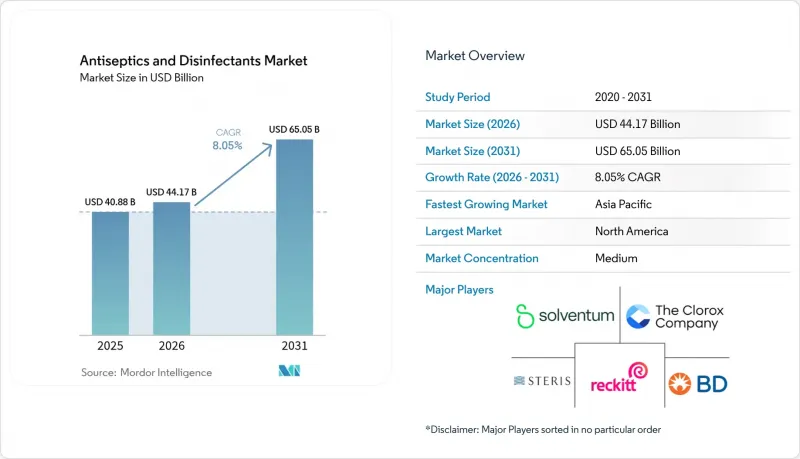
본 보고서는 제품 유형별(4급 암모늄 화합물, 기타), 제형별(액제, 스프레이·에어로졸, 물티슈, 젤·폼), 용도별(표면용 소독제, 기타), 최종 사용자별(병원 및 클리닉, 기타), 지역별(북미, 유럽, 아시아태평양, 중동 및 아프리카, 남미)로 분류되어 있습니다. 시장 예측은 금액(달러) 기준으로 제시되어 있습니다.
세계의 소독제 및 살균제 시장 동향과 인사이트
전 세계적으로 심각해지는 병원 내 감염의 부담
의료 관련 감염(HAI)은 특정 날짜 기준 입원 환자 31명 중 1명에게 영향을 미치고 있으며, 매년 수백만 건의 예방 가능한 사례가 추가되고 있습니다. 2023-2024년 중심정맥카테터 및 카테터 관련 감염은 감소했으나, 반면 복부 자궁적출술 절개부 감염 증가로 상쇄되어 프로토콜 준수 미흡이 드러나고 있습니다. 비용 조사에 따르면, 중추정맥카테터 관련 혈류 감염 1건당 의료비는 최대 9만 9,900달러에 달하는 반면, 감염되지 않은 환자의 경우 8,500달러에 그치기 때문에 병원들은 고표면 및 의료기기용 소독제 도입을 서둘러야 하는 상황입니다(1). 미국의 ‘병원 내 감염 감소 프로그램(Hospital-Acquired Condition Reduction Program)’에 따른 보상 감액 조치는 이러한 재정적 긴급성을 더욱 가중시키고 있습니다. 급성기 의료와 장기 요양 현장의 차이는 교육, 약물 투여 기기, 준수 분석을 융합한 ‘턴키형 소독 서비스’ 제공에 새로운 기회를 창출하고 있습니다.
팬데믹 이후 시설 위생 프로토콜의 정착
코로나19로 인해 청소 빈도가 증가했으며, 현재는 의료 및 상업용 부동산의 모든 부문에서 공식적인 운영 절차로 정착되어 있습니다. 2025년 5월에 시행될 캐나다의 ‘살생물제 규제’에서는 팬데믹 기간과 마찬가지로 더 높은 유효성 및 안전 기준이 법제화되어 있습니다. 공기 중 병원체에 대한 효과를 내세운 최초의 제품으로 EPA 승인을 받은 레킷(Reckitt)사의 ‘Lysol Air Sanitizer’는 규제상의 새로운 틀이 인접한 카테고리를 개척하고 브랜드의 프리미엄화를 촉진하는 좋은 사례입니다. 임대인이 임대차 계약에 소독 빈도를 명시하는 사례가 늘어나고 있으며, 관련 지출은 일회성 청소용품 구매에서 수년에 걸친 서비스 계약으로 전환되고 있습니다. 에코랩의 기관용 사업부는 보충품을 자동으로 주문하는 IoT 연동형 디스펜서를 판매함으로써 2024년 4분기에 6%의 유기적 성장을 기록했으며, 위생 관리 준수를 관리형 서비스로 전환했습니다.
여러 지역의 엄격한 화학물질 등록 및 표시 요건
유럽화학물질청(ECHA)의 에탄올 심사는 2024년에 시작되었으나 2026년까지 연장될 전망이며, 이로 인해 27개 회원국 전체에서 제품 출시가 동결될 것입니다(3). 미국 환경보호청(EPA)이 2024년 6월에 정한 잔류물 시험 방법에 따라 SKU당 5만-10만 달러의 검증 비용이 추가됩니다. 캘리포니아주 유해물질관리국(DTSC)은 4급 암모늄 화합물을 ‘우선 제품’으로 지정할 가능성이 있으며, 이에 따라 400개 병원에 파급되는 더 안전한 대체품의 분석이 의무화될 것입니다. 캐나다의 3단계로 구성된 살생물제 규제에서는 신규 유효 성분에 대해 최대 24개월의 심사가 요구될 수 있어, 시장 출시까지의 기간이 장기화됩니다. 소규모 제조업체는 여러 신청 서류를 동시에 처리할 규제 대응 담당자가 부족하여, 전 세계 제품 포트폴리오 전반에 걸쳐 규정 준수 비용을 분산할 수 있는 다국적 기업에 시장 점유율을 빼앗기고 있습니다.
부문 분석
4급 암모늄 화합물은 광범위한 살균 작용과 1회 사용당 낮은 비용이라는 장점 덕분에 2025년 소독제 및 살균제 시장 매출의 27.43%를 차지했습니다. 한편, 효소계 세제는 복잡한 관절경용 셰이버나 로봇 수술 기구 표면의 생물막을 부식을 일으키지 않고 분해해야 할 필요성에 힘입어 2031년까지 연평균 성장률(CAGR) 10.43%로 성장하고 있습니다. 효소계 제제의 소독제 및 살균제 시장 규모는 2026년 61억 달러에서 2031년까지 111억 달러로 확대될 것으로 예측됩니다. ISO 14644의 로테이션 프로토콜을 채택하고 있는 병원에서는 미생물의 적응을 억제하기 위해 현재 분기마다 효소계, 산화계, 4급 암모늄계 제품을 번갈아 사용하고 있습니다. 잔류물 허용도가 극히 낮은 제약용 클린룸은 2024년 에코라보의 생명과학 부문 매출에 두 자릿수 성장을 가져다주었습니다.
수처리 시스템의 소독 분야에서는 염소계 화합물이 여전히 주류를 이루고 있지만, 알데히드계 및 페놀계 제품은 캘리포니아주 DTSC의 규제 모니터링을 배경으로 시장 점유율이 축소되고 있습니다. 손 소독제 시장에서는 알코올계 제품이 주류를 이루고 있지만, 2025년까지 이소프로파일 알코올 가격이 톤당 1,300-1,600달러 사이에서 변동하고 있어 원료 비용 변동에 직면해 있습니다. 10분 만에 99.7%의 미생물 살균 효과를 발휘하는 포비돈 요오드 비강 내 면봉은 틈새 투여 시스템이 어떻게 프리미엄 가격을 실현할 수 있는지를 보여주고 있습니다. 소독제 및 살균제 시장에서는 로봇 수술용 금속 및 폴리머와의 재료 적합성을 인증받은 공급업체가 계속해서 높은 평가를 받고 있으며, 이는 수술실 관리자의 위험을 경감시키고 있습니다.
2025년에는 소독제 및 살균제 시장에서 바닥 청소 및 기구 침지 용도가 주도하면서, 벌크 액체가 제제 매출의 51.25%를 차지했습니다. 반면, 외래 진료 센터에서는 희석 실수를 방지할 수 있는 일회용 형태가 선호되기 때문에 물티슈는 연평균 성장률(CAGR) 10.78%로 성장하고 있습니다. ‘Sani-Cloth’는 접촉 시간 내내 4급 암모늄계 유효 성분을 유지하는 원단을 채택하고 있으며, 이 특성은 EPA에 의해 검증되었습니다. 이로 인해 이 기업의 제품은 미국 임상용 와이프 시장을 선도하고 있습니다. 각 사전 침지된 캐니스터는 동등한 농축액 1리터와 비교하여 30-40% 더 높은 매출 총이익률을 가져오기 때문에 제조업체 입장에서는 이 형태로 전환을 추진하는 데 있어 이익상의 동기가 되고 있습니다.
‘Lysol Air Sanitizer’와 같은 스프레이 및 에어로졸 제품은 공기 중에서의 효과에 대해 EPA의 승인을 획득함으로써, 항균제의 새로운 투여 경로로서의 유효성이 입증되었습니다. 젤이나 폼, 특히 WHO 기준을 충족하는 70% 알코올 제제는 액체 흘림 방지가 중요한 외과용 스크럽 용도에서 지지를 넓혀가고 있습니다. 와이프는 소독제, 도포 도구, 투여량을 하나의 SKU로 제공하기 때문에 조달 담당자가 재고 관리를 간소화할 수 있어, 이로 인해 채택이 더욱 촉진되고 있습니다. 소독제 및 살균제 시장은 물티슈의 보급으로 혜택을 보고 있으며, 물티슈는 환자 교체가 빈번한 ASC(외래수술센터(ASC))의 일정에서 수술실 유휴 시간을 단축하고 있습니다.
지역별 분석
북미는 2025년 매출의 42.32%를 차지했으며, 병원 내 감염에 대한 메디케어의 엄격한 제재와 성숙한 감염 관리 인력 체계 덕분에 계속해서 최대의 소독제 및 살균제 시장으로 자리매김하고 있습니다. 이 지역의 성숙한 인프라는 간호 인력의 업무 부담을 경감시키고, 규정 준수 현황을 전자적으로 기록하는 프리미엄 서비스 패키지의 보급을 뒷받침하고 있습니다. 원자재 가격 압박, 특히 이소프로판올의 가격 변동은 처방 목록에 지속적인 부담을 주고 있으며, 출하 중량을 줄여주는 농축 와이프의 매력을 높이고 있습니다.
아시아태평양은 2024년 중국에서 13만 병상, 2027년까지 인도에서 60만 병상의 증설이 계획되어 있는 것을 배경으로, 2031년까지 연평균 성장률(CAGR) 9.43%로 성장을 주도할 것으로 예측됩니다. 높은 병상 가동률이 자동 소독제 투여 시스템을 갖춘 새로운 격리 병동 건설을 촉진하고 있습니다. ISO 13485 인증을 획득하고 클라우드 기반 재고 관리 시스템을 도입한 다국적 기업들은 인도 시장을 장악하고 있는 민간 병원 체인으로부터 수주를 따내고 있습니다.
유럽에서의 실적은 살생물제 규제의 복잡성으로 인해 제약을 받고 있습니다. 2024년에 시작된 EU BPR에 따른 에탄올 재검토로 인해 제품 출시가 일시 중단되었으나, 최종적으로는 27개 회원국 전체에서 유효성 기준이 통일될 전망입니다. 중동 및 아프리카에서는 의료 관광객을 대상으로 한 전문 병원 계획이 착실히 진행되고 있어, EPA 등록 및 CE 마크를 획득한 소독제에 대한 수요를 뒷받침하고 있습니다. 남미에서는 판매량 증가세가 둔화되고 있습니다. 브라질의 통합 보건 시스템(Unified Health System)은 최저가를 중시하는 중앙 집중형 입찰을 통해 조달을 진행하고 있으며, 이로 인해 현지에서의 위탁 조제가 촉진되고 있습니다.
기타 혜택
- 엑셀 형식 시장 예측(ME) 시트
- 3개월간의 애널리스트 지원
자주 묻는 질문
목차
제1장 서론
제2장 조사 방법
제3장 주요 요약
제4장 시장 구도
제5장 시장 규모 및 성장 예측
제6장 경쟁 구도
제7장 시장 기회 및 향후 전망
AJY 26.09.11According to Mordor Intelligence, the antiseptics and disinfectants market size is expected to increase from USD 40.88 billion in 2025 to USD 44.17 billion in 2026 and reach USD 65.05 billion by 2031, growing at a CAGR of 8.05% over 2026-2031.
This report is Segmented by Product Type (Quaternary Ammonium Compounds, and More), Formulation (Liquids, Sprays & Aerosols, Wipes, and Gels & Foams), Application (Surface Disinfectants, and More), End User (Hospitals & Clinics, and More), and Geography (North America, Europe, Asia-Pacific, Middle East & Africa, and South America). The Market Forecasts are Provided in Terms of Value (USD).
Global Antiseptics And Disinfectants Market Trends and Insights
Escalating Burden of Healthcare-Associated Infections Worldwide
Healthcare-associated infections (HAIs) affect 1 in 31 inpatients on any given day, adding millions of preventable cases each year. Declines in central-line and catheter infections between 2023 and 2024 have been offset by rising abdominal-hysterectomy site infections, exposing gaps in protocol adherence. Cost studies show that a single central-line bloodstream infection can cost up to USD 99,900 in care, compared with USD 8,500 for uninfected patients, pressing hospitals to adopt advanced surface and device disinfectants[1]. Reimbursement penalties under the U.S. Hospital-Acquired Condition Reduction Program amplify this financial urgency. A divergence between acute-care and long-term-care settings creates white-space for turnkey disinfection-as-a-service offerings that blend training, dosing hardware, and compliance analytics.
Post-Pandemic Institutional Hygiene Protocols Becoming Permanent
COVID-19 elevated cleaning frequencies that have now crystallized into formal operating procedures across healthcare and commercial real estate. Canada's Biocides Regulations, effective May 2025, codify higher efficacy and safety standards that mirror the pandemic era. EPA approval of Reckitt's Lysol Air Sanitizer-the first agent cleared for airborne pathogen claims-illustrates how regulatory novelty opens adjacent categories and drives brand premium. Landlords increasingly include disinfection cadence in lease covenants, shifting spend from ad hoc janitorial supplies to multi-year service contracts. Ecolab's Institutional segment logged 6% organic growth in Q4 2024 by selling IoT-linked dispensers that auto-reorder refills, turning hygiene compliance into a managed service.
Stringent Multi-Region Chemical Registration Requirements
The European Chemicals Agency's review of ethanol, opened in 2024, is likely to extend into 2026, freezing product launches across 27 member states[3]. The U.S. EPA's June 2024 residue test methods add USD 50,000-100,000 in validation costs per SKU. California's Department of Toxic Substances Control may list quaternary ammonium compounds as a Priority Product, forcing safer-alternative analyses that ripple through 400 hospitals. Canada's three-tier Biocides Regulations can require up to 24 months of review for novel actives, lengthening time-to-market. Small manufacturers lack the regulatory staff to navigate simultaneous dossiers, ceding share to multinationals that amortize compliance across global portfolios.
Other drivers and restraints analyzed in the detailed report include:
- Rising Surgical Procedure Volumes and Complex Device Reprocessing
- Rapid Expansion of Hospitals and Ambulatory Care Infrastructure
- Material Compatibility Limitations with Advanced Medical Devices
For complete list of drivers and restraints, kindly check the Table Of Contents.
Segment Analysis
Quaternary ammonium compounds accounted for 27.43% of 2025 revenue in the Antiseptics and Disinfectants market, benefiting from a broad spectrum of microbicidal activity and low per-dose cost. Yet enzymatic cleaners are growing at 10.43% CAGR through 2031, fueled by the need to break down biofilms on complex arthroscopic shavers and robotic instruments without corrosion. The Antiseptics and Disinfectants market size for enzymatic formulations is projected to expand from USD 6.1 billion in 2026 to USD 11.1 billion by 2031. Hospitals adopting ISO 14644 rotation protocols now cycle enzymatic, oxidizing, and quaternary products each quarter to blunt microbial adaptation. Pharmaceutical cleanrooms, where residue tolerance is minimal, contributed double-digit gains to Ecolab's Life Sciences sales in 2024.
Chlorine compounds remain staples for water-system disinfection, while aldehydes and phenolics retreat under regulatory scrutiny from California's DTSC. Alcohols dominate hand antisepsis but face input cost swings as isopropyl prices hover between USD 1,300-1,600 per ton into 2025. Povidone-iodine intranasal swabs that deliver 99.7% microbial reduction in 10 minutes illustrate how niche delivery systems can command premium pricing. The Antiseptics and Disinfectants market continues to reward suppliers that certify material compatibility with robotic-surgery metals and polymers, reducing risk for operating-room managers.
Bulk liquids delivered 51.25% of formulation revenue in 2025, driven by floor-cleaning and instrument-soak applications in the Antiseptics and Disinfectants market. Wipes, however, are growing at a 10.78% CAGR, as outpatient centers prefer single-use formats that eliminate dilution errors. Sani-Cloth leads the U.S. clinical wipe segment with a fabric that retains quaternary actives throughout the full contact time, a feature validated by the EPA. Each pre-saturated canister commands 30-40% higher gross margin than an equivalent liter of concentrate, giving manufacturers a profit motive to push conversion.
Sprays and aerosols, such as Lysol Air Sanitizer, validate new delivery vectors for antimicrobials after securing EPA approval for airborne claims. Gels and foams, especially 70% alcohol formulations that meet WHO standards, gain traction for surgical-scrub applications where drip control matters. Because wipes ship disinfectant, applicator, and dose in a single SKU, procurement officers can simplify inventory management, thereby furthering adoption. The Antiseptics and Disinfectants market benefits from wipes, which shorten turnover times in crowded ASC schedules.
Complete Report Scope:
- By Product Type
- Quaternary Ammonium Compounds
- Chlorine Compounds
- Alcohols & Aldehydes
- Biguanides & Iodine Derivatives
- Enzymes
- Phenolics & Others
- By Formulation
- Liquids
- Sprays & Aerosols
- Wipes
- Gels & Foams
- By Application
- Surface Disinfectants
- Medical-Device Disinfectants
- Enzymatic Cleaners
- Skin & Wound Antiseptics
- By End User
- Hospitals & Clinics
- Ambulatory & Day-Surgery Centers
- Long-Term Care Facilities
- Pharma & Biotech Manufacturing
- Other End Users
- Geography
- North America
- United States
- Canada
- Mexico
- Europe
- Germany
- United Kingdom
- France
- Italy
- Spain
- Rest of Europe
- Asia-Pacific
- China
- Japan
- India
- Australia
- South Korea
- Rest of Asia-Pacific
- Middle East & Africa
- GCC
- South Africa
- Rest of Middle East & Africa
- South America
- Brazil
- Argentina
- Rest of South America
- North America
Geography Analysis
North America, with 42.32% of 2025 revenue, remains the largest Antiseptics and Disinfectants market owing to strict Medicare penalties for hospital-acquired conditions and mature infection-control staffing models. The region's mature infrastructure favors premium service bundles that reduce nursing workload and electronically document compliance. Raw-material pricing pressure, notably volatility in isopropyl alcohol, continues to squeeze formularies and elevate the appeal of concentrated wipes that reduce shipment weight.
Asia-Pacific is projected to lead growth at 9.43% CAGR through 2031, underpinned by China's 130,000 new beds added in 2024 and India's planned 600,000 beds by 2027. High bed-occupancy rates are driving the construction of new isolation wards, each fitted with automated disinfectant dosing systems. Multinationals with ISO 13485 certification and cloud-based stock controls win tenders from private hospital chains dominating India's market.
Europe's performance is tempered by the complexity of biocide regulation. The ethanol review under EU BPR, opened in 2024, has paused product launches but will ultimately harmonize efficacy criteria across 27 member states. The Middle East and Africa enjoy a steady pipeline of specialty hospitals aimed at medical tourists, spurring demand for EPA-registered and CE-marked disinfectants. South America sees slower unit growth; Brazil's Unified Health System procures through centralized tenders that emphasize the lowest bid, encouraging local toll blending.
- BASF
- Becton Dickinson & Co. (BD)
- Cardinal Health
- The Clorox Company
- Diversey Holdings, Ltd.
- Ecolab
- GlaxoSmithKline
- GOJO Industries, Inc.
- Johnson & Johnson (Ethicon, ASP)
- Kimberly-Clark Worldwide
- Lonza Group
- Metrex Research, LLC
- Molnlycke Health Care
- Procter & Gamble
- Reckitt Benckiser Group
- Schulke & Mayr GmbH
- Solventum Corporation
- STERIS Plc
- Whiteley Corporation
Additional Benefits:
- The market estimate (ME) sheet in Excel format
- 3 months of analyst support
TABLE OF CONTENTS
1 Introduction
- 1.1 Study Assumptions & Market Definition
- 1.2 Scope Of The Study
2 Research Methodology
3 Executive Summary
4 Market Landscape
- 4.1 Market Overview
- 4.2 Market Drivers
- 4.2.1 Escalating Burden of Healthcare-Associated Infections Worldwide
- 4.2.2 Post-Pandemic Institutional Hygiene Protocols Becoming Permanent
- 4.2.3 Rising Surgical Procedure Volumes and Complex Device Reprocessing
- 4.2.4 Rapid Expansion of Hospitals and Ambulatory Care Infrastructure
- 4.2.5 Stringent Occupational Safety Regulations Mandating Disinfection
- 4.2.6 Growing Consumer Shift Toward Preventive Self-Care Antiseptics
- 4.3 Market Restraints
- 4.3.1 Stringent Multi-Region Chemical Registration & Labeling Requirements
- 4.3.2 Material Compatibility Limitations With Advanced Medical Devices
- 4.3.3 Volatility in Key Raw Material Prices (Alcohols, QACs, Chlorine)
- 4.3.4 Emergence of Disinfectant-Resistant Microorganisms
- 4.4 Value / Supply-Chain Analysis
- 4.5 Regulatory Landscape
- 4.6 Technological Outlook
- 4.7 Porter's Five Forces Analysis
- 4.7.1 Threat Of New Entrants
- 4.7.2 Bargaining Power Of Buyers
- 4.7.3 Bargaining Power Of Suppliers
- 4.7.4 Threat Of Substitutes
- 4.7.5 Intensity Of Competitive Rivalry
5 Market Size & Growth Forecasts (Value, USD)
- 5.1 By Product Type
- 5.1.1 Quaternary Ammonium Compounds
- 5.1.2 Chlorine Compounds
- 5.1.3 Alcohols & Aldehydes
- 5.1.4 Biguanides & Iodine Derivatives
- 5.1.5 Enzymes
- 5.1.6 Phenolics & Others
- 5.2 By Formulation
- 5.2.1 Liquids
- 5.2.2 Sprays & Aerosols
- 5.2.3 Wipes
- 5.2.4 Gels & Foams
- 5.3 By Application
- 5.3.1 Surface Disinfectants
- 5.3.2 Medical-Device Disinfectants
- 5.3.3 Enzymatic Cleaners
- 5.3.4 Skin & Wound Antiseptics
- 5.4 By End User
- 5.4.1 Hospitals & Clinics
- 5.4.2 Ambulatory & Day-Surgery Centers
- 5.4.3 Long-Term Care Facilities
- 5.4.4 Pharma & Biotech Manufacturing
- 5.4.5 Other End Users
- 5.5 Geography
- 5.5.1 North America
- 5.5.1.1 United States
- 5.5.1.2 Canada
- 5.5.1.3 Mexico
- 5.5.2 Europe
- 5.5.2.1 Germany
- 5.5.2.2 United Kingdom
- 5.5.2.3 France
- 5.5.2.4 Italy
- 5.5.2.5 Spain
- 5.5.2.6 Rest of Europe
- 5.5.3 Asia-Pacific
- 5.5.3.1 China
- 5.5.3.2 Japan
- 5.5.3.3 India
- 5.5.3.4 Australia
- 5.5.3.5 South Korea
- 5.5.3.6 Rest of Asia-Pacific
- 5.5.4 Middle East & Africa
- 5.5.4.1 GCC
- 5.5.4.2 South Africa
- 5.5.4.3 Rest of Middle East & Africa
- 5.5.5 South America
- 5.5.5.1 Brazil
- 5.5.5.2 Argentina
- 5.5.5.3 Rest of South America
- 5.5.1 North America
6 Competitive Landscape
- 6.1 Market Concentration
- 6.2 Market Share Analysis
- 6.3 Company Profiles {(Includes Global Level Overview, Market Level Overview, Core Segments, Financials as Available, Strategic Information, Market Rank/Share for Key Companies, Products & Services, and Recent Developments)}
- 6.3.1 BASF SE
- 6.3.2 Becton Dickinson & Co. (BD)
- 6.3.3 Cardinal Health Inc.
- 6.3.4 The Clorox Company
- 6.3.5 Diversey Holdings, Ltd.
- 6.3.6 Ecolab Inc.
- 6.3.7 GSK Plc
- 6.3.8 GOJO Industries, Inc.
- 6.3.9 Johnson & Johnson (Ethicon, ASP)
- 6.3.10 Kimberly-Clark Corporation
- 6.3.11 Lonza Group AG
- 6.3.12 Metrex Research, LLC
- 6.3.13 Molnlycke Health Care AB
- 6.3.14 Procter & Gamble Co.
- 6.3.15 Reckitt Benckiser Group Plc
- 6.3.16 Schulke & Mayr GmbH
- 6.3.17 Solventum Corporation
- 6.3.18 STERIS Plc
- 6.3.19 Whiteley Corporation
7 Market Opportunities & Future Outlook
- 7.1 White-Space & Unmet-Need Assessment